Munich trip planning guide: everything you need before you go
Munich: old town guided walking tour in English
How do I plan a Munich trip from scratch?
Decide on dates first — avoid Oktoberfest unless that is the goal, since hotels triple in price. Two to three days covers central Munich; add two to three more for Neuschwanstein, the Alps, or Salzburg. Book accommodation at least 6–8 weeks ahead (earlier for Oktoberfest). Get a Bayern-Ticket for day trips by train.
Munich rewards planning. Not because the city is complicated — it is actually one of the most navigable cities in Central Europe — but because the difference between a trip that clicks and one that does not usually comes down to timing, accommodation choice, and knowing which experiences genuinely earn their slot in a limited itinerary. This guide covers all of that from the beginning.
| Ideal length | 2–3 days city, +2–3 days for day trips |
| Book accommodation | 6–8 weeks ahead (6–12 months for Oktoberfest) |
| Getting around | MVV transit in the city, Bayern-Ticket for day trips |
| Avoid unless intended | Oktoberfest dates (Sep 19–Oct 4, 2026) — hotel prices triple |
| Best all-round months | May, June, September |
Step one: choose your dates
The single most consequential decision in planning a Munich trip is when to go. Munich’s calendar has two very different modes: Oktoberfest season and everything else.
Oktoberfest 2026 runs September 19 to October 4. If attending the festival is your primary goal, plan and book accommodation at least six months ahead — ideally twelve. Hotels within 3 km of the city centre charge three to five times their normal rates. If Oktoberfest is not your goal, those dates are worth avoiding entirely: the city is extremely crowded and staying anywhere near central Munich becomes expensive and uncomfortable.
Outside Oktoberfest, the best months are May through September for weather and outdoor life, and December for Munich’s exceptional Christmas markets. July and August are peak tourist season with higher prices and longer queues. April, May, and September offer the best balance of good weather, manageable crowds, and reasonable hotel prices.
Winter (January–March) is the low-season entry point for Munich itself but the high season for the Bavarian Alps if skiing is on the agenda. Garmisch-Partenkirchen and the Zugspitze are accessible by train year-round; see the Munich skiing day trips guide for specifics.
For a full analysis of when to visit, see the best time to visit Munich guide.
Step two: decide how many days to allocate
Two to three days in Munich covers the essential city sights comfortably: Marienplatz and the Glockenspiel, the Residenz and Treasury, the Englischer Garten, Nymphenburg Palace, the Deutsches Museum or Pinakothek museums, and the mandatory beer garden or beer hall experience.
Add two to three more days if you plan day trips. The Neuschwanstein Castle day trip from Munich takes a full day (leaving by 08:00 and returning by 19:00–20:00). A Zugspitze day trip is similarly full. Salzburg and Nuremberg are both manageable in a full day by train.
For a complete breakdown by duration, see the how many days in Munich guide.
Step three: arrange accommodation
Munich has accommodation across all price points, but it books up. The neighbourhoods closest to the main sights are the Altstadt and Maxvorstadt; both put you within walking distance of Marienplatz. Schwabing and the Au-Haidhausen areas offer more affordable options with good U-Bahn connections. For Oktoberfest, staying in outer Munich districts (Pasing, Moosach) and using the S-Bahn saves significant money.
2026 accommodation price guide:
- Hostel dorm: €30–45 per person per night
- Budget hotel (en suite): €90–130 per room
- Mid-range hotel: €120–180 per room
- Boutique/design hotel: €180–280 per room
- Luxury: €280+ per room
- Oktoberfest premium (all categories): 2–4x above
For neighbourhood guidance, see where to stay in Munich and the Munich areas guide.
Step four: understand the transport system
Munich’s public transport network (Münchner Verkehrsgesellschaft, MVG) is excellent. The U-Bahn (underground) and S-Bahn (suburban rail) cover the city and connect to the airport and surrounding region. Trams cover many inner-city routes; buses fill the gaps.
Key tickets:
- Single journey: €3.90 inner zones
- Day ticket (Tageskarte): €9.20 for 1 person, €16.60 for up to 5 people (Streifenkarte)
- Munich City Day Ticket: €9.20 single, €17.30 group up to 5
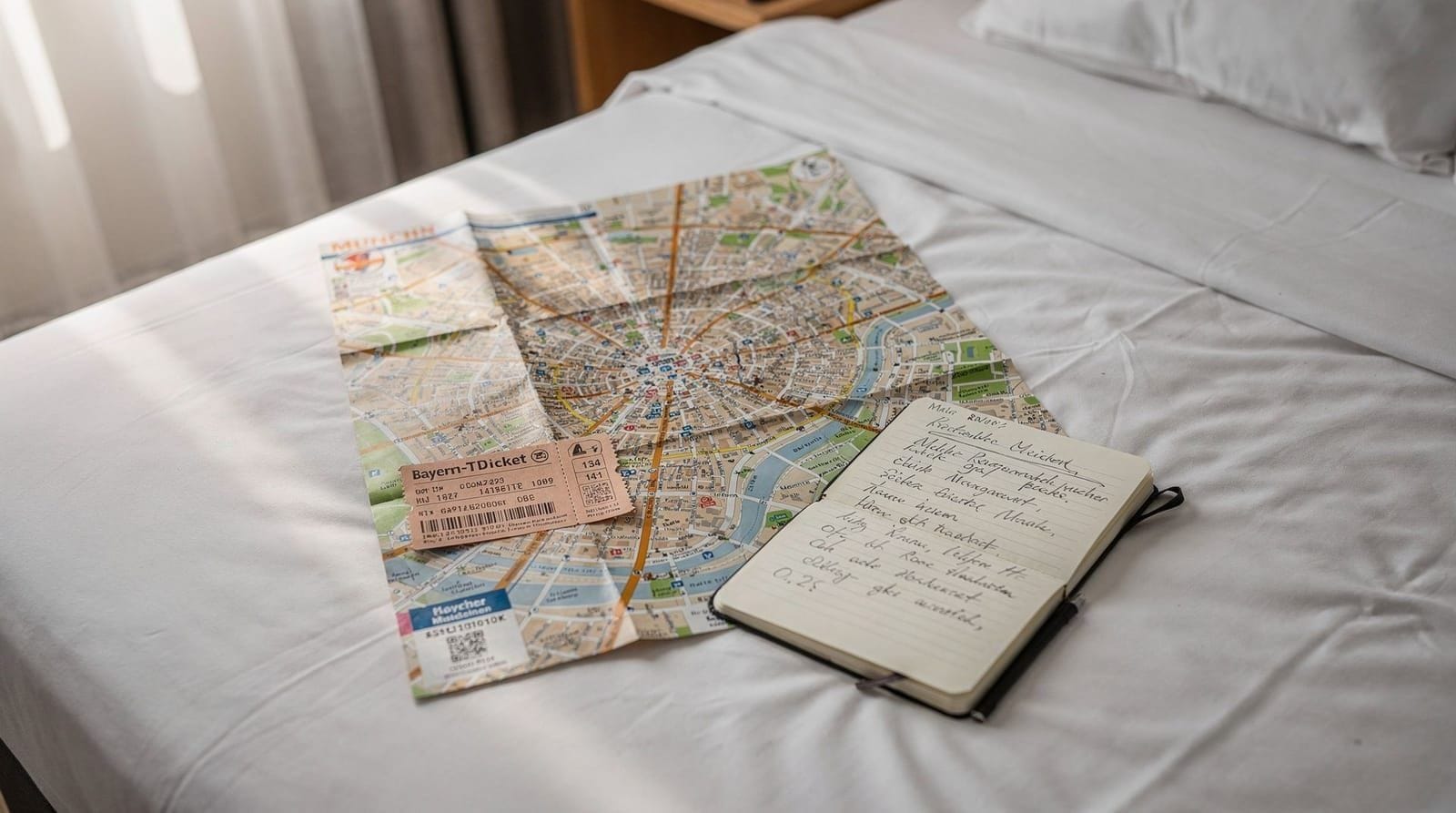
- Bayern-Ticket: €29.00 for 1 person, +€9 per additional person up to 5. Covers all regional trains (second class) across Bavaria for one full day. Essential for Neuschwanstein, Zugspitze, Regensburg, Nuremberg day trips by train.
The Munich public transport guide and Bayern-Ticket guide cover all this in detail.
Step five: plan your sightseeing priorities
Munich has more to see than any two or three-day trip can accommodate. The honest advice is to pick a thread — beer and food culture, art and museums, history and WWII, castles and palaces, the Alps — and do it properly rather than trying to tick every sight.
Beer and Bavaria thread: Hofbräuhaus, English Garden beer garden, Viktualienmarkt, Augustiner Keller, maybe the Oktoberfest Museum. Guides: Munich beer halls guide, best beer gardens.
Museums and art thread: Deutsches Museum (allow a full day), Alte Pinakothek, Residenz Museum and Treasury, Lenbachhaus. Guides: Deutsches Museum guide, Pinakothek museums guide.
Castles and palaces thread: Nymphenburg Palace (in Munich), then a day trip to Neuschwanstein and Linderhof. Guides: Nymphenburg Palace guide, Neuschwanstein guide.
History thread: Dachau Memorial Site (half day), Documentation Center for the History of National Socialism, Residenz (Wittelsbach history). Guides: Dachau Memorial guide, Munich WWII history guide.
Alps thread: Zugspitze, Königssee, Garmisch. Guides: Zugspitze day trip guide, Königssee guide.
For ready-made day-by-day plans, the Munich itinerary ideas guide covers 1-day through 7-day options.
Comparing the classic day trips
If you can only fit one or two day trips, this comparison helps prioritise:
| Day trip | Time needed | Transport | Best for |
|---|---|---|---|
| Neuschwanstein | Full day (08:00–20:00) | Train + bus/shuttle | Fairytale castle, the single most-requested day trip |
| Zugspitze | Full day | Train (cog railway) | Germany’s highest peak, Alpine views |
| Salzburg | Full day | Train (~1.5hrs each way) | Mozart’s city, Sound of Music sites, Austria |
| Nuremberg | Full day | Train (~1hr each way) | Medieval old town, WWII history |
| Dachau | Half day | S-Bahn + bus | Memorial site, manageable alongside another half-day activity |
Step six: budget for the trip
Munich is not cheap, but it is cheaper than Paris, London, or Zurich for equivalent accommodation and dining quality. The big costs are hotel and restaurants; most major sights have reasonable or no entry fees.
Key 2026 costs:
- A Maß (1 litre) of beer: €9–12 in a beer garden or traditional beer hall; €14–15 at Oktoberfest
- Meal at a traditional restaurant: €15–25 for a main, €30–45 for a full lunch with beer
- Weißwurst breakfast (2 sausages, pretzel, wheat beer): €8–12
- MVV day ticket: €9.20 single, €17.30 for 5 people
- Deutsches Museum entry: €15
- Residenz Museum: €9
- Neuschwanstein Castle ticket: €17 (adults, 2026)
For a full breakdown with daily budget scenarios, see the Munich budget guide.
Step seven: practical logistics
Cash: Always carry some. Many traditional restaurants, beer gardens, and market stalls are cash-preferred or cash-only. The Pfand (deposit) system on bottles in supermarkets returns €0.25 per bottle — use it.
Tipping: Service charges are not included in bills. A 5–10% tip rounded up to a convenient figure is the norm. In a beer garden, rounding up €1–2 is typical.
Tap water: Munich’s tap water is excellent quality — filtered through Alpine rock. Bring a reusable bottle. Ordering Leitungswasser (tap water) in a restaurant is socially acceptable and free or very cheap.
Sunday closures: Most supermarkets and shops are closed on Sundays. Bakeries and restaurants remain open. Plan grocery shopping for Saturday if you are self-catering.
Language: In Munich, English is spoken in tourist areas. In outlying villages and on day trips to rural Bavaria, some German ability helps, though most encounters are manageable with basic German and goodwill.
For all practical tips, see the Munich travel tips guide.
Step eight: pack appropriately
Munich is a walkable city that also involves a lot of cobblestones. Comfortable, broken-in walking shoes are essential. The weather is variable — bring layers regardless of the season. If visiting October through April, a waterproof outer layer is non-negotiable. Alps day trips call for decent footwear.
If Oktoberfest is on the agenda, the question of Tracht (traditional dress: Dirndl for women, Lederhosen for men) is covered in the Munich packing guide.
Small items that save hassle: a reusable water bottle (tap water is excellent and free), a portable phone charger for long sightseeing days, and a small day bag with a zip — pickpocketing is rare but not unheard of at crowded beer festivals and on packed S-Bahn trains during Oktoberfest. If your day trips include cable cars or mountain huts, a light fleece works even in summer, since temperatures drop noticeably above the treeline.
Guided first-timer overview
For first-time visitors who want a structured introduction to Munich before exploring independently, a walking tour on arrival day is a practical move — it orients you to the city, gives context to what you are looking at, and typically points out things that are not in guidebooks. Munich old town guided walking tour in English
A note on tourist traps
Not everything that comes first in a Munich search is worth your money. The Hofbräuhaus is the most famous beer hall in Munich and also the most tourist-oriented — it is fine for the experience, but you will be surrounded primarily by other tourists and the service reflects that. The Augustiner Keller, Augustiner am Dom, and the Chinesischer Turm beer garden in the English Garden are all significantly more local in atmosphere.
Hop-on hop-off bus tours have limited value in a city as walkable and well-connected by public transport as Munich. The City Pass is worth considering only if you plan to visit four or more paid attractions — run the numbers against individual entry prices first.
The Munich City Pass: is it worth it?
The Munich City Pass covers entry to 45+ attractions including the Residenz, Deutsches Museum, Nymphenburg Palace, BMW Museum, Hellabrunn Zoo, Sea Life, and the three Pinakotheks, plus all-zone public transport for the pass period.
When it is worth it: If you plan to visit 4+ paid attractions in 2–3 days and do not already have a transit pass. A 2-day Munich City Pass priced around €50–60 covers: Residenz (€9), Deutsches Museum (€15), Alte Pinakothek (€10), and Nymphenburg (€15) = €49 in individual tickets. The transit inclusion and any rides or smaller attractions then represent genuine surplus value.
When it is not worth it: If you plan leisurely sightseeing with only 1–2 paid attractions per day, or if your itinerary is heavy on day trips (Neuschwanstein, Alps) rather than Munich museums. The Bayern-Ticket for day trips is separate and not covered by the City Pass.
Buying: Available at the Munich Tourist Office (Marienplatz), Munich Airport, and via the Munich Tourism website. Some hotels sell them at reception. Munich City Pass — 45+ attractions and all-zone public transport included
Getting from Munich Airport to the city
Munich Airport (MUC) is one of Europe’s most efficient. Transport to the city:
S-Bahn (best value): The S1 and S8 lines both run from the airport to Marienplatz in about 40 minutes. Single ticket: €13.60. Day ticket: €20.20 (covers all city transit for the rest of the day). The S1 takes a slightly different route than the S8 — both terminate at Marienplatz and work well from the central stops.
Lufthansa Airport Bus: Runs to the central bus station (ZOB) near the Hauptbahnhof. Cheaper than a taxi, more direct than the S-Bahn if you are staying near the Hauptbahnhof. Runs every 20 minutes; journey approximately 45 minutes.
Taxi: €60–80, 45–60 minutes in normal traffic. Useful for very early arrivals with heavy luggage or if you are travelling in a group of 3–4 people where the per-person cost approaches the S-Bahn price.
Rideshare (Uber, etc.): Available from Munich Airport but subject to similar traffic as taxis. Regulated taxi services are reliable and metered.
The Munich airport to city guide covers all options in detail.
Step nine: build in flexibility
Even a well-planned Munich trip benefits from one unscheduled block of time — a rainy afternoon, a slower morning, or simply a day where you follow whatever looks interesting. Munich’s museums, beer gardens, and neighbourhood walks reward wandering as much as ticking off a fixed list. If you are travelling with a group, agree in advance on which single day trip is non-negotiable (usually Neuschwanstein) so a late start or a transit delay does not force choosing between it and something else.
Frequently asked questions about planning a Munich trip
How far in advance should I book a Munich trip?
For standard dates, 6–8 weeks ahead is sufficient for hotels. For Oktoberfest (September 19 – October 4, 2026) or major events, 6–12 months is the realistic window for decent prices and availability.
Is a car necessary to see Bavaria from Munich?
No. The Bayern-Ticket and regional train network cover most major destinations: Neuschwanstein, Zugspitze, Berchtesgaden, Nuremberg, Regensburg, and Salzburg are all accessible by train. A car is useful for the Romantic Road and for smaller Alpine villages off the main rail lines.
Can Munich be combined with other cities in a longer European trip?
Yes. Munich sits well with Vienna (4 hours by train), Salzburg (1.5 hours), Innsbruck (2 hours), and is a natural hub between Italy and northern Germany. The ICE high-speed rail network connects Munich to Berlin (about 4 hours) and Frankfurt (about 3 hours).
Are day trips from Munich worth the time?
Strongly yes. The Bavarian countryside around Munich — the Alps, the royal castles, the historic cities — is part of what makes Munich distinctive as a travel destination. Spending at least one day outside the city significantly enriches the trip. See the best day trips from Munich guide for a ranked overview.
What are the biggest mistakes first-time Munich visitors make?
Underestimating distances between sights, visiting only Marienplatz and the Hofbräuhaus and calling it done, not having cash, booking central Oktoberfest hotels without checking prices, and missing the English Garden. The city rewards curiosity beyond the headline attractions.
Where can I find real-time Munich event information?
The Munich Tourism Office (muenchen.de/tourism) and the Münchner Merkur events listings are reliable sources. For Oktoberfest specifically, oktoberfest.de is the official source.
Should I plan every day in detail before arriving?
No — plan the fixed points (day trips, restaurant reservations for weekend evenings, any ticketed attractions) and leave the rest loose. Munich works well for wandering between neighbourhoods, and a rigid hour-by-hour plan tends to create stress rather than prevent it.
What is the single most common Munich planning mistake?
Under-allocating time. Visitors often plan Munich as a one- or two-day stopover on a longer Europe trip, then discover the city and its day trips deserve three to five days. If your schedule is flexible, err on the side of adding a day rather than removing one.