Neuschwanstein Castle
Complete visitor guide to Neuschwanstein Castle — timed tickets, Marienbrücke viewpoint, train from Munich, crowd strategy and honest tips for 2026.
From Munich: Neuschwanstein Castle full-day trip by van
Quick facts
- Distance from Munich
- 127 km (about 2 hrs by train + bus)
- Adult ticket (2026)
- €21 (palace only)
- Combo with Hohenschwangau
- €35 adult
- Opening hours
- Apr–Oct 9:00–18:00; Nov–Mar 10:00–16:00
- Booking window
- Opens exactly 3 months in advance online
Bavaria’s most recognisable landmark — and the logistics to match
Neuschwanstein is the castle that appears on Bavaria’s postcards, Disney’s logos, and roughly ten million tourist photographs every year. King Ludwig II commissioned it in 1869 as a retreat from the court life he despised, and he spent only 172 days inside before dying under mysterious circumstances in 1886. The irony: the castle that was meant to be his private refuge became one of the world’s most visited tourist attractions almost immediately after his death. Today it receives around 1.4 million visitors annually, and the logistics of visiting require more planning than most people expect.
This guide tells you exactly how to get a timed ticket, how to reach the castle from Munich without a car, what to expect inside, where to stand for the famous photographs, and how to avoid the two biggest mistakes first-timers make.
Quick answer — can I just show up? No. Neuschwanstein uses a strict timed-entry system. Without a pre-booked ticket assigned to a specific 15-minute entry window, you will be turned away or forced to queue for same-day tickets at the Hohenschwangau ticket centre — which often sell out by mid-morning in summer. Book online at least 2–4 weeks ahead; in July and August, 6–8 weeks is not excessive.
| Where | Schwangau, near Füssen, 127 km from Munich |
| Cost | Around €21 solo, €35 combo with Hohenschwangau |
| Time needed | 5–6 hours from Munich, full day comfortably |
| Getting there | Train to Füssen (~2h) + bus/carriage/walk |
| Best time | Weekday mornings, May/Jun/Sep |
Getting there from Munich
The journey from Munich without a car takes about two hours each way and involves a train to Füssen followed by a short bus or horse-drawn carriage ride up the hill.
Step 1 — Train from Munich Hauptbahnhof to Füssen. Direct regional trains (RB 84) depart Munich Hauptbahnhof roughly every two hours. Journey time is 1 hour 55 minutes to 2 hours 5 minutes depending on the service. A Bayern-Ticket covers this journey: from €31 for a single person, or €9 per additional person up to five people on the same ticket. It is valid from 09:00 Monday to Friday and all day at weekends. See the Bayern-Ticket guide for how to buy and validate.
Step 2 — Bus from Füssen to Hohenschwangau (the ticket centre). Bus 73 or 78 from Füssen bus station (directly adjacent to the train station) takes about 9 minutes to the Hohenschwangau / Alpsee stop. Buses run roughly every 30 minutes. Single fare is €2.70 with a Bayern-Ticket or about €4 without.
Step 3 — Up to the castle. From the Hohenschwangau ticket centre, the castle entrance is about 1.2 km uphill. Options:
- Walk (30–40 minutes uphill, steep sections, no shade in summer)
- Horse-drawn carriage (€7 up, €3.50 down; queues form early and there is no booking)
- Shuttle bus (€4 up, €2 down; faster but also queues)
The horse-drawn carriage drops you off a 5-minute walk from the castle entrance, not at the gate itself. Factor this into your timing — you must be at the gate before your timed slot expires.
By car: A3 and A95 from Munich, then B17 south through Schongau. Parking in Schwangau (P3, P4, P5 lots near Hohenschwangau; €9–12 per day). Do not expect to park free — the entire area has paid parking, and lots fill by 09:30 in peak season. Read more on getting to Bavaria by train for public transport comparisons.
Tickets and booking
The ticket centre is at Alpseestraße 12, 87645 Hohenschwangau — not at the castle itself. All tickets, including pre-booked ones, must be collected here. If you book online, you still go to the ticket centre to exchange your booking reference for a paper or digital ticket.
Prices (2026):
- Neuschwanstein adult: €21
- Neuschwanstein reduced (under 18 EU, disabled): free or €1 administrative fee
- Combo Neuschwanstein + Hohenschwangau adult: €35
- Combo reduced: €17 (for those qualifying)
Online booking: tickets.hohenschwangau.de — the official site. Open 3 months in advance to the day, at 08:00 Munich time. For high-demand dates (Saturdays in July/August, weekends in October), that 3-month window opens and slots fill within minutes. A booking fee of €1.80 applies per ticket online. Third-party sellers resell these tickets at significant markups — buy direct from the official site.
Same-day tickets: Available at the ticket centre from opening (08:00 in summer). Join the queue before 07:30 in July and August. By 09:00 on peak days, same-day timed slots are often exhausted.
Guided tour option: Most visitors take the self-guided audio tour included with the ticket. Timed guided tours in English run several times daily but book up quickly through the same ticketing system.
If you prefer not to handle logistics yourself, a guided day trip from Munich handles the transport and ticket queue: Full-day Neuschwanstein tour from Munich (van, small group)
For those who want to combine with Linderhof Palace on the same day: Neuschwanstein and Linderhof full-day tour from Munich
Marienbrücke — the classic viewpoint
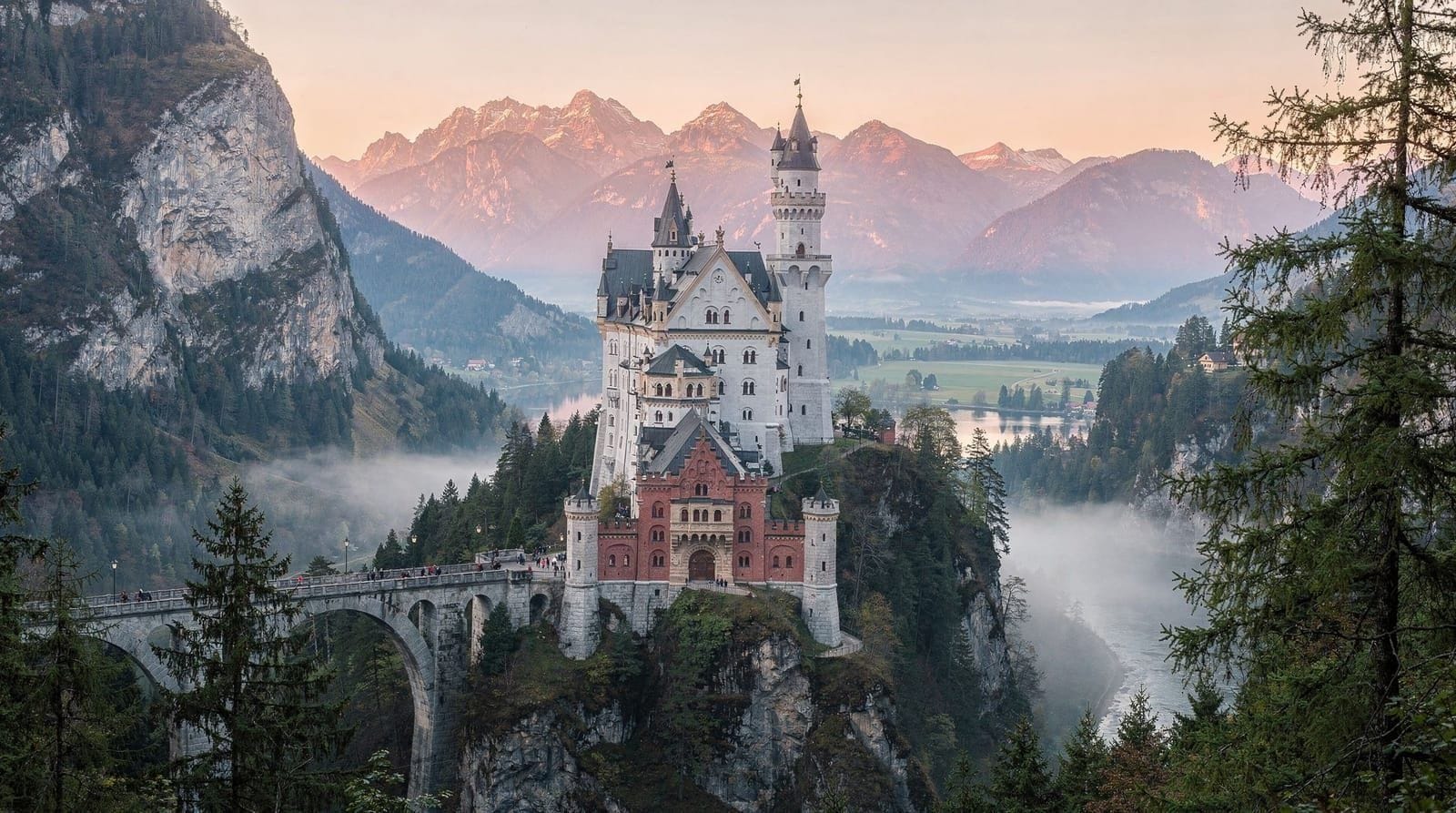
The Marienbrücke (Mary’s Bridge) is the iron footbridge suspended above the Pöllat Gorge, roughly 15 minutes’ walk above the castle entrance. This is where the definitive photograph — looking back at the castle with the Alps behind it — is taken. Nearly every image you have seen of Neuschwanstein was taken from this bridge or the gorge path below it.
Access: Free. No ticket required for the bridge itself. Follow the signed path from the castle entrance uphill (about 15 minutes, 90 metres of altitude gain). The path is unpaved and uneven; wear shoes with grip.
Crowds: In summer the bridge holds perhaps 60 people safely, but on busy days you will find 100+ people queuing to cross. Arrive at the bridge before 10:00 to get a clear shot. By 11:00 it becomes difficult to photograph without strangers in frame.
Safety note: The bridge closes in icy or high-wind conditions, and closures are not always announced in advance. In winter (November–March), check the official website or ask at the ticket centre before making the bridge your primary objective.
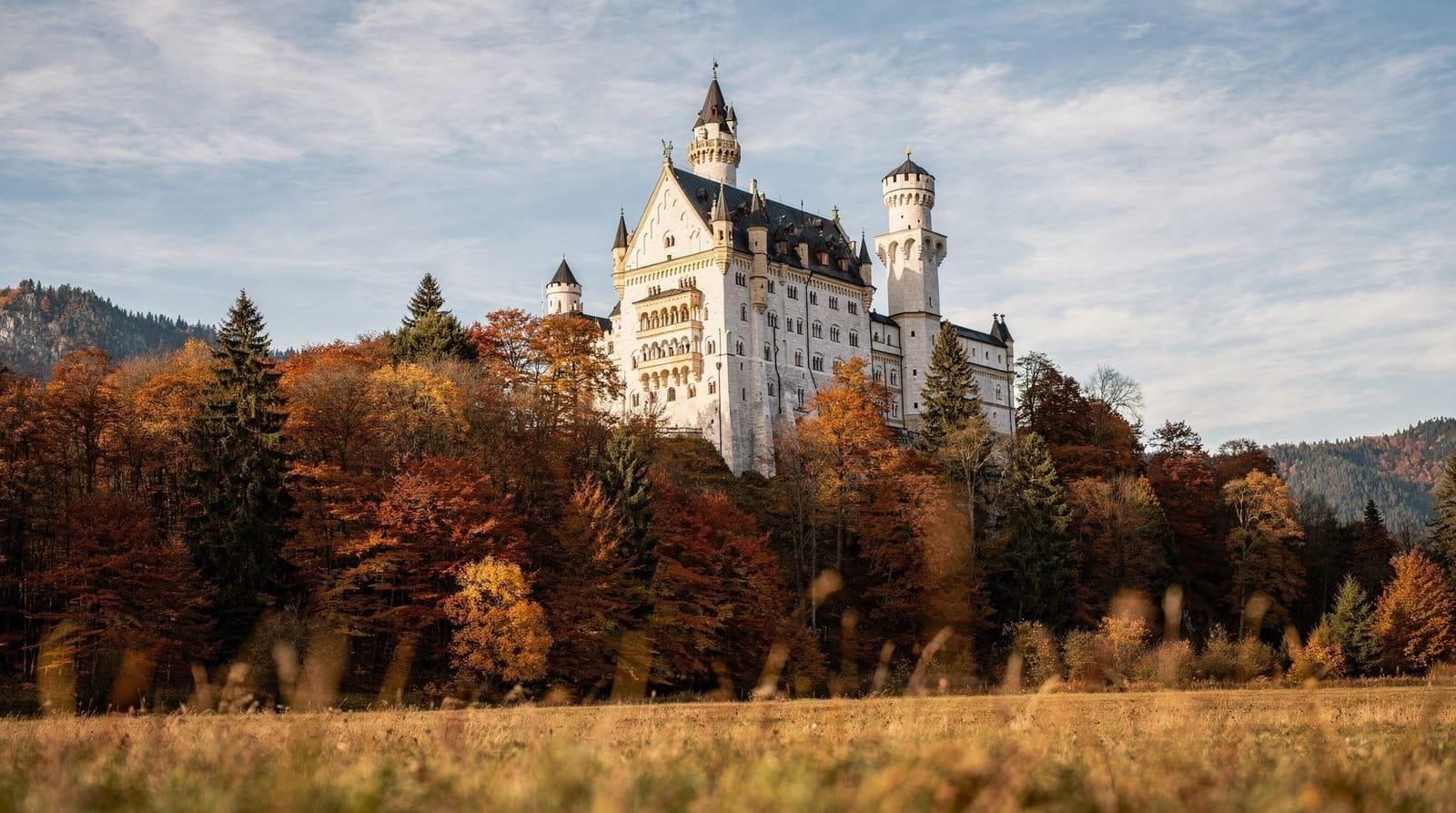
Alternative viewpoints: The gorge path below Marienbrücke offers a different angle showing the castle above the treeline. Less crowded, and particularly good in autumn when the forest colours are visible. The path can be slippery after rain. More photography locations are covered in the Neuschwanstein photo spots guide.
Inside the castle
The interior tour covers 15 rooms (out of the 200+ that were planned but never completed). You are guided through in a group of 60–70 people, and the visit lasts exactly 35 minutes from entry. No photography is permitted inside. This is strictly enforced.
What you see:
- Throne Room — unfinished (Ludwig died before the throne was installed), but with a spectacular Byzantine mosaic floor and nine-tonne chandelier
- Singer’s Hall — the largest room, inspired by Tannhäuser legends, with murals covering the walls
- Bedroom — took 14 woodcarvers 4.5 years to complete the Gothic-style carved oak bed and surrounding furniture
- Kitchen — modern for its era, with running hot and cold water and a mechanised spit
What you do not see: significant sections of the castle, including the upper floors, are closed to visitors. The construction was rushed after Ludwig’s death, and large parts remain structurally unfinished.
The tour is fast and the rooms are genuinely impressive, but some visitors find the 35-minute pace rushed. If you want more time with the architecture, the Hohenschwangau Castle tour next door is less crowded and allows a slower pace. A comparison of the two castles is covered in the Neuschwanstein vs Hohenschwangau guide.
Practical tips
Timing your visit: Tuesday to Thursday mornings in May, June, or September give the smallest crowds. Saturdays in summer are the worst possible day. School holiday weeks (Bavarian and German national holidays) are heavier than international school holidays.
What to wear: Comfortable walking shoes are essential. The path from the bus/carriage drop-off to the castle is cobbled and uneven. In summer, bring a hat — the final approach has little shade. In winter, the paths ice over and the castle itself is noticeably colder than the valley.
Food and drink: There is a café next to the castle entrance with reasonable prices for hot drinks and Brezeln. A larger restaurant (Schlossrestaurant Neuschwanstein) is adjacent to the ticket centre — serviceable, tourist prices. For better food, walk or take the bus to Füssen town centre. The Füssen destination page covers the best options.
Luggage: No left-luggage service at the castle. Füssen train station has coin lockers (€2–4) — leave large bags there.
Combining destinations: Neuschwanstein pairs naturally with Hohenschwangau Castle on the same day (15-minute walk apart). Adding Linderhof Palace requires a car or joining a tour — it is 40 km away and not reachable by public transport on a single day. See the King Ludwig II castles guide for the full picture, or the castles day trip by train guide for car-free planning.
Weather: Afternoon thunderstorms are common in summer, particularly July and August. The castle stays open in rain, but the Marienbrücke may close. Mountain weather changes fast — a jacket is sensible year-round.
For a full day trip plan from Munich, including transport timings, the Munich to Neuschwanstein day trip guide covers everything in detail.
What the tours include that going independently does not
Independent visitors handle their own tickets, transport, and timing. The main advantages of joining an organised day trip:
- Guide handles ticket collection and queuing
- Coach pick-up from central Munich — no Deutsche Bahn logistics
- Often includes Hohenschwangau or Linderhof in the same day
- Commentary on Ludwig II’s life and Bavarian history en route
The disadvantage: you are on the guide’s schedule, not your own. The carriage ride up the hill and Marienbrücke are often skipped or rushed. If you want the full photography experience at the bridge, an independent visit with an early arrival is more effective. Combo ticket: Neuschwanstein and Hohenschwangau Castle (Schwangau)
Frequently asked questions about Neuschwanstein Castle
How far in advance should I book Neuschwanstein tickets?
In July and August, 6–8 weeks in advance is realistic for weekdays; weekends can be fully booked 10–12 weeks out. In May, June, September and October, 2–4 weeks usually suffices. Tickets go on sale exactly 3 months ahead at 08:00 Munich time on the official site (tickets.hohenschwangau.de).
Can I visit Neuschwanstein without booking in advance?
You can try for same-day tickets at the Hohenschwangau ticket centre, which opens at 08:00. Arrive before 07:30 in summer to queue. In shoulder months (April, May, late September, October) same-day availability is reasonable on weekdays. In winter, same-day tickets are almost always available. Saturdays in July and August: assume none.
Is there a free way to see Neuschwanstein?
The exterior and the Marienbrücke viewpoint are free — no ticket required. You can walk up the hill, see the castle from outside, cross the bridge, and visit the gorge path all without paying. The €21 ticket covers only the interior timed tour. Honest assessment: the exterior and viewpoint are the photographic highlights; the interior tour is worth it for the history but requires rushing through.
How long does the visit take?
Allow 5–6 hours from Munich for the full experience (travel 2 hrs each way, bus, uphill walk, castle tour, Marienbrücke). If combining with Hohenschwangau Castle next door, add 1 hour. A full day (7–8 hours) is comfortable.
Can I visit Neuschwanstein with a Bayern-Ticket?
Yes. The Bayern-Ticket covers the train from Munich to Füssen and the local bus (line 73/78) from Füssen to Hohenschwangau. It does not cover the castle ticket, carriage, or shuttle bus up the hill. See the Bayern-Ticket guide for current prices and validation rules.
Is Neuschwanstein accessible for visitors with mobility limitations?
Partially. The approach road and shuttle bus route are manageable. The castle interior involves stairs and is not wheelchair accessible. Visitors with disabilities should contact the ticket office (info@hohenschwangau.de) in advance — there are limited arrangements for ground-floor viewing in some areas.
What is the difference between Neuschwanstein and Hohenschwangau?
Neuschwanstein was built by Ludwig II as his own romantic fantasy, is more dramatic architecturally, and is far more visited. Hohenschwangau was where Ludwig grew up — it was his father Maximilian II’s castle. It is older (rebuilt 1832–1836), less theatrical, but less crowded and arguably more liveable as a royal residence. Visiting both is recommended if time allows. The Neuschwanstein vs Hohenschwangau guide compares them in detail.
Is Neuschwanstein suitable for young children?
Yes, but the approach is the limiting factor, not the tour itself. The uphill walk (30–40 minutes) or queue for the shuttle/carriage can tire young children, and a stroller is impractical on the final stretch — use a carrier instead. The interior tour is child-friendly in content but moves at a fixed 35-minute pace with no lingering.
Can I combine Neuschwanstein with Linderhof or Herrenchiemsee on the same day?
Linderhof, yes, but only with a car or an organised tour — it’s about 40 km away and not reachable by public transport in a single day trip. Herrenchiemsee is impractical to combine, as it’s roughly 135 km in the opposite direction. Most visitors dedicate separate days to each, using the Munich castles 3-day itinerary as a framework.
King Ludwig II — who was he and why did he build this?
Understanding Neuschwanstein requires understanding Ludwig II, and Ludwig II was genuinely one of the most unusual monarchs of the 19th century. Born in 1845 as the second Bavarian king of the Wittelsbach dynasty, he acceded to the throne in 1864 at age 18. He ruled Bavaria until 1886, when he was declared mentally unfit for office by a medical commission and removed from power. Three days later, his body — and that of the psychiatrist who led the commission — were found drowned in the Starnberger See, under circumstances that have never been definitively explained.
In the 22 years of his reign, Ludwig presided competently over Bavaria’s integration into the new German Empire after 1871 while conducting an extensive and obsessive building programme. He funded three palaces — Neuschwanstein, Linderhof, and Herrenchiemsee — almost entirely from personal funds (supplemented by loans that left him deep in debt). He was a devoted patron of Richard Wagner and financed the composer’s Bayreuth opera festival. He retreated increasingly from public life, preferring his mountain palaces and night rides by sleigh to court ceremony.
The psychiatric commission that removed him reported delusions, paranoid behaviour, and an inability to function as a monarch. Modern historians debate whether the diagnosis was genuine, politically motivated, or a combination. Ludwig’s personal behaviour was certainly eccentric — he dined alone, kept nocturnal hours, and spent money on his building projects that alarmed his government. Whether this constituted genuine mental illness by the standards of the era is contested.
What is not contested is the quality of what he left behind. The three palaces are among the finest examples of 19th-century royal architecture in Europe, and their quality — of craftsmanship, of artistic ambition, of sheer scale — reflects a patron who knew exactly what he wanted and was willing to pay for it.
For visitors today, the story of Ludwig II is inseparable from the experience of Neuschwanstein. The Munich royal history and Wittelsbach guide provides deeper context, and the King Ludwig II castles guide traces the full building programme across all three sites.
What to expect on a summer weekend
It is worth being direct about peak-season conditions. Neuschwanstein in July and August on a Saturday is not a pleasant experience for many visitors. What you encounter:
- The approach from the ticket centre has queues for the shuttle bus (30–45 minutes) and horse-drawn carriage (45–60 minutes). Many visitors walk (30–40 minutes uphill) and still arrive sweating.
- The Marienbrücke has 100+ people on it from 10:00 onwards. The classic photograph involves waiting 20–30 minutes for a gap.
- The interior tour groups of 60–70 feel crowded in the smaller rooms.
- The café at the castle has queues of 20–30 minutes.
- The shuttle bus back down at the end of the day has queues.
This is not a reason to avoid the castle — the interior is genuinely worth seeing and the setting is spectacular. But visitors who arrive expecting a serene experience will be disappointed. The Neuschwanstein crowds and honest planning guide covers mitigation strategies in detail.
Best mitigation: Take the first available timed slot (09:00 in summer), walk up rather than taking the shuttle or carriage, go to the Marienbrücke before your castle entry time rather than after, and have lunch in Füssen rather than at the castle.
A quieter alternative sequence: Visitors who prioritise photography over the interior tour sometimes skip the castle ticket entirely, arrive early for the Marienbrücke, spend an unhurried hour photographing from multiple angles, and treat the day as a hike and viewpoint visit rather than a museum tour. This works well if you’ve already seen Hohenschwangau or another castle interior and want Neuschwanstein purely for the view — the exterior and bridge cost nothing and are arguably more photogenic than anything inside.
Planning your royal castles itinerary
Neuschwanstein sits within the royal-castles region alongside Hohenschwangau, Linderhof, and Herrenchiemsee. Most visitors focus on Neuschwanstein alone, but the King Ludwig II castles guide explains how to combine them over two or three days. The Munich castles 3-day itinerary offers a full route for those based in Munich.
If you want to book a flexible train-based day trip without committing to a guided group: Neuschwanstein Castle day trip from Munich by train
Neuschwanstein vs the other Bavarian castles
Deciding whether Neuschwanstein alone is enough, or whether to add another site, comes down to what you’re after:
| Castle | Character | Access from Munich | Crowds |
|---|---|---|---|
| Neuschwanstein | Iconic fantasy exterior | Train + bus, ~2h | Very high |
| Hohenschwangau | Lived-in royal residence next door | Same trip, 15-min walk | About a third of Neuschwanstein’s |
| Linderhof | Intimate retreat, Venus Grotto | Car needed, ~1h45 | Low |
| Herrenchiemsee | Grandest interior, island setting | Train + boat, ~2h | Low–moderate |
If you’re doing a single day trip from Munich, Neuschwanstein plus Hohenschwangau is the natural, well-supported pairing — same ticket system, same transport, minimal extra effort. Linderhof and Herrenchiemsee reward a second or third day with a car. The King Ludwig II castles guide covers the full comparison, and the best castles near Munich guide places all four alongside other regional options like Burghausen and Harburg for visitors who want to go beyond the Ludwig II trio.
Families and accessibility
Neuschwanstein is manageable with children but requires realistic expectations: the uphill approach (30–40 minutes on foot, or a queue for the shuttle bus or carriage) is tiring for young legs, and the 35-minute interior tour moves at a fixed pace with no lingering. Strollers are impractical on the final approach — a carrier is the better option for toddlers. The Marienbrücke, while dramatic, has no barriers preventing a fall beyond the railing height and gets crowded; hold children’s hands closely. For wheelchair users, the castle interior involves stairs throughout and is not accessible — contact the ticket office in advance for the limited ground-floor arrangements that exist. The Munich with kids guide has broader family-trip planning for the region, and pairing the castle visit with time at the Alpsee lake below Hohenschwangau gives children a break from queuing and walking uphill.
Top experiences
Bookable activities with verified prices and instant confirmation on GetYourGuide.
From Munich: Neuschwanstein Castle full-day trip by van
From Munich: Neuschwanstein Castle full-day trip by train
Schwangau: combo ticket Neuschwanstein and Hohenschwangau Castle
From Munich: Neuschwanstein and Linderhof Castle full-day trip
Füssen: Neuschwanstein and Hohenschwangau Castle entry ticket and audio guide