Neuschwanstein photo spots: where to get the best shots in 2026
Munich: Neuschwanstein Castle tour
What is the single best place to photograph Neuschwanstein Castle?
Marienbrücke (Mary's Bridge) gives the classic elevated view and is the most photographed angle. For a wider alpine context, the Tegelbergbahn cable car station offers a higher vantage point. Both require early arrival in summer — Marienbrücke crowds peak 10am–3pm.
| Where | Marienbrücke, Tegelbergbahn, Alpsee meadows near the castle |
| Cost | free for most spots; Tegelbergbahn around €21 return |
| Time needed | 15 min at Marienbrücke; a half day for the full circuit |
| Getting there | walk from Hohenschwangau ticket center, or cable car from Schwangau |
| Best time | before 8am or after 4pm in summer; October for colour with fewer crowds |
Getting the shot everyone wants — and avoiding the crowd in it
Neuschwanstein is one of the most photographed buildings in Europe. The problem is obvious the moment you arrive: everyone else has the same shot in mind, and most of them are already standing where you want to stand. This guide maps out the actual photography locations, what each delivers, when to be there, and what the limitations are — so you can plan around the crowds rather than compete with them.
There are five distinct photography spots worth knowing about. Three are publicly accessible without buying a castle ticket.
| Spot | Distance/effort | Best for |
|---|---|---|
| Marienbrücke | 10 min uphill from castle entrance | The classic postcard angle |
| Tegelbergbahn summit | Cable car, ~2.5km from castle | Wide alpine landscape context |
| Alpine meadows | 15 min walk from ticket center | Wildflowers, both castles in frame |
| Pöllat Gorge viewpoint | 45 min round trip, uneven path | Bridge-and-castle reverse angle |
| Alpsee lake | 10 min walk from ticket center | Calm-water reflection attempts |
Spot 1: Marienbrücke (Mary’s Bridge) — the definitive angle
Marienbrücke is a narrow iron bridge spanning the Pöllat Gorge at 92 metres above a waterfall, perched on a rocky cliff beside Neuschwanstein. It was built in 1845 by Maximilian II and replaced with the current metal structure in 1866. From the bridge, the castle’s full south face fills the frame with alpine slopes behind — the view you have seen on every postcard, guidebook, and desktop background.
The bridge is a 10-minute walk uphill from the Neuschwanstein entrance gate. There is no entry fee. The walkway is narrow — roughly 1.8 metres wide — and has safety railings. In summer, it holds perhaps 40–50 people, and at peak times it feels crowded even at that capacity.
When to arrive: Before 8am in July–August for a crowd-free bridge. The first castle tour groups arrive around 9–9:30am, and Marienbrücke fills to capacity by 10am. In shoulder season (May, June, September), before 9am is manageable. If you plan to visit Marienbrücke after your castle tour, go immediately after your tour ends — before lunch groups arrive.
Light: Morning light hits the south face of the castle from roughly 7:30am onwards in summer. The castle faces roughly southeast, so morning is better than afternoon for direct light on the facade. Late afternoon (after 4pm) gives warm golden tones but the bridge is crowded again.
Camera settings: Standard zoom (35–85mm equivalent) works well from the bridge. Wider angles capture more sky and valley context. A polarising filter reduces haze on bright summer days.
Closed season: Marienbrücke closes in winter — typically November through late April — due to ice risk. The official closure dates vary by year. Check bayerische-schloesser.de before a winter visit. 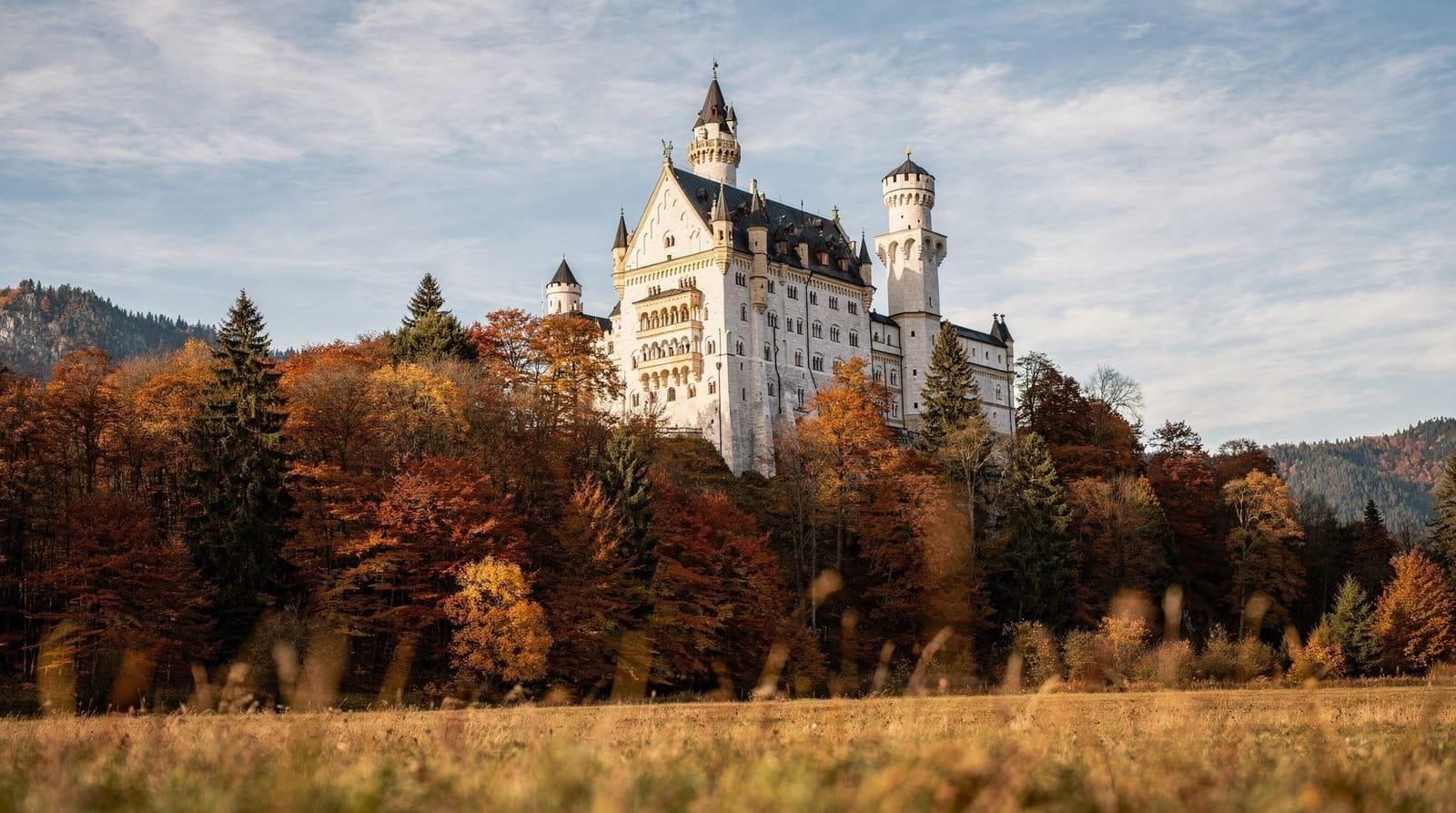 Neuschwanstein Castle tourCheck availability
Spot 2: Tegelbergbahn cable car — the aerial perspective
The Tegelbergbahn is a gondola cable car that runs from the valley station at Schwangau (about 2.5 km from the castle) up to 1,707 metres on Tegelberg mountain. The summit gives a dramatically different perspective: you look down across the entire Allgäu valley, with Neuschwanstein and Hohenschwangau small in the middle distance, the Alpsee and Bannwaldsee lakes glinting below, and the Austrian Alps on the horizon.
This is not a telephoto castle shot — the castle is small at this distance, and you need a lens in the 100–200mm range to isolate it meaningfully. What the summit gives you instead is a comprehensive landscape shot showing both castles in their geographic context, with the valley and lakes as a natural frame.
The cable car costs approximately €21 return in 2026 (check tegelbergbahn.de for current pricing). It runs year-round except for maintenance. At the summit, the Tegelberghaus restaurant serves basic Bavarian food and is warm on cold days.
Mid-station viewpoint: The mid-station at around 1,200 metres often has cleaner views of the castles than the summit, because the angle is less steep and tree cover does not obscure the foreground. Worth stopping on the way up to check both vantage points.
When to go: Cloudy days at valley level are often clear at 1,707 metres in the Alps. If Neuschwanstein is in low cloud from the valley, the summit may be above the cloud layer — or may give you atmospheric mist-in-the-valley shots. Morning cable car rides have good eastward light; afternoon rides give a sun-behind-the-castle silhouette effect.
Spot 3: Alpine meadows below the castle
The meadows between Hohenschwangau village and the Alpsee lake give ground-level shots of Neuschwanstein rising above the treeline. This is a less commonly photographed angle because it requires a 15-minute walk from the ticket centre, but it rewards the effort with:
- A view that includes Hohenschwangau castle in the left frame and Neuschwanstein upper right — showing both in a single wide shot
- Wildflower foreground in May–June (primarily Bavarian yellow and white meadow flowers)
- Lower crowds (most tourists stay near the ticket centre and castle path)
Walk south from the ticket centre along the Alpsee lake path. After about 500 metres, clear views of both castles appear through gaps in the trees. The best open meadow section is roughly 700–900 metres from the ticket centre.
Light: The castle facade is in shadow in the morning from this angle (west-facing view). Best light is from late afternoon onwards — the 4–6pm window in summer gives warm golden light on the western face.
Spot 4: Pöllat Gorge viewpoint (below Marienbrücke)
Below Marienbrücke, a signed hiking path descends into the Pöllat Gorge. From certain points on this path, you can photograph Marienbrücke with the castle as backdrop — reversing the usual perspective and showing the bridge in its dramatic gorge setting.
This is an intermediate photography spot requiring some scrambling on rocky paths. Not accessible for visitors with limited mobility. The gorge path is open in dry conditions only — it can be slippery after rain. Allow 45 minutes for the descent and return to the main path.
Spot 5: Alpsee lake — reflection shots
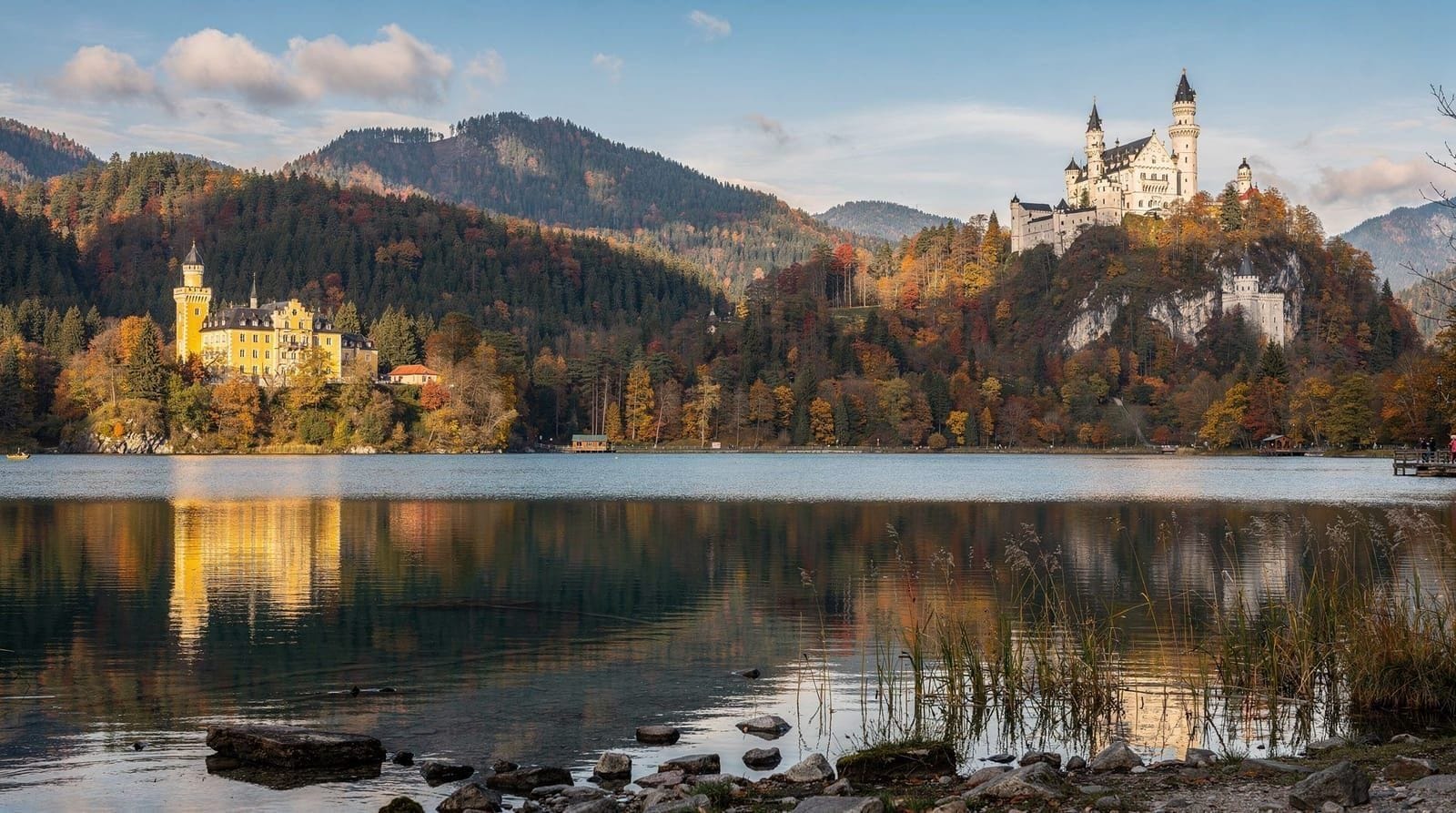
The Alpsee lake is directly below Hohenschwangau castle, about 500 metres from the ticket centre. In very calm early-morning conditions, the reflection of Hohenschwangau in the lake surface is achievable. Neuschwanstein is further away and higher, making a clean reflection harder — trees and distance both work against it.
Reach the lake via the path from the ticket centre, bearing right toward the Alpsee rather than left toward the castles. The lakeside is peaceful and often deserted before 8am. Rowing boat rental is available from the Alpsee boat station in season (approximately €12 per hour).
Honest assessment: This is a pleasant walk rather than a must-do photography location. If you are specifically chasing reflection shots, Forggensee lake to the northwest of Füssen gives wider views across a lake with Neuschwanstein visible on the distant hillside on clear days — but requires a car or bike to reach.
Shooting inside the castle
Photography inside Neuschwanstein is permitted without flash. The two rooms most worth preparing for:
Throne Room: The Byzantine interior with its gold mosaics, chandelier of 96 candles, and the famous view toward the apse. Tour guides often allow a brief pause here — use it. The room is circular and challenging to capture without distortion on a phone; a wide-angle lens on a camera gives better results.
Singers’ Hall: The fourth-floor hall with its painted medieval scenes and elaborate ceiling. Long and narrow — a focal length of 24–35mm works better than a wide-angle here to avoid barrel distortion on the painted ceiling.
Move quickly through other rooms and be ready — the paced tour does not stop for photography.
Seasonal photography: what changes across the year
The castle itself does not change. The landscape around it does, dramatically.
Spring (April–May): Snow on the surrounding peaks, green valleys below. Wildflowers in the meadows from mid-May — primarily white and yellow species. Marienbrücke reopens in late April (check bayerische-schloesser.de for the exact date). Lower crowds. Morning mist in the valley can create atmospheric shots from Tegelbergbahn. This is arguably the best season for photography — compelling scenery, manageable crowds, and good contrast between white peaks and green valley.
Summer (June–August): Long days with golden hour as late as 9pm. Fully green valley. Crowds at maximum. The classic postcard shot from Marienbrücke requires pre-dawn positioning in July–August. The advantage: long warm evenings allow for extended photography sessions. The soft blue hour (20–30 minutes after sunset) gives attractive light without the crowd competition of golden hour.
Autumn (September–October): Colour on the hillsides from mid-September. The surrounding larch trees turn gold in October — a strong compositional element from Marienbrücke and the meadows. Significantly fewer visitors than summer. Tegelbergbahn summit views are excellent in clear autumn days. First snow on the high peaks (2,000m+) typically arrives in October, giving snow-capped mountains above an autumn-coloured valley.
Winter (November–March): Marienbrücke closed. Snow at the castle level from December onwards in most years. The castle in snow — photographed from the valley or from the Tegelbergbahn — is extraordinary. Getting there in winter requires checking bus 73/78 schedules (reduced frequency) and road conditions near the castle. Fewer visitors than any other season. The Bavaria palace website keeps Neuschwanstein open year-round except on specific closure days (1 January, Shrove Tuesday, 24 December) — but verify before winter visits.
Equipment considerations
Most visitors photograph Neuschwanstein on smartphone cameras, which are more than capable for the Marienbrücke view in good light. A few notes on equipment by location:
Marienbrücke: Any camera or phone. A standard zoom (24–70mm equivalent) covers the full castle facade. The gorge below is photographically interesting if you look down from the bridge — wide angle works well for this. A tripod or monopod is useful for low-light dawn shots but makes the bridge even more congested; consider a small tabletop tripod on the bridge railing.
Tegelbergbahn summit: Telephoto compression is the tool here. A 100–200mm equivalent lens allows you to frame just the castle against the valley background. Without telephoto, the castle is a small element in a wide landscape shot, which can still be compositionally strong but is different in character.
Alpine meadows: Wide angle for landscape context with castle as background element; telephoto to isolate the castle above a field of wildflowers. A polarising filter helps reduce atmospheric haze on bright days and saturates the green meadow grass.
Inside the castle: No flash permitted. A camera or phone that performs well in mixed light (the interior combines natural window light with artificial chandelier light) gives better results than one requiring flash. A lens with image stabilisation (or phone with night mode) handles the lower light in the corridor sections.
Tripods, drones and other access rules
Tripods are permitted at all the outdoor viewpoints, though on a crowded Marienbrücke in peak season a full-size tripod is impractical and unwelcome — a small tabletop model braced on the railing is the realistic option, or simply steady the shot handheld with image stabilisation. Drones are not permitted anywhere in the immediate Neuschwanstein and Pöllat Gorge area, as the site sits in protected airspace; this is actively enforced and fines apply. Inside the castle, flash photography and any kind of monopod or tripod are prohibited, and the paced tour group does not stop for setup shots, so plan interior photography around brief pauses rather than deliberate compositions. At the Tegelbergbahn summit, tripods are fine and there’s considerably more space than at Marienbrücke, making it a better spot for anyone shooting long exposures or panoramas.
Useful distances and walking times
Getting oriented around the site takes time if you have not visited before. Key distances:
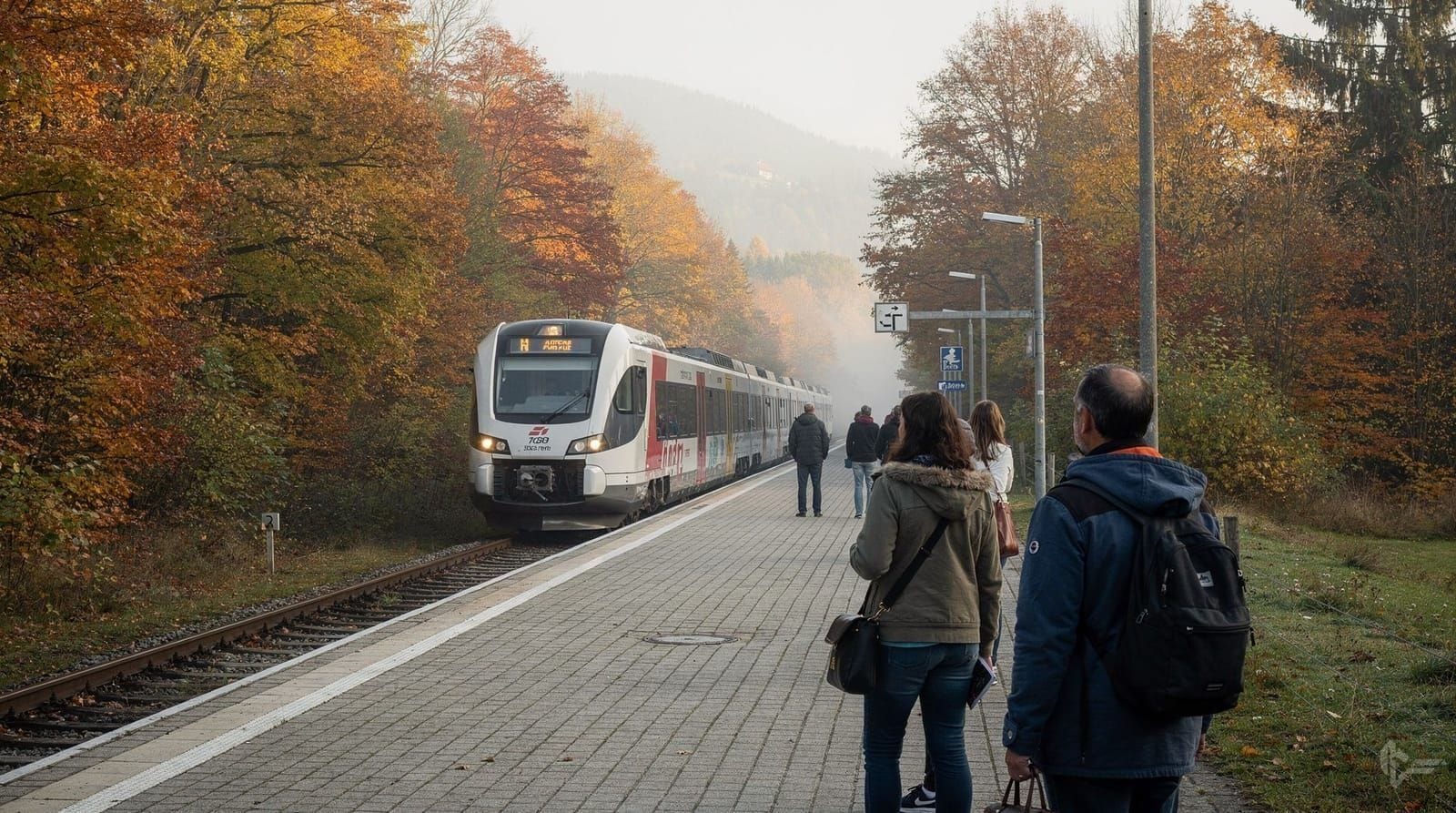
- Füssen train station to Hohenschwangau ticket centre: 3.5 km (bus 73/78, 10 minutes; walking, 45 minutes)
- Ticket centre to Hohenschwangau castle entrance: 200 metres, flat
- Ticket centre to Neuschwanstein castle entrance (on foot): 1.5 km uphill, 30 minutes
- Neuschwanstein entrance to Marienbrücke: 500 metres, 10 minutes uphill
- Tegelbergbahn valley station to ticket centre: 2.5 km (no direct bus — taxi or bike recommended)
- Ticket centre to Alpsee lakeside meadow start: 700 metres, 10 minutes
If you are combining Marienbrücke photography with a castle tour, the sequence of ticket centre → Hohenschwangau tour → walk to Neuschwanstein → Neuschwanstein tour → walk to Marienbrücke → back to ticket centre totals about 5 km of walking with significant uphill gradient. Wear appropriate footwear.
Backup plan for bad weather
Bavarian weather near the Alps changes quickly, and a forecast that looks clear for Munich can still mean low cloud sitting directly over Schwangau. If Marienbrücke is fogged in, don’t abandon the morning — the alpine meadows and the Alpsee lakeside often sit below the cloud layer and still give a usable shot of the castle emerging from mist, which some photographers prefer to a clear-sky version. Conversely, if the valley is clouded over, the Tegelbergbahn summit is frequently above the cloud line, turning a grey morning into a striking shot of peaks rising from a sea of fog with the castle only occasionally visible below. Building 20-30 minutes of flexibility into a photography-focused day, rather than committing entirely to one spot, is the most reliable way to salvage a session when the weather doesn’t cooperate.
Practical planning for photography visits
If photography is your primary reason for the trip, structure the day differently from a standard tourist visit:
Ideal schedule (summer):
- 5:30am: Arrive at Marienbrücke (pre-hike from ticket centre area)
- 5:45am–7:30am: Golden hour photography from bridge
- 8:00am: Descend, breakfast at hotel or packed food
- 9:00am: First Hohenschwangau tour slot
- 11:00am: First Neuschwanstein tour slot (pre-booked)
- 1:00pm: Walk to alpine meadows for afternoon light setup
- 4:00pm: Tegelbergbahn for late-afternoon elevated shot
- 6:00pm: Return to Füssen
For logistics on reaching the castle area from Munich, see Neuschwanstein day trips from Munich and castles by train.
For ticket booking so your visit is confirmed, see Neuschwanstein tickets guide. private tour to Neuschwanstein Castle from MunichCheck availability
Honest notes on crowds and expectations
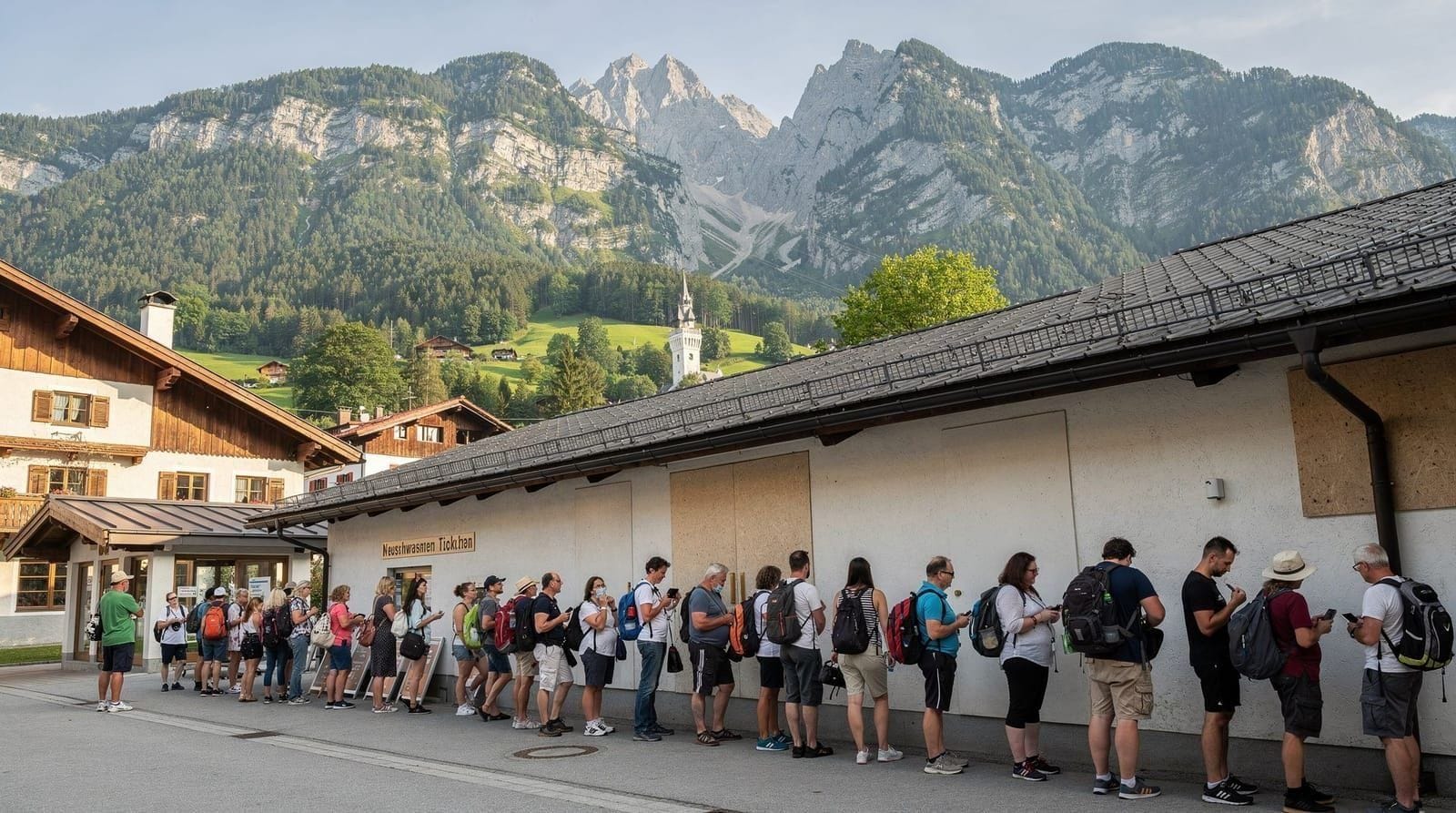
Neuschwanstein in July and August is exceptionally crowded. Marienbrücke at 11am looks like a queue more than a viewpoint. The castle path is a steady stream of visitors. The ticket centre car park fills before 9am.
None of this means the photos are impossible — but it does mean shooting around people rather than of the castle alone. A few honest observations:
- The “empty Marienbrücke with castle” shot requires either a very early start or post-processing compositing. In July–August, there is no time of day when the bridge is genuinely empty between 8am and 6pm.
- Telephoto compression from the meadows or Tegelbergbahn can isolate the castle from crowds below.
- Autumn (late September through October) reduces crowds significantly and adds colour context. The castle does not change, but the valley does.
- Snowfall transforms Neuschwanstein into something extraordinary. Winter visits require checking Marienbrücke closure and weather conditions, but if you catch fresh snow with an open bridge, the photographs are unlike anything possible in summer.
For more on avoiding the worst crowds, see Neuschwanstein crowds — honest guide.
Frequently asked questions about Neuschwanstein photo spots
When is the best time of day to photograph Neuschwanstein?
Golden hour after sunrise gives the best light and smallest crowds. In summer, sunrise near Füssen is around 5:15–5:30am. Arriving at Marienbrücke by 6am gives roughly 2 hours before coach groups arrive. Late afternoon after 4pm also has strong light but the bridge fills up again.
Is Marienbrücke always open?
No. Marienbrücke closes in winter when ice makes it dangerous, typically November through April. Always check closure status on the official Bayern palace website before planning a winter visit.
How do I reach Marienbrücke from the castle?
From the Neuschwanstein entrance, walk uphill for about 10 minutes along a signed path through the forest. Marienbrücke is a short metal bridge spanning the Pöllat Gorge at 92 metres above the waterfall below. There is no entry fee to the bridge itself.
What is the Tegelbergbahn and how does it help for photography?
The Tegelbergbahn is a gondola cable car that climbs to 1,707 metres on Tegelberg mountain, about 2.5 km from the castle. From the summit, you get an elevated view across the entire Allgäu valley with Neuschwanstein, Hohenschwangau, and the Alpsee lake below. The ride costs approximately €21 return.
Can I photograph Neuschwanstein from the fields below?
Yes. The meadows between the castle area and the Alpsee lake give a lower perspective with alpine foreground in spring and early summer. Reach them via the lakeside path from Hohenschwangau village — a 15-minute walk.
Is there a good reflection shot of Neuschwanstein?
The Alpsee lake occasionally gives partial castle reflections in very calm early-morning conditions. Trees and distance limit the shot. This is a secondary spot — not as reliable as Marienbrücke.
Are there any photo spots inside the castle itself?
Photography is permitted inside Neuschwanstein without flash. The Throne Room and Singers’ Hall are the most photographed interiors. The guided tour moves quickly, so arrive with camera ready.
Can I use a tripod at Marienbrücke?
Technically yes, but in practice a full-size tripod is impractical on a crowded bridge in peak season — there simply isn’t the space, and other visitors will not appreciate the delay. A small tabletop tripod braced on the railing, or a well-stabilised handheld shot, works better. The Tegelbergbahn summit has much more room if a tripod is essential to your setup.
Top experiences
Bookable activities with verified prices and instant confirmation on GetYourGuide.