
Neuschwanstein crowds: the honest guide to visiting without regret
Munich: half-day skip-the-line Neuschwanstein Castle tour
Is Neuschwanstein Castle worth visiting given the crowds?
Yes, but only if you plan correctly. Book timed tickets at least 4-8 weeks in advance in peak season (June-August). Arrive early (first entry slot at 9am). The interior tour is 35 minutes, photography inside is banned, and the Marienbrücke viewpoint may be closed for maintenance. If you go in prepared, it's genuinely impressive. If you arrive without a ticket expecting to walk in, you will be turned away.
| Where | Hohenschwangau village, near Füssen (2hrs from Munich by train) |
| Cost | around €18 adult ticket, plus around €30-35pp transport from Munich |
| Time needed | half a day minimum, including the uphill walk and travel |
| Getting there | train to Füssen then Bus 73/78, or a guided tour with pickup |
| Best time | first 9am slot, October-November or April-May for lower crowds |
What Neuschwanstein actually is — and what visitors expect vs reality
Let’s start with the numbers, because they set the scene better than any description: Neuschwanstein Castle receives approximately 1.4 million visitors per year. In summer, that works out to roughly 6,000 people per day, all funneled through timed 35-minute interior tours. On a Saturday in July, you are sharing this experience with thousands of other people who all had the same idea.
That context matters because the marketing around Neuschwanstein doesn’t prepare you for it. The castle appears on an estimated 90 million postcards. It inspired Walt Disney’s Cinderella Castle. Every travel photo shows it gleaming white against alpine peaks, moat, and perfect reflections — serene, romantic, seemingly just waiting for you. The reality is that it’s one of the most visited sites in Europe, and the experience on the ground feels nothing like those postcards.
None of this means you shouldn’t go. Neuschwanstein is genuinely breathtaking, and the interior is stranger and more theatrical than most people expect. But you need to arrive knowing what you’re actually in for: a 30-40 minute uphill walk, a timed entry window with zero flexibility, a guided tour that moves quickly through 15 of the castle’s 200 rooms, and a complete ban on interior photography. You also need to know that on popular days, the viewpoint at Marienbrücke — the place where the iconic postcard photo is taken — may have a queue of 45-60 minutes just to stand on the bridge.
This guide covers the unglamorous logistics: what the ticket system actually involves, what the walk is like, what you’ll see inside and what you won’t, and whether the whole experience is worth the considerable planning effort it requires in 2026.
For a fuller overview of the castle’s history and architecture, see Neuschwanstein Castle: the complete guide. If you’re weighing it against the nearby Hohenschwangau Castle, the honest comparison lives at Neuschwanstein vs Hohenschwangau.
The ticket reality: timed entry, what sells out, and when to book
The most important thing to understand about Neuschwanstein tickets is this: there is no walk-up purchase at the castle. You buy tickets at the ticket center in Hohenschwangau village, which sits about a 30-40 minute walk below the castle. When you buy a ticket, you receive a timed entry window — miss it by more than a few minutes and the ticket is forfeited. No re-entry, no refund, no exceptions.
The official ticket source is tickets.hohenschwangau.de. This is the only legitimate online booking platform for Neuschwanstein. Do not buy from secondary resellers or aggregator sites presenting themselves as official — prices will be inflated and tickets may not be valid.
2026 pricing: Adult tickets are €18. Children under 18 from EU countries enter free. Seniors and students pay €17. There is a booking fee of approximately €2.50 per ticket when purchasing online, but online booking is strongly recommended for summer visits.
How far in advance does it sell out?
- June, July, August (peak): specific time slots sell out 4-8 weeks ahead. Popular morning slots go first.
- May and September: expect slots to sell out 2-4 weeks ahead, especially weekends.
- October through April: much better availability. Same-week or even same-day tickets are often possible, though not guaranteed on weekends in October when autumn colors draw larger crowds.
The practical implication: if you’re visiting in summer and haven’t booked yet, check the availability calendar now before reading further. A lot of people discover mid-itinerary that their preferred date is fully booked.
Guided tours as an alternative: If online booking feels complex or you’ve missed the advance window, organized guided tours from Munich often include pre-allocated ticket access as part of the package. This is a legitimate option, not a tourist trap — the convenience is real when tickets are scarce. 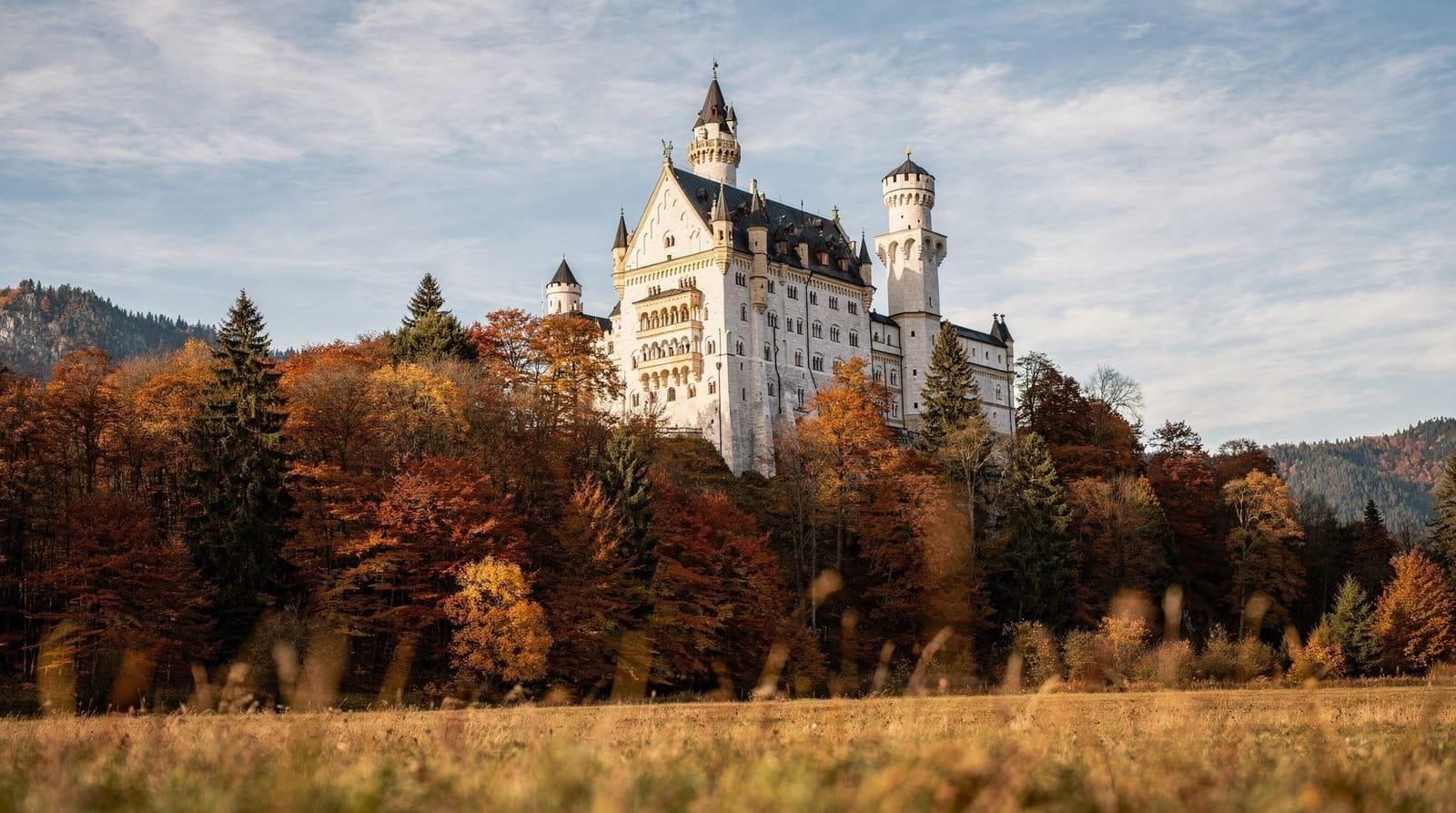 half-day skip-the-line Neuschwanstein Castle tourCheck availability
For a full breakdown of ticket types, time slots, and booking strategy, see the dedicated Neuschwanstein tickets guide.
Getting there: the logistics nobody explains upfront
The journey to Neuschwanstein has more steps than most visitors realize, and each step has a potential failure point if you haven’t planned it.
From Munich to Füssen:
The train from Munich Hauptbahnhof to Füssen takes approximately 2 hours on the Bayerische Oberlandbahn regional service. You’ll need to change trains at Buchloe. The Bayern-Ticket (€29 for the first person, €6 for each additional) covers this journey for up to 5 people and is the best value option for groups. Single tickets are around €30-35 each way without a day pass.
By car, Füssen is about 118km from Munich — roughly 1.5 hours without traffic, longer in summer on weekends when the B17 road through the Alps is congested.
From Füssen to Hohenschwangau:
Füssen train station is not at the castle. From the station, take Bus 73 or 78 to Hohenschwangau (about 15 minutes, approximately €2.50 each way). Taxis from the station cost around €12-15. The bus is reliable and runs frequently in season — check the timetable before you arrive to make sure your connection works with your timed entry slot.
From Hohenschwangau village to the castle:
This is the section most visitors are not prepared for. There is no bus, cable car, or direct transport to the castle entrance. Your options are:
-
Walk uphill: 30-40 minutes, ascending about 200 metres in elevation. The path is paved but uneven in sections, and it’s genuinely steep in parts. Most fit adults manage it without difficulty. Strollers are very hard work. For anyone with significant mobility limitations — joint problems, heart conditions, or difficulty with sustained steep inclines — this is worth thinking through carefully before committing to an independent visit.
-
Horse carriage: Seasonal service running from the village up to the upper parking area. Cost is €8 uphill and €4 downhill. The important caveat: the carriage drops you at the upper parking area, not at the castle door. You still have a 10-minute walk from the drop-off point to the entrance. It reduces the climb but doesn’t eliminate it.
-
There is no third option for reaching the castle itself.
The walk is not prominently advertised anywhere in the castle’s official communications. Many visitors — particularly those who book independently without reading detailed logistics — arrive at the ticket center and discover the physical reality only then. If you’re traveling with young children, elderly relatives, or anyone with limited mobility, factor this into your planning before you book.
For full logistics on the Munich to Neuschwanstein journey by every method, see Munich to Neuschwanstein day trip.
Driving and parking at Hohenschwangau: If you’re driving from Munich or elsewhere in Bavaria, there are several paid car parks in the village — P4 is the largest and closest to the ticket center, with spaces filling by mid-morning in peak season. Expect to pay around €8 for the day. Sat-nav systems sometimes route drivers to a farm track above the village rather than the official car parks — follow the signs for “Schlossparkplätze” rather than blindly trusting GPS. Once parked, you still face the same 30-40 minute uphill walk or carriage ride as everyone arriving by train and bus; driving only shortens the journey to Hohenschwangau, not the climb to the castle itself. If you’re combining the visit with other stops in the Bavarian Alps, a rental car gives more flexibility than the train, but budget extra time for parking on weekends.
What you actually see inside: the honest 35-minute tour
Neuschwanstein’s interior tour lasts exactly 35 minutes. A guide takes groups of approximately 60 people through 15 rooms. The castle has around 200 rooms in total — the other 185 were never completed when King Ludwig II died in 1886 at age 40, under disputed circumstances. Three days after his death, the castle was opened to the public to help pay his debts. It had been under construction for 17 years.
Photography inside is strictly banned. No exceptions. No phone photos, no quick snaps, nothing. Staff enforce this consistently. If you’ve mentally built your visit around an Instagram shot in the throne room, you need to adjust expectations now.
What you’ll actually see:
The throne room is the standout — a vast Byzantine space with a vaulted ceiling dripping in gold mosaic, a chandelier weighing 900kg, murals of Christ flanked by saints, and a raised apse where a throne was planned but never installed. It was designed not as a functional room but as a statement of divine kingship. It’s genuinely spectacular and worth the visit on its own.
The Singer’s Hall is the largest room and was inspired by the Hall of Song in Tannhäuser, the Wagner opera Ludwig was obsessed with. It was never used in Ludwig’s lifetime — the first concert was held here in 1933, decades after his death.
The King’s bedroom took 14 craftsmen four years to build. Every surface is carved oak — the bed canopy alone has 27 spires. A small adjoining artificial grotto, complete with stalactites and a waterfall that once operated mechanically, was Ludwig’s private retreat.
The tour moves quickly. At 35 minutes across 15 rooms, you average just over two minutes per room. There’s no lingering, no doubling back, no wandering off at your own pace. Audio guides are included in the ticket price as an alternative to a live group guide — they allow some individual pacing but you still exit through the designated route.
What the tour doesn’t tell you overtly: much of what made Ludwig unusual was his near-total disregard for function. He never entertained at Neuschwanstein. He spent a total of about 170 nights there before dying. The castle was built as an escapist fantasy, not a residence, and that feeling comes through strongly in the theatrical quality of every room.
For a deeper look at Ludwig’s three major building projects and what drove them, see King Ludwig II castles guide.
The Marienbrücke situation — the famous photo spot
The Marienbrücke is a 19th-century iron footbridge suspended 90 metres above the Pöllat Gorge. From it, you get the panoramic view of Neuschwanstein that appears on every postcard, calendar, and travel magazine cover — the castle framed against alpine peaks with the gorge dropping away below you. It’s about a 10-minute walk uphill past the castle entrance.
Here is the honest situation in 2026: the Marienbrücke is frequently closed for safety inspections and structural maintenance. It was closed for extended periods in both 2023 and 2024. Whether it’s open on your specific visit day is something you cannot confirm until you’re there, or until you check the current status at the ticket center website close to your visit.
Before travelling, check the current status at schloss-neuschwanstein.de or through the Hohenschwangau ticket center directly. Don’t assume it will be open because a blog post from six months ago said it was.
When the bridge is closed, the alternative viewpoint is the castle’s own terrace, which gives a partial elevated view of the gorge and surrounding landscape. It’s pleasant but substantially less dramatic than the bridge perspective — you lose the full castle silhouette that makes the Marienbrücke shot distinctive.
When the bridge is open, the honest crowd reality: on a clear summer day, expect 45-60 minutes of queueing just to get onto the bridge. The bridge itself is narrow. Once you’re on it, you have roughly 2 minutes before the next group needs your spot. The photo you’ve imagined — unhurried, you alone against the alpine backdrop — takes careful timing.
Best timing for the Marienbrücke: either the very first entry slot of the day (arrive at the castle at 9am and head straight to the bridge before your tour), or late afternoon in shoulder season after 4pm when day-tripper crowds thin. The bridge stays open until sunset in summer.
For detailed advice on viewpoints and timing the shot, see Neuschwanstein photo spots and Marienbrücke viewpoint guide.
When to go to avoid the worst crowds
| Month | Crowd level | Ticket lead time | Notes |
|---|---|---|---|
| Jul-Aug | Very high | 4-8 weeks | Peak season, Oktoberfest-adjacent travel spikes demand |
| May, Sep | High, esp. weekends | 2-4 weeks | Good weather, still busy on weekends |
| Oct-Nov | Moderate | Same-week often possible | Autumn colour, our pick for the best balance |
| Apr | Low-moderate | Days ahead often fine | Spring light, gorge wildflowers below Marienbrücke |
| Dec-Mar | Low, but reduced hours | Days ahead | Possible closures for maintenance, check ahead |
Worst times to visit:
July and August weekends are the peak of the peak. On a Saturday in July between 10am and 3pm, the castle and surrounding paths are at maximum capacity. The queue for the Marienbrücke is longest, the walk up is most congested, and the overall atmosphere is more theme park than historic castle. If this is your only option, it’s still worth going — but go in with full expectations set.
Best times:
October and early November are arguably the best months overall. The deciduous trees on the hillsides turn gold and amber against the white castle walls — the colors make for exceptional photography even without a blue-sky backdrop. Visitor numbers drop significantly from peak, tickets are available with much less advance booking, and the alpine air is crisp. There is a possibility of early snow on the peaks from October onwards, which adds atmosphere rather than detracting.
April and May offer spring light, green hillsides, wildflowers in the gorge below Marienbrücke, and substantially lower crowds than summer. Tickets for weekdays in April are sometimes available the same week. The Marienbrücke is typically open and less congested.
Any weekday outside of July and August is notably calmer than weekends year-round.
The first entry slot of the day — 9am — reduces crowd pressure significantly in any season. The walk up is cooler, the Marienbrücke queue is shorter, and you’ll finish your interior tour before the bulk of day-trippers from Munich arrive.
Eating near the castle: Hohenschwangau village has a handful of restaurants and cafés clustered around the ticket center and the lakeside, ranging from quick bratwurst stands to sit-down Bavarian restaurants with terrace views of both castles. Prices run higher than in Munich or Füssen given the captive tourist market — expect around €14-20 for a main course. If your schedule is tight between the walk up, the tour, and Marienbrücke, a quick snack before or after is more realistic than a leisurely lunch; save the proper meal for Füssen old town afterwards, where prices are more reasonable and the pace is calmer.
Winter visits (November to March): The castle is open through winter but operates reduced hours, and individual days may close for maintenance without much notice. Confirm your specific date on the official website before booking transport. Snow on the castle and surrounding landscape is genuinely magical — but you need reliable weather information and some flexibility.
If your visit coincides with time for a second castle, Hohenschwangau is directly adjacent and tickets run through the same system. It’s Ludwig’s actual childhood home — quieter, more lived-in, and historically richer in some respects despite being less architecturally theatrical. The combo option is worth considering. 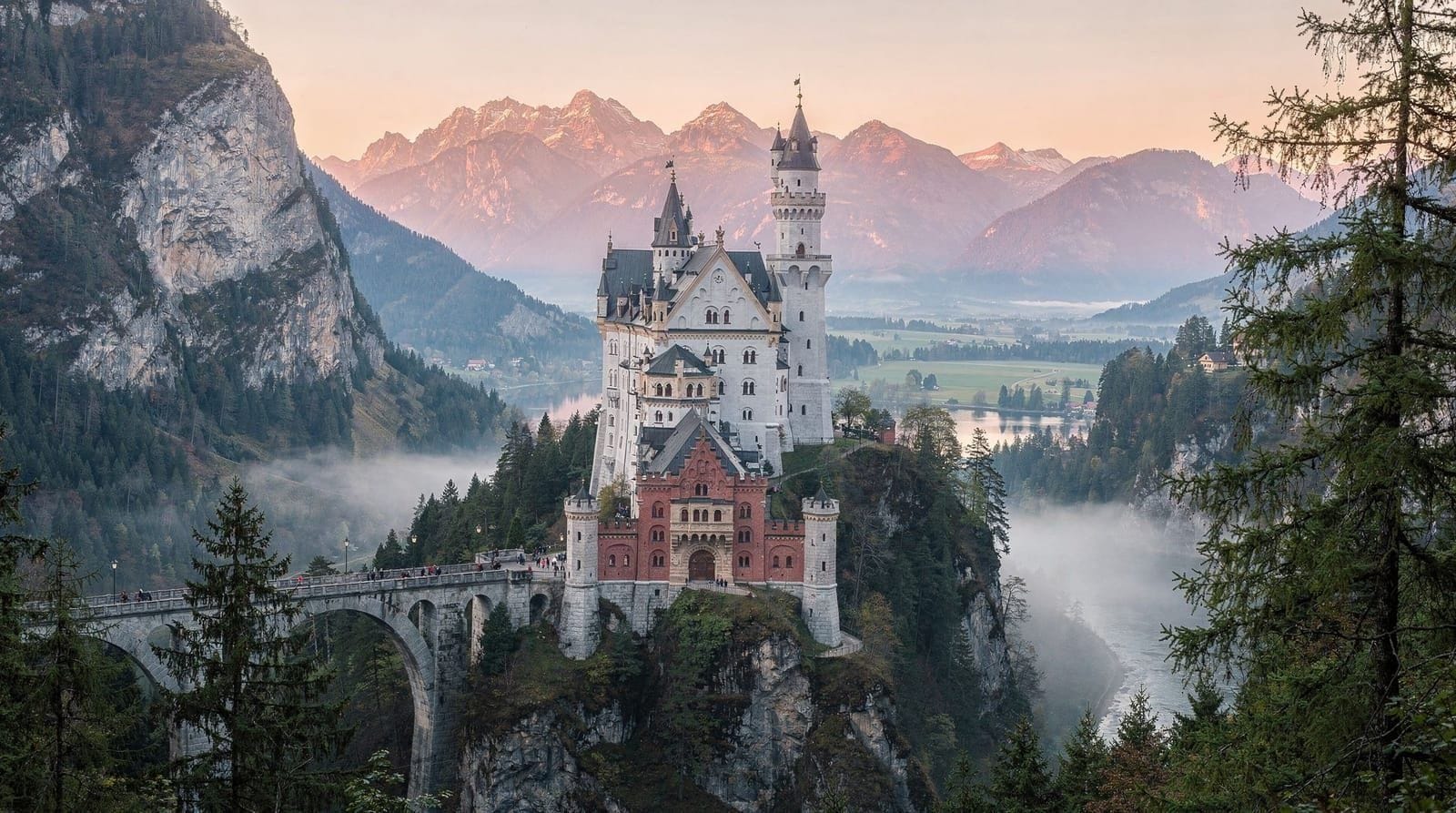 combo ticket Neuschwanstein and Hohenschwangau CastleCheck availability
Packing and accessibility: what to bring, and who should think twice
What to bring: sturdy, closed shoes with grip — the uphill path is paved but uneven and can be slick after rain. A light layer even in summer, since the walk gains 200 metres of elevation and it’s noticeably cooler at the top than in Hohenschwangau village. A refillable water bottle, since there’s no service on the walk up. Cash in small denominations for the horse carriage and any snacks at the top, though the main ticket purchase is card-friendly. Large backpacks and suitcases are not permitted inside the castle and must be left at a bag drop near the entrance, so travel light on tour day.
Accessibility: Neuschwanstein was never built with accessibility in mind, and the honest answer is that it’s genuinely difficult for anyone using a wheelchair or with significant mobility limitations. The 30-40 minute uphill walk has no step-free shortcut, and the horse carriage still requires walking the final stretch from the upper parking area. Inside, the interior tour includes stairs with no lift alternative. Travelers with limited mobility are better served by admiring the castle from a distance — the view from Hohenschwangau village or the drive-by viewpoints near Füssen — rather than attempting the full interior tour. If mobility is a concern for anyone in your group, Hohenschwangau Castle has a shorter, gentler approach and is worth checking directly with the ticket center about current accommodations before booking.
The honest verdict: is Neuschwanstein worth the effort?
After all of the above, here is a straightforward assessment.
You’ll find it genuinely worthwhile if:
You’ve booked tickets at least 4-6 weeks ahead for a summer visit and secured a morning slot. You’re comfortable with 30-40 minutes of uphill walking each way on an uneven path. You accept that 35 minutes inside with no photography is the format, and you find the throne room and singer’s hall worth seeing on their own terms. You pair the castle with Hohenschwangau, which gives you a fuller picture of Ludwig’s life and is noticeably less frantic. You add time in Füssen afterwards — the old town is small, pretty, and completely calm by comparison.
For a ready-made two-or-three-day structure combining the castles with other Bavarian highlights, the Munich castles 3-day itinerary is a good starting point.
You may be disappointed if:
You arrive in summer without a pre-booked timed ticket expecting to purchase on the day — you will be turned away. You expect a traditional medieval castle with original furnishings and centuries of real habitation — Neuschwanstein is more theatrical fantasy than historic residence. You have significant mobility limitations that make 40 minutes of steep uphill walking impractical. You need to linger and explore at your own pace — the timed format doesn’t allow it. The Marienbrücke closes during your visit, which is a genuine possibility and outside anyone’s control.
Alternatives worth considering if crowds are your main concern:
Linderhof Palace, also built by Ludwig II, sits in a secluded valley about 50km from Neuschwanstein. It’s smaller, more intimate, and sees a fraction of the visitor numbers. The grounds include a working cascade fountain, a Neptune grotto, and a Moorish kiosk that Ludwig had shipped from the 1867 Paris World’s Fair. It’s arguably the more interesting of Ludwig’s buildings for anyone who wants to understand what drove him.
Herrenchiemsee, Ludwig’s attempt to replicate Versailles on an island in Lake Chiemsee, is the grandest of the three and also the least visited. The Hall of Mirrors is longer than Versailles’ equivalent.
And Hohenschwangau itself — standing directly opposite Neuschwanstein, equally bookable through the same ticket system, and the place where Ludwig actually grew up watching Neuschwanstein being built on the hill opposite his childhood window. That biographical detail makes it unexpectedly moving.
Guided tour vs independent visit: honest comparison
Both approaches are valid. Here’s a direct comparison.
Independent visit: The ticket costs €18 per adult. Train from Munich to Füssen with Bayern-Ticket is roughly €13.60 per person return for groups, more for solo travelers without a day pass. Total cost for an independent visit from Munich: around €30-35 per person for a solo traveler including transport. This requires managing ticket booking 4-8 weeks ahead, navigating the Füssen bus connection, and allowing enough buffer time between arrival and your timed entry slot. Suitable for confident travelers who enjoy planning.
Guided tour from Munich: Typically priced between €55 and €90 per person, including return transport, ticket, and a guide for the journey and castle exterior. The main benefit is genuine: the tour operator holds pre-allocated ticket access, removing the need to book independently months ahead. The guide provides context on Ludwig’s history that enriches the interior tour. Best for first-time visitors to Bavaria, anyone who finds German transport logistics stressful, or families who want everything handled. Neuschwanstein Castle tourCheck availability
For the train-independent approach including timetables and bus connections, the castles day trip by train guide covers the route in detail.
See also the broader best castles near Munich guide if you’re weighing Neuschwanstein against other options in Bavaria.
Frequently asked questions
Can I visit Neuschwanstein without booking tickets in advance?
In theory, yes — unsold tickets are available at the Hohenschwangau ticket center on a first-come, first-served basis. In practice, from June through August and on most weekends in May and September, the day’s tickets are fully allocated before you arrive. Showing up without a booking in peak season is a realistic way to make a three-hour journey for nothing. October through April offers more flexibility, but confirming online before you travel is always the safer approach. The latest on ticket sell-outs covers how fast slots go in 2026.
How long is the uphill walk to the castle?
30-40 minutes from the Hohenschwangau ticket center, ascending approximately 200 metres. The path is paved but uneven and steep in sections. Most adults in reasonable fitness find it manageable. The horse carriage reduces the climb but deposits you at the upper parking area, not the castle door — there’s still a 10-minute walk from there. There is no lift, cable car, or alternative access route.
Is photography allowed inside Neuschwanstein?
No. Photography inside the castle is strictly prohibited, and the rule is enforced. This includes phone cameras. If interior photography is central to your reason for visiting, you need to know this before you go. The exterior, the grounds, the view from Marienbrücke — all of these are unrestricted. The interior is not.
Is the Marienbrücke viewpoint open in 2026?
As of the time of writing, check the current status before your visit at the official Hohenschwangau ticket center website or schloss-neuschwanstein.de. The bridge undergoes periodic closures for safety inspection and structural maintenance, and these are not always announced far in advance. It was closed for extended periods in 2023 and 2024. Treat Marienbrücke access as something to verify close to your visit date, not something to assume.
What’s the best month to visit Neuschwanstein to avoid crowds?
October and November for the best balance of atmosphere, reasonable crowd levels, and accessible tickets. April and May for spring conditions and lower visitor numbers. Any weekday outside of July and August will be noticeably calmer than a summer weekend. The absolute worst time is a Saturday or Sunday in July between 10am and 3pm. The first entry slot at 9am is the best option within any given season.
Is the inside of Neuschwanstein worth seeing, or should I just go for the outside view?
Both are worth it, but they’re different experiences. The exterior and the view from Marienbrücke are more immediately photogenic and emotionally satisfying for many visitors. The interior is stranger, more theatrical, and more historically interesting — the throne room in particular is unlike anything else in Bavaria. If you’re going to make the journey at all, booking the interior tour makes sense. The €18 ticket price is modest relative to the planning effort required to get there. The constraint is the 35-minute format and the photography ban, not the quality of what’s on offer.
Can I bring a stroller, backpack or suitcase into the castle?
Large backpacks and suitcases are not allowed inside and must be left at the bag drop near the entrance, so travel light on tour day. Strollers can technically make the uphill walk but it’s genuinely hard work on the uneven, steep sections, and they are not practical inside the castle itself, where the tour route includes stairs. If you’re visiting with a very young child, consider a soft carrier instead, and check current stroller policy with the ticket center if you plan to bring one anyway.
For more on the Neuschwanstein destination and how to build a wider Bavarian itinerary around it, start with the Munich to Neuschwanstein day trip logistics guide.
Top experiences
Bookable activities with verified prices and instant confirmation on GetYourGuide.