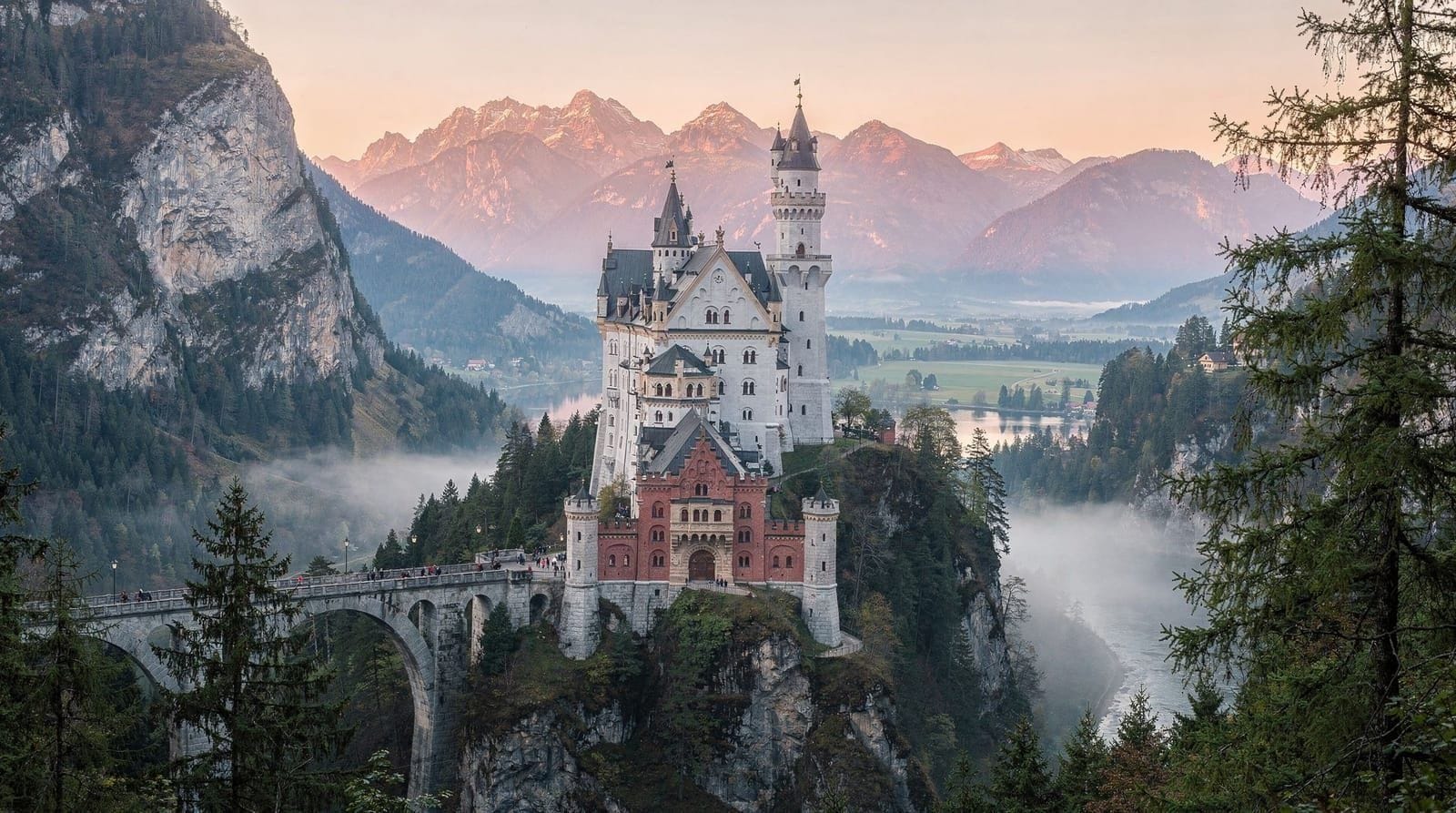
Hohenschwangau castle: the complete visitor guide
Schwangau: combo ticket Neuschwanstein and Hohenschwangau Castle
Is Hohenschwangau Castle worth visiting?
Yes — especially if you enjoy authentic royal interiors. Unlike Neuschwanstein, photography is allowed inside, the history is richer, and it's where Ludwig II actually grew up. Pair it with Neuschwanstein for a full day in the Schwangau valley.
Why Hohenschwangau deserves your full attention
Every year, roughly 1.5 million people visit the Schwangau valley south of Füssen to see Neuschwanstein Castle. A significant portion of them also buy a ticket for Hohenschwangau — the yellow castle sitting on a lower ridge just across the valley. And then they rush through it, spend thirty-five minutes inside, and spend the next hour staring up at Neuschwanstein for photos.
That is a mistake. Hohenschwangau Castle is not a consolation prize or a warm-up act. In many ways it is the more interesting of the two royal properties: the interiors are richer in authentic royal history, you can photograph almost everything inside, and the building itself has been standing in some form since the twelfth century. King Ludwig II — the eccentric “fairy-tale king” who built Neuschwanstein — spent most of his childhood and young adulthood here. Understanding Hohenschwangau is the key to understanding why Ludwig built what he built.
This guide covers everything you need to plan a proper visit: what you will actually see inside, how to get tickets, how the combo option works, what to expect from the guided tour, and honest advice on whether to combine it with Neuschwanstein on the same day.
| Where | Schwangau valley, near Füssen, ~90–120 min from Munich |
| Cost | around €22 adult / €21 youth; combo with Neuschwanstein around €31 |
| Time needed | 1.5–2 hours including the walk up and down |
| Getting there | Train Munich–Füssen then Bus 73/78, or A95 by car |
| Best time | Weekday mornings, April–May or September–October |
A brief history: from medieval fortress to royal residence
The site of Hohenschwangau has been fortified since at least the twelfth century, when the Knights of Schwangau built a fortress here. Over the following centuries the structure passed through many hands, suffered sieges, and fell gradually into ruin. By the early nineteenth century, little remained beyond crumbling walls and romantic legend.
Enter Crown Prince Maximilian of Bavaria — later King Maximilian II — who discovered the ruins in 1829 and became determined to restore them. He commissioned the theatrical designer Dominik Quaglio to rebuild the castle in a medieval-romantic style, and the project was completed in 1837. The resulting building is not a medieval original; it is a romantic-era interpretation of what a medieval castle should look like, which was fashionable throughout Europe at the time. But unlike Neuschwanstein — which was never finished and never served as a real royal home — Hohenschwangau actually functioned as a royal family residence for decades.
Crown Prince Ludwig was born in 1845 and spent significant portions of his childhood and young adulthood at Hohenschwangau. The castle shaped him profoundly. The murals inside depicted legends from medieval German history and the operas of Richard Wagner, which Ludwig had not yet seen performed but whose worlds he absorbed through the imagery surrounding him from childhood. His obsession with Wagner and with the medieval myth of the Swan Knight (Lohengrin) — which would later drive the construction of Neuschwanstein — took root here.
Maximilian II died in 1864 and eighteen-year-old Ludwig became King of Bavaria. He continued to use Hohenschwangau as a residence throughout his life, spending summers here and planning Neuschwanstein from the bedroom window. The two castles are visible to each other, which is not coincidental: Ludwig positioned his grand project on the opposite ridge so he could watch its construction and see it illuminated at night from the bedroom where he had grown up.
What you will see on the guided tour
Entrance to Hohenschwangau’s interior is only possible on a guided tour, which runs approximately 35 minutes and includes about 15 rooms on two floors. Groups are kept to a manageable size — around 30 people — and tours depart frequently throughout the day in both German and English.
The ground floor: state rooms and reception halls
The tour begins on the ground floor with the reception and dining rooms. These spaces are decorated with elaborate murals depicting German heroic legends — scenes from the Nibelungenlied, the story of Siegfried, and other medieval sagas that Maximilian II considered foundational to Bavarian national identity. The furniture is period-appropriate and largely original, which sets Hohenschwangau apart from many restored royal properties where the interiors are reconstructions.
The Hall of Swan Knight (Schwansrittersaal) is the centerpiece of the ground floor. It depicts the story of Lohengrin, the Swan Knight from medieval Arthurian legend, in a cycle of murals covering all four walls. Ludwig II found this room — and this legend — formative. The imagery of a mysterious knight arriving by swan-drawn boat, pledging loyalty and love on condition that his origins not be questioned, resonated with something deep in his imagination. The swan motif that runs through Neuschwanstein, Herrenchiemsee, and his other projects finds its origin here.
You are free to photograph everything on the ground floor, so bring your camera and take your time.
The upper floor: Ludwig’s private quarters
The upper floor contains the private apartments of King Ludwig II. This is where the guide tour earns its ticket price.
Ludwig’s bedroom is small and deeply personal — not the grand theatrical space you might expect from the man who built Neuschwanstein. The ceiling is painted with stars that could be illuminated at night using gas lamps hidden behind the plasterwork, turning the bedroom ceiling into a night sky. Ludwig is said to have spent long hours in this room planning Neuschwanstein, sketching ideas and writing to his architects while looking out the window at the opposite ridge where his dream castle would eventually rise.
The bedroom also contains the piano where Wagner himself played during his visits to the castle. Ludwig’s relationship with Wagner was one of the most famous patron-artist relationships in nineteenth-century Europe: the young king was so devoted to Wagner’s music that he paid off the composer’s debts, funded his theatre at Bayreuth, and provided him with a private residence for years. The piano in this room is tangible evidence of that extraordinary relationship.
A small study and dressing room complete the private apartment. Throughout the upper floor, the murals shift from heroic legend to more personal imagery: scenes from Wagner operas Ludwig had seen performed, imagery from his travels in the Alps, and portraits of family members.
Photography compared to Neuschwanstein
One practical point worth emphasizing: photography is freely allowed throughout Hohenschwangau’s interior. This is genuinely unusual among major Bavarian royal properties. Neuschwanstein Castle bans cameras inside completely — a rule strictly enforced and frustrating for visitors who have traveled long distances. If photographing royal interiors matters to you, Hohenschwangau is where you spend time with your camera out.
Tickets, pricing, and the combo option
All tickets for Hohenschwangau — as well as for Neuschwanstein Castle — are sold through the central ticket office at the bottom of the valley, near Alpsee lake in Schwangau. The ticket website is tickets.hohenschwangau.de. You cannot buy tickets at the castle entrance itself.
Hohenschwangau only: €22 adults, €21 youth (ages 6–17). Children under 6 free. There is a €2.50 online reservation fee per ticket, which is well worth paying to secure a time slot rather than queuing on the day.
Combo ticket (Hohenschwangau + Neuschwanstein): approximately €31 per adult. This represents a modest saving over buying both separately and also simplifies logistics since you receive entry time slots for both castles in sequence.
Museum of the Bavarian Kings: a separate museum at Alpsee lake, run by the same organization, covers the history of the Wittelsbach dynasty including Ludwig II. Combination tickets including the museum are available if you want the full historical picture.
Tickets sell out weeks in advance during peak season (June–August). If you are visiting in summer and have not pre-booked, check availability first thing in the morning when new cancellation slots sometimes appear, or consider arriving on a weekday rather than a weekend. Book the Neuschwanstein and Hohenschwangau combo ticket
If you prefer a guided day trip from Munich that handles all ticket logistics for you, this is a practical option that eliminates the booking stress entirely. Guided tour from Füssen including both castles
Getting to Hohenschwangau
From Munich by train
The most straightforward route is the train from Munich Hauptbahnhof to Füssen — the journey takes about two hours on a regional service and is covered by the Bayern-Ticket if you are traveling as a group. From Füssen station, Bus 73 or 78 runs directly to the Hohenschwangau ticket center, taking about 10 minutes. See the full logistics breakdown in our Bayern Ticket guide and the detailed Munich to Bavaria by train guide.
From Munich by tour bus
Organized day trips from Munich handle the entire journey — bus transport, ticket reservations, and a guide. The advantage is convenience; the disadvantage is a fixed schedule that may not suit everyone’s pace. For a comprehensive look at day trip options, see Munich to Neuschwanstein day trip.
By car
Driving takes around 90–100 minutes from Munich via the A95 motorway towards Garmisch-Partenkirchen, then south to Füssen. Parking lots near Alpsee fill quickly in summer; aim to arrive before 9am. Navigation to “Ticket Center Hohenschwangau” will bring you to the right location.
The walk up to the castle
Hohenschwangau sits at a lower elevation than Neuschwanstein, which means a shorter and less strenuous uphill walk from the ticket center. The path takes 10–15 minutes at a moderate pace. It is paved and suitable for most levels of fitness, though it involves a steady incline. There is no horse-drawn carriage option up to Hohenschwangau (that service exists only for Neuschwanstein), so walking is the only option.
The yellow castle announces itself long before you arrive — it is visible from the road below and from Alpsee lake, and the color makes it easy to identify against the forested hillside. The approach through the trees is pleasant and increasingly dramatic as the towers come into view above you.
Combining Hohenschwangau with Neuschwanstein in one day
The two castles are a natural pair. Both sit in the same valley, tickets are sold at the same location, and the combo ticket is designed for a single day’s visit. How to structure your day depends on logistics.
Practical sequence: If you have a morning entry slot for Hohenschwangau and an afternoon slot for Neuschwanstein, you can spend the time between the two visits walking around Alpsee lake — a beautiful reservoir at the valley floor with views of both castles — or visiting the Museum of the Bavarian Kings. This is our recommended structure.
Timing your slots: Entry time slots are staggered to prevent overcrowding. When you book the combo ticket, your two entry times will be separated by at least an hour or two. Do not try to squeeze both into back-to-back morning slots; you will feel rushed at Hohenschwangau and stressed walking up to Neuschwanstein.
Energy management: Neuschwanstein requires a longer and steeper climb from the valley — about 30–40 minutes on foot — and may involve additional walking to Marienbrücke (the bridge with the famous view) above the castle. A full day doing both castles, including the walks, involves a few hours on your feet. Wear comfortable shoes.
For a detailed honest assessment of which castle to prioritize if you can only do one, see Neuschwanstein vs Hohenschwangau.
What is not worth it (and what often surprises visitors)
The walk-up queue without a ticket: Some visitors arrive at the ticket center hoping to buy same-day tickets only to find the day sold out by 10am in peak season. This is genuinely common in July and August. Do not risk it — book in advance and pay the €2.50 reservation fee. See our detailed breakdown of why Neuschwanstein tickets sell out.
Rushing Hohenschwangau to spend more time at Neuschwanstein: The tour inside Hohenschwangau lasts 35 minutes and there is no extending it — it is a guided group tour on a fixed schedule. Many visitors spend more time outside photographing the exterior than inside actually learning about the history. The interior is genuinely worth your full attention.
The horse carriages on busy days: The horse-drawn carriage service runs only to Neuschwanstein, not Hohenschwangau. On peak summer days, the wait for the carriage can exceed 30 minutes, often making it slower than walking. Most experienced visitors simply walk.
What surprises people: The interior at Hohenschwangau feels more genuinely royal than Neuschwanstein. Neuschwanstein’s famous rooms — the Throne Room, the Singers’ Hall — are theatrical and spectacular, but the castle was never finished and Ludwig only lived there for a few months before his mysterious death in 1886. Hohenschwangau was a functioning royal home for decades. Visitors who expect a second-rate castle often leave feeling it was the more emotionally resonant of the two.
Around the valley: what else to do
Alpsee lake
The lake at the bottom of the valley, visible from both castles, is a highlight in its own right. The water is startlingly blue-green even in overcast weather, fed by snowmelt from the surrounding Alps. A path circles the lake (about 3.5km) and offers changing views of both castles above. In summer you can swim from the lakeside.
Museum of the Bavarian Kings
This relatively new museum, opened in 2011 and located directly on Alpsee, covers 300 years of Wittelsbach dynasty history with an emphasis on the nineteenth century and Ludwig II. It is well-curated and accessible, filling in historical context that the castle tours themselves do not have time to cover. Allow 60–90 minutes.
Füssen
The nearest town, Füssen, is 5km north and worth at least a brief visit. The old town center has a late-Gothic character with a Benedictine monastery (the Hohes Schloss) and a decent pedestrian zone. The Füssen Heritage Museum in the monastery is small but covers the region’s history including the Wittelsbach connection.
Oberammergau
If you have a car and want to extend the day toward Linderhof Palace — Ludwig II’s most personal and intimate castle — Oberammergau is a logical stop on the way. The village is famous for its wood-carving tradition and its Passion Play (performed every ten years, next in 2030), and it sits about 10km from Linderhof. See the Linderhof Palace guide for details on visiting that property.
Hohenschwangau vs Neuschwanstein: how they compare
If you are deciding how to split your time — or whether to buy the combo ticket at all — this side-by-side covers the essentials. For the full honest breakdown, see Neuschwanstein vs Hohenschwangau.
| Hohenschwangau | Neuschwanstein | |
|---|---|---|
| Photography inside | Allowed throughout | Banned completely |
| Tour length | ~35 minutes | ~30 minutes |
| Walk up | 10–15 minutes, gentler | 30–40 minutes, steeper |
| Carriage option | None — walking only | Available, but often slower than walking in peak season |
| Historical character | Lived-in royal family home | Ludwig’s unfinished fantasy project |
| Price (solo ticket) | around €22 adult | around €21–23 adult |
Where to stand for the best photos
Photography is the one area where Hohenschwangau outshines its famous neighbor, so it is worth planning for. Inside, the Hall of Swan Knight and Ludwig’s star-ceiling bedroom are the two rooms most worth slowing down for — the guide typically allows a minute or two in each. Outside, the classic shot is from the shoreline path around Alpsee lake, where the yellow castle reflects in the water on a calm morning. For a wider view that takes in both Hohenschwangau and Neuschwanstein together, walk a short way up the lower slopes of the path toward Neuschwanstein and look back down the valley — this angle is far less crowded than Marienbrücke, which is reserved for Neuschwanstein close-ups.
If you only have time for one castle
Short on time or tickets sold out for one property? Hohenschwangau is the better choice for travelers who care about interiors, history, and photography — you leave with pictures and a real sense of how a nineteenth-century Bavarian royal family actually lived. Neuschwanstein wins on sheer visual drama and is the one people recognize from photos, but the interior tour is shorter, no-camera, and the castle itself was never finished. If your priority is ticking off the postcard image, prioritize Neuschwanstein; if you want the richer, calmer visit, choose Hohenschwangau. Either way, book well ahead — see our guide to why Neuschwanstein tickets sell out for the booking timeline that applies to both castles.
Practical information summary
Address: Alpseestraße 30, 87645 Schwangau (ticket center; castle is 10–15 min walk uphill)
Hours: April to October, daily 8am–5:30pm (last entry). November to March, daily 9am–3:30pm (last entry).
Getting there: Train Munich–Füssen (~2 hours), then Bus 73/78 to Hohenschwangau. By car: A95 Munich–Garmisch, then south to Füssen, ~90 min.
Tickets: tickets.hohenschwangau.de. Book well in advance for summer visits. €22 adult, €21 youth; combo with Neuschwanstein ~€31.
Photography: Allowed throughout the interior — bring your camera.
Accessibility: The uphill path to the castle is paved but steep. The castle interior involves stairs and is not wheelchair accessible.
Language: Guided tours run in German and English; audio guides available in additional languages.
Time to allow: 1.5–2 hours for the full Hohenschwangau visit including the walk up and down. A full day for both castles including travel from Munich.
Planning your wider Bavaria castle trip
Hohenschwangau fits naturally into a multi-day castle itinerary across Bavaria. Ludwig II’s three major projects — Hohenschwangau (where he grew up), Neuschwanstein (his famous alpine fantasy), and Herrenchiemsee (his tribute to Versailles on an island in Chiemsee lake) — together tell the story of one of Europe’s most singular figures.
For a structured multi-day plan covering all three, see the Munich castles 3-day itinerary and the broader Munich and Bavaria 5-day itinerary. You can also browse the overview of best castles near Munich to decide which properties suit your interests and available time.
Frequently asked questions about Hohenschwangau Castle
How much do Hohenschwangau tickets cost?
€22 for adults and €21 for youth aged 6–17. Children under 6 enter free. A combo ticket covering both Hohenschwangau and Neuschwanstein costs approximately €31 per adult. There is a €2.50 online reservation fee per ticket when booking in advance — strongly recommended in peak season.
Can you take photos inside Hohenschwangau?
Yes. Photography is freely permitted throughout the castle interior, including the bedroom, the muralled halls, and the Hall of Swan Knight. This makes Hohenschwangau unusual — Neuschwanstein famously bans all photography inside. If documenting royal interiors matters to you, this is where you spend time with your camera.
Do you need a guided tour for Hohenschwangau?
Mandatory. The interior is only accessible on guided tours of approximately 35 minutes. Tours run throughout the day in German and English, with groups capped at around 30 people. Self-guided exploration of the interior is not permitted.
How far is Hohenschwangau from the ticket center?
10–15 minutes uphill on foot along a paved path. The castle sits at a lower elevation than Neuschwanstein, making the approach shorter and easier. No carriage service runs to Hohenschwangau — walking is the only option.
Can you visit Hohenschwangau without visiting Neuschwanstein?
Absolutely. Tickets are sold separately and there is no requirement to combine the two. Many visitors find Hohenschwangau more historically rewarding on its own merits. If Neuschwanstein tickets are sold out, a Hohenschwangau-only visit is a genuinely worthwhile alternative.
When is the best time to visit?
Weekday mornings in the shoulder seasons — April to May and September to October — offer the best combination of good weather, manageable crowds, and full opening hours. July and August are the busiest months; arrival before 9am and advance booking are essential. November to March is quieter but some features of nearby Neuschwanstein may be restricted.
Is there somewhere to eat near the castle?
No restaurant or café operates inside Hohenschwangau itself. The ticket center area has several cafés and restaurants serving traditional Bavarian food. The Museum of the Bavarian Kings at Alpsee has a pleasant café with lake views. Füssen town (5km north) has a full range of restaurants for a post-visit meal.
Is Hohenschwangau or Neuschwanstein better?
It depends what you value. Hohenschwangau offers richer, photographable interiors and a genuine sense of lived-in royal history; Neuschwanstein offers the famous fairy-tale exterior and more theatrical (but no-camera) staterooms. Many visitors rate Hohenschwangau higher once they’ve actually toured both. See Neuschwanstein vs Hohenschwangau for the full comparison.
Can I visit Hohenschwangau on a day trip without a car?
Yes. The train from Munich Hauptbahnhof to Füssen takes about two hours, and Bus 73 or 78 covers the last stretch to the ticket center in around 10 minutes. It is entirely feasible as a car-free day trip — see the Munich to Bavaria by train guide for the full connection details, or book a guided tour that handles the logistics for you.
Top experiences
Bookable activities with verified prices and instant confirmation on GetYourGuide.