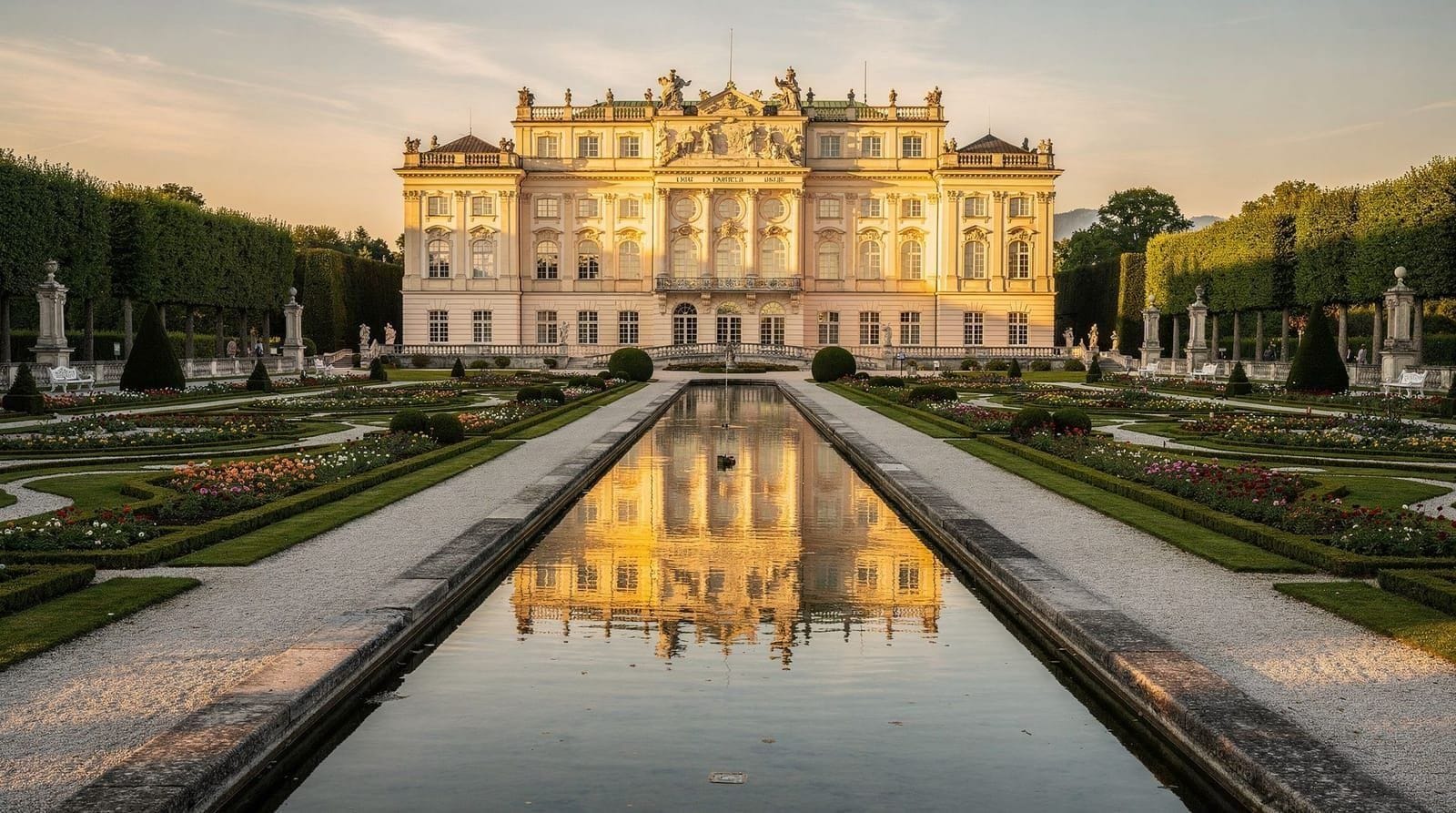
Linderhof Palace
Visit Linderhof Palace — Ludwig II's intimate rococo retreat, Venus Grotto, English landscape garden, combine with Oberammergau and Ettal Monastery.
From Munich: Linderhof Palace full-day tour with Oberammergau
Quick facts
- Distance from Munich
- 85 km (about 1 hr 45 min by car)
- Adult ticket (2026)
- €12 (palace + garden); €5 extra for Venus Grotto
- Opening hours
- Apr–Oct 9:00–18:00; Nov–Mar 10:00–16:00
- Nearest town
- Oberammergau (10 km) or Ettal (6 km)
- Venus Grotto
- Open Apr–Oct only
The castle Ludwig II actually lived in
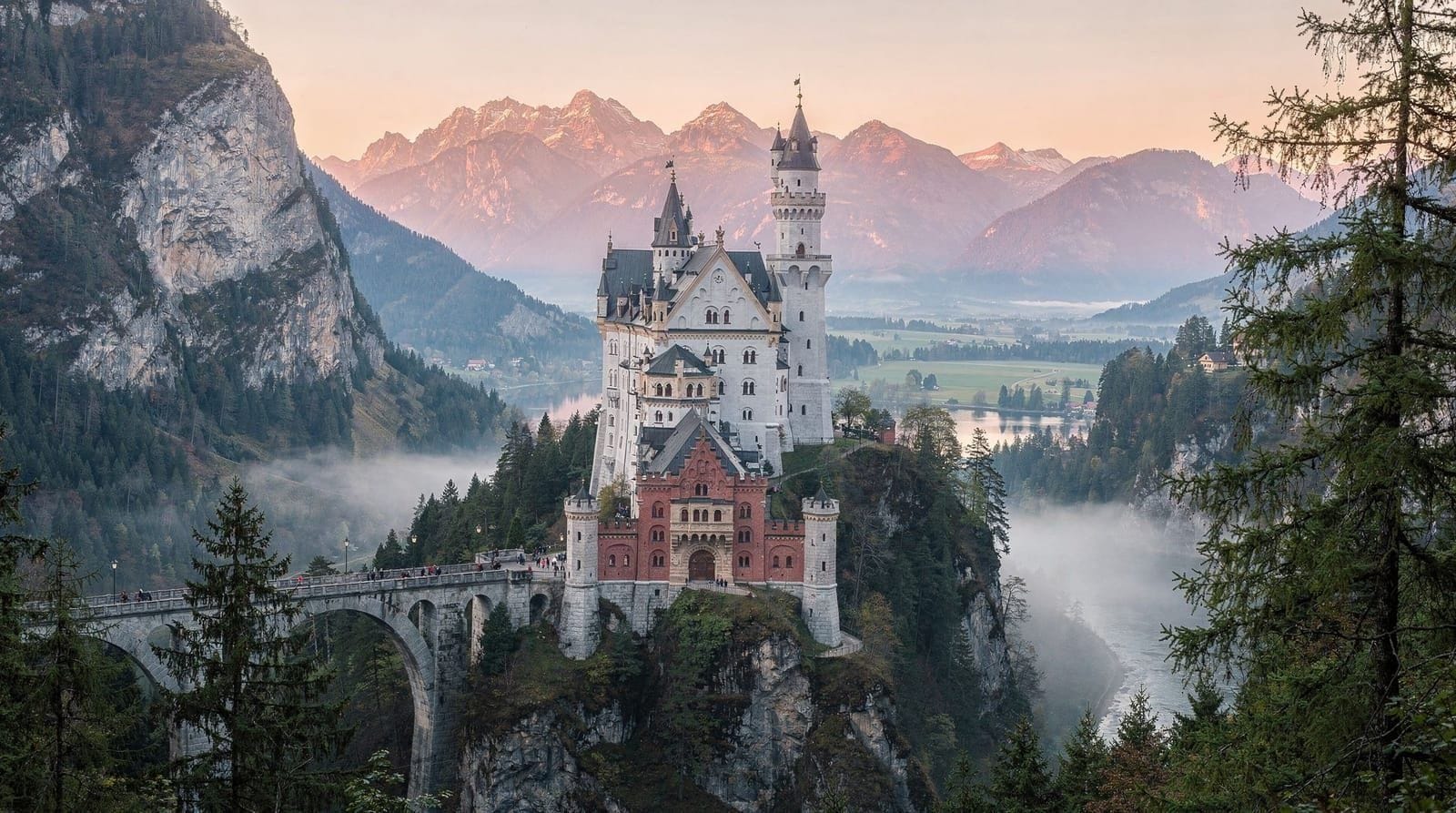
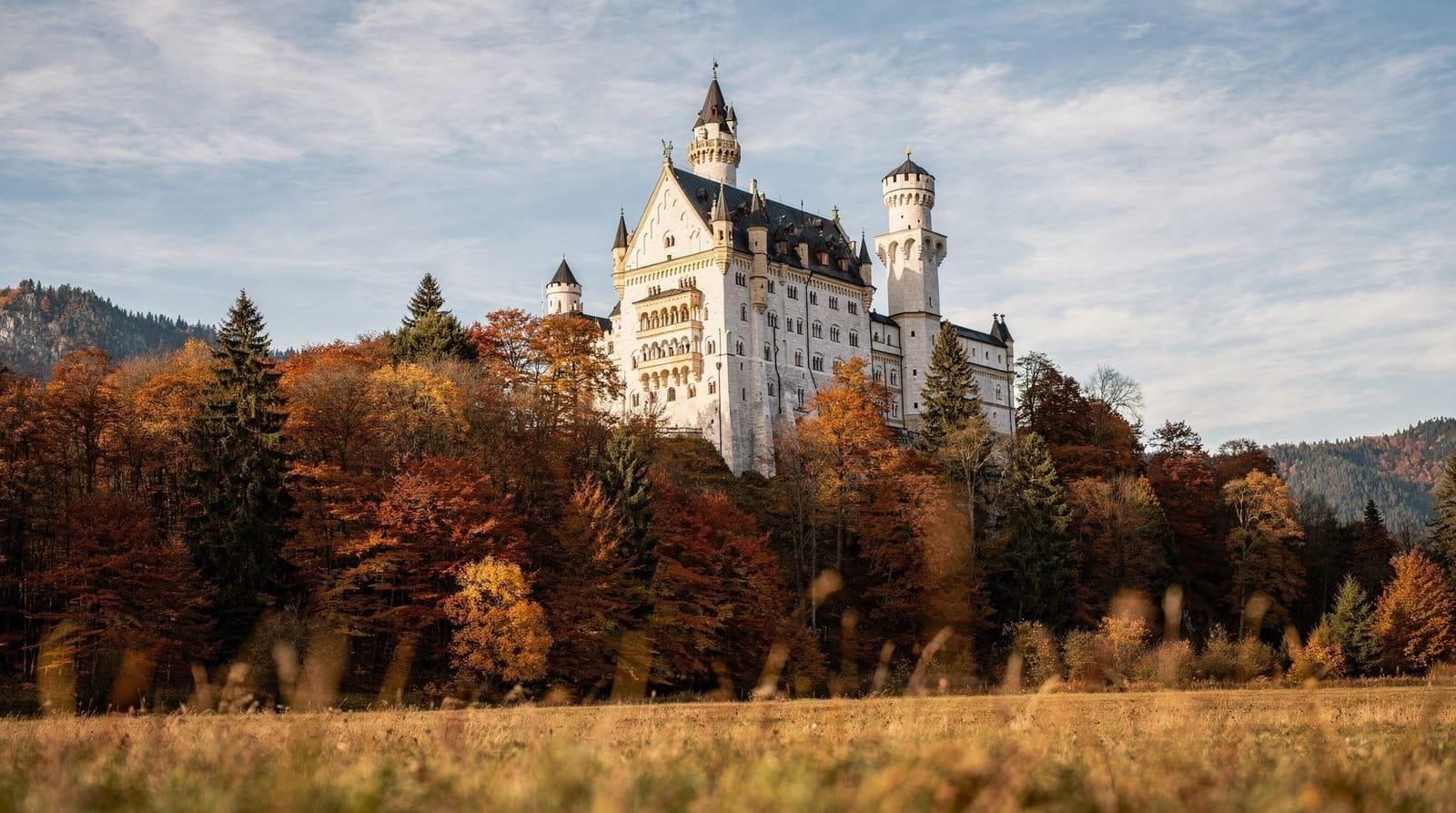
Of King Ludwig II’s three palaces, Linderhof is the smallest, the most intimate, and the only one he completed and actually inhabited for extended periods. It is also, by most measures, the most architecturally coherent — a Rococo fantasy built at a single moment (1874–1878) with a clear vision, rather than the partially finished dream of Neuschwanstein or the Napoleon III pastiche of Herrenchiemsee.
Ludwig chose the Graswangtal valley — a remote Alpine landscape he had known since childhood — for his most personal project. There was no practical reason to build here: no road access, no town nearby, no strategic or political significance. He wanted seclusion, and Linderhof gave it. He slept days and worked nights, received almost no visitors, and spent months here alone with his servants. The palace reflects this personality: extravagant but private, theatrical but human-scaled.
Compared to Neuschwanstein, Linderhof is consistently easier to visit. The ticket price is lower, same-day tickets are almost always available outside summer weekends, and the timed palace tour feels less rushed. The Venus Grotto — an artificial stalactite cave on the palace grounds — is unlike anything else in Bavaria.
Quick answer: Linderhof is worth the 85 km drive from Munich. Allow half a day for the palace and garden; add another 1.5 hours if you visit Oberammergau and Ettal Monastery on the same trip. There is no practical public transport route from Munich, so a car or organised tour is necessary.
| Where | Graswangtal valley, 85 km southwest of Munich |
| Cost | Around €12 palace + garden, +€5 Venus Grotto |
| Time needed | Half day; add 1.5h for Oberammergau/Ettal |
| Getting there | Car recommended; no direct public transport |
| Best time | Late Apr–Jun and Sep for gardens, fewer crowds |
The palace
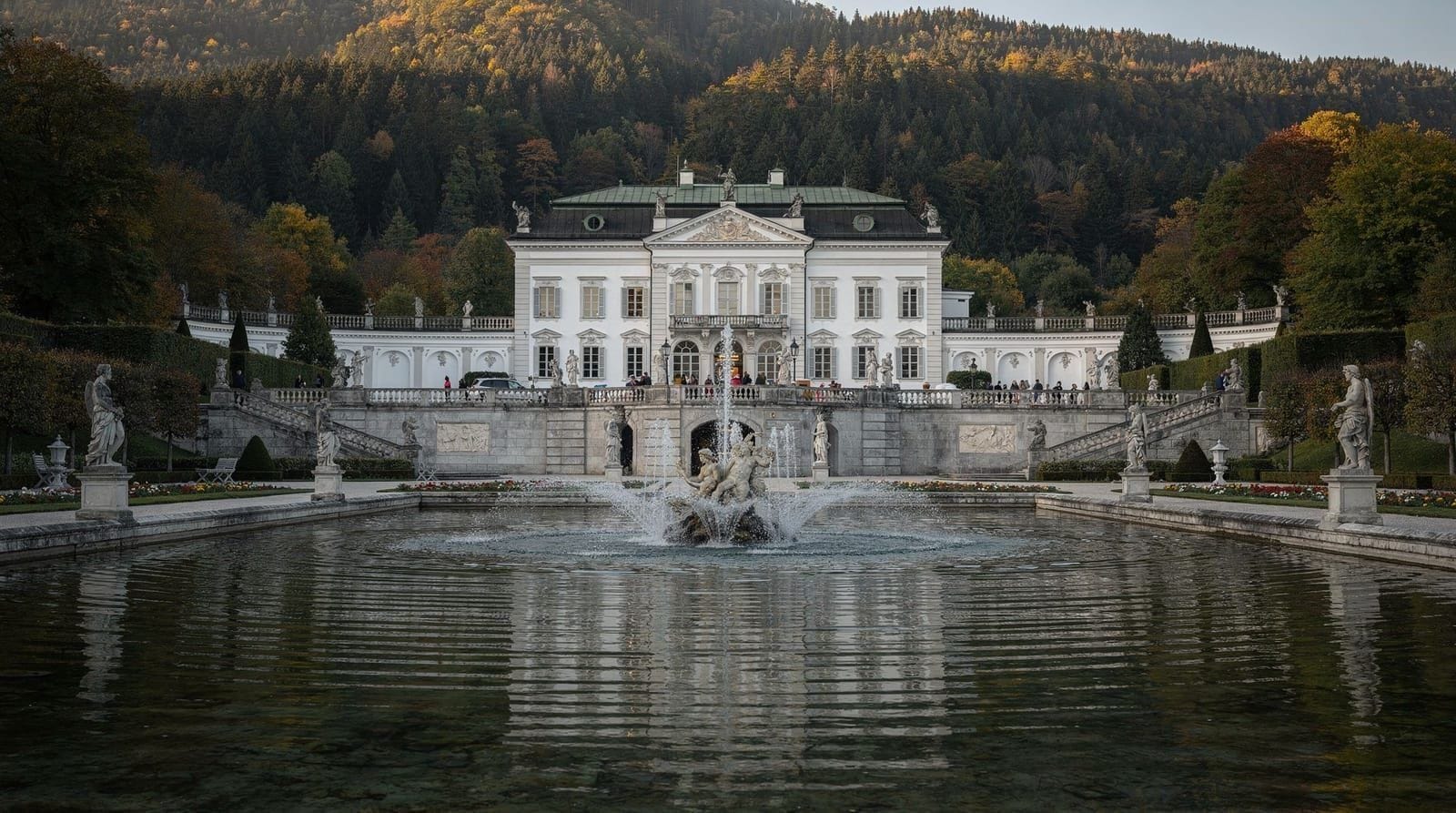
Linderhof Palace is a small, white, high-baroque structure that would not look out of place in the grounds of Versailles — which was the point. Ludwig was obsessed with the Sun King Louis XIV of France, and Linderhof is the most direct expression of that obsession: the name itself is a variation of his father’s hunting lodge, but the architectural language is pure 17th-century French royal.
The palace is small enough to tour without feeling hurried — all the major rooms are on one floor, connected by a central corridor. The guided tour lasts approximately 25–30 minutes and covers:
Audience Chamber: Where Ludwig would have received state visitors, though he generally refused to do so. Yellow silk walls, formal portrait of Louis XIV, and gold-leaf ornamentation at a density that needs to be seen rather than described.
Bedroom: Ludwig’s personal room, with a canopy bed so elaborate it resembles a stage set more than sleeping furniture. The blue and gold palette reflects the Bavarian royal colours.
Hall of Mirrors: Smaller than Herrenchiemsee’s version, but more concentrated — a narrow corridor entirely lined with mirrors and gilded candelabra, producing an effectively infinite reflection when illuminated. Ludwig reportedly used this room for candlelit dinners alone.
Dining room with the “magic table”: The famous Tischlein-deck-dich mechanism — a table that rises mechanically through the floor from the kitchen below, already set, so Ludwig never had to encounter servants during meals. The mechanism still works and is demonstrated on some tours.
Photography is not permitted inside the palace. The exterior is photographed from the formal parterre garden directly in front, with a cascade fountain and the palace reflected in the semicircular basin.
Venus Grotto
The Venus Grotto is the most singular feature of the Linderhof estate — an artificial stalactite cave built into the hillside above the palace, large enough to contain a lake, a gilded bark, and a full stage. Ludwig commissioned it in 1877 as a theatrical space based on Act I of Wagner’s Tannhäuser, in which the goddess Venus holds court in her underground kingdom.
The cave is constructed from artificial rock (cement over an iron frame) and spans approximately 2,500 square metres. Inside:
- A lake fed by underground water, on which Ludwig would row alone in a gilded shell-shaped boat
- A rock stage set as the Venusberg from Tannhäuser
- Early electric arc lighting (powered by 24 dynamos — one of the first uses of electric light in Germany, installed 1883) that could change the colour of the cave from blue to red
- A waterfall
Today the cave is open April to October only (closing in winter for structural maintenance). The experience is genuinely unlike anything in the tourist mainstream — you stand in a large, lit cave watching coloured light play across a fake lake with a golden boat in it, and it is both absurd and fascinating.
Ticket: The Venus Grotto requires a separate ticket (approximately €5 in addition to the palace ticket) or is sometimes included in a combined site ticket — confirm the current pricing at the ticket office. Entry times are separate from the palace tour.
The gardens
The formal garden at Linderhof is compact by the standards of Versailles but impressive by any other measure. The main formal garden directly in front of the palace is laid out in the French parterre style, with geometric flower beds, topiary, and a central basin with a fountain that shoots water 30 metres into the air (the Wasserparterre, active in summer, on the hour and half-hour).
Above and behind the palace, the garden transitions into an English landscape park on the wooded hillsides. Follies and garden buildings are scattered throughout:
Moroccan House: Ludwig acquired the entire Moroccan Pavilion from the 1878 Paris World Exhibition and had it rebuilt here. Open seasonally.
Moorish Kiosk: Another World Exhibition acquisition (Paris 1867), a cast-iron Islamic-style pavilion with peacock throne where Ludwig reportedly sat for hours. One of the more atmospheric of his collecting impulses.
Hunding’s Hut: A reproduction of the Germanic forest hut from Act I of Die Walküre — a full-sized theatrical stage set in the middle of the garden.
Temple of Venus: Small circular temple on a hill above the main garden, with a view back to the palace.
The garden is included in the standard palace ticket. Allow at least 45 minutes to walk the formal section and visit the main follies.
Getting there
Linderhof has no practical public transport connection from Munich. A car is strongly recommended.
By car from Munich: Take the A95 motorway towards Garmisch-Partenkirchen, exit at Eschenlohe or Oberau, then follow signs to Ettal and Linderhof. Total journey: approximately 85 km, 1 hour 40 minutes in normal traffic. Parking at the palace: free, large car park immediately adjacent.
By organised tour: Several operators run day trips from Munich combining Linderhof with Neuschwanstein: Neuschwanstein and Linderhof full-day tour from Munich
For a combined tour also including Oberammergau: Neuschwanstein, Linderhof and Oberammergau day trip from Munich
By public transport (indirect and slow): Flixbus or Deutsche Bahn to Oberammergau (about 1.5–2 hours from Munich, depending on route), then taxi or local bus (line 9650) to Linderhof. The bus is infrequent (2–3 times per day in summer) and the taxi costs approximately €15 each way. Total journey time from Munich is 2.5–3 hours each way. Not recommended unless you have a full day and no alternatives.
Tickets and booking
Tickets are purchased at the ticket office at the entrance to the palace estate (there is no separate castle approach — the ticket office is immediately at the car park).
2026 prices:
- Palace + garden: approximately €12 adult, €11 reduced (student, senior over 65), under 18 EU/EEA free
- Venus Grotto additional entry: approximately €5 (confirm on site — pricing structure occasionally changes)
- Combined site ticket (all attractions): approximately €17 where available
Same-day availability: Unlike Neuschwanstein, Linderhof rarely sells out except on long-weekend Saturdays in July and August. Booking in advance is available through the official site (schloss-linderhof.de) but is generally not necessary outside peak summer.
Guided tours: Audio guides in English are included with the palace ticket. Live guided tours in English run several times daily in summer. Check the schedule at the ticket office on arrival. Linderhof Palace full-day tour from Munich
Combining with Oberammergau and Ettal
Linderhof sits in a valley with no town of its own. The two nearest villages make natural companions on the same day trip:
Ettal Monastery: 6 km from Linderhof. The Benedictine monastery of Ettal was founded in 1330 and its current Baroque basilica (rebuilt after a fire in 1744) is one of the most impressive Baroque interiors in Germany — a full rotunda covered in fresco. Entry is free. The monastery also produces its own beer and schnapps, sold at the adjoining shop. Allow 30–45 minutes.
Oberammergau: 10 km from Linderhof. This village is most famous for its Passion Play (performed every 10 years, next in 2030), but it is also notable for Lüftlmalerei — the elaborate exterior murals that cover many of the village buildings. The woodcarving tradition here is genuine and old; shops selling handmade religious figures and decorative objects are legitimate craft outlets, not souvenir factories. The village church has another fine Rococo interior. Allow 1–1.5 hours.
A practical day combining all three: leave Munich by 09:00, arrive Ettal by 10:40, monastery by 10:45 (30 mins), drive to Linderhof by 11:30, palace and garden until 14:00, Venus Grotto until 14:45, drive to Oberammergau by 15:00, walk the village until 16:30, drive back to Munich, arrive by 18:15.
The Garmisch-Partenkirchen destination is also within reasonable driving distance (30 km south of Linderhof) if you want to extend the day trip further into the Alps.
Practical tips
Best time to visit: Late April through June and September offer the gardens in their best condition without the peak summer crowds. The Venus Grotto closes in winter (roughly November–March) — if it is a priority, visit in the warmer months.
Weather: The Graswangtal valley can be cold and rainy even in summer. The mountain terrain means afternoon thunderstorms develop rapidly. Bring a waterproof layer regardless of the morning forecast.
Food on site: There is a restaurant at the palace entrance (Linderhof Schlossrestaurant) — serviceable, Bavarian menu, tourist prices. Ettal Monastery has a café. Oberammergau has multiple restaurants with reasonable quality. Plan lunch in Ettal or Oberammergau rather than the palace.
Time needed: Palace tour 30 minutes + gardens 45 minutes + Venus Grotto 20 minutes = approximately 1 hour 45 minutes on site. Allow 2.5 hours total including travel between sites.
Photography: No photos inside the palace. All exterior and garden areas are open to photography. The cascade fountain in front of the palace is the classic exterior shot; the garden follies are worth individual photographs.
For the historical context of all three Ludwig II palaces, the King Ludwig II castles guide covers the timeline of construction and Ludwig’s motivations. For castle comparisons, the best castles near Munich guide includes Linderhof alongside the major alternatives.
Frequently asked questions about Linderhof Palace
How do I get to Linderhof from Munich without a car?
The most practical car-free option is a guided day tour from Munich that includes Linderhof in its itinerary — several operators combine it with Neuschwanstein or Oberammergau. Independent public transport involves a train or bus to Oberammergau (about 1.5–2 hours from Munich) and then a local bus or taxi to Linderhof — functional but slow. See the Munich to Bavaria by train guide for public transport details.
Does Linderhof need to be booked in advance?
Usually not. Unlike Neuschwanstein, same-day tickets are almost always available at Linderhof outside peak summer weekends. You can generally arrive without a pre-booking and purchase tickets on the spot. If you are visiting in July or August on a Saturday or Sunday, booking online a week ahead is a sensible precaution.
How long should I allow at Linderhof?
Minimum 1.5 hours for the palace tour and main formal garden. 2.5 hours for palace + garden + Venus Grotto. 3–3.5 hours if you want to walk the full garden including the hillside follies (Moroccan House, Moorish Kiosk, Hunding’s Hut). The Venus Grotto is worth the extra time if it is open.
Is the Venus Grotto included in the standard ticket?
In 2026 the Venus Grotto typically requires a small additional ticket (approximately €5) separate from the main palace and garden ticket. A combined ticket is sometimes available. Confirm current pricing at the on-site ticket office as the structure occasionally changes.
Can I visit Linderhof and Neuschwanstein on the same day?
Yes, but only with a car or on an organised tour. The two palaces are approximately 40 km apart (about 50 minutes by road). A typical day-tour sequence: arrive Neuschwanstein for a morning slot (09:00–11:00), drive to Linderhof by 12:00, finish by 14:30, return to Munich by 17:00. It is a full day. The Munich castles day trip guide covers this sequence in detail.
What is the difference between Linderhof and Herrenchiemsee?
Both are Ludwig II palaces inspired by Versailles, but Linderhof is intimate (designed for one person) while Herrenchiemsee is massive (a direct copy of the Hall of Mirrors). Linderhof is 85 km from Munich, reachable by car in under 2 hours; Herrenchiemsee requires a boat to reach an island 90 km from Munich. Linderhof is the more personal creation; Herrenchiemsee is the more architecturally dramatic.
Is there much to do near Linderhof for a full day?
Yes. The combination of Linderhof Palace (2.5 hours), Ettal Monastery (45 minutes, 6 km away), and Oberammergau village (1.5 hours, 10 km away) fills a full day comfortably. For those with outdoor interests, the Graswangtal valley has hiking trails and the Ammergau Alps are immediately accessible. The Bavarian Alps hiking guide has routes in the wider region.
Linderhof in context — Ludwig II’s most personal creation
Of the three palaces, Linderhof is the one that most clearly reflects Ludwig as a private individual rather than a public monarch. Neuschwanstein was a theatrical statement, a medieval fantasy designed with visual impact in mind. Herrenchiemsee was a political gesture — a re-creation of absolute monarchy as a challenge to the constitutional order that had diminished Bavaria’s royal prerogatives. Linderhof was neither. It was a retreat, in the most literal sense: a place to be alone with luxury, art, and the world of Wagnerian legend.
The scale is telling. Linderhof is small enough to be warmed and lit without an army of servants, intimate enough to be navigated alone, manageable enough to actually inhabit. Ludwig lived here more than at either of his other palaces. He is said to have ridden here by sleigh at night, arriving in the early hours and dismissing the staff so he could move through the candlelit rooms without human company.
The Venus Grotto embodies this impulse perfectly. A man alone in a boat on an underground lake, in a cave built to represent a Wagner opera set, with coloured electric lights playing on artificial stalactites. By any objective standard this is eccentric behaviour. But the execution is so thorough, so technically extraordinary for its era (1877), and so aesthetically consistent that it demands respect even if it defies easy categorisation.
For visitors who want to understand what the three palaces together say about Ludwig II’s personality, the King Ludwig II castles guide attempts a synthesis. The best castles near Munich guide places Linderhof within the wider landscape of Bavarian palaces and historical buildings.
Photography at Linderhof: No photos inside the palace, but the exterior and gardens are fully open. The classic shot is from the formal parterre looking up at the palace with the cascade fountain in the foreground (active in summer, on the hour). The garden follies — particularly the Moroccan House and the Moorish Kiosk — are photographically interesting and usually uncrowded. The Hunding’s Hut (the Walküre stage set in the forest) is not immediately signposted; follow the path behind and above the palace through the forest — it takes about 15 minutes to find.
The Neuschwanstein photo spots guide covers castle photography techniques in the wider region, though it is Neuschwanstein-focused rather than Linderhof-specific.
The three palaces compared
Deciding which of Ludwig II’s palaces to prioritise is one of the most common planning questions for a Bavaria trip:
| Palace | Scale | Access from Munich | Character |
|---|---|---|---|
| Linderhof | Smallest, most intimate | 85 km, car needed, ~1h45 | Personal retreat, Venus Grotto |
| Neuschwanstein | Iconic fantasy exterior | ~120 km, train + bus, ~2h | Most visited, most crowded |
| Herrenchiemsee | Grandest interior | 90 km, train + boat, ~2h | Versailles copy, island setting |
Linderhof wins for visitors who want the calmest, least crowded experience and who are already driving through the Ammergau Alps. If you have only one day and no car, Neuschwanstein remains the more accessible choice by public transport. With two or three days and a car, seeing all three completes the picture of Ludwig’s very different building projects.
Families and accessibility
Linderhof is one of the more manageable Ludwig II palaces for families: the site is compact, the palace tour is short (25–30 minutes), and the formal garden with its fountain is genuinely engaging for children. The Venus Grotto in particular tends to be a highlight for younger visitors — a lit cave with a golden boat has obvious appeal. The main garden paths are flat and stroller-friendly; the hillside paths to the Moroccan House and Moorish Kiosk involve some incline and steps, so a carrier is more practical than a pram for those sections. The palace interior itself has a few steps at the entrance and is not fully wheelchair accessible, though the grounds and gardens are.
Frequently asked questions, continued
Is Linderhof suitable for families with young children?
Yes, and often more manageable than Neuschwanstein — the palace tour is shorter, the site is compact, and the Venus Grotto and garden fountain both appeal to children. The main garden paths are flat and stroller-friendly, though the hillside follies involve some incline. The palace interior has a few entrance steps and is not fully wheelchair accessible.
How does Linderhof compare to Neuschwanstein for a car-free visitor?
Neuschwanstein is the far more practical choice without a car — it has a direct train and bus connection from Munich, roughly 2 hours each way. Linderhof has no equivalent direct route; without a car, an organised day tour is the only realistic option for visiting comfortably.
What should I wear or bring to Linderhof?
Layered clothing is the safest choice — the Graswangtal valley is noticeably cooler than Munich and afternoon showers develop quickly even in summer, so a waterproof layer is worth carrying regardless of the morning forecast. Comfortable walking shoes matter more than for the palace itself, which is a short indoor tour, than for the garden and hillside follies, which involve gravel paths and some incline. If you plan to linger for the Venus Grotto or walk to the Moorish Kiosk, allow extra time rather than rushing between a tight tour schedule.
Can I visit Linderhof as a standalone trip without Neuschwanstein or Oberammergau?
Yes, though most visitors combine it with at least Ettal Monastery (6 km away, free entry, 30–45 minutes) simply because it’s so close and adds little extra driving. A standalone Linderhof visit — palace, garden and Venus Grotto — takes about 2.5 hours on site, which leaves a Munich-based day trip feeling slightly short given the 1h45 drive each way; pairing it with at least one nearby stop makes better use of the travel time.
Top experiences
Bookable activities with verified prices and instant confirmation on GetYourGuide.