King Ludwig II castles: the complete guide for 2026
From Munich: Neuschwanstein and Linderhof Castle full-day trip
How many castles did King Ludwig II build?
Ludwig II built or substantially developed three palaces: Neuschwanstein, Linderhof, and Herrenchiemsee. He also grew up in Hohenschwangau (built by his father) and was born at Nymphenburg Palace (the Wittelsbach family seat). Most visitors focus on the three he created himself.
The story behind the fairy tale castles
Bavaria has hundreds of castles. Most are interesting. A handful are spectacular. And then there are the three that King Ludwig II built between 1868 and 1886, which exist in a category of their own — not because they are the oldest or most historically significant, but because they represent something rarer: a single person’s obsessive vision, executed at enormous cost, in defiance of everything his government and his era expected of a ruling monarch.
Ludwig II became King of Bavaria in 1864 at the age of 18. He was tall, intelligent, deeply introverted, and had almost no interest in the political machinery of kingship. What he cared about was music — specifically the operas of Richard Wagner, whom he rescued from bankruptcy and became the principal patron of — and architecture. While his ministers dealt with the practical business of running a state that was losing its autonomy to Bismarck’s Prussia, Ludwig was designing rooms.
He built three palaces from scratch: Neuschwanstein in the Alps above Füssen, Linderhof in a narrow Alpine valley, and Herrenchiemsee on an island in Lake Chiemsee. He spent his personal fortune, then borrowed heavily against the Bavarian treasury. By 1886, his debts were unsustainable. The government moved to depose him.
On 12 June 1886, a commission arrived at Neuschwanstein to take the king into custody. He was transferred to Berg Castle on Lake Starnberg. The following evening, he went for a walk with his psychiatrist, Dr. Gudden. Neither returned. Their bodies were found in shallow water near the lake shore later that night. Ludwig II was 40 years old.
He had lived in Neuschwanstein for fewer than 180 days. He had spent only nine days at Herrenchiemsee. Linderhof was the only palace he actually lived in for any sustained period. Within weeks of his death, all three castles were opened to the public — not as monuments to a king, but as revenue sources to service his debts. The decision was made with ruthless pragmatism. The irony is complete: Ludwig built his palaces as private retreats from the world, and they are now visited by nearly two million people a year.
This guide covers all five castles associated with Ludwig II, explains what makes each distinctive, and gives you an honest framework for deciding which to visit, in what order, and whether a tour or independent travel makes more sense for your trip.
| Castles | Neuschwanstein, Hohenschwangau, Linderhof, Herrenchiemsee, Nymphenburg |
| Cost | around €10–21 per castle; Jahreskarte pass €40/year if visiting 3+ |
| Time needed | one full day per castle, including travel from Munich |
| Getting there | train/bus (Bayern-Ticket) for Neuschwanstein/Hohenschwangau; car or tour recommended for Linderhof |
| Best time | May, June, or September for weather and manageable queues |
The five castles: what each one is
Neuschwanstein Castle
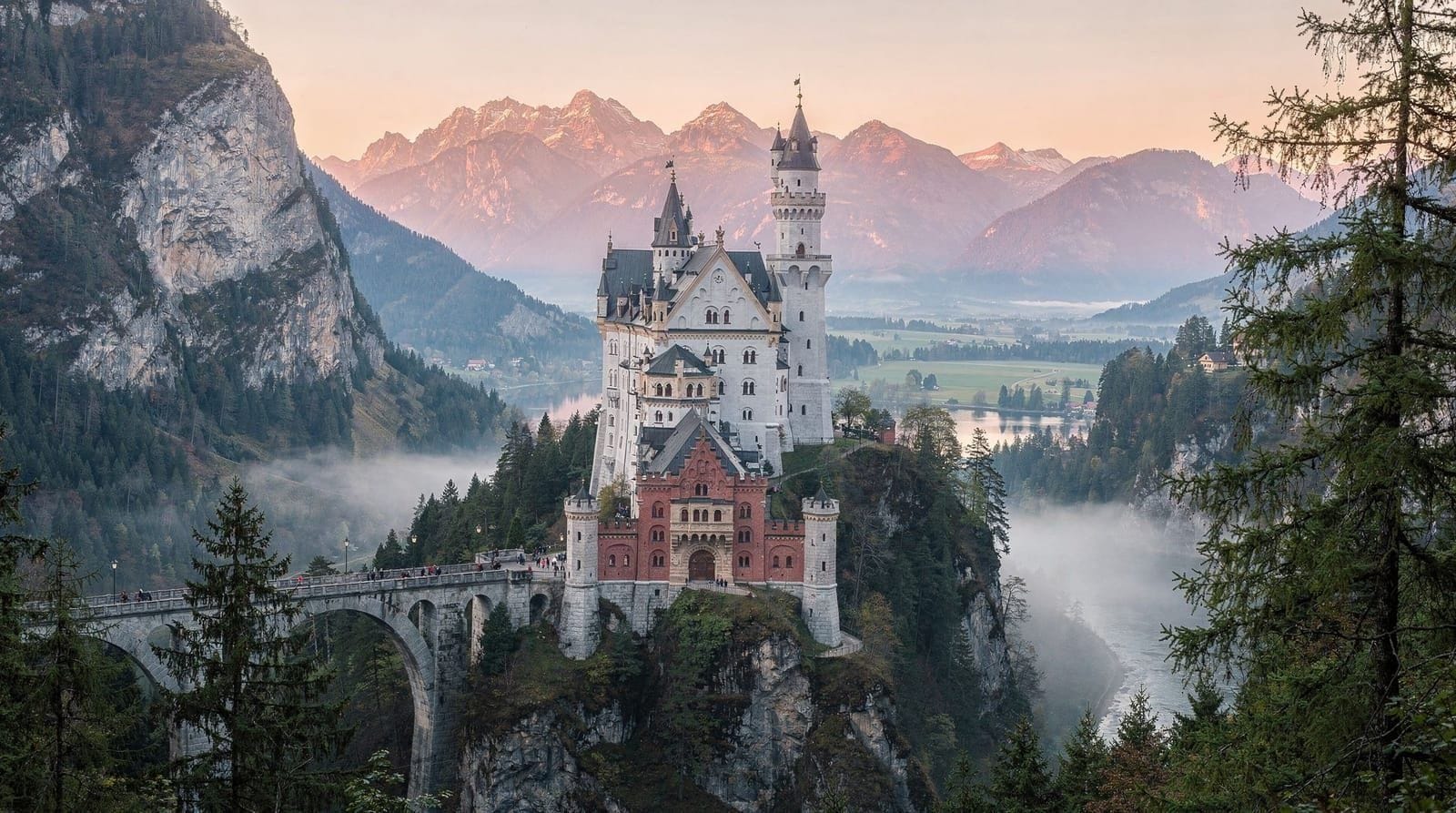
The most famous building in Germany and possibly the most photographed castle in the world. Ludwig began construction in 1869 on a rocky hilltop above the village of Hohenschwangau, with a direct view to Hohenschwangau Castle below — where he grew up.
Neuschwanstein was conceived as a tribute to the medieval Germanic world celebrated in Wagner’s operas. Every room references Wagnerian themes: the Singers’ Hall was never used for performances but was designed as the setting for Parsifal; the throne room dome evokes a Byzantine church; the study walls depict scenes from Lohengrin.
From the outside, the castle is everything the photographs promise: white limestone towers against a backdrop of forested alpine ridges, with the Pöllat gorge dropping away beneath the access path. The view from the Marienbrücke bridge above the castle is the iconic one, and yes, it is genuinely breathtaking.
Inside, the guided tour covers the most complete rooms — the Singers’ Hall, the throne room, the royal apartments — in about 35 minutes. It moves quickly. The crowds in summer are significant. Pre-booking your timed-entry slot online is not optional in July and August; it is essential. The Neuschwanstein tickets guide covers the booking system in full detail.
Visitor numbers: approximately 1.5 million per year.
Hohenschwangau Castle
Often overlooked by visitors rushing to reach Neuschwanstein, Hohenschwangau deserves more attention than it gets. This was Ludwig’s childhood home, rebuilt by his father Maximilian II in a neo-Gothic style in the 1830s. Ludwig spent his formative years here, developing his obsession with medieval legend and Wagner’s world.
The castle sits at a lower elevation than Neuschwanstein, with a different relationship to the landscape — more domestic in scale, warmer in its interiors, more clearly lived-in. The private rooms give a better sense of what it actually felt like to inhabit these spaces than the grander but emptier Neuschwanstein.
The Hohenschwangau Castle guide covers the visit in detail. Practically speaking, both castles share the same ticketing system and access point in the village below, which makes visiting both on the same day straightforward. The combined kombi ticket saves money versus buying separately.
The Neuschwanstein and Hohenschwangau combined ticket is the most efficient way to book both in a single transaction if you are visiting independently.
Linderhof Palace
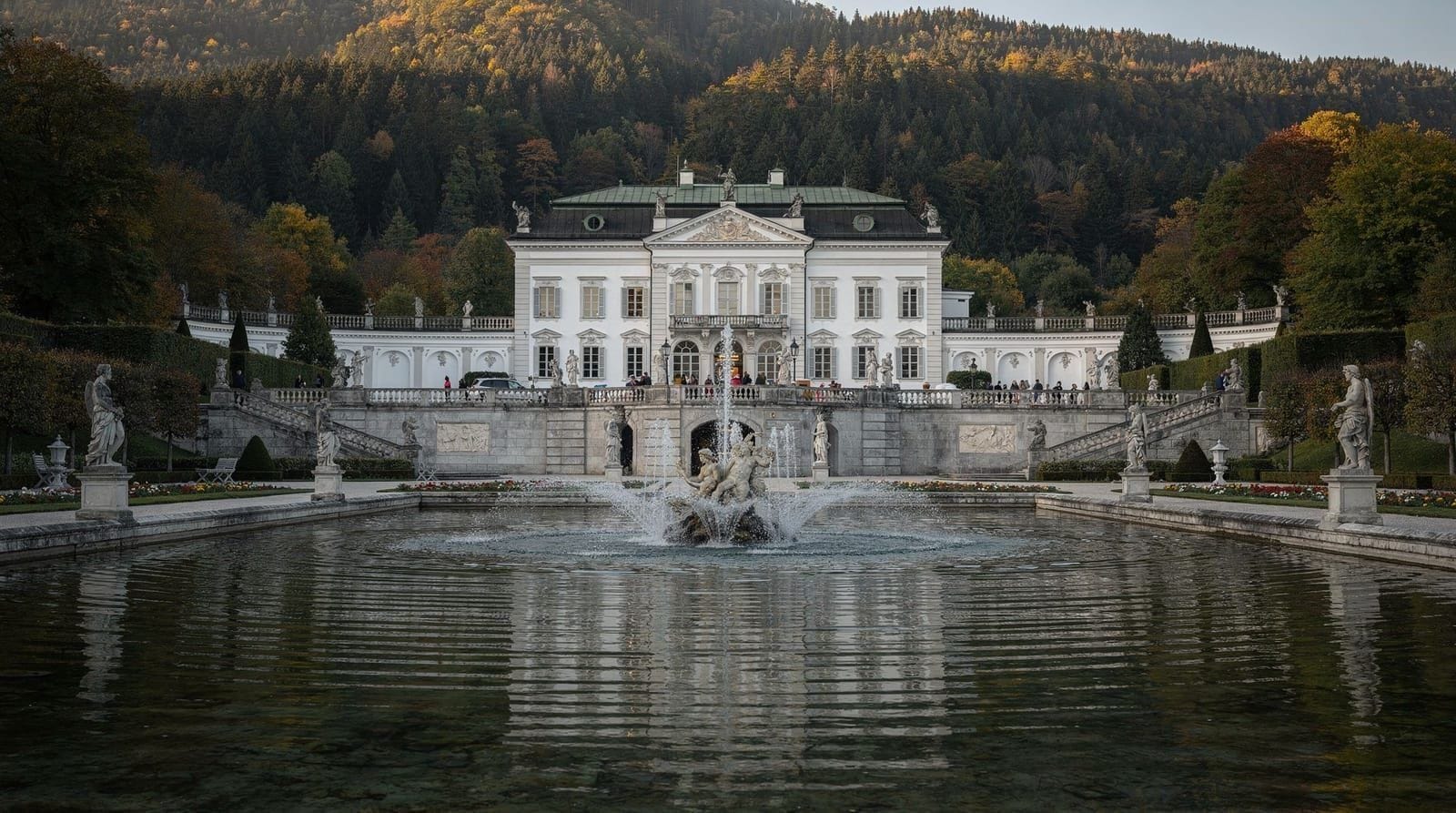
The smallest of Ludwig’s three palaces, and the only one he ever truly lived in. Linderhof sits in the Graswang Valley near Oberammergau, about 85 kilometres southwest of Munich. Where Neuschwanstein is theatrical and Herrenchiemsee is grandiose, Linderhof is intimate — a scaled-down Rococo palace that feels, despite its opulence, almost cosy.
The palace was built around the idea of the French Sun King Louis XIV, whom Ludwig studied obsessively. The Hall of Mirrors here is a fraction of the size of Herrenchiemsee’s, but the private rooms — the bedroom with its enormous canopied bed, the east gobelin room with its tapestries — are the most liveable spaces in any of Ludwig’s buildings.
What makes Linderhof genuinely distinctive is the grounds. The Venus Grotto, an artificial stalactite cave with a lake, coloured electric lighting, and a gilded shell-shaped boat, is one of the strangest and most wonderful things Ludwig created. The Moroccan House and Moorish Kiosk (currently under restoration in 2026 — check ahead) add to the sensation of visiting a private world built by someone with unlimited money and very particular tastes.
The Linderhof palace guide covers what to see and how to plan the visit. A full-day tour from Munich that pairs Linderhof with a stop in Oberammergau — the village famous for its Passion Play and its painted house facades — is the most popular and most satisfying approach.
The Munich to Linderhof full-day tour handles all transport and includes a guided visit. It is the right choice if you do not have a car, since Linderhof’s location in a narrow valley makes it the hardest of the three major palaces to reach by public transport alone.
Herrenchiemsee Palace
Ludwig’s most ambitious and least-known creation. He purchased Herreninsel — a wooded island in Lake Chiemsee — in 1873 with the specific intention of building a direct replica of the Palace of Versailles, complete with a Hall of Mirrors that would surpass the original. Construction began in 1878.
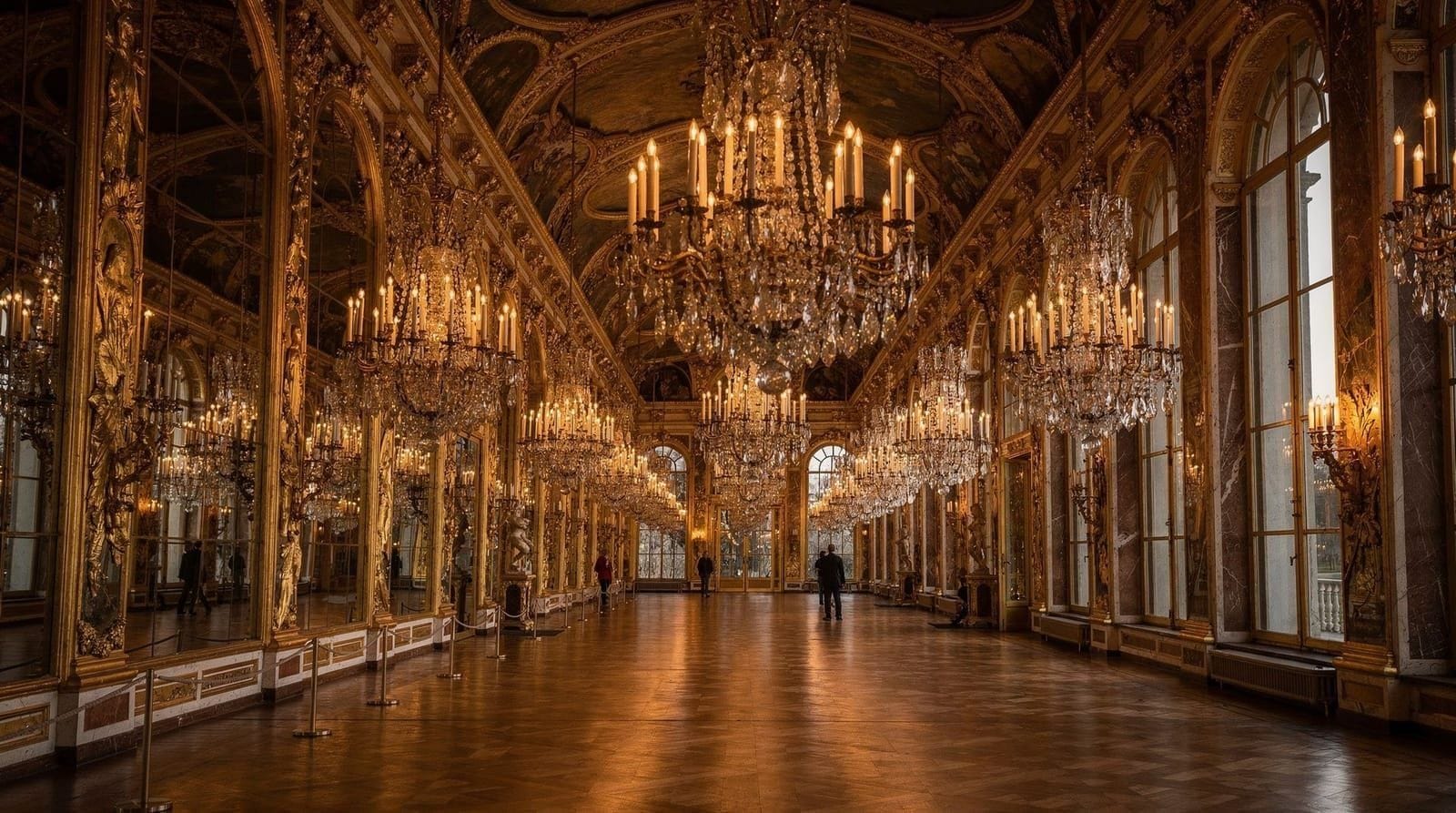
The Hall of Mirrors at Herrenchiemsee stretches 98 metres and holds 17 chandeliers and 44 girandoles — technically longer than the Versailles room, though with different proportions. It is among the most extraordinary interiors in Europe, and the fact that it receives a fraction of the visitors of either Neuschwanstein or Versailles remains one of Bavaria’s best-kept secrets.
Ludwig spent nine days at Herrenchiemsee before his deposition. He died before the flanking wings of the palace could be completed. What you see today is the central block only — extraordinary, but visibly incomplete. The Museum Ludwig II, housed in the unfinished south wing, is among the best resources for understanding who he was and what actually happened to him.
Getting there requires a train to Prien am Chiemsee, a short connection to the harbour, a 15-minute boat crossing, and a 15-minute walk through the royal forest. It is a full-day commitment from Munich. The experience is worth every minute.
The Herrenchiemsee palace guide covers the logistics in detail.
Nymphenburg Palace
The fifth castle in Ludwig’s story is not one he built, but one he was born in. Nymphenburg Palace in Munich is the principal seat of the Wittelsbach family, enlarged over successive generations into a sprawling Baroque complex on the western edge of the city.
Ludwig was born in Nymphenburg on 25 August 1845. The palace today houses the Museum of the Nymphenburg Porcelain Manufactory, the Gallery of Beauties commissioned by his grandfather Ludwig I, the Royal Stables Museum, and a large English-style park with smaller pavilions including the Amalienburg hunting lodge — arguably the finest Rococo interior in Bavaria.
Unlike the three palaces Ludwig built himself, Nymphenburg is accessible within the city and can be combined with a morning or afternoon in Munich without significant travel. A half-day is the right allocation. The Nymphenburg Palace visit guide covers entry, highlights, and what is worth your time.
How to plan your Ludwig II castle visit
The core question: how many days do you have?
One day: If you have only a single day for Ludwig II’s castles, go to Neuschwanstein. Add Hohenschwangau in the afternoon using the combined ticket — they share the same access point and the combined visit takes a full day comfortably. The Neuschwanstein and Hohenschwangau day trip from Munich covers how to structure this.
Two days: Day 1 as above — Neuschwanstein and Hohenschwangau. Day 2 Linderhof with an Oberammergau stop. This is the most popular two-day Ludwig itinerary and covers his two most contrasting palace styles: the Gothic exterior drama of Neuschwanstein versus the intimate Rococo interiors of Linderhof.
Three days: Add Herrenchiemsee on a third day. This is the ideal minimum to get a full picture of Ludwig’s architectural ambitions. The Munich castles 3-day itinerary maps this out day by day.
Four or five days: A full Bavaria 5-day itinerary can add Nymphenburg (morning in Munich), time in Füssen or the Bavarian Alps, and potentially include the Bavarian Alps 3-day loop as an extension.
Base camp: Munich or Füssen?
For visitors combining all three of Ludwig’s palaces, the choice of base matters.
Munich offers better transport connections overall and more accommodation variety at every price point. All three palaces are reachable by day trip. The trade-off is that Neuschwanstein and Linderhof are each a significant journey from Munich, and doing both on consecutive days means two long transit days.
Füssen puts you within walking distance of Hohenschwangau and a 10-minute bus ride from the Neuschwanstein ticket centre. Linderhof is about 90 minutes by public bus or car. Herrenchiemsee requires backtracking to Munich or a complex overland route. Füssen makes the most sense if your primary focus is the southern castles.
The honest recommendation: if you have three or more days, base yourself in Munich and do each castle as a day trip. The city is far more interesting than Füssen for evenings, food, and the broader Bavarian experience.
Tours vs independent travel
For Neuschwanstein and Hohenschwangau, independent travel is entirely viable. The train-and-bus route from Munich to Füssen is well-served, clearly signposted, and covered by the Bayern Ticket. The Bavaria train castle day trips guide explains the logistics in detail.
The Neuschwanstein and Linderhof combined day tour from Munich is the most efficient way to cover two castles in a single day without worrying about connections. It is a long day — you leave Munich early and return in the evening — but it is the only realistic way to see both without a rental car.
For Linderhof specifically, a tour or rental car is the practical choice. Public bus connections from Füssen or Oberammergau exist but are infrequent and require careful timetable checking.
For Herrenchiemsee, the boat element adds complexity that makes a tour appealing even for experienced independent travellers. The guided Herrenchiemsee day tour handles train timing, boat booking, and the castle visit in a single package.
Tickets: what costs what
There is no combined Ludwig II ticket. Each palace is ticketed separately.
| Castle | Adult ticket | Notes |
|---|---|---|
| Neuschwanstein | €15 | Timed entry, must pre-book in season |
| Hohenschwangau | €21 | More expensive but less crowded |
| Linderhof | €10 | Grotto costs extra (€4.50) |
| Herrenchiemsee | €12 | Plus €12 boat round trip |
| Nymphenburg | €15 | Covers palace + Marstall museum |
The Bavarian Palace Administration Jahreskarte annual pass costs €40 for adults and grants unlimited entry to all state palaces for one year. If you are visiting more than three of these sites, the pass pays for itself. It does not cover the Herrenchiemsee boat transfer or the Hohenschwangau ticket (which is managed separately from the BSV system).
Seasonal advice: when to go
Spring (April–May): Ideal conditions. Crowds are manageable, snow is often still visible on surrounding peaks giving excellent photography, and the landscapes are green and bright. Pre-booking Neuschwanstein is advisable but not yet critical.
Summer (June–August): Peak season. Neuschwanstein in July sees enormous queues even with timed-entry tickets. The crowds at Herrenchiemsee remain lower. Linderhof is busy but manageable. If you are visiting in summer, pre-book Neuschwanstein weeks in advance. Early morning first-slot entry is the only way to avoid the worst pressure.
Autumn (September–October): A strong second choice. September in particular offers near-summer weather with noticeably thinner crowds. The autumn colour on the forest surrounding Neuschwanstein is excellent in late October. Herrenchiemsee boats run reliably through October.
Winter (November–March): Neuschwanstein is dramatic in snow and often strangely uncrowded. However, the Marienbrücke bridge above the castle may be closed for safety in ice conditions, removing the best viewpoint. Herrenchiemsee becomes difficult with reduced boat services. Linderhof’s grotto may be closed. Winter requires research before committing.
The honest question: who was Ludwig II?
The “Mad King” label has stuck, partly because it makes for a better story and partly because the palaces themselves seem to support the narrative — who but a madman would build a replica of Versailles on a lake island that he never intended the public to see?
But the label was invented by his political enemies and applied via a psychiatric diagnosis compiled by a doctor who never met him. Ludwig was certainly unusual: he was reclusive, he worked at night and slept during the day, he conducted long imaginary conversations at dining tables set for guests who never arrived, and he spent money with a recklessness that would have alarmed any finance minister.
He was also genuinely perceptive about art and architecture, a loyal and generous patron to Wagner at a moment when Wagner’s work was not yet universally admired, and a monarch who — whatever his personal eccentricities — never started a war and never initiated political persecution. The Bavarian politicians who deposed him were motivated primarily by the castle debts and the risk that Ludwig might ally with Austria against Bismarck’s Germany.
The mystery of his death only deepens the story. The official verdict was suicide by drowning. His personal physician, who died alongside him, had defensive wounds suggesting violence. A private detective hired by the Wittelsbach family concluded in 1966 that Ludwig was shot attempting to escape. No definitive answer has emerged. The Museum Ludwig II at Herrenchiemsee presents the evidence without resolution, which is the only intellectually honest approach.
What Ludwig left behind is five extraordinary buildings, built in just over 17 years, none of which he lived to see finished or enjoyed for any length of time. That is the thing the “Mad King” label obscures: the buildings are not symptoms of madness. They are the output of a profoundly serious aesthetic intelligence working in a specific historical moment. You can disagree with his priorities, but the architecture speaks for itself.
Getting the most from a multi-castle trip
A few practical observations for visitors planning to see multiple castles:
Do not underestimate transit times. Munich to Füssen is 2 hours by train. Munich to Linderhof by public transport is close to 2.5 hours. Munich to Herrenchiemsee is 1.5 hours to Prien am Chiemsee, then the boat. Each castle visit takes 3 to 4 hours minimum including travel from the carpark or station to the entrance. Plan your days generously.
Guided tours inside are non-negotiable. All three of Ludwig’s palaces require guided tours of the interior state rooms. You cannot wander freely. Tours are typically 35 to 45 minutes. Arrival times for your timed entry slot are strict. Being even 10 minutes late can mean losing your slot in high season.
The exteriors matter. A significant part of what makes these castles extraordinary is the approach and the setting. Budget time to walk around Neuschwanstein before and after your interior tour, to explore Linderhof’s grounds properly, and to walk the island path at Herrenchiemsee. The interiors are unforgettable, but the landscapes are the context that makes them mean something.
Photography: The iconic Neuschwanstein shot is from the Marienbrücke bridge, a 20-minute walk above the castle entrance. It requires its own time allocation. The Neuschwanstein crowds guide has practical advice on when to photograph and when to avoid.
For castle completists, the best castles near Munich guide and the blog ranking of Bavaria’s best castles extend the picture beyond Ludwig’s own buildings to include other strong candidates within a day’s reach of Munich.
If you can only pick one or two
Most visitors do not have five days to spare, so here is the honest priority order. Neuschwanstein is non-negotiable if this is your first trip to Bavaria — it is the castle people picture, and the exterior alone justifies the day. Hohenschwangau pairs naturally with it on the same day for very little extra effort, and its photographable interior arguably rewards you more than Neuschwanstein’s. If you have a second day, Linderhof is the best follow-up: intimate, strange, and genuinely different in character from the first two. Herrenchiemsee is worth the extra effort only if you have a third day or a particular interest in the Versailles connection — the Hall of Mirrors is extraordinary, but the half-day of train-plus-boat travel is a real cost. Nymphenburg is the easy add-on since it sits inside Munich itself; slot it into any city day rather than treating it as a separate excursion. See the best castles near Munich guide if you want to weigh non-Ludwig options too.
Frequently asked questions about King Ludwig II’s castles
Can you walk between Neuschwanstein and Hohenschwangau?
Yes. The two castles are within sight of each other and connected by a path through the village of Hohenschwangau. Walking between them takes roughly 20 to 30 minutes. Most visitors take the shuttle bus up to Neuschwanstein and walk down to Hohenschwangau in the afternoon, which is the most comfortable direction.
Is a rental car worth it for a Ludwig II castle tour?
If you want to visit Linderhof as a self-guided trip, a rental car makes a significant difference. Linderhof’s public transport connections are the weakest of the three main palaces. A car also lets you visit Oberammergau, Ettal Monastery, and other valley sites at your own pace without worrying about bus schedules. For Neuschwanstein and Herrenchiemsee, public transport or organised tours are equally effective and remove parking headaches.
What is the Museum Ludwig II at Herrenchiemsee?
The museum occupies the unfinished south wing of Herrenchiemsee Palace and is included in the palace ticket. It covers Ludwig II’s biography, his relationship with Wagner, his castle-building projects, the political circumstances of his deposition, and the mystery of his death. It is the best single resource on Ludwig’s life available at any of his palaces and alone justifies the visit to Herrenchiemsee beyond the Hall of Mirrors.
Are the Ludwig II castles accessible for visitors with mobility limitations?
Access varies considerably. Neuschwanstein requires a steep 30-minute walk or shuttle bus to reach the entrance, with further stairs inside. The castle is not fully wheelchair accessible. Linderhof has more manageable terrain but steps inside. Herrenchiemsee requires the island walk but is otherwise more accessible on flat ground. Contact the relevant castle administration before your visit if accessibility is a concern — they can advise on current conditions and assistance options.
Which Ludwig II castle is best for families with children?
Neuschwanstein wins with children on visual impact alone — the exterior looks exactly like the castle in every fairy tale they have ever seen, because it literally inspired Disney’s Cinderella Castle. Herrenchiemsee is the runner-up for families willing to commit to the boat trip, as the island with free-roaming deer is a genuinely memorable experience for younger visitors. Linderhof’s Venus Grotto with its coloured lighting and underground lake is reliably popular with children who have the patience for the approach.
How did Ludwig II afford to build his castles?
Initially from his personal inherited fortune as King of Bavaria. As that was exhausted, he borrowed from the treasury and from private banks, initially without parliamentary approval. By the mid-1880s, his total debts had reached approximately 14 million Marks — equivalent to hundreds of millions of euros in modern terms. The Bavarian government’s decision to depose him in 1886 was largely driven by creditors’ concerns about the state’s ability to service those debts. The castles paid them back quickly once opened as tourist attractions.
Is the Bavarian Palace Jahreskarte worth buying for a short trip?
Only if you are visiting three or more state palaces (Neuschwanstein, Linderhof, Nymphenburg, and other Bavarian state sites — note Hohenschwangau is ticketed separately). At €40 for adults, it pays for itself against paying individually for Neuschwanstein, Linderhof, and Nymphenburg alone. For a one- or two-castle trip, buying individual tickets is cheaper and simpler.
Can I see Neuschwanstein without booking a full-day tour?
Yes. Independent train-and-bus travel from Munich to Füssen, then a local bus to the ticket centre, is straightforward and covered by the Bayern-Ticket. A guided tour adds convenience and commentary but is not required — see the Munich to Neuschwanstein day trip guide for the independent-travel version.
Top experiences
Bookable activities with verified prices and instant confirmation on GetYourGuide.