Linderhof palace: the complete visitor guide
From Munich: Linderhof Palace full-day tour with Oberammergau
Is Linderhof Palace worth visiting?
Yes — it is Ludwig II's most personal and intimate residence, the only one he finished and actually lived in. The rococo interior is extraordinary, the grounds are beautiful, and the famous Venus Grotto is unlike anything else in Bavaria. The main challenge is getting there without a car.
Linderhof: the castle Ludwig II actually finished
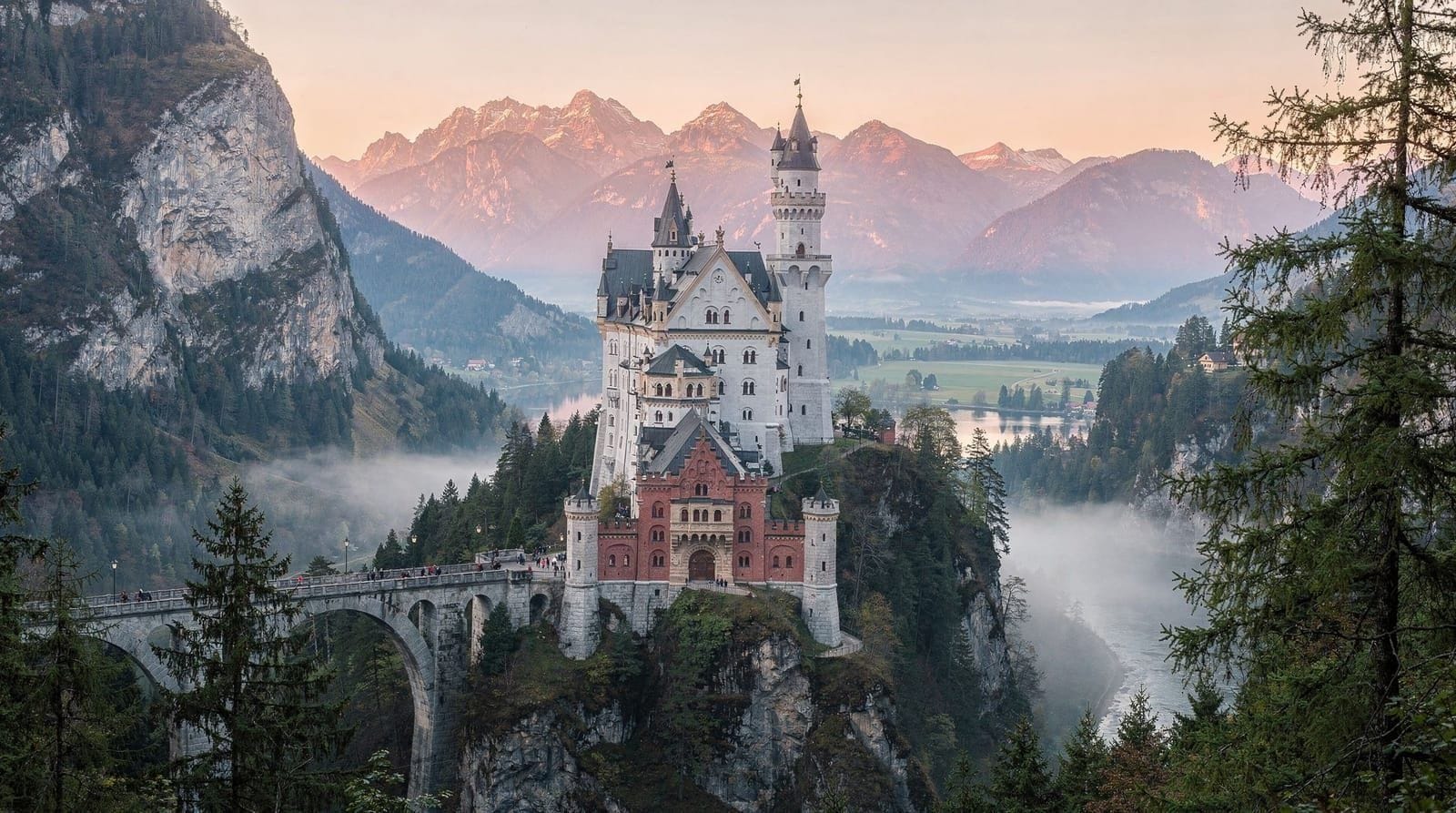
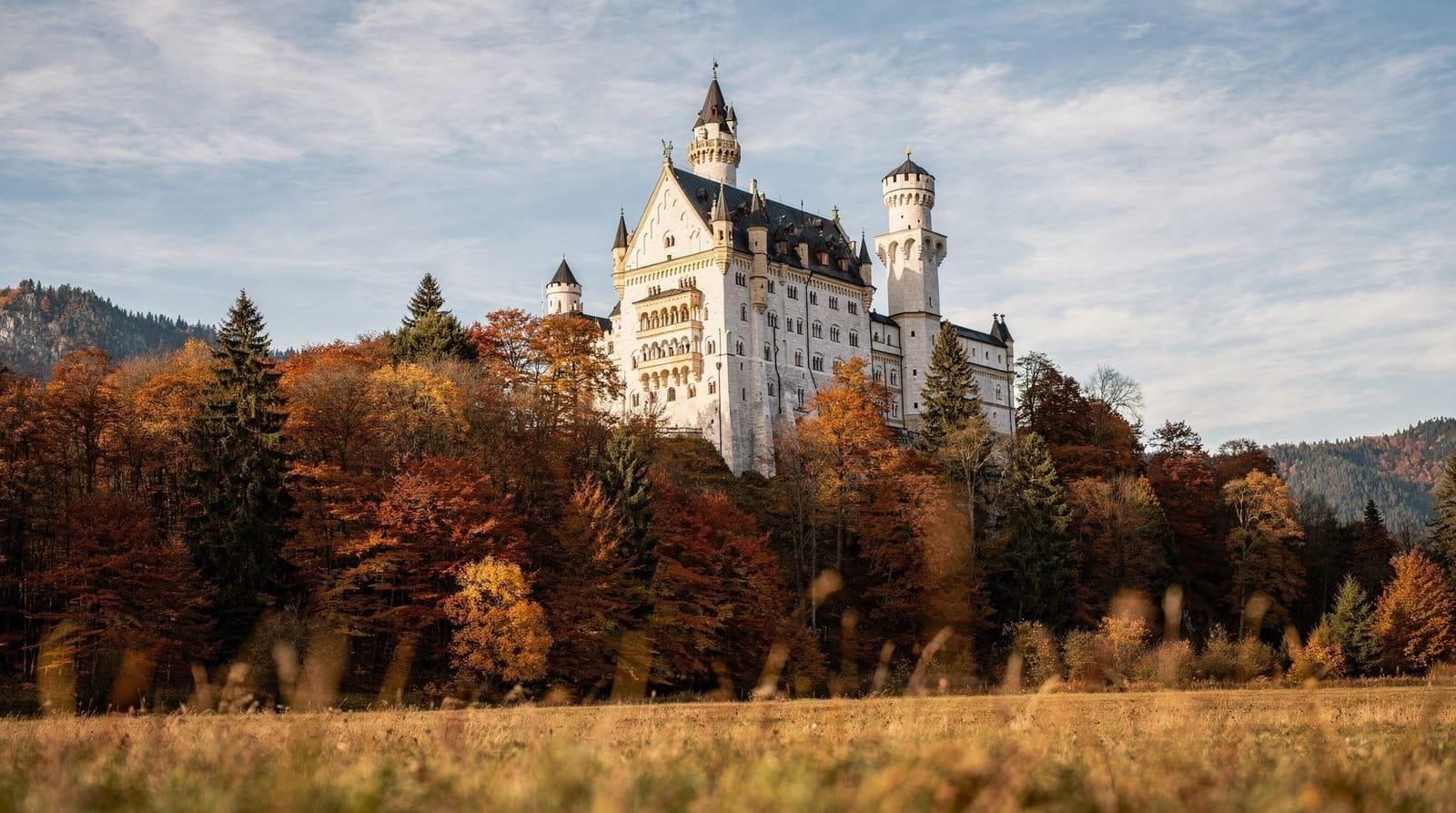
Of all the architectural projects that King Ludwig II of Bavaria commissioned during his short and eccentric reign, Linderhof Palace holds a unique distinction: it is the only one he actually completed, and the only one where he lived for any significant period. Neuschwanstein — the white spires that have become Bavaria’s most iconic image — was unfinished at the time of Ludwig’s death and he spent only a few months there. Herrenchiemsee on its island in the Chiemsee was never completed at all. But Linderhof was finished in 1878, furnished exactly as Ludwig wanted, and occupied regularly by the king for the remaining eight years of his life.
That matters enormously for the quality of the visitor experience. Linderhof feels like someone actually lived here — because someone did. The rooms are dense with personal taste: rococo decoration pushed to its absolute limits, references to Wagner’s operas woven into every surface, and the unmistakable sensibility of a man who wanted to live inside a fantasy he had constructed entirely for himself. The palace contains only ten rooms open to visitors, but those ten rooms are among the most intensely realized royal interiors anywhere in Bavaria.
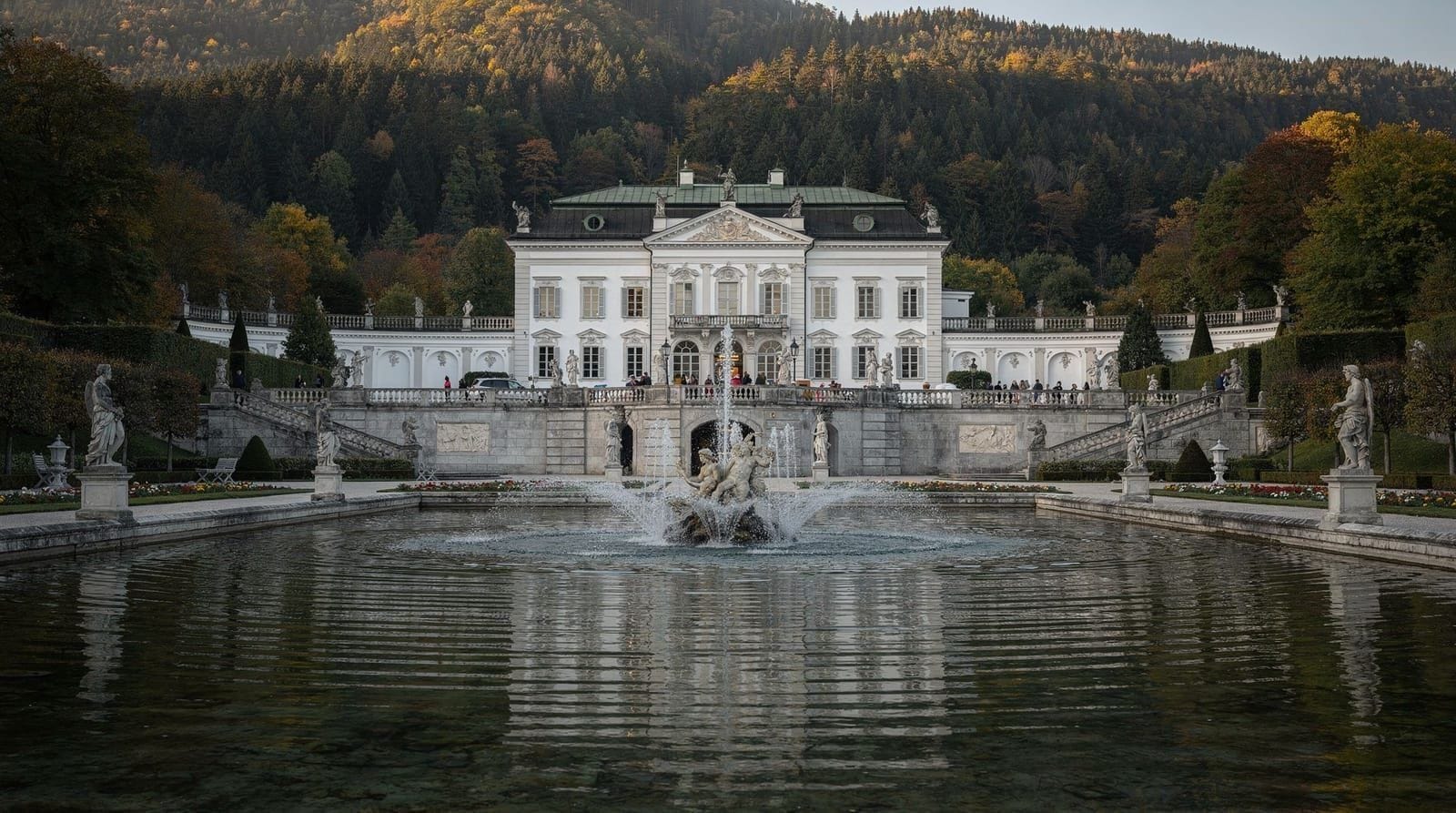
The setting compounds the effect. Linderhof sits deep in the Graswang valley near Ettal and Oberammergau, surrounded by forested slopes that make Munich feel genuinely far away. The gardens, the fountains, the artificial grotto — all of it exists in a landscape of considerable natural beauty, and all of it was designed by Ludwig as a unified private world rather than a public monument.
This guide covers everything you need to visit Linderhof: what you will see, how to get there, what tickets cost, how to deal with the transport challenge, and honest advice on what is worth your time in the grounds.
| Where | Graswang valley, near Oberammergau, ~90 km south of Munich |
| Cost | around €10 adult (summer) / €9 (winter); Venus Grotto +€3 |
| Time needed | 2.5–3 hours minimum |
| Getting there | train to Oberammergau via Murnau + bus 9622, or car/guided tour |
| Best time | weekday mornings; avoid peak summer midday |
A history in brief: how Linderhof came to exist
The site of Linderhof Palace began as a modest hunting lodge belonging to the Wittelsbach dynasty in the Graswang valley. Crown Prince Ludwig used it as a retreat during hunting trips to the Alps, and he found the isolation of the valley deeply appealing. After becoming king in 1864, he began transforming the lodge into something more personal.
The process took over a decade. Ludwig worked obsessively with his architects and decorators, revising and expanding plans repeatedly. Construction began in earnest in 1869 — the same year groundwork started on Neuschwanstein — but unlike that vast gothic project, Linderhof proceeded more or less as planned. The palace itself was complete by 1878. The grounds, park buildings, and artificial grotto were added progressively through the early 1880s.
Ludwig’s primary inspiration was the French royal court at Versailles — specifically the Sun King, Louis XIV, whose absolute monarchy and elaborate ceremonial culture fascinated Ludwig as an alternative to the increasingly constitutional and parliamentary world he actually inhabited as King of Bavaria. Linderhof is sometimes called “the small Versailles of Bavaria,” and while the comparison is useful for conveying the decorative register, it can be misleading: Linderhof is not a copy of Versailles but a deeply personal reworking of its spirit, adapted for a very different personality and a much more intimate scale.
The other great influence was Richard Wagner. Ludwig had discovered Wagner’s operas as a teenager and his devotion to the composer was total — he funded Wagner’s work, built him a theatre, and absorbed the mythological world of the Ring cycle, Lohengrin, Parsifal, and Tannhäuser into his own imagination. Linderhof’s most famous feature, the Venus Grotto, translates one of Wagner’s operatic scenes into a physical three-dimensional space. The Moorish Kiosk and Hunding’s Hut in the grounds are similarly shaped by Wagnerian imagery.
Ludwig died in 1886 under circumstances that remain officially unexplained — he was found drowned in the Starnberger See along with his doctor, the day after being declared mentally unfit to rule. He was forty years old. Without his patronage, work stopped on Neuschwanstein and Herrenchiemsee immediately. Linderhof became a museum shortly thereafter.
The palace interior: ten rooms, maximum effect
Entry to the palace is by guided tour only. Tours last approximately 25 minutes and cover all ten rooms open to the public, on the ground floor and upper level. Groups are capped and tours depart regularly throughout the day in German and English.
Photography inside the palace is not permitted — a rule enforced by staff throughout the tour. Plan to leave cameras and large bags at the entrance. What follows is a summary of what you will see.
The Hall of Mirrors
The first room of significance that visitors encounter is a small but intensely decorated Hall of Mirrors — two mirrored walls facing each other and a chandelier of extraordinary weight and complexity hanging at the center. The effect is the familiar Versailles-inspired infinite recession of reflections, but compressed into a room that feels more jewel-box than grand salon. Ludwig used this space for private dinners; a table that could be lowered through the floor to be set and then raised again (a “magic table” device also found at Herrenchiemsee) survives in the room.
The bedchamber
The most important room in Linderhof is the royal bedchamber, and by continental royal standards it is spectacular: the ceiling is a deep blue covered in gilded stucco, the bed is a blue velvet construction of extraordinary elaborateness, and every surface is decorated in the highest rococo manner — swirling ornament, gilded shells, allegorical figures. By the standards of the actual space available the effect is almost overwhelming.
This was Ludwig’s private room, which makes it simultaneously more intimate and more strange than the ceremonial bedchambers at Versailles that inspired it. At Versailles, the king’s bedchamber was a public theater where getting dressed was a court ritual watched by dozens of nobles. Ludwig had no interest in that kind of court life. His bedchamber was genuinely private — the elaborate decoration existed for his own eyes and the few servants who maintained the room.
The remaining rooms
The dining room, writing room, and audience chambers follow a consistent decorative logic: rococo forms pushed to their fullest expression, blue and gold as the dominant palette (a reference to the Wittelsbach colors as much as to Versailles), and a density of ornament that the eye takes time to fully absorb. The quality of craftsmanship throughout is exceptional — Ludwig demanded the highest standards and paid for them.
A portrait of Louis XIV hangs prominently in the audience chamber. It is not merely decorative. Ludwig genuinely admired the Sun King as an ideal of absolute monarchy in an age when that kind of monarchy was already becoming obsolete, and he arranged his private spaces partly as a tribute to that vanished world.
The Venus Grotto: Linderhof’s most extraordinary feature
No other royal property in Europe has anything quite like the Venus Grotto. Located in the palace grounds a short walk from the main building, it is an entirely artificial stalactite cave constructed between 1876 and 1877 to Ludwig’s specifications, covering an area of roughly 2,000 square meters. The project required a steel framework, cement, and technologies borrowed from theatrical set design to create convincing cave formations at scale.
Inside the grotto is a lake — artificial, fed by a local stream — crossed by a gilded shell-shaped boat large enough for several people. The lake and its surroundings reproduce the opening scene of Wagner’s opera Tannhäuser: the grotto of the goddess Venus, where the knight Tannhäuser is held in enchanted captivity. Ludwig had the grotto equipped with colored lighting systems — gas-powered originally, later electric — that could illuminate the cave in blue, red, or golden tones depending on the effect required.
Ludwig used the grotto as a retreat. Records describe him arriving by boat, attended by a small number of servants, and spending hours in the colored light surrounded by the Wagnerian imagery he had spent years constructing around himself. Whether he staged actual theatrical performances inside is debated; what is clear is that the grotto served as a kind of private theatre of the imagination.
The Venus Grotto closed for major structural restoration in 2006 and reopened in 2019 after a thirteen-year conservation project. The restoration stabilized the cave structure and restored the lighting systems. It is now one of the most complete and best-preserved features of the Linderhof estate.
Entry to the grotto costs €3 as a supplement to the standard palace ticket, or it is included in combination tickets. It is unambiguously worth visiting — you will not find anything comparable at Neuschwanstein or Hohenschwangau. Book a full-day guided tour from Munich to Linderhof
The grounds and park buildings
The grounds at Linderhof cover a relatively compact area by the standards of major European royal parks, but they are densely designed and worth a thorough exploration. The central axis of the formal garden runs from the palace down to a large cascade and a pool with a fountain that reaches around 25 meters high. Terraced gardens with parterres, hedges, and statuary line the main axis on either side.
Several park buildings merit specific attention:
The Moorish Kiosk
One of the stranger and more charming objects in the grounds is the Moorish Kiosk: an elaborate cast-iron pavilion in an orientalist style that Ludwig acquired from the Paris World Exhibition of 1867 and had reassembled here. He fitted the interior with peacock-feather thrones and other extravagant furniture, and the building sits slightly incongruously among the alpine forest — which is entirely the point. Ludwig was assembling fragments of different worlds and traditions into his private universe, and the Moorish Kiosk represents his fascination with the Islamic world he had encountered through Moroccan palace imagery and the operas of Wagner.
Hunding’s Hut
A more overtly Wagnerian structure, Hunding’s Hut reproduces the setting from the first act of Die Walküre — a thatched forest dwelling built around an ash tree. Ludwig had this pavilion constructed for use as a hunting and retreat space, and while the structure itself is relatively rustic by Linderhof standards, it illustrates the degree to which Wagner’s operas functioned for Ludwig as a sourcebook for how he wanted to inhabit space.
The Moroccan House
An additional orientalist pavilion acquired from a later world exhibition, the Moroccan House sits near the Moorish Kiosk and adds another layer of exoticism to the grounds. It was added in the 1880s and reflects Ludwig’s continued collection of theatrical environments.
Note: some park buildings are closed during winter (November–March). Check the official website for current seasonal status before planning your visit.
Getting to Linderhof: the honest transport situation
This is the main challenge with Linderhof. The palace sits in the Graswang valley about 90km south of Munich, roughly 10km from Oberammergau. Unlike Neuschwanstein, which has a mainline train station at Füssen nearby, Linderhof has no direct public transport connection to Munich. Getting there requires combining a train with a bus, and the bus schedule is limited.
By public transport (train and bus)
The most practical route without a car: take the train from Munich Hauptbahnhof toward Garmisch-Partenkirchen, change at Murnau for the branch line to Oberammergau. This journey takes about 1 hour 40 minutes to 2 hours depending on connections. From Oberammergau station, bus line 9622 runs to Linderhof — the journey is about 20 minutes. The bus runs several times a day but not hourly; check the timetable at bahn.de and build your return journey around it before you go.
The Bavaria-wide Bayern Ticket covers both the train and the bus, making this a cost-effective option for groups. See our detailed Munich to Bavaria by train guide for timetable planning tips.
The key constraint: the last bus from Linderhof to Oberammergau often departs in the late afternoon, leaving limited time if you arrive after midday. Confirm times the day before.
By car
Driving is the most flexible option and takes about 90 minutes from Munich via the A95 motorway toward Garmisch-Partenkirchen and then southwest toward Ettal and Oberammergau. The palace is well signposted from Oberammergau. Parking at the site is available and costs a few euros. A car also allows you to combine Linderhof with Oberammergau village (10km away) and, if ambitious, continue north to Neuschwanstein (~60km) in the same day.
Guided day trip from Munich
The easiest solution for many visitors is a guided day trip from Munich that combines Linderhof with either Oberammergau or Neuschwanstein. These tours handle all transport, include a guide, and often include pre-booked palace entry — eliminating the public transport timing puzzle entirely. Full-day tour from Munich combining Neuschwanstein and Linderhof
If you want to include Oberammergau as well, dedicated tours cover all three sites: Day trip from Munich: Neuschwanstein, Linderhof, and Oberammergau
Combining Linderhof with Oberammergau
The village of Oberammergau is only 10km from Linderhof and is an excellent addition to a half-day or full-day visit. Oberammergau is one of Germany’s most famous wood-carving centers — the tradition goes back centuries and the best work is genuinely remarkable, ranging from small devotional figures to elaborate furniture. The main street is lined with workshops and shops selling carved pieces of varying quality, so be selective.
The village is also famous for its Passion Play, a theatrical production covering the Passion of Christ that has been performed every ten years since 1634 (a vow made during a plague outbreak). The next performance runs in 2030. The theatre building is visible from the village center and can be visited outside performance years.
The Lüftlmalerei (facade frescoes) decorating many Oberammergau buildings are worth a slow walk through the old center. The Pilatushaus has particularly elaborate examples and offers a brief insight into the region’s painting tradition alongside its carving tradition.
What is worth it and what is not
Worth it — the Venus Grotto: Pay the supplement (or book a combination ticket) and allow adequate time. There is nothing else like it anywhere in the Ludwig II properties, and the 2019 restoration has left it in excellent condition. Factor in at least 30–45 minutes.
Worth it — the grounds in any season: The formal gardens are beautiful in summer when the fountain is running, but even in the shoulder seasons the terraced layout and forest backdrop make for a pleasant extended walk. The Moorish Kiosk and the other park buildings are quirky and memorable.
Worth it — a guided tour from Munich rather than DIY public transport: The bus schedule from Oberammergau is the main stress point in a self-guided visit. A guided tour from Munich eliminates this and typically includes a knowledgeable English-speaking guide. For the castles day trip by train option to work well for Linderhof, you need careful scheduling.
Less worth it — rushed palace tours: The guided interior tour lasts only 25 minutes. There is nothing you can do to extend it. Accept this and spend the time you save properly exploring the grounds rather than trying to linger inside.
Not worth it — peak summer midday: The palace and grounds see meaningful visitor numbers in July and August, particularly on weekends when day-trippers from Munich coincide with overnight visitors from the region. Arriving early (9am opening) or later in the afternoon gives you a noticeably calmer experience, especially in the grounds.
Ticket information
Palace tickets are available at the ticket office on site and online at schlosser.bayern.de (the official Bavarian Palace Administration website). Linderhof does not operate a strict timed-entry system like Neuschwanstein — tours depart continuously and queuing on the day is usually possible, especially outside peak summer. However, organized guided tours from Munich typically pre-book entry, which eliminates any on-site waiting.
Standard prices:
- Adults (summer, April–October): €10
- Adults (winter, November–March): €9
- Reduced (students, seniors): €9 summer / €8 winter
- Children and youth under 18: free
- Venus Grotto supplement: €3 (or included in combination tickets)
Combination tickets: Available for Linderhof plus the Venus Grotto and all park buildings, offering a small saving over paying for elements separately.
No reservation fee applies at Linderhof unlike the Hohenschwangau/Neuschwanstein system.
Practical information summary
Address: Linderhof 12, 82488 Ettal (nearest village is Ettal; navigation to “Schloss Linderhof” is reliable)
Hours: April–October daily 9am–6pm (last palace entry 5:30pm). November–March daily 10am–4pm (last entry 3:30pm). Some park buildings closed in winter.
Tickets: schlosser.bayern.de or on site. €10 adults (summer), €9 (winter), children under 18 free.
Getting there: Train Munich–Murnau–Oberammergau (~1h40–2h), then bus 9622 to Linderhof. By car: A95 then B2 via Ettal, ~90 min. Or guided day trip from Munich.
Photography: Grounds and park buildings freely photographable. Inside the palace: not permitted.
Accessibility: The grounds involve some slopes and gravel paths; the Venus Grotto requires steps. The palace interior is not fully wheelchair accessible.
Languages: Guided tours in German and English. Audio guides in the grounds available in additional languages.
Time to allow: Minimum 2.5–3 hours. A half-day works comfortably; a full day including Oberammergau is ideal.
Linderhof in the context of Ludwig’s other castles
Understanding Linderhof requires placing it among Ludwig’s other projects. Hohenschwangau Castle is where Ludwig grew up, surrounded by the medieval romanticism and Wagnerian imagery that shaped his imagination from childhood. Neuschwanstein, visible from Hohenschwangau across the valley, was his most ambitious attempt to make that childhood world tangible — a castle from a fairy tale built at real scale. Herrenchiemsee on Chiemsee island was his most overtly Versailles-inspired project, an attempt to construct the grandeur of the French court in Bavaria.
Linderhof is the one that worked — finished, lived in, deeply personal. Visiting it gives you something that Neuschwanstein, for all its visual drama, cannot: a sense of what it was actually like to inhabit Ludwig’s world rather than admire it from outside. For a comprehensive view of all three major Ludwig castles and how to visit them efficiently, see the King Ludwig II castles guide and the Munich castles 3-day itinerary.
For broader context on the best castles near Munich, including properties beyond the Ludwig II circuit, that guide ranks and compares all the major options.
Frequently asked questions about Linderhof Palace
How much does Linderhof Palace cost to visit?
€10 for adults in summer (April–October) and €9 in winter (November–March). Reduced tickets for students and seniors cost €9 or €8 respectively. Children and youth under 18 enter free. The Venus Grotto costs €3 as a supplement, or is included in combination tickets that cover all park buildings. There is no online reservation fee — tickets can be bought on the day at the site.
How do you get to Linderhof without a car?
Train from Munich to Oberammergau (change at Murnau), then bus line 9622 to Linderhof — total journey around 2–2.5 hours. The bus schedule is limited to a few services per day, so check times carefully before traveling. The Bayern Ticket covers both the train and the bus. A guided day trip from Munich is the easier alternative and eliminates the scheduling puzzle.
Is photography allowed inside Linderhof Palace?
No — interior photography is not permitted during the guided tour. Cameras should be left at the entrance. The grounds, the Venus Grotto, and all park buildings can be freely photographed.
How long should you spend at Linderhof?
A minimum of 2.5–3 hours is realistic: 25 minutes for the guided interior tour, 30–45 minutes for the Venus Grotto, and at least an hour for the grounds and park buildings. If you are combining Linderhof with Oberammergau village, allow a full half-day for Linderhof and a couple of hours for the village.
What is the Venus Grotto?
An artificial stalactite cave Ludwig II had constructed in the 1870s, inspired by the opening scene of Wagner’s opera Tannhäuser. It contains a lake, a gilded shell-shaped boat, and colored lighting effects replicating the cave of the goddess Venus. Closed for restoration from 2006 to 2019, it is now in excellent condition. One of the most unusual features of any royal property in Europe.
Can you combine Linderhof with Neuschwanstein in one day?
By car, yes — the two are about 60km apart and a long day covering both is feasible. By public transport, combining them in a single day is very difficult. A guided day trip from Munich that includes both sites is the practical solution for visitors without a car. See the Munich to Neuschwanstein day trip guide for options.
When does Linderhof open?
April to October: daily 9am–6pm (last palace entry 5:30pm). November to March: daily 10am–4pm (last entry 3:30pm). Some park buildings close during the winter months — check the official Bavarian Palace Administration website for seasonal details before visiting.
Is Linderhof worth the transport hassle without a car?
Yes for most visitors, provided you plan the bus timing carefully or book a guided tour. The Venus Grotto and the intimacy of the interior are genuinely unlike anything else among Ludwig’s castles, and the Bayern Ticket keeps the train-and-bus route affordable for groups. If schedules stress you out, a guided day trip removes the problem entirely.
Which is better for a first visit: Linderhof or Herrenchiemsee?
If you can only choose one beyond Neuschwanstein, Linderhof edges it for most visitors — it is easier to combine with Oberammergau, has the unique Venus Grotto, and feels more personal since Ludwig actually lived there. Herrenchiemsee’s Hall of Mirrors is more grand in scale but the island crossing adds a half-day commitment of its own. See the Herrenchiemsee palace guide for the full comparison.
Top experiences
Bookable activities with verified prices and instant confirmation on GetYourGuide.