Herrenchiemsee palace: the complete visitor's guide
From Munich: Herrenchiemsee Palace and boat trip day tour
How do you get to Herrenchiemsee Palace from Munich?
Take the train to Prien am Chiemsee (1 hour, Bayern Ticket valid), then a short bus or walk to Prien Stock harbor, then a 10-minute boat ride to Herreninsel. The palace is a 15-minute walk through the royal forest from the dock.
Ludwig II’s forgotten masterpiece on the lake
Most visitors to Bavaria put Neuschwanstein at the top of their list and stop there. That is understandable — the silhouette is iconic, the marketing is everywhere, and the castle lives up to its postcard reputation. But if you want to understand what King Ludwig II was really reaching for, you need to get on a boat.
Herrenchiemsee Palace sits on Herreninsel, a wooded island in the middle of Lake Chiemsee, roughly 80 kilometres southeast of Munich. Ludwig II began construction in 1878 with a single obsession: to build a perfect replica of the Palace of Versailles, complete with a Hall of Mirrors that would outshine the original. He largely succeeded. Then he died.
The palace was never finished. Only the central block was completed. Ludwig spent just nine days living here before the Bavarian government declared him mentally unfit to rule and removed him from the throne. Three days after that, he was found dead in Lake Starnberg under circumstances that remain genuinely mysterious. The palace was opened to the public almost immediately after his death — not as a tribute, but to start paying off his enormous debts.
What you see today is an extraordinary fragment: a palace of staggering ambition, frozen mid-construction, set on a beautiful island that most tourists never bother to visit. Crowds are a fraction of what you encounter at Neuschwanstein. The setting is calmer, more contemplative. Deer roam the royal forest between the dock and the palace gates. It is, in many ways, the best day trip you can do from Munich that most people skip.
This guide covers everything: how to get there, what the tickets cost, what is inside, what is genuinely worth seeing, and what the organised tours offer versus going independently.
| Where | Herreninsel, Lake Chiemsee, ~80km southeast of Munich |
| Cost | Around €12 palace entry + €12 boat return |
| Time needed | Full day from Munich (transit + palace + island) |
| Getting there | Train to Prien am Chiemsee (~1hr), then boat (~15min) |
| Best time | June or September for weather and lighter crowds |
How to get to Herrenchiemsee from Munich
Independent route by train
The journey is straightforward and uses public transport, which matters if you already hold a Bayern Ticket.
From Munich Hauptbahnhof, take a direct train toward Salzburg. Trains run frequently and the journey to Prien am Chiemsee takes approximately one hour. From Prien station, you have two options to reach the harbour at Prien Stock: a short bus connection or a pleasant 10-minute walk if you feel like stretching your legs after the train.
At Prien Stock harbour, boats run by Chiemsee-Schifffahrt depart regularly for Herreninsel. The crossing takes about 15 minutes and costs €12 return for adults, €6 for children. Note that the boats also stop at Fraueninsel — make sure you board the correct service for Herreninsel.
From the dock on the island, the palace is about a 15-minute walk through a royal forest of old oak and linden trees. It is a genuinely lovely walk, especially on a clear morning when light comes through the canopy. Horse-drawn carriages are available at the dock if you prefer not to walk, for an additional fee.
Total transit time from Munich city centre: roughly 1.5 hours each way. Build your itinerary around that reality. This is a full-day excursion — not something you can reasonably combine with a visit to Neuschwanstein or Hohenschwangau.
Going with a guided tour
If the logistics of trains, buses, boats, and timed entry feel like too many moving parts, guided tours handle all of it.
The standard group day tour from Munich is the most popular option. It covers transport from Munich, the boat crossing, palace entry, and a guided visit of the state rooms. The advantage is efficiency — you do not have to figure out train times or boat schedules. The trade-off is pace; group tours move quickly through the rooms and you will not linger in the Hall of Mirrors as long as you might like.
The private van tour is a noticeably better experience if you have a family or small group. The guide tailors the commentary to your interests, the pace is yours to set, and you can spend longer in the Museum Ludwig II if you find yourself fascinated by the king’s life — which most visitors do. The cost per person works out more reasonably when split across a group of four or more.
For those who want a blend of independence and guidance, the private train excursion travels by rail (enjoying the Bavarian countryside en route) and then guides you through the island once you arrive. A good middle option for travellers who enjoy train travel.
Tickets and entry: what you need to know
Palace tickets
Adult tickets cost €12, with a reduced rate of €11 for students, seniors, and those with relevant ID. The ticket includes entry to the palace state rooms (mandatory guided tour, approximately 35 minutes) and entry to the Museum Ludwig II, which is housed in the south wing of the unfinished palace.
Unlike Neuschwanstein, where online pre-booking is almost essential in high season, Herrenchiemsee tickets are purchased at the ticket office on the island. There is no pre-booking system. Timed-entry slots are allocated when you buy your ticket at the booth near the palace gates. In July and August, morning slots can fill up by mid-morning, so arrive on an early boat if you want a 10am or 11am entry time.
The Bavarian Palace Administration’s annual Jahreskarte pass costs €40 for adults and covers entry to most state palaces including Herrenchiemsee. If you are planning to visit multiple Ludwig II castles across your Bavaria trip, this pass pays for itself quickly. It does not cover the boat transfer to the island.
Timing your visit
Best months: June and September offer the ideal combination of good weather, reasonable crowds, and reliable boat services. July and August are busier and hotter, but the palace gardens are at their best. October sees thinner crowds and beautiful autumn light on the lake.
Worst months for access: November through February. Boat services are heavily reduced in winter. The palace itself remains open, but reaching it requires checking Chiemsee-Schifffahrt’s winter schedule carefully. The experience is also more atmospheric in summer, when the fountain shows in the gardens run on specific days.
| Month | Crowds | Notes |
|---|---|---|
| June | Moderate | Good weather, gardens in bloom |
| July–August | Higher | Best fountain shows, book an early boat |
| September | Moderate | Best overall balance of weather and crowds |
| October | Lower | Autumn light, cooler on the boat crossing |
| Nov–Feb | Minimal | Reduced boat schedule, check timetable carefully |
Within the day: First boats in the morning are the best strategy. You get the rooms in softer light, and you secure an early timed-entry slot before any tour buses arrive.
What to see inside Herrenchiemsee
The Hall of Mirrors
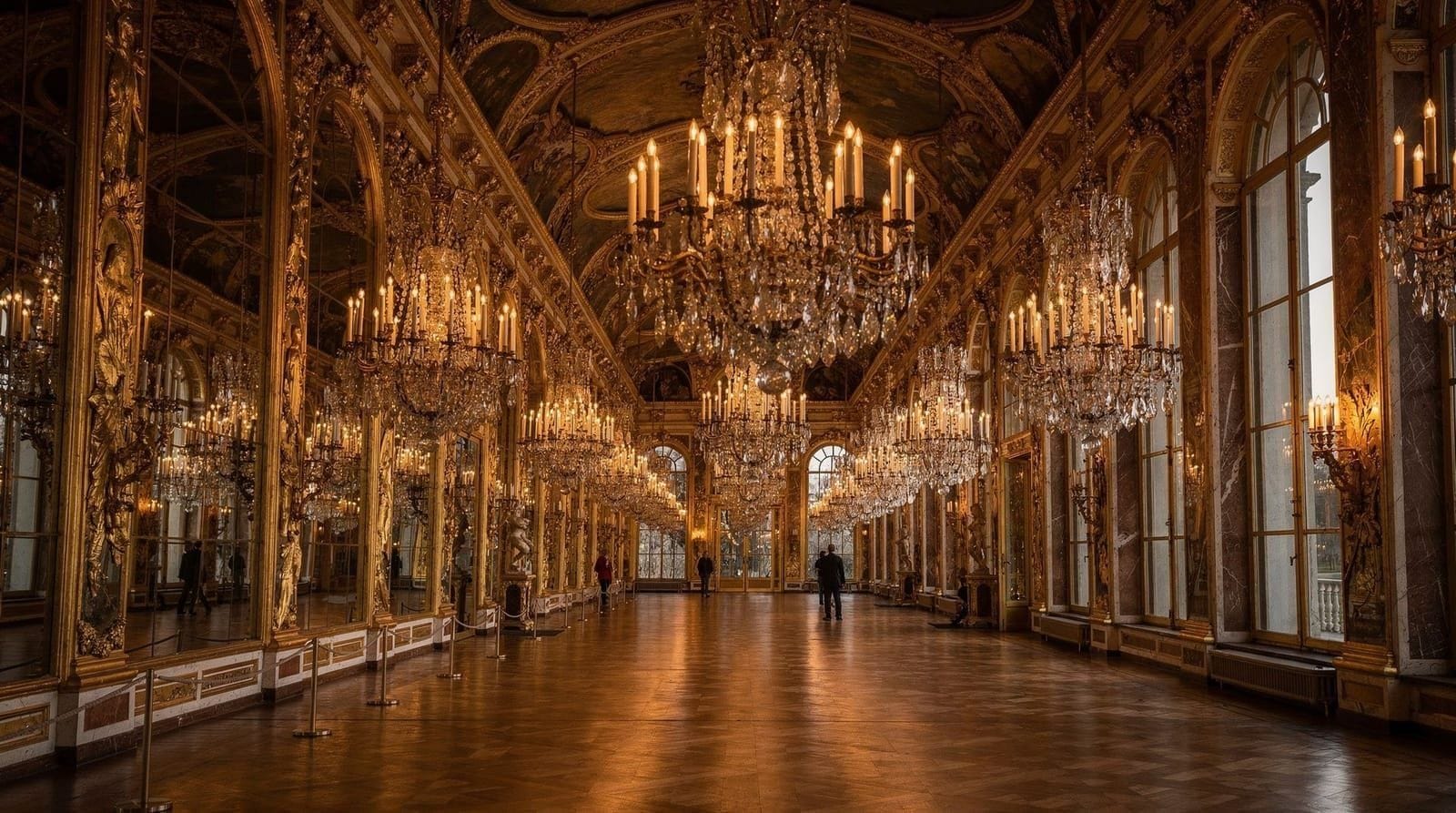
This is why you came. The Herrenchiemsee Hall of Mirrors stretches 98 metres in length, making it technically longer than the Hall of Mirrors at Versailles — though the Versailles hall has a higher ceiling and different proportions. Ludwig did not simply copy Versailles; he studied it obsessively and then tried to improve on it.
The room contains 17 chandeliers and 44 girandoles, all original candelabras that were designed to hold real candles. When the palace holds its summer candlelight concerts, the entire hall is lit by candles alone — roughly 2,500 of them. The effect, by all accounts, is extraordinary. If you are visiting in summer, it is worth checking whether your dates align with a concert performance.
The ceiling frescoes glorify the Sun King, Louis XIV of France — Ludwig’s obsession and the model he was trying to emulate (and surpass). What makes the room poignant is what is missing: the south and north wings of the palace that would have flanked this central block were never built. You exit through construction-era spaces that Ludwig never lived to see completed.
The state apartments
The guided tour takes you through a sequence of state rooms that are among the most opulent surviving interiors in Europe. The Grand Bedchamber contains a bed with gold embroidery so dense and heavy that it has never been slept in. The Council Chamber retains its original furnishings. The Small Blue Cabinet gives a sense of Ludwig’s taste at a more human scale — intimate, rich, and slightly melancholy.
Guides are knowledgeable and tours run in German and English. The 35-minute duration is genuinely not enough time to absorb the rooms fully, but the structure of the visit does not allow for lingering. Take your time in the Museum instead.
Museum Ludwig II
The museum occupies the south wing of the palace — the unfinished part that Ludwig never used. It is arguably the most valuable part of the visit for understanding the man.
Exhibits cover his biography, his relationship with composer Richard Wagner, his increasingly strained relationship with the Bavarian government, and the final days leading to his mysterious death in Lake Starnberg in June 1886. Original documents, personal possessions, and photographs make the story vivid in a way that a castle tour alone cannot.
The circumstances of his death remain disputed. Was he murdered by political opponents who feared he might reclaim power? Did he take his own life? Was it an accident? The museum presents the evidence without imposing a conclusion. You will leave with more questions than answers — which is the appropriate response.
Allow 45 to 60 minutes for the museum if history interests you. This is not a room you rush through.
The palace gardens and island
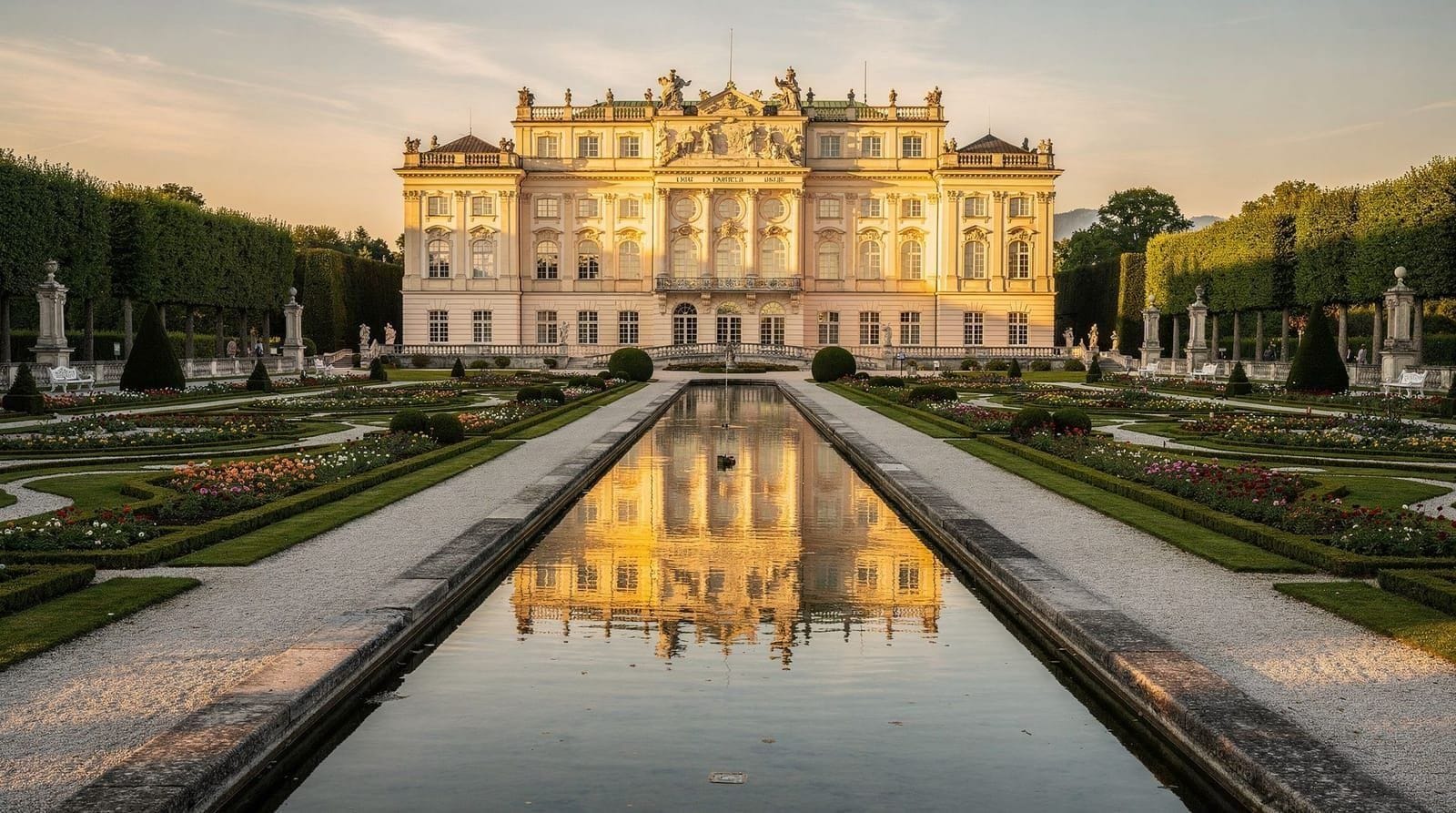
Herrenchiemsee Palace was designed to sit within formal French gardens modelled on Versailles. What exists today is a partially realised version of that vision — the central axis with its fountain and reflecting pool survives, flanked by lawns that extend toward the treeline.
On specific days in summer, the fountain show runs, with the great central fountain in operation. The schedule is posted at the ticket office and changes by year. If the fountain show is running during your visit, it adds significantly to the garden experience.
Beyond the formal gardens, Herreninsel is a forested island of considerable natural beauty. Deer are genuinely free-roaming here — you will almost certainly encounter them on the walk between the dock and the palace. The island was a monastery before Ludwig purchased it, and parts of the old Augustinian monastery still stand near the dock, with a small museum of their own.
If time and weather allow, walk the perimeter path around part of the island after your palace visit. The lake views back toward the mainland are excellent, and the atmosphere — quiet, wooded, slightly other-worldly — is exactly what Ludwig was looking for when he chose this location.
Photography inside the palace
Photography inside the state rooms is restricted — flash photography and tripods are not permitted, and in some rooms photography is prohibited outright to protect the fragile textiles and gilding. Check the current rules at the ticket office, as they are enforced by the guides during the walkthrough. The exterior, gardens, and Museum Ludwig II generally allow photography for personal use, and the fountain show in the formal gardens is one of the better photo opportunities on the island.
Toilets and facilities on the island
Public toilets are available near the dock, at the ticket office by the palace, and in the restaurant building. There are no facilities along the forest walk between the dock and the palace, so use them before setting off if you have children or anyone who might need a break partway.
Honest advice: is Herrenchiemsee worth the effort?
Yes. Without qualification.
The transit logistics put off a lot of visitors who are comparing it to Neuschwanstein, which is accessible by bus from Füssen or by direct tours from Munich. Herrenchiemsee requires an extra boat step and a full day commitment. In exchange, you get a palace interior that is genuinely without parallel in Germany — more lavish than Linderhof, more historically layered than Neuschwanstein — combined with crowds that are dramatically lower than either of those sites.
On a summer weekday at Neuschwanstein, you will queue, shuffle, and share every room with dozens of strangers. At Herrenchiemsee on the same day, your tour group will be smaller, the atmosphere quieter, and the island itself will feel like a discovery you made. That contrast matters.
What is NOT worth it: trying to rush the visit. If you are the type of traveller who wants to hit three sites in one day, Herrenchiemsee will disappoint you because it resists rushing. The boat schedule is what it is, the walk to the palace takes as long as it takes, and the museum rewards unhurried attention. Give it a full day and it rewards you generously.
For more context on how Herrenchiemsee fits within Ludwig’s complete legacy, the King Ludwig II castles guide covers the full picture, including how to prioritise your time if you want to visit multiple castles. If you are planning two or three days of castle-hopping from Munich, the Munich castles 3-day itinerary is the most useful planning resource.
Herrenchiemsee vs Neuschwanstein: which to prioritise
This comparison comes up constantly, so here is an honest answer.
Neuschwanstein wins on drama and setting. The exterior silhouette against the Alpine peaks is genuinely iconic, and the approach from the Marienbrücke bridge is one of the great views in Europe. If you have only one day for a Ludwig castle and you have never been to either, Neuschwanstein is the correct choice.
But if you have already seen Neuschwanstein, or if you have two days, Herrenchiemsee offers something the more famous castle does not: interior grandeur at a scale that feels genuinely overwhelming. The Hall of Mirrors stops people in their tracks in a way that Neuschwanstein’s Singers’ Hall, impressive as it is, does not.
For a comparison of the two southern castles, Neuschwanstein vs Hohenschwangau covers that specific question in depth. For the broader picture of Bavaria’s castle circuit, best castles near Munich ranks the options.
Planning your visit alongside Lake Chiemsee
The lake itself is worth a few hours of your time, and building a Herrenchiemsee day around the broader Chiemsee experience makes the logistics feel less like a slog and more like a genuine excursion.
After your palace visit, take a later boat back to Prien Stock and walk along the lakefront before catching your train. In good weather, the Chiemsee is one of the most beautiful lakes in Bavaria — wide, calm, backed by Alps on clear days. There are cafes at the harbour in Prien Stock where you can sit with a beer and watch the sailing boats before your train home.
Alternatively, add Fraueninsel — the smaller island with its working Benedictine convent and fish-smoking traditions — as a 90-minute addition if your ferry schedule allows. The contrast between Ludwig’s extravagance on Herreninsel and the austere monastic life on Fraueninsel is quietly striking.
The Chiemsee lake guide has more on both islands and the lake villages on the southern shore.
Booking the palace against other Bavarian palaces
If your itinerary already includes Nymphenburg Palace in Munich itself, note that Herrenchiemsee is a completely different scale of experience — Nymphenburg is a manageable half-day within the city, while Herrenchiemsee is a full-day excursion requiring the boat crossing. Travellers assembling a multi-palace Bavaria itinerary should treat these as separate days rather than trying to combine them. Nymphenburg Palace entry ticket is worth booking separately if Herrenchiemsee is your main Ludwig II day.
Frequently asked questions about Herrenchiemsee palace
How much does the boat to Herrenchiemsee cost?
The boat round trip from Prien Stock to Herreninsel costs €12 for adults and €6 for children. This is separate from the palace entry ticket (€12 adults, €11 reduced). Budget approximately €24 to €25 per adult for entry and boat transport combined, excluding travel to Prien am Chiemsee from Munich.
Is the Bayern Ticket valid to get to Herrenchiemsee?
Yes. The Bayern Ticket covers train travel from Munich to Prien am Chiemsee. It does not cover the bus connection from Prien station to the harbour or the boat to the island — those are paid separately. The Bayern Ticket guide explains the full terms and how to use it on a castle day trip.
How many people visit Herrenchiemsee per year?
Approximately 300,000 visitors per year — a fraction of the 1.5 million who visit Neuschwanstein. This is the main practical reason the experience feels so much calmer and more personal. You will likely never feel crowded inside the state rooms.
Can children visit Herrenchiemsee?
Yes, and children generally find the experience engaging. The palace interior is dramatic in a way that works for older children and teenagers. The island walk with free-roaming deer is a reliable hit. For very young children, be aware that the boat crossing and the 15-minute walk each way can add up. The museum has some challenging historical content about Ludwig’s death, which is worth previewing for sensitive children.
What should I wear to Herrenchiemsee?
Comfortable walking shoes are important — you walk from the harbour to the palace and through the gardens. In summer, sunscreen and a hat are useful for the gardens. In spring and autumn, bring a layer as the boat crossing can be cool. The palace interior itself is cool year-round, which is welcome in July and August.
Is there food on the island?
Yes. There is a restaurant and cafe near the dock on Herreninsel that serves Bavarian standards. Quality is reasonable for a captive-audience location. Bring snacks or a packed lunch if you plan to spend extended time on the island and want to picnic in the grounds.
How does Herrenchiemsee compare to Linderhof?
Both are interior-focused palaces rather than exterior landmarks. Linderhof Palace is significantly smaller — more of a grand hunting lodge — but its grounds, including the Venus Grotto and Moroccan House, are theatrical in a way the Chiemsee island cannot match. Herrenchiemsee wins on interior scale and grandeur; Linderhof wins on eccentric outdoor spectacle. Both are worth visiting on a Bavaria 5-day itinerary.
Is Herrenchiemsee doable as a day trip without a guided tour?
Yes, and many independent travellers do exactly this. The train and boat connections are straightforward, tickets are bought on arrival, and English-language guided tours of the state rooms run alongside the German ones. The main advantage of a paid tour is not having to think about the logistics at all, particularly the train and boat timing from Munich.
What’s the earliest sensible start time from Munich?
Aim to leave Munich by 8am to catch an early boat and secure a morning entry slot, particularly in July and August. This gets you to the palace before the day’s tour groups arrive and leaves the afternoon free to explore the gardens or add Fraueninsel.
Top experiences
Bookable activities with verified prices and instant confirmation on GetYourGuide.