Chiemsee guide: Bavaria's Sea, Herrenchiemsee Palace and the Fraueninsel
From Munich: Herrenchiemsee Palace and boat trip day tour
What is the best way to visit Lake Chiemsee from Munich?
Take the direct train from Munich Hauptbahnhof to Prien am Chiemsee — about 55-60 minutes, covered by Bayern Ticket. From Prien station, a heritage steam train (the Chiemseebahn) runs to the lake pier. Boats to both Herreninsel (Herrenchiemsee Palace) and Fraueninsel run from there throughout the day.
The Bavarian Sea: understanding why Chiemsee is different
Bavaria’s other major day-trip lakes — Tegernsee, Starnberger See, Ammersee — are all beautiful, but Chiemsee is in a different category in terms of scale. At 80 square kilometres, Bavaria’s largest lake is genuinely lake-like in a way the others are not: standing at the Prien shore and looking west or north, the far bank is a thin line at the horizon. In low cloud or haze it can disappear entirely. The Bavarians were not being whimsical when they called this the Bayerisches Meer (Bavarian Sea) — at a pre-railway era scale, it must have felt like an inland ocean.
The lake has three islands: Herreninsel (the largest, with the palace), Fraueninsel (with the convent), and the uninhabited Krautinsel. A visit to Chiemsee combining both inhabited islands, a swim from the Prien shore, and a meal at one of the island restaurants makes a compelling full day from Munich.
But there is a specific structure to how that day works best, and it is worth planning it in advance — particularly the boat connections, which run on set schedules and need to be factored into your timing.
| Where | Prien am Chiemsee, ~85km southeast of Munich |
| Cost | Train ~€29 Bayern-Ticket, boat pass ~€12, palace ~€15 |
| Time needed | Full day for both islands; half day for one |
| Getting there | Train to Prien, Chiemseebahn, then boat |
| Best time | Weekday, or before 10am on summer weekends |
Getting to Chiemsee from Munich
The direct train from Munich Hauptbahnhof to Prien am Chiemsee takes approximately 55-60 minutes. Trains run roughly every hour on the Munich-Salzburg main line. The Bayern Ticket covers the full journey both ways, making this one of the most economical day trips in the region for groups — a group Bayern Ticket covering up to five people costs €29 and covers the return rail journey for everyone.
From Prien station, the Chiemseebahn is a local institution: a narrow-gauge heritage railway (still steam-operated on some services) that runs from the main station down to the pier at Prien-Stock in around 10 minutes. Chiemseebahn tickets are not included in Bayern Ticket and cost a few euros separately.
At Prien-Stock pier, the Chiemsee Schifffahrt (boat service) operates boats to both Herreninsel and Fraueninsel throughout the day, from approximately 8am to 6pm (reduced services in shoulder season). Timetables are available at the pier and on the Chiemsee Schifffahrt website.
A day ticket for unlimited boat travel (all crossings to and between both islands) costs approximately €12 for adults, €6 for children in 2026. This is the sensible option for a day combining both islands. Book a guided day trip from Munich to Herrenchiemsee Palace with boat transfer
Herrenchiemsee Palace: Ludwig II’s Versailles on a Bavarian island
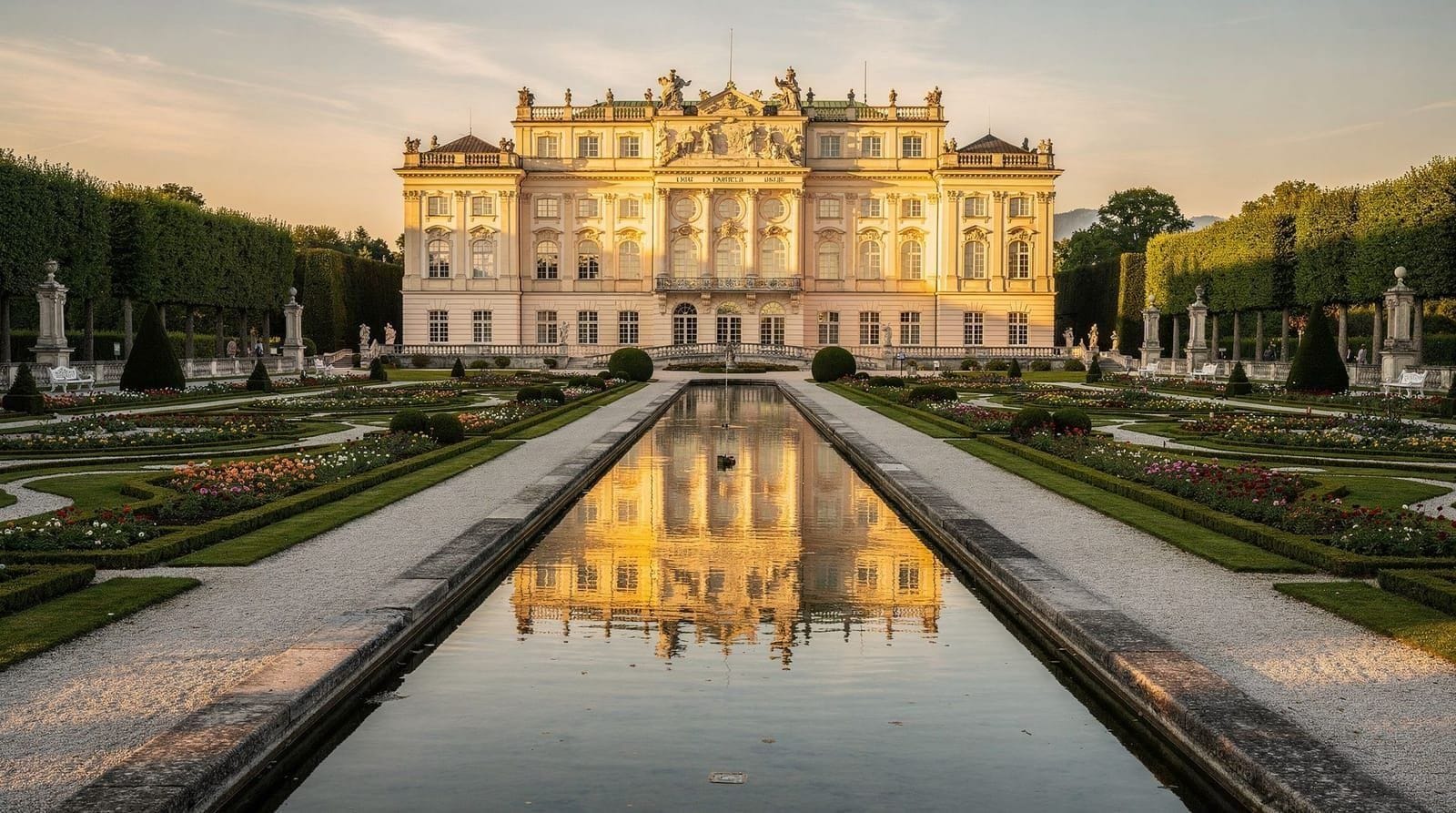
Herreninsel is named for the Augustinian monks (Herren, or men) who occupied a monastery here from the 12th century until the monastery’s dissolution in 1803. The island then passed through various hands until King Ludwig II of Bavaria purchased it in 1873 with a specific and extraordinary intention: to build a replica of the Palace of Versailles on the island.
Ludwig was obsessed with the Sun King, Louis XIV of France, who he viewed as the ideal of absolute monarchy — everything that Ludwig wished to be but was not constitutionally permitted to in 19th-century Bavaria. Herrenchiemsee Palace was his attempt to conjure that world on Bavarian soil, at his own expense, as a private refuge.
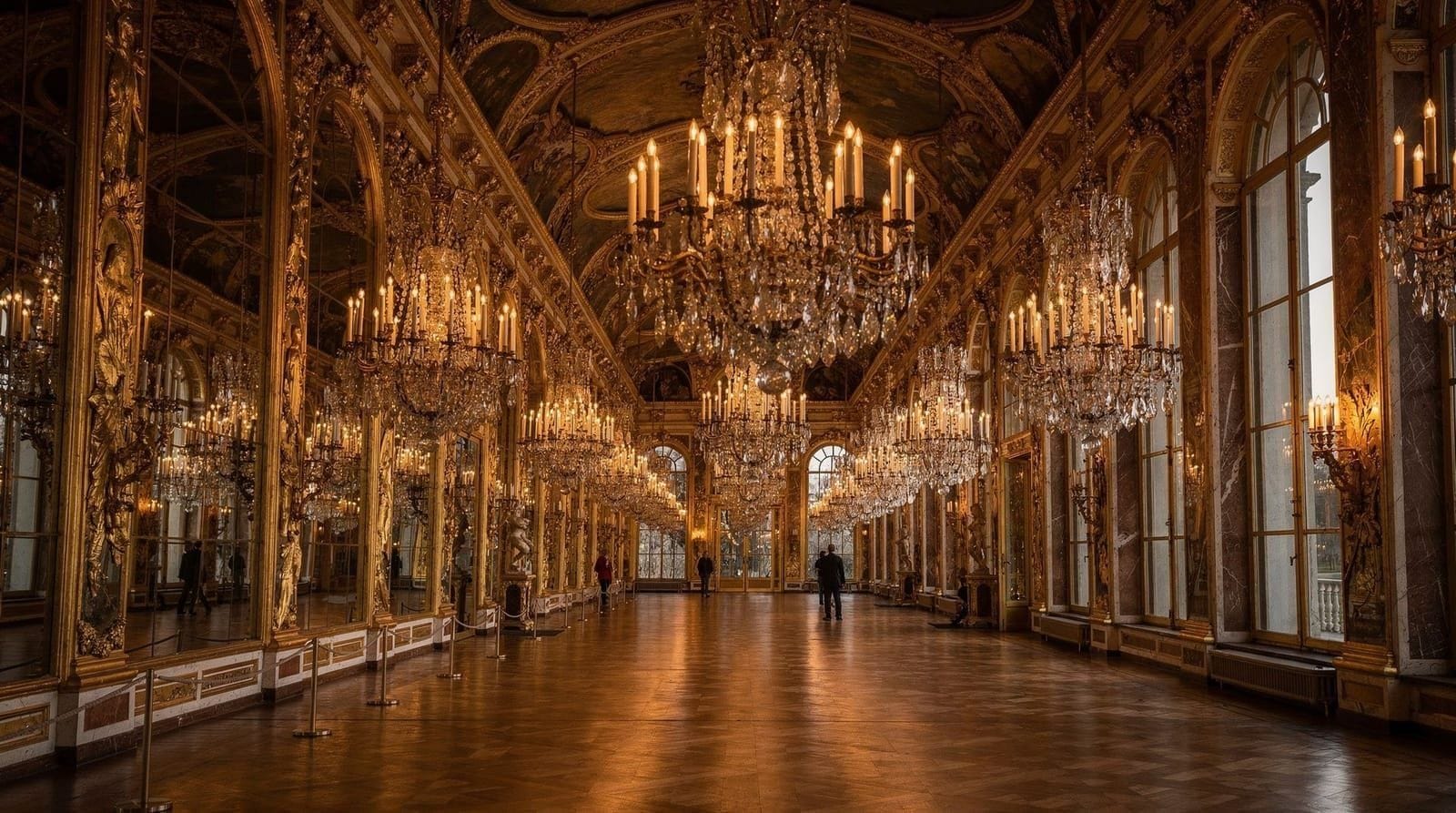
Construction began in 1878. Ludwig died in 1886, aged 40, before it was anywhere near complete. Of the planned 70 rooms, only about 20 were finished to any degree. The central Hall of Mirrors — the most direct copy of Versailles’s Galerie des Glaces — was completed and is genuinely astonishing: 98 metres long, 17 arched windows alternating with 17 mirror arches, and a ceiling fresco visible through 44 gilded chandeliers. It is the most direct comparison to the Versailles original available anywhere outside France.
Other rooms that reached completion include the State Bedroom (Ludwig’s bedroom with a ceremonial bed he barely used, the ceremony of the king’s rising being more important to him than actual sleep), the Grand Staircase (a white marble affair of spectacular effect), and the dining room with its famously eccentric mechanical table — designed to rise fully laid from below so Ludwig could dine without servants entering the room.
The museum in the former monastery building (same ticket as the palace) displays personal effects and documents from Ludwig’s life — more intimate and historically illuminating than the palace itself, and consistently overlooked by visitors who head straight back to the boat after the interior tour.
Logistics for visiting Herrenchiemsee: The boat lands at the western end of Herreninsel. From the landing pier, a path through the palace grounds (passing formal French-style gardens with fountains) leads to the palace entrance — approximately 20 minutes on foot. Carriage rides are also available from the pier for those who prefer not to walk. Interior access is by guided tour (approximately 35-40 minutes). A combined palace and museum ticket costs approximately €15 adults. Book online at schloesser.bayern.de to avoid queuing at the island ticket desk, particularly in summer.
Fraueninsel: the convent island and what makes it different
Fraueninsel (or Frauenchiemsee) is the island where Chiemsee’s day-trip character changes completely. Where Herreninsel is dominated by Ludwig’s abandoned fantasy palace, Fraueninsel is a functioning community with a 1,200-year history of continuous habitation.
The Benedictine convent here was founded around 782 AD — making it one of the oldest continuously inhabited monastic communities in Bavaria. The nuns who live here (currently around 20-25) run a small guesthouse, operate a shop selling the convent’s famous Klosterlikör (a herbal liqueur) and other products, and maintain the 11th-century convent church. The church interior is Romanesque with later additions and has a simplicity and atmosphere very different from the ornate Baroque of most Bavarian churches.
The island is small — walking the perimeter path takes around 20 minutes at a relaxed pace. There are no cars. The buildings are predominantly 18th and 19th-century Bavarian farmhouse architecture mixed with the older monastic structures. In the immediate fishing village around the convent, several families still live and operate traditional Chiemsee fishing, making Fraueninsel one of the last places in Bavaria where freshwater fishing as a livelihood still functions.
Eating on Fraueninsel: The Klostergasthof (convent guesthouse restaurant) serves Bavarian standards including freshwater fish from the lake — the Renke (a local whitefish variety) is the house specialty and is worth ordering if available. The restaurant has both indoor and garden seating. Prices are reasonable rather than tourist-inflated. There are also two or three smaller cafés on the island.
The Convent Café (run by the nuns) serves Chiemsee fish, Kaffee und Kuchen (coffee and cake), and the convent’s own herbal products. It is one of the few places in Bavaria where you can directly purchase goods made by an active monastic community.
Combining both islands: how to structure the day
The most logical sequence for a full day at Chiemsee:
First boat to Herreninsel (typically departing Prien-Stock at 9:00 or 9:30am). Arrive early enough to be at the palace entrance well before the first tour of the day fills. Do the palace interior tour, explore the formal gardens (the fountain displays run on a set schedule in summer — check the timetable at the entrance), and visit the monastery museum. This takes around 2.5-3 hours.
Midday boat from Herreninsel to Fraueninsel (direct boat connections run approximately every 45-60 minutes between the two islands). Walk the perimeter path, visit the convent church, and eat lunch at the Klostergasthof — aim to arrive before 12:30 to secure a table. The Renke and a local beer from the Inselwirt (the other island pub) is a classic combination.
Afternoon: Depending on time and inclination, either take the late afternoon boat back to Prien-Stock for a swim from the Strandbad before the return train, or catch an afternoon boat directly back to the pier and the Chiemseebahn.
Last boats back to Prien-Stock typically depart at around 5:30-6pm in summer. The last return trains from Prien to Munich run in the late evening.
Swimming at Chiemsee
The lake water is clean and, by Bavarian lake standards, relatively warm in summer — reaching 22-23°C in July and August. Free swimming is available at several points on the main shore.
The Strandbad Prien near the pier has changing facilities, a grassed sunbathing area, a diving platform, and lifeguard supervision on peak season days. Entry is approximately €5 adults. Alternative free swimming points include the beach at Gstadt on the western shore (reachable by boat or bicycle from the west) and the Seebruck beach at the lake’s northern outflow to the Alz river.
For those staying the full day, an afternoon swim after the island visits is the natural way to use remaining daylight before the evening train. The water is always clear enough to see several metres below the surface, which makes Chiemsee markedly different from the more turbid lowland lakes further north.
What is honest about the crowds
Chiemsee in July and August is busy — genuinely so, not just guidebook-hyperbole busy. On summer weekends, the 9am and 10am boats from Prien-Stock fill quickly, and the queue at the pier can be 30-45 minutes by 11am. The palace interior has timed entry and can book up by midday.
The practical response: catch the first or second boat of the day (before 10am), and book palace tickets online in advance. Mid-week visits are dramatically more relaxed. Late September and October are beautiful months for Chiemsee — the summer crowds are gone, the light is excellent, the water is still swimmable for the willing, and the islands have their authentic character back.
Early season (May and June) is also good, though the fountain displays at the palace don’t typically start until June. Book a private excursion from Munich to Herrenchiemsee Palace by train
Beyond the palace: what else the Chiemsee area offers
The Chiemsee area extends beyond the lake itself to some genuinely interesting surroundings.
Prien am Chiemsee town is pleasant without being remarkable — a well-maintained market town with a few good cafés and a small Roman Catholic church with surprising 18th-century interior. The town is primarily a transit point for lake visitors, but if you arrive on the early train, a coffee at one of the cafés near the station before the Chiemseebahn is not wasted time.
Seebruck, at the lake’s northern end where it flows out to the river Alz, has a small Roman history museum (remains of a Roman fort are excavated nearby) and a relaxed atmosphere well away from the main tourist flow.
The wider Chiemgau region — the hills and valleys east and south of the lake — offers walking and cycling that most day-trippers do not reach. For those with transport and two or more days, the Chiemgau Alps south of the lake (peaks around 1,700-1,900 m) are a quieter alternative to the more famous Bavarian Alpine destinations. The Kampenwand (1,669 m) above Aschau, accessible by cable car, gives excellent views back across the lake.
For more on Ludwig II’s wider legacy, see our King Ludwig II castles guide, which covers Herrenchiemsee alongside Neuschwanstein and Linderhof in sequence. The Herrenchiemsee Palace guide gives fuller detail on the interior and history.
Chiemsee versus Munich’s other lakes
Visitors deciding between Chiemsee and Munich’s closer lakes — Starnberger See, Ammersee, Tegernsee — should weigh scale against convenience:
| Lake | Distance from Munich | Character | Best for |
|---|---|---|---|
| Chiemsee | ~85km, 55–60min train | Vast, island palace, ferry culture | A full day-trip destination in its own right |
| Starnberger See | ~30min S-Bahn | Closer, quieter villages | A quick swim or half-day escape |
| Tegernsee | ~50–60min | Alpine backdrop, upmarket villages | Scenery plus beer-garden culture |
| Ammersee | ~40min S-Bahn | Gentler, less crowded than Starnberg | Families, easy cycling |
Chiemsee’s scale and the Herrenchiemsee Palace make it the strongest choice when a full day trip is the plan; the closer lakes suit a half-day when time is tighter. The Munich lakes guide covers all of Munich’s lake options side by side.
What to pack for a Chiemsee day
Because the day spans train, heritage railway, boat, walking and possibly swimming, pack accordingly: a swimsuit and towel if you plan to use the Strandbad, comfortable walking shoes for the palace grounds and Fraueninsel’s perimeter path, a light rain layer (lake weather can shift faster than in Munich), and cash for the smaller island cafés that sometimes prefer it over cards. Sun protection matters on the boat crossings, where there is little shade.
Frequently asked questions about Lake Chiemsee
Why is Lake Chiemsee called the Bavarian Sea?
Chiemsee is called the Bayerisches Meer because at 80 square kilometres it is Bavaria’s largest lake. Standing on the shore, the far bank is a thin line at the horizon — on a hazy day it disappears entirely. The name reflects how large it felt before modern transport.
What is the best way to visit Lake Chiemsee from Munich?
Take the direct train from Munich Hauptbahnhof to Prien am Chiemsee (about 55-60 minutes, Bayern Ticket valid), then the Chiemseebahn heritage railway to the pier, then boat to the islands.
What is on Herreninsel and how do you get there?
Herreninsel is dominated by Herrenchiemsee Palace — Ludwig II’s unfinished attempt to replicate Versailles. Boats from Prien-Stock pier take about 15 minutes. Boat day pass approximately €12 adults. Palace entry approximately €15 adults.
What is on Fraueninsel?
Fraueninsel is home to a Benedictine convent founded around 782 AD, a Romanesque convent church, a fish restaurant, and the island community of around 20 nuns who still live and work here. Small enough to walk around in 20 minutes.
Can you swim in Lake Chiemsee?
Yes. Free swimming available at several shore points. Water temperature reaches 22-23°C in July-August. The Strandbad at Prien-Stock has facilities and costs approximately €5 adults.
Is Chiemsee busy in summer?
Yes, particularly on July and August weekends. Arrive at the pier before 10am or book boats in advance. Palace entry should be booked online. Mid-week visits are substantially quieter.
What is the entry price for Herrenchiemsee Palace in 2026?
Palace interior tour approximately €15 adults, free for under-18s. Boat day pass approximately €12 adults (separate purchase). Bayern Ticket covers the train to Prien but not boats or palace entry.
Top experiences
Bookable activities with verified prices and instant confirmation on GetYourGuide.