Nuremberg
Imperial castle, WWII rally grounds, Documentation Center, Nuremberg trials courtroom, Christkindlesmarkt, gingerbread — 1h by ICE from Munich.
From Munich: Nuremberg day trip by train
Quick facts
- Distance from Munich
- 170 km (1 hr by ICE, 1h15 by IC)
- Train from Munich Hbf
- ICE from €21 (flex) or ~€29 Bayern-Ticket-Plus not valid, use Sparpreis
- Documentation Center (2026)
- €8 adult, €5 reduced; closed Mondays
- Imperial Castle (Kaiserburg)
- €9 adult, €8 reduced; guided tour in English daily
- Christkindlesmarkt dates
- Late Nov–24 Dec on Hauptmarkt
- UNESCO status
- Not UNESCO (Regensburg is); but listed monument protection
Germany’s imperial city — and where the 20th century went on trial
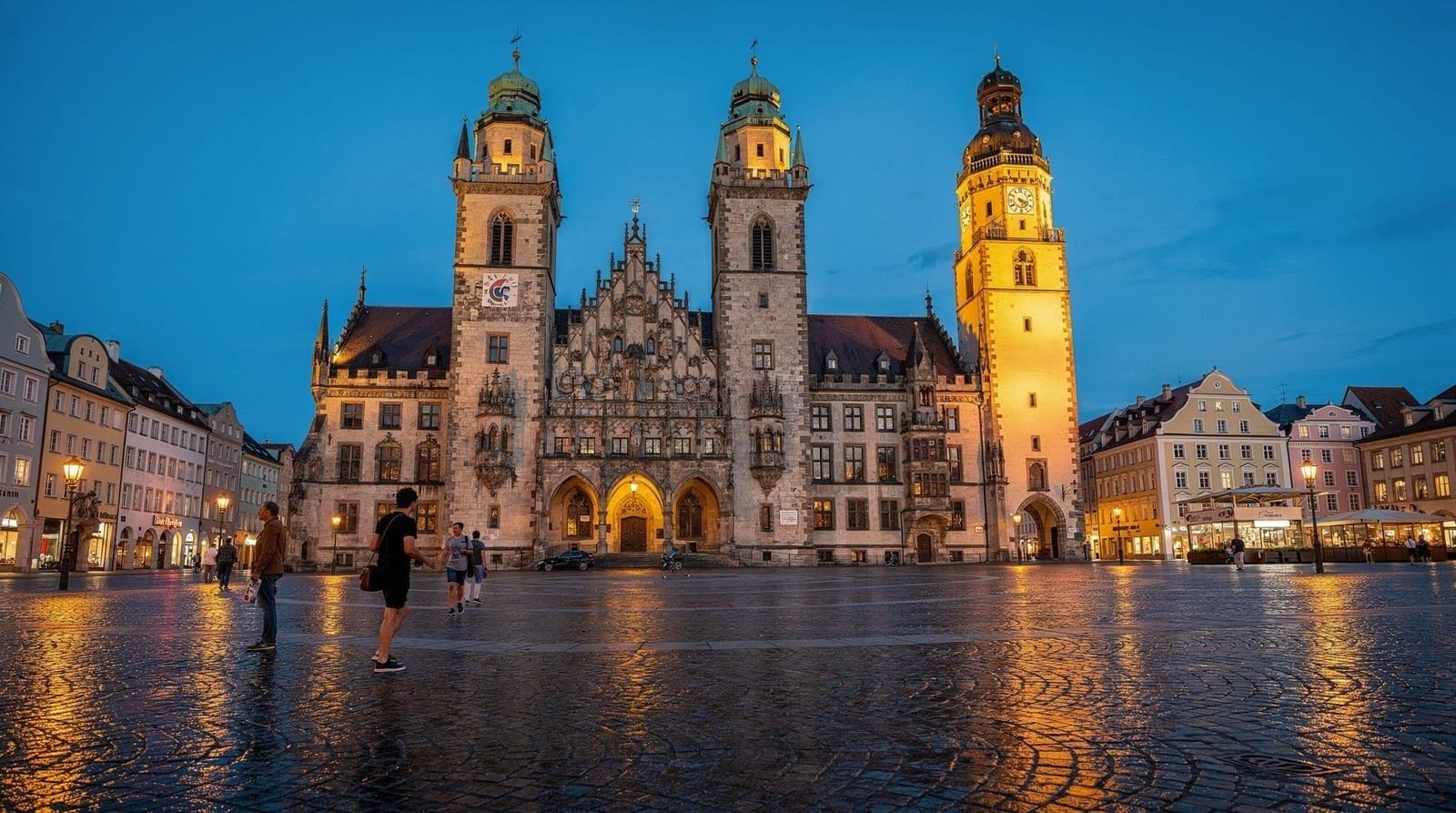
Nuremberg sits an hour south of Munich by ICE train, and it packs more historical weight per square kilometre than almost anywhere else in Germany. In a single day you can walk through a perfectly restored medieval old town, climb to a Hohenzollern imperial castle that hosted Holy Roman Emperors for five centuries, stand in the courtroom where Nazi leaders were convicted of crimes against humanity, and eat the smallest sausages Germany produces at a restaurant that has been serving them since 1419.
The city’s relationship with the 20th century is unavoidable and handled with unusual directness. Nuremberg was the site of the Nazi Party rallies from 1933 to 1938 — enormous mass events designed by Albert Speer and held on a purpose-built grounds south of the city centre. It was also, deliberately, the city chosen by the Allies in 1945 for the International Military Tribunal that convicted Hermann Göring, Rudolf Hess, and nineteen other senior Nazi officials. The Documentation Center in the surviving Congress Hall now offers one of Europe’s best accounts of how a democracy turns into a totalitarian state. Courtroom 600, where the trials took place, is still an active courthouse — which makes visiting it a slightly unusual experience — but guided access is available and worth booking.
Quick answer — is Nuremberg worth a day trip from Munich? Yes, unambiguously. The ICE takes 58–65 minutes, the main sites are all walkable from the station, and the old town survived the bombing raids significantly better than many German cities at that scale. A well-organised day covers the Kaiserburg, Hauptmarkt, Documentation Center, and Trials Courtroom comfortably. December visits add the Christkindlesmarkt, which is one of Germany’s oldest and least commercialised Christmas markets.
| Where | 170 km north of Munich, Franconia |
| Cost | Around €21+ ICE each way, €8–9 per major sight |
| Time needed | 1 full day; 2 days with Bamberg overnight |
| Getting there | ICE from Munich Hbf, 58–65 min, every 30 min |
| Best time | Weekdays May–Jun/Sep; Dec for Christkindlesmarkt |
Getting there from Munich
The logistics are unusually simple for a German day trip.
By ICE train: ICE trains run directly between Munich Hauptbahnhof and Nuremberg Hauptbahnhof roughly every 30 minutes. Journey time: 58–65 minutes depending on the specific service. Prices vary significantly by booking window — Sparpreis fares start at €21 each way if booked 3–6 weeks ahead; flex tickets cost €39–55 each way. Check the Deutsche Bahn app or bahn.de and book early if you have a fixed date.
Bayern-Ticket: The Bayern-Ticket does NOT cover ICE trains. It covers regional trains only (RB, RE lines), and the Munich–Nuremberg regional journey takes around 2h30 using the RE trains that stop at all intermediate stations. If you have a Bayern-Ticket, the trip is possible but adds nearly 3 hours of total transit. The ICE Sparpreis is almost always the better value.
By car: A9 motorway, about 1h45 without traffic. Parking in Nuremberg city centre is expensive (€2.50–3.50/hr). Park-and-ride options on the U-Bahn lines are more practical for a day visit.
From Nuremberg Hauptbahnhof, the old town is a 10-minute walk across the Pegnitz river. The Documentation Center and Rally Grounds require U-Bahn line U2 to Doku-Zentrum (about 12 minutes from the main station, €3.40 single or covered by a day ticket).
If you prefer a guided day trip from Munich that handles transport and provides commentary: From Munich: Nuremberg day trip by train with guide
Kaiserburg — the Imperial Castle
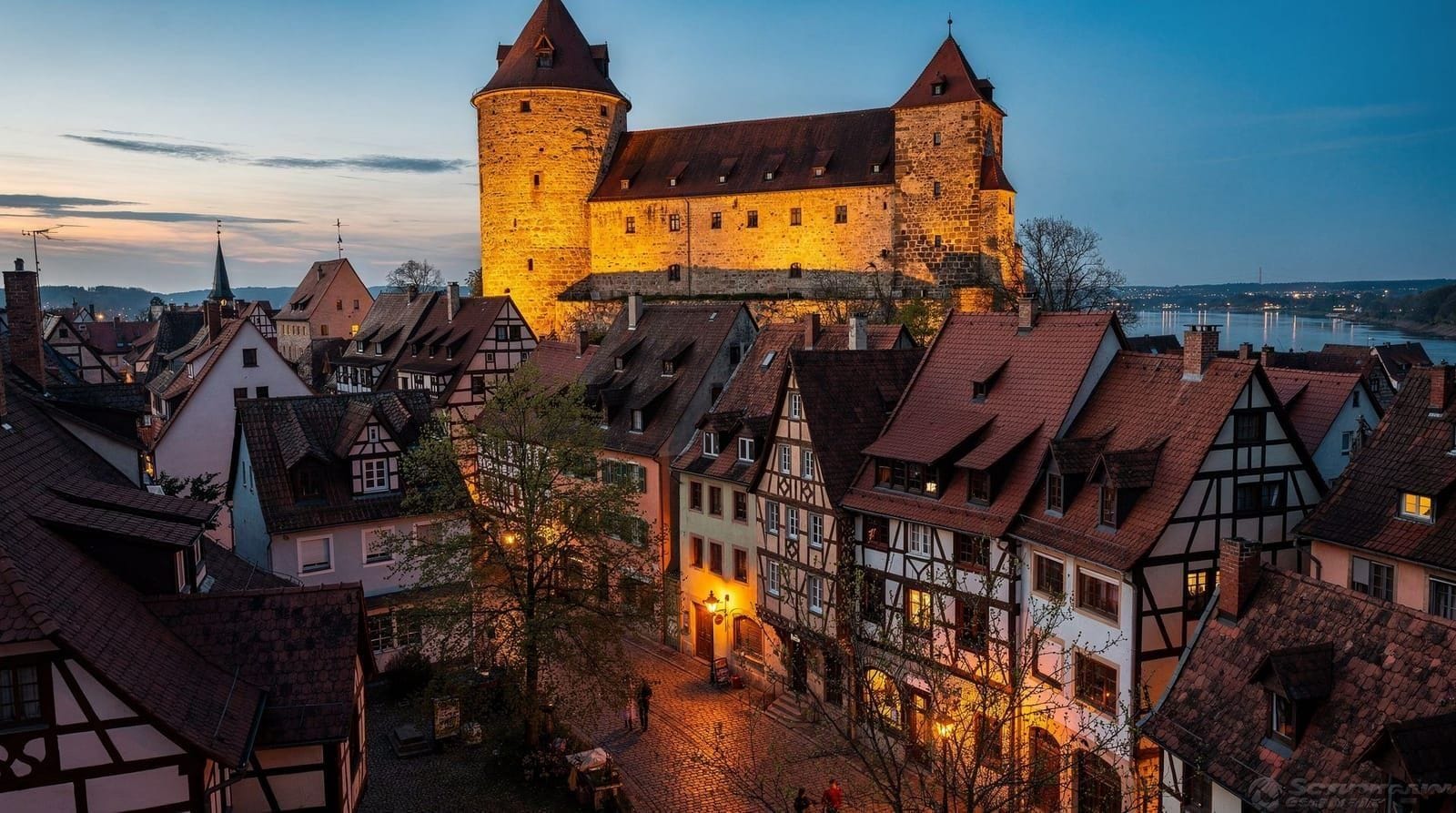
The Kaiserburg (Imperial Castle) sits on a sandstone ridge at the northern edge of the old town and is the dominant visual feature of the city skyline. Holy Roman Emperors were required by the Golden Bull of 1356 to hold their first Imperial Diet in Nuremberg after their coronation — the city was effectively the political centre of the empire for several centuries, and the castle reflects that status.
The castle complex divides into three parts: the Kaiserburg proper (the imperial residence), the Burggrafenburg (the oldest surviving section), and the Stadtburg (the city’s fortifications). The combination ticket for the Kaiserburg (€9 adult, €8 reduced) covers the palace rooms, the Sinwellturm (a 13th-century round tower with good views over the city), and the Tiefer Brunnen — a 47-metre-deep well that was essential for surviving sieges and still draws water today.
Guided tours in English run daily at 11:00 and 14:00 (included in the ticket price, confirm current times at the desk). The palace rooms are furnished modestly — this was a working imperial residence, not a showpiece like Versailles — but the Romanesque double-chapel on two levels is architecturally distinctive and worth seeing. The upper level was reserved for the emperor; the lower for the court. Both share an altar, connected by an oculus in the floor above.
The views from the castle terraces over the old town are among the best in Nuremberg. The castle opens at 09:00 and the morning light on the red-tile roofs below is worth timing your visit for.
The old town and Hauptmarkt
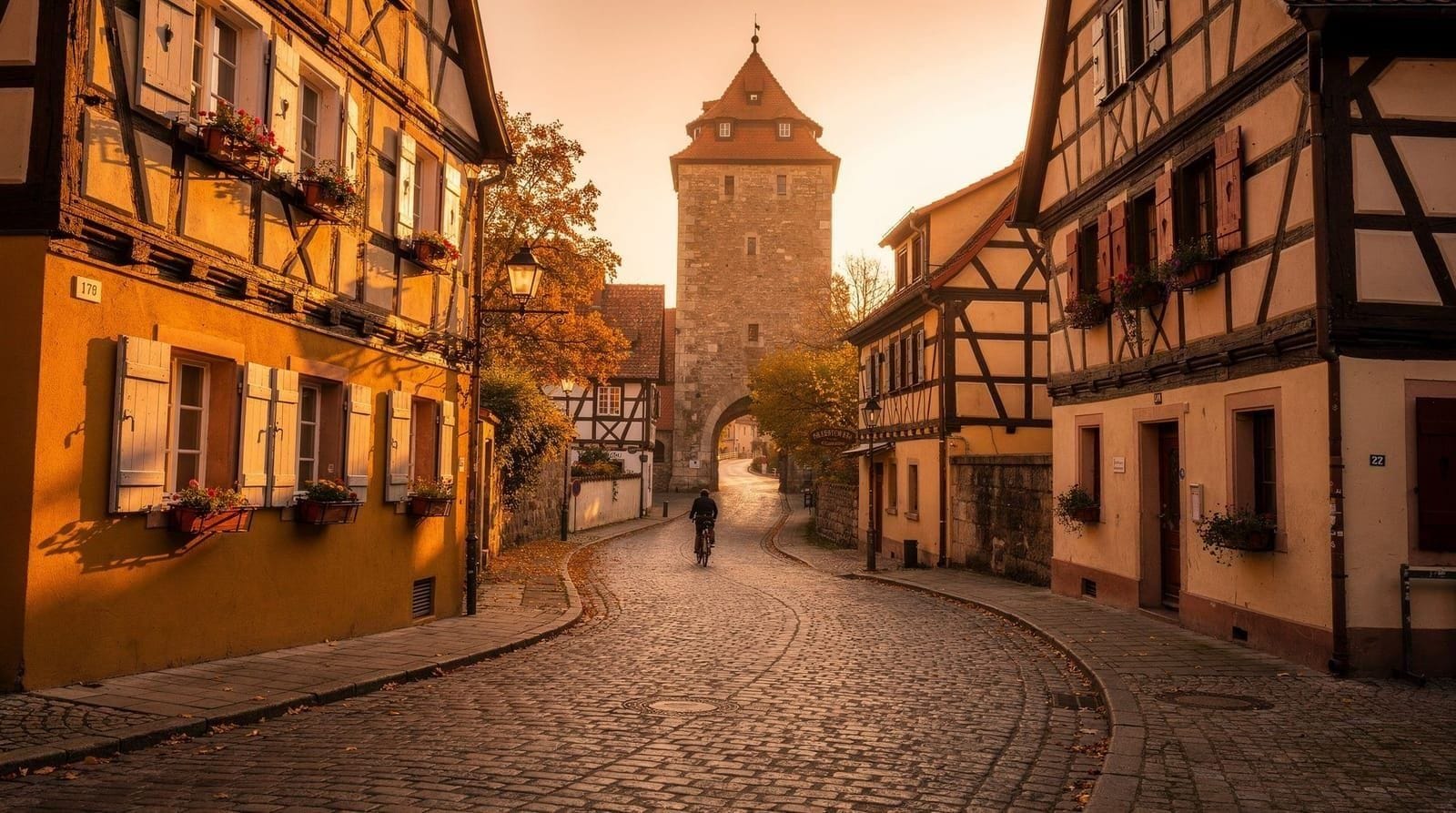
Nuremberg’s Altstadt was largely destroyed in Allied bombing raids in January 1945 — the city had been a major arms manufacturing centre — but it was systematically rebuilt from rubble, stone by stone, using original materials where possible. The result is a reconstruction that looks and feels medieval without being Disneyland. The main framework of streets, the Stadtmauer (city wall), and the major churches are all genuine structures rebuilt to their pre-war appearance.
Hauptmarkt: The central market square is large by German standards and holds the Schöner Brunnen (Beautiful Fountain) — a 14th-century Gothic spire fountain with 40 gilded figures arranged in tiers. The golden ring set into the iron railing around the fountain is said to bring good luck if you spin it, and the queue of people trying it is a permanent feature. The ring was inserted by a locksmith, the story goes, so smoothly that the join is invisible. Whether this is true is not documented.
The Frauenkirche (Church of Our Lady) on the east side of the Hauptmarkt has a Männleinlaufen — a mechanical clock on its facade that performs daily at 12:00. Seven electors circle the figure of Emperor Charles IV in a procession that takes about 10 minutes. It dates from 1509 and has been running ever since, briefly interrupted by the bombing.
St. Sebaldus Church (Sebalduskirche), five minutes north of the Hauptmarkt, is Nuremberg’s oldest parish church (consecrated 1273) and contains the Sebaldus Shrine — a bronze reliquary that took the sculptor Peter Vischer 11 years to complete (1508–1519) and is one of the finest examples of German Renaissance metalwork.
St. Lorenz Church (Lorenzkirche), south of the Hauptmarkt across the Pegnitz, has the Angelic Salutation by Veit Stoss — a carved limewood altarpiece suspended from the ceiling of the choir, dating from 1517–1519. It is the most important work of art in Nuremberg and is not always noticed by visitors looking down rather than up.
WWII and Nazi history
Nuremberg’s role in the Nazi period is impossible to separate from a visit to the city, and the Documentation Center takes that responsibility seriously.
The Rally Grounds (Reichsparteitagsgelände): The Nazi Party held its annual rallies here from 1933 to 1938. The grounds were designed by Albert Speer at massive scale — the Zeppelin Field (Zeppelinfeld) could accommodate 150,000 people in tiered stands, with a replica of the Pergamon Altar as its tribune. The Luitpoldhalle, Luitpoldain, and the vast unfinished Congress Hall (larger in footprint than the Colosseum) are all on the same site south of the city centre.
The grounds are largely intact, partly because the scale made demolition impractical, partly as a deliberate act of historical preservation. The Zeppelin Field is now used as a vehicle test area and concerts venue — the juxtaposition is deliberate and unsettling. Parts of the stands have been left to decay as a structural commentary on the regime’s permanence fantasies.
Documentation Center (Dokumentationszentrum): Opened in 2001, it occupies part of the unfinished Congress Hall — the contrast between the exposed building’s interior and the exhibition content is part of the design intention. The permanent exhibition, “Faszination und Gewalt” (Fascination and Violence), covers the rise of the Nazi party, the mechanics of mass mobilisation, the role of Nuremberg specifically, and the post-war trials. Audio guide is included in the €8 ticket.
It is one of the most rigorous museum presentations of the Nazi period in Germany. Plan 2–3 hours minimum. The congress hall exterior and the view of the indoor courtyard are included in the ticket at no extra charge.
The Documentation Center is closed on Mondays. On Tuesdays to Fridays, it closes at 18:00; weekends at 18:00 (last entry 17:00). Take U2 to Doku-Zentrum — the station exits directly at the site.
For visitors wanting a guided walking interpretation of the Munich-Nuremberg Nazi history connection, some tours originating from Munich cover both cities’ roles: Munich: Third Reich and WWII walking tour
Nuremberg trials courtroom
Courtroom 600 in the Nuremberg Palace of Justice (Justizpalast) is where the International Military Tribunal convened from November 1945 to October 1946 to try 24 senior Nazi officials. The defendants included Hermann Göring, Rudolf Hess, Joachim von Ribbentrop, Wilhelm Keitel, Albert Speer, and Karl Dönitz. Twelve were sentenced to death (Göring committed suicide the night before his scheduled execution), three received life sentences, and three were acquitted.
The courtroom was chosen by the Allies partly for practical reasons (the building had survived bombing with its structure intact, and Nuremberg had sufficient prison space adjacent) and partly for symbolic ones: Nuremberg was where the Nuremberg Race Laws of 1935 had been promulgated, declaring Jews non-citizens. Trying the perpetrators in the same city carried deliberate weight.
What makes visiting unusual: Courtroom 600 is still an active courtroom, used for current criminal trials in the Bavarian legal system. Access is therefore limited and regulated. The memorial within the courtroom — “Memorium Nuremberg Trials” — is open to visitors when court is not in session.
Entrance: €7.50 adult, €6 reduced. Opening hours are Wednesday–Monday, 10:00–18:00 (closed Tuesdays). The site is at Bärenschanzstrasse 72, about 15 minutes on foot from the Hauptbahnhof or 5 minutes on the U1 to Bärenschanze. Audio guide included.
The exhibition covers the legal proceedings, the defendants, the evidence presented, and the long-term significance of the Tribunal for international law (the Nuremberg Principles became the foundation for subsequent war crimes tribunals and eventually the International Criminal Court).
Book ahead for peak season — slots do sell out on Saturdays in summer. From Munich: Nuremberg guided day tour
Food, gingerbread, and bratwurst
Nuremberg’s culinary identity is more distinct than most German cities of comparable size.
Nuremberg Bratwürste (Rostbratwürste): Nuremberg’s sausages are protected by PGI (Protected Geographical Indication) status — they can only be produced within the city boundaries, must be 7–9 cm long, and weigh between 20–25 grams each. They are significantly smaller than the Bavarian variety and are traditionally served in multiples: 3, 6, 9, or 12, with Sauerkraut or potato salad, on a pewter plate.
The Bratwursthäusle am Handwerkerhof (Königstrasse 82) and Bratwurst Röslein (Rathausplatz 6) are both solid choices near the old town. But the most historically notable option is the Historische Bratwurst-Küche Zum Gulden Stern on Zirkelschmiedsgasse 26 — in continuous operation since 1419, which makes it one of the oldest restaurants in Germany still serving the same product. The interior is dark, cramped, and unchanged. The sausages come over an open beechwood fire. No reservations, expect queues at lunch.
Nuremberg Lebkuchen (gingerbread): Nuremberg gingerbread has been produced in the city since the 14th century, protected by its own PGI designation. The classic variety is made with a minimum 25% nut content (almonds, hazelnuts, walnuts), no flour base, and spices including anise, coriander, cloves, allspice, and cinnamon. Lebkuchen Schmidt (Hauptmarkt 5) and Lebkuchen Weiss are the main specialist shops; most bakeries also produce their own variants.
The gingerbread is sold year-round, not only at Christmas — though December is when the stalls on the Hauptmarkt carry the widest range.
Schneeballen are a Rothenburg specialty, but Nuremberg Lebkuchen tins are the standard souvenir. Buy them from the specialist shops rather than supermarkets — the quality difference is significant.
Christkindlesmarkt
Nuremberg’s Christmas market (Christkindlesmarkt) opens on the last Friday before the first Advent Sunday and closes on 24 December. It runs on the Hauptmarkt — the same square where the Schöner Brunnen stands. The market has been documented since 1628, which makes it one of Germany’s oldest.
The Christkind (Christ Child) — traditionally a young woman in a golden crown and white robe — officially opens the market from the gallery of the Frauenkirche with a prologue that has been spoken annually since 1948. The opening ceremony draws thousands and the gallery view fills quickly.
The market itself is predominantly local craft and food stalls rather than imported goods. The Christmas decorations (Nuremberg tinsel, Zwetschgenmännle — little figures made from dried prunes — and handblown glass ornaments) are traditional craft items with genuine production histories. Prices are not cheap; quality varies by stall.
Accommodation in December requires booking 2–4 months ahead. Hotels within walking distance of the Hauptmarkt fill at rates of €150–250/night on weekends.
If you are visiting Munich in December, combining both cities’ Christmas markets is a realistic two-day itinerary. See the Munich Christmas markets guide for the Munich side of that plan.
Why Nuremberg chose to confront its history so directly
Nuremberg’s approach to its Nazi-era sites is unusual by the standards of many former totalitarian regimes, which more often demolish or quietly repurpose the physical evidence of the period. The decision to preserve the Rally Grounds, rather than raze them, was contested for decades after the war — some residents wanted the reminder gone, others argued that a democracy needed the evidence in plain sight. The Documentation Center, opened only in 2001, represents the eventual consensus: preserve, contextualise, and explain rather than erase. The building’s design deliberately drives a modern steel-and-glass spike through the historic Congress Hall structure, a literal architectural statement about breaking with the ideology the building was built to serve. Visitors sometimes expect a purely commemorative or solemn space; what they get is closer to a rigorous history lesson, dense with primary documents, propaganda material, and first-hand accounts, designed to explain mechanisms rather than simply mourn victims. It complements rather than duplicates Munich’s own Nazi-history sites — the Munich Third Reich tour and the Dachau Memorial — and visitors doing both cities often find the combination gives a more complete picture than either alone.
Practical tips
Day structure: Train to Nuremberg by 09:30. Kaiserburg first (morning light, fewer crowds by 10:00). Old town walk (Hauptmarkt, St. Sebaldus, St. Lorenz). Lunch at Historische Bratwurst-Küche or a local Metzgerei. Afternoon: U2 to Documentation Center (2–3 hours). Optional: Memorium Nuremberg Trials (30 minutes additional travel). Train back from 18:00.
Getting between sites: The old town and Documentation Center are 3 km apart — not walkable in a comfortable day unless you are skipping lunch. The U2 runs from the Hauptbahnhof to Doku-Zentrum in 12 minutes; single ticket €3.40 or day pass €9 (covers all trams and U-Bahn within the city).
What to skip: The Toy Museum (Spielzeugmuseum) is decent but not essential for first-timers. The Albrecht Dürer House is interesting for art history visitors; Dürer was born and worked in Nuremberg, and the house on Albrecht-Dürer-Strasse 39 has been a museum since 1826. Budget an extra 45 minutes if it interests you.
Honest assessment of the old town: Nuremberg’s reconstruction is very well done, but it is important to understand you are walking through a rebuilt city, not an organically preserved medieval one. The stones are original in many cases; the urban fabric is not. Regensburg, for comparison, has a genuinely intact medieval city centre that survived the war largely undamaged. If authentic preservation is your priority, Regensburg is the more intact of the two.
Combining Nuremberg with other historic cities: Nuremberg pairs well with Bamberg (57 km north, 45 minutes by regional train) for an overnight trip. Rothenburg ob der Tauber is 90 km southwest. See the day trips from Munich guide for ranked options.
Frequently asked questions about Nuremberg
How long does it take to get from Munich to Nuremberg?
ICE trains cover the 170 km in 58–65 minutes, with departures roughly every 30 minutes from Munich Hauptbahnhof. Regional trains take 2h20–2h45. Sparpreis fares on ICE start around €21 each way when booked 3–6 weeks ahead.
Is one day enough for Nuremberg?
A focused day is enough to cover the main sites: Kaiserburg, old town (Hauptmarkt, St. Sebaldus, St. Lorenz), Documentation Center, and a Bratwurst lunch. Adding the Memorium Nuremberg Trials requires a very efficient schedule or cutting one of the other sites. Two days allows a relaxed pace with time for the Dürer House and Bamberg as a side trip.
Can I visit Nuremberg on a Bayern-Ticket?
The Bayern-Ticket covers regional trains (not ICE) within Bavaria. The Munich–Nuremberg regional journey on RE trains takes about 2h30. If you already have a Bayern-Ticket for other reasons, the trip works; otherwise the ICE Sparpreis is faster and usually cheaper for a dedicated Nuremberg day.
Is the Documentation Center appropriate for children?
The Documentation Center contains graphic content including photographs of Nazi persecution and violence. The exhibition is aimed at adults and older teenagers. Children under 12 may find it distressing. The Kaiserburg, Hauptmarkt, and Bratwurst experience are entirely family-appropriate and make a good self-contained family day.
When does the Nuremberg Christkindlesmarkt run?
From the last Friday before the first Sunday of Advent until 24 December, on the Hauptmarkt. Exact 2026 dates: 27 November to 24 December. Hours approximately 10:00–21:00 daily (shorter on 24 December, market closes at midday). The opening ceremony is on the first day.
Is Courtroom 600 always accessible to visitors?
No. The Memorium is closed Tuesdays and when court is in session. Check the current schedule at museen.nuernberg.de before visiting. Summer weekdays typically have good access; peak weeks see more court activity that limits visitor access.
What is Nuremberg Lebkuchen and where should I buy it?
Nuremberg Lebkuchen is a PGI-protected gingerbread made with at least 25% nut content and a specific blend of spices. Lebkuchen Schmidt (Hauptmarkt 5) is the largest and most tourist-facing specialist; Lebkuchen Weiss is smaller and more local. Both are better than supermarket tins. The classic formats are Oblaten-Lebkuchen (on a rice-paper disc) and Elisenlebkuchen (the premium nut-heavy variety, glazed or chocolate-coated).
Is Nuremberg suitable for a visit with young children?
The Kaiserburg, old town walk, and Bratwurst lunch make an entirely family-appropriate day. The Documentation Center is the exception — its content is graphic and aimed at adults and older teenagers, so plan around it if travelling with younger children, or split the day so one adult visits while the other explores the old town or the Toy Museum with the kids.
How does Nuremberg compare to Rothenburg ob der Tauber for a medieval old-town day trip?
Rothenburg is smaller, more compact, and marketed more heavily as a picture-postcard medieval town, which makes it feel busier with tour groups relative to its size. Nuremberg is a genuine city with a rebuilt (not originally intact) old town, but it offers far more historical depth — the Kaiserburg, the WWII sites, and the Nuremberg trials courtroom give it substance beyond photogenic streets. If you want one afternoon of picturesque wandering, Rothenburg; if you want a fuller day combining history, architecture, and food, Nuremberg.
Nuremberg vs Regensburg vs Rothenburg
Visitors deciding which Franconian or Bavarian historic city to prioritise from Munich often compare these three:
| City | Character | Distance from Munich | Best for |
|---|---|---|---|
| Nuremberg | Rebuilt medieval + WWII history | 170 km / ~1h ICE | Depth: castle, trials, Documentation Center |
| Regensburg | Genuinely intact medieval centre | 120 km / ~1h30 train | Authentic preservation, UNESCO status |
| Rothenburg ob der Tauber | Compact walled town | 200 km / ~2h with change | Photogenic streets, Romantic Road |
Nuremberg wins on substance and range of things to do in a single day; Regensburg wins if untouched medieval authenticity matters most; Rothenburg wins for the classic postcard image in the shortest possible visit. All three are covered together in the best day trips from Munich guide, which also weighs travel time and cost against what each city delivers for a single day away from Munich.
Families and accessibility
Nuremberg’s old town is largely flat and stroller-friendly, with cobblestones in places that make wheels bumpier than on smooth pavement. The Kaiserburg involves some stairs and uneven ground typical of a medieval fortress, though the courtyards and terraces are accessible without climbing the Sinwellturm tower itself. The Documentation Center building is fully accessible (lifts, ramps), though as noted its content is not suitable for young children. The Christkindlesmarkt in December gets extremely crowded on weekends — visiting on a weekday morning is considerably easier with a pram or young children in tow.
Top experiences
Bookable activities with verified prices and instant confirmation on GetYourGuide.