Regensburg
UNESCO World Heritage old town, 900-year-old Stone Bridge, Roman ruins, the Danube, and Germany's oldest sausage kitchen — 1h30 by train from Munich.
Munich to Regensburg: UNESCO World Heritage Site day tour
Quick facts
- Distance from Munich
- 120 km (1h30–1h45 by train)
- UNESCO status
- World Heritage Site since 2006
- Stone Bridge (Steinerne Brücke)
- Built 1135–1146, 336 m long, 16 arches; free to cross
- Wurstkuchl (sausage kitchen)
- Est. 1146; sausages from €9.30 for 3 at lunch, queue typical
- Roman Tower (Porta Praetoria)
- 179 AD, free to view; original north gate of the Roman fort
- Dom St. Peter (Cathedral)
- Gothic, begun c.1275; free entry, guided tours €5
A medieval city that was never bombed — and shows it
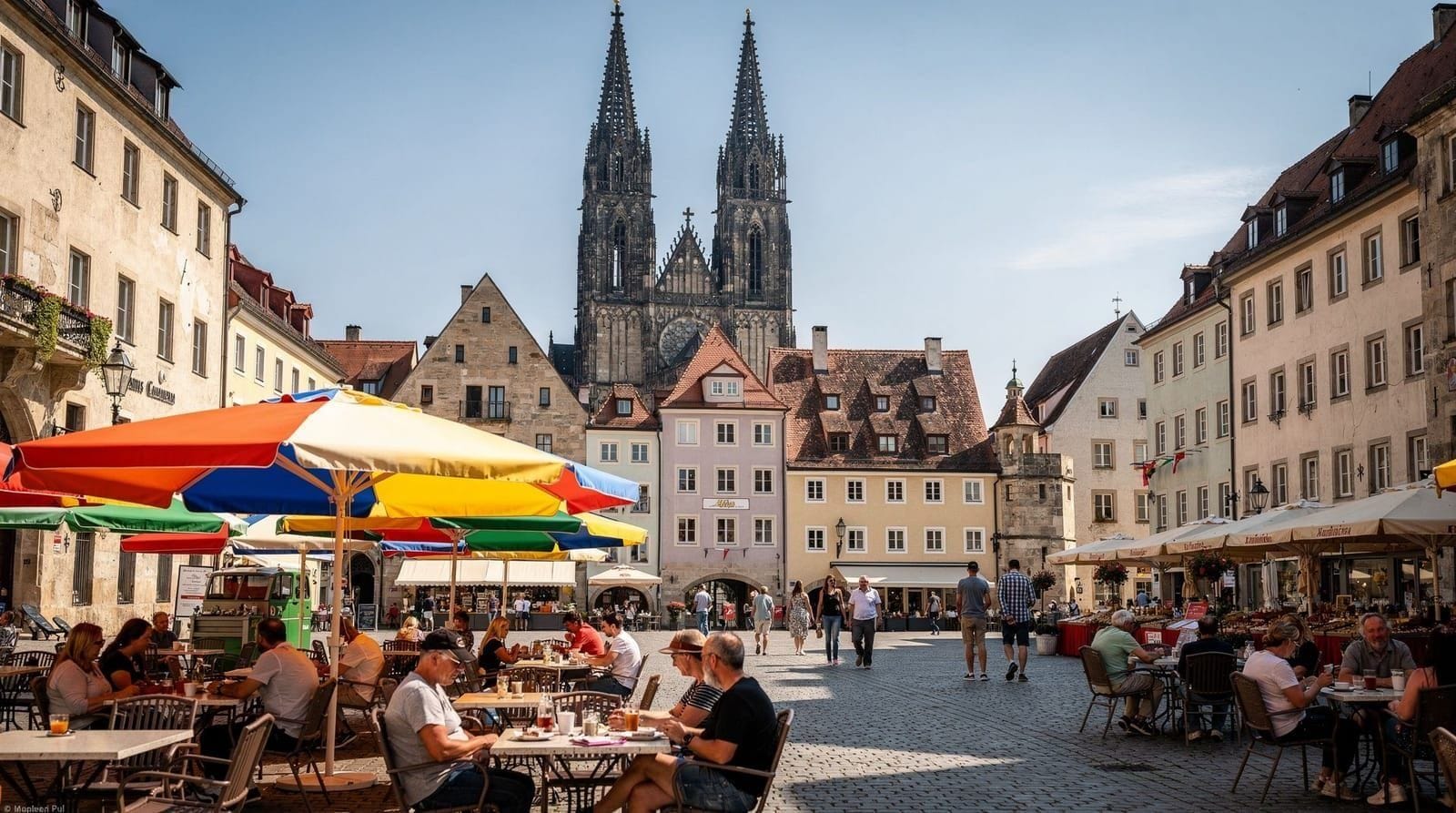
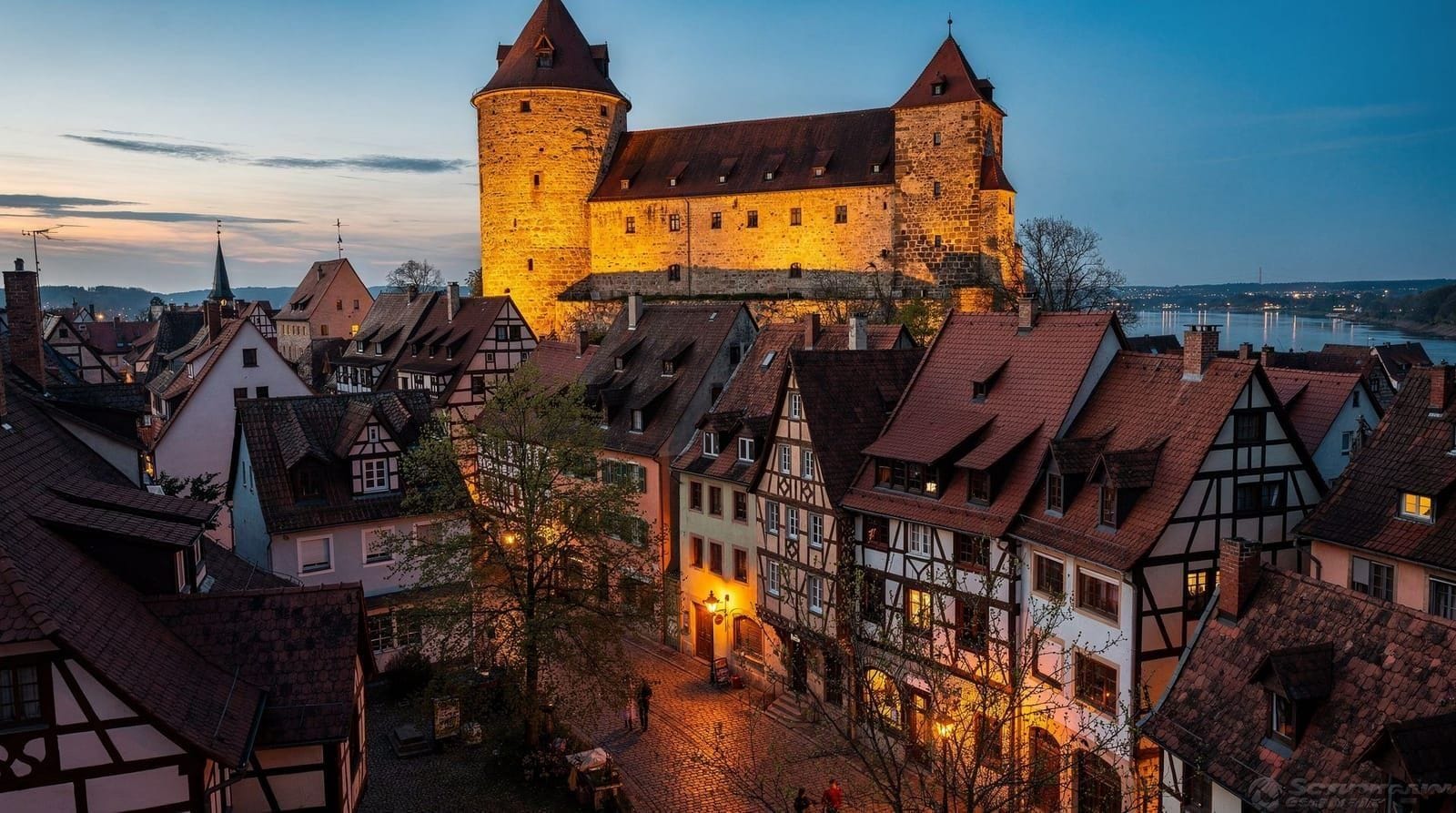
Regensburg is one of Germany’s least-known great cities outside Germany, and one of its most intact. Unlike Nuremberg, Munich, or Würzburg, Regensburg survived the Second World War without significant bomb damage — the Allies classified it as a protected historical site, and a combination of circumstance and strategic decisions left the city centre largely standing. The result is a medieval urban fabric that is genuinely 12th to 14th century, not reconstructed: the alleys, towers, patrician merchant palaces, and the Steinerne Brücke (Stone Bridge) are the originals.
UNESCO recognised this in 2006 when it inscribed the “Old Town of Regensburg with Stadtamhof” as a World Heritage Site, citing it as an “exceptionally well-preserved example of a medieval central European trading city.”
The city also sits at the most northerly bend of the Danube — the point where the river turns east toward Vienna, Budapest, and the Black Sea. The Romans established a fort here in 179 AD under Marcus Aurelius. The medieval patrician families who grew rich on the salt and spice trade with the east built towers modelled on Italian precedents — Regensburg has over 20 such towers still standing, earning it the nickname “the Bologna of the north.” The oldest continuously operating sausage restaurant in the world is here, built into the city wall in the 12th century to feed the bridge workers.
Quick answer — is Regensburg better than Nuremberg for a day trip? Different, not better. Regensburg’s old town is more authentically intact, less touristic, and more pleasant to walk. Nuremberg has more dramatic WWII-related history and the Kaiserburg. If you have one day for both cities: impossible without rushing. Pick based on interest — Regensburg for authentic medieval atmosphere and Roman layers; Nuremberg for imperial and 20th-century history.
| Where | 120 km northeast of Munich, on the Danube’s northernmost bend |
| Cost | Around €31 Bayern-Ticket return; cathedral and Roman gate free |
| Time needed | 1 full day; overnight adds Kelheim/Weltenburg Gorge |
| Getting there | Direct regional train from Munich Hbf, about 1h30 |
| Best time | April–June or September–October; avoid August weekends |
Getting there from Munich
By train: Direct trains (RE or IC) connect Munich Hauptbahnhof to Regensburg Hauptbahnhof in 1h25–1h45 depending on the service. Regional trains are covered by the Bayern-Ticket (€31 single person, +€9 per additional passenger up to five). Intercity trains are faster but require a supplement or separate ticket. Direct trains run roughly every hour; check the Deutsche Bahn app for the current timetable.
From Regensburg Hauptbahnhof, the old town and Stone Bridge are 15 minutes on foot (roughly 1.2 km). The city centre is compact and walkable — you will not need public transport for a typical day visit.
By car: A9 from Munich toward Nuremberg, then A93 toward Regensburg. Total 1h30–2h without traffic. Parking in the Altstadt is limited; use the P+R facilities at the main station or the car parks at Dultplatz (near the Danube). Parking costs €2–3/hour in central areas.
For a guided tour that covers the key sites with expert context: Munich to Regensburg: UNESCO World Heritage day tour
Steinerne Brücke — the Stone Bridge
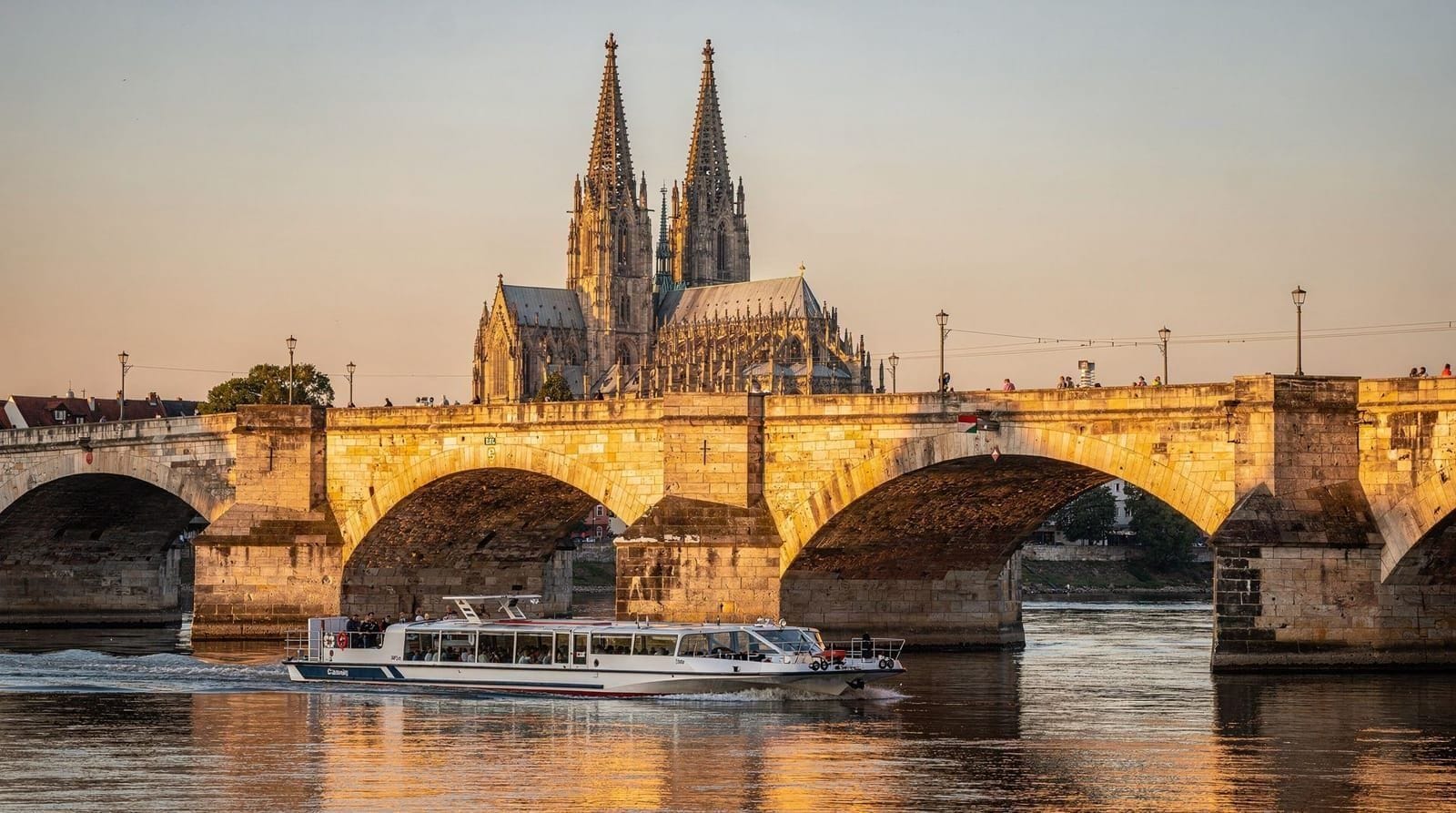
The Steinerne Brücke was completed in 1146 after 11 years of construction. For centuries it was the only permanent crossing of the Danube between Vienna and the Black Sea region — which made Regensburg a dominant trading hub and made the bridge itself a piece of strategic infrastructure as much as a civic monument. It is 336 metres long, 8 metres wide, and rests on 16 arches, with two gate towers (one still standing, one demolished in the 19th century).
Building a permanent stone bridge over the Danube at this point was a significant engineering achievement for the 12th century. The spans over the central channel had to withstand the Danube’s spring floods, which are substantial at this bend. The structure used no mortar in its original construction — the stones were shaped and fitted under dry-stone principles, which counterintuitively makes the bridge more flexible under stress than a mortared structure.
The bridge is free to cross and has pedestrian and bicycle traffic. The view from the midpoint, looking back at the cathedral and the old town above the Danube embankment, is the classic Regensburg photograph. Mornings and evenings in good light are the best times.
The Brücktor (bridge tower) on the Regensburg side contains a small exhibition about the bridge’s history (entry €2; hours vary seasonally — check the Regensburg tourism website). The Historische Wurstkuchl (see below) is directly at the bridge foot on the northern bank.
The bridge has been under ongoing restoration since 2009. Some scaffolding on individual arches is likely during your visit; the walkway itself remains open.
Roman Regensburg
Regensburg’s pre-medieval history is better preserved and more visible than in most German cities.
Porta Praetoria: The north gate of the Roman fort Castra Regina, built in 179 AD under Emperor Marcus Aurelius. It stands at the corner of Unter den Schwibbogen and Dachauplatz in the old town — a 10-metre-high section of the original Roman wall and gate structure, now embedded in the wall of the Bischofshof hotel. The fort, at its height, housed the Third Italian Legion (Legio III Italica) and was one of the most important military installations on the Danube frontier. Entry is free; the gate is simply part of the street.
Römisches Museum (Roman Museum): Located in the former Minorite monastery at Dachauplatz, it contains Roman finds from the Castra Regina site: inscribed stones, military equipment, everyday objects, and the famous Castra Regina inscription that names Marcus Aurelius as the emperor under whom the fort was established. Entry €3.50 adult; closed Mondays.
The Roman layout under the city: The street pattern of the Altstadt partially follows the Roman grid — the Hauptstrasse runs along what was the Via Principalis of the fort. Several sections of the Roman wall are visible embedded in later medieval buildings throughout the old town; the Stadtmuseum has maps showing the overlay.
The cathedral and old town
Dom St. Peter (Regensburg Cathedral): Construction of the Gothic cathedral began around 1275 on the site of an earlier Carolingian church. The twin spires, at 105 metres, were not completed until 1869. This 600-year building period is visible in the fabric: the nave is 13th–14th century, the choir is early 14th century, and later additions include the Eselsturm (Donkey Tower), used to haul building materials.
The cathedral is famous for its Domspatzen (Cathedral Sparrows) — the boys’ choir founded in 975, making it one of the oldest choirs in the world still functioning. The choir performs at Sunday Mass and at concerts throughout the year. The stained glass in the nave (13th–14th century) is among the best-preserved medieval glass in Germany; the cloister on the north side contains an All Saints Chapel with Romanesque frescoes.
Entry to the cathedral is free. Guided tours in English run at 13:00 on weekdays (€5 per person; 45 minutes). The cathedral treasury (Domschatz) is a separate museum (€3) covering the liturgical objects and vestments.
Patrician towers and palaces: Regensburg’s trading families built stone towers as status symbols from the 12th century onwards — the height of your tower reflected your family’s wealth. More than 20 towers survive, some converted to apartments, some visible as sections integrated into later buildings. The Baumburger Turm (9 floors, 28 metres) on Watmarkt and the Goldener Turm (10 floors, 42 metres) on Wahlenstrasse are the most intact. Walking between them gives a clear sense of the medieval social competition they represented.
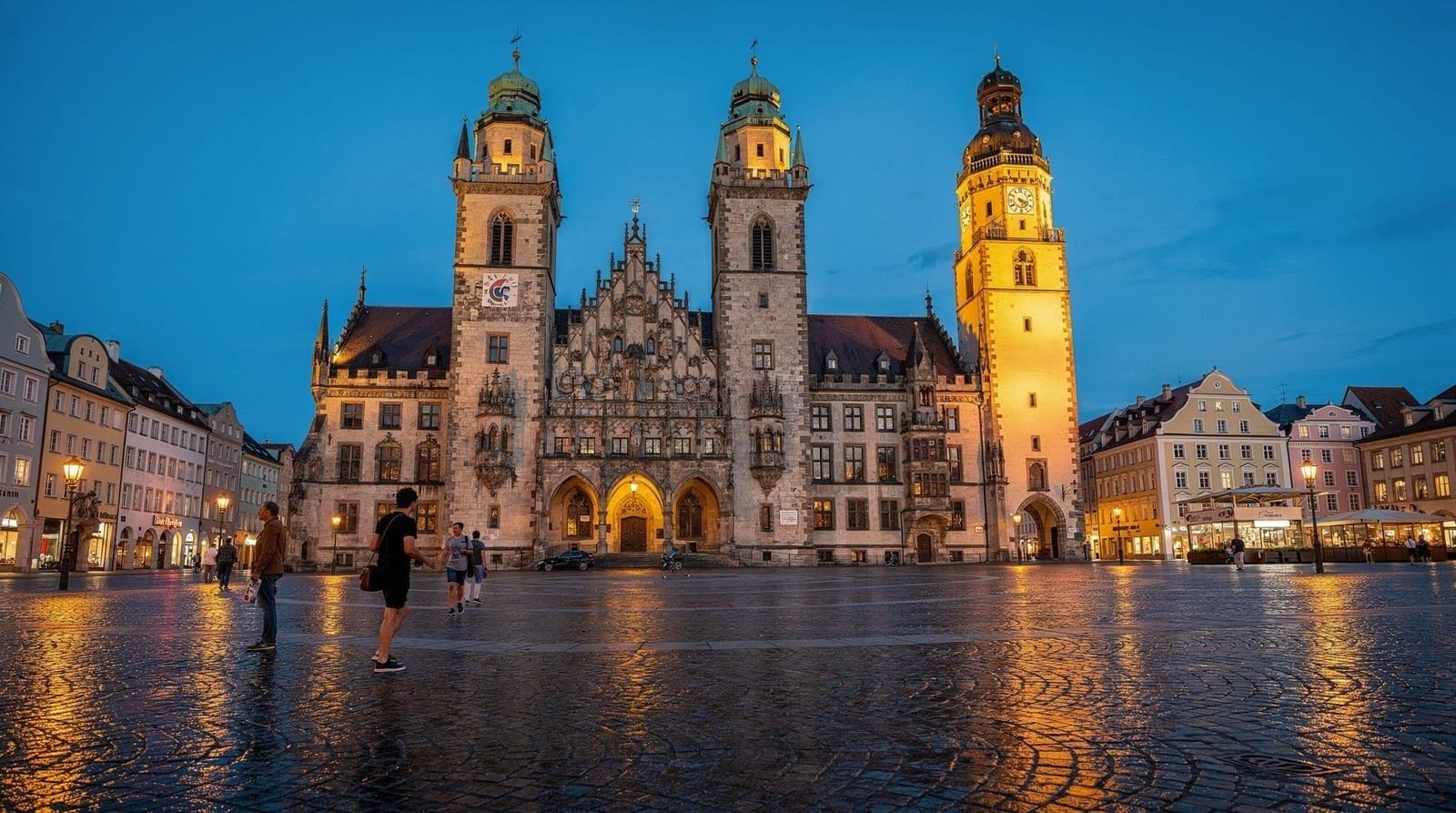
Altes Rathaus (Old Town Hall) and Imperial Diet Museum: The Reichssaal (Imperial Hall) of the Altes Rathaus was the meeting room of the Immerwährender Reichstag — the Perpetual Imperial Diet — which sat here from 1663 to 1806, one of the longest-running parliamentary sessions in history. The museum covers the political processes of the Holy Roman Empire with unusual clarity. Entry €7.50 adult; guided tours in English at 15:15 daily.
Historische Wurstküche — the oldest sausage kitchen
The Historische Wurstküche at Thundorferstrasse 3 — right at the foot of the Stone Bridge on the Danube embankment — has been identified in documents from 1135 as a cooking facility for the workers building the bridge. It served workers; later it served travellers crossing the bridge; now it serves tourists, but the product and the location are unchanged.
The kitchen produces one thing: small pork sausages (Regensburger Rostbratwürste) grilled over open beechwood, served with sweet mustard and Sauerkraut on a pewter plate. Portions come in 3, 6, or 9 sausages. The standard lunch portion (6 sausages) costs €10.80 (2026 price). A stein of beer is €5.50.
The outdoor seating on the Danube embankment operates when weather permits. The indoor section is tiny and fills quickly. Queue times at 12:00–13:00 on weekends are 20–30 minutes. Go before 11:30 or after 14:00 for easier access.
The kitchen is open daily 08:00–19:00 (kitchen closes 18:30). It accepts cash only. There is no reservations system.
This is not a tourist gimmick — the product is genuinely good and the setting, at the foot of the 900-year-old bridge with the Danube in view, is one of the better lunch experiences in Bavaria.
The Danube riverfront
Regensburg’s Danube embankment offers a perspective on the city that the old town streets do not. The Stone Bridge is the dominant feature from the south bank (Stadtamhof), looking back across the water at the cathedral spires and the patrician towers.
Stadtamhof: The island district north of the Danube, connected to the old town by the Stone Bridge and a footbridge further east, was historically a separate settlement (it became part of Regensburg officially only in 1924). Its character is quieter than the Altstadt — narrower lanes, local cafés, residential buildings. The view back across the river from Stadtamhof toward the cathedral and bridge is the best long-lens view of the city.
River cruises: Short Danube boat trips depart from the quay at the Steinerne Brücke on weekends and in summer. The 45-minute trips cover the old town embankment and upstream towards the Danube gorge. Operated by Wurm+Köck (Donauschifffahrt); prices approximately €10–13 adult. Booking at the dock; no advance booking required. A more substantial day cruise to the Weltenburg Gorge (see below) departs from Kelheim, accessible by regional train.
Walhalla: Situated 10 km east of Regensburg above the Danube, the Walhalla is a marble hall of fame for German-speaking notables, built by Ludwig I of Bavaria between 1830 and 1842. Its exterior is an exact copy of the Parthenon in Athens, which Ludwig considered the peak of architectural achievement. It contains 65 marble busts and 128 memorial plaques. Reachable by Donau-Schiffahrt boat from Regensburg (60-minute trip, approximately €12 one-way) or by car (10 km east on the B8). Entry €4.50 adult. An unusual and genuinely interesting detour if you have extra time.
Practical tips
Day structure: Train arrives Regensburg ~11:00. Walk from station to old town (15 min). Hauptstrasse and patrician towers. Dom St. Peter (free; 45-min). Altes Rathaus Imperial Diet Museum (if interested, add 45 min). Stone Bridge at midpoint for views. Lunch at Historische Wurstküche (arrive before 11:30 for shortest queues). Afternoon: Porta Praetoria and Roman Museum, or Walhalla boat trip. Train back from 17:30 or 18:30.
What the guided tours add: The layering of Roman, Carolingian, Romanesque, Gothic, and Renaissance in Regensburg’s old town is genuinely complex — guided tours make the chronology intelligible. The guided day trip from Munich provides expert commentary on the history that self-guided visitors typically miss: Munich: one perfect day in Regensburg guided day tour
Private car option: For families or small groups wanting maximum flexibility, a private driver tour from Munich covers Regensburg with custom timing: Munich: private tour by car to Regensburg medieval city
Combining with other day trips: Regensburg and Nuremberg are 80 km apart (45 minutes by RE train). Visiting both in a single day from Munich is possible but rushed — you sacrifice depth at both sites. Regensburg also pairs well with Kelheim and the Weltenburg Gorge (a limestone canyon with the oldest monastery brewery in the world, Kloster Weltenburg, dating from 620 AD) for an overnight trip.
Travel links from Munich: The day trips from Munich guide covers the full range of options including transport costs and time comparisons. The Bayern-Ticket guide explains how to use the €31 day pass that covers this route.
Eating beyond sausages: The Altstadt has numerous good restaurants and cafés. Café Orphée on Untere Bachgasse 8 is a French-style café in a 19th-century building — dependable coffee and lunch (€12–18 mains). Leerer Beutel on Bertoldstrasse 9 is a cultural centre with a riverside terrace and a good German menu. For beer: Alte Linde beer garden on Müllerstrasse has Danube views and local Kneitinger beer.
Getting around once you are there
Regensburg’s old town is flat and compact — around 1 km end to end — so almost everyone covers it entirely on foot. There is no need for local buses or trams for a standard day-trip itinerary; they exist mainly for residents in the outer districts. Cobblestones are extensive, so comfortable shoes matter more than in flatter, more modernised German city centres. If you are extending to Stadtamhof, the Stone Bridge and the Eiserner Steg footbridge further east are both short, level crossings. Bicycles can be rented at the Hauptbahnhof (several operators, roughly €12–15/day) if you want to combine the old town with a longer Danube-path ride toward Walhalla or Kelheim rather than taking the boat.
Regensburg vs Nuremberg vs Passau: which day trip
Three of Bavaria’s best historic-city day trips from Munich sit within a similar travel-time band. Here is how they compare on the things that usually decide it.
| Regensburg | Nuremberg | Passau | |
|---|---|---|---|
| Travel time from Munich | ~1h30 | ~1h | ~2h |
| Character | Intact medieval, Roman layers | Imperial + WWII history | Baroque, three-rivers geography |
| Crowds | Moderate | Higher (bigger city) | Lower, except cruise arrivals |
| Signature experience | Stone Bridge + Wurstküche | Kaiserburg + Documentation Center | Cathedral organ + fortress view |
| Best for | Architecture and food history | 20th-century history depth | River scenery, quieter pace |
See the best day trips from Munich guide for the full ranked list, and day trips by train from Munich for timetable specifics.
Regensburg with more time: Kelheim and Weltenburg Gorge
If a single day feels rushed, Regensburg pairs naturally with an extension to Kelheim, 30 km southwest and reachable by regional train (about 40 minutes) or bus. From Kelheim, a short boat trip runs through the Weltenburg Gorge (Donaudurchbruch), a narrow limestone canyon carved by the Danube, ending at Kloster Weltenburg — a Benedictine monastery brewery founded around 620 AD, generally credited as the oldest monastery brewery in the world still in operation. The monastery’s dark Barock Dunkel beer is worth the trip on its own, served in the abbey’s lakeside beer garden. Boats run roughly hourly in summer (April–October), less frequently outside season; check the Schifffahrt Kelheim-Weltenburg timetable before travelling, as winter sailings are weather-dependent. This extension turns a single day into a genuinely different second day rather than more of the same medieval streets.
Frequently asked questions about Regensburg
How long is the train ride from Munich to Regensburg?
Direct regional trains (RE or RB) take 1h25–1h45 from Munich Hauptbahnhof. The Bayern-Ticket covers regional trains and costs €31 for a single person, plus €9 per additional person (up to five on one ticket). Check Deutsche Bahn for current schedules; trains run roughly every hour.
Is Regensburg a UNESCO World Heritage Site?
Yes. The Old Town of Regensburg with Stadtamhof was inscribed in 2006, covering the medieval city centre, the Stone Bridge, and the Stadtamhof district across the Danube. The inscription specifically cites the unusually intact medieval street pattern, the patrician towers, and the layering of Roman, Carolingian, and Gothic history.
What is the Historische Wurstküche and do I need to book?
The Historische Wurstküche is a sausage kitchen operating at the foot of the Stone Bridge since approximately 1135 — the oldest restaurant of this type in the world still producing the same product in the same location. No reservations; arrive before 11:30 or after 14:00 on weekends to avoid 20–30 minute queues. Cash only. Sausages from €9.30 for three.
Did Regensburg survive WWII intact?
Largely yes. The Allies classified Regensburg as a protected historical city, and the bombing of the city was limited compared to Nuremberg, Munich, or Würzburg. The old town’s medieval fabric, the Stone Bridge, and the cathedral survived without major damage. This makes Regensburg one of the most authentically intact medieval cities in southern Germany.
How does Regensburg compare to Nuremberg as a day trip from Munich?
Regensburg has a more authentically intact medieval city (not reconstructed), a more relaxed atmosphere, stronger Roman heritage, and the oldest sausage kitchen in the world. Nuremberg has the more dramatic WWII history (Documentation Center, Nazi Rally Grounds, Trials Courtroom), a slightly easier ICE train connection, and more tourist infrastructure. Both are excellent; the choice depends on whether you prioritise medieval authenticity or 20th-century history.
Is Regensburg suitable for children?
Very much so. The Stone Bridge walk, the Danube river view, the sausages at the Wurstküche, and the Walhalla boat trip are all engaging for children. The Roman Tower and fortress history provide age-appropriate historical context. The city is flat and compact, making it easier to navigate with children than hillier Bavarian destinations.
Can I visit the Walhalla on a day trip from Munich?
Yes, but it adds 1h30–2h to the itinerary. Take the Danube boat from the Regensburg quay (approximately €12 one-way, 60 minutes) or drive 10 km east. Entry €4.50 adult. If including the Walhalla, take an early train from Munich to have enough time for both.
Is Kelheim and the Weltenburg Gorge worth adding to a Regensburg trip?
Yes, if you have a second day or are willing to make it a long single day. Kelheim is 30 km southwest of Regensburg by regional train or bus, and the boat trip through the Weltenburg Gorge to Kloster Weltenburg — the world’s oldest monastery brewery, founded around 620 AD — is a genuinely different experience from the old town’s medieval streets: dramatic limestone cliffs and a working abbey brewery with a lakeside beer garden.
Which is better for a first-time visitor with only one Bavaria day trip to spare: Regensburg or Rothenburg ob der Tauber?
Both are excellent and quite different. Rothenburg ob der Tauber is the more classic “fairy-tale walled town” image and is more geared toward tourism, with the Night Watchman tour and Christmas Village. Regensburg is a larger, more lived-in city with a livelier local scene, better food beyond one specialty, and stronger Roman and medieval-political history. If you want the postcard image, choose Rothenburg; if you want a fuller city experience, choose Regensburg.
Top experiences
Bookable activities with verified prices and instant confirmation on GetYourGuide.