Rothenburg ob der Tauber
Medieval walled town on the Romantic Road — fully intact city walls, Käthe Wohlfahrt Christmas shop, the night watchman tour, and the Schneeball pastry.
From Munich: private guided tour to Rothenburg ob der Tauber
Quick facts
- Distance from Munich
- 260 km (2h30 by car; 2h45–3h15 by train with change)
- Population
- ~11,000 within the walled town and surroundings
- City walls
- 3.5 km, walkable full circuit in 1h; free access
- Night watchman tour
- Daily 20:00 in English (May–Dec), €9 adult; no booking needed
- Käthe Wohlfahrt Christmas store
- Open year-round; Herrngasse 1
- Schneeball (pastry)
- €2.50–5 depending on size and coating; controversial locally
The medieval town that survived the Thirty Years’ War and six million tourists a year
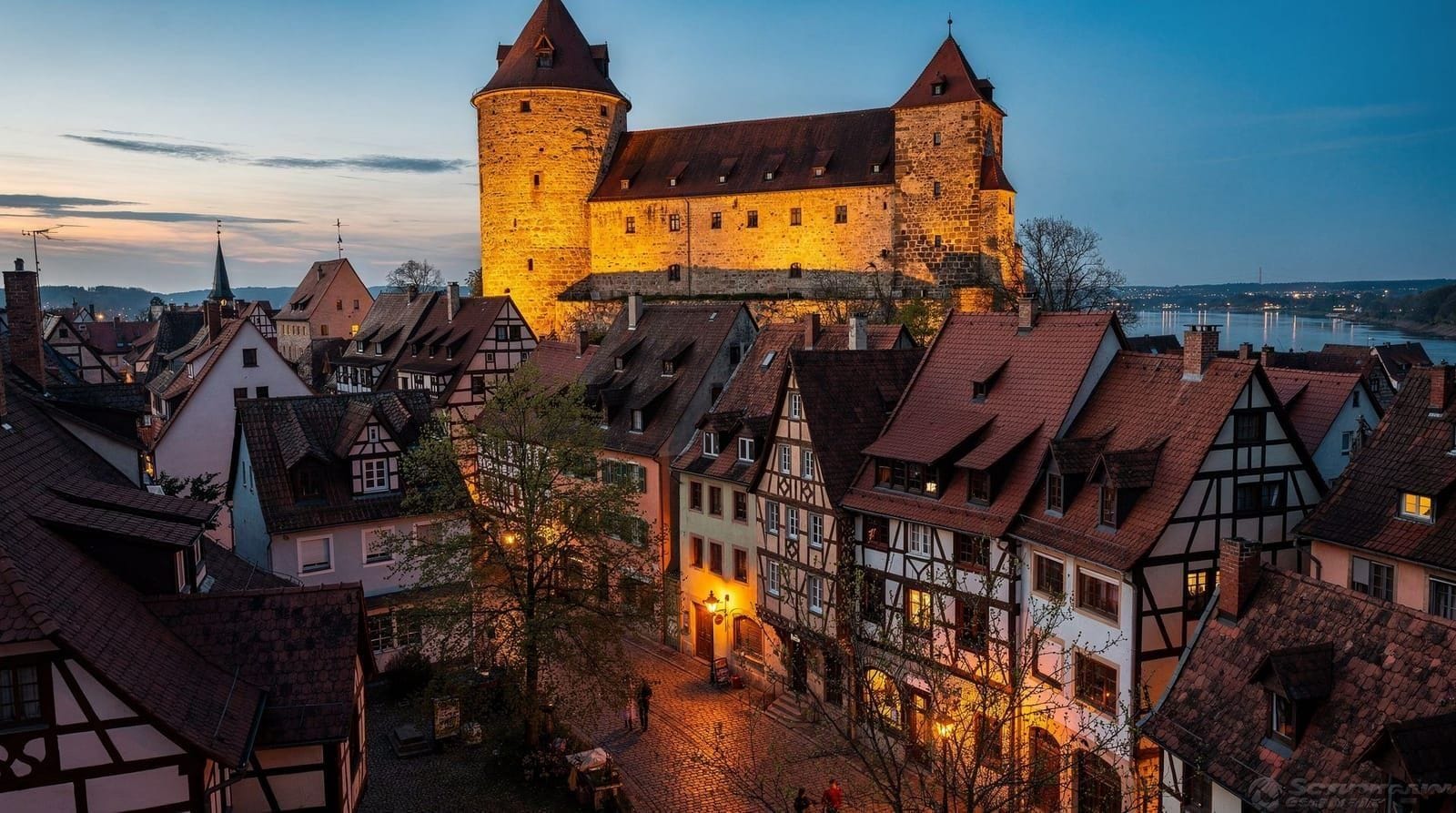
Rothenburg ob der Tauber sits on a plateau above the Tauber valley and has been enclosed by the same ring of medieval walls and towers since the 14th century. Its streets, half-timbered houses, Gothic churches, and market square look as they did 600 years ago — not because they were rebuilt, but because the town was economically irrelevant for three centuries after the Thirty Years’ War (1618–1648) and lacked the capital to modernise. Stagnation preserved it. By the time Germany’s 19th-century tourism industry discovered it, the town had become a living museum of the late medieval German merchant city.
Six million visitors a year now pass through a town of 11,000 residents. The challenge for the first-time visitor is understanding what is worth seeing (the city walls, the night watchman tour, the interior of St. Jakob Church, the Plönlein), what is tourist theatre (most of the shop-window displays), and how to experience the town in a way that justifies the 2h30 drive or 3-hour train journey from Munich.
Quick answer — is Rothenburg worth the trip? Yes, with managed expectations. The city walls circuit is genuinely extraordinary — 3.5 km of medieval battlements you can walk completely, with views over the Tauber valley, that have no peer in Germany. The night watchman tour at 20:00 is one of the best guided experiences in Bavaria for the combination of quality and value. The medieval town centre is as intact as the photographs suggest. The problem is volume: in July and August, Marktplatz is so crowded that the experience degrades significantly. Overnight stays or very early morning arrivals reveal a different city.
| Where | 260 km north of Munich, on the Romantic Road, Tauber valley |
| Cost | Wall walk free; night watchman tour €9; Crime Museum €7 |
| Time needed | 1 full day; overnight recommended for the evening atmosphere |
| Getting there | No direct train — 2h15–2h45 by car, 2h45–3h15 by train via Nuremberg/Steinach |
| Best time | April–May or late Sept–Oct; December for the Christmas market |
Getting there from Munich
Rothenburg is further from Munich than Nuremberg, Regensburg, or Augsburg — 260 km by road — which makes the logistics more important to plan.
By car: A9 north from Munich to Nuremberg, then A6 west toward Heilbronn, exit at Schwabach-West or Bad Windsheim, then B13 south to Rothenburg. Alternatively, A8 west to Augsburg, then B25 north through the Romantic Road towns. Total: 2h15–2h45 without traffic. Weekend summer traffic on the A9 and around Nuremberg can add 45–60 minutes. Parking in Rothenburg is in designated lots outside the walls — P1 at the western gate (Galgentor) and P2 at the south (Rödertor) are both free or nominal charge.
By train: No direct train from Munich. The standard route is ICE or RE to Nuremberg (1h–2h30 depending on train type), then regional train (RB) from Nuremberg to Steinach (45 min), then a connecting local train to Rothenburg (15 min). Total journey: 2h45–3h15 with good connections. Bayern-Ticket covers the regional portion (Nuremberg–Steinach–Rothenburg) but not the ICE Munich–Nuremberg leg. Check the Deutsche Bahn app for current connections; the Steinach–Rothenburg branch runs hourly.
Organised day trip from Munich: Given the train complexity, a guided day trip is significantly more convenient for visitors without a car. Tours typically include transport, a guided walk of the old town, and the key sites: From Munich: private guided tour to Rothenburg ob der Tauber
The seasonal bus tour is cheaper and runs April to October: From Munich: Rothenburg and Romantic Road day trip by bus
The city walls
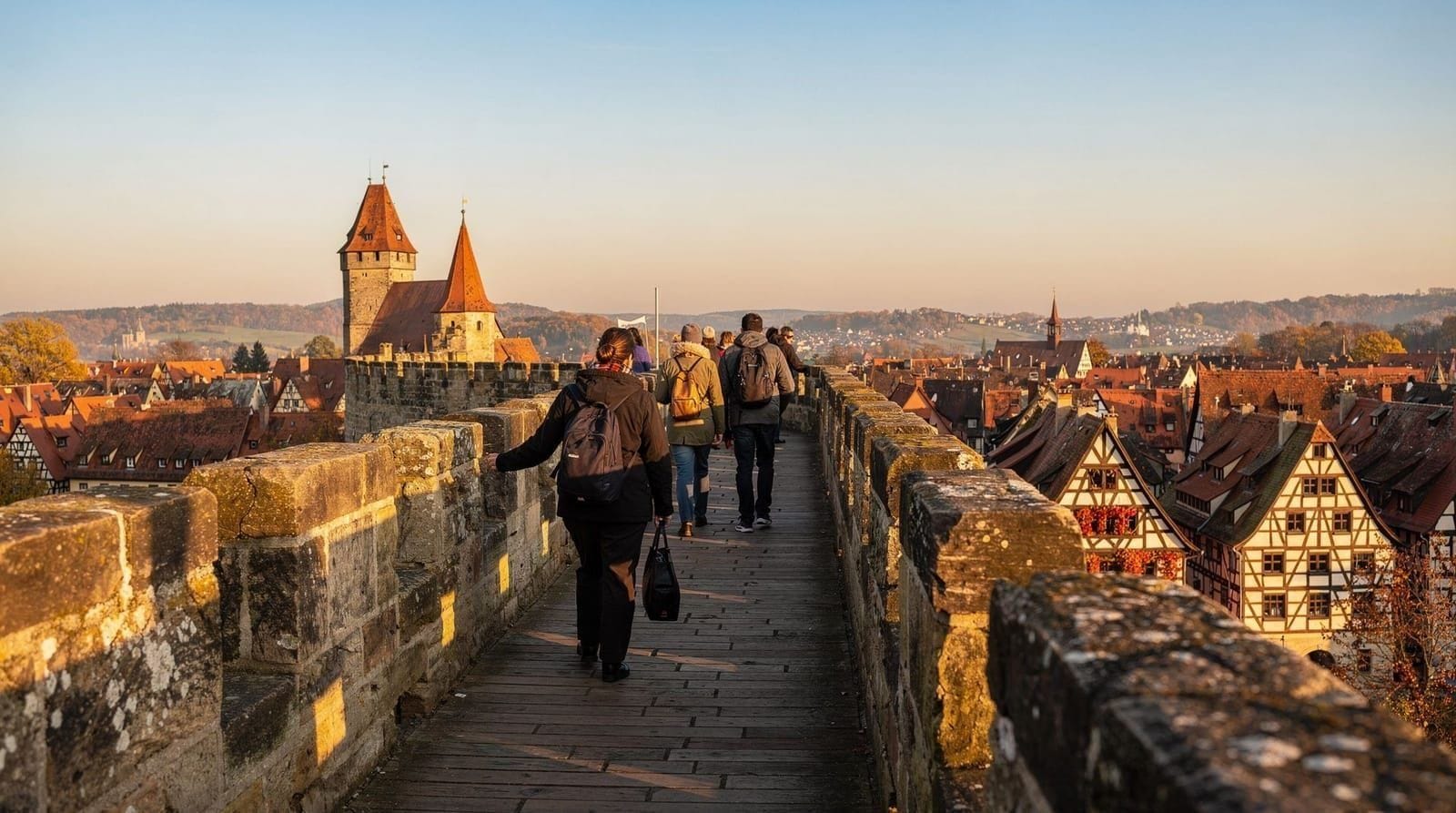
The Stadtmauer of Rothenburg is the definitive experience of the town. The walls are 3.5 km in circumference, 14th–15th century, and walkable almost in their entirety on a covered gallery running along the battlements. Entry to the wall walks is free; the roofed galleries are open from sunrise to sunset.
The walls were built in several phases. The inner ring (much of which is now the inner town street pattern) dates from the 12th century. The outer ring with the 42 towers was added in the 14th century when the town expanded. The battlements are equipped with crenellations, shooting slots (Schießscharten), and in places the original wooden hoarding platforms over the gates. The towers include the Röderturm (with a museum of the wall’s history, entry €2) and the Klingenturm (northern gate tower with views over the Tauber valley).
The best section for views is the northern stretch between the Klingenturm and the Galgenturm (Gallows Tower), which looks out over the valley below the town plateau. The best photographs of the town’s exterior are from the road below the walls on the Tauber valley side — particularly the Kobolzeller Steige path down to the valley floor, which gives the classic perspective of the towers above the vineyards.
Walking the full circuit takes approximately 1 hour at a relaxed pace. The walls are accessible at multiple entry points via stairways throughout the old town.
Old town highlights
Marktplatz: The central market square is dominated by the Rathaus (Town Hall) — a combination of Gothic (14th century, the older southern section) and Renaissance (16th century, the northern section) architecture. The Renaissance facade on the Herrngasse side has a Councillors’ Tavern (Ratstrinkstube) with a clock where mechanical figures emerge on the hour to re-enact the legend of the Meistertrunk (see below).
The Meistertrunk legend: During the Thirty Years’ War in 1631, Rothenburg was occupied by the Catholic Imperial forces under General Tilly. The story (semi-documented, partly apocryphal) holds that Tilly agreed to spare the town from destruction if a councillor could drink a 3.25-litre tankard of wine in one draught. Former mayor Nusch succeeded, the town was spared, and the Meistertrunk (Master Draught) became the town’s founding legend, re-enacted in a festival every Whitsun weekend. The clock mechanism performs at 11:00, 13:00, 15:00, and 17:00.
St. Jakob Church (Stadtpfarrkirche St. Jakob): The Gothic church begun in the 14th century contains the Heilig-Blut-Altar (Holy Blood Altar) by Tilman Riemenschneider, completed in 1505. Riemenschneider was the most important wood sculptor of late medieval Germany; this altarpiece, with its central depiction of the Last Supper, is considered one of his finest works. The three-dimensional spatial arrangement of the figures — with Judas placed at the centre rather than pushed to one side — is a deliberate and unusual compositional choice. Entry to the church: €2.50 adult.
Plönlein: The most photographed corner of Rothenburg — a small square where the street divides around a fountain, with two different towers (Siebers Tower and Kobolzeller Tower) visible simultaneously at different heights. The word “Plönlein” derives from the Latin “planum” (flat square). The view is genuinely as good as in every photograph; arrive before 09:00 in summer to have it without 50 people in the frame.
Medieval Crime Museum (Mittelalterliches Kriminalmuseum): Burggasse 3. A collection of 4 floors of medieval torture and punishment instruments, trial documentation, and legal history. The tone is museum-academic rather than sensationalist. Entry €7 adult, €5 reduced. Allow 1h30. More interesting than it sounds; the legal history section covering the transition from trial by ordeal to evidence-based procedure is genuinely illuminating.
The night watchman tour
Hans Georg Baumgartner has been performing the Rothenburg night watchman tour since 1995, wearing a medieval costume and carrying a horn lantern, halberd, and a copy of the 1654 night watchman’s book. He now has imitators in several other German towns; his Rothenburg version remains the original.
The tour departs at 20:00 from the Marktplatz, runs approximately 1 hour, and covers the medieval history of the town with a combination of genuine historical content and well-timed comedy. Topics include medieval municipal law, the night watch’s responsibilities (from checking locks to carrying the drunk home), the price of beer in 1500, and the role of the night watchman as the town’s lowest-paid municipal official.
Entry: €9 adult. No advance booking required — show up at the Marktplatz before 20:00 (arrive by 19:45 on summer weekends). The tour operates in English from May to December; in winter it runs on Fridays and Saturdays only. In summer peak season (June–August), tours regularly attract 80–120 people; the content remains audible as the guide projects well.
The experience is recommended without reservation. It is one of the most effective ways to learn the actual social history of a medieval German town while being entertained, and at €9 it is exceptional value.
For visitors who want a similar night watchman experience in Munich before the day trip to Rothenburg: Munich: Middle Ages tour with night watchman
Käthe Wohlfahrt Christmas Village
Käthe Wohlfahrt (Herrngasse 1) is the largest permanent Christmas shop in the world, operating year-round in a building fitted out as a permanent Christmas village with a working carousel, a 6-metre tree, and approximately 6,000 Christmas ornaments, nutcrackers, incense smokers, pyramids, and decorative items. It opened in 1977 and now sells mail-order to 120 countries.
The merchandise divides into two tiers: German-made traditional items (Erzgebirge carved figures, mouth-blown glass ornaments, Räuchermänner smokers from Seiffen) and lower-cost mass-produced items made in Asia. The traditional German-made items are expensive by most measures (a single hand-carved Erzgebirge figure can cost €80–200) but are genuinely high-quality craft objects. The Asian-made ornaments are priced at €5–20 and are essentially identical to what you would find in any Christmas market.
The shop is simultaneously worth visiting (the interior display is spectacular and the traditional craft section is a legitimate specialist retailer) and an obvious tourist operation. Buy if you find something you specifically want; don’t feel pressured by the atmosphere.
The Käthe Wohlfahrt Christmas Museum in the same building (entry €4 adult) covers the history of Christmas tree decoration traditions in Germany from the 17th century. It is small (about 45 minutes) and the admission is optional — the shop is free to enter.
December visits: The Reiterlesmarkt (Rothenburg Christmas market) runs on the Marktplatz from late November to 23 December. Smaller than Munich’s or Nuremberg’s markets but set against the half-timbered backdrop of the medieval square. Accommodation in December books out entirely; plan 2–3 months ahead and expect rates of €120–200/night for basic rooms.
Rothenburg on the Romantic Road
Rothenburg is the most famous and most visited stop on the Romantic Road — the 460-km route running from Augsburg in the south to Würzburg in the north. The route was established in 1950 to promote tourism in the region and passes through 29 towns and cities, mostly with medieval or Baroque character.
Rothenburg’s position on the route (roughly midpoint, 140 km north of Augsburg, 60 km south of Würzburg) makes it the natural overnight base for a Romantic Road drive. From Rothenburg, day drives reach Dinkelsbühl (40 km south, another intact walled town, smaller and less touristy), Nördlingen (70 km south, built entirely within a meteorite crater rim — the crater is visible from the church tower), and Würzburg (60 km north, with the Residenz palace and Würzburg wine country).
For a Munich-based itinerary that combines the Romantic Road towns:
Suggested 2-day road trip from Munich: Day 1: Munich to Augsburg (30 min, morning); Augsburg to Dinkelsbühl (100 km, 1h15); Dinkelsbühl to Rothenburg (40 km, 30 min); overnight Rothenburg. Day 2: Rothenburg morning (walls walk, Plönlein, St. Jakob, night watchman at 20:00 requires second overnight or timing adjustment); Rothenburg to Nördlingen (70 km); return to Munich via A9.
See the Romantic Road itinerary for a full multi-day plan.
Practical tips
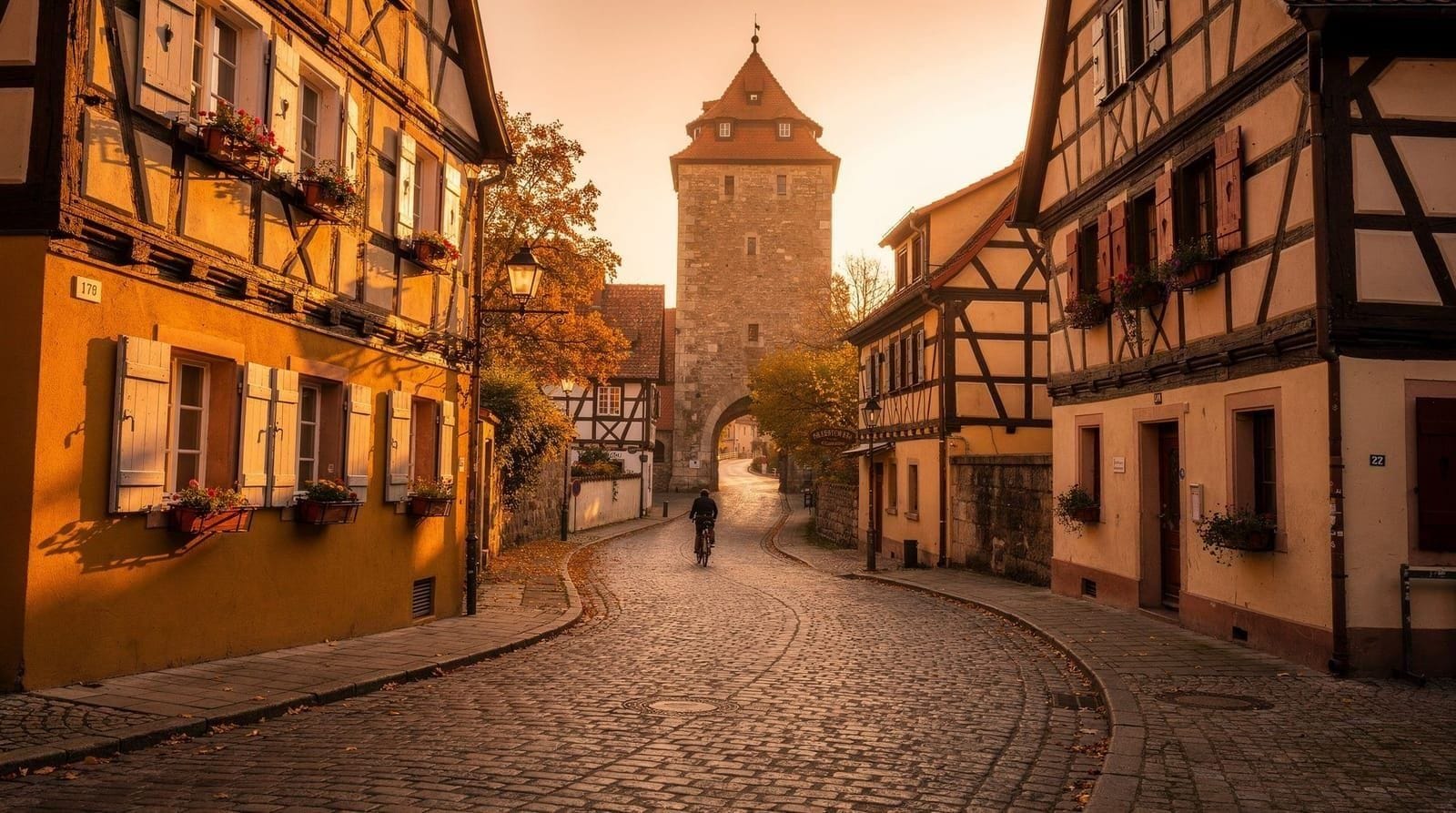
When to arrive: The old town is quiet before 09:00 and after 18:00 on most days. The tour groups (primarily from the US, Japan, and South Korea, arriving by coach) are heaviest between 10:00 and 16:00. The Plönlein, Marktplatz, and Herrngasse are meaningfully less crowded in the early morning. An overnight stay reveals the town after the day-trippers have left — the evening light on the half-timbered facades is completely different from the midday experience.
Schneeballen — what they are and whether to buy them: The Schneeball (“snowball”) is a Rothenburg-specific pastry: a disc of shortcrust dough wrapped around a special mold and deep-fried into a hollow ball, then coated with powdered sugar, chocolate, or other toppings. It is an 18th-century recipe with local roots. The version sold in most tourist shops (€2.50–5 depending on coating) is typically 3–4 days old and not particularly good. Fresh Schneeballen from a bakery on the same day are better, but the product is inherently dry. It is a novelty food rather than a culinary achievement. The Konditorei-Café Uhl (Plönlein 7) makes the most consistently fresh version in the old town.
Accommodation: Rothenburg has hotels and guesthouses within the walls and in the valley below. Within the walls, the Hotel Eisenhut (Herrngasse 3–7) is the most established option (doubles from €150). Gasthof Zum Breiterle (Rödergasse 7) is a cheaper local guesthouse (doubles from €85). Outside the walls, more functional hotels at lower prices.
Connecting with the Munich to Nuremberg day trip guide: Rothenburg is 90 km west of Nuremberg; they can be combined in a single long day by car, stopping in Rothenburg in the morning and Nuremberg in the afternoon, or vice versa. Public transport between the two requires a change at Ansbach and Steinach.
Getting around within Rothenburg: The old town is small (roughly 600 x 400 metres) and entirely walkable. No cars are permitted in most of the centre. From the main gate (Rödertor or Galgentor), all main sites are within 10 minutes on foot.
Rothenburg by season
| Period | Crowd level | Notes |
|---|---|---|
| April–May | Moderate | Good light, gardens and vineyards greening, fewer coach tours than summer |
| June–August | Highest | Marktplatz and Herrngasse crowded 10:00–16:00; early/late visits essential |
| Late September–October | Moderate, falling | Comfortable walking weather, harvest season in the surrounding vineyards |
| November (pre-Christmas) | Rising | Reiterlesmarkt setup, cooler, fewer coach groups than December |
| Late Nov–23 Dec | High (market-driven) | Christmas market atmosphere but accommodation books out months ahead |
| January–March | Lowest | Some restaurants and the Crime Museum on reduced hours; quietest, coldest streets |
Eating beyond the Schneeball
Rothenburg’s food scene is inevitably tourist-oriented on the main streets, but a few places reward seeking out. Zur Höll (Burggasse 8), in a building dating to the 10th century and once the town executioner’s residence, serves Franconian wine and hearty regional dishes in a genuinely atmospheric cellar — book ahead for dinner in summer. Villa Mittermeier (Vorm Würzburger Tor 7), just outside the walls, is the most ambitious kitchen in town, pairing modern German cooking with an extensive Franconian wine list; noticeably better value than similar quality in Munich. For a quick, unpretentious lunch, Marktplatz-Bäckerei stalls sell Franconian bratwurst rolls for €3–4, a far better use of a few euros than a stale Schneeball. Franconian wine, rather than Bavarian beer, is the local specialty here — the Tauber valley’s vineyards produce dry Silvaner and Müller-Thurgau whites worth a glass with dinner.
Rothenburg for photography
Rothenburg rewards planning around light more than most Bavarian stops. The classic Plönlein shot works best in the first hour after sunrise, when the low side-light picks out the half-timbering and the square is still empty. The exterior wall views — towers rising above the vineyards on the Tauber valley side — are best from the Kobolzeller Steige path in late-afternoon light, and again after dark when several towers are floodlit against the sky. Inside the walls, the Marktplatz clock performances (11:00, 13:00, 15:00, 17:00) draw crowds that are worth avoiding if you are shooting the square itself rather than the clock. A tripod is not required for most of these shots but is useful for the blue-hour tower views. None of this needs special access — everything is visible from public streets and the free wall walkway.
Frequently asked questions about Rothenburg ob der Tauber
How long does it take to get from Munich to Rothenburg?
By car: 2h15–2h45 (A9 via Nuremberg or A8 via Augsburg and the Romantic Road B25). By train: 2h45–3h15 with connections at Nuremberg and Steinach. The train route involves two changes; a guided bus or private tour is more convenient for visitors without a car.
Is Rothenburg ob der Tauber too touristy?
Yes and no. In July and August between 10:00 and 16:00, the Marktplatz and main shopping street (Herrngasse) are genuinely overcrowded. The same town at 08:00 or 19:00, or in April, May, or October, is a completely different experience. The city walls walk and the night watchman tour remain worthwhile regardless of crowds. The Schneeball shops and Christmas merchandise are obviously commercial. Understanding this in advance means you get the best of what the town offers without disappointment.
What is the night watchman tour and do I need to book in advance?
The night watchman tour departs at 20:00 from Marktplatz, lasts 1 hour, costs €9 adult, and requires no advance booking. Hans Georg Baumgartner leads the original version in English, May–December daily (winter weekends only). Arrive by 19:45 in summer. It covers medieval municipal history and night-watch duties with genuine content and good humour. Widely considered one of the best value guided experiences in Germany.
Can I walk the complete city walls in Rothenburg?
Yes. The Stadtmauer is 3.5 km in circumference with a covered walkway that allows the full circuit to be walked in approximately 1 hour. Access is free; entry points via stairways throughout the old town. The best views are from the northern wall section looking over the Tauber valley and from the towers at the main gates.
When is the Rothenburg Christmas market?
The Reiterlesmarkt runs from the last weekend of November to 23 December on the Marktplatz, roughly 10:00–19:00 daily. The Käthe Wohlfahrt shop is open year-round. Accommodation for the December market period must be booked months in advance.
Is it worth staying overnight in Rothenburg?
Yes, emphatically, if your schedule allows. The town after 18:00, when coach groups have departed, has a completely different character. The night watchman tour at 20:00 justifies the overnight stay by itself. Mornings before 09:00 allow photography at the Plönlein and Marktplatz without crowds. Budget approximately €85–150/night for a room within the walls.
How does Rothenburg compare to other Romantic Road towns?
Rothenburg is the most visited because it has the best-preserved complete city walls and the most coherent medieval streetscape. Dinkelsbühl (40 km south) is smaller, less touristy, and has intact walls of similar quality — worth adding if you are driving the route. Nördlingen (70 km south of Rothenburg) is built entirely within a meteorite impact crater and has a tower you can climb to see the crater rim — a genuinely unique geography. Augsburg (140 km south) is the most historically substantial and least picturesque. Each has a distinct character; the route works best as a 2–3 day drive rather than a series of identical day trips.
What is the best time of day to photograph Rothenburg?
The first hour after sunrise, before the coach tours arrive around 09:30–10:00, gives the Plönlein and Marktplatz without crowds and with flattering low-angle light on the half-timbered facades. For the classic exterior view of the towers above the valley, late afternoon light or the floodlit towers after dark from the Kobolzeller Steige path both work well.
Is Rothenburg accessible without a car for visitors staying in Munich only one night?
It is possible but tight: an early train (departing Munich by 07:00) via Nuremberg and Steinach can reach Rothenburg by mid-morning, leaving a reasonable afternoon before a last connection back, but the round trip alone consumes 5–6 hours of travel. Most visitors without a car choose a guided day tour instead, which removes the connection risk and includes commentary.
What should I eat in Rothenburg besides the Schneeball?
Franconian wine and hearty regional cooking are the better local specialty here rather than the tourist pastry — try Zur Höll for atmosphere in a 10th-century cellar building, or Villa Mittermeier for a more ambitious modern-German kitchen just outside the walls. A bratwurst roll from a Marktplatz bakery stall makes a cheaper, fresher quick lunch than a several-day-old Schneeball.
Top experiences
Bookable activities with verified prices and instant confirmation on GetYourGuide.