Romantic Road itinerary: Würzburg to Füssen by car or bus (2026)
From Munich: Rothenburg and Romantic Road day trip by bus
What the Romantic Road actually is
The Romantische Straße is a 460 km tourist driving route connecting Würzburg in northern Bavaria to Füssen in the foothills of the Alps. The route passes through 29 towns, but the four most worthwhile stops for a first-time traveller are Würzburg (the start, with a UNESCO-listed Residenz palace), Rothenburg ob der Tauber (the best-preserved medieval walled town in Germany), Augsburg (Roman foundations, Renaissance architecture, serious art), and Füssen (gateway to Neuschwanstein).
A direct drive from Würzburg to Füssen takes about 4 hours without stops. This itinerary spreads it over 4 days, allowing genuine time in each town rather than a windshield-tour approach. If you only have 2 days, focus on Rothenburg and Füssen.
Practical note on the Romantic Road bus: A dedicated tourist coach called the Romantic Road Coach runs the full route once a day from April to October. It departs Frankfurt at 08:00, stops at all major towns, and arrives in Füssen around 20:30. The full fare in 2026 is approximately €29.90 from Würzburg to Augsburg or €85 for the full Frankfurt–Munich route. It is a reasonable option if you have no car, though departure times are fixed and layover times at each stop are limited (45–90 minutes in Rothenburg).
| Where | Würzburg → Rothenburg ob der Tauber → Augsburg → Füssen/Neuschwanstein |
| Cost | Around €120–180 for a 4-day rental, or €29.90–85 for the Romantic Road Coach |
| Time needed | 4 days (3–4 minimum for the four main stops) |
| Getting there | Würzburg from Munich: 2h ICE; full route: 460 km, about 4h non-stop driving |
| Best time | May or September for good weather with fewer tour-bus crowds |
Day 1: Würzburg
Residenz and old town
Begin in Würzburg. If arriving from Munich by train, the journey takes 2 hours on a direct ICE; the Bayern-Ticket is not valid on ICE trains but a regular ticket costs about €45. From Frankfurt, it is 1 hour by ICE.
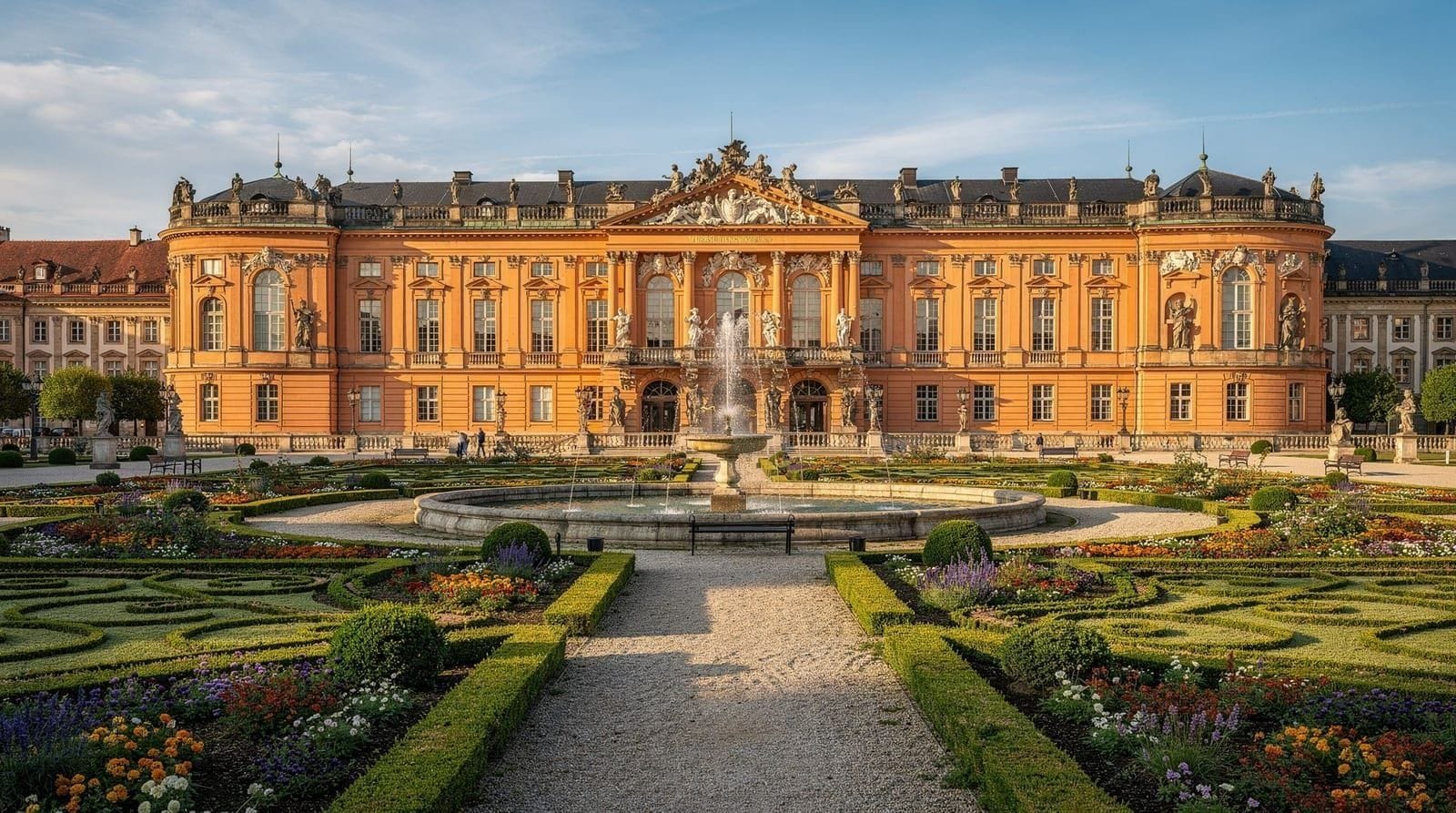
Würzburg Residenz (2026): Adults €9. This 18th-century palace designed by Balthasar Neumann contains what art historians generally consider the largest ceiling fresco in the world — Giovanni Battista Tiepolo’s allegory of the four continents in the staircase hall. It is genuinely impressive and not over-hyped. Tours run in multiple languages; the English guided tour is included in the entry price and lasts 50 minutes.
The Residenz gardens are free and pleasant for a walk. The old town and Alte Mainbrücke (Old Main Bridge, free) are 10 minutes walk from the Residenz. The bridge has wine bars built into the railing area on summer evenings — Würzburg is Franconian wine country and local Silvaner white wine is worth trying.
Fortress Marienberg: The hilltop fortress above the Main river is reachable on foot (30 minutes uphill) or by bus. Entry to the fortress grounds is free; the Princes’ Museum inside costs €5. The views over Würzburg vineyards and the old town are good.
Where to stay in Würzburg: The Hotel Rebstock at Neubaustrasse 7 is a historic inn with rooms from €95 per night. Budget options like Hotel Wittelsbach run €65–75. Dinner: Weinhaus Stachel at Gressengasse 1 serves Franconian food and local wine (mains €14–22).
Day 2: Rothenburg ob der Tauber
Medieval walls and the Plönlein
Drive or take the train from Würzburg to Rothenburg ob der Tauber (1 hour 10 minutes by train with a change at Steinach). By car it is 75 km on the B19/B290, about 1 hour direct.
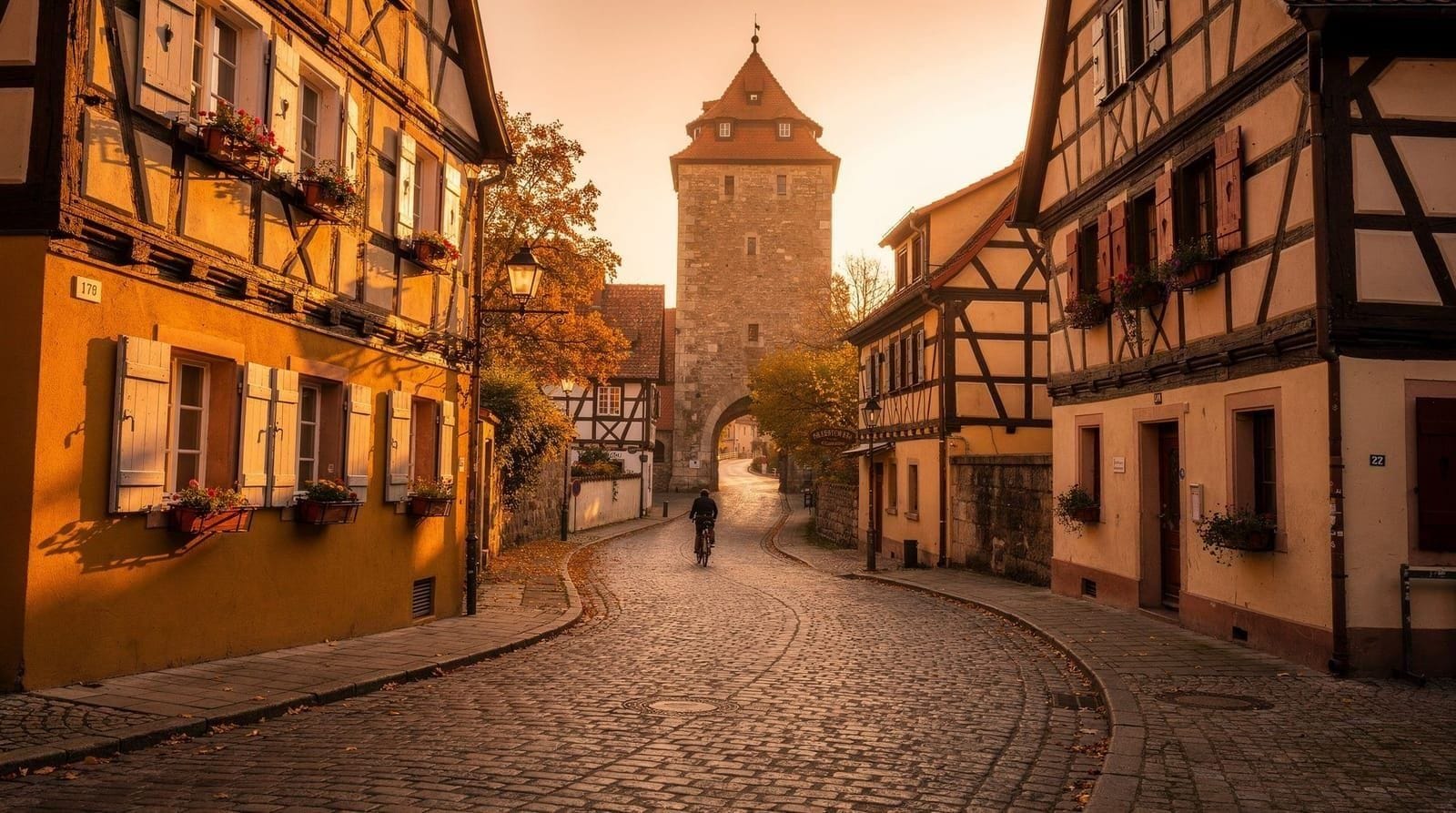
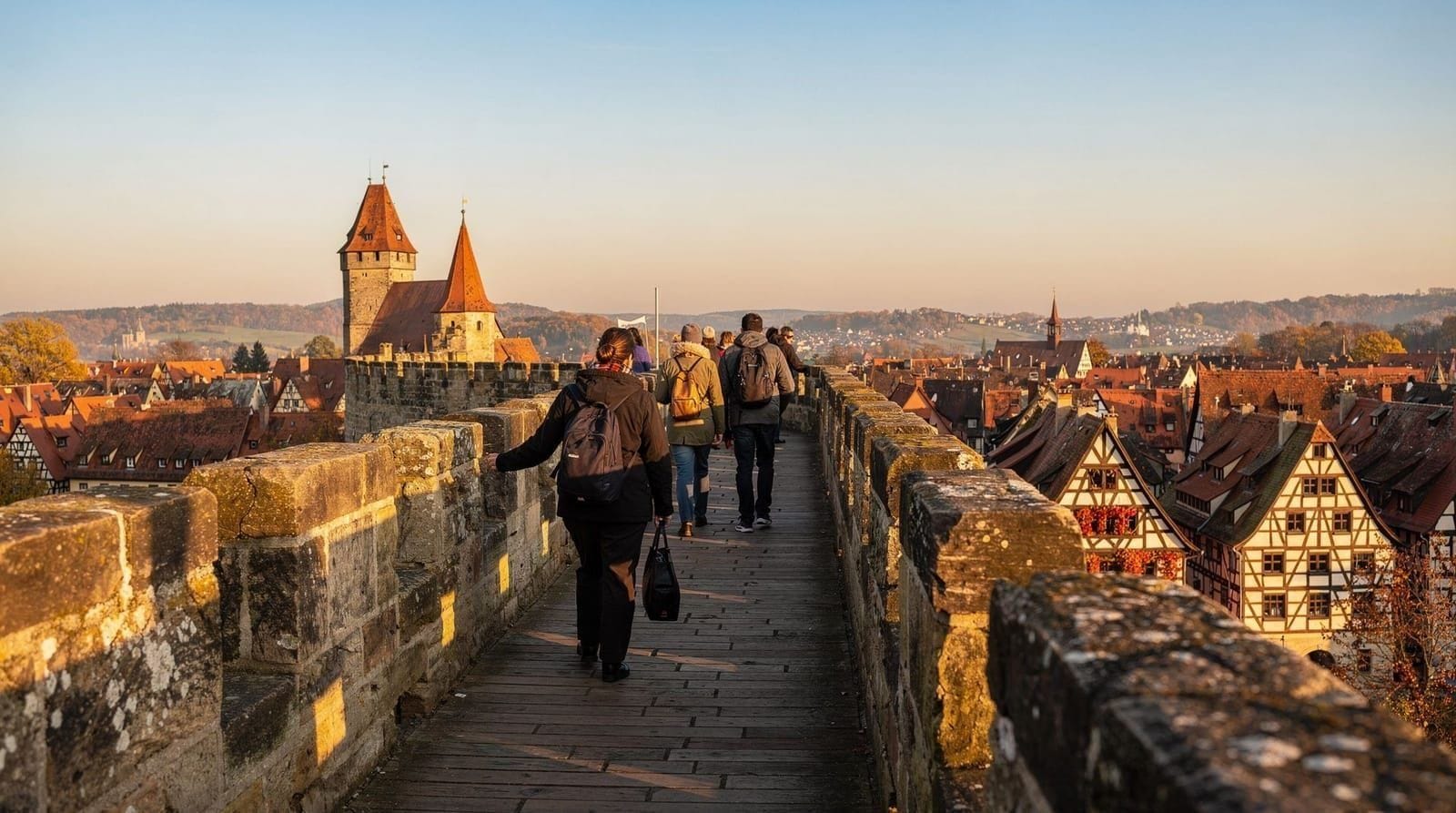
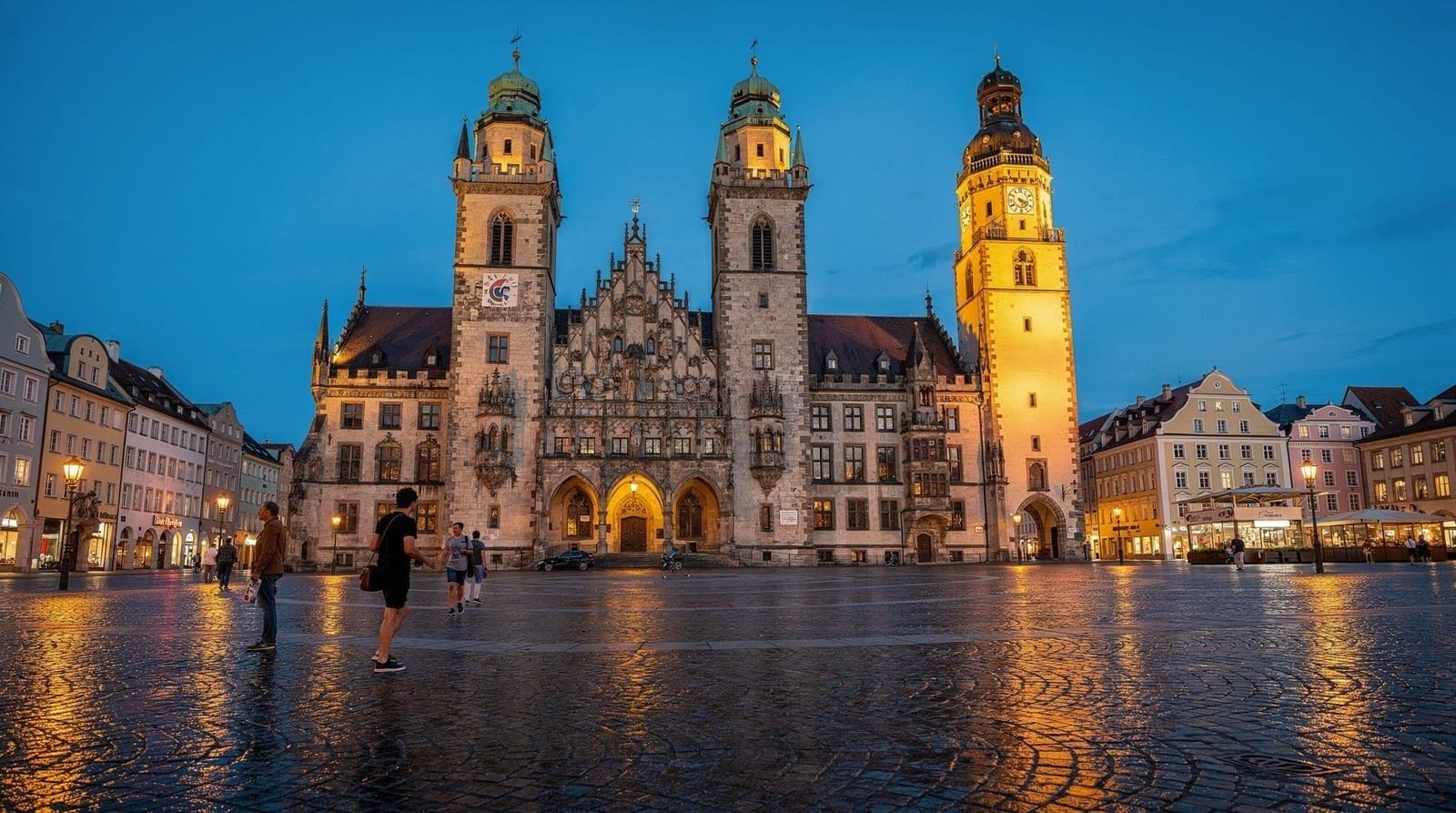
Rothenburg is the most visited stop on the Romantic Road. The medieval wall circuit is 2.5 km and can be walked in 45–60 minutes on the rampart path (free, some staircases closed in winter). The Plönlein — a half-timbered crossroads with a tower in the background — is the most photographed scene in Germany outside of Neuschwanstein. It is at its best before 09:00 or after 17:00 when day-trippers are absent.
St. Jakob’s Church: Entry costs €4.50. The church contains Tilman Riemenschneider’s 1504 Altar of the Holy Blood, a carved lindenwood altarpiece of exceptional quality. Worth 30 minutes.
Kriminalmuseum (Medieval Crime Museum): Rothenburg’s most genuinely interesting museum. Entry €8.50. Tools of medieval punishment and legal documentation from the 12th–18th centuries. Not for the squeamish, but instructive. Allow 1.5 hours.
Christmas village shopping: Käthe Wohlfahrt’s Christmas store at Herrngasse 1 is open year-round and sells German Christmas decorations at high prices. The quality is real; the tourist trap label applies to the crowds, not the products.
Honest assessment of Rothenburg: The town is extremely photogenic but also heavily commercialised. Dinner on the Marktplatz can cost 30% more than equivalent quality in Würzburg. Eat at Zur Höll (Hell’s Kitchen) at Burggasse 8 — it operates in a medieval cellar and serves honest Franconian food at reasonable prices (mains €13–18). Stay one night: Hotel Goldener Greifen at Obere Schmiedgasse 5 runs €90–130.
Day 3: Augsburg
Roman heritage and Renaissance wealth
Drive from Rothenburg to Augsburg (about 1 hour 45 minutes on the A7). Augsburg is often skipped on the Romantic Road, which is a mistake: it has more genuine historical depth than Rothenburg.
Fuggerei: The world’s oldest social housing complex, built in 1521 by the Fugger banking family. Entry €8. Residents still live here (around 150 people) and still pay the original rent of 88 cents per year, plus three daily prayers for the Fugger family. The small museum explains the social history. Allow 1 hour.
Augsburg Cathedral: Free. The nave dates from the 9th century. Five stained glass windows from around 1100 are among the oldest intact figurative stained glass in the world.
Golden Hall (Goldener Saal): Inside the City Hall on Rathausplatz. Entry €2. Rebuilt after WWII bombing, the original ceiling frescoes were reconstructed in the 1980s. The room was used for imperial receptions under Maximilian I in the early 1500s.
St. Anna’s Church: Free. Martin Luther stayed in the adjacent monastery in 1518 for his confrontation with Cardinal Cajetan. The Fugger Memorial Chapel inside (1509–1512) is considered the first Renaissance interior in Germany.
Augsburg has better value dining than Rothenburg. August restaurant at Beim Glaspalast 1 is the local fine-dining option (€45–65 per person for tasting menu). For a casual dinner, Zum Weissen Hasen at Rathausplatz 1 serves Swabian-Bavarian food at around €14–20 per main.
Where to stay in Augsburg: Hotel Ibis Augsburg Hauptbahnhof runs €75–95. Steigenberger Drei Mohren at Maximilianstrasse 40 is the historic luxury option at €150–200. Take the Romantic Road bus from Munich through Rothenburg (April–October)
Day 4: Füssen and Neuschwanstein
Alpine approaches and Neuschwanstein
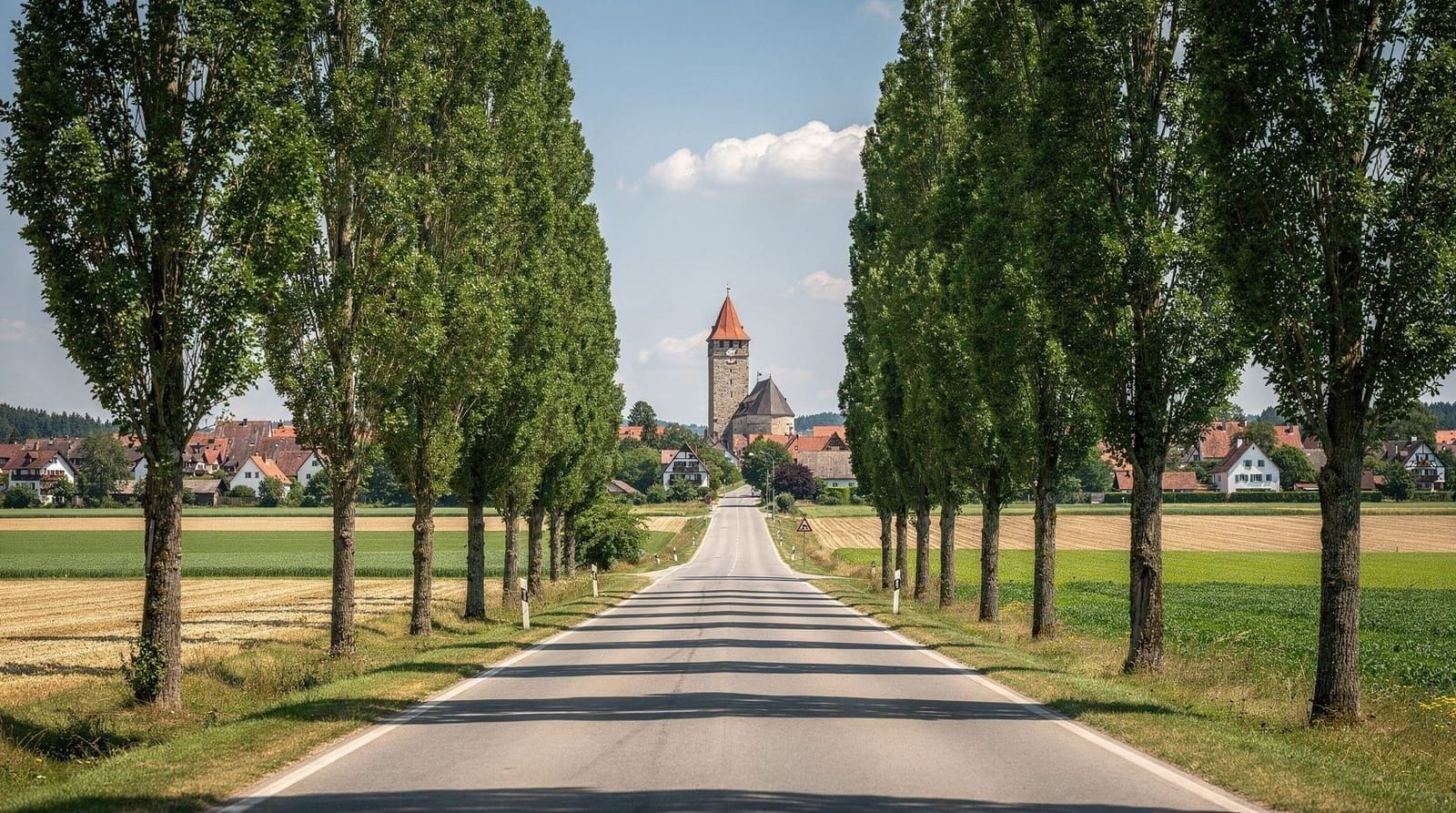
Drive from Augsburg to Füssen (about 1 hour 15 minutes on the B17 south). The B17 in its southern section is the Romantic Road itself — you drive through small Bavarian towns and the foothills become visible from about Landsberg am Lech onwards.
Arrive in Füssen by 09:00. The old town centre (Hohes Schloss, a late-Gothic bishops’ castle) can be seen in 45 minutes.
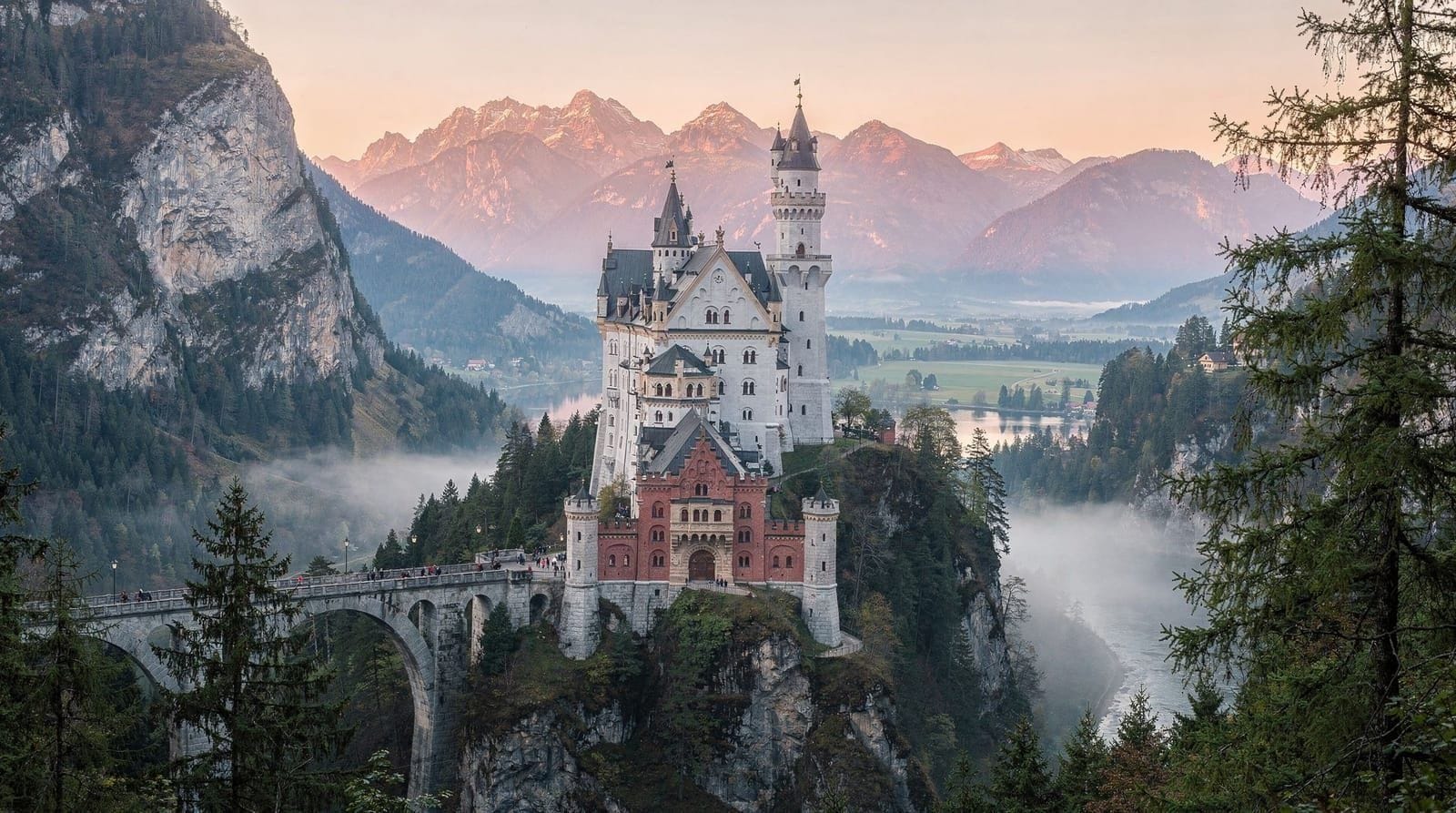
From Füssen, Schwangau and the Neuschwanstein ticket centre are 5 km away. If you pre-booked Neuschwanstein tickets (strongly recommended in summer), head directly there. If not, check ticket availability when you arrive — wait times can be 3–4 hours for walk-up visitors.
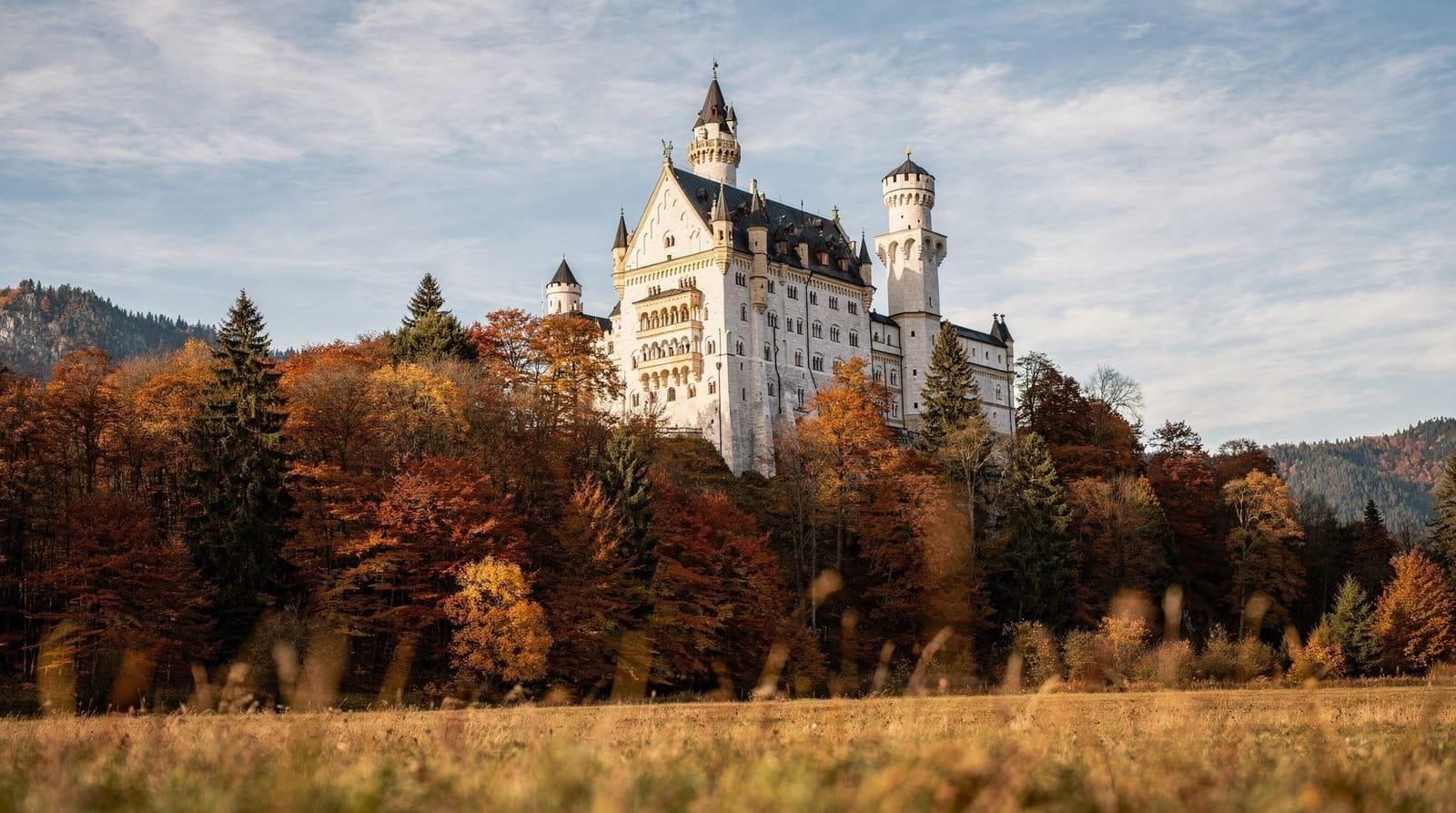
See our Neuschwanstein Castle guide for the full visit logistics. Entry costs €15 in 2026; the guided tour is included in the ticket.
Alpsee Lake: Below the castles, free to walk around. Swimming is permitted. On a warm afternoon, this is the most pleasant way to spend time after the castle.
If you are ending the trip in Munich, the train from Füssen takes 2 hours (change at Buchloe, Bayern-Ticket valid). If continuing by car, Füssen to Munich is 120 km on the A96, about 1 hour 20 minutes. Book your Neuschwanstein and Hohenschwangau entry ticket with audio guide from Füssen
Lesser-known stops worth adding
If you have extra time or want to leave the main tourist trail, three towns between the major stops are worth brief visits:
Dinkelsbühl (between Rothenburg and Augsburg): A walled medieval town that many travellers skip in favour of Rothenburg, but which is smaller, less commercial, and has an exceptional late-Gothic parish church (St. Georg’s Minster, free entry). The town never suffered major war damage and the intact wall circuit can be walked in 30 minutes. Allow 1–2 hours.
Landsberg am Lech (between Augsburg and Füssen on the B17): A pretty Bavarian market town on the River Lech. The Bayertor city gate (1425) is one of the finest Gothic town gates in Bavaria. The Rathaus facade by Dominikus Zimmermann is late-baroque rococo. Adolf Hitler wrote Mein Kampf while imprisoned in Landsberg fortress (1924); the fortress is still used as a prison and not publicly accessible, but the local Stadtmuseum has a small section covering the history. 1–1.5 hours.
Schongau (further south on the Lech): Intact medieval town walls, quiet market square, good lunch options. Rarely visited. 45 minutes.
Practical information
Car rental: Pick up in Würzburg and drop off in Munich (or Füssen). One-way rentals add a modest fee (€25–50). Budget about €120–180 for 4 days all-in at a mid-range provider (Sixt, Europcar).
By bus without a car: The Romantic Road Coach covers the route, but you are constrained by fixed schedules. A day in Rothenburg gets you 2.5 hours; enough for the walls and one museum. Book at romantische-strasse.de.
Fuel costs: The full driving route (Würzburg to Füssen via all stops) covers about 320 km. Fuel at 2026 prices (roughly €1.85/litre for petrol) costs around €30–40 for a standard car.
Accommodation total: 3 nights at €80–130 per night averages €240–390 per person in shared double room.
Honest assessment of the Romantic Road
The Romantic Road is worth doing once, and it rewards visitors who slow down and engage with the individual towns rather than ticking off sights from a moving vehicle. The biggest trap is trying to see too many of the 29 official stops — most of the smaller towns (Creglingen, Weikersheim, Bad Mergentheim) are pleasant but not remarkable enough to justify a dedicated stop unless you have a specific interest.
The four towns in this itinerary represent the genuine highlights. Rothenburg is the most photogenic in Germany; Würzburg has the most world-class single attraction (the Tiepolo fresco); Augsburg has the most depth for history-minded travellers; Füssen+Neuschwanstein is one of the most famous views in Europe.
What the route lacks: the Romantic Road avoids Munich almost entirely, which means you miss Bavaria’s capital. Connect it to a Munich stay before or after (Füssen is 2 hours from Munich by train).
For day-trip options from Munich to individual Romantic Road stops, see our Munich to Rothenburg day trip guide and romantic road day trip guide. If you are starting from Munich and driving north, see our best day trips from Munich guide for context on relative distances. Book a private guided tour from Munich to Rothenburg ob der Tauber
Würzburg in more depth
The Würzburg Residenz is on UNESCO’s World Heritage List (since 1981) and is one of the finest Baroque palaces in Europe. A few things the standard tour does not emphasise:
The ceiling fresco: Tiepolo painted the staircase hall ceiling (650 square metres) in 1752–1753. The allegory of the four continents is complex: Europe is depicted as a continent of art and learning (musicians, painters, architects); Asia as sensual and exotic; Africa as dominated by a camel; America as primitive (a problematic 18th-century worldview worth understanding in context). The fresco survived the 1945 bombing that destroyed most of Würzburg because the masonry vaulting was exceptionally strong — British architectural historian Gombrich described it as an “almost incredible miracle.”
The White Hall: The stucco decoration in the White Hall (adjoining the staircase) is by Antonio Bossi and represents the apotheosis of European Rococo plasterwork. No paint — everything is in natural white plaster, intricately carved. Often overlooked because the fresco upstairs is so dominant.
The Court Garden: Behind the Residenz, free to enter, open dawn to dusk. The terraced formal garden with its wrought-iron balustrades is the best-preserved Baroque garden in northern Bavaria.
Würzburg wine: The city produces some of the most respected white wines in Germany — Franconian Silvaner and Riesling in distinctive squat Bocksbeutel bottles. Buy directly from the Staatlicher Hofkeller (a wine estate that has operated since 1128, located in the Residenz vaults). Prices are fair: a quality bottle costs €9–18 at the cellar shop, half what equivalent quality costs in a Munich restaurant.
Rothenburg in more depth
The Meistertrunk legend: The most repeated Rothenburg story is that the city was saved from destruction during the Thirty Years’ War (1618–1648) when the mayor drank a 3.25-litre stein of wine in one go, satisfying a bet made by the conquering general. The tale is almost certainly invented in the 18th century, but it is commemorated in a clock mechanism on the Ratstrinkstube (Councillors’ Tavern) that animates at 11:00, 12:00, 13:00, 15:00, and 20:00–22:00.
Tilman Riemenschneider: The sculptor responsible for the Altar of the Holy Blood in St. Jakob’s Church is one of the most significant German artists of the late Gothic period. Riemenschneider worked in Würzburg, Bamberg, and Rothenburg — this itinerary passes through the heart of his geographic range. The Würzburg Museum im Kulturspeicher has additional Riemenschneider pieces.
The Deutsche Weihnachtsmuseum: Adjacent to Käthe Wohlfahrt’s store at Herrngasse 1. Entry €4. A serious collection of German Christmas ornament history, covering 150 years. Worth 45 minutes if Christmas is your primary reason for visiting.
Augsburg in more depth
Jakob Fugger “the Rich”: The founder of the Fuggerei was also the most powerful banker in Europe in the early 16th century. He personally financed the election of Holy Roman Emperor Charles V (effectively buying the position for the Habsburgs against competing offers from the French). The Fugger Palace at Maximilianstrasse 36–38 (free to enter the courtyard) has original Renaissance arcading from 1515.
The Augsburg Water System: The city has a UNESCO-designated water system of towers, canals, and pumping stations dating from the 15th–17th centuries. Three water towers (Vogeltor, Rotes Tor, and Hochablaß) are visible in the old town. The Maximilian Museum at Philippine-Welser-Strasse 24 covers the system’s history.
Extending toward Munich or the Alps
This itinerary ends in Füssen, but two natural extensions exist depending on your onward plans. Travellers heading back toward Munich can add the Munich castles 3-day itinerary sites (Linderhof, Herrenchiemsee) since Füssen is already within striking distance of Linderhof — about 40 minutes further south. Travellers continuing into Austria can use Füssen as a springboard toward Reutte and the Tyrolean Alps, though that falls outside the scope of this Bavaria-focused route. Either extension works better as a genuinely separate multi-day addition rather than a rushed same-day detour, given how much ground the core four-day Romantic Road route already covers.
Day-by-day summary at a glance
| Day | Town | Highlight |
|---|---|---|
| 1 | Würzburg | Residenz and the Tiepolo ceiling fresco |
| 2 | Rothenburg ob der Tauber | Medieval wall circuit and the Plönlein |
| 3 | Augsburg | Fuggerei and Golden Hall |
| 4 | Füssen / Neuschwanstein | Castle visit and Alpsee lake |
If you only have two days
Focus on Rothenburg and Füssen, as noted above, and treat Würzburg and Augsburg as a future trip rather than a rushed add-on. A workable two-day version: drive or train directly to Rothenburg (skip Würzburg), spend a full day there including an early-morning or late-evening Plönlein visit, then continue to Füssen the next morning for Neuschwanstein. This keeps the two most visually distinctive stops without the compressed, tiring version of trying to touch all four towns in the same window.
Comparing the four towns
For travellers deciding which stops matter most if time is tight, a direct comparison helps:
| Town | Best for | Time needed | Crowd level |
|---|---|---|---|
| Würzburg | World-class Baroque art (Tiepolo fresco) | Half to full day | Moderate |
| Rothenburg | Photogenic medieval streets | Full day | High, especially midday |
| Augsburg | Underrated history depth, better value dining | Half to full day | Low to moderate |
| Füssen/Neuschwanstein | The single most famous Bavarian view | Full day | Very high at the castle |
Genuine road trip logistics
Bavaria and Franconia’s rural roads are well-maintained but narrow through many town centres — Rothenburg’s old town, for instance, restricts vehicle access for non-residents, so park at one of the signed car parks just outside the walls (around €1–2/hour) rather than attempting to drive to your hotel door. Fuel stations are frequent along the B27, B19, and B17 routes that make up most of the drive, so range anxiety is not a real concern even with a smaller rental car. Speed limits outside built-up areas are typically 100 km/h on B-roads, and Google Maps or a dedicated GPS unit works reliably throughout; data roaming within the EU is included on most phone plans, but download offline maps as a backup for the more rural stretches near Dinkelsbühl and Landsberg am Lech.
Frequently asked questions about this itinerary
How long does the full Romantic Road take to drive?
A non-stop drive from Würzburg to Füssen is about 4 hours. With proper stops at Rothenburg, Augsburg, and Füssen including castle visits, allow 3–4 days minimum. Day-trippers who want only Rothenburg can do it as a single long day from Munich.
Is the Romantic Road bus worth using?
The Romantic Road Coach is useful if you have no car. It covers the full route once daily (April–October) and is affordable. The downside is fixed stop times — in Rothenburg you get 90 minutes, which is not enough for the castle wall circuit plus a museum. You also cannot deviate from the route.
What is the best single stop on the Romantic Road?
Rothenburg ob der Tauber is the most photogenic and most visited. Würzburg has the strongest cultural case (the Residenz fresco is genuinely world-class). Augsburg is the most underrated. Neuschwanstein at Füssen is the most famous.
Can I drive the Romantic Road in reverse (Füssen to Würzburg)?
Yes. Many travellers start in Munich, head south to Füssen and Neuschwanstein, then drive north through Augsburg and Rothenburg to Würzburg or Frankfurt. The route works equally well in either direction.
Is the Romantic Road actually romantic?
The name was coined in 1950 as a marketing concept by local tourism boards. The towns are genuinely beautiful, but the route itself is heavy with tourist coaches in summer. The most “romantic” experience comes from arriving early or late in the day in each town, after the coach tours have left.
Do I need to book accommodation in advance on the Romantic Road?
In Rothenburg, yes — in summer the limited hotel stock fills up fast. In Würzburg and Augsburg, walk-up rooms are usually available. Book Rothenburg at least a week ahead for July and August.
Can I combine the Romantic Road with a Munich stay?
Yes, and it is a common and sensible pairing since the route otherwise bypasses Bavaria’s capital entirely. Füssen is about 2 hours from Munich by train or 1 hour 20 minutes by car, making it easy to add a Munich stay either before day 1 (flying into Munich, then training north to Würzburg to start the route) or after day 4 (finishing in Füssen, then heading into Munich for a city stay). See our Munich first-time itinerary for a city programme that slots in cleanly on either end.
What is the best time to drive the Romantic Road?
May and September offer the best balance of weather, fewer crowds, and open attractions. Rothenburg at Christmas (Advent market from late November) is atmospheric but very crowded. Avoid the peak three weeks of July–August if you dislike tour buses.
Top experiences
Bookable activities with verified prices and instant confirmation on GetYourGuide.