Neuschwanstein castle: the complete visitor guide
Munich: Neuschwanstein Castle tour
Is Neuschwanstein worth visiting?
Yes — but only with a timed interior ticket booked well in advance. The interior is genuinely stunning; the crowds outside are brutal from June to August. Go in May, September, or October for a far better experience.
What Neuschwanstein actually is — and why most visitors misunderstand it
Let’s get one thing clear from the start: Neuschwanstein Castle was never a real medieval fortress. It was a private retreat, a theatrical fantasy built for a king who arguably never wanted to be king. That misunderstanding changes how you experience the whole place.
King Ludwig II of Bavaria commissioned Neuschwanstein in 1869, at the age of 23. Construction never fully finished before his death in 1886 — at just 40 years old, under circumstances that remain contested to this day. Out of the 200-plus rooms planned, only 14 were ever completed. The castle opened to the public just six weeks after Ludwig died, a decision he would almost certainly have hated.
What Ludwig did complete, however, is extraordinary. The throne room, the singer’s hall, the artificial stalactite cave in the basement — these aren’t dusty historical exhibits. They are the vision of a man who was genuinely obsessed with medieval mythology, Richard Wagner’s operas, and the idea of a world more beautiful than his own. Cynical it is not.
The other thing worth knowing before you go: Walt Disney visited Bavaria in the 1930s and was so struck by Neuschwanstein that it directly inspired Sleeping Beauty Castle at Disneyland. More than six million visitors come here every year — which means the experience of visiting requires some strategy if you want to actually enjoy it.
| Where | Schwangau, near Füssen — about 120km southwest of Munich |
| Cost | €21 adult ticket + €2.50 online reservation fee |
| Time needed | 3–4 hours (add a full day with Hohenschwangau) |
| Getting there | Train + bus (Bayern Ticket) or a guided day tour |
| Best time | Book May–October a month or more ahead; go early morning |
Getting to Neuschwanstein from Munich
Neuschwanstein is located near the village of Schwangau, outside the small town of Füssen, approximately 120 kilometres southwest of Munich. You have two realistic options for getting there.
By train: Take the Bayern Ticket from Munich Hauptbahnhof to Füssen — the journey takes around two hours and involves a change, usually at Buchloe or Kaufbeuren. From Füssen station, bus 73 or 78 runs directly to the castle ticket center in Schwangau (around 10 minutes). A Bayern Ticket covers the whole journey and represents excellent value, especially if you are travelling with others. See our Bayern Ticket guide for how to make it work.
By organised tour: Tours from Munich pick you up, handle transportation, and often include skip-the-line access. If you want to remove the logistics entirely — including not having to worry about timed tickets selling out — a guided tour from Munich is worth considering. Our Munich to Neuschwanstein day trip guide covers the comparison in detail. Book a guided tour from Munich with skip-the-line castle entry
From the ticket center, the castle sits uphill. You have three options:
- Walk: 30-40 minutes up a paved but steep road through forest. Most people manage it without difficulty. Wear comfortable shoes.
- Shuttle bus: €4 up, €2 down. Drops you a 5-minute walk from the castle entrance. Runs frequently.
- Horse carriage: €9 up, €4.50 down. Slower than the bus and drops you about 10 minutes’ walk below the castle — not much time-saving over walking, honestly. Best if you enjoy the novelty.
Allow at least 30 minutes before your timed entry slot to get uphill. If you miss your slot, you lose your ticket with no refund.
The interior: what you will actually see
Interior access to Neuschwanstein is by guided tour only, lasting approximately 35 minutes. Groups are led through the completed rooms by a castle staff member. Audio guides in 14 languages (including English) are included in the ticket price — you follow along while the guide presents. The audio guide is the better of the two, frankly; it has more detail and better pacing.
The rooms you visit are as follows.
The throne room is the centrepiece of the castle and arguably one of the most jaw-dropping interiors in Bavaria. Ludwig never actually sat on a throne here — the throne itself was never installed before his death. What you see instead is a Byzantine gold mosaic floor depicting the natural world, a massive chandelier shaped like a crown, and walls covered in paintings of saints and kings. It was designed to evoke a heavenly palace, not a seat of government.
The singer’s hall occupies the entire fourth floor and was Ludwig’s tribute to the operas of Richard Wagner. The murals depict scenes from the legend of Parsifal, and the room was designed to host performances — though Ludwig died before any ever took place. Today it hosts a small number of classical concerts each year (check the castle website for dates if you visit in summer).
The study, dressing room, and bedroom form the private royal apartments. They are decorated in Neo-Gothic carved wood that took over a dozen craftsmen four years to complete. The bedroom features a Gothic bed canopy so elaborate it looks more like an altarpiece than furniture.
The artificial stalactite cave in the basement is a peculiar and often-overlooked detail. Ludwig had an indoor cave built beneath the upper floors — complete with a waterfall, a grotto, and mood lighting. It was intended as a retreat for reading and reflection, modelled after the Venusberg from Wagner’s Tannhäuser. It is strange and fascinating in equal measure.
One hard rule: no photography inside. This is enforced without exception. Guards are stationed throughout. You can photograph anything you like outside — the courtyard, the views, the exterior — but inside, keep your camera away.
Marienbrücke: the view that makes the postcard
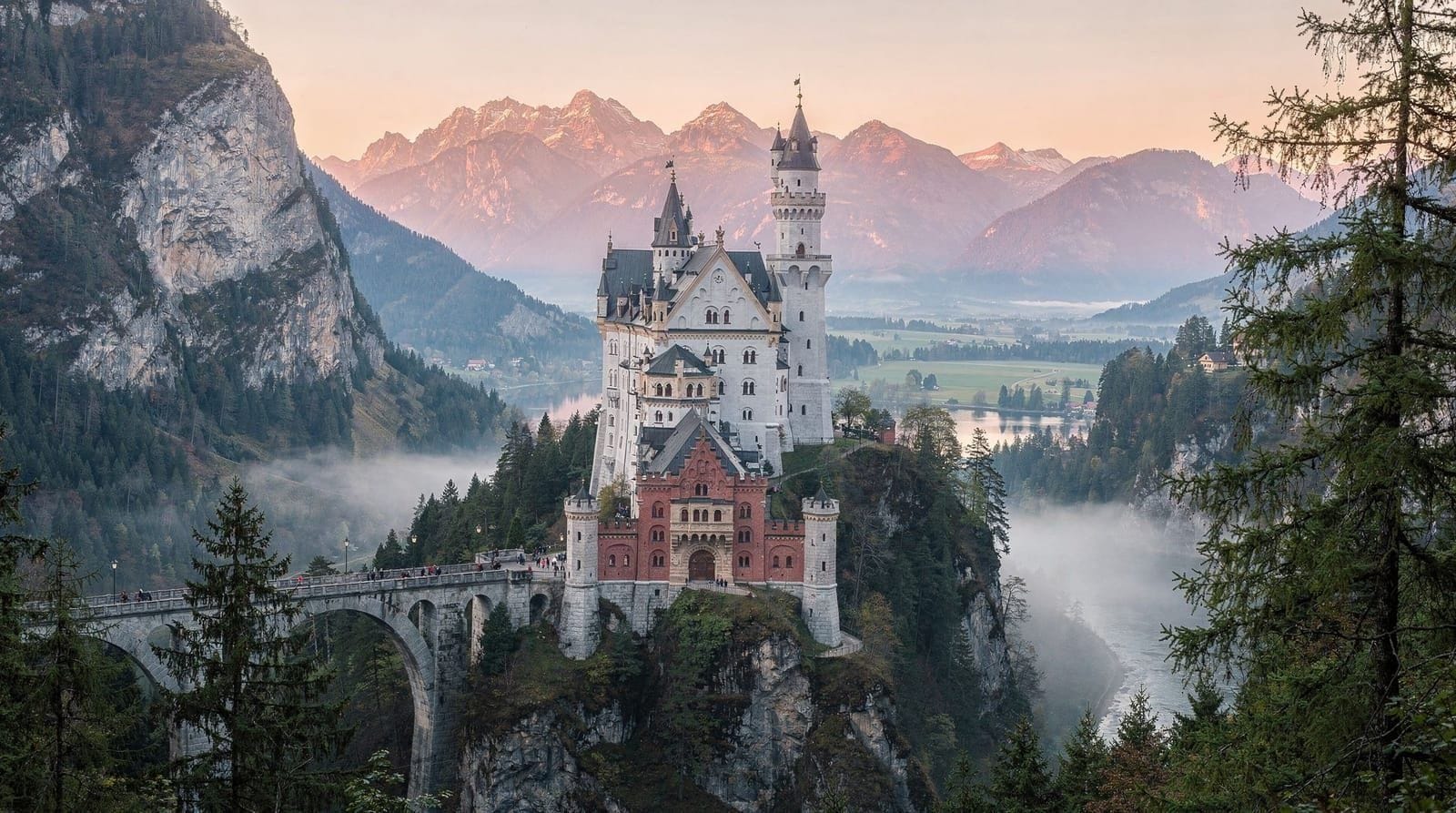
Most photographs of Neuschwanstein are taken from Marienbrücke, the narrow iron bridge that spans the Pöllat Gorge about a 10-minute walk above the castle. The view from there — the castle below you against forested peaks, ideally with snow on the Alps beyond — is the one that appears in every travel magazine and screensaver.
Getting there from the castle entrance is an uphill walk of around 10-15 minutes. It is worth it. However, be aware that Marienbrücke is frequently closed in winter and during icy or stormy weather, for the straightforward reason that it is a metal bridge over a very deep gorge. Check conditions on the day if you are visiting between November and April.
An alternative view, less famous but arguably more atmospheric, is from the Pöllat Gorge below the bridge. A path leads down into the gorge from near the castle; the light in the morning is particularly good for photography. See our Neuschwanstein photo spots guide for specific vantage points and the best times of day.
Combining with Hohenschwangau castle
The ticket center serves both Neuschwanstein and Hohenschwangau Castle, which sits on a hill directly across the valley. Most visitors focus entirely on Neuschwanstein and skip Hohenschwangau — which is actually a mistake.
Hohenschwangau was Ludwig’s childhood home, the place where he grew up surrounded by murals of medieval legends that shaped his entire imagination. Where Neuschwanstein is theatrical grandeur, Hohenschwangau is more intimate and historically grounded. Together they tell the full story of Ludwig’s life. See our honest comparison in the Neuschwanstein vs Hohenschwangau guide.
The two castles are about a 20-minute walk apart. Visiting both requires two separate timed entry tickets, which you can purchase together on the official booking site. Stagger your entry times by at least 90 minutes to allow travel and uphill time between them. Book a combo ticket for both Neuschwanstein and Hohenschwangau
Crowds: the honest picture
July and August are, without softening it, brutal. You will queue. You will wait in the heat. The path up to the castle will be clogged. Marienbrücke will have a crowd 10 people deep at the railing. On peak summer days, the ticket center opens walk-up availability for the day’s remaining slots at 8am — and they are often gone by 8:05am.
The practical consequence: if you visit in peak season without a pre-booked ticket, you have a real chance of travelling 120 kilometres and being turned away at the gate. This is not a hypothetical risk. Our blog post on Neuschwanstein tickets selling out documents exactly how quickly this happens.
The better months are May, September, and October. Specifically:
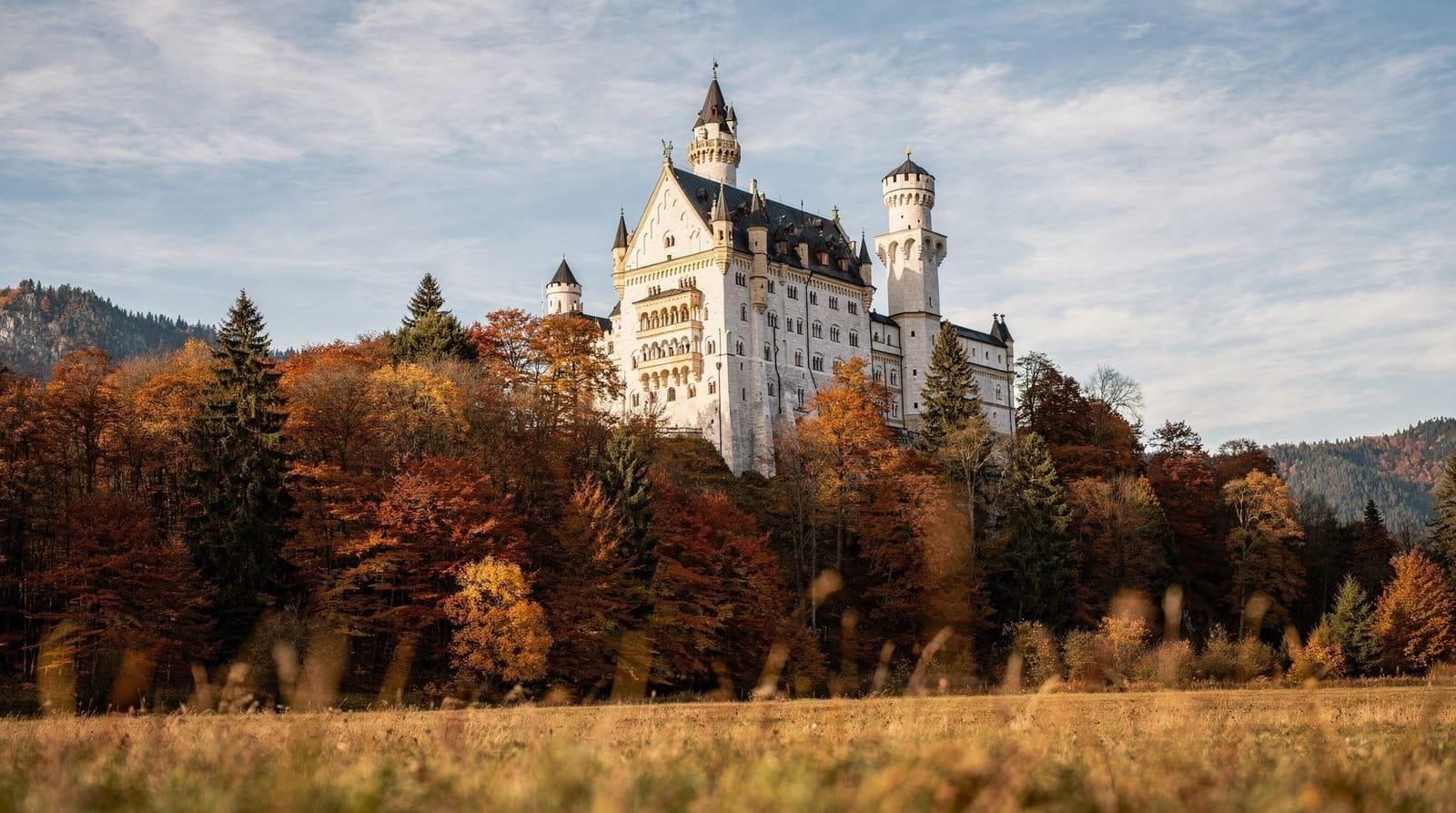
- Late September to mid-October: autumn colour in the forests makes the views exceptional, and crowds drop significantly after German school holidays end.
- May: weather is generally good, wildflowers on the hillside, and you stand a reasonable chance of getting tickets within a week or two of your travel date rather than a month out.
Early mornings help regardless of season. The first entry slots of the day (around 9am) see the thinnest crowds. By 11am, the site is full.
What is not worth it (honest notes)
The horse carriage. It sounds romantic. In practice it is a slow, crowded shuttle that deposits you further from the castle than the bus does, for more than double the price. Unless you have mobility difficulties and the bus isn’t an option, spend the money elsewhere.
The souvenir shops at the ticket center. Overpriced and identical to those in every other Bavarian tourist destination. If you want a decent keepsake, the castle’s own small shop at the exit has better-curated items.
Arriving without food. There is no restaurant inside the castle, and the options near the ticket center are expensive and mediocre. Pack lunch. Eat in Füssen before or after — it has good options and is far better value.
Fitting Neuschwanstein into a wider Bavaria itinerary
Neuschwanstein is an excellent anchor for a longer exploration of Ludwig II’s castles, which are genuinely some of the strangest and most beautiful buildings in Europe.
Linderhof Palace, Ludwig’s smallest and most personal castle, is about 45 minutes north of Füssen and is remarkably undervisited compared to Neuschwanstein. The gardens are spectacular. Herrenchiemsee Palace — Ludwig’s attempt to build a replica of Versailles on an island in Lake Chiemsee — is reached by boat and is equally astonishing in a completely different way.
If you are planning two or three days in the region, our Munich castles 3-day itinerary walks through a logical sequence that covers all three major sites without requiring a car.
For a broader look at how Neuschwanstein fits among Bavaria’s finest architecture, see our guide to the best castles near Munich. See tours combining Neuschwanstein and Linderhof in one day
What to do in Füssen before or after
Füssen is a small, well-preserved historic town about 5 kilometres from the castle ticket center and worth a couple of hours in its own right. The old town has a late-medieval street layout, a high castle of its own (the Hohes Schloss), and a Benedictine monastery church with remarkable Baroque interior. It is also where you will find the best restaurants and cafés in the area.
Practical note: if you take the train from Munich, you arrive at Füssen station and need to connect to the castle. Use that moment — eat, have a coffee, see the town — before the bus. Trying to get there and back in a single rushed day without pausing in Füssen means missing one of the genuinely pleasant parts of the trip.
If you have extra time after the castle visit, the Lechfall waterfall on the edge of Füssen is a short walk from the old town and makes a pleasant final stop before heading back to the station — quieter than anything near the castle itself and a good spot to decompress after the crowds.
Weather, layers, and what to bring
The valley around Schwangau sits at the foot of the Alps, which means weather can shift faster than in Munich itself. Even on a warm summer morning, mornings can be cool at the higher points of the walk, and afternoon thunderstorms are common June through August. Bring a light rain layer regardless of season, and sturdy, broken-in walking shoes — the paved road up is steep enough that flip-flops or dress shoes become genuinely uncomfortable. In winter, the path can be icy, and Marienbrücke’s frequent closures mean it is worth checking conditions the morning of your visit rather than assuming it will be open. A refillable water bottle is worth carrying, since prices at the ticket-centre kiosks are tourist-premium. Sunscreen matters more than most visitors expect, too — the exposed uphill road and Marienbrücke both sit above the tree line for stretches, with little shade in summer.
Accessibility notes
The uphill walk to the castle is genuinely steep and unpaved sections exist on some shortcuts, though the main road is paved throughout. Wheelchair users and anyone with significant mobility limitations should use the shuttle bus rather than attempt the walk, though even the bus stop is a short walk from the castle entrance with some incline. The interior tour itself involves stairs between floors with no lift, which is an unavoidable limitation of a 19th-century building — contact the ticket centre in advance if you need specific accommodation, as staff can sometimes arrange alternative arrangements for visitors with mobility needs.
Getting the most out of your visit: a practical summary
A few things that will meaningfully improve your experience:
Book your ticket at tickets.hohenschwangau.de as early as possible, certainly more than a month ahead for any visit between May and October. The online reservation fee is €2.50 per ticket on top of the €21 adult price. That €2.50 is among the best money you will spend on the whole trip. Full ticketing strategy is in our Neuschwanstein tickets guide.
Choose a first entry slot. The 9am slots are consistently the least crowded. The difference between a 9am and 11am visit in summer is significant.
Walk up rather than taking the carriage. The walk is pleasant through forest and gives you time to adjust expectations and take the place in gradually.
Go to Marienbrücke before your entry slot if you arrive early, not after. By the time you finish the interior tour, the bridge is often packed.
Leave time for Hohenschwangau if you have any interest in how the castle and the man who built it came to be. It adds substance to what can otherwise feel like a purely aesthetic experience.
For the full picture on how all of Ludwig’s projects connect — Neuschwanstein, Linderhof, Herrenchiemsee, and Hohenschwangau — our King Ludwig II castles guide is the best place to start.
Frequently asked questions about Neuschwanstein Castle
How long does a visit to Neuschwanstein Castle take?
The guided interior tour lasts about 35 minutes. Add 30-40 minutes to walk uphill from the ticket center, plus time at Marienbrücke, and you are looking at 3-4 hours total. Budget a full day if you plan to visit Hohenschwangau as well.
Can I take photos inside Neuschwanstein?
No. Photography of any kind is strictly prohibited inside the castle. You can take as many photos as you like from outside, from Marienbrücke bridge, and in the courtyard.
Is the walk up to Neuschwanstein difficult?
The uphill walk from the ticket center takes 30-40 minutes and is moderately steep on a paved road. Alternatives are the shuttle bus (€4 uphill) or horse carriage (€9 uphill) — but the carriage is slow and still requires a 10-minute walk at the end.
What is the best time of year to visit?
April to May and September to October offer the best balance of good weather, manageable crowds, and open facilities. July and August are extremely crowded. Winter can be beautiful but Marienbrücke is often closed and hours are shorter.
Can I visit Neuschwanstein without a tour guide?
Entry to the interior is only possible on a guided tour — no independent exploration. The tour is guided by staff in English or German, and an audio guide in 14 languages is included in the ticket price.
Do I need to book tickets to Neuschwanstein in advance?
Yes, strongly. From May through October, tickets regularly sell out weeks or even months in advance. Walk-up availability is extremely limited during peak season. Book online at tickets.hohenschwangau.de as early as possible.
Is Neuschwanstein suitable for children?
Children aged 6-17 pay €20, and under-6s enter free. The walk uphill is manageable for most children. The interior tour is 35 minutes of guided talk, so younger children may find it long — bring snacks for the walk.
Is Neuschwanstein wheelchair accessible?
Partially. The shuttle bus is the practical way up for wheelchair users, though the final stretch to the entrance still involves some incline. The interior itself has stairs between floors with no lift, which limits full access inside the castle. Contact the ticket centre in advance if specific accommodation is needed.
What should I do if I cannot get a ticket for my dates?
Check for cancellations closer to your date, since some tickets are released back into the pool. If nothing is available, consider Linderhof Palace as an alternative — it is less crowded, easier to book, and offers a different but equally rewarding look at Ludwig II’s architectural obsessions.
Top experiences
Bookable activities with verified prices and instant confirmation on GetYourGuide.