Bamberg
Bamberg's UNESCO old town, Rauchbier smoked beer, Little Venice and the cathedral on seven hills — complete day trip guide from Munich 2026.
From Munich: Nuremberg day trip by train
Quick facts
- Distance from Munich
- ~230 km (about 2 h by direct train)
- Train fare
- €28–€45 return (book in advance on DB)
- Bamberg Card
- €17 — covers 2 museums + public transport (48 hours)
- UNESCO status
- Old town listed since 1993
- Rauchbier price
- €3.20–€4.50 per 0.5 L (Schlenkerla brewery)
Germany’s best-preserved medieval city — and the smoky beer that comes with it
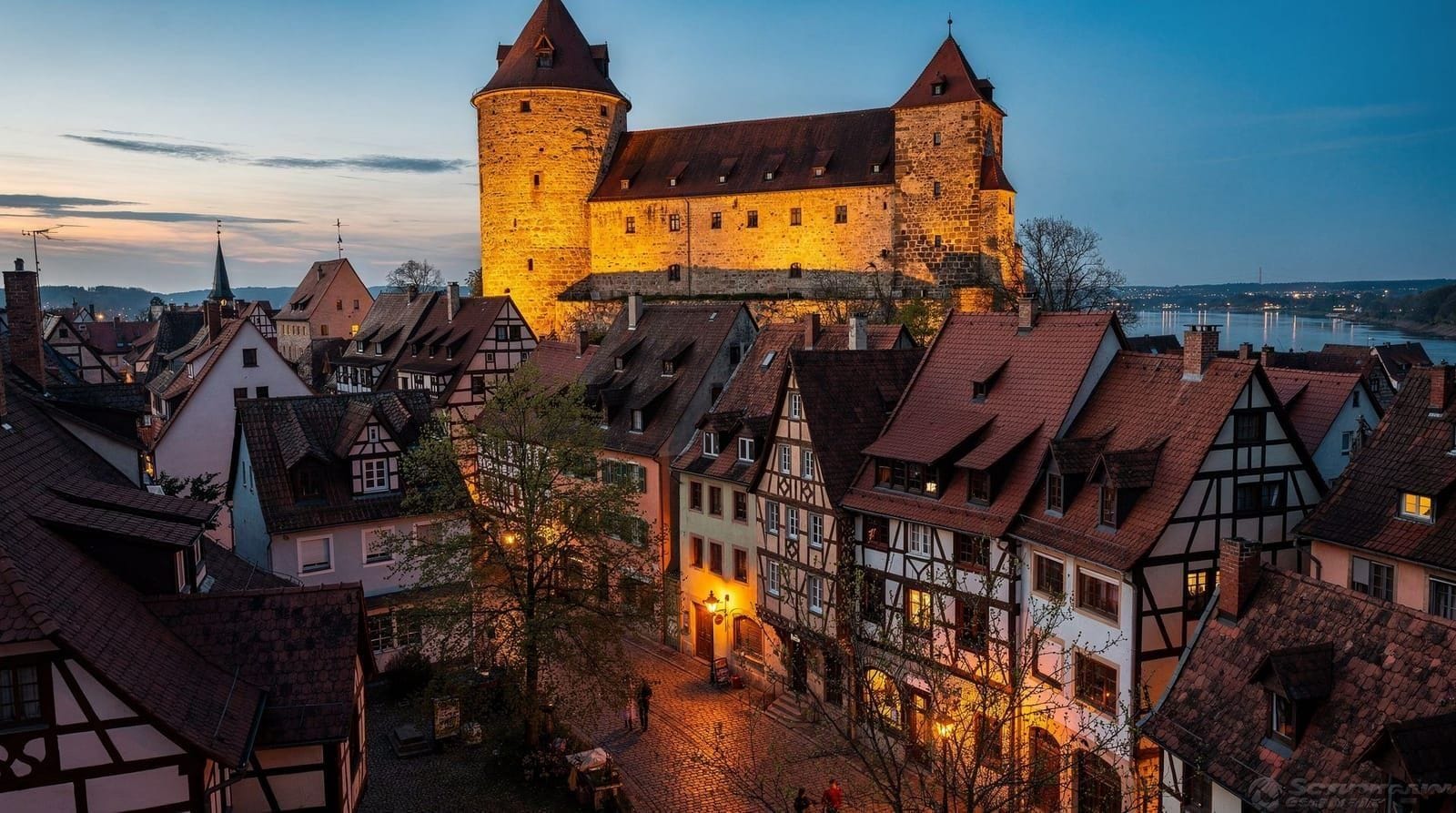
Bamberg is one of those rare German cities that escaped Allied bombing almost entirely. The result is a compact old town of around 2,400 listed buildings, mostly intact from the Middle Ages and baroque period, spread across seven hills above the River Regnitz. UNESCO added the entire old town to its World Heritage List in 1993 — not just a castle or a church, but the whole urban fabric.
The city is also home to Rauchbier, a smoked beer that tastes like liquid bacon and has been brewed here since the 16th century. The Schlenkerla brewery has been making it in the same half-timbered brewpub on Dominikanerstraße since 1405. You will either love it or find it startling; either way, it is the reason many people come to Bamberg at all.
From Munich, Bamberg is about 2 hours by direct train — a slightly longer journey than Nuremberg or Regensburg, but the lower tourist numbers and higher architectural density make it worth the extra 40 minutes.
quickAnswer — How far is Bamberg from Munich by train? Direct ICE and IC trains run from Munich Hauptbahnhof to Bamberg in approximately 1 hour 55 minutes to 2 hours 15 minutes. Fares range from €28 return (booked 30+ days ahead) to €60+ for walk-on tickets. There is no equivalent of the Bayern-Ticket discount for this journey — Bamberg is in Bavaria but the DB regional services are slower (3+ hours via Ingolstadt and Nuremberg). Book online for the best fares.
| Where | ~230 km north of Munich, in Upper Franconia |
| Cost | €28–€45 return by ICE/IC (book ahead); Bamberg Card €17 for 48 hours |
| Time needed | Full day from Munich; overnight allows a more relaxed pace |
| Getting there | Direct ICE/IC, 1h55–2h15 from Munich Hbf |
| Best time | April–October for cycling and beer gardens; December for the Christmas market |
Getting there from Munich
The fast option is ICE or IC from Munich Hbf, stopping at Bamberg (some services go via Nuremberg, some direct). Journey time is 1 h 55 min to 2 h 15 min. Fares on the DB app: €28–€35 return booked 3–4 weeks ahead; €50–€70 flexible. The Bamberg station (Bamberg Bahnhof) is a 20-minute walk from the old town centre, or a short tram ride.
Regional trains via the Bayern-Ticket (€29 base) are possible but take 3–3.5 hours via Nuremberg or Ingolstadt, making them impractical for a day trip. Stick to the fast trains for this one.
By car: A9 north to the A70 junction near Bayreuth, then west to Bamberg — about 2 h 15 min in light traffic. Parking available at the Intercity Hotel garage (€1.70/hour) near the station, or the Maximiliansplatz parking garage (€1.50/hour, 10 minutes’ walk from the old town).
Combination with Nuremberg: Bamberg is 55 km north of Nuremberg (30 minutes by train). Many visitors combine both in a two-day Franconia trip, staying overnight in Nuremberg and making a half-day or full-day side trip to Bamberg.
Bamberg’s UNESCO old town
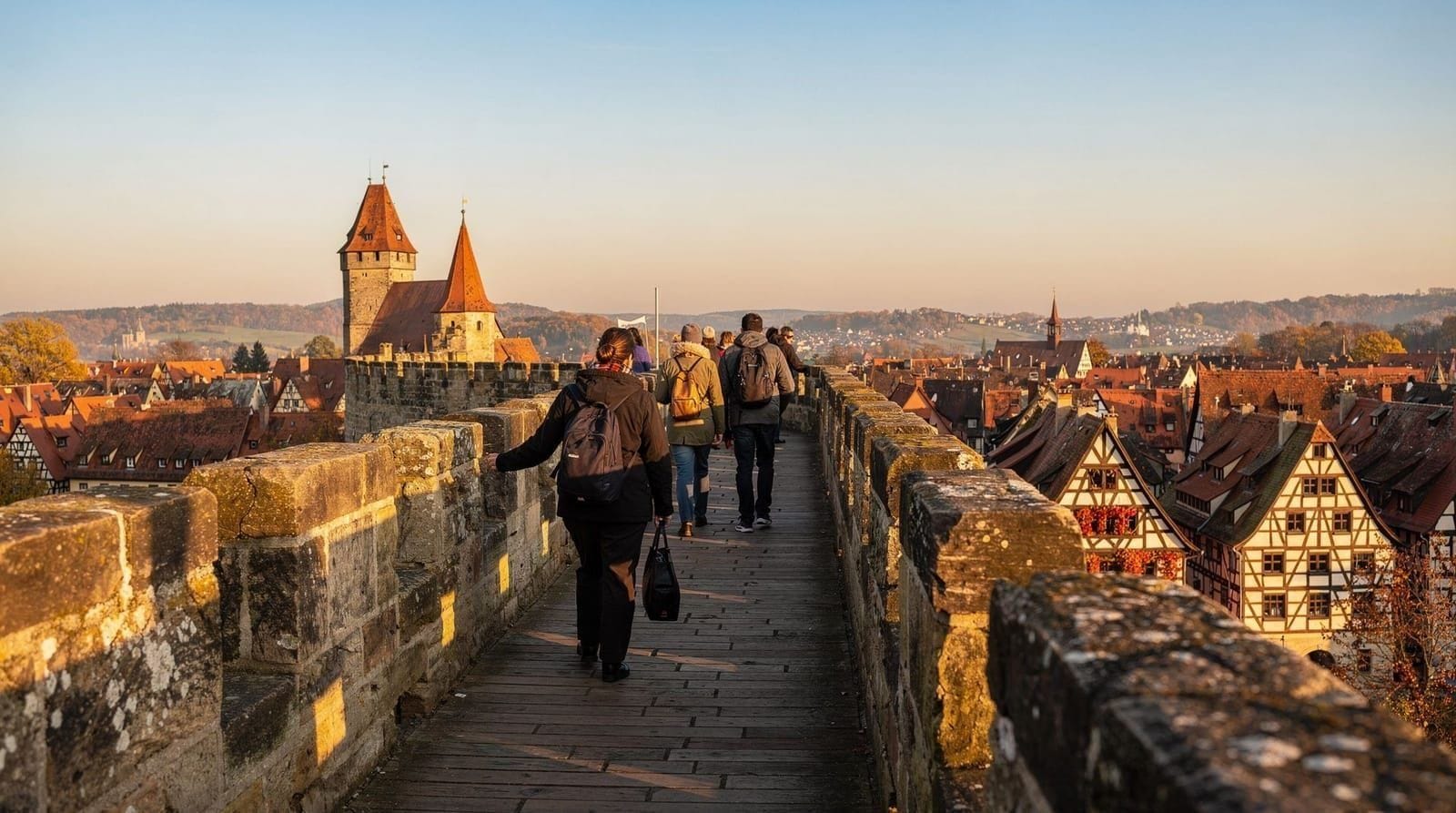
The old town of Bamberg is divided roughly into three parts: the Domberg (Cathedral Hill), the Bürgerstadt (Citizens’ Town) along the river, and the Inselstadt (Island Town) between the two arms of the Regnitz. Walking between them takes 15–20 minutes; cycling is the locals’ preferred way to move around.
Altes Rathaus (Old Town Hall) is the most-photographed building in Bamberg: a baroque town hall built literally on a bridge pillar in the middle of the Regnitz, with frescoed facades visible from both bridges. The building dates from 1467 and houses the Bamberg Porcelain Museum (€7 adult, 2026). The frescoes on the exterior walls include a cherub’s leg protruding from the painted surface in trompe-l’oeil — visible from the Upper Bridge.
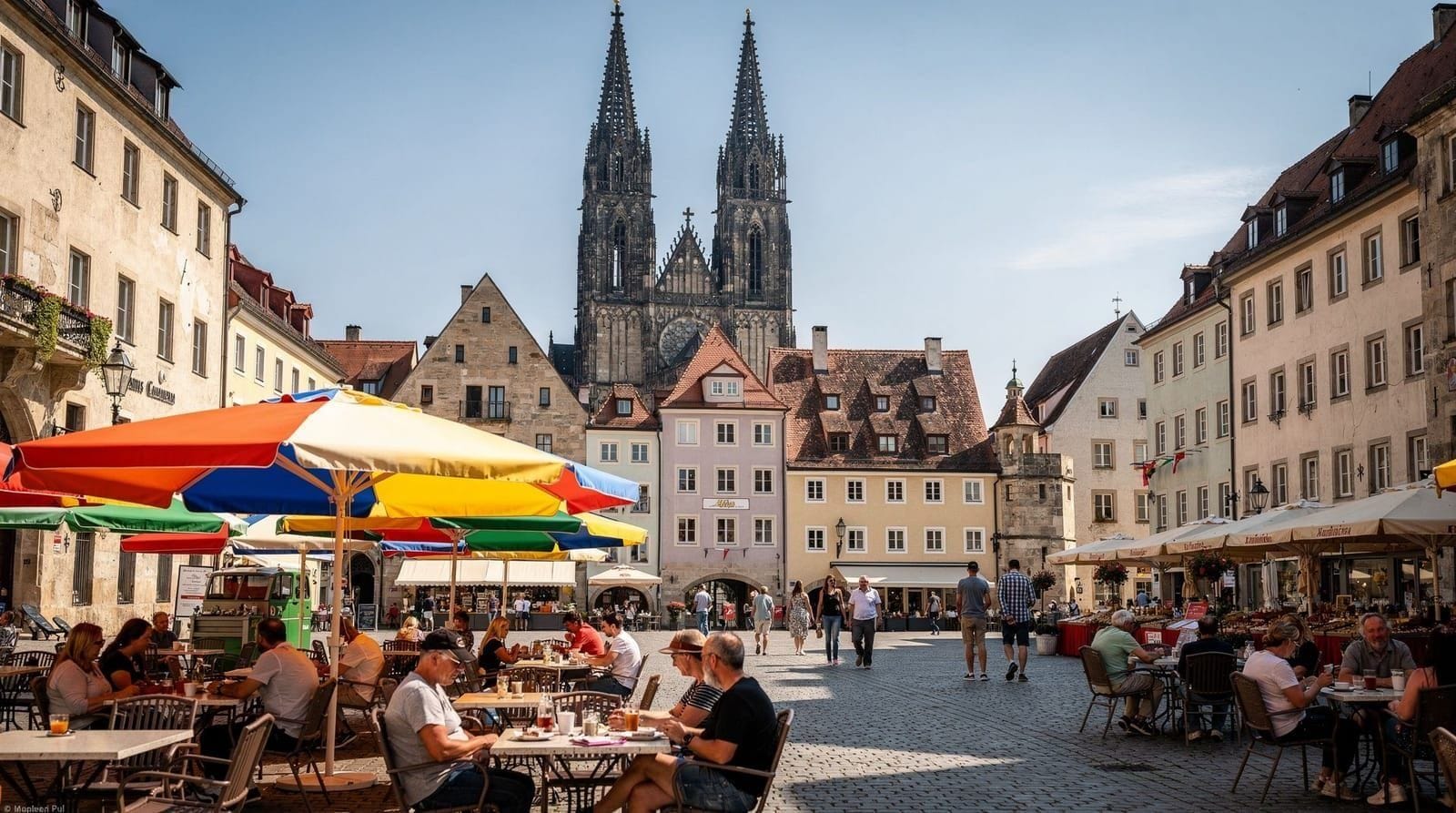
Domplatz (Cathedral Square) is the civic and ecclesiastical heart. The square is ringed by the Cathedral, the Old Court (Alte Hofhaltung, a Renaissance palace now housing the Historical Museum, €7), and the Neue Residenz palace. It is spacious, not overcrowded, and genuinely beautiful. Arrive in the morning when the light catches the Cathedral’s sandstone towers.
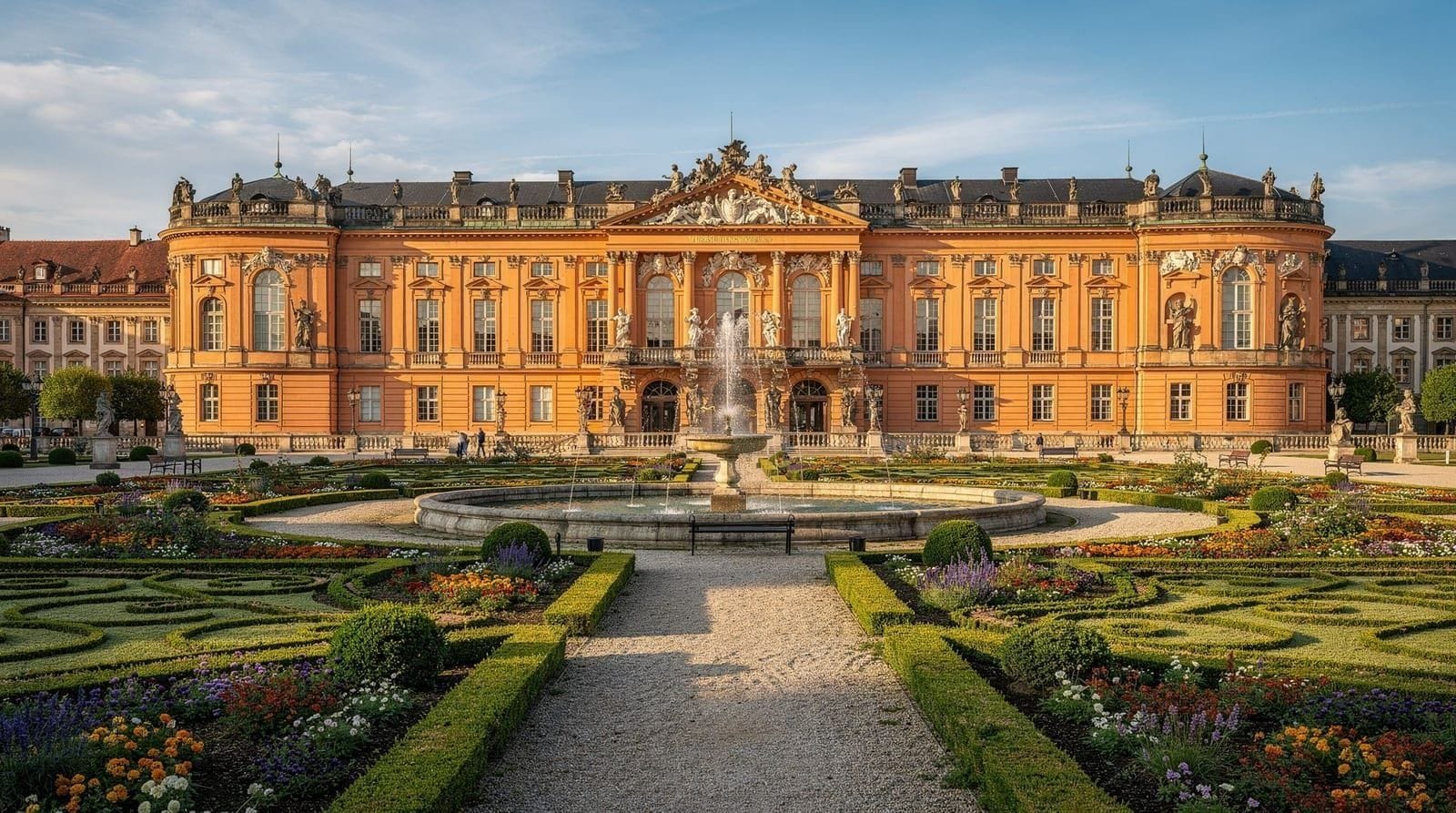
Neue Residenz (New Residence, Domplatz 8) is the baroque palace of the prince-bishops of Bamberg. You can visit the State Apartments (€7 adult) and the Rose Garden behind it — the garden is free and has a fine view over the city and towards the Cathedral towers. The State Apartments include some good Flemish tapestries and a Cranach altarpiece, but the palace as a whole is less compelling than the Würzburg Residenz.
Bamberg Cathedral
The Bamberger Dom (Bamberg Cathedral) is one of the four great Romanesque imperial cathedrals of Germany (alongside Speyer, Worms, and Mainz). Construction began in 1002 under Emperor Heinrich II, who is buried here with his wife Kunigunde. The current building dates mainly from 1237 after the earlier structure burned down.
Entry is free (donations appreciated). The Cathedral is open 09:00–18:00 most days, with shortened hours on religious services.
What to see inside:
- Bamberger Reiter (Bamberg Rider, c.1235) — a life-size equestrian statue of an unidentified medieval king, carved from a single block of sandstone. It is one of the most important medieval sculptures in Germany and stands in the north aisle. The identity of the rider has been debated for 800 years.
- Tomb of Heinrich II and Kunigunde — a carved limestone sarcophagus by Tilman Riemenschneider, the master sculptor of Würzburg. Completed around 1513, it shows scenes from the couple’s life in extraordinary detail.
- Pope Clement II’s tomb — the only papal tomb north of the Alps. Clement II was a bishop of Bamberg before becoming pope; he died in 1047 and his lead sarcophagus is in the west chancel.
Allow 45–60 minutes for a thorough visit. Guided tours in English run at 12:00 on Sundays from April to October (€5, confirm at the cathedral office).
Rauchbier: the smoked beer of Bamberg
Rauchbier (smoked beer) is Bamberg’s most distinctive product and one of the rarest beer styles in the world. It is made with malt that has been dried over burning beechwood, giving the beer a pronounced smokiness — like a smoked ham or bacon, translated into a lager. Before the 19th century, most German beer tasted similar, as indirect heat drying of malt was not yet standard. Bamberg preserved the tradition where most breweries moved on.
Schlenkerla (Dominikanerstraße 6) is the essential address. The brewery dates to 1405, and the current building has operated continuously since then. The Märzen Rauchbier (5.1% ABV) is the flagship — amber, medium-bodied, assertively smoky. A 0.5 L Masskrug costs about €4 (2026). The Bock version (seasonal, winter) is stronger at 6.5% and deeply malty. The Weizen Rauchbier (smoked wheat beer) is more approachable for people who find the Märzen too intense.
Sit in the vaulted tap room (dark, atmospheric, no reservations for small groups) or in the courtyard in summer. The food menu is limited but reliable — Schäufele (pork shoulder, €14) is the thing to order if you are hungry.
Spezial (Obere Königstraße 10) is the other traditional Rauchbier brewery with its own taproom, making a slightly lighter version. Both are walking distance from the Cathedral; locals debate which is superior. Both are worth trying.
Beer gardens: Bamberg has several beer gardens along the Regnitz where you can drink Franconian lagers and wheat beers (Rauchbier is less common in the gardens, where Helles and Kellerbier dominate). Keesmann (Wunderburg 5) and Fässla (Obere Königstraße 19) are local breweries with their own taprooms within the old town. Guided day trip to Nuremberg (combine with Bamberg)
Little Venice (Klein Venedig)
The fishermen’s houses along the Regnitz waterfront, south of the Island Town, are known collectively as Klein Venedig (Little Venice). The half-timbered houses back directly onto the river, with small gardens and boat landings at the water’s edge. The row extends about 200 metres along the Untere Brücke and is best photographed from the opposite bank (Geyerswörthstraße) in the morning or evening light.
The comparison to Venice is loose — there are no canals and no gondolas — but the reflection of coloured facades in the calm river water is genuinely picturesque. If you arrive early on a weekday, you can photograph it without other tourists in frame. On summer weekend afternoons, it is busy.
The area around Little Venice has a few good independent cafes and wine bars (Franconian white wine — Silvaner and Müller-Thurgau — is the local drink alongside beer). Try Weinbar Sternla (Lange Straße 46) for a glass of Franken-Silvaner by the glass (€4.50–€6).
Seven hills and the wider city
Bamberg’s famous comparison to Rome is that both cities are built on seven hills. This is moderately true — the old town is spread across several ridges above the Regnitz floodplain, and the Cathedral, Michaelsberg, Kaulberg, and other quarters each occupy their own elevation.
Michaelsberg (St Michael’s Hill) is the hill directly north of the Cathedral, topped by the Benedictine Kloster Michaelsberg monastery. The monastery is now a retirement home, but the church (Klosterkirche St Michael) is open and worth visiting for the remarkable herb garden ceiling fresco — a painted botanical encyclopedia of 578 medicinal plants, created around 1617. The monastery beer garden (Michaelsberg Brauerei) has panoramic views over the city.
Altenburg Castle on the western hill is the highest point in Bamberg, with a ruined medieval tower and wide views over the Franconian countryside. It is 2.5 km from the old town — an easy 30-minute walk or short bike ride. Entry to the tower is €2.50.
What to eat beyond the Schlenkerla
Bamberg’s food scene is Franconian at its core: pork-heavy, robust, and unpretentious.
- Brauerei Spezial — smoked beer and Sülze (head cheese) in a traditional tap room, less famous than Schlenkerla, which keeps it marginally less crowded.
- Messerschmidt (Lange Straße 41) — upscale Franconian restaurant in a historic building, mains €22–€36, good wine list of Franken wines.
- Café Müller (Hauptwachstraße 10) — local institution for coffee and cake; try the Bamberger Hörnla (horned pastry) in the morning.
- Markthalle Bamberg (near Maximilianplatz) — covered market with local produce, cheese, sausage; good for a picnic lunch assembled from stalls.
Expect to pay €15–€22 for a main course at a sit-down restaurant; beer garden meals are cheaper (€10–€15 with a beer).
Practical tips for Bamberg
Bamberg Card (€17, 48-hour): covers entry to two museums of your choice (Alte Hofhaltung Historical Museum, Bamberg Natural History Museum, Diocesan Museum) plus unlimited city bus use. For a day visitor doing one or two museums, it is borderline; for overnight visitors, it is good value.
Cycling: Bamberg is a very cycle-friendly city. Rent bikes at Fahrradstation (Ludwigstraße 25, €15/day) and cover significantly more ground. The cycle path along the Regnitz is flat and pleasant.
When to arrive: Schlenkerla opens at 09:30 for breakfast. Cathedral morning light is best before 10:00. Try to be in the old town before the day-trip coaches from Nuremberg arrive around 10:30–11:00.
Christmas market: Bamberg’s Weihnachtsmarkt runs from late November to 23 December. It is smaller than Nuremberg’s famous market but genuinely atmospheric, set in the shadow of the Cathedral on Maximilianplatz. Strongly recommended if you are in Bavaria in December. Romantic Road private day tour (Bamberg + Rothenburg)
Combining Bamberg with other destinations
Bamberg sits on the Franconian tourist axis between Munich and the north. Natural pairings:
- Bamberg + Nuremberg (30 min by ICE): a 2-day Franconia circuit — Bamberg on day one, Nuremberg on day two. See the Munich to Nuremberg day trip guide.
- Bamberg + Würzburg (75 min by train): both are on or near the northern end of the Romantic Road. See Würzburg for the Residenz palace and Franconian wine country.
- Bamberg + Regensburg: requires routing via Nuremberg. More complex logistics but feasible for a two-day northern Bavaria tour.
The best day trips from Munich guide includes a ranking of historic city day trips by ease and reward. The day trips by train from Munich guide has timetable logistics.
Bamberg by season
| Season | Character | Notes |
|---|---|---|
| Spring (Apr–May) | Fresh, quiet, gardens in bloom | Good light for photographing the Regnitz houses |
| Summer (Jun–Aug) | Busiest, beer gardens in full swing | Book ahead for weekends; day-trip coaches arrive from 10:30 |
| Autumn (Sep–Oct) | Comfortable walking weather, cycling season winding down | Michaelsberg gardens still pleasant |
| December | Christmas market on Maximiliansplatz | Cold but atmospheric; Schlenkerla’s tap room is a good winter refuge |
| Jan–Mar | Quiet, some attractions on reduced hours | Cheapest hotel rates; check museum winter schedules |
Bamberg’s beer gardens along the Regnitz are a summer-specific pleasure — most close or move indoors from October, so a winter visit concentrates on the indoor tap rooms (Schlenkerla, Spezial) rather than outdoor drinking.
Is Bamberg better as a day trip or an overnight stay?
Given the 2-hour train journey each way, Bamberg rewards an overnight stay more than most Munich day trips on this list. A day trip (departing Munich around 08:00, returning around 19:00) covers the Cathedral, Altes Rathaus, Little Venice, and a Schlenkerla beer comfortably, but leaves out Michaelsberg, Altenburg Castle, and a relaxed second Rauchbier at Spezial. An overnight stay — one night in a mid-range old-town hotel, typically €90–140 — allows an unhurried two-day pace: old town and Cathedral on arrival afternoon, Michaelsberg and Altenburg the next morning before the return train. For visitors combining Bamberg with Nuremberg, staying overnight in Nuremberg and taking a half-day side trip to Bamberg is often more time-efficient than a dedicated Bamberg overnight.
Frequently asked questions about Bamberg
Is Bamberg worth visiting from Munich?
Bamberg is emphatically worth visiting if you care about medieval architecture, beer culture, or simply want a day trip to somewhere less obvious than Nuremberg. The combination of a fully intact UNESCO old town and a unique beer tradition (Rauchbier) that you cannot find elsewhere makes it genuinely distinctive. The 2-hour train journey is the main deterrent; if you are prepared for that, the reward is high.
What is Rauchbier and is it an acquired taste?
Rauchbier (smoked beer) uses malt dried over open beechwood fire, giving the finished beer a pronounced smokiness — like drinking a slightly liquid smoked ham. Most first-time drinkers find the flavour startling; some love it immediately, others need a few sips to adjust. It is not bitter in the hop sense; it is more savory and malt-forward. The Schlenkerla Märzen is the standard introduction; the Weizen (wheat beer) version is lighter and might be a better starting point for uncertain visitors.
How many hours do you need in Bamberg?
A focused 5-hour visit covers the Cathedral, Altes Rathaus, Little Venice, and a beer at Schlenkerla. A more relaxed day — cycling, including Michaelsberg and Altenburg — needs 8–9 hours. Most day-trippers from Munich take the 08:00 train and return at 18:00 or 19:00.
Is Bamberg expensive?
Bamberg is notably cheaper than Munich. A beer at Schlenkerla is €4; a restaurant main averages €15–€18; a Tageskarte bus pass is €3.40. Museum entry is €7 per institution or covered by the €17 Bamberg Card. Overall, a comfortable day (train + 2 museums + lunch + beer) costs €80–€110 per person depending on train ticket price.
Are there any good day trip tours from Munich to Bamberg?
No major tour operator runs a Munich–Bamberg group day tour, as Bamberg is slightly off the main Bavaria circuit. The most common approach is a self-guided train trip. Alternatively, you can combine Bamberg with Nuremberg on private guided tours that depart Munich and cover both cities in a day with a car.
Can I visit Bamberg without a car?
Easily. The train from Munich is direct and frequent; the old town is compact and walkable; a bike rental covers the wider city. A car adds nothing for the central sights and creates parking hassle. Public buses within Bamberg run frequently (day ticket €3.40) if you do not want to walk between the Cathedral Hill and the waterfront.
Should I do Bamberg as a day trip or stay overnight?
A day trip works if you focus on the Cathedral, Altes Rathaus, Little Venice, and Schlenkerla — realistically 5–7 hours including travel. An overnight stay (typically €90–140 for a mid-range old-town hotel) is worth it if you also want Michaelsberg, Altenburg Castle, and a more relaxed pace, given the 2-hour journey each way makes the day trip feel compressed. Travellers combining Bamberg with a wider Franconia circuit often find an overnight stay in Nuremberg, with a half-day Bamberg side trip, the most efficient use of limited time.
What is the best month to visit Bamberg?
April to October is best overall, with warm weather for cycling and the Regnitz beer gardens. September specifically balances good weather with thinner crowds. December is worth planning around separately for the Christmas market on Maximiliansplatz, which is smaller and more atmospheric than Nuremberg’s and considerably less crowded to actually walk through.
Top experiences
Bookable activities with verified prices and instant confirmation on GetYourGuide.