Day trips by train from Munich: best routes and the Bayern-Ticket explained
From Munich: Herrenchiemsee Palace and boat trip day tour
What is the Bayern-Ticket and how does it work?
The Bayern-Ticket is a day pass for unlimited travel on regional trains, S-Bahn, U-Bahn, trams, and buses across Bavaria. In 2026 it costs €29 for 1 person; each additional traveler (up to 5 total) adds €6. Valid Monday–Friday from 09:00, and all day on weekends and public holidays. It does NOT cover ICE/IC trains or destinations outside Bavaria such as Innsbruck or Salzburg.
How the Bayern-Ticket actually works — and when it makes sense
Bavaria has an exceptionally well-developed regional rail network, and the Bayern-Ticket is the pass that unlocks it for a flat daily fee. Understanding exactly what it covers — and just as importantly, what it does not — saves both money and confusion on the day.
| Where | Bavaria-wide regional rail network from Munich Hauptbahnhof |
| Cost | €29 solo, +€6/extra traveller (up to 5), €53 for a group of 5 |
| Time needed | Valid 09:00–03:00 weekdays; midnight-to-midnight weekends |
| Getting there | DB Navigator app, station ticket machines, or DB counters |
| Best time | Weekday off-peak departures (10:30–11:00) avoid the busiest trains |
In 2026 the Bayern-Ticket costs €29 for a single person, with each additional traveler adding €6, up to a maximum group of five people. A group of five pays €53 total. For context, a standard return train ticket from Munich to Garmisch-Partenkirchen costs around €22 to €26 per person without a pass. A group of five at that price would pay €110 to €130; on the Bayern-Ticket they pay €53. The group economics are compelling.
The ticket covers unlimited travel on:
- All regional trains in Bavaria (RE, RB, and private regional operators including BOB, BRB, ALX and similar)
- All S-Bahn lines in the Munich metropolitan area and across Bavaria
- All U-Bahn, trams, and buses within the MVV network (Munich and surroundings)
- Most local buses throughout Bavaria
On weekdays the Bayern-Ticket is valid from 09:00 until 03:00 the following morning — so there is a morning cut-off that means it does not cover early commuter hours. On weekends and public holidays it is valid from midnight to midnight, meaning you can start travelling from the first service of the day.
What it does NOT cover is equally important. The Bayern-Ticket is invalid on ICE, IC, and EC trains — the faster long-distance services. Many routes that appear in the DB timetable app have both regional and fast-train options; always select “regional only” or check that your train is an RE or RB before boarding. The ticket also does not cover any journey crossing into Austria or any other country. Salzburg and Innsbruck, despite being popular day-trip targets from Munich, are not included. And it does not cover the Munich Airport Express direct service — the standard S-Bahn (S1 or S8) to the airport is covered, but the dedicated Airport Express is not.
You can buy the Bayern-Ticket via the DB Navigator app (the easiest option), at ticket machines in any DB station, or at DB counters. The app version is digital and needs no printing. One person in a group purchases the ticket and lists the number of additional travelers — inspectors will ask for ID to verify names match the ticket, so everyone in the group needs to travel together.
The Bayern-Ticket Night follows the same pricing and covers travel from 18:00 to 06:00 — useful if you plan a late evening out in a nearby city and want cheap transport back.
The best day trips from Munich by train
What follows is a practical, honest assessment of the best day trips reachable by train from Munich — organised roughly by journey time, with notes on the Bayern-Ticket economics for each.
Close and easy: Augsburg (40 minutes)
Augsburg is Munich’s neighbour to the west and one of Germany’s oldest cities — founded by the Romans as Augusta Vindelicum in 15 BC, it predates Munich by well over a thousand years. For a half-day trip or for travellers who want a city experience without a long journey, it is an outstanding choice.
The old town has an unusually intact medieval streetscape anchored by the Fuggerei, the world’s oldest social housing complex, built in 1516 and still inhabited. Social housing tenants pay an annual rent of just €0.88 — a figure unchanged since the 16th century — in exchange for praying daily for the founder’s soul. The rate is real; the complex is real; it remains operational. Entry to the Fuggerei as a visitor costs around €8.
Augsburg’s Rathaus (Town Hall) with its golden Goldener Saal is one of the finest Renaissance civic buildings in Germany, and the Dom is a quieter, older alternative to Munich’s Frauenkirche. The pedestrianised centre is compact enough to cover comfortably in four to five hours.
On the Bayern-Ticket, Augsburg is one of the strongest value propositions: a standard return by regional train costs around €14 to €16, so even solo travellers essentially break even if they plan to make any other journey during the day. For groups it is straightforwardly cheap.
Journey time: approximately 40 minutes on RE from Munich Hauptbahnhof. Trains run frequently throughout the day.
The Alpine lakes: Tegernsee and Chiemsee
Tegernsee (50–60 minutes)
Tegernsee is where Munich’s wealthy have always escaped to, and arriving there you understand why immediately. The deep-green lake sits in a valley ringed by peaks that stay snow-capped into May; the air is sharply different from the city the moment you step off the train.
The route from Munich Hauptbahnhof uses the BOB (Bayerische Oberlandbahn) network, with a change typically at Miesbach or directly to the Tegernsee station depending on service. The journey takes around 50 to 60 minutes. Our full Tegernsee day trip guide covers the lake in detail.
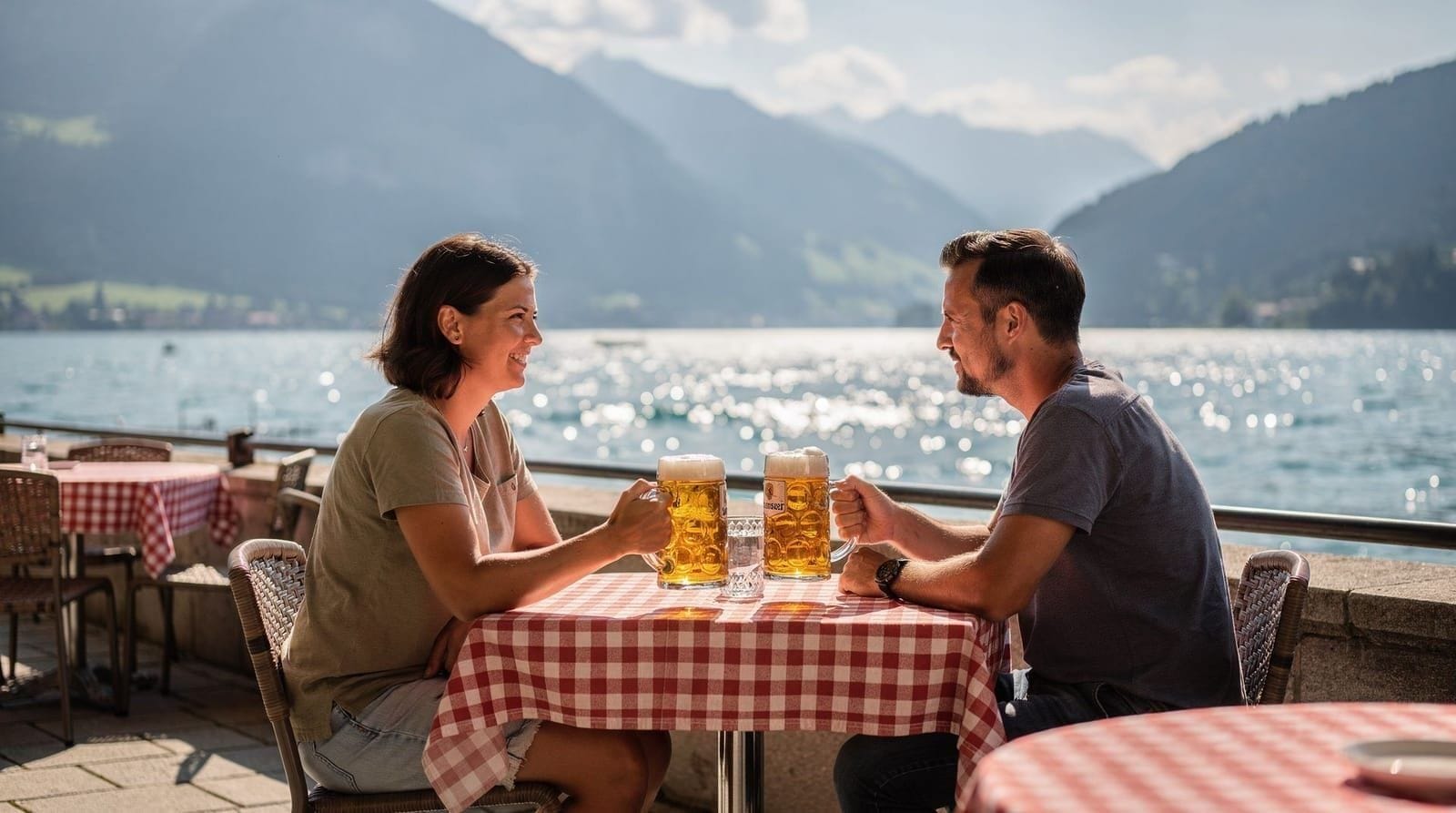
On a warm day the primary activity is straightforward: swim, walk along the shore, eat at one of the lakeside beer gardens, and absorb the scenery. In the village of Tegernsee itself, the former Benedictine monastery (now the Herzogliches Bräustüberl brewery) serves some of the most respected beer in Bavaria in a setting that has changed very little in two centuries. Boat trips across the lake are available and inexpensive.
The Bayern-Ticket covers the BOB connection, making this an excellent value day for groups.
Chiemsee (50–55 minutes)
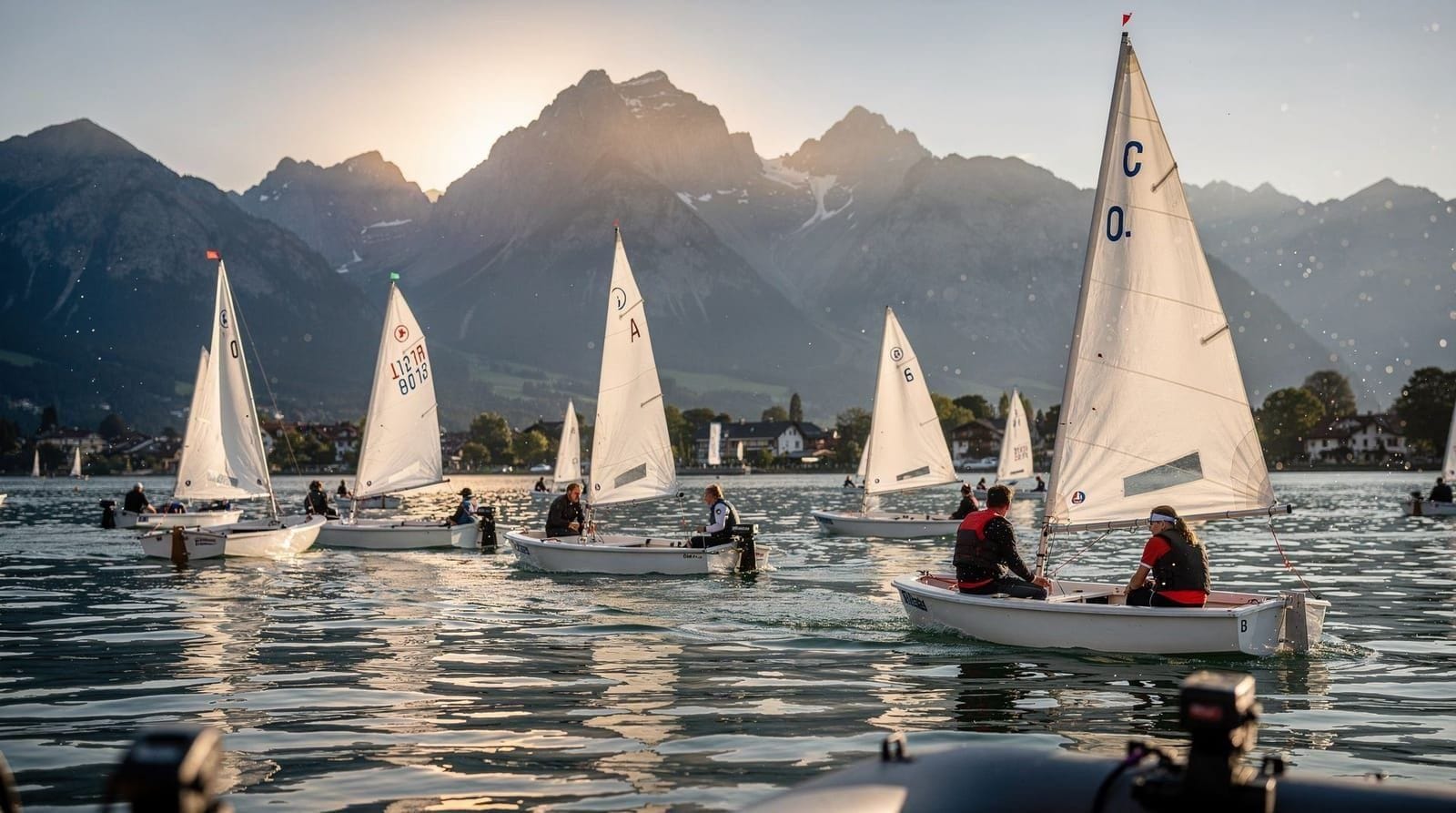
Lake Chiemsee — the Bavarian Sea — is a different scale from Tegernsee. At 80 square kilometres, standing at the shore and looking north or west, the far bank disappears into the horizon. The lake has two inhabited islands: Herreninsel, where King Ludwig II built his unfinished replica of Versailles, and Fraueninsel, home to a Benedictine convent inhabited continuously since the 8th century.
The train from Munich Hauptbahnhof reaches Prien am Chiemsee in about 55 minutes, fully covered by Bayern-Ticket. From Prien station, the heritage Chiemseebahn narrow-gauge railway (sometimes steam-hauled) runs down to the lake pier at Prien-Stock — a short ride, with a small separate fare. Boats to the islands run throughout the day; a day boat pass for unlimited island crossings costs approximately €12 adults in 2026.
Combining Herrenchiemsee Palace (entry approximately €15, roughly 35-minute guided tour inside) with a visit to the peaceful Fraueninsel makes for a full day. Our Chiemsee lake guide has the full detail on both islands and timing. Book a guided day trip to Herrenchiemsee Palace with boat transfer
The mountains: Garmisch-Partenkirchen (1h22)
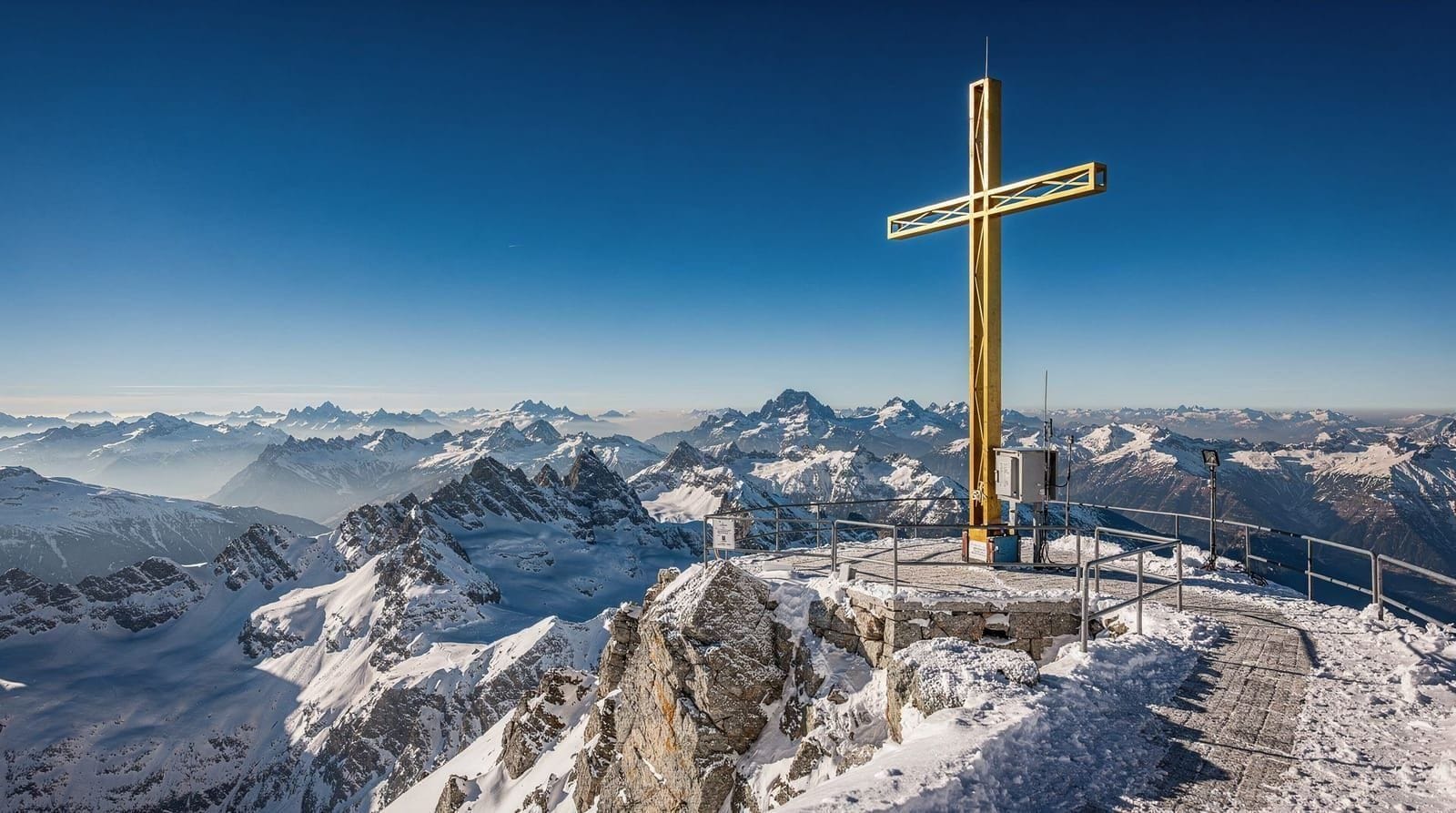
Garmisch-Partenkirchen is Munich’s go-to mountain escape and one of the most visited day trips in Bavaria. The town sits at the foot of the Zugspitze — Germany’s highest peak at 2,962 metres — and even without ascending the mountain the surrounding landscape is dramatic. Snow-covered summits are visible from the town centre most of the year.
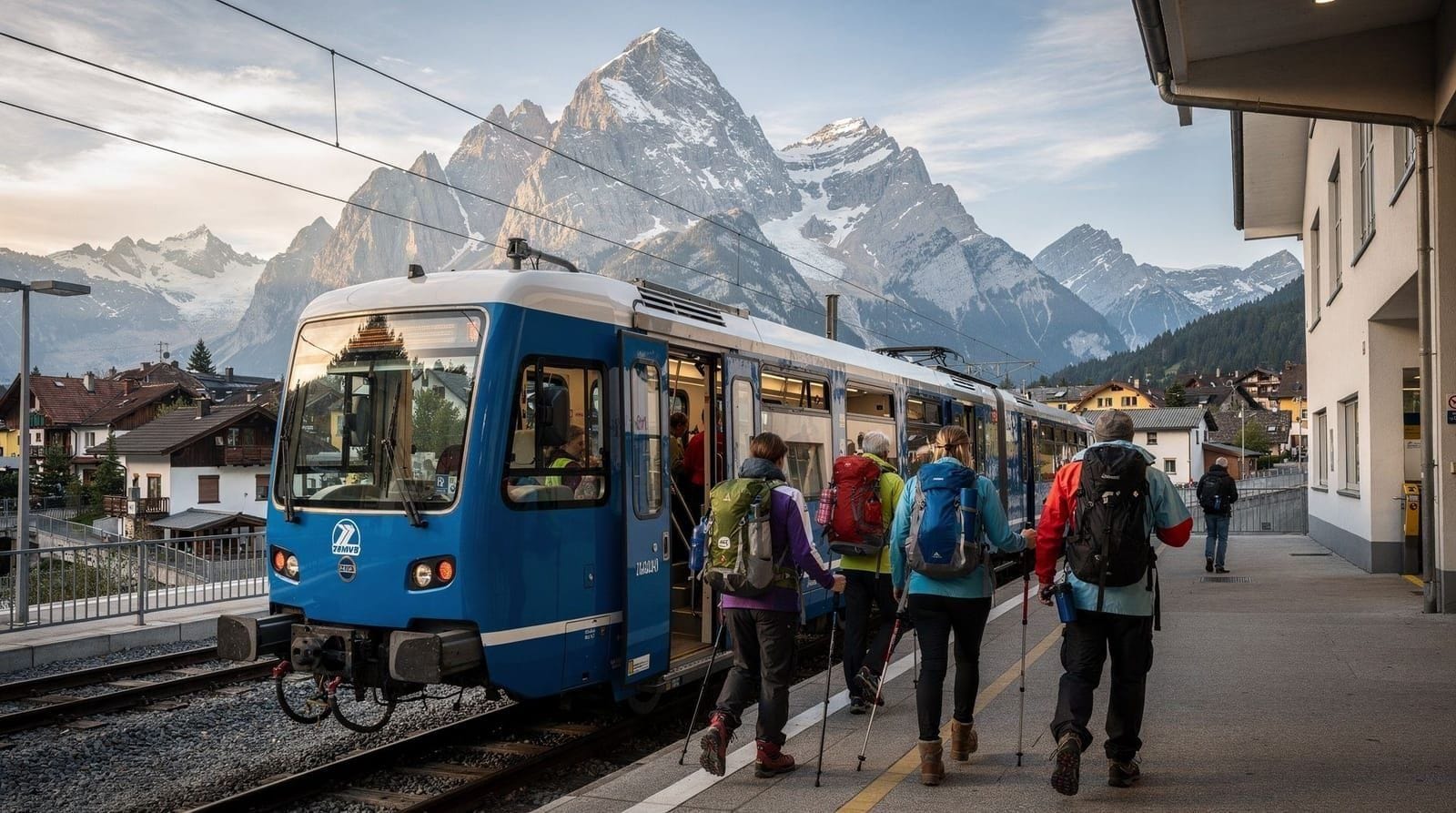
The BOB train from Munich Hauptbahnhof to Garmisch departs from the main station and runs via Pasing; the journey is approximately 1 hour and 22 minutes. Trains run roughly every hour. The Bayern-Ticket covers the full journey.
Once in Garmisch, the options branch significantly. The most obvious is the Zugspitze itself — but note that reaching the summit requires either the Zugspitzbahn cog railway or the cable car, neither of which is included in the Bayern-Ticket. Zugspitze summit access costs approximately €70 adults return by cable car. Our detailed Zugspitze day trip guide covers the best approach depending on weather and what you want to see.
For those not going to the summit, Garmisch itself rewards a day on foot. The old town (Garmisch side, as opposed to Partenkirchen) has painted Lüftlmalerei facades on many buildings; the Partnachklamm gorge walk is one of the best gorge walks in Germany, accessible on foot or by horse-drawn carriage from near the Olympic ski stadium. The gorge path winds through a narrow limestone canyon for about 700 metres — dramatic in any season but spectacular in winter when the walls are iced over.
Hikers have an enormous range on the trails above town. The Garmisch hiking guide covers the main routes by difficulty. The area is also close to the beautiful Zugspitze massif viewpoints accessible without paying summit prices.
For groups, Garmisch represents solid Bayern-Ticket value. A regular return from Munich to Garmisch costs around €22 to €26 per person; five people paying individual returns would spend €110 to €130. The same group on a Bayern-Ticket pays €53.
The castles: Füssen and Neuschwanstein (2 hours)
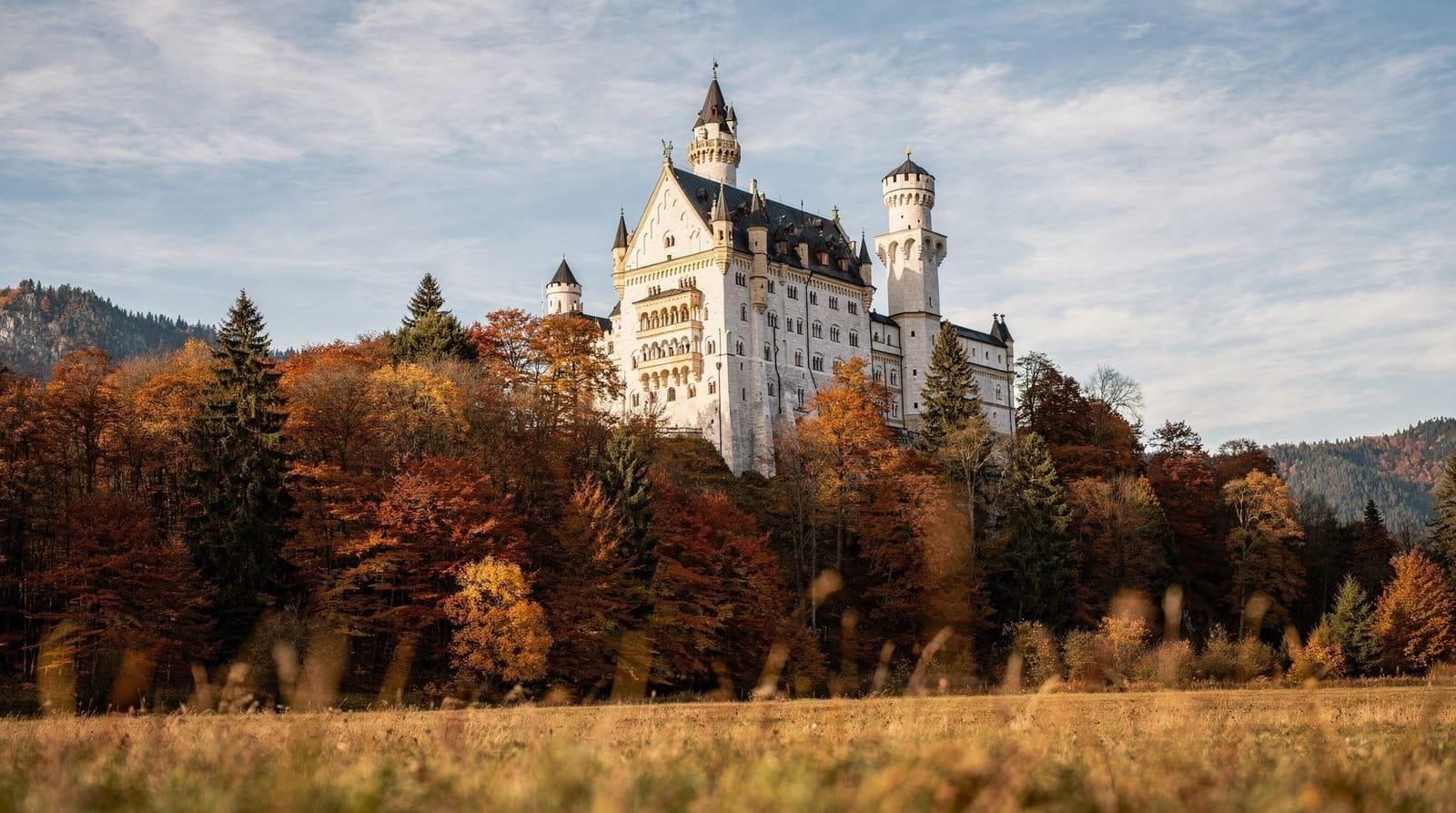
Füssen is the gateway to Neuschwanstein and Hohenschwangau — the two castles that, between them, define Bavaria’s fairy-tale image worldwide. The journey from Munich Hauptbahnhof takes approximately two hours on a direct regional service via Augsburg, Kaufbeuren, and Buchloe. Trains run roughly every two hours on this route; check the timetable in advance and plan around the castle visiting hours.
The Bayern-Ticket covers the train in full. From Füssen station, local buses run to the castle car park at Hohenschwangau village (the Bus 73 or 78; these are usually covered by Bayern-Ticket as standard Bavarian local buses, but confirm on the day as route coverage can change).
What matters most at Neuschwanstein is booking timed castle entry in advance. Walk-up tickets are often sold out by mid-morning in peak season (June through August), and the queue at the ticket centre in the valley can run to two hours or more. Timed-entry tickets can be booked at least 24 hours in advance online. Our Neuschwanstein tickets guide explains the booking system and what to expect on the ground.
The castle itself takes around 35 to 40 minutes on a guided tour. The view from the Marienbrücke bridge, suspended over a gorge with the castle as backdrop, is one of the most photographed images in all of Germany — and it is free to access. The combination of Neuschwanstein with the slightly older Hohenschwangau Castle next door can fill a full day. Our broader Munich castles day trip guide gives context for how to fit both into a single visit. Book a guided Neuschwanstein day trip by train from Munich
History: Dachau Memorial Site (35–45 minutes)
Dachau Concentration Camp Memorial Site is not a cheerful day trip in any conventional sense — but it is one of the most historically significant sites reachable from Munich, and many visitors feel it is an important part of understanding the city and the 20th century.
The journey from Munich Hauptbahnhof uses S-Bahn line S2 to Dachau (about 22 minutes), then bus 726 to the memorial site (about 13 minutes). The entire journey is covered by Bayern-Ticket, including the local bus.
The memorial site is free to enter. A self-guided visit covering the main exhibition in the former maintenance building, the reconstructed barracks, the camp perimeter, and the memorials takes a minimum of two to three hours; four hours is more realistic if you read the exhibition in detail. Guided tours (in English) are available and recommended for context; these are included in the free entry.
Our detailed Dachau day trip guide covers what to see, how to plan the visit, and how to combine it with a morning or afternoon in Munich. Book a guided memorial tour to Dachau from Munich
Further afield: Regensburg (1h25)
Regensburg is one of Germany’s most complete medieval cities — UNESCO World Heritage Site since 2006, and the only major German city to have survived World War II with its historic centre largely intact. The old town is an extraordinary density of Romanesque and Gothic architecture: the Dom, the Stone Bridge (one of the oldest surviving bridges in Germany, dating to the 12th century), the patrician towers, and the tangle of narrow lanes that feel unchanged from five centuries ago.
The RE regional train from Munich Hauptbahnhof reaches Regensburg in approximately 1 hour and 25 minutes. Services run roughly every hour. The Bayern-Ticket covers the journey in full.
Regensburg works well as a pure city exploration day. The Wurstkuchl sausage kitchen beside the Stone Bridge is reputedly the oldest public catering establishment in the world in continuous operation — dating to the early 12th century — and is worth the short queue. The cathedral treasury and the view from the Dom towers are highlights. A boat trip on the Danube (the river that Regensburg sits on) is available in summer.
For groups particularly, Regensburg is excellent Bayern-Ticket territory: a standard return costs roughly €35 to €42 per person by regional train, so five people on individual tickets would pay €175 to €210. The group Bayern-Ticket at €53 total is a significant saving.
Berchtesgaden and Königssee (2h30)
Berchtesgaden is Bavaria’s most dramatic alpine corner — a town set deep in a valley surrounded by near-vertical limestone walls, at the extreme southeastern tip of Bavaria where Germany almost becomes Austria. The approach by train is already scenically striking.
The journey from Munich Hauptbahnhof by Bayern-Ticket takes approximately 2 hours 30 minutes and requires a change, typically at Freilassing. It is a longer day by train than by car, but entirely doable and fully covered by Bayern-Ticket.
The primary attractions are Königssee — the dark-green fjord-like lake where electric boats glide silently past sheer cliff faces — and the Eagle’s Nest (Kehlsteinhaus), the former Nazi building perched at 1,834 metres that today operates as a restaurant with astonishing views. Königssee boat trips cost approximately €24 adults return; the Eagle’s Nest requires a special bus from the Obersalzberg (additional cost, open late May through October).
A Berchtesgaden day is ambitious — the train journey alone is five hours of travel round-trip — but it is one of the most visually spectacular destinations in Bavaria.
Nuremberg (1h50 on Bayern-Ticket)
Nuremberg is Bavaria’s second city: a city of enormous cultural and historical depth, with one of the best-preserved medieval old towns in Germany, the reconstructed Kaiserburg castle, the vast Nazi Party Rally Grounds (now a documentation centre), and the city of the Nuremberg Trials.
One important nuance: the journey from Munich to Nuremberg is often done on ICE trains, which take around 1h10 and are not covered by Bayern-Ticket. The regional RE option takes approximately 1h50 and is covered. If you are planning the day, factor in 1h50 each way by Bayern-Ticket train, not the faster ICE timing. The extra 40 minutes each way is still very manageable for a full day.
The old town is compact and walkable; the Hauptmarkt square, the Germanic National Museum, and the Nazi Party Rally Grounds are all within range. The Nuremberg trials courtroom at the Palace of Justice is a moving and significant historical site — the same courtroom where the trials were held is still in use as an active court and open to visitors when not in session.
Salzburg by train: what the Bayern-Ticket does not cover
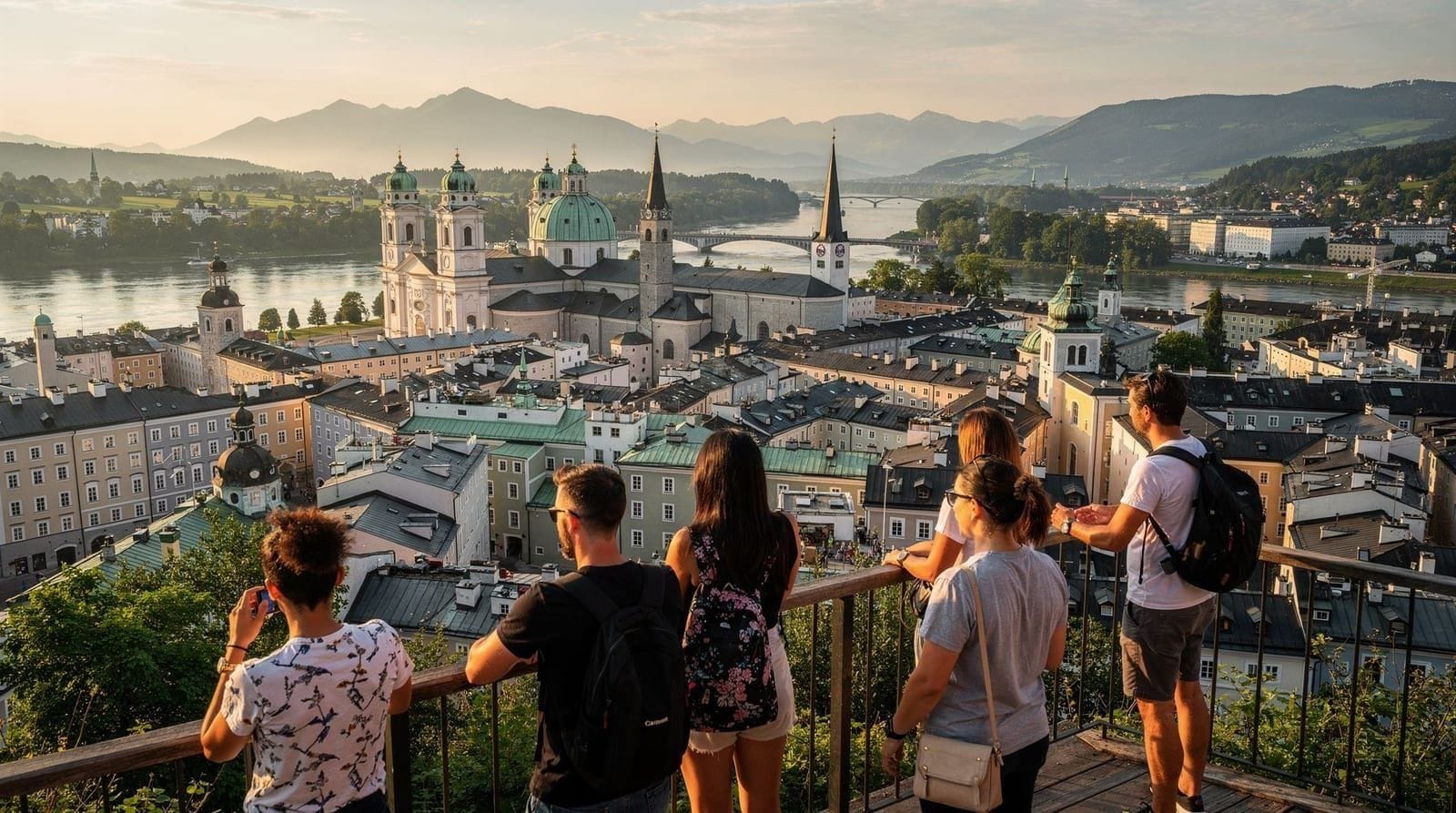
Salzburg deserves direct, honest treatment in any guide about train travel from Munich: it is one of the most popular day trips from Munich, it is extremely easy to reach by train, and the Bayern-Ticket does not cover it at all.
Salzburg is in Austria. The Bayern-Ticket expires at the German border. For Salzburg you need a regular DB or ÖBB point-to-point ticket, which in 2026 costs approximately €23 to €39 each way depending on how far in advance you book and which service you take. Railjets from Munich Hauptbahnhof reach Salzburg Hauptbahnhof in approximately 1h30; these run frequently throughout the day.
Book Salzburg tickets in advance through the DB Navigator app or ÖBB website for the best prices. The savings on early bookings can be significant. Our Munich to Salzburg day trip guide covers what to do and how to structure the visit. Similarly, Innsbruck requires a separate Railjet ticket (approximately €29 to €49 each way, journey time 1h50). Book a guided Munich to Salzburg day trip with train transfer
Group pricing worked examples
One of the Bayern-Ticket’s strongest features is its group economics. Here are worked examples at 2026 pricing to illustrate:
Couple (2 people) to Chiemsee:
- Bayern-Ticket: €29 + €6 = €35 total
- Individual returns: approximately €19 to €22 each = €38 to €44 total
- Bayern-Ticket saving: modest but positive, and the ticket also covers your Munich S-Bahn, U-Bahn and trams all day
Family of 4 to Füssen/Neuschwanstein:
- Bayern-Ticket: €29 + 3 x €6 = €47 total
- Individual returns: approximately €34 each = €136 total
- Bayern-Ticket saving: approximately €89
Group of 5 to Garmisch-Partenkirchen:
- Bayern-Ticket: €29 + 4 x €6 = €53 total
- Individual returns: approximately €22 to €26 each = €110 to €130 total
- Bayern-Ticket saving: approximately €57 to €77
The pattern is consistent: the larger the group, the more compelling the Bayern-Ticket becomes relative to individual tickets.
Practical notes for planning your train day trip
Seat reservations: Bayern-Ticket and regional trains do not require seat reservations — you simply board with the ticket. On busy weekend days, regional trains to Garmisch, Füssen, and the alpine lakes can be crowded; if you prefer a guaranteed seat on a busier route, consider travelling slightly off-peak (leaving Munich around 10:30 or 11:00 rather than 09:00).
Buying the ticket: The DB Navigator app is the simplest option — download it in advance, and the Bayern-Ticket can be purchased and stored digitally. When buying for a group, the person purchasing lists the number of additional travelers; inspectors may ask for IDs to check names match. All travelers named on the ticket must travel together throughout the day.
Train apps and planning: DB Navigator shows all regional connections. When searching routes, filter by “regional trains only” to ensure you see only Bayern-Ticket-compatible services. Some results will default to ICE or IC options that look faster but are not covered.
Return times: The Bayern-Ticket is valid until 03:00 the following morning on weekdays (from 09:00). This means you can comfortably take an evening train back from most destinations without the ticket expiring; a 21:00 or 22:00 departure from Garmisch or Regensburg is entirely valid.
Combining trips: Because the Bayern-Ticket covers all of Bavaria for the day, you can in principle visit two destinations — for example, Augsburg on the way out and Garmisch as the main destination, stopping briefly on the return. This requires careful timetable checking but is perfectly valid.
The Romantic Road day trip from Munich connects several Bavarian towns in a single route, and the regional train network serves the key stops along it — making a Bayern-Ticket day trip along the Romantic Road a realistic and often overlooked option.
Which trip should you choose?
The answer depends on three factors: group size, interests, and how much travel time feels acceptable.
For first-time visitors looking for the most iconic Bavaria experience, Garmisch-Partenkirchen (mountains and alpine scenery) or Füssen and Neuschwanstein (the definitive Bavarian castle) are the two headline choices. Both require planning — Neuschwanstein especially needs advance ticket booking.
For couples or small groups on a budget, Tegernsee or Chiemsee deliver spectacular scenery with low railway costs, easy logistics, and a relaxed pace.
For history-focused visitors, Dachau and Regensburg are the strongest options — one for the most important site of 20th-century history within easy reach of Munich, the other for one of Germany’s finest intact medieval cities.
For large groups (four or five people), the Bayern-Ticket group economics are strong enough that almost any destination becomes significantly cheaper than individual tickets — and the choice shifts toward whichever destination the group finds most compelling.
Whatever the destination: buy the Bayern-Ticket via the DB Navigator app before you travel, download the DB timetable for your specific day, and check whether your trains are RE or RB services (not ICE or IC). Those three steps cover nearly everything that can go wrong with a train day trip from Munich.
Solo travellers: is the Bayern-Ticket still worth it?
For a single traveller, the Bayern-Ticket’s value is more marginal than for groups, and it is worth doing the maths before assuming it is automatically the cheaper option. For short hops like Augsburg (a standard return around €14-16), a solo Bayern-Ticket at €29 is not the cheapest choice unless you plan a second journey the same day, such as combining Augsburg with an evening in central Munich using the city’s S-Bahn and U-Bahn network — both covered by the same ticket. For longer routes like Regensburg or Füssen, where standard returns run €34-48, the Bayern-Ticket wins clearly even solo. As a rule of thumb: for journeys under roughly €25 return, compare prices directly; for anything above that, the Bayern-Ticket is close to always the better deal.
What happens if you miss your return train
Missing a return train is the most common real-world problem on a Bayern-Ticket day trip, and the fix depends on the destination. On routes with hourly or better frequency — Augsburg, Tegernsee, Chiemsee, Garmisch — the Bayern-Ticket simply covers the next available regional service, since it is a day pass rather than a specific-train ticket. On routes with only every-two-hours service, such as Füssen, missing the last realistic train back can mean a genuinely late arrival in Munich or, in rare cases, needing to arrange a taxi or overnight stay. Before setting off, it is worth noting the last one or two return departure times for your specific destination so a delay at the castle or lake does not turn into a logistics problem.
Frequently asked questions about Day trips by train from Munich
How much does the Bayern-Ticket cost in 2026?
The Bayern-Ticket costs €29 for a single traveler. Each additional person adds €6, up to a maximum of 5 people (€53 total for a group of 5). There is also a Bayern-Ticket Night, valid from 18:00 to 06:00, at the same price. Buy it via the DB Navigator app, at ticket machines, or at DB counters.What destinations can I reach with the Bayern-Ticket?
The Bayern-Ticket covers the entire Bavaria regional network: Garmisch-Partenkirchen (1h22), Füssen (2h), Nuremberg (1h10), Regensburg (1h25), Augsburg (40 min), Salzburg (NOT included — Austria is excluded), Berchtesgaden (2h30), Chiemsee (50 min), Tegernsee (50 min), and many others.Is the Bayern-Ticket valid to Salzburg and Innsbruck?
No. Both Salzburg and Innsbruck are in Austria and are NOT covered by the Bayern-Ticket. For Salzburg you need a regular DB or ÖBB ticket (around €23–€39 each way). For Innsbruck, a Railjet ticket is around €29–€49 each way. Book these in advance for the best prices.Can I use the Bayern-Ticket on S-Bahn and local buses?
Yes. The Bayern-Ticket is valid on all S-Bahn lines in the Munich metropolitan area, regional trains (RE, RB, ALX, BOB, BRB), and most local buses within Bavaria. In Munich itself it covers the entire MVV network including U-Bahn and trams, making it excellent for a full day that includes city travel.What is the best value day trip from Munich by train using the Bayern-Ticket?
For solo travelers, Garmisch-Partenkirchen (€29 Bayern-Ticket vs €22.40 regular return) offers modest savings. For groups of 3–5, the savings are significant: a Bayern-Ticket for 5 people at €53 total beats 5 individual returns to almost any destination. Chiemsee, Tegernsee, and Augsburg are all excellent value on the Bayern-Ticket.What trains does the Bayern-Ticket NOT cover?
The Bayern-Ticket does not cover ICE (high-speed intercity trains), IC or EC trains, night trains, or any service outside Bavaria. You cannot use it on the Munich Airport Express (Munich-Airport Rapid Transit from the main station — the direct service). It also excludes private tourist railways unless specified.
Top experiences
Bookable activities with verified prices and instant confirmation on GetYourGuide.