Best alpine views near Munich: ranked viewpoints from summits to lakes
From Munich: tour of Germany's highest peak Zugspitze
What is the best alpine view near Munich?
For pure altitude and panoramic range, Zugspitze summit (2,962 m) is unmatched — on clear days you can see Munich 70 km north and deep into Austria. For accessible beauty without a €74 ticket, Herzogstand ridge above Walchensee or the Wendelstein summit (1,838 m) offer outstanding views with shorter travel times and lower cost.
| Where | Bavarian Alps and lakes, 30–150 min from Munich |
| Cost | Free (Eibsee shore, Marienbrücke) up to around €74 (Zugspitze) |
| Time needed | Half a day for lake views; a full day for summit views |
| Getting there | S-Bahn/BOB train plus cable car or bus depending on the viewpoint |
| Best time | Clear mornings, May/September/October for fewer crowds and clearer air |
Why the view question matters — and how to answer it honestly
“Best view near Munich” is a question that has an obvious answer (Zugspitze — it’s the highest) and a more nuanced one that actually helps people plan. This guide provides both. Not every visitor should go to Zugspitze on every trip. The best view for any given person depends on budget, time, tolerance for crowds, and whether the goal is a summit experience, a lake panorama, a castle backdrop, or something else entirely.
The viewpoints in this guide are ranked within categories: summit views, lake views, castle and historical viewpoints, and gorge perspectives. Within each category, they are ordered by a combination of objective visual quality and practical accessibility from Munich. Travel time, cost, crowd density, and seasonal considerations are included for each.
One general point that applies across all of them: altitude weather behaves independently of Munich weather. The same day can be cloud-free in the city and completely fogged in at 1,500 metres, or vice versa. Before travelling specifically for a view, check the mountain webcam (usually available on the venue’s own website) rather than the Munich weather forecast.
Summit views: ranked
1. Zugspitze summit (2,962 m)
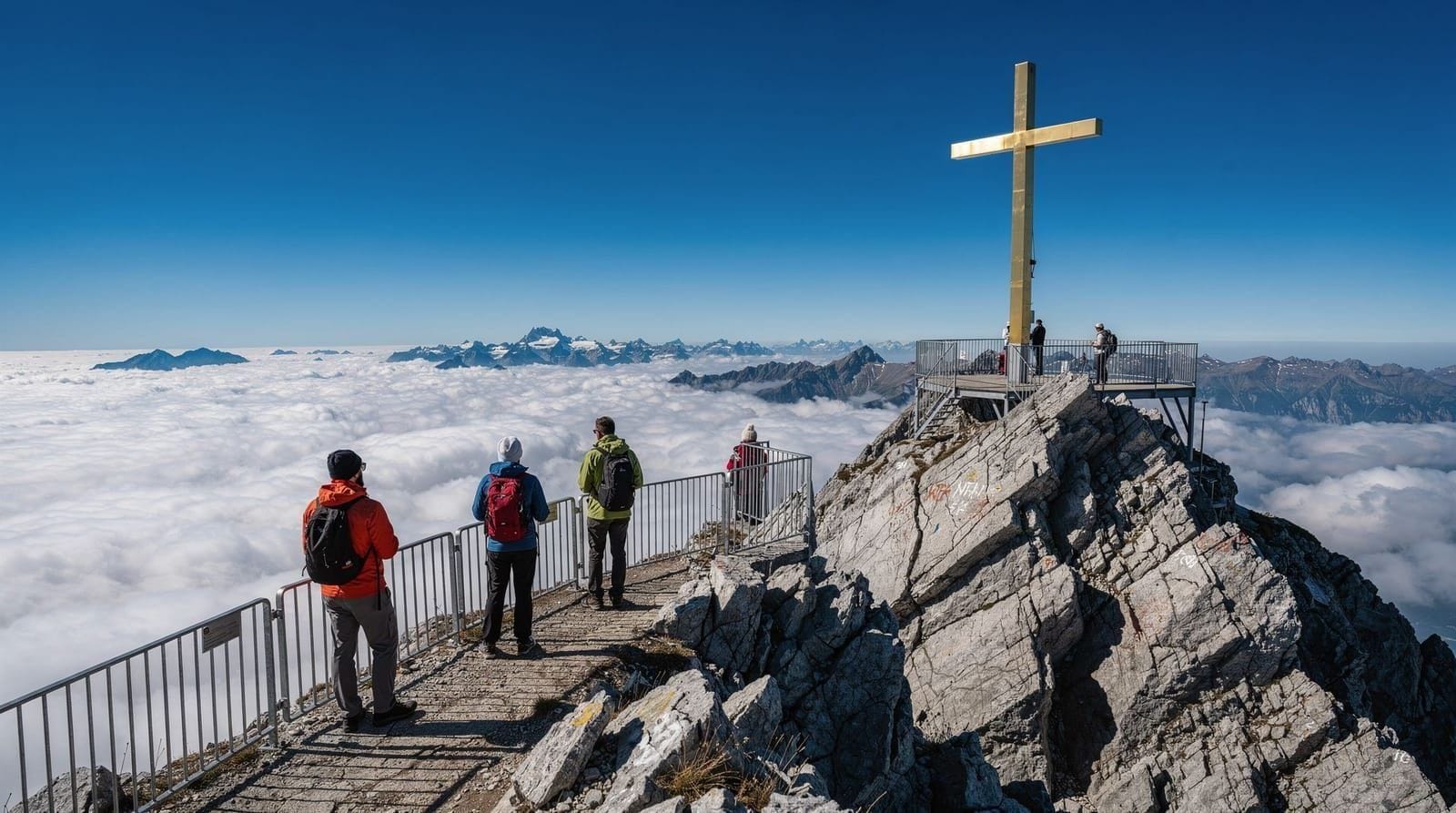
Germany’s highest point gives the most expansive panorama available in Bavaria. On clear days, the view spans from Munich and the Bavarian plateau to the north, across the full chain of Bavarian Alps (Zugspitze, Wetterstein, Karwendel, Berchtesgadener Alps visible sequentially), and deep into Austria — the Ötztal, Stubai, and Zillertal Alps are identifiable with basic knowledge of alpine geography.
The unique element at Zugspitze that no other Bavarian summit offers: standing on a glacier. The Zugspitzplatt glacier below the summit is small and receding, but in summer it gives a high-alpine environment — blue-white snow extending across a plateau at 2,600 metres — that is visually unlike anything at lower altitude. The psychological effect of being above the snowline when it is 25°C in Munich is distinctive.
Access: Bayerische Zugspitzbahn from Garmisch-Partenkirchen (direct trains from Munich Hauptbahnhof, 75-80 min). Cogwheel train plus cable car to summit. Total travel time from Munich approximately 2-2.5 hours. Return ticket approximately €74 adults. Bayern Ticket covers rail to Garmisch; Zugspitzbahn is additional.
Best conditions: May, September, October for clearest weather and fewest crowds. Midweek mornings in summer. Avoid Saturday noon in July. Book a guided day trip from Munich to the Zugspitze summit
2. Nebelhorn (2,224 m) above Oberstdorf
Nebelhorn’s summit view faces southwest into the Allgäu Alps — a different landscape to Zugspitze’s broader panorama, but in many respects more dramatically alpine in character at the human scale. The jagged ridges of the Großer Wilder and Hochvogel are visible in close relief; the Austrian Vorarlberg peaks fill the southern horizon. What Nebelhorn lacks in raw altitude it compensates with summit atmosphere — significantly fewer visitors and better walking options from the top.
Access: IC train from Munich to Immenstadt (around 75 minutes), regional to Oberstdorf (15 minutes), cable car to summit (25 minutes). Bayern Ticket covers the train sections. Cable car approximately €33 round trip. Total journey approximately 2 hours.
Best conditions: Summer mornings for hiking; late summer (August-September) for clearest visibility in the Allgäu.
Our Zugspitze vs Nebelhorn guide compares the two mountains in detail if you are deciding between them.
3. Wendelstein (1,838 m) above Brannenburg
Wendelstein is the most unusual summit near Munich — the 1912 cogwheel railway, the 11th-century chapel, the atmospheric research station, and the natural cave at the summit combine to create an experience that is more than just a viewing platform. The view north to Munich and the Bavarian foothills, combined with the Zugspitze chain filling the southern horizon, is outstanding. The summit faces north-northwest, giving good morning light on the view toward Munich.
Access: S4 or main-line train to Rosenheim, BOB to Brannenburg (around 75-80 minutes from Munich), then the cogwheel railway. Bayern Ticket covers rail. Cogwheel railway and cable car approximately €36 adults round trip.
Best conditions: Year-round, as the cogwheel railway operates throughout winter. Snow at the summit from November to April transforms the experience.
4. Herzogstand ridge (1,731 m) above Walchensee
The view from the Herzogstand ridge is arguably the most photogenic in Bavaria south of the Zugspitze — looking east and north from the ridge crest, the turquoise Walchensee occupies the entire foreground, with the Karwendel mountains rising behind and the Zugspitze chain visible to the south. It is the kind of landscape composition that makes the view feel like a painting rather than a natural scene.
The ridge walk from Herzogstand to Heimgarten (1,791 m) extends the panorama and is the best accessible alpine ridge walk near Munich for non-specialists.
Access: BOB to Kochel am See (around 75 minutes from Munich), bus to cable car valley station. Cable car approximately €26 adults round trip. Bayern Ticket covers rail and bus.
Best conditions: Check operational status at herzogstand.de before visiting — the cable car has seasonal closures. Best in May-June and September-October.
5. Brauneck summit (1,559 m) above Lenggries
More modest in altitude but outstanding for its specific northern viewpoint — the Isar valley stretches to the north toward Munich, framed by forested ridges, while the Karwendel chain appears to the south. The Brauneck is primarily a ski resort, but summer visits on the gondola give a relaxed, crowd-free summit experience with an excellent mountain restaurant and straightforward walking.
Access: BOB to Lenggries (around 65 minutes from Munich), then cable car. Bayern Ticket covers rail. Cable car approximately €22 adults round trip in summer.
Lake and lowland views: ranked
1. Eibsee below Zugspitze
The Eibsee is Bavaria’s most dramatic lake setting — the turquoise water sits in a deep glacially-carved hollow directly below the Zugspitze’s southern face, at 972 metres elevation. The colour of the water, fed by glacial meltwater, is genuinely vivid rather than a colour-saturated photograph effect. The lake is surrounded by conifer forest with the grey limestone cliffs and snow of the Zugspitze massif directly above.
The Eibsee is reachable without paying the Zugspitze ticket — the lake is a public area with a free car park and walking paths. A 7 km footpath circles the entire lake (about 2 hours at a comfortable pace). The lake restaurant (Eibsee Hotel terrace) provides good food with the view.
Access: Train to Garmisch, then bus or taxi to Eibsee (or the Zugspitzbahn train stops at Eibsee station). Bayern Ticket covers the rail leg.
2. Walchensee from the shore and Herzogstand
The Walchensee seen from above (Herzogstand ridge) is described above. From the lake shore itself, the view looking south toward the Karwendel peaks is dramatic — steep forested ridges rise directly from the water. The lake is also Bavaria’s deepest (69 metres) and is known for reliable wind, making it one of Bavaria’s premier sailing and windsurfing locations.
Access: BOB to Kochel am See (75 minutes from Munich), bus to the lake. A small admission fee applies to the main beach area in summer.
3. Königssee from the boat and St Bartholomä
Königssee near Berchtesgaden is the most dramatically enclosed lake in Bavaria — a 7.7 km elongated lake sitting in a narrow glacial valley, cliffs rising almost vertically 1,000 metres on both sides. The boat trip from Schönau to St Bartholomä (a pilgrimage church isolated on a small peninsula with no road access) passes through this landscape. The echo from the cliffs is demonstrated by the boat operator playing a flugelhorn midflight — a Bavarian tradition maintained for well over a century.
Access: Train from Munich to Berchtesgaden (around 2.5 hours with changes), then bus to Schönau. Bayern Ticket covers all rail and bus legs. Boat tickets approximately €19 adults round trip.
Our Königssee guide covers this in full.
4. Starnberger See from the west shore
The Starnberger See is the closest lake to Munich with an alpine backdrop — from the western shore, the view south takes in the full Alpine chain from the Zugspitze in the west to the Bavarian-Austrian border mountains in the east, about 50-60 km distant. On clear autumn days after rainfall, the peaks appear in sharp relief against a blue sky over the glittering lake. This is one of the most accessible alpine views from Munich — the western shore is reachable by S-Bahn (S6 line).
Access: S6 from Munich city centre to Starnberg (under 30 minutes). Bavaria Ticket covers the journey.
Castle and historical viewpoints: ranked
1. Marienbrücke at Neuschwanstein
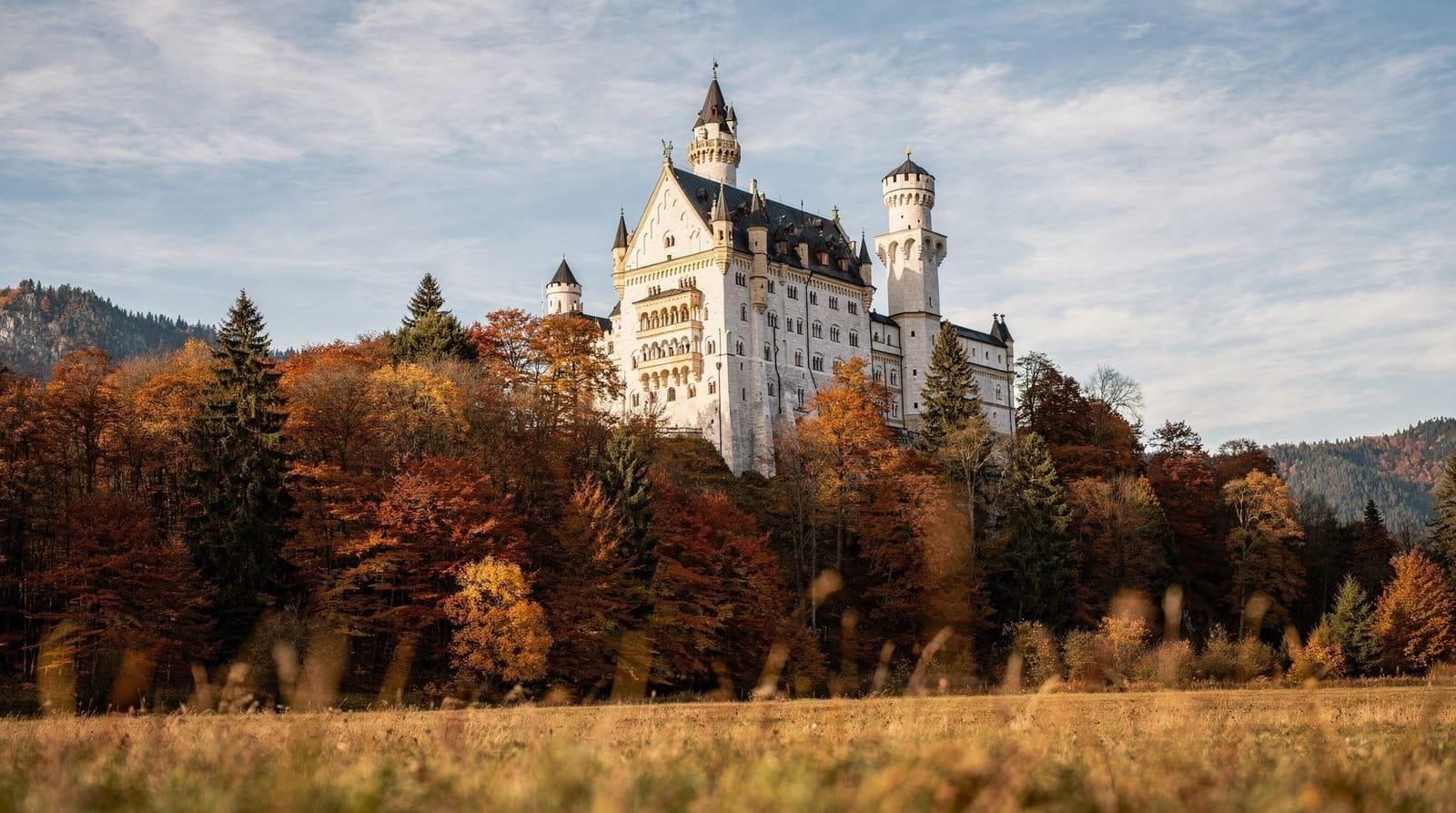
The famous bridge over the Pöllat Gorge gives the defining photograph of Neuschwanstein Castle from above — towers and spires set against forested alpine ridges. When the bridge is open (summer and good-weather autumn), this view is justifiably famous. The castle is actually below the viewer, seen from a metal bridge spanning a 90-metre gorge.
See our dedicated Marienbrücke guide for full access details, crowd strategy, and winter closure information.
Access: Train to Füssen (Bayern Ticket), bus to Schwangau, walk uphill. The bridge itself is free without a castle ticket.
2. Tegelberg summit above Neuschwanstein
From Tegelberg cable car summit (1,720 m), Neuschwanstein appears below as a castle in its full landscape context — something impossible to appreciate from ground level. The surrounding terrain of the Ammergau Alps is visible in a way that gives the castle’s isolation its full meaning. This view is less famous than Marienbrücke but arguably more informative about the place and why Ludwig built here.
Access: Same as Neuschwanstein — train to Füssen, bus to Schwangau. Cable car from near the Neuschwanstein ticket center, approximately €28 adults round trip. See our Bavarian Alps cable cars guide for more detail.
Gorge and close-up landscape views
Partnachklamm near Garmisch is the best close-landscape experience near Munich — a narrow limestone gorge carved by the Partnach stream, walkable for 700 metres through tunnels cut in the rock, with the torrent audible and sometimes visible below. Entry costs approximately €6. Access from Garmisch station on foot (1 km walk to the gorge entrance). The Zugspitze is not visible from inside the gorge, but the landscape is distinctive and very different from any summit view.
Aachenklamm above Jachenau and Breitachklamm near Oberstdorf are less visited but similarly dramatic gorge experiences for those who have already done Partnachklamm.
For more on Munich’s viewpoints within the city itself, see our Munich viewpoints guide. Book a private alpine tour combining Zugspitze, Eibsee and Garmisch
How to choose: a practical summary
For a first alpine experience and a maximum-impact day, Zugspitze delivers what no other viewpoint near Munich can. But the premium — in cost, travel time, and summer crowds — is real.
For value and quiet, Herzogstand above Walchensee or Wendelstein give outstanding views at half the cost with far fewer visitors. Both are underused by English-speaking visitors, which is partly a language-barrier issue (less international marketing) and partly a perception gap (they lack the brand recognition of Zugspitze or Neuschwanstein).
For a view that integrates cultural history rather than pure landscape, Marienbrücke at Neuschwanstein combines a genuinely dramatic alpine gorge perspective with one of Europe’s most recognisable castle silhouettes.
For lake-landscape views, Eibsee and Walchensee are objectively more beautiful than the more-visited Tegernsee or Starnberger See — a judgement that holds under any reasonable assessment of their visual qualities, though all four are worth visiting on their own terms.
The most honest recommendation for a visitor with two or three free days: Zugspitze for one of them, Herzogstand or Nebelhorn for another, and a lakeside afternoon (Eibsee or Walchensee) for the third. This combination covers the range of what the Bavarian alpine landscape actually offers without repeating the same experience twice.
Ranked viewpoints at a glance
| Viewpoint | Category | Cost | Travel time from Munich |
|---|---|---|---|
| Zugspitze summit | Summit | ~€74 | 2–2.5 hrs |
| Nebelhorn | Summit | ~€33 | ~2 hrs |
| Wendelstein | Summit | ~€36 | ~1.5–2 hrs |
| Herzogstand ridge | Summit/lake | ~€26 | ~1.5–2 hrs |
| Eibsee | Lake | Free (lake); cable car extra | ~1.5–2 hrs |
| Walchensee | Lake | Free shore; small beach fee | ~1.5–2 hrs |
| Königssee | Lake | ~€19 boat | ~2.5–3 hrs |
| Marienbrücke | Castle | Free | ~2–2.5 hrs |
| Partnachklamm | Gorge | ~€6 | ~1.5–2 hrs |
Combining viewpoints with where you stay
If alpine views are the priority for your whole trip rather than a single day out, where you base yourself matters. Staying a night or two in Garmisch-Partenkirchen puts Zugspitze, Wank, Eibsee, and Partnachklamm all within a short local trip rather than a full Munich round-trip each time. For a lake-focused stretch, Mittenwald or a night near Tegernsee works similarly. Visitors building a full itinerary around this theme should check the Bavarian Alps 3-day itinerary, which sequences several of these viewpoints without excessive backtracking to Munich.
For those staying in Munich the whole time, the best day trips from Munich guide and the Munich to Garmisch day trip guide cover the logistics of doing these as return trips within a single day.
Frequently asked questions about the best alpine views near Munich
Which alpine view near Munich is best for first-time visitors?
Zugspitze is the most dramatic introduction — Germany’s highest peak, a glacier, and a panorama unlike anything at lower altitude. For visitors who want a spectacular view without paying €74 or dealing with crowds, Wendelstein gives an outstanding summit experience.
What is the best free alpine view near Munich?
Marienbrücke at Neuschwanstein is free to walk to. The Walchensee shore and Eibsee lakeside paths are free. Some of the best high-altitude views come via cable car tickets, but these cover all the walking once you are up.
Can you see the Alps from Munich itself?
Yes, on clear days from elevated points: the Olympiaturm, St Peter’s church tower, and southern suburbs. Best visibility in autumn after rainfall clears the air.
What is the most underrated alpine view near Munich?
Herzogstand ridge above Walchensee — turquoise lake below, Karwendel mountains across, Zugspitze chain to the south. Reachable by BOB train and cable car, consistently overlooked in favour of more famous destinations.
Which viewpoint is best for photography?
Marienbrücke at Neuschwanstein for iconic subject matter. Herzogstand ridge for natural landscape composition. Zugspitze at dawn for extraordinary light conditions.
Which alpine view is best in winter?
Wendelstein is excellent year-round by cogwheel train. Zugspitze in winter is primarily a ski resort but spectacular for non-skiers on the viewing terrace. Marienbrücke closes in icy conditions.
How accessible are these viewpoints for people with limited mobility?
Zugspitze summit terrace is fully accessible by cable car or cogwheel train. Wendelstein summit building is reachable by cogwheel train. Tegelberg cable car reaches a largely flat summit area. Marienbrücke requires a 10-15 minute uphill walk from the castle entrance.
Can I combine an alpine view with a hike rather than just a cable car ride?
Yes — Herzogstand’s ridge walk to Heimgarten and the trails around Nebelhorn are the two best options for combining a genuine hike with a summit view. The Garmisch hiking guide covers trail options for those based around Zugspitze and Wank specifically, including routes that connect back down to Partnachklamm.
Is it worth paying for a guided tour instead of doing these independently?
For a single alpine day with limited time, a guided tour removes the logistics of train timing, cable car queues, and weather decision-making, which matters if this is your only alpine day of the trip. Independent travel is cheaper and more flexible if you have a full day to spare and are comfortable navigating Bayern Ticket connections yourself. Neuschwanstein Castle guided day tour from Munich is a good starting point if you want the castle-and-alpine-view combination handled for you.
Top experiences
Bookable activities with verified prices and instant confirmation on GetYourGuide.