Zugspitze vs Nebelhorn: which Bavarian mountain summit is worth your day?
From Munich: tour of Germany's highest peak Zugspitze
Should I visit Zugspitze or Nebelhorn from Munich?
Zugspitze (2,962 m) is Germany's highest peak with glacier views and costs around €74 return — worth it as a once-in-a-trip experience but crowded in summer. Nebelhorn (2,224 m) above Oberstdorf costs around €33, has outstanding views in a different direction, and is far less crowded — better value for visitors who already know the Zugspitze or prefer a quieter mountain day.
Two mountains, two completely different days
The Zugspitze and the Nebelhorn are both excellent reasons to leave Munich for a day. They are also genuinely different experiences in almost every respect — altitude, atmosphere, crowd levels, cost, hiking options, and the character of the views. Comparing them is not about finding a winner; it is about understanding which one matches what you are actually looking for.
The simplest summary is this: Zugspitze offers Germany’s highest vantage point, a glacier at your feet, and the specific satisfaction of standing at 2,962 metres on a cross marking the point where Bavaria ends and Austria begins. Nebelhorn offers outstanding alpine scenery at a more moderate altitude, one of Bavaria’s best accessible via ferrata routes, and a level of quiet and space that Zugspitze cannot offer in summer.
This guide runs through each mountain in detail, then provides a direct comparison across the factors that matter for planning a day trip from Munich.
| Zugspitze cost | around €74 adults return |
| Nebelhorn cost | around €33 adults return |
| Travel time from Munich | 2–2.5 hours each way, either mountain |
| Best for | Zugspitze: first-timers; Nebelhorn: hikers and repeat visitors |
| Best time | May–June or September for both, clear mornings |
Zugspitze: what you actually get at Germany’s highest point
The Zugspitze experience divides into two distinct parts: the journey and the summit. Both are worthwhile on their own terms.
The Bayerische Zugspitzbahn cogwheel railway departs from a dedicated station next to Garmisch Hauptbahnhof and takes around 70 minutes to reach the Zugspitzplatt glacier plateau, passing through forested lower slopes, a long tunnel section, and emerging above the snowline at around 2,000 metres before the final ascent. The railway has operated since 1930 and is engineering of the first order — the gradient in the upper section is steep enough that the cogwheel mechanism is the only reliable option. The Eibsee cable car offers an alternative ascent (departing from the Eibsee lake below the mountain) that covers the full 1,945 metres of vertical rise in about 10 minutes. Using one direction on each gives the most complete experience.
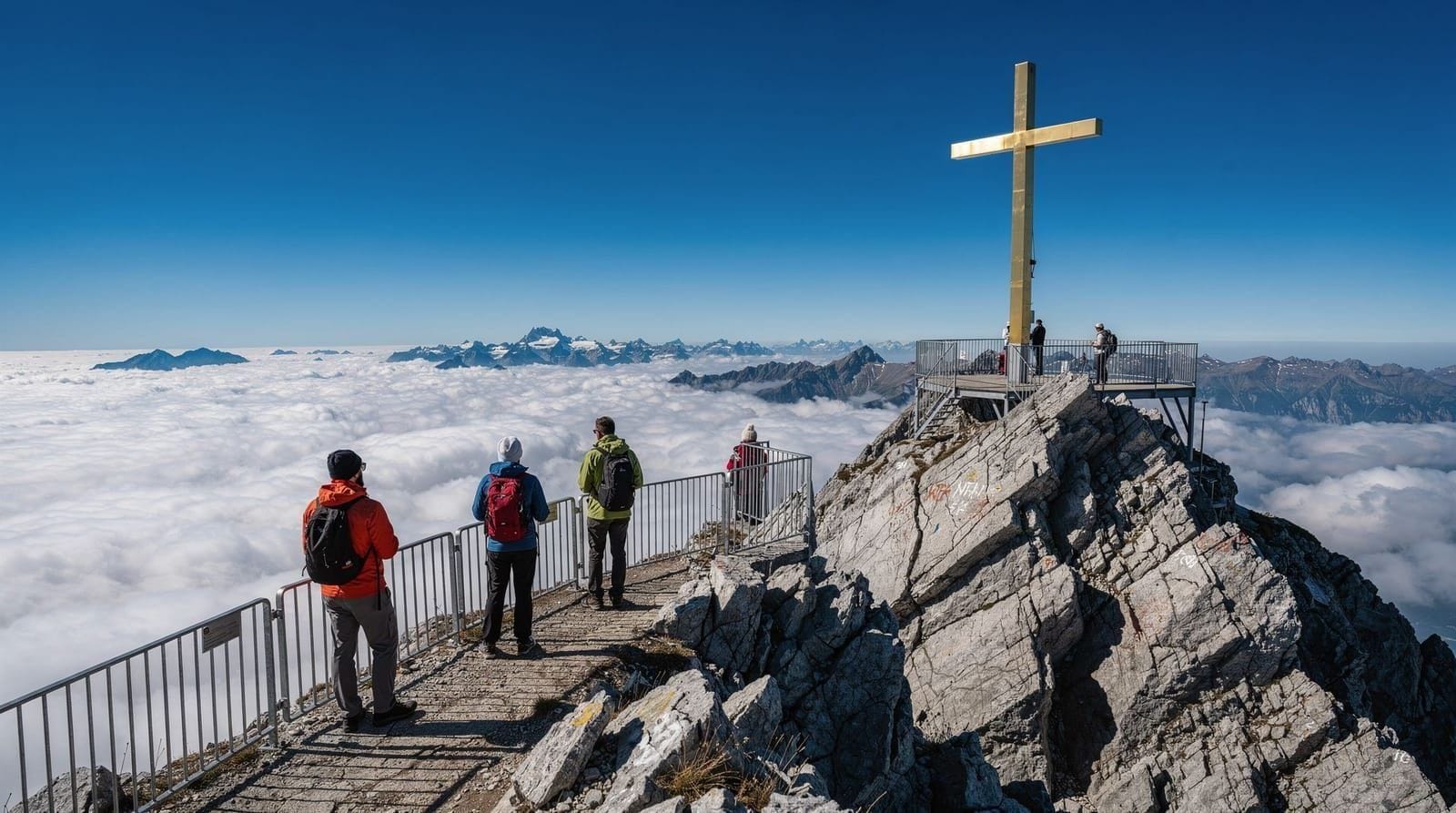
At the summit, you are at 2,962 metres with a 360-degree panorama on clear days. Looking north from the terrace, Munich and the Bavarian plateau extend to the horizon 70 km away. Looking south and east, the Austrian Alps range across the skyline — the Ötztal, Stubai, and Zillertal ranges are all visible on a clear day. The summit straddles the German-Austrian border; the summit cross is positioned directly on the frontier line.
The glacier immediately below the summit terrace is not large by Alpine standards — the Zugspitzplatt glacier has retreated significantly in recent decades due to warming temperatures — but it is Bavaria’s only glacier of note and walking on packed snow in late October or November, when the ski area has not yet opened, feels genuinely remote. In summer, the glacier is a ski area (open from roughly October to May).
What is less good: The summit facilities feel overcrowded in summer. The restaurant is expensive (mains around €22-28) and service is stretched. On peak weekend days, the cable car queues can be 30-60 minutes. The summit terrace is not large, and with hundreds of visitors, the sense of alpine solitude that some people travel here hoping for is not available between 10am and 4pm in July and August. For the summit experience at its best, go on a midweek morning in May, September, or early October. Book a guided tour from Munich to Germany’s highest peak
Nebelhorn: the Allgäu’s best-kept summit
Nebelhorn sits above Oberstdorf in the Allgäu Alps, Bavaria’s southwestern corner bordering Austria and Vorarlberg. At 2,224 metres, it is below Zugspitze’s altitude in absolute terms, but in terms of what the summit delivers for a day visitor, it is closer to Zugspitze than the 738-metre difference might suggest.
The Nebelhorn Seilbahn (cable car) operates in two stages: the main gondola to Höfatsblick (1,938 m), then a smaller 8-person gondola to Gipfelstation (2,224 m). Total ascent time is around 25-30 minutes. The view from the upper station faces southwest into the Allgäu Alps — specifically the dramatic rocky ridgeline of the Großer Wilder (2,379 m), Hochvogel (2,592 m), and the Austrian peaks beyond. It is a different landscape character than Zugspitze: more rugged and ridge-dominated, with fewer of the broad plateau areas of the Zugspitze glacier.
The key advantage Nebelhorn has over Zugspitze is hiking access. The Hindelanger Klettersteig (via ferrata route) begins near the summit and runs south and west along the ridge — it is graded B/C on the alpine scale (moderate to demanding, requiring proper equipment: helmet, harness, via ferrata set). For those not equipped for via ferrata, walking routes descend from the summit to Seealpe (a Bergalpe restaurant) and then to Oberstdorf over around 2.5 hours. This is one of the more pleasant summit-to-valley descents accessible from any Bavarian cable car.
The summit hut at Nebelhorn serves solid Allgäu food — Käsespätzle (cheese noodles), Brotzeit (bread and cold cuts), Weißbier — at reasonable prices for an alpine summit. It is a genuinely pleasant place to eat, not a tourist canteen.
Direct comparison: the key factors
Altitude: Zugspitze 2,962 m vs Nebelhorn 2,224 m. The 738-metre difference matters for those susceptible to altitude effects (headache, breathlessness), and it matters for the nature of the summit environment — Zugspitze has permanent snow and ice; Nebelhorn is rocky but snow-free from June to October.
Cost: Zugspitze approximately €74 adults return. Nebelhorn approximately €33 adults return. Nebelhorn costs less than half as much. This is not a trivial difference for budget travellers or families.
Travel time from Munich: Both are around 2 to 2.5 hours total from Munich city centre. Zugspitze via Garmisch involves a change to the dedicated Zugspitzbahn. Nebelhorn via Oberstdorf involves a change at Immenstadt (on IC trains from Munich) or requires the regional train from Munich to Oberstdorf directly (approximately 2 hours 15 minutes, one change).
Crowds: Zugspitze is significantly more crowded. As Germany’s highest peak, it draws visitors specifically because of its height record, which Nebelhorn does not have. On peak summer weekends, Zugspitze summit can feel like an outdoor visitor attraction; Nebelhorn feels like a mountain.
Hiking: Nebelhorn is the better mountain for hiking from the cable car. Zugspitze’s summit area is high-alpine terrain that most casual visitors do not explore beyond the terrace. Nebelhorn’s descents and ridge walks are genuinely accessible to walkers with reasonable fitness.
Skiing: Both have ski areas in winter. Zugspitze glacier skiing is more reliable for the full season; Nebelhorn is the main ski mountain above Oberstdorf (which is also the departure point for the Allgäu cross-country ski network).
Views: Genuinely different. Zugspitze gives a broader panorama across the full Bavarian Alps and north to Munich. Nebelhorn gives a more intimate view into the Allgäu’s dramatic ridge landscape and west toward Vorarlberg.
Side-by-side summary
| Factor | Zugspitze | Nebelhorn |
|---|---|---|
| Altitude | 2,962 m | 2,224 m |
| Round-trip cost | ~€74 | ~€33 |
| Ascent time | ~70–75 min (cog railway) or ~10 min (cable car) | ~25–30 min (two-stage gondola) |
| Crowds | High, especially July–August | Moderate to low |
| Hiking from summit | Limited, high-alpine terrain | Good — via ferrata and descent trails |
| Glacier/snow | Yes, permanent snowfields | No, rocky and snow-free June–October |
| Best for | First Bavarian Alps trip | Hikers, repeat visitors, quieter day |
For more Bavarian summits beyond these two, the Bavarian Alps cable cars guide rounds up the full set of options, and the Munich skiing day trips guide covers both mountains’ winter season in more depth.
Which should you choose?
Choose Zugspitze if:
- This is your first time in the Bavarian Alps
- You specifically want to stand on Germany’s highest point
- You want a glacier environment in summer
- You are doing a full day dedicated to the mountain and budget is not a primary constraint
- You are visiting with people who will be satisfied by the facilities and viewing terrace without hiking
Choose Nebelhorn if:
- You want to hike from the summit (via ferrata or descending trail)
- You have already visited Zugspitze and want a different perspective
- You prefer a quieter, less crowded mountain experience
- Cost is a significant factor
- You are based in Munich for more than one day and can allocate a separate day to each
- You want the more authentic Bavarian hiker’s mountain rather than a tourist peak
Do both if:
- You are spending a week or more in southern Bavaria and have time
- You want to understand the contrast between Bavaria’s different alpine landscapes
- You are a mountain enthusiast who will appreciate how the Allgäu differs in character from the central Bavarian Alps
The weather factor and how to plan around it
Both mountains share the same fundamental challenge: summit weather is unpredictable and independent of valley weather. On any given day, it is entirely possible to have clear skies in Munich and dense cloud at 2,200 metres. It is equally possible to have overcast Munich weather and brilliant clarity at altitude.
The most reliable way to manage this: check the mountain’s own webcam on the morning of your planned visit. Both Zugspitze (zugspitze.de) and Nebelhorn (nebelhorn.de) publish live summit camera images. A webcam showing blue sky and sharp horizon lines at 8am is a reliable indicator of a clear summit day. Grey or white (cloud-obscured) webcam images mean the summit view will be poor or nonexistent.
If your visit falls on a borderline day, the Bergwetter forecast on bergfex.com gives summit-specific weather that is more accurate than general Munich weather forecasts. For Zugspitze specifically, ZAMG (Austrian Meteorological Service) publishes summit forecasts that cover the cross-border summit area.
Winter is worth noting separately: both mountains are beautiful under snow, but access conditions and the experience change substantially. Zugspitze summit in January is cold (-10 to -20°C is common), icy on exposed sections, and the ski area makes it feel very different from a summer summit visit. Nebelhorn in winter is primarily a ski resort above Oberstdorf.
For detailed seasonal guidance on visiting both mountains, see our best alpine views near Munich guide and the full Zugspitze day trip guide.
Combining either mountain with a wider day
Zugspitze combination: The most natural pairing is Garmisch-Partenkirchen itself — the town below has a good old town section and several Bavarian restaurants. The Partnachklamm gorge (a 40-minute walk from Garmisch, very impressive narrow limestone gorge) is accessible in an afternoon after returning from the summit. Our Munich to Garmisch day trip guide covers the town and surroundings in detail, and the Garmisch hiking guide has trail options if you want to add a walk to the day.
Nebelhorn combination: Oberstdorf is a genuinely pleasant town with a well-maintained pedestrian zone, good restaurants, and the Breitachklamm gorge nearby (one of Germany’s deepest and most dramatic gorges, accessible year-round). Spending the morning on Nebelhorn and the afternoon in Oberstdorf before the evening train back to Munich makes an excellent full day.
Booking logistics: what to reserve in advance
For Zugspitze, buy cog railway or cable car tickets ahead for July and August visits — walk-up availability on peak weekends can be limited, particularly for specific time slots. For Nebelhorn, advance booking is rarely necessary outside of German school holiday peaks; the gondola runs frequently and queues are manageable even in summer. Both mountains’ train legs from Munich (to Garmisch or to Oberstdorf/Immenstadt) are covered by the regional Deutsche Bahn network — see the day trips by train from Munich guide for ticket options including the Bayern-Ticket, which covers the regional train but not the mountain transport itself at either destination.
If you are planning several alpine day trips rather than just one, it is worth reading the best day trips from Munich guide to see how Zugspitze and Nebelhorn compare against other options like Berchtesgaden or the Bavarian lakes before committing a full day to either mountain.
Frequently asked questions about Zugspitze vs Nebelhorn
Which is higher, Zugspitze or Nebelhorn?
Zugspitze is significantly higher — 2,962 metres versus Nebelhorn’s 2,224 metres. The 738-metre difference is meaningful: Zugspitze has a glacier, permanent snowfields, and is high enough to cause altitude-related symptoms in some visitors.
How much does each mountain cost to visit?
Zugspitze round-trip ticket: approximately €74 adults in 2026. Nebelhorn round-trip: approximately €33 adults. Nebelhorn is less than half the cost of Zugspitze.
How long does it take to get from Munich to each mountain?
Zugspitze: roughly 2 to 2.5 hours total from Munich to summit. Nebelhorn: roughly 2 hours total from Munich to summit — comparable travel time, different route.
Which has better views, Zugspitze or Nebelhorn?
The views are genuinely different. Zugspitze gives a broad panorama extending to Munich and deep into Austria. Nebelhorn faces southwest into the dramatic Allgäu Alps. Zugspitze’s view is broader; Nebelhorn’s view has more intimate alpine character.
Which mountain is less crowded?
Nebelhorn is significantly less crowded than Zugspitze. On peak summer weekends the difference is substantial — Zugspitze summit can have hundreds of visitors simultaneously.
Can you hike at both mountains?
Yes, but Nebelhorn is the better hiking mountain. The Hindelanger Klettersteig (via ferrata) starts near the summit, and descent routes to Oberstdorf are well-marked. Zugspitze’s high-alpine summit terrain is not suited to casual hiking.
Which mountain should I visit first?
If this is your first time in the Bavarian Alps, Zugspitze offers the more dramatic introductory experience. If you have done Zugspitze before or want a quieter, hiking-oriented day at lower cost, Nebelhorn is the better choice.
Is Nebelhorn worth visiting if I have already done Zugspitze?
Yes, and for many repeat visitors it is the better of the two second time around. The landscape character is different enough — rugged Allgäu ridgelines rather than a broad glacier plateau — that it does not feel repetitive, and the lower crowds and via ferrata access give it a distinct appeal. It also costs under half as much, which makes it an easy add if you have a second free day in the region.
Can I visit both Zugspitze and Nebelhorn on the same trip to Munich?
Yes, but not on the same day — they are in different directions from Munich (Garmisch to the south, Oberstdorf to the southwest) and each requires a full day. If you have four or more days in the Munich area with a car or good rail connections, dedicating separate days to each is a reasonable plan, ideally with a night in or near Oberstdorf to avoid two long return trips to the city.
Top experiences
Bookable activities with verified prices and instant confirmation on GetYourGuide.