Bavarian Alps cable cars: Zugspitze, Nebelhorn, Wendelstein and beyond
From Munich: tour of Germany's highest peak Zugspitze
Which Bavarian cable car offers the best views near Munich?
The Zugspitze glacier cable car (2,962 m) gives Germany's highest panorama, but costs around €74 return in 2026. For a better value-to-view ratio, Nebelhorn above Oberstdorf (2,224 m) and Wendelstein near Rosenheim (1,838 m) are both outstanding and far less crowded.
| Where | Bavarian Alps, 75–120 min from Munich by train |
| Cost | Around €26–74 return depending on mountain |
| Time needed | Half a day minimum; a full day for hiking summits |
| Getting there | DB/BOB train to the valley station, then cable car |
| Best time | Clear mornings, June–September for walking; check the summit webcam first |
Six mountains, one guide: understanding the Bavarian cable car landscape
The Bavarian Alps between Munich and the Austrian border contain more accessible alpine summits than almost anywhere else in central Europe. Within 90 minutes of Munich Hauptbahnhof, you can stand at Germany’s highest point, ride a 19th-century cogwheel railway, or launch off a cliff on a paraglider. The challenge is not finding a mountain — it is knowing which one makes sense for your time, budget, and fitness level.
This guide covers the six cable cars and mountain railways most relevant to visitors based in Munich: Zugspitze, Nebelhorn, Wendelstein, Tegelberg, Herzogstand, and Wank. Each has a genuinely different character. Getting the choice right means the difference between a memorable day in the Alps and an expensive queue at a foggy summit.
One thing to say upfront: alpine weather in Bavaria is unpredictable at any time of year. A clear morning in Munich does not guarantee clear skies at 2,000 metres — and cloud at altitude can roll in within hours. Before travelling specifically to see the views from a summit, check the mountain’s own weather camera (most publish live feeds) and the Bergwetter forecast at wetter-berge.de or bergfex.com. A phone call to the valley station on a doubtful morning is not excessive caution; it is practical sense.
Zugspitze: Germany’s highest mountain and what you actually get
At 2,962 metres, the Zugspitze is Germany’s highest peak, and its summit straddles the Austrian border. There are two distinct ways to reach the top from the Bavarian side, both operated by Bayerische Zugspitzbahn.
The classic route starts at Garmisch-Partenkirchen. The cogwheel Zugspitzbahn railway departs from the main Garmisch train station and climbs south, running through a tunnel and past the turquoise Eibsee lake, before ascending steeply to the Zugspitzplatt glacier plateau at 2,600 metres. From there, a cable car completes the final ascent to the summit. The round trip — train up, cable car down (or reverse) — takes about three hours of travel time plus however long you spend at the top.
The Eibsee cable car is the faster and more dramatic option. It departs from the Eibsee station (reachable by bus from Garmisch, or by parking at the lake) and swings 4.45 kilometres over a single span directly to the summit in around 10 minutes. This cable car was the world’s longest single-span cable car when it opened in 2017. The views on the ascent — especially looking back down to the vivid green of Eibsee against dark forest — are exceptional.
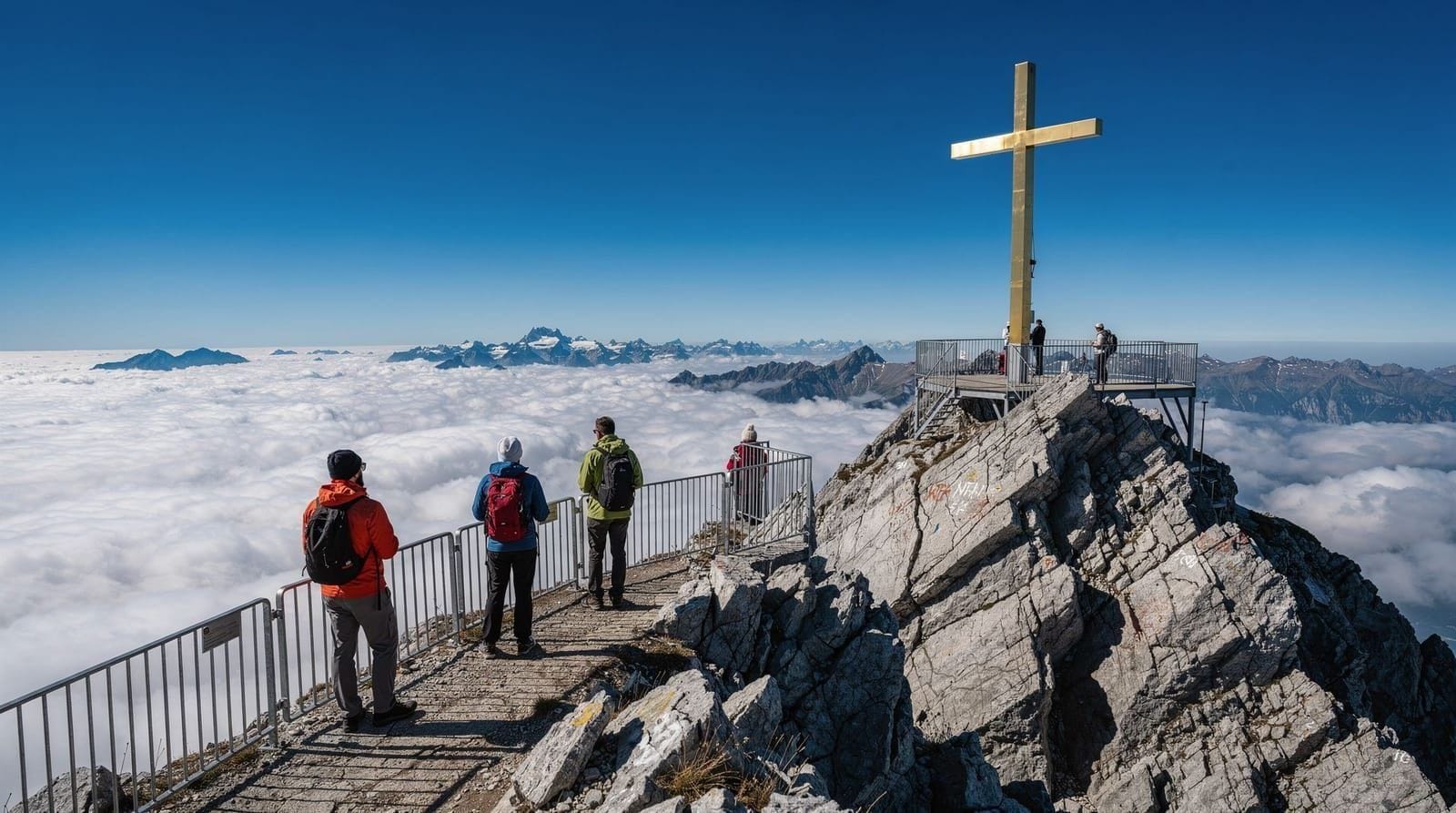
At the summit, you have the Zugspitzplattform viewing terrace with 360-degree panoramas on clear days extending to Munich (70 km north) and deep into Austria. There is a restaurant, a small glacier museum, a German-Austrian summit cross shared between the two countries, and in winter a ski area operating from October to May. The summit can be genuinely cold even in July — bring a layer regardless of the valley temperature.
The 2026 round-trip ticket for adults is approximately €74 (via the Zugspitzbahn or Eibsee cable car; the ticket covers both directions via either route). Bayern Ticket is not valid. The summit is busy on summer weekends, with queues at both the cable car and the restaurants. Wednesday and Thursday mornings tend to be quieter. Book a guided tour from Munich to the Zugspitze summit
For a full breakdown of how to do this day independently versus on a tour, our Zugspitze day trip guide covers the logistics in detail.
Nebelhorn: Oberstdorf’s underrated summit and why it rivals Zugspitze for views
The Nebelhorn above Oberstdorf reaches 2,224 metres and, unlike Zugspitze, feels genuinely quiet outside of ski season weekends. The reason it is undervisited by Munich day-trippers is distance — Oberstdorf is around 2 hours from Munich by train (IC train to Immenstadt, then regional to Oberstdorf). But for those willing to make the journey, the payoff is considerable.
The Nebelhorn Seilbahn operates in three stages from the valley: the main gondola to Höfatsblick (1,938 m), then an 8-person gondola to Gipfelstation (2,224 m). The ascent takes around 25 minutes total. From the top, the view southwest into the Allgäu Alps and toward the Austrian Vorarlberg is one of the most photogenic in Bavaria — dominated by the jagged limestone ridges of the Großer Wilder and Hochvogel.
In summer, Nebelhorn is a hiking hub. The Hindelanger Klettersteig (via ferrata) starting near the summit is one of Bavaria’s most popular alpine fixed-rope routes. The via ferrata requires proper equipment (helmet, harness, via ferrata set) and a head for exposure; it is not a casual walk, but the route is well-marked and graded B/C (moderate on the alpine scale). Several easier walking routes also descend to Faistenoy and Oberstdorf.
Cable car round-trip costs approximately €33 adults, €21 children (6-15) in 2026. Oberstdorf is reached on the Bayern Ticket (the train leg from Munich). The cable car itself requires a separate ticket. A full day — train, summit walk, descent, and a beer in Oberstdorf’s pedestrian zone — is achievable without a car.
Our comparison guide Zugspitze vs Nebelhorn gives more detail on when to choose each.
Wendelstein: cogwheel trains, a cave, and views to the north
Wendelstein (1,838 m) is the most characterful of Bavaria’s mountain railways. The Wendelsteinbahn — a cogwheel (rack) railway running since 1912 — departs from Brannenburg station in the Inn Valley and climbs through forest to the summit over 7.5 kilometres. Alternatively, a cable car departs from Bayrischzell on the west face.
The summit building dates from 1883 and has been modernised while retaining its original stone structure. Inside, there is a small natural cave (actually a volcanic shaft formed by geological uplift), a chapel, and an observatory that conducts genuine atmospheric research. The panorama from the summit cross faces north toward Munich and the foothills — on clear days the city is visible 60 km away, and the Zugspitze and its neighbours fill the southern horizon.
Getting there from Munich: take the S4 or S-Bahn to Rosenheim, then the BOB (Bayerische Oberlandbahn) to Brannenburg. The cogwheel railway departs from Brannenburg station directly. Journey time from Munich is around 75-80 minutes. Wendelstein’s railway and cable car are not included in Bayern Ticket; a combined ticket (cogwheel train or cable car up, other down) costs approximately €36 adults in 2026.
The food at Wendelsteinkhaus (the summit hut) is notably better than at many alpine summits — Bavarian standards, not tourist fare. For a round trip with a meal at the top, budget a half day minimum; a full day if you want to walk part of the descent.
Tegelberg: the launch pad above Neuschwanstein
Tegelberg (1,720 m) is unusual among Bavarian cable cars because it serves two completely different visitor types simultaneously: families visiting nearby Neuschwanstein and experienced paraglider pilots who launch from the summit ridge year-round.
The Tegelbergbahn departs from near Schwangau, a 15-minute walk from the Neuschwanstein ticket center. The cable car rises 900 metres in about 15 minutes. At the top, a restaurant and terrace with views across the Ammergau Alps and south toward the Zugspitze chain makes this one of the more relaxed summits in the region — broad, easily walkable, without the extremes of altitude that affect some visitors at Zugspitze.
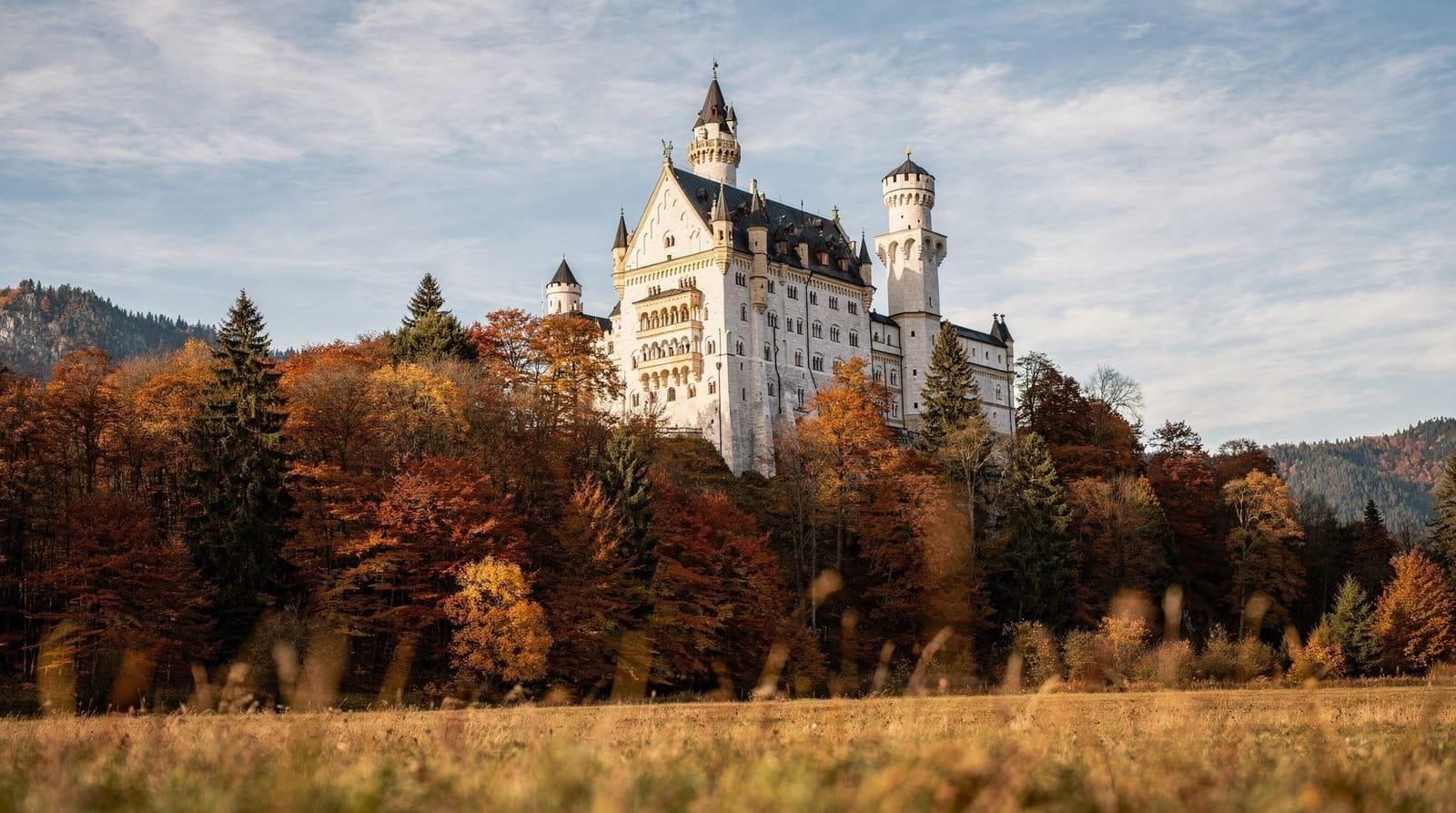
The classic combination is Neuschwanstein castle in the morning, Tegelbergbahn for a post-visit lunch with views in the early afternoon, then the cable car down and bus back to Füssen for the train home. This works on a Bayern Ticket from Munich — the rail journey to Füssen, and then a short bus to Schwangau, are both covered.
Round-trip cable car tickets are approximately €28 adults, €18 children in 2026. There is no ski resort at Tegelberg — the mountain is a walking and paragliding destination.
Herzogstand: an underrated ridge walk with direct lake views
Herzogstand (1,731 m) sits above Walchensee — one of Bavaria’s deepest and most scenic lakes — and is reached by cable car from Kochel am See or, more scenically, from a small station at lake level. The mountain is notable for two things: the view directly down to the turquoise Walchensee from the summit ridge is genuinely striking, and the ridge walk to Heimgarten (1,791 m) is one of the best half-day hikes accessible from Munich without serious alpine experience.
Kochel am See is reachable by BOB train from Munich (around 75 minutes). From Kochel, there is a bus connection to the cable car valley station. The cable car ascent is approximately 20 minutes. The Herzogstand hut at the top serves Bavarian food and has a sun terrace.
The main draw, however, is the ridge walk. From Herzogstand, a clearly marked path traverses the ridge south to Heimgarten in around 45 minutes, with views to the east over Walchensee and the Inn valley. From Heimgarten, a descent north to Urfeld on the Walchensee shore takes 1.5-2 hours. A bus then returns to Kochel am See. This is a complete mountain day accessible by public transport.
The cable car has experienced periods of reduced operation for maintenance — checking current status at herzogstand.de before travelling is advisable. Round-trip cable car costs approximately €26 adults in 2026.
Wank: the quiet summit above Garmisch
Wank (1,780 m) is the least-visited of the major summits above Garmisch-Partenkirchen, which makes it the most pleasant for those who want views without queues. The Wankbahn cable car departs from a station about 10 minutes’ walk east of Garmisch town centre and takes 10-12 minutes to the summit.
The summit area is wide, grassy, and easy to walk. There is a restaurant with a panoramic terrace facing north toward the Zugspitze chain. The walking here is genuinely gentle — Wank is one of the better mountains for visitors who want alpine views without alpine effort. A circular walk from the top takes about 45 minutes. Descent on foot to Garmisch takes around 90 minutes on a marked path.
The Zugspitze and Alpspitze (its near neighbour) are directly visible from the Wank summit — so those who have already done Zugspitze and want a different perspective, or those deterred by the Zugspitze’s price and crowds, find Wank a satisfying alternative. Round-trip costs approximately €27 adults in 2026. Garmisch is reached by hourly direct trains from Munich Hauptbahnhof in about 75-80 minutes.
Our Munich to Garmisch day trip guide covers the full options in the Garmisch area. Book a private alpine tour to Zugspitze and Eibsee Lake from Garmisch
The six mountains at a glance
| Mountain | Height | Round-trip price (2026) | Best for |
|---|---|---|---|
| Zugspitze | 2,962 m | ~€74 | Germany’s highest views, first-timers |
| Nebelhorn | 2,224 m | ~€33 | Value, quiet, via ferrata hikers |
| Wendelstein | 1,838 m | ~€36 | Cogwheel-train character, a cave, families |
| Tegelberg | 1,720 m | ~€28 | Pairing with Neuschwanstein |
| Herzogstand | 1,731 m | ~€26 | Lake views, ridge hiking |
| Wank | 1,780 m | ~€27 | Quiet, gentle terrain, budget alternative to Zugspitze |
Choosing between them: a practical decision framework
If you want Germany’s highest views and have €74 to spend: Zugspitze, and go early to beat the crowds. Take the cogwheel train up and the Eibsee cable car down.
If you want outstanding views at half the cost: Nebelhorn above Oberstdorf, but factor in the 2-hour train. Best for visitors with a full free day.
If you want the most unusual experience: Wendelstein, for the 1912 cogwheel railway, the cave, and a summit that feels more like a small mountain community than a viewing platform.
If combining with a castle visit: Tegelberg pairs naturally with Neuschwanstein and is the most sensible pairing.
If you want a hiking day above a lake: Herzogstand and the ridge to Heimgarten is the best option — genuinely beautiful and still little-known outside Bavaria.
If you want a quiet summit close to Garmisch: Wank, at a fraction of Zugspitze’s price and a tenth of the queues.
For a broader view of the region’s scenery, our best alpine views near Munich guide ranks all the main summit viewpoints. And for those who want to ski, our Munich skiing day trips guide compares the main ski areas.
Practical logistics: what all cable cars have in common
A few points that apply across all six mountains:
Weather: Summit weather is independent of valley weather. Always check the summit’s own webcam on the day. Most mountains have these visible on their websites. A grey Munich morning sometimes clears to a brilliant alpine summit; a blue Munich sky sometimes means dense cloud at 1,800 metres. Neither is predictable without a specific forecast.
Clothing: Even on the hottest Munich summer day, bring a windproof layer. Summit temperatures are typically 10-15°C cooler than the valley. At Zugspitze, they can be below freezing in July. The restaurants at summits are generally warm, but exposed terraces and ridge walks are exposed to wind at any time of year.
Altitude: Zugspitze’s 2,962 metres is high enough that some visitors — particularly children, older adults, and those with cardiovascular conditions — experience headaches or shortness of breath. Take it slowly for the first hour and drink water. Symptoms usually pass within a couple of hours at altitude; if they worsen, descend.
Booking: None of these cable cars require advance booking in the same way that Neuschwanstein tickets do. You can buy at the valley station. The exception is peak summer weekends at Zugspitze, where the Eibsee cable car can have waits of 30-60 minutes. Arriving before 9am eliminates this almost entirely.
Combining a cable car day with other Alps destinations
Several of these mountains sit close enough to other Bavarian Alps highlights that a single day trip can cover more than one. Garmisch-Partenkirchen, the base for both Zugspitze and Wank, is also the gateway to Partnach Gorge, a dramatic short walk that pairs well with a Wank ascent if Zugspitze feels like too much for one day. Visitors staying near Mittenwald can reach several of these cable car valleys without returning to Munich first. For those planning a longer stay, the Bavarian Alps 3-day itinerary sequences two or three of these mountains alongside lake and town stops so you are not backtracking to Munich between each one.
If you are travelling with a group that wants a guided rather than independent day, a private tour covering Garmisch, Zugspitze, and Eibsee removes the logistics of train timing and ticket queues entirely — useful on a tight schedule or if this is your only alpine day of the trip. Garmisch 2-day hiking and Zugspitze tour
Frequently asked questions about Bavarian Alps cable cars
Which Bavarian cable car is easiest to reach from Munich by public transport?
Wendelstein is the most practical by train — take the BOB to Brannenburg station, then a short bus connection to the valley station. The cogwheel railway and cable car combination to the summit is unique in Bavaria. Zugspitze requires an S-Bahn to Munich Hauptbahnhof, then the Bayerische Zugspitzbahn from Garmisch — about 90 minutes total travel plus the ascent.
How much does the Zugspitze cable car cost in 2026?
The Zugspitze round-trip ticket costs approximately €74 for adults, €40 for children aged 6-15, and free for under-6s. The full experience — cogwheel train up, cable car down — is included in the price. Bayern Ticket is not valid on Bayerische Zugspitzbahn; you need a dedicated ticket.
Are Bavarian cable cars open year-round?
Most operate year-round, but schedules change significantly by season. Always check current operating schedules on the operator’s website before visiting, especially in late autumn and early spring.
Is a Bayern Ticket valid on any alpine cable cars?
No. Bayern Ticket covers DB rail and regional buses but does not include cable car or mountain railway tickets. These require separate purchase at the valley station or online.
Can you walk down from any Bavarian cable cars?
Yes, and many visitors prefer it. Wendelstein has well-marked descent paths to Bayrischzell (about 2.5 hours). Herzogstand has a beautiful ridge walk to Heimgarten and descent to Kochel am See. Wank above Garmisch offers an easy descent.
Which cable car is best for families with young children?
Tegelberg near Neuschwanstein is ideal — short cable car ride, meadows at the top, no extreme altitude, and it can easily be combined with a Neuschwanstein visit. Wank above Garmisch is another good option: gentle terrain at the top, easy walks, and a restaurant.
What is the best time of year to visit Bavarian cable cars?
June to September for walking and summit restaurants. December to March for skiing at Zugspitze and Nebelhorn ski areas. May and October offer clearer skies statistically and thinner crowds on most mountains.
Can I combine a cable car visit with a castle in the same day?
Yes — Tegelberg is built for exactly this, sitting a 15-minute walk from the Neuschwanstein ticket centre. Do the castle first (tickets are timed, so book that slot before anything else), then ride up Tegelberg for lunch with alpine views before heading back to Füssen. See the Neuschwanstein tickets guide for how to time the castle portion.
Which cable car pairs best with a hike rather than just a viewpoint?
Herzogstand, for the ridge walk to Heimgarten above Walchensee, and Nebelhorn, for the Hindelanger Klettersteig via ferrata if you have the equipment and experience. Both go well beyond a simple up-and-down cable car ride. The Garmisch hiking guide covers trail options around Wank and Zugspitze for those based in Garmisch specifically.
Top experiences
Bookable activities with verified prices and instant confirmation on GetYourGuide.