Munich castles day trip: Neuschwanstein and Linderhof combo guide
From Munich: Neuschwanstein and Linderhof Castle full-day trip
Can you visit Neuschwanstein and Linderhof in one day from Munich?
Yes, but it is a full day and requires a guided tour or careful planning. Neuschwanstein is near Füssen (2h from Munich by train or 1h45 by car) and Linderhof is 30km west near Oberammergau. Most guided tours combine both in 10–11 hours. Self-driving is easier than public transport for this combo.
Why this combo works — and where it asks a lot of you
The two castles most closely associated with King Ludwig II of Bavaria sit about 30km apart in the Allgäu Alps south of Munich. Neuschwanstein is the famous one — perched on a rocky outcrop above a gorge, white-turreted, photographed by millions — while Linderhof is smaller, completed, and in some respects more genuinely interesting. Doing both in a single day from Munich is possible, but it is a long day, and the logistics are not trivial.
The distance from Munich to Neuschwanstein is about 130km. From there to Linderhof adds another 30km in a different direction. By the time you return to Munich, you will have covered around 320km. Add timed entry tickets, walking uphill to the castle, mandatory guided palace tours at both sites, and the fact that the Linderhof gardens alone can absorb an hour — and you are looking at a 10 to 11 hour day if you want to do it properly.
That said, it is one of the most rewarding day trips available from Munich. The broader Ludwig II castle picture — which also takes in Herrenchiemsee on Lake Chiemsee — requires more days. But Neuschwanstein and Linderhof together give you a complete introduction to the king’s architectural ambition, his personal obsessions, and the scale of what he managed to build before his death in 1886.
This guide covers the practical decisions: guided tour or self-drive, what to book and when, how long to allow at each site, and what to actually see once you are there.
| Where | Neuschwanstein (Füssen, ~130km) + Linderhof (Oberammergau, +30km) |
| Total time needed | 10–11 hours from Munich, door to door |
| Cost | Neuschwanstein €18, Linderhof €10, plus transport |
| Getting there | Guided tour, self-drive (~1h45), or train (Neuschwanstein only) |
| Best time | Book Neuschwanstein timed entry 3–6+ weeks ahead in summer |
The core decision: guided tour or self-drive
Before anything else, decide how you are getting there. This decision shapes everything else about the day.
Guided tour from Munich is the right choice for most visitors. A quality operator picks you up in Munich (typically 7:30–8:00am), handles all driving and parking, includes a local guide who adds historical context, and brings you back to Munich by early evening. You do not have to think about the logistics of connecting Neuschwanstein and Linderhof — which, by public transport, are genuinely awkward to link. The main disadvantage is pace: you move with the group, and the time at each site is fixed.
Full-day guided tour: Neuschwanstein and Linderhof from Munich — the standard option covering both castles with a local guide, departing early morning and returning by evening.
If you want more flexibility or a smaller group, premium minivan tours exist that take on fewer passengers and allow slightly more time at each site.
Premium small-group tour: Neuschwanstein and Linderhof — recommended if you want to avoid large coach groups and have more time for questions.
Self-driving gives you full control over timing and pacing. Leave Munich by 7:00–7:30am via the A96 motorway toward Landsberg am Lech, then south on the B17 to Füssen and Hohenschwangau. The drive takes about 1 hour 45 minutes in reasonable traffic. Parking at Neuschwanstein costs €7 for the day. After Neuschwanstein, the drive to Linderhof via Oberammergau takes around 35–40 minutes. Self-driving allows you to linger at the Marienbrücke viewpoint without worrying about a coach schedule, and you can stop in Oberammergau on the way to or from Linderhof if you want to see the village.
Public transport alone is not recommended for this specific combination. You can reach Neuschwanstein by train from Munich (regional service to Füssen, about 2 hours with one change at Buchloe, then bus 73 or 78 to Hohenschwangau — Bayern-Ticket is valid). But getting from Hohenschwangau to Linderhof by public transport requires multiple buses via Füssen and Oberammergau, takes 1.5–2 hours, and leaves almost no time at Linderhof before the last buses stop running. The train-only Neuschwanstein day trip works well if you are visiting just that one castle, but for the combo it is genuinely impractical.
Neuschwanstein day trip from Munich by train — the right option if you want just Neuschwanstein without a car or guided tour.
Neuschwanstein: what you are actually seeing
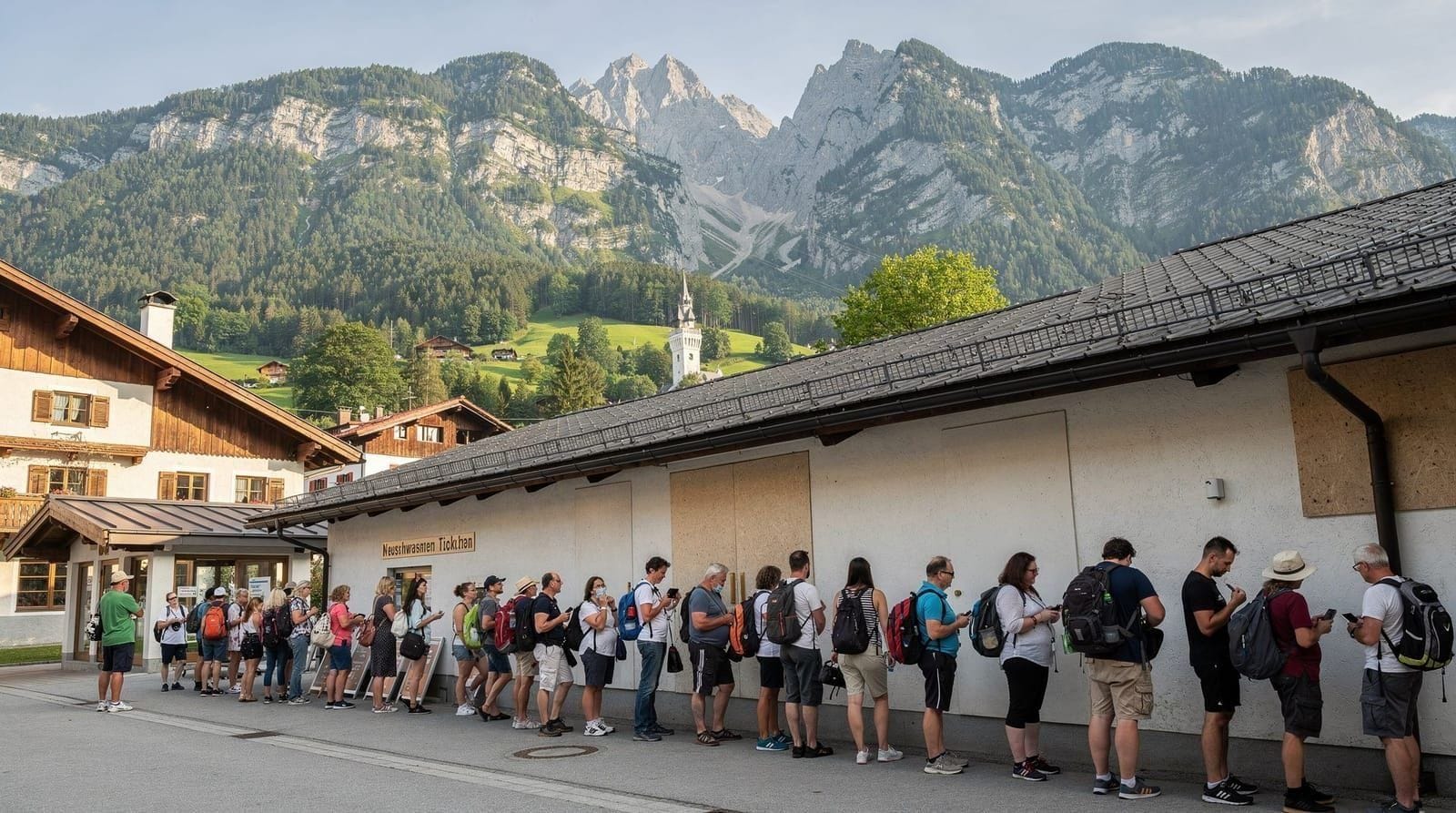
Neuschwanstein Castle is one of the most visited buildings in Europe, receiving over 1.4 million visitors per year. That number matters before you visit because it directly affects your experience: in summer, the site is genuinely crowded. Early arrival — or a guided tour that ensures an early timed entry — makes a significant difference to what the visit feels like.
The castle was commissioned by Ludwig II in 1869 as a private retreat and an homage to medieval chivalric culture as filtered through the operas of Richard Wagner. Construction continued until Ludwig’s death in 1886; only 14 of the 200 rooms originally planned were ever finished. The castle opened to the public six weeks after Ludwig died, which gives it an odd, incomplete quality — grand public rooms set against unfinished corridors, plaster walls where carved stone was planned, a castle that is as much an unrealised vision as a completed building.
Timed entry: Entry is by timed slot only. Tickets must be booked in advance at tickets.hohenschwangau.de. In summer (June–September), tickets sell out weeks or months ahead. Adults pay €18, seniors aged 65 and over pay €17, children under 18 enter free. The palace interior can only be visited as part of a mandatory guided tour lasting approximately 35 minutes.
The full Neuschwanstein tickets guide covers booking strategies, best time slots, and what happens if you arrive without a ticket.
Getting up to the castle: From the car park in Hohenschwangau village, the castle is a 15–20 minute uphill walk. Alternatives exist: a shuttle bus runs for €3 uphill (€1.50 downhill), or a horse-drawn carriage for €7 uphill (€3.50 downhill). The shuttle drops you a short walk below the castle entrance; the carriage stops slightly lower. Walking is the most reliable option — the shuttle queue can be long in summer, and the carriage is slow. If you are on a guided tour, your guide will advise which option fits your timed entry slot.
Inside the castle: The guided tour takes you through the Singers’ Hall — a vast, elaborately frescoed space inspired by the Wartburg and intended for Wagnerian performances that never happened — the royal bedroom, the artificial grotto that Ludwig had built inside the castle itself, the study, the dining room, and various connecting corridors. Photography is not permitted inside. The throne room is one of the most striking spaces: Byzantine in style, a grand ascending staircase leading to a raised apse where a throne was planned but never installed before Ludwig died.
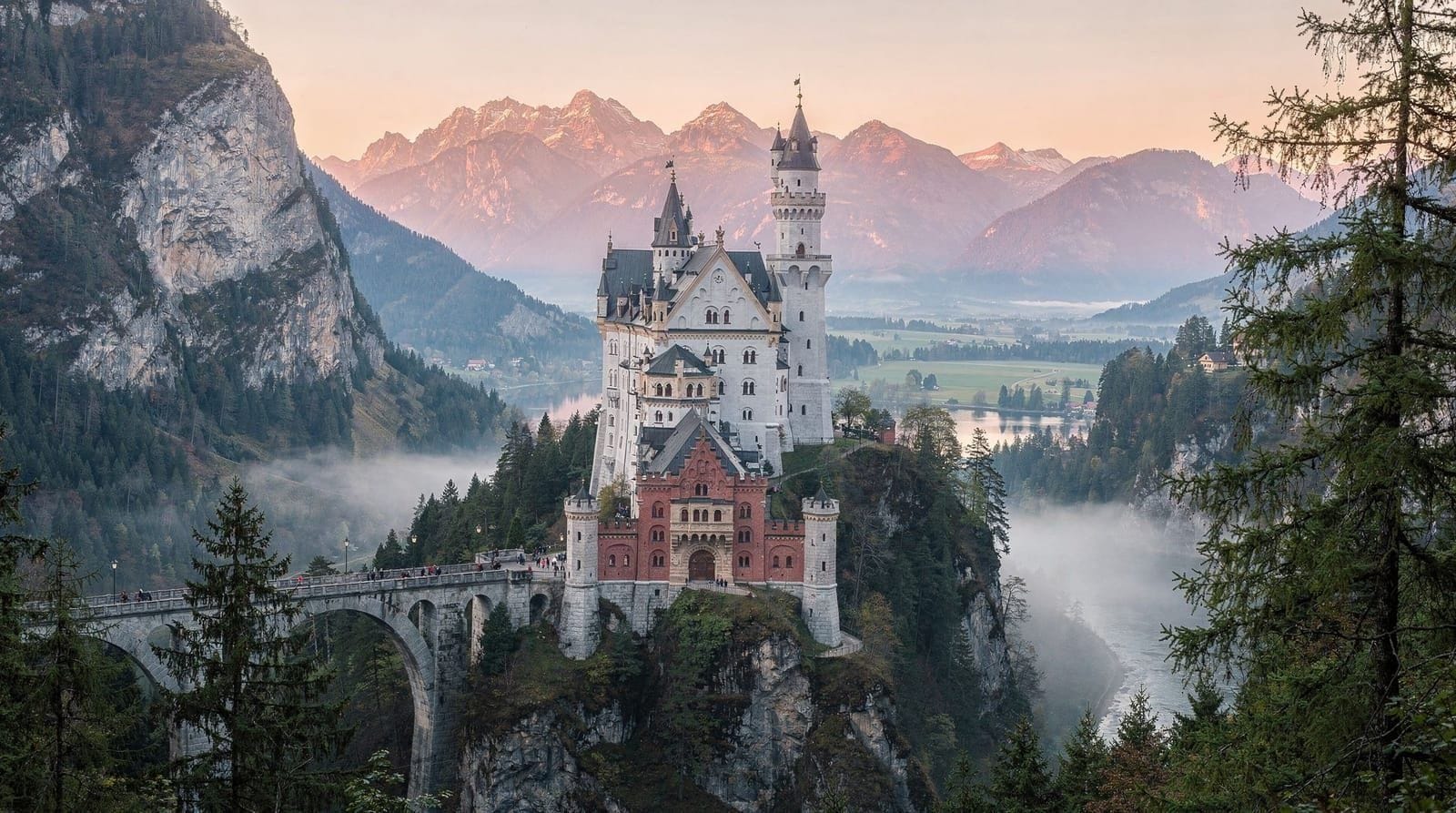
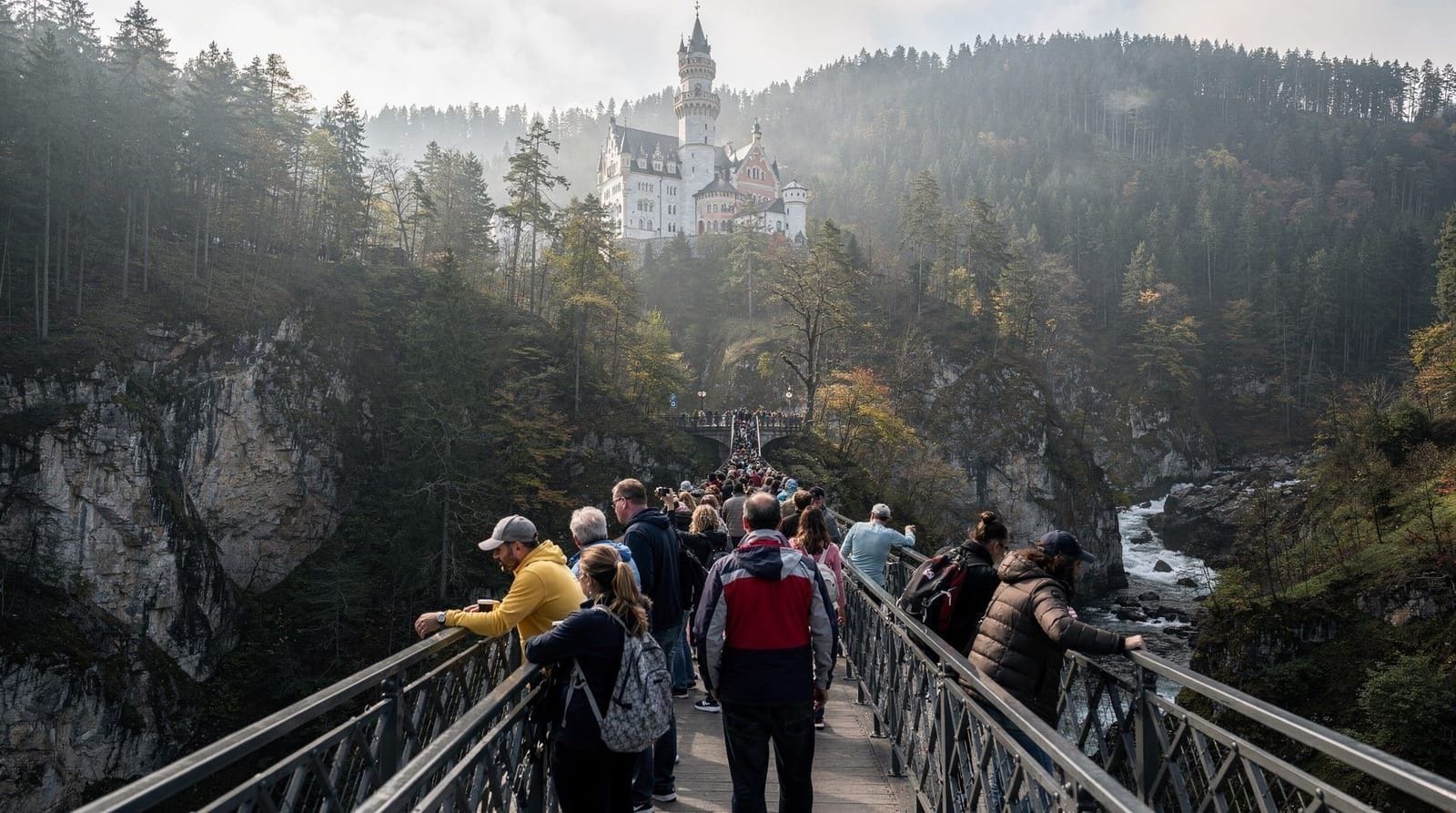
The Marienbrücke viewpoint: The iron footbridge above the castle — built across a gorge in the 1860s — gives the photograph that most people associate with Neuschwanstein: the castle seen from slightly above, with the gorge below and the Bavarian Alps behind. It is a 10–15 minute walk above the castle entrance. The view is genuinely worth the extra effort. In winter and spring the bridge is sometimes closed for safety reasons. Full coverage of timing and access is in the Marienbrücke guide.
Seasonal crowd differences: Neuschwanstein’s 1.4 million annual visitors are not spread evenly. July and August are by far the busiest months, with timed slots selling out weeks ahead and the walk up the hill feeling genuinely congested by mid-morning. May, June, and September are noticeably calmer while still offering reliable weather. November through March sees far fewer visitors and shorter queues, but the trade-off is a real chance of snow or ice on the uphill path, and the Marienbrücke is more often closed. If your travel dates are flexible, shoulder season (May, June, or September) gives the best balance of manageable crowds and dependable conditions for this specific day trip.
Should you add Hohenschwangau?
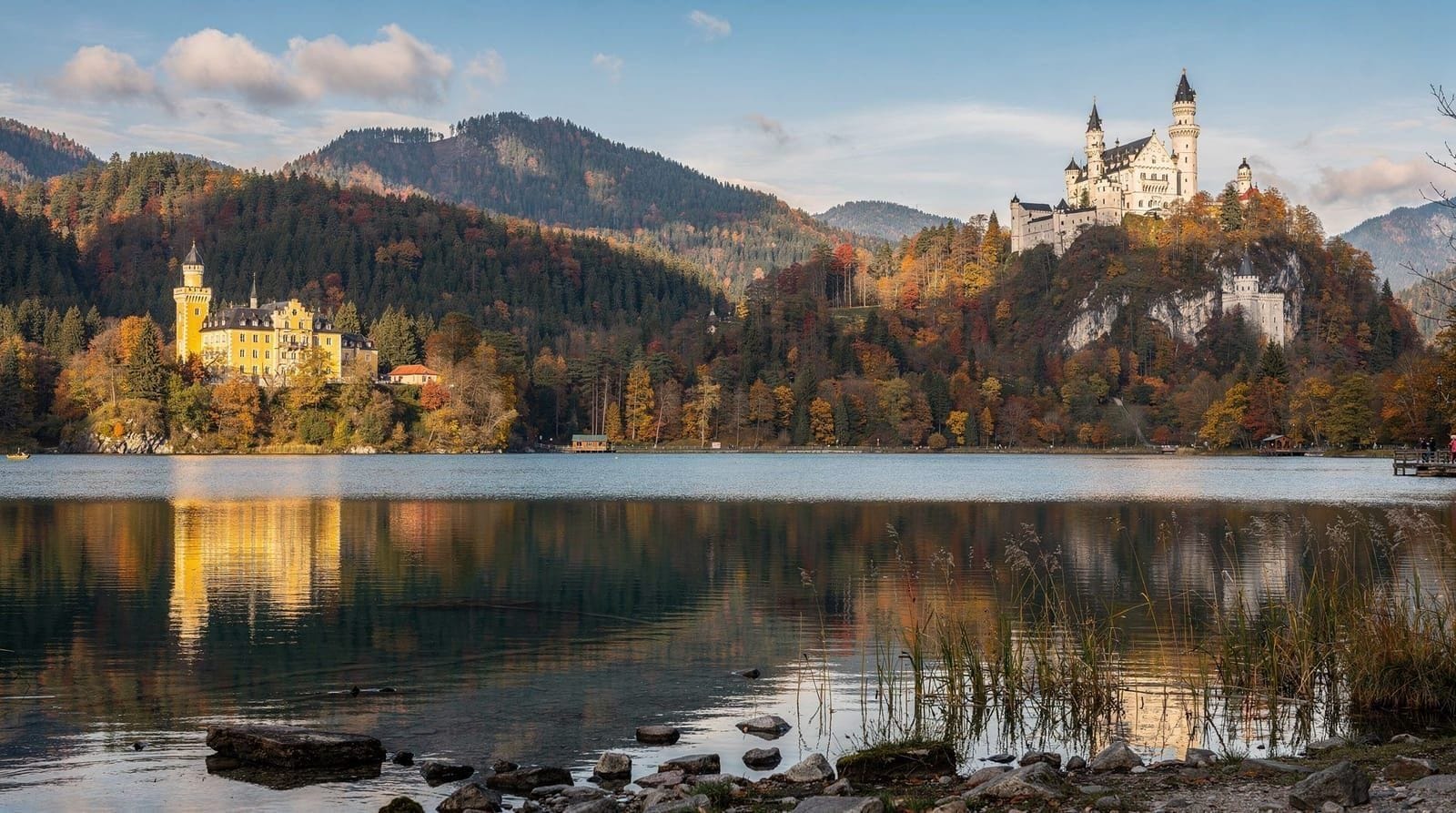
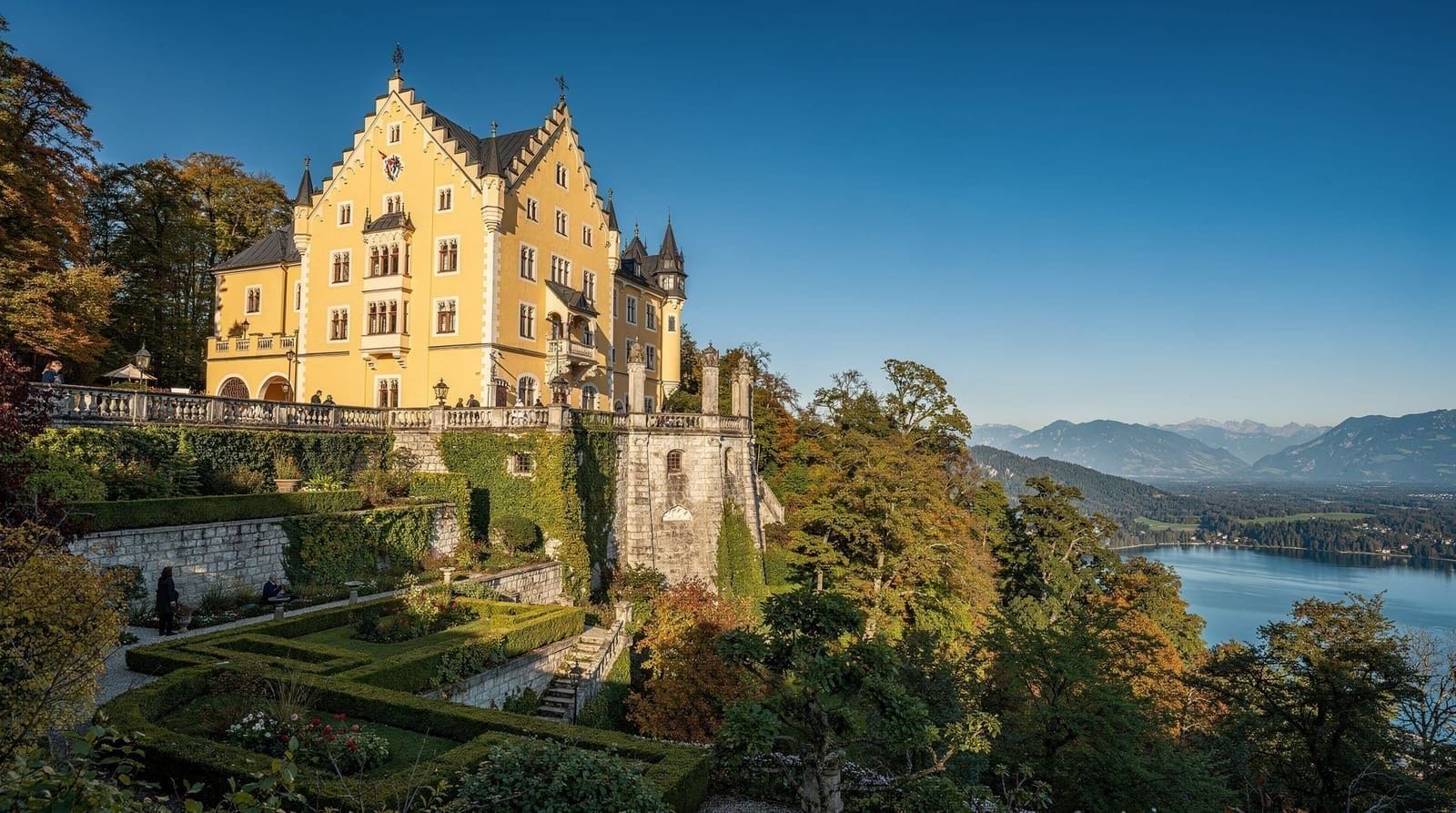
Hohenschwangau Castle — the yellow castle visible from the car park below — is where Ludwig II spent most of his childhood. It was built by his father, Maximilian II, in the 1830s on the ruins of a medieval fortification. The interior is more completely furnished than Neuschwanstein and gives a much clearer picture of how Ludwig’s imagination was shaped: the frescoes of medieval legends and Wagnerian themes throughout the building essentially explain where Neuschwanstein came from.
Tickets for Hohenschwangau cost €21 for adults (separate from Neuschwanstein). A combined ticket for both Hohenschwangau and Neuschwanstein reduces the individual prices slightly. The Neuschwanstein vs Hohenschwangau comparison covers the relative merits in detail, but the short version is: Neuschwanstein is more famous and more spectacular; Hohenschwangau is more historically informative and less crowded.
If you are doing the Neuschwanstein and Linderhof combo in a single day, adding Hohenschwangau as a third site is ambitious. The timeline works if your Neuschwanstein timed entry is in the morning (9:00–10:00) and you visit Hohenschwangau immediately beforehand (its guided tours also depart at timed intervals and run about 30–35 minutes). Many guided tours do not include Hohenschwangau interior access; if it matters to you, check the tour description carefully before booking.
Linderhof: the castle Ludwig actually finished
Linderhof Palace sits in the Graswangtal valley near Oberammergau, about 30km northwest of Neuschwanstein. It is the smallest of Ludwig’s three major royal projects and the only one he lived in long enough to use regularly. He completed it in 1878.
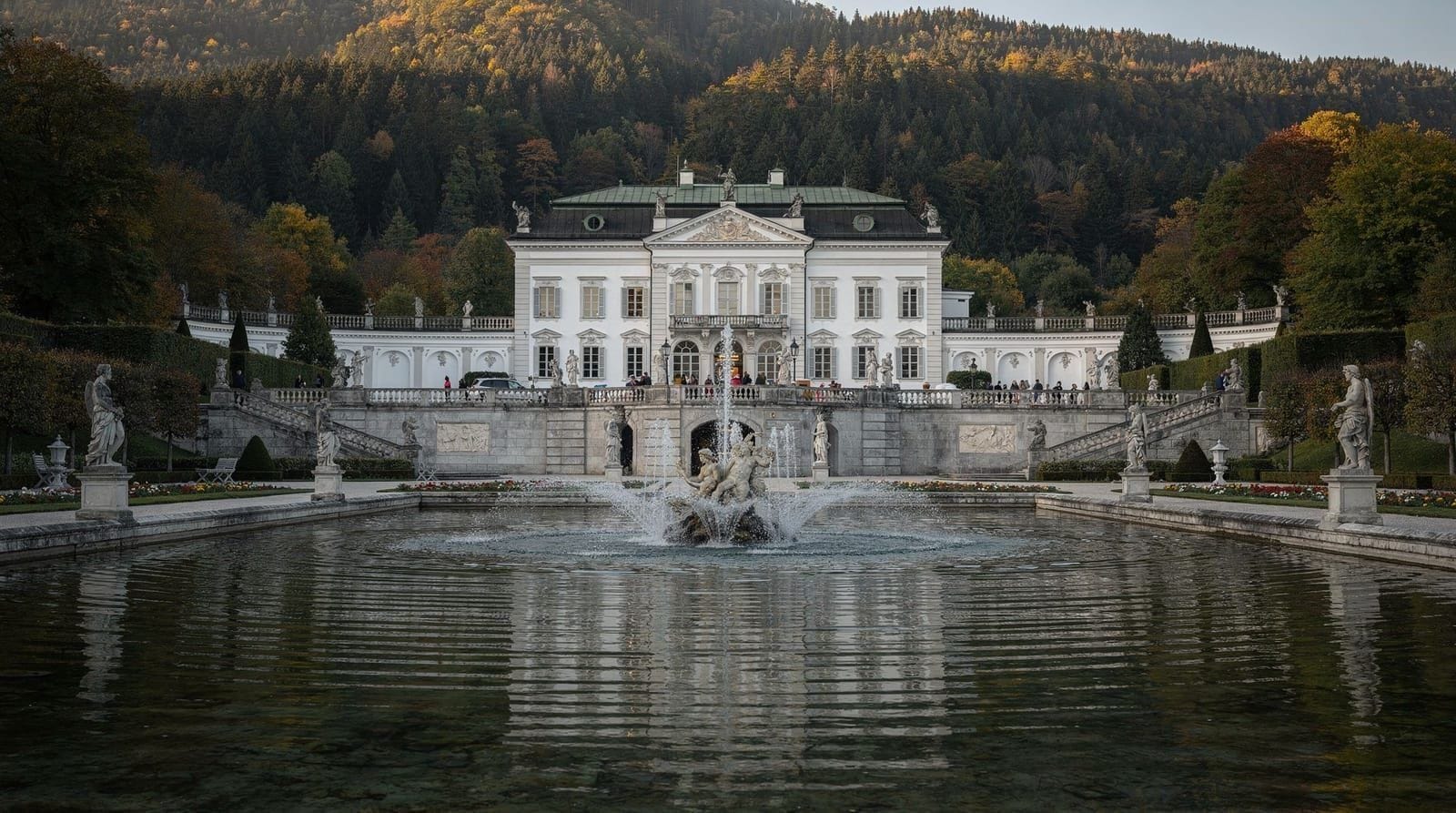
Where Neuschwanstein was a medieval fantasy, Linderhof is emphatically French Rococo — specifically, a homage to Versailles and the Sun King, Louis XIV, with whom Ludwig had a near-obsessive identification. The palace is intimate in scale: it has only one floor of principal state rooms. But the decoration is extraordinarily dense — gilded surfaces, chandeliers, frescoed ceilings, mirrored halls, elaborate porcelain — and the grounds are genuinely exceptional.
Tickets: Linderhof Palace tickets in 2026 cost €10 for adults in summer (April to October), which includes the palace and access to the Venus Grotto. The palace gardens are free to enter. Opening hours are 9:00–18:00 in summer. Winter hours are shorter and the Venus Grotto and some garden features close from late October to mid-April.
The Linderhof Palace guide covers the full site in detail, including the seasonal availability of each attraction.
The palace interior: Entry is by mandatory guided tour, departing every 15–20 minutes. The tour lasts about 25–30 minutes. Key rooms include the Mirror Hall — a smaller but intense version of the Versailles hall of mirrors — the royal bedchamber with its elaborate state bed, and the dining room, which featured a mechanical lift-table that could be raised and lowered between floors so Ludwig could eat without staff present. He was famously uncomfortable with company.
The Venus Grotto: This is the most unusual feature of Linderhof and one of the more extraordinary things you can see anywhere in Bavaria. An artificial cave constructed entirely for Ludwig’s private entertainment: it has a small lake with a gilded shell-shaped boat, stalactite formations built from iron and cement, and a colored lighting system — originally gas-powered, later converted to electric — that could shift between blue, red, green, and gold. Ludwig would sit in the boat while an orchestra played from behind the stalactites. It is absurd and spectacular in equal measure.
The grounds: The formal gardens surrounding the palace include a cascade fountain that runs in summer, a Moorish Kiosk purchased from the 1867 Paris World’s Fair and installed in the grounds, and a Moroccan House acquired from the 1878 Vienna World’s Fair. The grounds take at least 45 minutes to explore properly, and in good weather they are one of the reasons Linderhof holds its own against the more famous Neuschwanstein.
Winter at Linderhof: Unlike Neuschwanstein, which stays fully accessible year-round, Linderhof’s character changes significantly in winter. The Venus Grotto and several garden features close from late October to mid-April, and winter ticket prices drop to reflect the reduced offering. If your day trip falls in this window, check what is actually open before building your schedule around the Grotto specifically — it is the single feature most visitors come to see, and arriving to find it closed is a common disappointment that a five-minute check avoids.
Hour-by-hour: how a self-drive day looks
If you are driving from Munich:
6:45am — Leave Munich. The A96 motorway heading toward Lindau is the route; take the Landsberg exit and follow the B17 south. Avoid leaving later — the earlier you arrive, the less crowded Neuschwanstein will be.
8:30am — Arrive Hohenschwangau car park. Park for €7.
8:45–9:30am — If visiting Hohenschwangau Castle (optional), enter for the first morning tour.
9:30am or 10:00am — Timed entry for Neuschwanstein. Guided palace tour runs about 35 minutes. Allow 15–20 minutes’ walk up from the village, or use the shuttle.
11:00am — After the castle interior, walk up to Marienbrücke for the view over the castle and gorge (15–20 minutes from the entrance, add 15 minutes at the bridge).
12:00pm — Return to the car park. Eat lunch in Hohenschwangau village or bring food.
12:45pm — Drive to Linderhof. Route via Steingaden and Oberammergau takes around 35–40 minutes.
1:30pm — Arrive Linderhof. Join the next palace guided tour.
2:00–4:30pm — Palace tour, Venus Grotto, and grounds.
4:30pm — Depart Linderhof for Munich.
6:15–6:30pm — Arrive back in Munich (traffic permitting).
This schedule assumes no delays and that your Neuschwanstein timed entry is already booked for 9:30 or 10:00. If your entry is later in the morning, the whole timeline shifts and Linderhof time is compressed. Book your timed entry as early as possible — both morning slots and the logistics that follow from them.
Booking tickets: the critical details
Neuschwanstein tickets are the bottleneck for this entire day. Book at tickets.hohenschwangau.de — the official site. In summer, particularly July and August, available slots can sell out six to eight weeks in advance. If you are planning a July visit and reading this in May, check availability now.
Do not buy from resellers or third-party ticket platforms that charge significantly more than the face value. The official booking site accepts major credit cards and issues timed-entry tickets by email. You present these at the ticket booth in Hohenschwangau village, where you collect physical tickets, and then at the castle entrance at your designated time.
Arriving late for your timed slot is a genuine risk. The entry time is fixed; if you miss it, you lose the ticket and must join a standby queue, which in summer can mean waiting hours or not entering at all.
Linderhof does not require advance booking in the same way. Queuing for the next guided tour departure (every 15–20 minutes) is generally manageable outside of peak summer weekends. That said, arriving at Linderhof after 15:30 in summer cuts into your time in the grounds significantly — the gardens close at 18:00 and the Venus Grotto has separate entry queues.
Ticket price summary for the combo day:
| Ticket | Adult price (2026) | Notes |
|---|---|---|
| Neuschwanstein Castle | €18 | Timed entry, book ahead |
| Hohenschwangau Castle (optional) | €21 | Separate timed slot |
| Combined Neuschwanstein + Hohenschwangau | Slight discount vs separate | Worth it if adding both |
| Linderhof Palace (summer) | €10 | Includes Venus Grotto access |
| Guided full-day tour (both castles) | Varies by operator | Often includes transport + tickets |
Total per-person ticket cost for Neuschwanstein plus Linderhof alone, excluding transport, runs about €28. Adding Hohenschwangau brings it closer to €49 before any combined-ticket discount.
What if it rains? Both castle interiors are indoor, so a wet day does not derail the palace tours themselves — it mainly affects the Marienbrücke view (worth skipping in heavy rain or high wind, since the bridge can close for safety) and the Linderhof gardens, which are still walkable but less pleasant. Pack a proper rain layer rather than an umbrella, since much of the walking is uphill and hands-free gear works better on the uneven paths.
The Ludwig II context: why any of this was built
Understanding even a small amount about King Ludwig II makes both castles considerably more interesting to visit.
Ludwig II became King of Bavaria in 1864 at the age of 18. He had almost no interest in the administrative or military duties of his position, but an intense and obsessive interest in art, architecture, music, and mythology — particularly the operas of Richard Wagner. He was Wagner’s primary patron and financier for over a decade.
His three castle projects — Neuschwanstein, Linderhof, and Herrenchiemsee on Lake Chiemsee — were funded from his personal royal income and from loans, many of which he could not service. By the mid-1880s, his debts had reached what would today be tens of millions of euros. His ministers, alarmed at the financial situation and his increasing withdrawal from public life, had him declared medically unfit to rule in June 1886. Three days later, he was found dead in Lake Starnberg alongside his physician. The circumstances remain unexplained.
The castles he built were opened to the public almost immediately after his death, and within years they had paid off his debts many times over through visitor revenue. Neuschwanstein alone has generated income for the Bavarian state for over 130 years.
The full story — the personality, the debts, the relationship with Wagner, the disputed death — is covered in the Ludwig II castles guide. If you are visiting both Neuschwanstein and Linderhof, it is worth reading before you go rather than after.
Photo spots and practical notes
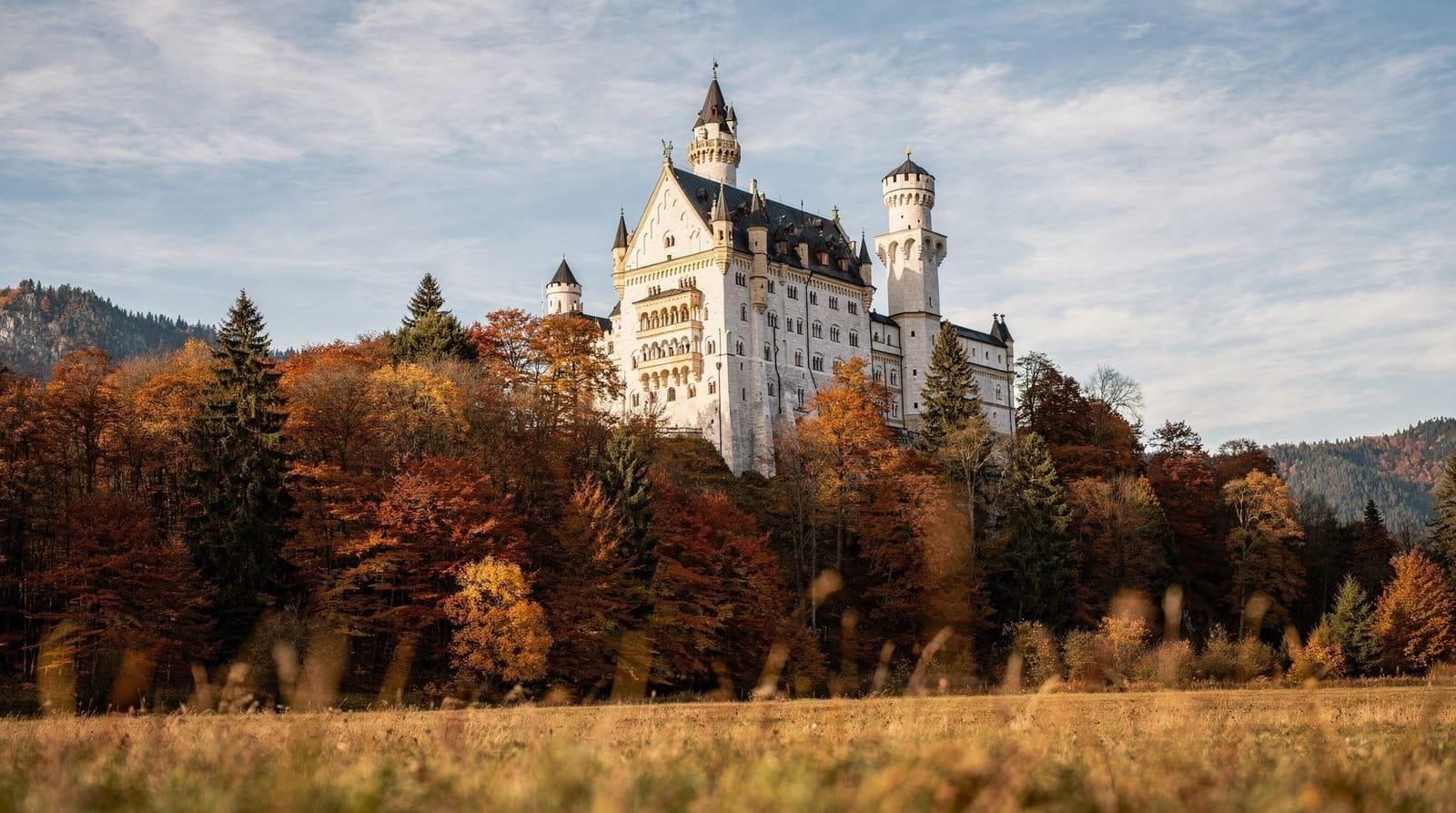
Neuschwanstein from below: The most famous view — the castle above the trees seen from the valley road — is available from several points on the walk up from the village. The light is best in the morning.
Marienbrücke: The bridge viewpoint above the castle gives the highest and most dramatic angle. Full details on access, seasonal closure, and crowd management are in the Marienbrücke guide. Arrive at the bridge before 10:00am if possible; by midday it is typically crowded to the point where the view is partly obscured by other visitors.
Linderhof from the cascade: Standing at the top of the formal cascade looking down toward the palace with the mountains behind it is the most photogenic view at Linderhof. The cascade runs in summer during operational hours; check the schedule on arrival.
Photography inside: Neither Neuschwanstein nor Linderhof permits photography inside the palace interiors. This is enforced by guides. Exterior and ground photography is unrestricted.
Other castles near Munich worth knowing
If this day trip leaves you wanting more, the best castles near Munich guide covers the full picture, including Blutenburg Castle in Munich itself, Nymphenburg Palace within the city, and the less-visited options in the surrounding region.
Herrenchiemsee Palace — Ludwig’s third and most ambitious project, on an island in Lake Chiemsee — requires a separate day trip involving the train to Prien am Chiemsee and a ferry to the Herreninsel. The palace was never finished and Ludwig spent only ten days there in his lifetime, but the Hall of Mirrors — directly modeled on Versailles — is the most overwhelming interior space of the three castles. It pairs well with a romantic road day trip if you are spending more than two or three days in the Munich region.
The Neuschwanstein photo spots guide covers the less obvious angles around the castle area, including viewpoints accessible on the morning walk from the village that most visitors miss.
What to pack and wear
Both sites involve significant walking. Neuschwanstein requires walking uphill on an uneven path for 15–20 minutes (or taking the shuttle). The Marienbrücke adds another 15 minutes uphill from the castle entrance. Linderhof’s grounds are largely flat but extensive. Comfortable walking shoes with grip are essential; heels or dress shoes will make both sites considerably less enjoyable.
The Allgäu Alps can be significantly cooler than Munich, especially in spring and autumn — bring a layer even on warm Munich days. Weather can change quickly in the mountains: light rain is not uncommon even in summer, and the views at Marienbrücke can close in with cloud. Check the forecast for Füssen specifically, not Munich, on the morning you leave.
Food at both sites is available from cafes and a small restaurant at Hohenschwangau village. Linderhof has a cafe near the palace entrance. Both are reasonably priced by tourist-site standards. Bringing your own lunch for the drive between the two sites saves time and allows a more flexible schedule.
Last practical notes before you go
Check the Neuschwanstein ticket confirmation email carefully: it states your timed entry window (usually a 15-minute slot), and you must be at the castle entrance — not the ticket booth at the bottom — within that window. The walk from ticket collection to the castle entrance takes 15–20 minutes; factor this in.
If you are on a guided tour, all of this is managed for you. If you are self-driving, build in buffer time at every stage. The combination of timed entry pressure at Neuschwanstein and the distance to Linderhof means the schedule is tighter than it looks on paper.
The Neuschwanstein castle guide and the Hohenschwangau castle guide both cover their respective sites in more depth than this overview allows. Read whichever is most relevant to how you are spending your time.
For visitors who want to do just Linderhof without the Neuschwanstein combination:
Linderhof Palace full-day tour from Munich — this option allows more time at Linderhof and often includes Oberammergau village as well.
How this combo compares to the Herrenchiemsee alternative
If the 10–11 hour day for two castles feels too ambitious, it is worth knowing what you are trading against the alternative: splitting Ludwig’s castles across two separate days rather than combining them into one.
| Neuschwanstein + Linderhof (this guide) | Neuschwanstein alone + Herrenchiemsee separately | |
|---|---|---|
| Days needed | 1 long day | 2 shorter, more relaxed days |
| Total distance from Munich | ~320km round trip | ~260km + ~180km round trip (2 days) |
| Pace | Tight, timed-entry pressure | Comfortable, more time at each site |
| Best for | Visitors with limited days in Munich | Visitors with 5+ days who can spread castles out |
Herrenchiemsee requires a train to Prien am Chiemsee and a ferry, which does not combine easily with Neuschwanstein or Linderhof in the same day — it is genuinely a separate excursion. For a full comparison of all three Ludwig II sites and how to sequence them across a longer trip, see the King Ludwig II castles guide.
Done right, the Neuschwanstein and Linderhof combination is a genuinely memorable day. The two castles complement each other well — the famous versus the intimate, the unfinished fantasy versus the completed folly — and the Bavarian Alpine setting is as good as the architecture. It asks more of your day than most Munich excursions, but it pays back the effort.
Frequently asked questions about Munich castles day trip
How much do Neuschwanstein tickets cost in 2026?
Neuschwanstein Castle tickets cost €18 for adults and €17 for seniors in 2026. Entry is by timed slot only — tickets sell out weeks in advance in summer. Book at the official tickets.hohenschwangau.de site. Avoid resellers charging inflated prices. Add €3.50 for Hohenschwangau Castle if you want both.How far is Neuschwanstein from Munich?
Neuschwanstein is about 130km southwest of Munich, near Füssen in the Allgäu Alps. By train, take the regional service to Füssen (about 2 hours, one change at Buchloe), then bus or taxi 5km to Hohenschwangau village. By car it takes about 1 hour 45 minutes via the A96 motorway.How far is Linderhof from Neuschwanstein?
Linderhof Palace is about 30km northwest of Neuschwanstein, near Oberammergau. By car it takes around 35–40 minutes. By public transport it is complex: bus from Hohenschwangau to Füssen, then regional bus to Oberammergau, then bus to Linderhof — allow 1.5–2 hours. For this reason, the combo is far easier with a guided tour or a rental car.What is the best way to combine Neuschwanstein and Linderhof in one day?
A guided minivan or bus tour from Munich is the most efficient option: you avoid parking, receive historical context, and the logistics are handled. If self-driving, leave Munich by 7:30 to reach Neuschwanstein early (timed entry at 9:00–10:00), visit Linderhof after lunch, and return to Munich by 19:00–20:00.Is Hohenschwangau Castle worth adding to the day?
Hohenschwangau is the yellow castle at the base of the hill, where Ludwig II grew up. It is less famous but historically more important — you see the interiors that shaped Ludwig's imagination. If your Neuschwanstein ticket allows enough flexibility in timing, adding Hohenschwangau is worthwhile, especially with a combined ticket.What is Linderhof like compared to Neuschwanstein?
Linderhof is the only royal palace Ludwig II completed in his lifetime. Smaller and more intimate than Neuschwanstein, it is Rococo in style, modeled on Versailles, and surrounded by French formal gardens and a working cascade fountain. The Venus Grotto — an artificial cave with colored lighting — is one of the most bizarre and memorable royal follies in Europe.Should I do Neuschwanstein and Linderhof in one day or split them across two days?
One day works well if your Munich stay is short and you're comfortable with a 10-11 hour, timed-entry day. If you have 5 or more days in the region, splitting the two castles across separate, more relaxed days gives you more time at each site and removes the timing pressure at Neuschwanstein. Families with young children or anyone with limited stamina generally do better splitting the visit.Is it worth adding Herrenchiemsee to the same trip?
Not on the same day. Herrenchiemsee is reached via a train to Prien am Chiemsee and a ferry to the island, in a different direction from Neuschwanstein and Linderhof, and does not combine logistically with either. Treat it as a separate day trip if you want to see all three of Ludwig II's major castles — the King Ludwig II castles guide covers how to sequence all three across a longer Munich stay.
Top experiences
Bookable activities with verified prices and instant confirmation on GetYourGuide.