Where to stay in Munich: neighbourhood guide for 2026
Munich: old town walking tour
What is the best area to stay in Munich?
The Altstadt-Lehel district is the most central for sightseeing but has the highest prices. Maxvorstadt is excellent for museum visitors, with lower prices and walkability. Schwabing offers a more local, residential feel with good U-Bahn connections. Au-Haidhausen is increasingly popular for its restaurant scene and Isar riverside access. All four are good options.
Choosing where to stay in Munich significantly affects your experience — not just convenience, but atmosphere, price, and the type of Munich you encounter on your doorstep. This guide covers the main areas with honest trade-offs for each, so you can match your base to your trip style and budget.
| Most central | Altstadt-Lehel — walk to everything, highest prices |
| Best value | Maxvorstadt — museums, walkable, moderate prices |
| Best for Oktoberfest budget | Pasing or Moosach — 40–60% cheaper, easy S/U-Bahn |
| Book by | 4–8 weeks ahead standard; 6–12 months for Oktoberfest |
| Transit threshold | 15 minutes or less by U/S-Bahn ≈ walking distance |
Overview: Munich’s accommodation geography
Munich’s districts fan out from the Altstadt (old town), which sits around Marienplatz. The concentric Mittlerer Ring road encircles the inner districts; the S-Bahn ring (Stammstrecke) connects the inner zones to the suburbs. Most visitors stay within the MVV inner zone — an area roughly 5–7 km radius from Marienplatz — which puts every major sight within 15–25 minutes by transit or foot.
For a deeper look at Munich’s neighbourhoods beyond accommodation, see Munich neighborhoods overview and where to stay in Munich.
Altstadt-Lehel: most central, most expensive
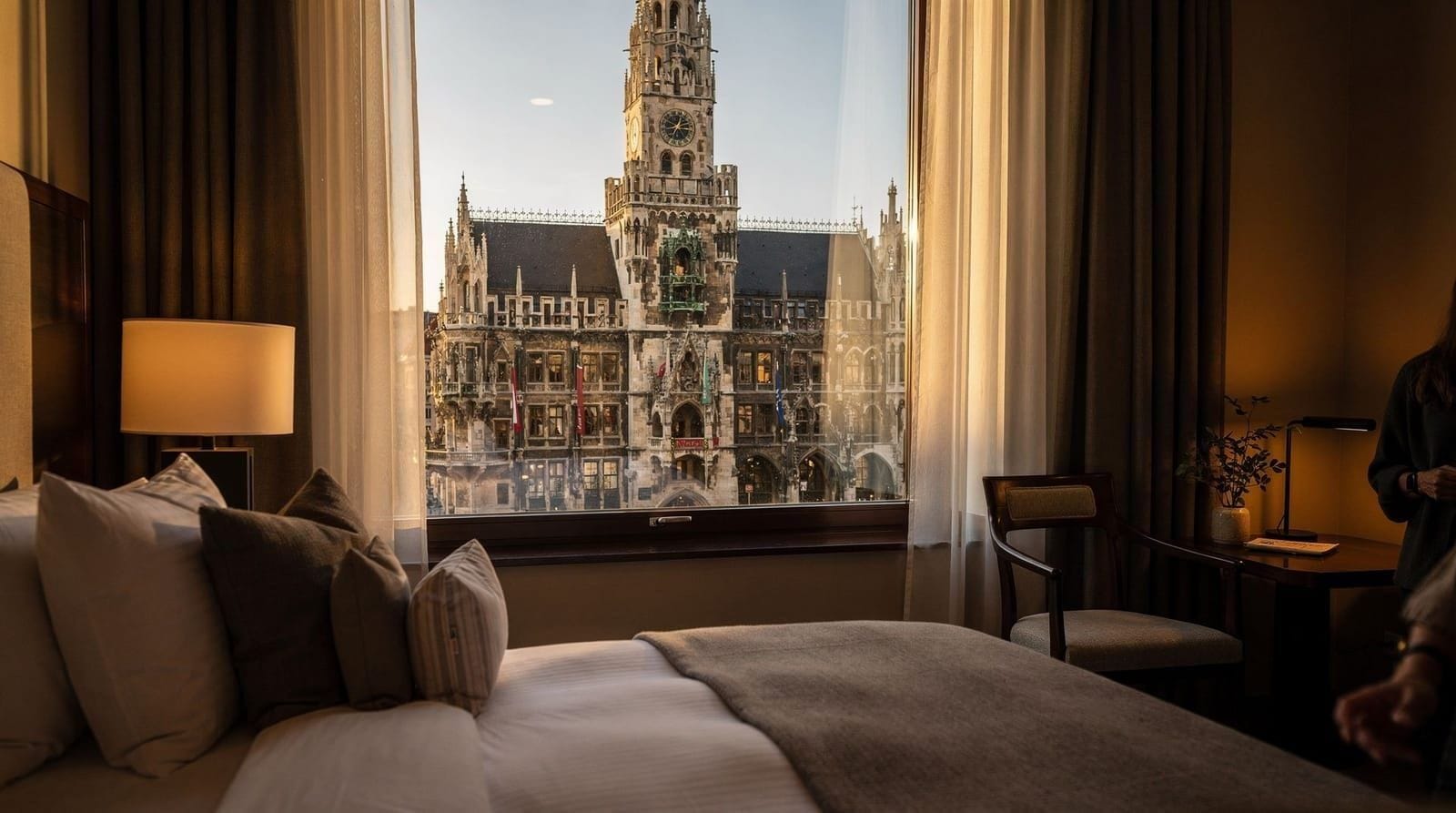
What it is: The historic heart of Munich, encompassing Marienplatz, the Residenz, Viktualienmarkt, Frauenkirche, and the Isartor. Also includes the Lehel district to the east, which is slightly quieter and marginally cheaper.
Walk times from Altstadt accommodation:
- Marienplatz: 0–10 minutes
- Residenz: 5–10 minutes
- English Garden entrance: 15–20 minutes
- Viktualienmarkt: 5 minutes
- Hauptbahnhof: 15–20 minutes on foot
Price range (2026):
- Budget hotels: Very few; mostly mid-range and above
- Mid-range hotel: €150–220 per room
- Boutique/luxury: €220–500+
Best for: Short visits (2–3 days) where convenience justifies premium pricing; honeymoons or luxury travel; visitors who want to wake up and step directly into the historic city.
Drawbacks: Expensive for the quality. Noisy in tourist season — Marienplatz and surrounding streets can be loud with tour groups and Glockenspiel crowds. Limited grocery access (nearest supermarket requires a walk).
Notable hotels and hostels: The Bayerischer Hof and Mandarin Oriental represent the hotel at its finest in this district; several design hotels around Maximilianstrasse. The nearby Platzl Hotel is a solid mid-range option close to the Residenz. For an orientation walk on arrival morning, staying in the Altstadt puts you steps from the meeting point for most old-town tours. Munich old town walking tour — a practical first-morning option if you are based centrally
Maxvorstadt: museums, universities, and walkability
What it is: The museum district northwest of the Altstadt, home to the Alte Pinakothek, Neue Pinakothek, Pinakothek der Moderne, Lenbachhaus, and the Technical University of Munich (TU München). A lively residential and student area with good cafés and restaurants.
Walk times from Maxvorstadt:
- Pinakothek museums: 2–10 minutes
- Marienplatz: 20–25 minutes on foot, or 5–8 minutes by U-Bahn (U2)
- English Garden: 10–15 minutes to the southern entrance
- Nymphenburg Palace: 20–25 minutes by tram
Price range (2026):
- Budget hotels and hostels: €75–120 per room/dorm
- Mid-range hotel: €120–170 per room
- Boutique: €150–220
Best for: Museum-focused visitors; people who want a university-neighbourhood atmosphere; families who want space and quieter streets than the Altstadt; those seeking better value than the Altstadt for mid-range budgets.
Drawbacks: Fewer traditional Bavarian restaurants than the Altstadt or Au-Haidhausen; more student/café culture than old-town atmosphere. The area is gentrified, so some of the rougher-around-the-edges charm of a decade ago has smoothed out.
Schwabing: residential, local, and green
What it is: The broad residential district north of the English Garden and Maxvorstadt. Historically Munich’s bohemian quarter (Kandinsky and Thomas Mann lived here), now a prosperous residential neighbourhood with independent shops, cafés, and excellent access to the English Garden’s northern sections.
Walk times from central Schwabing:
- English Garden (Schwabing entrance): 5–15 minutes
- Marienplatz: 35–40 minutes on foot, or 10–12 minutes by U3/U6
- Pinakothek museums: 15–20 minutes on foot
Price range (2026):
- Budget hotels: €70–110
- Mid-range: €100–160
- Boutique: €140–200
Best for: Visitors who want a more local feel than the tourist-heavy Altstadt; English Garden enthusiasts (morning jogs, afternoon beer gardens); those spending 4+ days in Munich and wanting a quieter base between sightseeing days.
Drawbacks: Sightseeing requires transit or 30–40 minute walks to the main Altstadt attractions. Fewer tourist infrastructure options (souvenir shops, tourist-facing services) — which is also what makes it appealing if you prefer residential atmosphere.
For more detail, see Schwabing neighbourhood guide.
Au-Haidhausen: the rising neighbourhood
What it is: A district east of the Isar, historically a working-class neighbourhood now thoroughly gentrified into Munich’s most restaurant-rich district. The Isar promenade, beer gardens on the east bank, and a dense café and restaurant scene make this a popular choice for food-motivated visitors.
Walk times from Au-Haidhausen:
- Marienplatz: 20–25 minutes on foot (across the Isar); or 5 minutes by S-Bahn (S3/S4) or U-Bahn (U5)
- Deutsches Museum: 10–15 minutes on foot (it sits on the Isar island)
- Isar riverside: 5 minutes
Price range (2026):
- Budget hotels: €80–120
- Mid-range: €110–170
- Boutique/design: €150–230
Best for: Food and café enthusiasts; visitors who want to be near the Deutsches Museum; those who enjoy river walks and a neighbourhood atmosphere; couples and mid-range travellers who want a pleasant base with great dining options within walking distance.
Drawbacks: Slightly further from the Altstadt on foot (though transit is fast); fewer chain hotels and hostels, so options are more boutique and apartment-focused.
For more detail, see Au-Haidhausen guide.
Glockenbachviertel: Munich’s most vibrant inner neighbourhood
What it is: A small but dense inner district south of the Altstadt and east of Theresienwiese. Munich’s most independently-minded neighbourhood — high concentration of design cafés, cocktail bars, independent restaurants, a strong LGBTQ scene, and compact streets that reward walking.
Walk times:
- Marienplatz: 15–20 minutes
- Theresienwiese (Oktoberfest): 10 minutes
- Hauptbahnhof: 15 minutes on foot
Price range (2026):
- Budget: Limited (one or two hostels, basic hotels €80–110)
- Mid-range: €110–160
- Boutique: €150–220
Best for: Younger visitors; those who prioritise nightlife, bars, and café culture over sightseeing proximity; Oktoberfest visitors who want to walk to Theresienwiese (budget permitting — prices here triple during Oktoberfest); visitors who want a neighbourhood with genuine local energy.
Drawbacks: Limited accommodation options compared to Maxvorstadt or Schwabing; Oktoberfest pricing extreme; not the most practical base if you are sightseeing the Altstadt, English Garden, and museums in quick succession.
For more detail, see Glockenbachviertel guide.
Hauptbahnhof area: convenient but characterless
What it is: The immediate vicinity of Munich’s central train station (Hauptbahnhof) — technically in the Ludwigsvorstadt-Isarvorstadt district but functioning as a transit hub neighbourhood with high density of chain hotels, budget accommodation, restaurants, and travel services.
Walk times:
- Hauptbahnhof: 0–5 minutes
- Marienplatz: 15 minutes on foot
- Theresienwiese: 20 minutes on foot
Price range (2026):
- Hostels: €25–45 per dorm
- Budget chain hotels: €80–130
- Mid-range: €110–180
Best for: Very early/late arrivals or departures; those in transit between destinations; budget-first travellers for whom location to sightseeing is secondary to price.
Drawbacks: The Hauptbahnhof area is the least charming place to be based in Munich. Streets around the station are busy, somewhat gritty, and lack the neighbourhood feel of the other districts. Petty crime rates (pickpockets) are the highest in Munich here. Chain hotels with thin walls and corridor noise are the norm.
When it makes sense: If you are arriving on an early flight and want somewhere to drop bags before exploring, or if you are using Munich as a transit point between European cities, the Hauptbahnhof area is practical. For a proper Munich stay of 3+ days, one of the other neighbourhoods offers more.
Outer Munich: Pasing, Moosach, and beyond
For Oktoberfest visitors or those on a tight budget, outer Munich districts offer significantly cheaper accommodation with reliable S-Bahn and U-Bahn connections.
Pasing (15–20 minutes by S-Bahn): A proper suburban town within Munich’s administrative boundary, with its own shopping and restaurant scene. Several good-value hotels and Airbnb apartments at 40–60% below Altstadt prices.
Moosach (U3, 15 minutes): Residential; very few tourist facilities but quiet and with supermarket access.
Strategy for Oktoberfest: Book in Pasing, Moosach, or Schwabing and take transit. A €9.20 MVV day ticket or Bayern-Ticket covers all transit. The saving on accommodation (often €100–200 per night below central Oktoberfest pricing) far outweighs the 15–20 minute commute.
Quick comparison table
| Area | Best for | Price relative | Transit to centre |
|---|---|---|---|
| Altstadt-Lehel | Sightseeing, luxury | Most expensive | Walk |
| Maxvorstadt | Museums, value | Moderate | U2, 5 min |
| Schwabing | Local feel, parks | Moderate | U3/U6, 10 min |
| Au-Haidhausen | Dining, Isar, culture | Moderate | U5/S-Bahn, 5 min |
| Glockenbachviertel | Nightlife, Oktoberfest | Moderate | Walk 15–20 min |
| Hauptbahnhof | Budget, transit | Budget | Walk 15 min |
| Outer Munich (Pasing, Moosach) | Oktoberfest savings, budget | Cheapest | S/U-Bahn, 15–20 min |
City Pass and guided sightseeing from any base
Munich City Pass — covers 45+ attractions and all-zone public transport, useful for museum-heavy staysHow Munich’s transport network affects your accommodation choice
Munich’s MVV public transport network is well-integrated enough that the difference between staying in Schwabing (U3/U6, 10 minutes to Marienplatz) and staying in the Altstadt (0 minutes) is not 10 minutes — it is about €8–40 per night, since Altstadt accommodation commands a significant premium.
The practical threshold for comfortable sightseeing from an outer location: any U-Bahn or S-Bahn journey of 15 minutes or less is operationally equivalent to walking distance from a sightseeing standpoint. You lose 30 minutes per day (15 minutes each way) but save significantly on accommodation costs.
The daily transit cost: An MVV day ticket is €9.20 for one person, €17.30 for up to 5 people. For a couple staying 5 nights in Schwabing versus the Altstadt, the transit cost for 5 days is €87. The hotel cost saving from Schwabing versus Altstadt might easily be €50–100 per night — so the transit cost is covered by the first night’s saving.
Tram 17 and 51: The tram routes along Nymphenburgerstrasse connect the Hauptbahnhof area to Nymphenburg Palace efficiently (about 15 minutes). This makes staying near the Hauptbahnhof or in inner Maxvorstadt a practical choice for anyone prioritising Nymphenburg.
Night transport: Munich’s U-Bahn and S-Bahn run frequent night services on Friday and Saturday nights. On other nights, the network runs roughly until 01:30–02:00 before resuming around 04:00–05:00. Night buses cover the gap. For visitors with late evening plans (beer halls typically close at 23:30–midnight), inner neighbourhood accommodation avoids any transit timing concerns.
Best area by trip type: quick recommendations
Solo travellers: Schwabing or Glockenbachviertel — both have a strong café and bar culture that makes solo evenings comfortable, plus reliable transit into the centre.
Couples on a short break: Altstadt-Lehel if budget allows, otherwise Au-Haidhausen for the combination of romantic riverside walks and a strong restaurant scene without Altstadt prices.
Families with children: Maxvorstadt or Schwabing — both offer more space per euro, quieter streets for evenings, and easy access to the English Garden’s playgrounds and open lawns. See the Munich with kids guide for family-specific logistics beyond accommodation.
First-time visitors with 2–3 days: Altstadt-Lehel or Maxvorstadt — both minimise transit time when your schedule is tight and every hour counts.
Longer stays (5+ days) or return visitors: Schwabing or Au-Haidhausen — the lower nightly cost and more residential pace suit a trip where you are not sprinting between sights every day.
Oktoberfest specifically: Glockenbachviertel if budget allows the premium and walking to Theresienwiese matters to you; Pasing or Moosach if it does not.
Booking strategies for Munich accommodation
Outside Oktoberfest: Book 4–8 weeks ahead for most dates. May, June, and early September are popular but rarely sell out. Hotel prices for non-event dates are relatively stable.
Oktoberfest (September 19 – October 4, 2026): Book 6–12 months ahead. The best rooms at reasonable prices go to early bookers. By 3–4 months before the festival, central Munich options are largely at premium prices. Checking for cancellations in the final month occasionally yields opportunities.
Christmas markets (late November–December): Book 6–10 weeks ahead. Demand is elevated but not to Oktoberfest levels.
Cancellation policy: Munich hotel demand means most properties sell rooms at non-refundable rates for popular dates. If your plans are uncertain, pay the small premium for a flexible-rate room — the refundable vs. non-refundable price difference is typically €15–30 per night, far less than a full night’s cost if your plans change.
Apartment vs hotel: For stays of 5+ days, serviced apartments or Airbnb can offer better value than hotels, particularly for families or groups. A two-bedroom apartment in Schwabing or Au-Haidhausen at €120–160/night often beats two hotel rooms at €120–180 each per night. Confirm any Kurtaxe (city tourist tax) is included in the quoted price — most Munich accommodation adds it separately at check-in or check-out, typically a few euros per person per night.
Frequently asked questions about where to stay in Munich
Is it cheaper to stay outside Munich and commute in?
For significant savings, yes. Augsburg (35 minutes by regional train, €9–10 single) and towns on the S-Bahn lines (Dachau, Freising, Starnberg) offer accommodation at 30–60% below central Munich prices. This works best for Oktoberfest, when the commute cost is trivially small compared to the accommodation savings, and for leisure visitors who do not mind a 30–45 minute morning transit.
Should I stay near the Hauptbahnhof for easy day trips?
The Hauptbahnhof is Munich’s central rail hub for both city transit and regional trains. All day trip trains leave from here. In practice, every accommodation in inner Munich is within 15–20 minutes of the Hauptbahnhof by U-Bahn or walking, so “staying near the Hauptbahnhof” gives minimal advantage over staying in Maxvorstadt or Schwabing while being more pleasant.
Are there hotels near the English Garden?
Yes — the boundary between Maxvorstadt and Schwabing has several hotels within 10–15 minutes’ walk of the English Garden’s southern entrance. The Chinesischer Turm beer garden, the Eisbach surfing channel, and the main walking paths are all accessible on foot from Maxvorstadt or northern Altstadt accommodation.
How do Munich neighbourhood prices change during Oktoberfest?
Every neighbourhood in Munich sees significant price increases during Oktoberfest (September 19 – October 4, 2026). The highest increases are nearest Theresienwiese (Glockenbachviertel, Ludwigsvorstadt) — often 4–5x normal. Outer neighbourhoods (Schwabing, Moosach, Pasing) see 2–3x increases. Book 6–12 months ahead if Oktoberfest accommodation is part of your plan.
Which neighbourhood is quietest for a good night’s sleep?
Schwabing and the residential parts of Au-Haidhausen are generally the quietest options among the central districts, since neither sits directly on a major tourist thoroughfare. The Altstadt and Glockenbachviertel are the noisiest, particularly on weekend nights when bar and beer garden crowds spill onto the street.
Is it worth paying extra to be near the English Garden?
Only if you plan to use the park daily — for a morning run, a picnic, or repeated beer garden visits. For occasional visits, any Maxvorstadt, Schwabing, or Altstadt base is within a reasonable U-Bahn or walking distance, so the premium for a location directly adjacent to the park is rarely worth it unless the park is central to your trip.