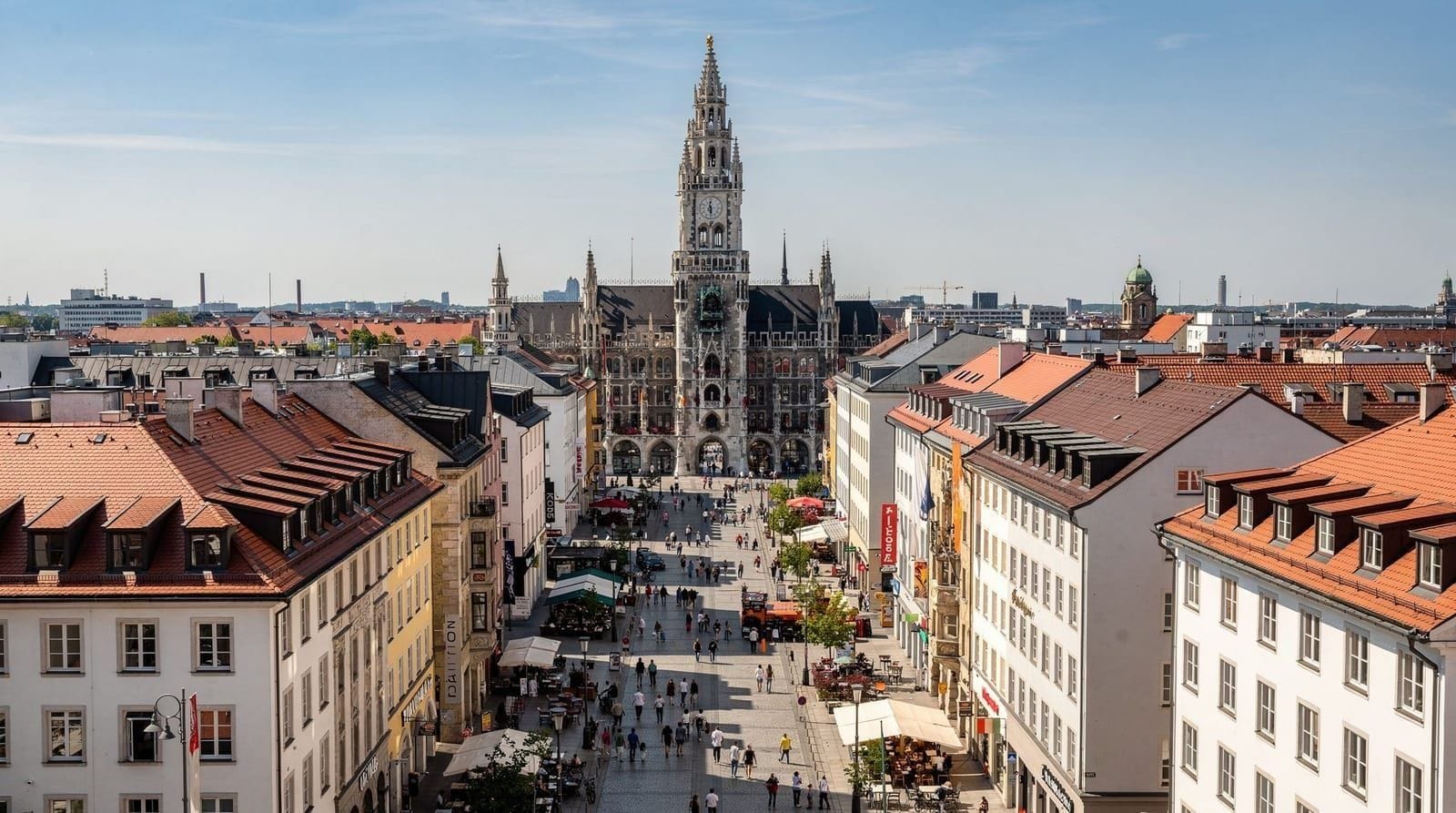
Munich Altstadt guide: old town streets, landmarks and what to do
Munich: old town walking tour
What is Munich's Altstadt and what's in it?
The Altstadt (Old Town) is Munich's historic core, contained within the ring road that follows the medieval city walls. It holds Marienplatz, the Frauenkirche, Hofbräuhaus, Viktualienmarkt, the Residenz and the Asamkirche. The entire area is walkable in half a day, though the Residenz alone takes 2–3 hours. Everything is within roughly 1 kilometre of Marienplatz.
The Altstadt is small enough to underestimate on a map and large enough to swallow a full day once you start reading plaques. This guide breaks the old town into its natural zones, tells you what each one is actually for, and points you toward the neighbourhoods worth a detour once you have seen the postcard sights.
| Where | Inside the Altstadtring, centred on Marienplatz |
| Time needed | Half a day for the highlights, a full day with the Residenz |
| Getting there | Marienplatz S-Bahn/U3/U6, one stop from Hauptbahnhof |
| Cost | Mostly free to walk; Residenz around €9–12, Rathaus tower around €4 |
| Best time | Early morning or weekday, before lunchtime crowds |
The old town core: how the Altstadt is organised
Munich’s Altstadt is the historic city centre contained within the ring road (Altstadtring) that traces the outer perimeter of the medieval city walls. Almost none of the walls themselves survive — they were mostly demolished in the 19th century as Munich expanded — but the ring road defines the boundary clearly: the Karlsplatz/Stachus in the west, Isartorplatz in the east, Odeonsplatz in the north, Sendlinger Tor in the south.
Within this boundary, the urban grid is medieval in origin but heavily rebuilt after World War II bombing destroyed large sections of the inner city. Munich’s postwar reconstruction was careful about facades — the Neues Rathaus, Frauenkirche, Hofbräuhaus and many other landmarks were rebuilt to their original appearance — but much of what looks historic is in fact mid-20th-century reproduction.
The Altstadt divides naturally into a few distinct zones:
The pedestrian core (Kaufingerstrasse/Neuhauser Strasse running east-west from Karlsplatz to Marienplatz, and the streets immediately surrounding Marienplatz) is the most heavily visited tourist zone. The area is well-maintained, walkable and oriented toward shopping and sightseeing.
The Marienplatz and Residenz quarter (the north-central section) contains the city’s most significant civic and royal buildings: the Neues Rathaus with its Glockenspiel, the Residenz, the Feldherrnhalle and Odeonsplatz.
The Viktualienmarkt quarter (south of Marienplatz) is a denser, more local area centred on Munich’s daily food market and extending south toward Sendlinger Strasse and the Gärtnerplatz area.
The eastern Altstadt (Tal Strasse and Isartor) is quieter, less polished and worth exploring for a less touristic perspective.
Marienplatz: the hub
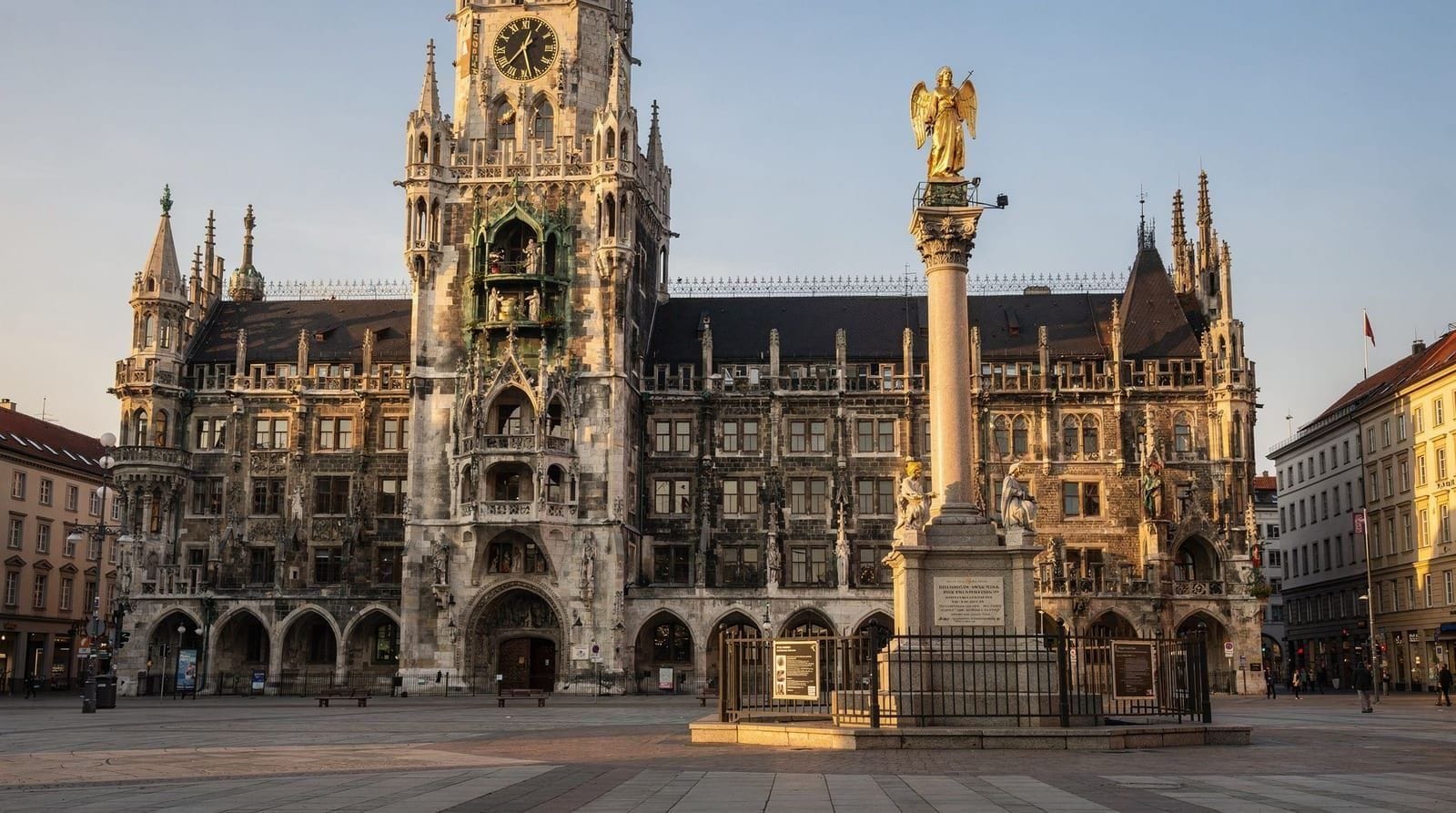
Marienplatz is unavoidable on any Altstadt visit and there is nothing wrong with that. It has been the city’s central public square since Munich’s founding in 1158 and it remains the geographical and symbolic heart of the city. The Mariensäule (Column of the Virgin Mary) at its centre dates from 1638; the Neues Rathaus dominating the north side was completed in 1909 in Gothic Revival style.
The famous Glockenspiel — 32 life-size mechanical figures in the Rathaus tower — performs at 11am and noon daily (also at 5pm from March to October). Each performance lasts 12 minutes and is free to watch from the square. The tower observation deck (€4) provides the best close-up rooftop view of the Altstadt.
The full Marienplatz guide covers performance times, the tower, the Mariensäule and what to avoid in the immediate area.
Frauenkirche: Munich’s defining silhouette
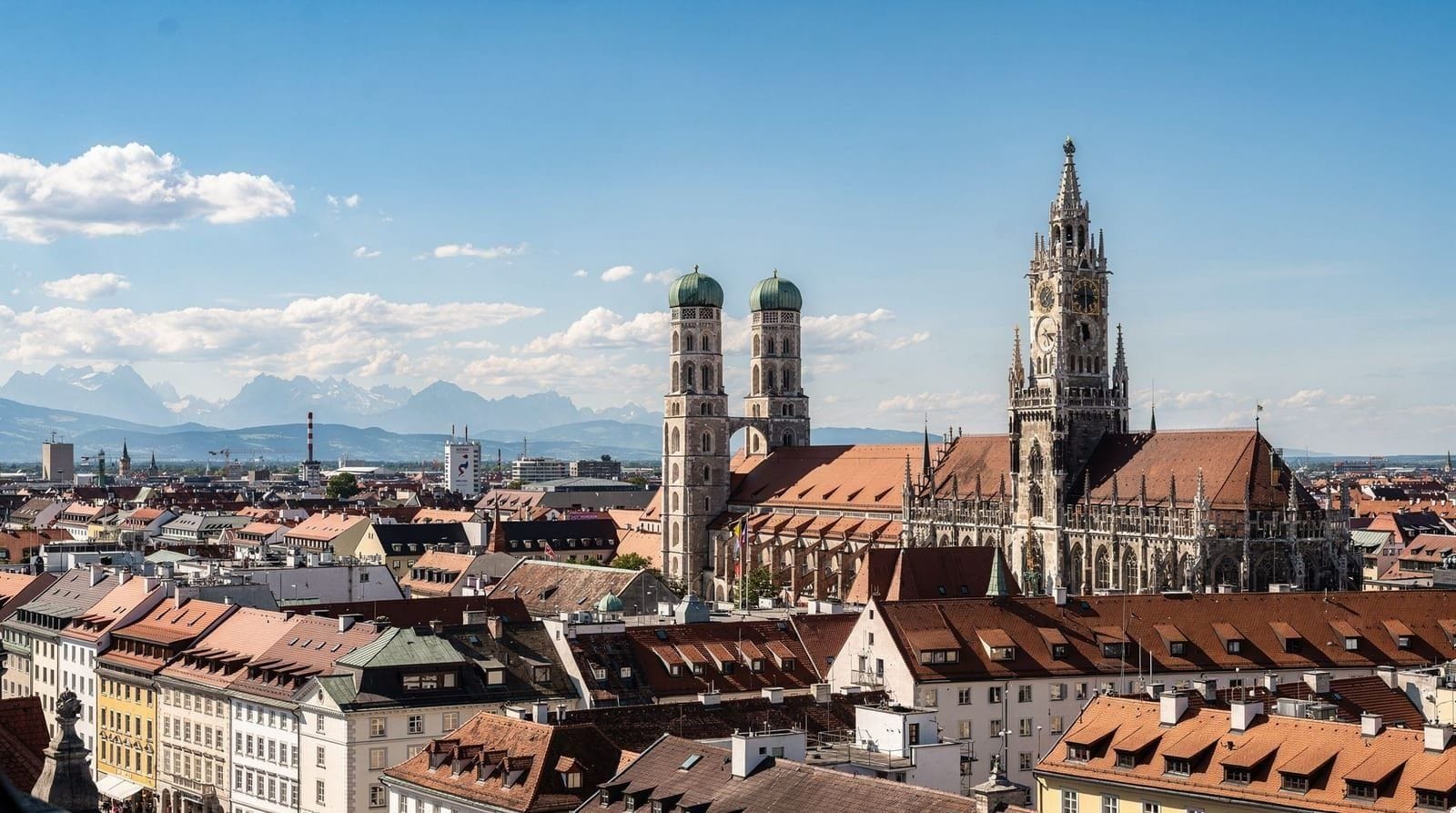
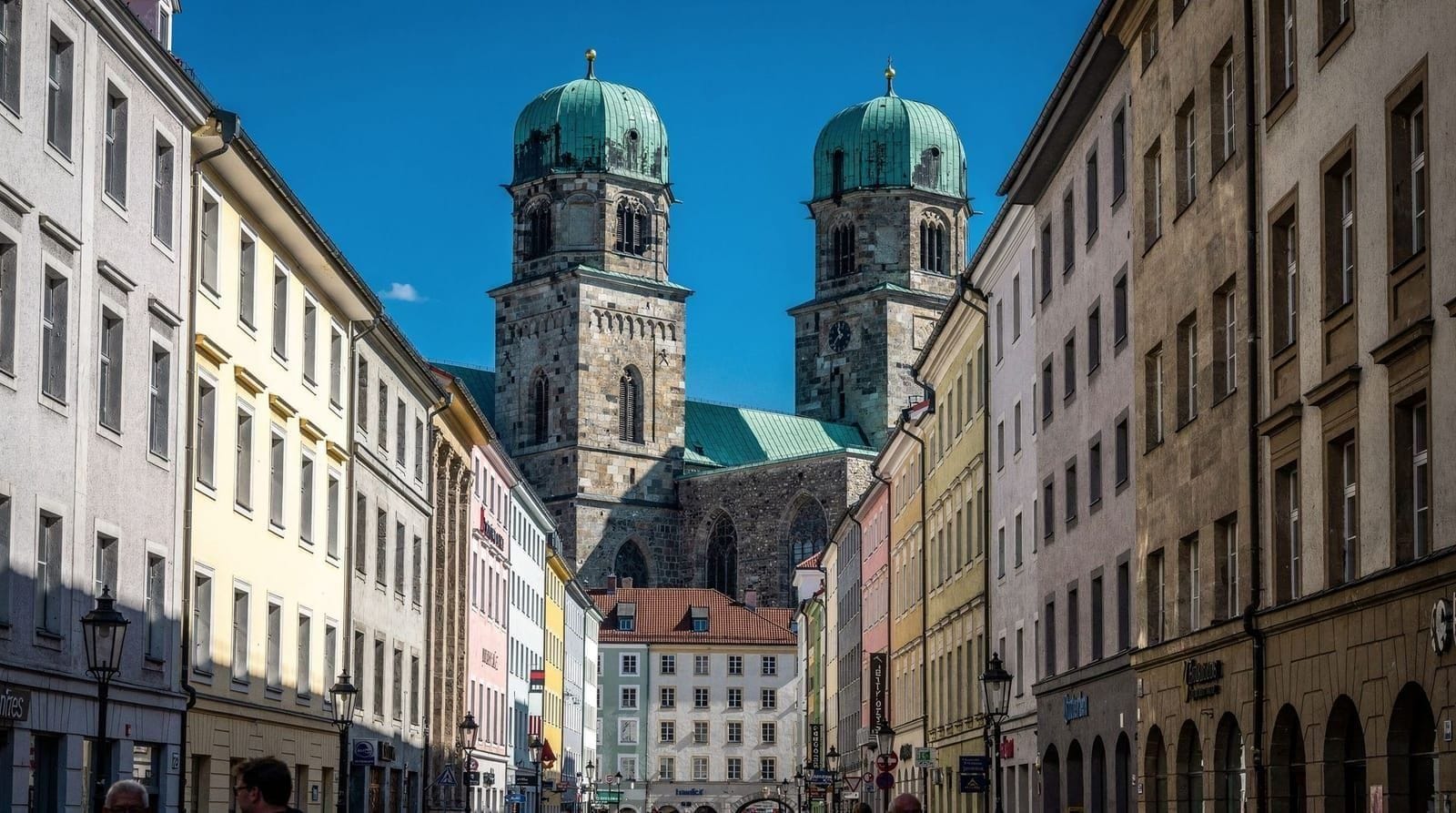
The twin copper-topped towers of the Frauenkirche (Cathedral of Our Lady) have been Munich’s architectural trademark since the late 15th century. A city regulation since 1619 prohibits new buildings from exceeding the 99-metre height of the towers — the modern city’s skyline is shaped by this rule. The towers are visible from Marienplatz (looking west) and from most elevated points in the city.
The cathedral was built between 1468 and 1488 by architect Jörg von Halspach in a deliberately austere Brick Gothic style. The interior is vast and airy — 109 metres long, 40 metres wide — with octagonal pillars and original Gothic vaulting. The building was heavily damaged in World War II and restored in phases through the 1990s.
Two things inside the Frauenkirche are specifically worth noting:
The Devil’s Footstep (Teufelstritt): A black footprint-shaped mark in the stone floor near the main entrance. According to legend, the Devil challenged the cathedral’s architect to build a church with no windows visible from this spot — and indeed from that exact point, the pillars hide all the windows. The Devil’s Footstep is still visible at ground level.
The tower (when open): One of the Frauenkirche towers is occasionally open to visitors with a lift. When operating, the view from 99 metres is the best elevated perspective in the Altstadt — better than the Neues Rathaus tower for range and better than the Olympiaturm for historic city views.
Entry to the cathedral itself is free. See the Frauenkirche guide for full access details and current tower status.
The Residenz: Munich’s royal palace
The Munich Residenz is the former royal palace of the Wittelsbach dynasty — the family that ruled Bavaria for seven centuries. What exists today is an enormous complex of 130 rooms across ten courtyards, built and extended from the 14th through 19th centuries. The Residenz museum contains:
- The Ancestral Gallery (Ahnengalerie): 121 Wittelsbach portraits in a rococo gallery
- The Treasury (Schatzkammer): the dynasty’s jewellery, crowns and ceremonial objects
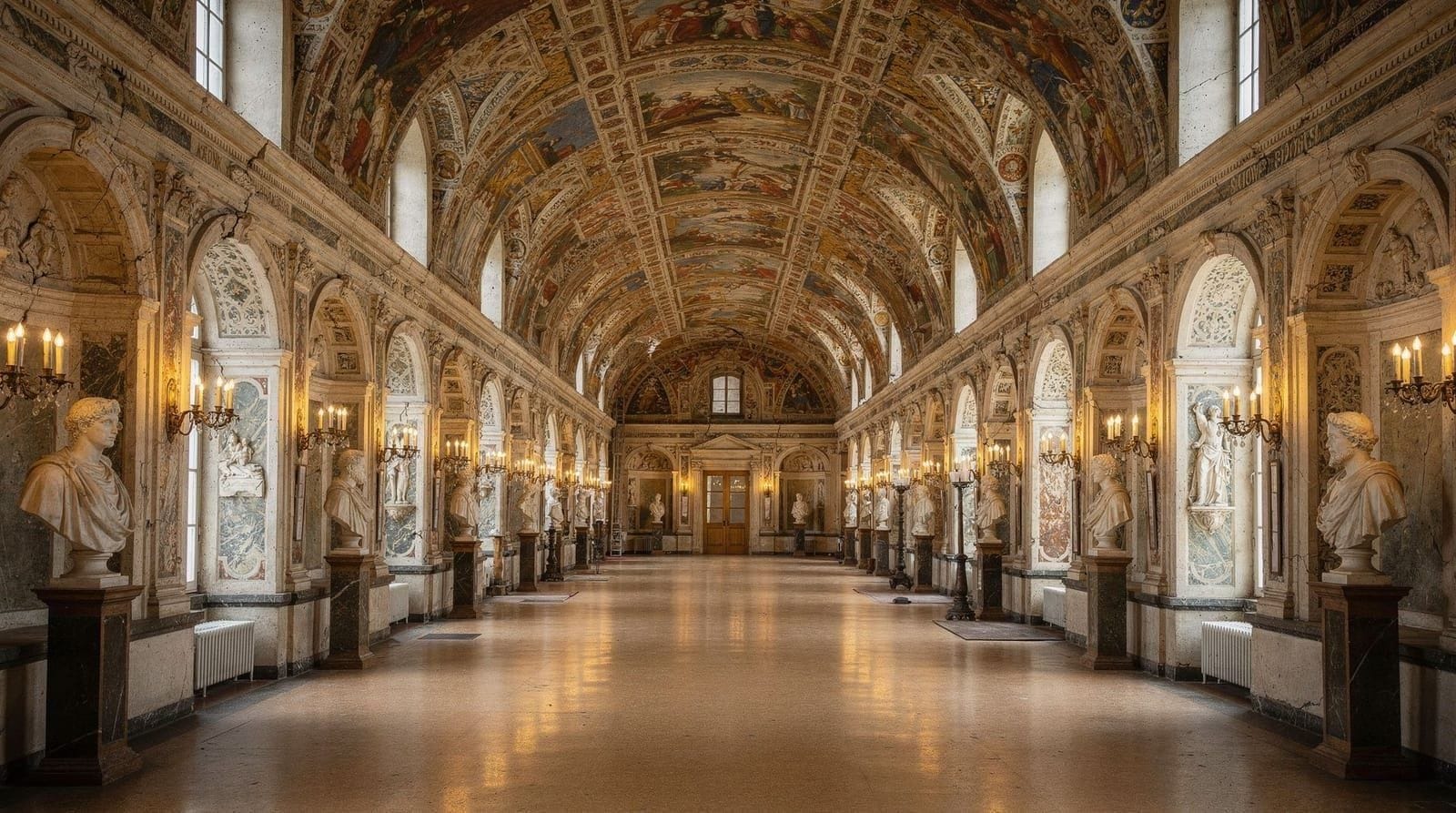
- The Antiquarium: a 66-metre Renaissance hall covered in frescoes, the oldest preserved room in the complex
- The Cuvilliés Theatre: an 18th-century rococo court theatre of extraordinary decoration
Admission: €9 for the museum alone, €12 combined with the Treasury. Allow 2–3 hours minimum for the main museum rooms; a full visit covers several hours. The Munich Residenz guide provides a room-by-room breakdown and advice on what to prioritise. Guided Old Town walking tour from Marienplatz — 2 hours
Viktualienmarkt: the local food heart
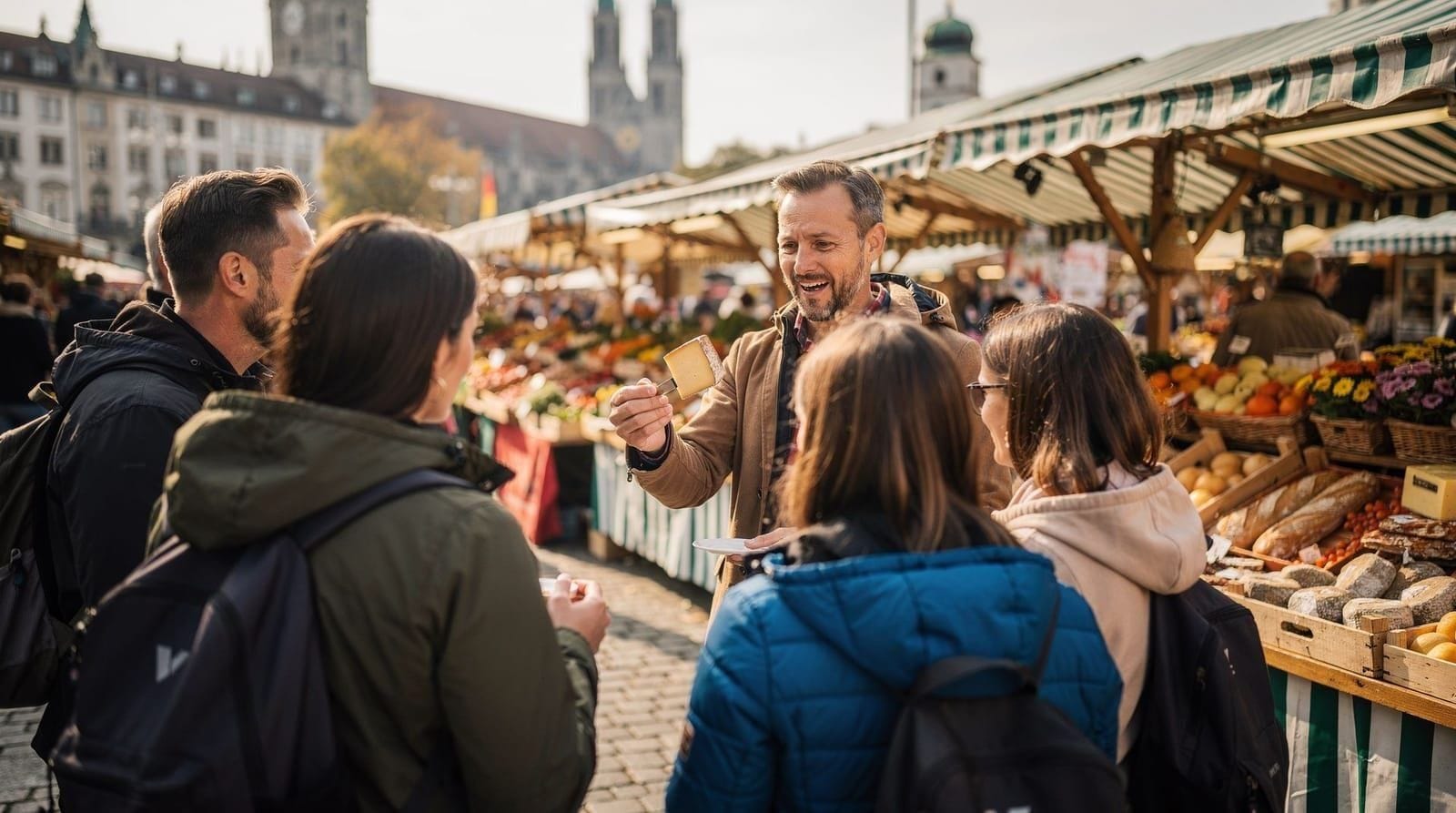
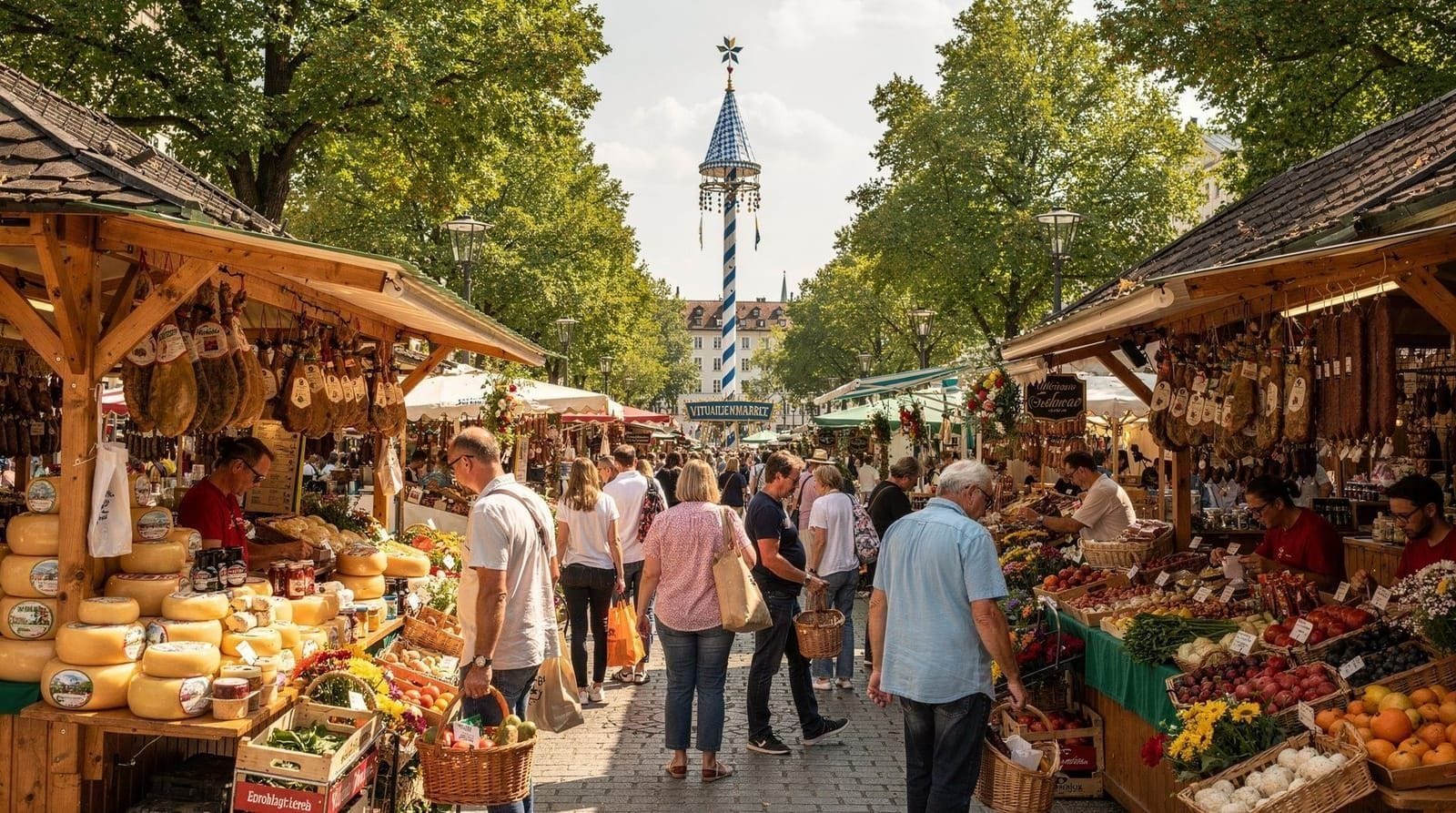
Two minutes south of Marienplatz on Frauenstrasse, the Viktualienmarkt is Munich’s main daily food market and one of the most functional (rather than merely scenic) markets in any major German city. It has operated in its current location since 1807, moved there from Marienplatz to relieve congestion on the main square.
The market runs Monday to Saturday, 8am to 8pm (some stalls close earlier). It sells:
- Fresh produce: vegetables, fruit, herbs, flowers
- Dairy: Bavarian cheeses, butter, cream
- Butchery: meats, Weisswurst, various sausages
- Delicatessen: Obatzda (Bavarian cheese spread), pickles, smoked fish
- Bread from multiple bakeries with stalls
- Seasonal specialities: white asparagus in spring, game in autumn
The permanent beer garden at the market’s centre is one of Munich’s most pleasant outdoor drinking spots. It is operated by a rotating selection of Munich’s six main breweries (Augustiner, Hacker-Pschorr, Hofbräu, Löwenbräu, Paulaner and Spaten, each taking a season), serves food from the nearby market stalls, and attracts a genuine cross-section of local workers, shoppers and visitors. A Masskrug (litre) of beer here costs €11–13 in 2026, which is average for Munich.
For an in-depth guide to what to buy and eat at the market, see the Viktualienmarkt food guide.
Hofbräuhaus: touristy but real
A five-minute walk east from Marienplatz on Orlandostrasse, the Hofbräuhaus is one of those genuine historical institutions that also happens to be extremely touristy. Both things are true simultaneously.
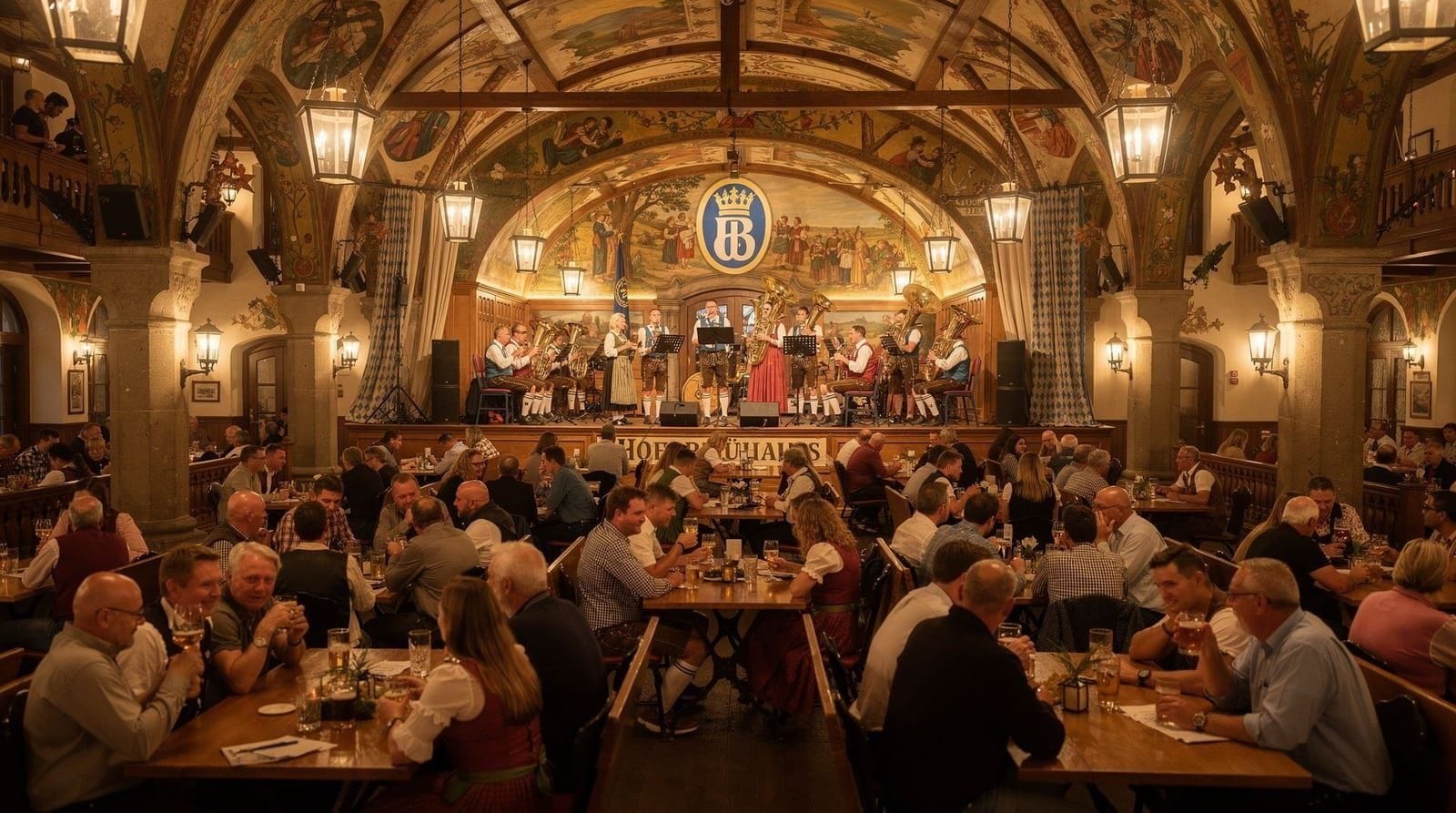
The Hofbräuhaus was founded as a royal brewery in 1589 by Duke Wilhelm V. The current building dates from 1897 and has been a public beer hall since 1828. The main hall (Schwemme) seats 1,000 people under vaulted ceilings with painted plaster; a brass band performs most evenings. The beer (HB Hofbräu, brewed nearby) is authentic Munich Helles. Prices in 2026: Masskrug €11.80–12.50 depending on session, Weisswurst breakfast €6.90, Schweinshaxe (pork knuckle) €22–26.
The Hofbräuhaus also has significant (and uncomfortable) historical associations — Hitler held early Nazi Party meetings here, including the failed Beer Hall Putsch of 1923. The building itself is not associated with the Putsch (that was the Bürgerbräukeller, which no longer exists), but the political history of the space is real. The Hofbräuhaus guide discusses this in full.
The Hofbräuhaus is worth visiting once for the scale, the beer and the atmosphere. Arriving at non-peak times (before noon or after 9pm on weekdays) gives a less overwhelming experience.
Asamkirche: the Altstadt’s architectural extreme
At the corner of Sendlinger Strasse and Asamstrasse, the Asamkirche (officially the Johannis-Nepomuk-Kirche) is a private baroque church built by the architect brothers Cosmas Damian and Egid Quirin Asam between 1733 and 1746. Its exterior is squeezed between two buildings and barely 8 metres wide; inside, every surface — floor, walls, ceiling — is covered in marble, gilding, frescoes and sculpture in a density that can feel overwhelming.
The Asamkirche was originally the brothers’ private chapel, built next to their residence. Entry is free. It is open daily 9am–6pm (later on religious holidays). As a piece of late-Bavarian baroque architecture, it is one of the most extreme examples in existence and worth the short detour from Sendlinger Strasse. The Asam Church guide covers the interior symbolism and architecture in detail.
Sendlinger Tor and the Glockenbachviertel edge
At the southern end of Sendlinger Strasse stands the Sendlinger Tor, one of three surviving medieval city gates (the others are Isartor and Karlstor). Built in the 14th century, the gate now frames a busy road junction. It is not a major attraction in itself but serves as a landmark orientation point — you are at the southern boundary of the Altstadt.
Immediately south of Sendlinger Tor, the character of the city changes. The Glockenbachviertel — Munich’s LGBTQ+ neighbourhood and one of the city’s most vibrant social districts — begins here and extends south toward Gärtnerplatz. The shift in atmosphere from Altstadt tourist zone to local neighbourhood happens within one or two blocks. Old Town and Viktualienmarkt walking tour — 2.5 hours with food tastings
The eastern Altstadt: Tal Strasse and Isartor
The Tal is the old street running east from Marienplatz toward the Isar river and the Isartor gate. It is less visited than the western pedestrian zone and consequently more authentic in character — a mix of local restaurants, specialist shops and small offices. Weisses Bräuhaus (Tal 7) is one of the oldest Bavarian restaurants in Munich, particularly known for its Weisswurst and its association with the Schneider Weisse brewery.
The Isartor at the east end of Tal Strasse is a 14th-century gate with a large fresco on its outer face depicting Ludwig IV’s triumphal entry into Munich after the Battle of Ampfing in 1322. It houses a small Karl Valentin museum (a Munich comedian important to local culture). The gate’s tower is not open to general visitors but the exterior is worth seeing.
Odeonsplatz and Feldherrnhalle: the northern Altstadt edge
At the northern boundary of the Altstadt, where Residenzstrasse opens into the broad Odeonsplatz, two monuments define the civic character of the space:
Feldherrnhalle (Field Marshals’ Hall): A 19th-century loggia modelled on the Loggia dei Lanzi in Florence, built under Ludwig I to honour Bavarian military commanders. It has an uncomfortable dual identity — it was also the site where the Munich police stopped Hitler’s Beer Hall Putsch in November 1923, killing four officers. A plaque on the east side of the loggia commemorates the police officers killed there. During the Nazi period (1933–1945), passersby were required to salute at the memorial on the Feldherrnhalle’s west face; those who wished to avoid doing so took a detour through Viscardigasse to the east, still unofficially called the “shirker’s alley” (Drückebergergasse).
Theatinerkirche (immediately west of Odeonsplatz): A Baroque Italian-style church with a distinctive yellow facade and two towers, built from 1663 to 1690 for the Theatine order. The interior is brilliant white with elaborate stucco — worth a brief visit, and entry is free.
For a complete account of the Altstadt’s layered history, see the Munich old town history guide.
Practical logistics for the Altstadt
Getting there: Marienplatz is served by all S-Bahn lines (central interchange point) and U3/U6. The Hauptbahnhof is one S-Bahn stop west (2 minutes). Marienplatz U-Bahn connects to U3 and U6 for direct access from the northern and southern city.
Parking: The Altstadt has few surface parking options. Underground garages at Viktualienmarkt, Schrannenhalle and Marienplatz exist but are expensive (€3–4/hour). Using public transport is strongly recommended.
Getting around the Altstadt: The pedestrian zone excludes vehicles. Bicycles are technically permitted in some sections but the crowds make cycling impractical during busy periods. The area is compact enough that walking is the most efficient option.
Best timing: Early mornings (before 9am) give the pedestrian zone and Marienplatz largely to yourself and offer the best light for photography. Weekday lunchtimes are particularly busy with a mix of workers and tourists. Weekends in summer are the most crowded.
For a structured route through the Altstadt, the Munich Old Town walking route guide maps a 3-kilometre circuit with timing. The Munich self-guided walk offers an alternative format. Private Old Town walking tour with a local guide
Altstadt zones compared
| Zone | Character | Good for |
|---|---|---|
| Marienplatz core | Busiest, most polished | First-time sightseeing, Glockenspiel |
| Viktualienmarkt quarter | Denser, local food trade | Lunch, market browsing |
| Tal / Isartor | Quieter, less renovated | A more authentic feel, local restaurants |
| Odeonsplatz / Feldherrnhalle | Grand, monumental | History, architecture, fewer crowds |
Eating and drinking beyond the obvious
Hofbräuhaus and the Viktualienmarkt beer garden cover the classic Altstadt experience, but they are far from the only options. For a proper sit-down meal, the best restaurants in Munich guide covers Altstadt options alongside the wider city, and the best beer gardens guide ranks the city’s gardens if you want an alternative to the Viktualienmarkt crowd. For something calmer between sights, the Munich cafés guide lists quieter spots tucked off the main pedestrian drag, mostly within a five-minute walk of Marienplatz.
Photography and viewpoints
The Altstadt rewards an early start for photography — before 9am, the pedestrian zone and Marienplatz are close to empty and the light on the Frauenkirche’s copper towers is best. For elevated views over the old town’s rooftops, see the Munich viewpoints guide, which ranks the Neues Rathaus tower against the Frauenkirche tower (when open) and the Peterskirche. Avoid framing shots that only show the reconstructed facades as if they were untouched medieval originals — worth knowing before you post them, since almost the entire visible Altstadt was rebuilt after 1945.
What to skip
Not everything inside the ring road deserves your time. The souvenir shops immediately fronting Marienplatz are markedly overpriced compared to stores a block or two away, and several “traditional” restaurants on the main pedestrian strip cater purely to footfall rather than quality. The Munich tourist traps guide names specific examples worth avoiding, mostly clustered in the Altstadt’s busiest few hundred metres.
Frequently asked questions about Munich’s Altstadt
How long should I spend in Munich’s Altstadt?
A surface walk covering Marienplatz, the Frauenkirche exterior, Viktualienmarkt and the Hofbräuhaus takes 3–4 hours. Adding the Residenz (allow 2–3 hours) makes it a full day. If you also visit the Neues Rathaus tower, the Asamkirche, the Pinakotheken and Odeonsplatz, you need at least two full days in the Altstadt area. The Munich trip planning guide has suggested allocations by visit length.
Is Munich’s Altstadt safe?
The Altstadt is one of the safer inner-city areas in Germany — Munich has a low violent crime rate by European standards. Pickpocketing can occur on the pedestrian zone and in crowded areas around Marienplatz, particularly during Oktoberfest season when visitor numbers are very high. Standard city precautions apply: use a bag that closes, do not leave valuables on café tables.
What areas of the Altstadt are locals actually using?
The Viktualienmarkt draws a genuine local clientele throughout the week, particularly in the mornings. The streets immediately around the market — Rosental, Heiliggeiststrasse — have local character. The eastern Altstadt along Tal Strasse is more local than the western pedestrian zone. The Hofbräuhaus itself has a mixed local/tourist split depending on the time of day and day of the week.
Can I visit the Munich Altstadt on a Sunday?
Most shops in the Altstadt are closed on Sundays (German retail law), including the Viktualienmarkt food stalls. Restaurants, cafés, beer halls and tourist attractions stay open. Sunday mornings are relatively quiet on the pedestrian zone and can be a good time for photography. The Christmas markets in December run on Sundays.
What’s the nearest neighbourhood to the Altstadt with a local atmosphere?
The Glockenbachviertel immediately south of the Altstadt is Munich’s most lively local neighbourhood — independent restaurants, bars and cafés along Gärtnerplatz and the canal streets. The Au-Haidhausen area east of the Isar is another genuinely local district, walking distance from the Isartor. Both are a 15–20 minute walk from Marienplatz.
What happened to the medieval city walls?
Munich’s medieval walls (built primarily in the 13th and 14th centuries) were systematically demolished from the early 19th century as the city expanded and the walls became an obstacle to traffic. The main survivals are the three gates — Isartor, Sendlinger Tor and Karlstor — and one tower (Alter Hof complex). The ring road (Altstadtring) traces the approximate route of the demolished walls.
Are there guided tours of the Altstadt worth taking?
A guided walking tour is genuinely useful for a first visit — the Altstadt’s layers of history (medieval, baroque, Nazi-era, postwar reconstruction) are hard to read without context. The Munich free walking tours (tip-based, starting at Marienplatz twice daily) are a reasonable option. For more depth, a private walking tour can be tailored to specific interests.
Are the Altstadt’s neighbourhoods worth comparing before I visit?
Yes — the Altstadt zones differ more than first-time visitors expect. The Munich neighbourhoods overview compares the old town against Schwabing, Glockenbachviertel and the other districts, which helps decide how much time to allocate inside the ring road versus outside it.
Is the Altstadt worth visiting more than once on a longer trip?
Yes, especially at different times of day. An early-morning pass for photography and a quiet look at the Frauenkirche feels completely different from an evening visit centred on the Hofbräuhaus or the Viktualienmarkt beer garden. On a trip of four days or more, splitting the Altstadt into two shorter visits usually beats one long, tiring day.
Top experiences
Bookable activities with verified prices and instant confirmation on GetYourGuide.