Viktualienmarkt food guide — Munich's finest market explained
Munich: Viktualienmarkt gourmet food tour
What should I eat at the Viktualienmarkt?
Start with Weißwurst and sweet mustard before noon, then add Obatzda on a pretzel, a warm Leberkäse roll, and finish with a Maß at the central beer garden. The market is open Mon-Sat from 8am; Sunday it is closed. Budget €20-25 for a proper market lunch including beer.
A market that has fed Munich since 1807
The Viktualienmarkt is not a heritage attraction designed to look like an old market. It is an old market — operating continuously on the same site in the heart of Munich since 1807, when it replaced a smaller market that had occupied Marienplatz itself. The Latin word “victualia” means provisions, and provisions are precisely what the Viktualienmarkt has always supplied.
In the early nineteenth century, Munich’s growth as a capital city required a market larger than Marienplatz could accommodate. The city designated a site 300 metres to the south, established the stall system, and the market has expanded, adapted, and endured through every subsequent upheaval — including wartime bombing that destroyed much of the surrounding architecture while leaving the market itself largely functional.
Today the Viktualienmarkt covers approximately 22,000 square metres, hosts around 140 permanent stalls, and serves both Munich residents doing their weekly shopping and visitors looking to understand what Bavarian food culture actually tastes like. The distinction between those two groups blurs considerably around the central beer garden at lunchtime, which is by design.
| Where | Central Altstadt, 5-minute walk south of Marienplatz |
| Cost | Free to browse; a proper market lunch with beer runs €20–25 |
| Time needed | 1–2 hours for a focused visit; half a day with a guided tour |
| Getting there | Walk from Marienplatz, or U-Bahn/S-Bahn to Marienplatz |
| Best time | Weekday mornings before 9am, before the tourist crowds arrive |
Layout and orientation
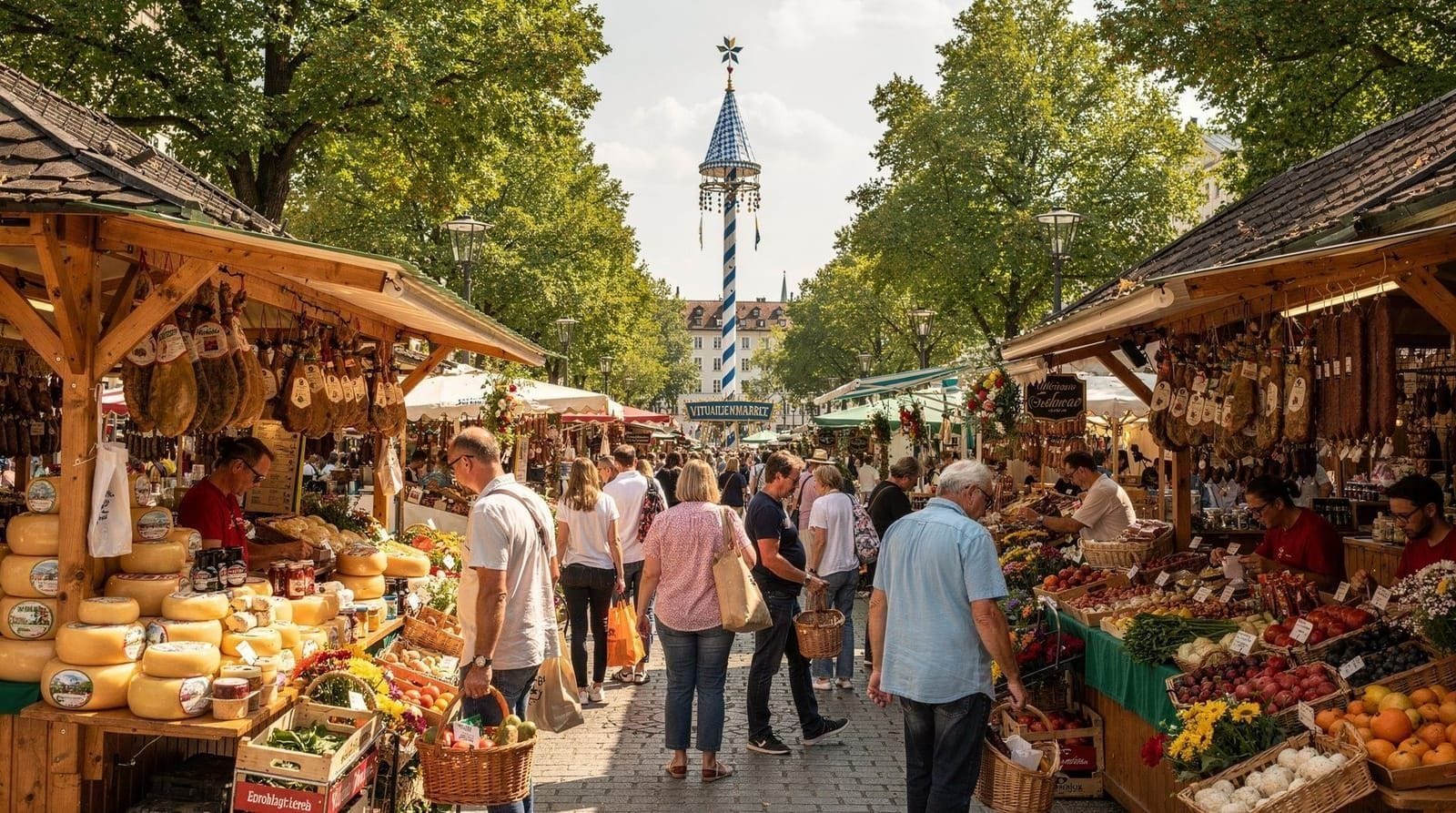
The Viktualienmarkt is bounded roughly by Frauenstraße to the north, Sebastiansplatz to the south, Blumenstraße to the west, and the continuation of the market lanes eastward. The central feature is the maypole (Maibaum) — a blue-and-white striped pole decorated with figures representing Munich’s guilds, surrounded by the beer garden tables.
The market is not organised by strict zones, but you’ll find:
- Sausage and meat stalls concentrated in the western section
- Cheese and dairy stalls in the northern lanes near Frauenstraße
- Produce and vegetable stalls in the eastern sections
- Bakery stalls distributed throughout, with the best Brezn near the main entrance points
- Specialist stalls (honey, pickles, spices, dried fruit) scattered throughout
Navigation is easiest by following the smell — fresh bread from the bakeries, grilled Leberkäse from the meat counters, and coffee from the multiple espresso stalls that serve the market’s traders and shoppers.
The essential eating and drinking stops
Weißwurst before noon
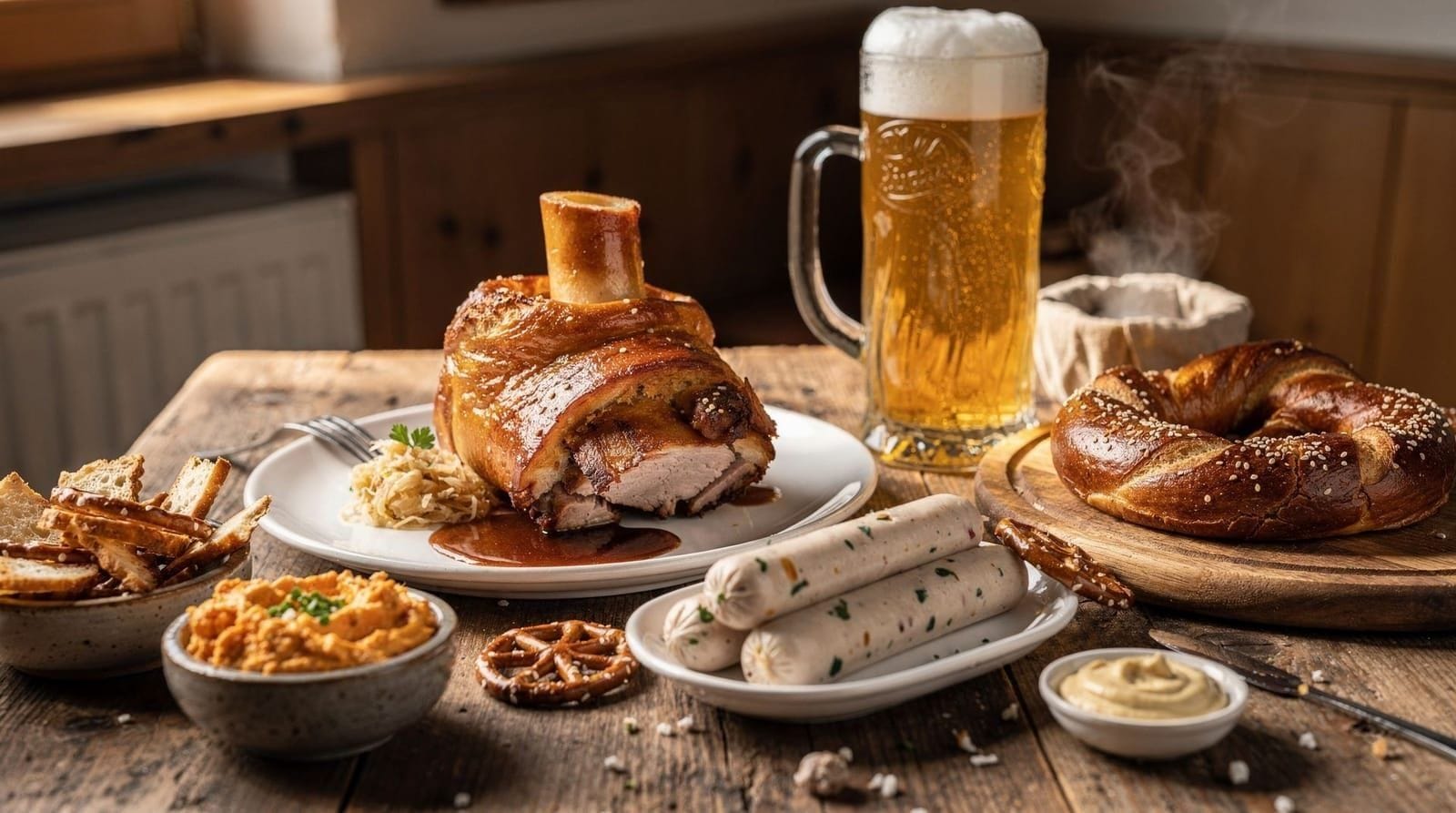
The single most culturally specific dish the Viktualienmarkt offers is the Weißwurst — white veal sausages made from finely minced veal and back bacon, parsley, lemon, onion, and cardamom, formed into a delicate pale sausage and poached rather than grilled. The texture is soft, almost mousse-like. The flavour is gentle and herby, carrying the lemon and cardamom clearly.
Weißwurst is strictly a morning dish. The rule — “Weißwurst darf den Mittagsgong nicht hören” (a Weißwurst must not hear the midday bell) — dates from the pre-refrigeration era when fresh sausages made without preservatives spoiled quickly in warm kitchens. The sausages were made fresh each morning and sold out before noon. That logic no longer applies in 2026, but the tradition holds: ordering Weißwurst after midday at a traditional Bavarian establishment will earn you a polite correction.
At the Viktualienmarkt, Weißwurst is served at the butcher stalls in their own broth, in small ceramic or stainless-steel pots. The correct accompaniments are:
- Süßer Senf (sweet mustard) — a lighter, sweeter Munich-style mustard, not the spicy variety
- Brezn (pretzel) — essential, used to mop up the mustard and to rest the sausage on
- Weißbier (wheat beer) if you’re eating later in the morning; coffee is equally traditional with an early breakfast version
A pair of Weißwurst with sweet mustard and a Brezn costs €7-9 at the market stalls. Several stalls offer seating; otherwise eat standing at the counter.
For a guided introduction to this tradition in context, the Viktualienmarkt gourmet food tour covers the Weißwurst tradition, the right stalls, and the cultural history in a 2.5-hour guided format.
Obatzda — Bavaria’s greatest spread
Obatzda (sometimes spelled Obazda) is a simple but completely satisfying cheese preparation: ripe Camembert or Brie mashed with butter, cream, and a mixture of spices that typically includes paprika, caraway, and sometimes onion or chives. The result is a spreadable, savoury, slightly pungent paste that belongs on bread, Brezn, or a Laugenbrötchen.
The recipe varies significantly between producers. Viktualienmarkt Obatzda at a good stall should be hand-mixed rather than commercial, slightly chunky rather than perfectly smooth, and served at room temperature so the flavour is fully developed. Cold Obatzda from a supermarket plastic tub is a different product entirely.
The cheese stalls at the Viktualienmarkt — particularly those in the northern lanes near Frauenstraße — generally make their own Obatzda daily. A tub to spread on your market Brezn costs €5-7.
Leberkäse — the Munich fast-food institution
Leberkäse means “liver cheese” but contains neither liver nor cheese in its modern form (the name is historical). What it is: a loaf of finely ground beef and pork, cured and baked until it develops a golden-brown crust, then sliced thick and served warm. The texture is denser than a sausage but softer than a meatloaf. The flavour is mild, deeply savoury, and slightly smoky.
The correct serving at a market stall is a thick slice between a fresh bread roll (Semmel), with or without mustard. It costs €3-4 and is filling enough to constitute a light meal on its own. Most butcher stalls at the Viktualienmarkt have a hot counter specifically for warm Leberkäse — look for the steam.
The beer garden at the centre
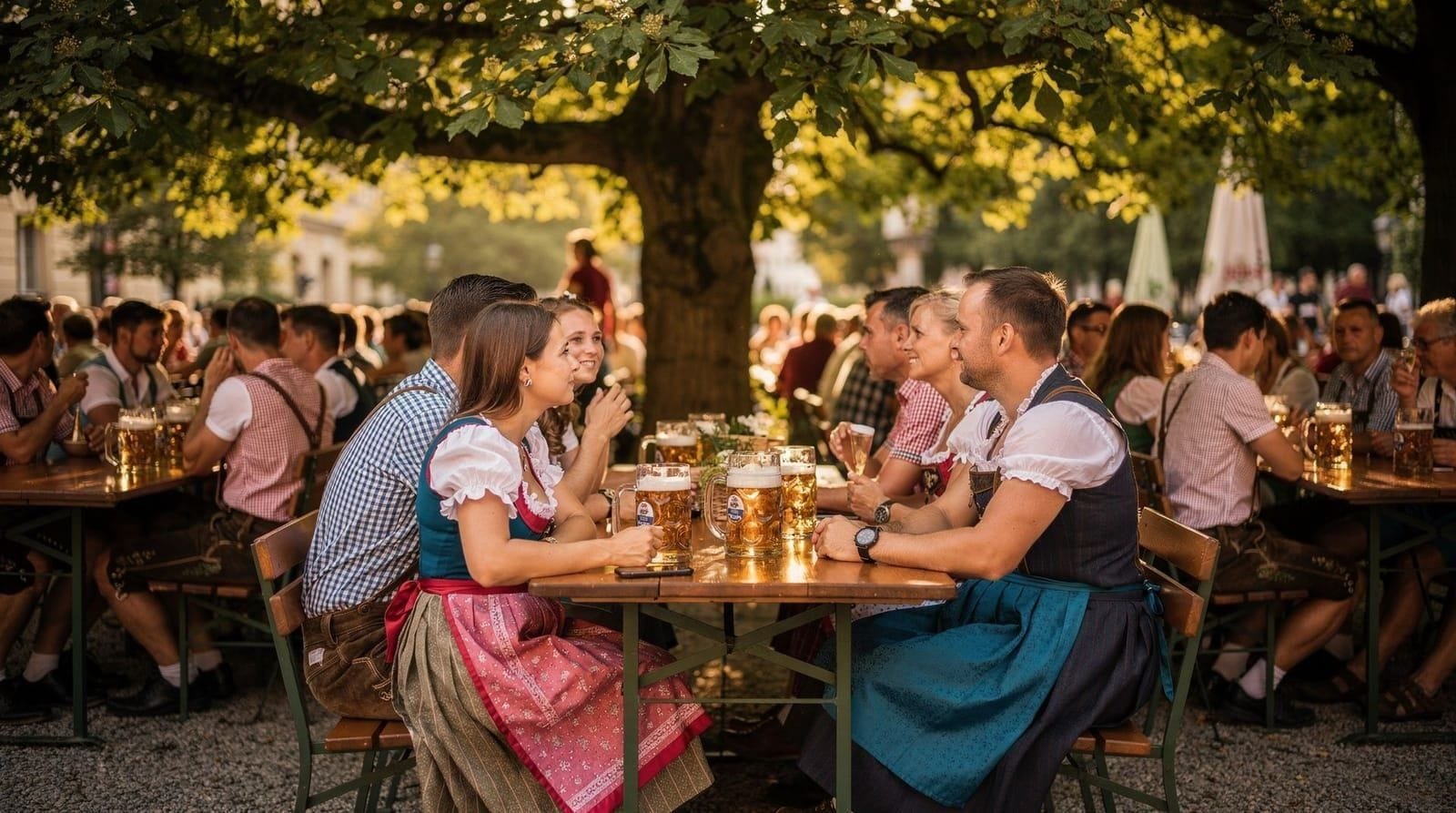
The Viktualienmarkt beer garden is modest in size — around 400 seats under the chestnut trees around the maypole — but occupies an extraordinary position, completely surrounded by the market stalls. It is the only major Munich beer garden that rotates through all six official breweries across the calendar year, which makes it a useful place to compare brewery styles if you visit multiple times or plan your visit to catch a specific brewery.
The beer garden is self-service: you queue at the counter, order your Maß (one litre, €9-10 in 2026) or Halbe (half litre), pay, and find a table. You can bring food purchased at the surrounding market stalls — this is the intended use of the space. Tables fill quickly on warm weekday lunchtimes and are essentially full by noon on sunny weekends.
The beer garden is open Monday to Saturday, approximately 10am to 8pm (weather dependent). It is closed Sundays. Bad weather, wind, or cold closes it immediately.
For a broader look at Munich’s beer garden culture and how to choose between them, the best beer gardens in Munich guide ranks and reviews the main options.
Specialty stalls worth seeking out
Beyond the Weißwurst, Obatzda, and Leberkäse staples, the Viktualienmarkt has specialist stalls that reward exploration:
Karl Albrecht — the honey stall: One of the oldest stalls in the market, selling Bavarian honey, mead, and bee products from local apiaries. The runny honey from flower meadows in the pre-Alpine region is distinctly different from supermarket honey — lighter, more complex, and worth the €6-8 for a small jar.
Stanniol — the olive and pickle stall: Barrels of olives, preserved peppers, artichoke hearts, and pickled vegetables from Mediterranean producers alongside Bavarian pickled cucumber specialties. These are excellent as market snacks with bread or for assembling a cold picnic.
Blumenstall — the flower stalls: Several florist stalls sell seasonal cut flowers and potted plants. Not food, but worth noting — fresh flowers from Munich’s flower stalls are particularly beautiful in spring and summer.
Mushroom vendors in autumn: From September to November, the market fills with wild mushroom vendors — Pfifferlinge (chanterelles), Steinpilze (porcini), and Eierschwämme from Bavarian and Austrian forests. The prices are high but the quality is exceptional.
What to buy to take home
The Viktualienmarkt is an excellent source of food souvenirs that are genuinely Bavarian rather than mass-produced tourist items:
- Regional honey from the Karl Albrecht stall — a small jar travels well and is significantly better than airport honey
- Bärlauch Pesto (wild garlic pesto) from produce stalls in spring — seasonal and regional
- Lebkuchen-Gewürz (gingerbread spice mix) — the specific blend used in Bavarian Christmas baking, sold at spice stalls year-round
- Bavarian mustard varieties — Händlmaier’s sweet Bavarian mustard is the essential condiment; the market stalls sell local equivalents that are sometimes better
Avoid buying Weißwurst to take home unless you have reliable refrigeration for the journey — they are highly perishable and rarely survive a flight in good condition.
Eating at the Viktualienmarkt on a budget
The market is one of Munich’s better options for eating cheaply without sacrificing quality. A realistic breakdown for 2026:
- Brezn from bakery stall: €2.50-3
- Weißwurst pair with mustard: €6-8
- Leberkäse roll: €3-4
- Maß at the beer garden: €9-10
- Obatzda portion: €5-7
A complete market breakfast — Weißwurst, Brezn, coffee, and a walk through the stalls — costs around €12-15. A proper market lunch including a beer costs €20-25. For context on Munich food prices more broadly, the Munich budget guide has a realistic breakdown across price categories.
For travellers planning a longer Munich stay, the market is worth returning to more than once rather than treating it as a single checklist stop — the seasonal produce changes what’s genuinely worth buying, and a second visit later in the trip often reveals stalls or specialties missed the first time. The Munich trip planning guide covers how to fit repeat market visits around the rest of a multi-day itinerary without it feeling repetitive.
Guided tours of the market
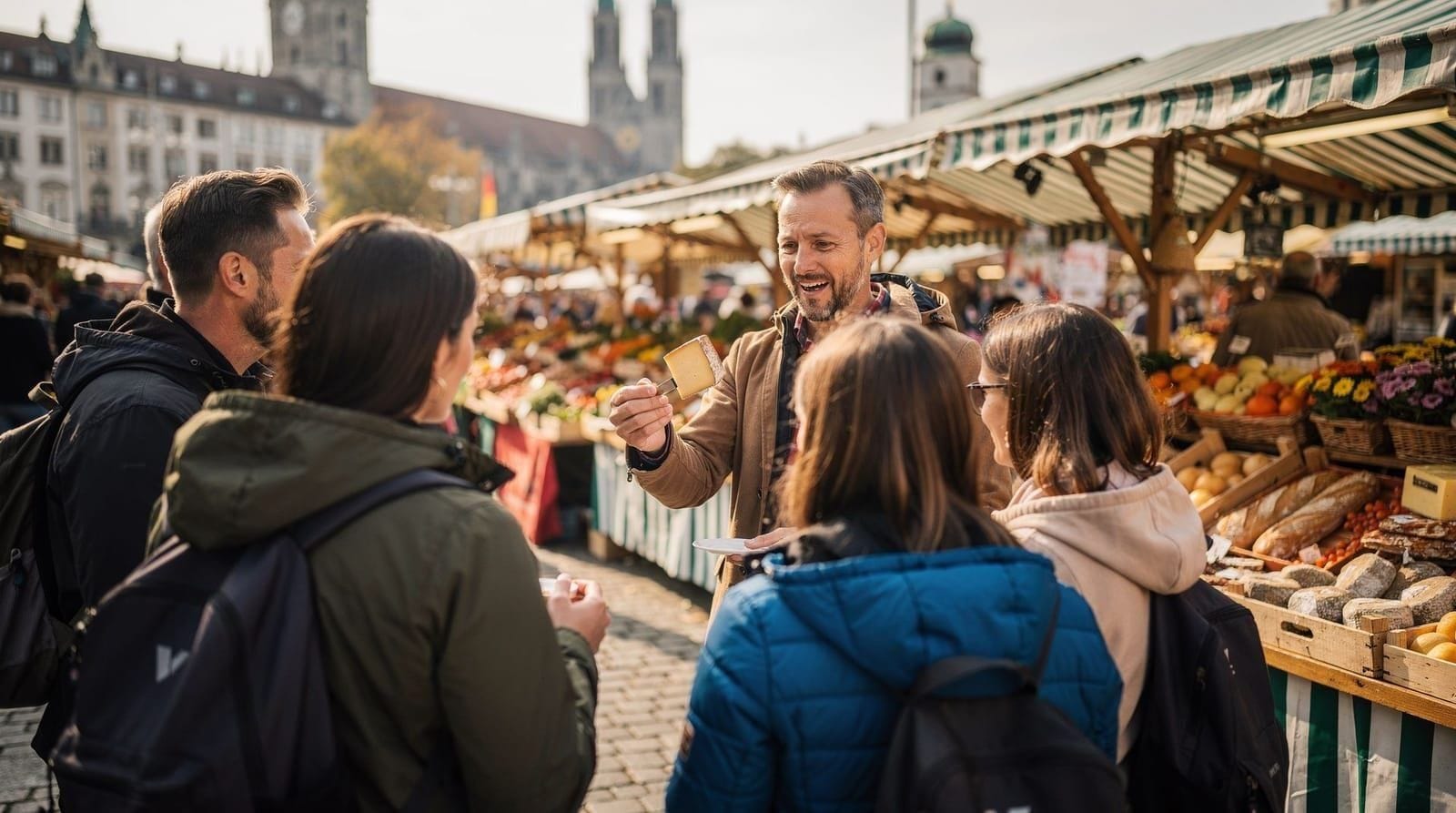
Visiting the Viktualienmarkt with a knowledgeable guide makes a significant difference in understanding what you’re looking at. A good guide knows which stalls have been run by the same family for three generations, which bakery actually mills its own flour, and why the specific blend of spices in the Weißwurst from stall 19 differs from the one at stall 4.
The Viktualienmarkt and old town food tour combines the market with the broader historic centre, covering the relationship between the market, Marienplatz, and Munich’s food culture from the 19th century to the present.
For visitors with a plant-based diet, the vegetarian food tour of the Viktualienmarkt concentrates on the market’s produce, cheese, and non-meat offerings, which are more extensive than the traditional Bavarian image of the market would suggest.
The market through the seasons
The Viktualienmarkt changes significantly with the seasons, and visiting at different times of year reveals different aspects of Bavarian food culture:
Spring (March-May): The market awakens with the first Bavarian asparagus (Spargel) from the Schrobenhausen region, considered the finest white asparagus in Germany. Stalls pile high with bunches of white and green asparagus from late April through mid-June, and seasonal menus across the city pivot around it. Bärlauch (wild garlic) appears in the produce stalls in March and April — used in pestos, soups, and fresh as a salad leaf. Radieschen (red radishes) from local growers appear alongside the first spring salad leaves.
Summer (June-August): The peak of the market’s energy. Stone fruits — Zwetschgen (plums), Kirschen (cherries), and Pfirsiche (peaches) — from Bavarian and Austrian orchards fill the produce stalls. Erdbeeren (strawberries) from regional producers in June, Himbeeren (raspberries) in July. The beer garden is at its most animated, the stalls are at full complement, and the weekly flower delivery makes Tuesday and Friday mornings particularly colourful.
Autumn (September-November): The season for mushrooms, game, and the transition to warming food. Chanterelles (Pfifferlinge) in September, porcini (Steinpilze) in October — wild mushroom stalls appear that operate only in this narrow window. Game meats — venison, wild boar — begin appearing at the butcher stalls. Kürbis (pumpkin) in orange and green varieties stacks up at the produce stalls for the Kürbissuppe (pumpkin soup) season. This is when the market is at its most photogenic and the produce most specifically tied to the Alpine region.
Christmas and advent (November-December): The Christkindlmarkt on Marienplatz is the famous Christmas market, but the Viktualienmarkt has its own advent stalls running alongside the regular market. Lebkuchen (gingerbread) vendors, roasted almond stalls, Glühwein stands, and seasonal imported citrus from Spain and Italy supplement the permanent stalls. The market is open through Christmas Eve.
The Viktualienmarkt and Munich’s food culture beyond the market
The Viktualienmarkt sits at the centre of a web of food culture that extends through the surrounding streets:
Frauenstraße and Sebastiansplatz: The streets immediately surrounding the market have a high concentration of good independent food shops — wine merchants, specialty food importers, and small delicatessens that carry goods not available at the stalls. Worth exploring if the market has given you an appetite for more specific products.
The covered market passage on the east side: Less visited than the open-air stalls, the roofed section of the market on the eastern edge carries additional produce vendors, flower stalls, and some of the less conspicuous specialty operations.
Schrannenhalle: The 19th-century grain storage hall on the western edge of the Viktualienmarkt site was restored in 2005 and now houses a small selection of specialty food vendors and a restaurant. Less authentic than the outdoor market stalls but useful for covered shelter in bad weather, and the architecture — iron frame and glass, originally built 1851-53 — is impressive.
Marienplatz and the Rathaus-Glockenspiel: A five-minute walk north, Marienplatz is the natural bookend to a Viktualienmarkt visit — many visitors do the Glockenspiel show, a look at the Neues Rathaus, and then walk south into the market for lunch. See the Marienplatz guide for showtimes and the best viewing spots.
For broader Munich eating, the best restaurants in Munich guide covers the sit-down options from traditional Wirtshaus through Michelin-starred dining, while the Munich food tour guide describes how to structure a half-day around the market and surrounding eating stops.
A one-hour speed version if you’re short on time
Not every visitor has a full morning to spend browsing. If you only have an hour, the efficient route is: enter from the Marienplatz side, head straight to a butcher stall for a Leberkässemmel (no queue, no ceremony, ready in minutes), walk past the cheese stalls in the northern lanes and pick up a small Obatzda tub to eat with your roll, then finish at the beer garden for a Halbe if the weather allows — or skip the beer and grab a coffee from one of the espresso stalls instead. This compressed version still captures the market’s essential character without the deeper stall-by-stall exploration a dedicated food tour offers.
Table manners and market etiquette
A few unwritten rules make a Viktualienmarkt visit smoother. Don’t handle produce at the fruit and vegetable stalls the way you might at a self-service supermarket — point and ask, and let the vendor select and weigh for you, which is the expected practice at most stalls. Queue politely and wait your turn rather than calling out over other customers. At the meat and sausage counters, it’s normal to ask questions about origin and preparation — vendors are generally proud of their product and happy to explain it, even with limited English. And when eating standing at a counter, it’s courteous to move along once you’ve finished rather than lingering at a stall’s small standing area during a busy period, since space is limited and other customers are waiting.
Frequently asked questions about the Viktualienmarkt
Is there parking near the Viktualienmarkt?
Parking immediately at the market is not practical — the Altstadt is a pedestrian zone. The nearest car parks are at Viktualienmarkt Tiefgarage (underground, beneath the market itself) and the Frauenstraße car park. However, Munich public transport reaches Marienplatz (5-minute walk) from every part of the city — driving to the market is unnecessary and expensive.
Can I eat at the market in the rain?
Most stalls are covered with awnings and remain open in light rain. The beer garden closes in bad weather. Some stalls close early in heavy rain. If you’re visiting in uncertain weather, the Munich trip planning guide covers backup options for wet days.
Is the Viktualienmarkt good for breakfast?
Yes, one of Munich’s best breakfast options. The market opens at 8am (some stalls at 7am), which allows an early morning Weißwurst, coffee from one of the espresso stalls, and a browse through the fresh produce before the tourist crowds arrive. Weekday mornings before 9am are the quietest time to visit.
Are stall prices negotiable?
No. The Viktualienmarkt operates at fixed prices, clearly displayed at each stall. The stalls are professional food businesses, not a bazaar. Prices at the market are generally in line with Munich’s premium supermarkets for similar quality food.
What happens at the Viktualienmarkt during Oktoberfest?
The market continues operating normally during Oktoberfest (late September to early October) — it is not part of the festival grounds. However, the surrounding streets are busier with visitors, and the beer garden rotation may feature Oktoberfest-style Märzen beer during this period. The market is a useful alternative to Theresienwiese for traditional Bavarian food without the tent queues and reservation complexity.
Can I do the Viktualienmarkt as a standalone visit or should I combine it with something else?
Both work. As a standalone visit, an hour to ninety minutes covers a satisfying meal and a browse of the stalls. Most visitors combine it naturally with the surrounding Altstadt — it sits directly on the walking route between Marienplatz and the Isartor, so folding it into a broader old-town walk costs little extra time. See the Munich Altstadt guide and Munich old town history for how the market fits into the wider historic centre.
Top experiences
Bookable activities with verified prices and instant confirmation on GetYourGuide.