Marienplatz guide: Glockenspiel, New Town Hall tower and what's actually worth your time
Munich: old town walking tour
What time does the Glockenspiel chime at Marienplatz?
The Glockenspiel performs at 11am and 12pm every day, and additionally at 5pm from March to October. Each performance lasts about 12 minutes. The 11am show is slightly less crowded than noon. The mechanism shows 32 life-size figures re-enacting two historical events from Munich's 16th century. You do not need a ticket to watch from the square.
Munich’s central square: what to actually do there
Every first-time visitor to Munich ends up at Marienplatz. The square has been the city’s main public space since 1158 — when Munich was founded as a market settlement on the salt road — and it remains the pivot around which the Altstadt is organised. S-Bahn and U-Bahn lines converge at the Marienplatz station directly below. Tourist itineraries radiate outward from it. Department stores, churches and the Rathaus itself all face it.
| Where | Altstadt, on U3/U6 and all S-Bahn lines |
| Cost | free to visit; tower lift around €4, Toy Museum around €4 |
| Time needed | around 1 hour for the square, half a day with Viktualienmarkt and Hofbräuhaus |
| Getting there | S-Bahn/U-Bahn to Marienplatz, or 15-min walk from Hauptbahnhof |
| Best time | before 9am for photos; 11am for a less crowded Glockenspiel |
The key to enjoying Marienplatz is managing expectations. As a historical market square in a major European city, it has inevitably been sanitised and optimised for visitors to a degree that can feel hollow. The souvenir shops and coffee chains that line the adjacent pedestrian zone (Kaufingerstrasse and Neuhauser Strasse) are interchangeable with those in any other European capital. But Marienplatz itself — the square proper, the buildings that frame it, the Mariensäule at its centre — has genuine historical and architectural weight. The Neues Rathaus is extraordinary as a piece of late-19th-century Gothic Revival architecture, and the Glockenspiel, even if it is slower than most people imagine from photos, is a functioning mechanical spectacle that has been running since 1908.
Getting there
Marienplatz is served directly by:
- S-Bahn (all S-Bahn lines, central city station)
- U-Bahn (U3 and U6)
The main entrance is via the underground station concourse. Exits are labelled for Marienplatz North and South — take the appropriate exit depending on where you are heading. From the Hauptbahnhof, it is a 2-minute S-Bahn ride (or a 15-minute walk east along Kaufingerstrasse). From the Munich Residenz, it is a 5-minute walk south.
The Neues Rathaus (New Town Hall)
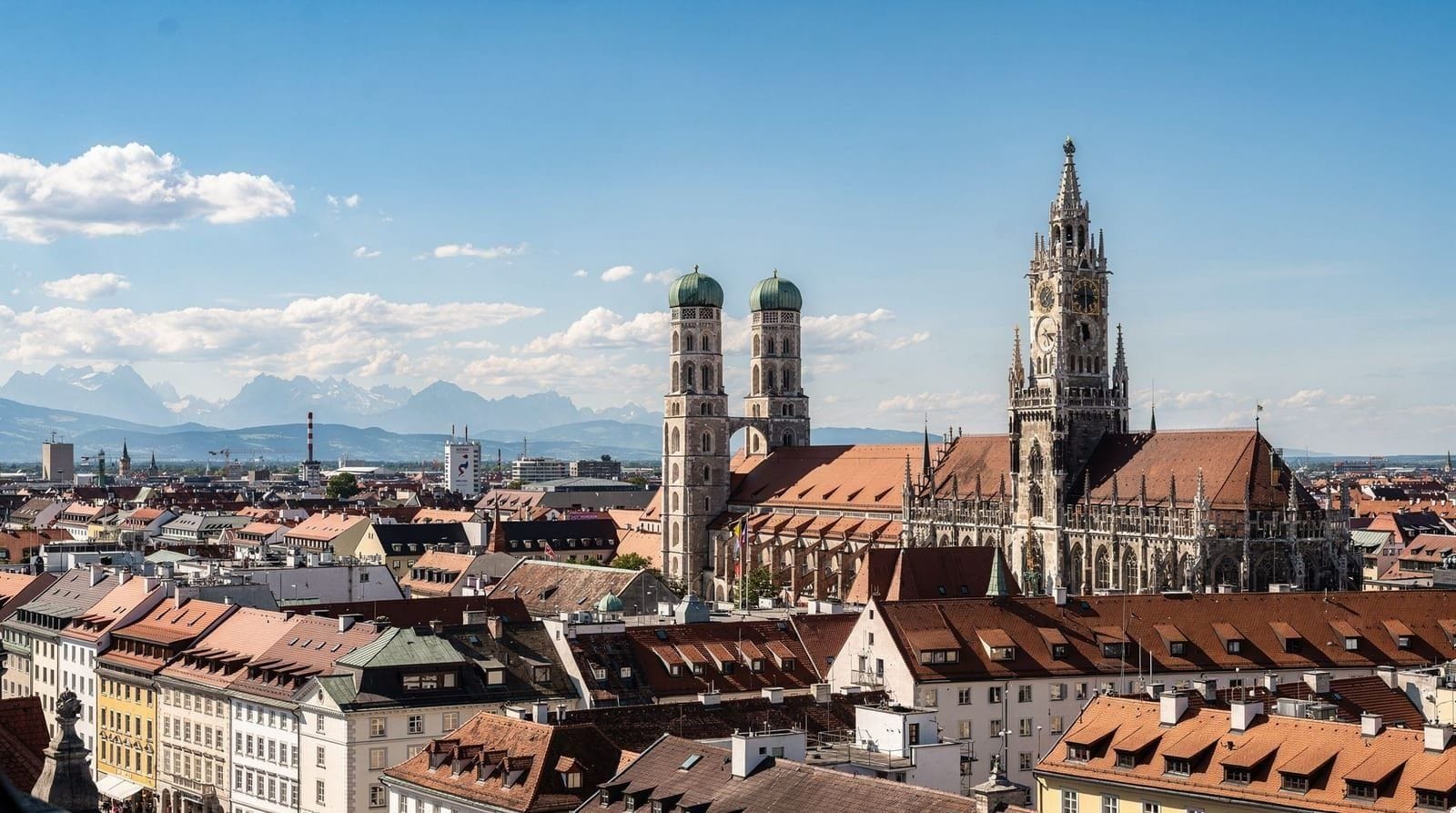
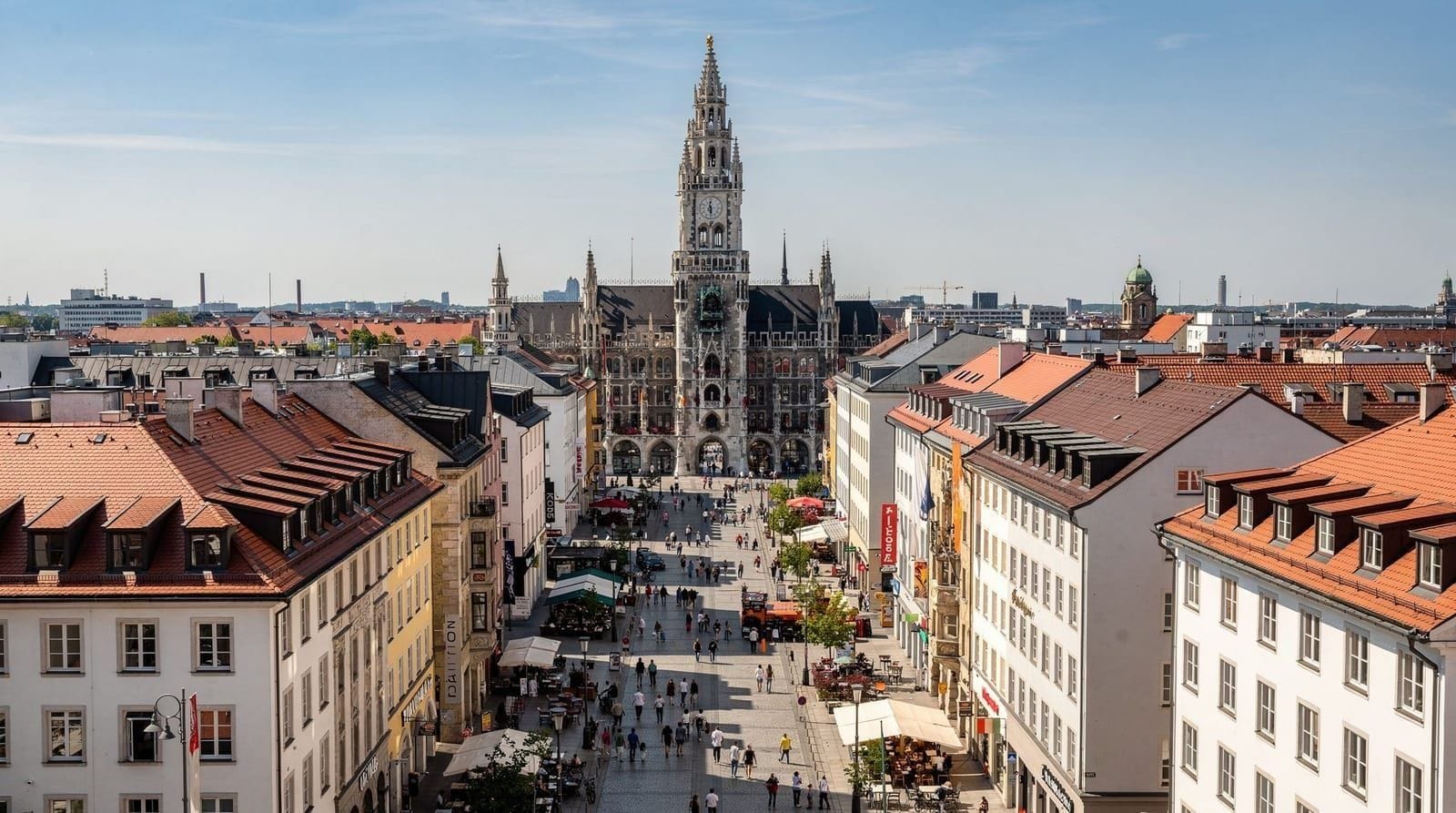
The building that frames the north side of Marienplatz is one of the finest examples of Neo-Gothic civic architecture in Germany. The Neues Rathaus was built in several phases between 1867 and 1909 to designs by Georg von Hauberrisser, expanding an earlier smaller building and eventually incorporating the entire north side of the square. The facade — 100 metres wide and covered in Gothic-style tracery, statues, pinnacles and turrets — is overwhelming in its detail.
It functions as Munich’s active city hall, housing the offices of the Oberbürgermeister (Mayor) and city administration. The inner courtyard (accessible during business hours) contains the lift to the observation tower and often hosts events.
The tower (Rathausturm): The tower rises 85 metres above the square. A lift in the inner courtyard brings visitors to the observation level. From the top, the view covers the Altstadt roofline, the two domes of the Frauenkirche rising above everything else, and — on clear days, particularly in autumn after the summer haze lifts — the Alps to the south.
Admission: €4 adults. Opening hours: 10am–5pm (July–September to 7pm). The observation level is not enclosed — it is an open terrace with railings. In wet weather, the views are obstructed.
The tower is a significantly better value than the Olympiaturm for city-centre views, though the Olympiaturm shows more of Munich’s peripheral landscape. For Altstadt views specifically, the Frauenkirche towers (when accessible) give an even better perspective.
The Glockenspiel: times, what you see and honest assessment
The Glockenspiel is the carillon and figurine mechanism built into the Neues Rathaus tower in 1908. It contains 43 bells and 32 life-size figures. It performs at:
- 11am — daily, year-round
- 12pm (noon) — daily, year-round
- 5pm — daily, March through October only
Each performance lasts approximately 12 minutes. There is no ticket, and it is entirely free to watch from the square.
What happens during a performance: The upper tier of figures re-enacts the Schäfflertanz (Coopers’ Dance) — a dance performed in 1517 to celebrate the end of an outbreak of plague — and the jousting tournament held at Marienplatz to celebrate the wedding of Duke Wilhelm V and Renate of Lorraine in 1568. The lower tier figures show the Schäfflertanz again with different figures. At the very end, a small cuckoo appears three times from the top of the tower.
Honest assessment: The Glockenspiel is slower than visitors expect — the figures move at a stately medieval tempo that can feel anticlimactic if you are anticipating something kinetic. The mechanism is genuinely old and genuinely interesting as an engineering artifact; the historical events it commemorates are part of the Bavarian civic mythology that Munich takes seriously. Whether you find 12 minutes of watching gilded medieval figurines rotate a worthwhile spectacle depends entirely on your taste. Many visitors find it charming; others are underwhelmed.
The 11am performance is marginally less crowded than noon. All performances draw crowds that fill the square — if you want a clear view from directly below the Glockenspiel, arrive 10–15 minutes early and stand on the north side of the Mariensäule. Munich Old Town walking tour from Marienplatz
The Mariensäule (Column of the Virgin Mary)
The golden column at the centre of the square is the Mariensäule, erected in 1638. Its history is specifically Bavarian and Catholic: Munich survived the Swedish occupation of Bavaria during the Thirty Years’ War (1618–1648) and an outbreak of bubonic plague with less devastation than much of the surrounding region. The column was erected as a votive offering — a public statement of gratitude. The sculpture at the top is a gilded baroque Virgin Mary in the crescent moon posture associated with Mary as Queen of Heaven.
At the base of the column, four putti (cherubs) defeat symbolic enemies: a lion (pestilence), a dragon (war), a basilisk (heresy) and a skeleton (famine). The theological programme is explicitly Counter-Reformation — Munich was and remains a Catholic city, and the Mariensäule stands as a statement of that identity.
The column gives the square its name. For Munich Catholics, it is a site of genuine devotion and not merely a tourist landmark; the square is occasionally used for public religious observances.
The Altes Rathaus (Old Town Hall) and the Toy Museum
The building on the east side of Marienplatz is the Altes Rathaus (Old Town Hall), substantially rebuilt in the 1470s after fire damage and restored/reconstructed in the 20th century. It now houses the Spielzeugmuseum (Toy Museum), a private collection of antique toys spread across four floors. Admission is €4 adults / €1 children.
The Toy Museum is a minor attraction — suitable for 30 minutes, mainly interesting for visitors with children or a specific interest in the history of toys and games. The staircase tower has a pleasant view back across the square. Most adult visitors without children can skip it entirely.
The hall on the ground floor of the Altes Rathaus (the Tanzsaal/Dance Hall) is historically significant — Adolf Hitler gave one of his early speeches here in 1938 during the Night of Broken Glass (Kristallnacht). This context is acknowledged with a plaque but is not the focus of the Toy Museum, which occupies the upper floors.
Viktualienmarkt: two minutes from Marienplatz
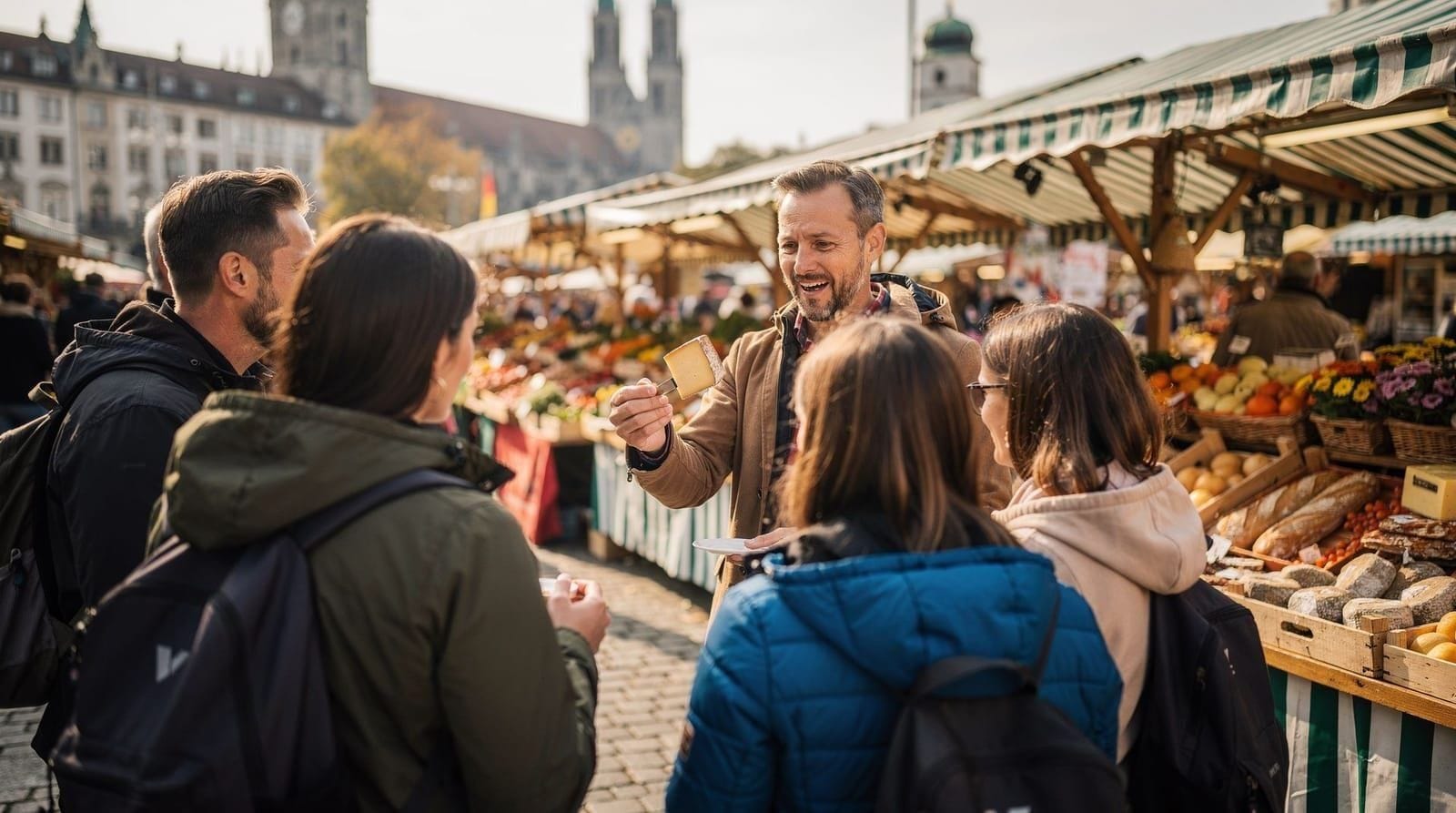
The single best recommendation within walking distance of Marienplatz is the Viktualienmarkt, two minutes south on Frauenstrasse. Munich’s main daily market occupies a square of its own and has been operating since 1807 (moved from Marienplatz to reduce congestion). It sells:
- Fresh produce, cheeses, cold cuts, bread, fish
- Bavarian specialities including Weisswurst and Obatzda
- Flowers, herbs and seasonal produce
- A permanent beer garden at the centre, operated by rotating Munich breweries
The beer garden at the Viktualienmarkt is one of the most pleasant in Munich — it is open year-round (in winter with gas heaters), serves a rotating selection of Munich breweries’ draught beer, and attracts a mix of market workers, office staff and tourists. It is a genuinely local experience in a way that the immediately Marienplatz-adjacent options are not.
For a full overview of the market and what to eat there, see the Viktualienmarkt food guide.
Nearby: Hofbräuhaus
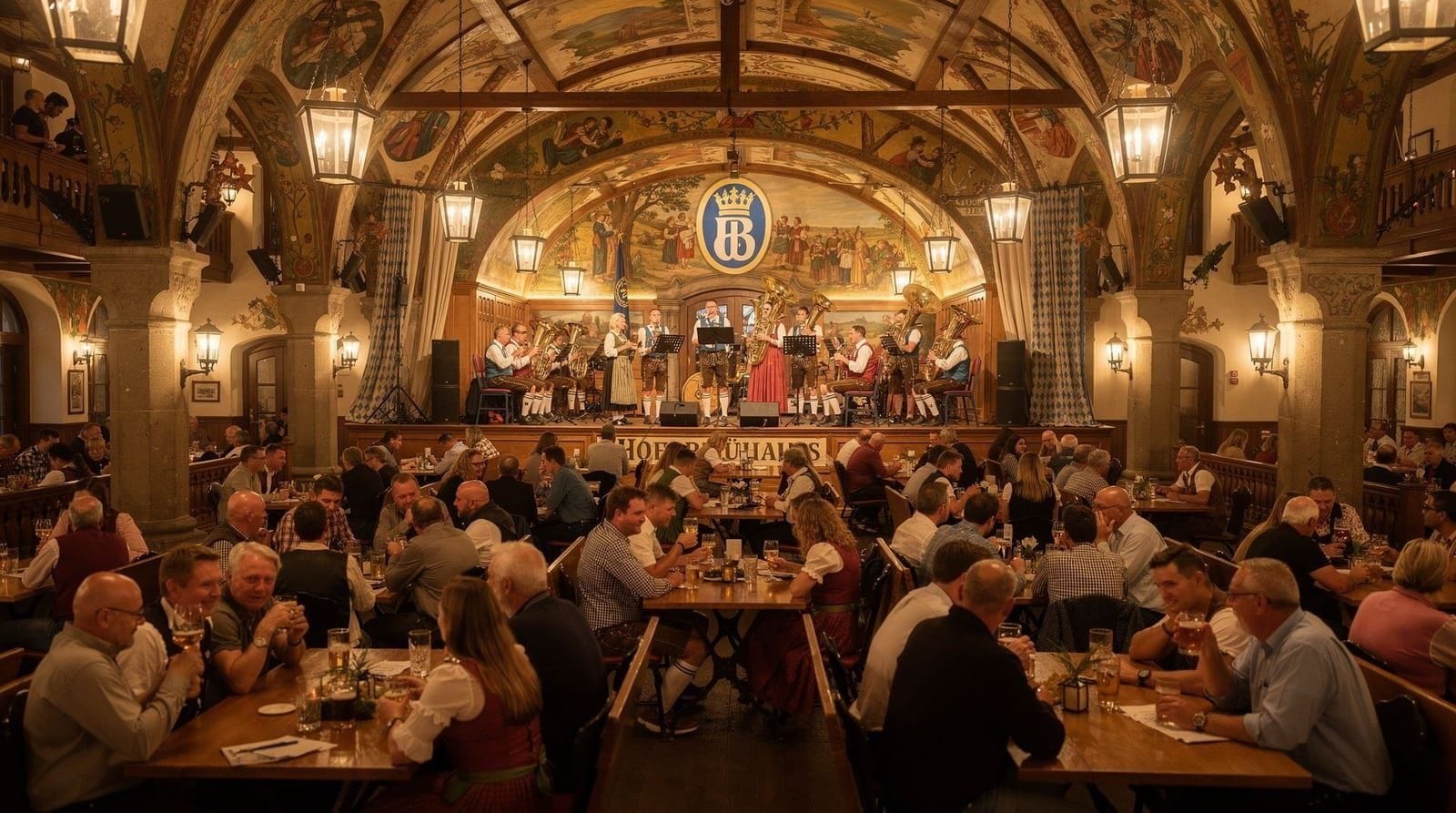
A 5-minute walk east from Marienplatz on Orlandostrasse leads to the Hofbräuhaus, Munich’s most famous beer hall. It was established as a royal brewery in 1589 and has occupied its current building since 1897. The Hofbräuhaus is unambiguously touristy — it operates 24 hours and attracts visitors from across the world for what is essentially a beer hall experience — but it is not fake. The building is genuine, the beer (HB, brewed on-site in the attached brewery) is authentic Munich Helles, and the dimensions of the main hall (Schwemme) — 1,000 seats, vaulted ceilings, brass band on most evenings — are historically accurate to how Munich beer culture operated.
See the Hofbräuhaus guide for a complete overview and honest assessment. Munich Old Town guided walking tour in English
Self-guided Altstadt walk from Marienplatz
Using Marienplatz as the starting point, a logical self-guided Altstadt walk covers:
- Marienplatz — Glockenspiel, Mariensäule, Neues Rathaus tower
- Frauenkirche (5 min west) — Cathedral, Devil’s Footstep, tower access
- Michaelskirche (5 min west on Neuhauser Strasse) — Baroque church, Wittelsbach crypt
- Sendlinger Tor (10 min south) — Medieval city gate
- Asamkirche (5 min northeast of Sendlinger Tor) — Rococo private church, architectural extreme
- Viktualienmarkt (back to 2 min south of Marienplatz) — Beer garden, market stalls
- Hofbräuhaus (5 min east of Marienplatz) — Munich’s most famous beer hall
This walk covers approximately 3.5 kilometres and takes 3–4 hours including stops. The full Munich Altstadt guide maps the route in detail. A free walking tour starting at Marienplatz is also a good alternative for first-time visitors.
What to avoid near Marienplatz
Kaufingerstrasse and Neuhauser Strasse (pedestrian zone): The shopping street running west from Marienplatz to Karlsplatz/Stachus is Munich’s main retail pedestrian zone and is lined with international chains, souvenir shops and tourist-oriented cafés with elevated prices. It is useful for orientation but not for food or authentic shopping.
The restaurants directly on Marienplatz: Most cafés and restaurants with views of the Glockenspiel are priced at a significant premium for the location. The food quality does not justify the markup. Walk 100–200 metres away from the square in any direction for better value.
The Toy Museum: Unless you have specific interest or young children, not worth the €4. Munich walking tour through the Old Town and Viktualienmarkt
Planning your visit
Best time to visit Marienplatz: The square is photographically best in early morning (before 9am) when the light on the Neues Rathaus facade is good and the tourist crowds have not yet arrived. For the Glockenspiel, 11am is the practical choice — early enough to have the rest of the morning free. Evenings are busy with crowds from the nearby bars and restaurants on Weinstrasse.
How long to allow: The Glockenspiel (12 minutes) + tower (30 minutes) + Mariensäule viewing (10 minutes) = about 1 hour. Adding the Viktualienmarkt and Hofbräuhaus extends to a half-day.
Getting to the Frauenkirche from Marienplatz: Walk west on Kaufingerstrasse for about 300 metres. Turn right through Frauenplatz to reach the south entrance of the cathedral. The Frauenkirche guide covers what to see inside, the towers and the Devil’s Footstep.
Marienplatz at different times of day
| Time | What it’s like |
|---|---|
| Before 9am | Quiet, best photo light on the Rathaus facade |
| 11am | Glockenspiel performance, moderate crowds |
| 12pm | Busiest Glockenspiel performance of the day |
| Afternoon | Steady foot traffic, shops and cafés full |
| Evening | Quieter square, busy surrounding bars on Weinstrasse |
| December | Christkindlmarkt transforms the square, very crowded but atmospheric |
Frequently asked questions about Marienplatz
Is the Glockenspiel in Munich really 32 life-size figures?
Yes. The Glockenspiel in the Neues Rathaus tower contains 32 figures approximately life-size (roughly the scale of actual human figures) and 43 bells. The figures re-enact two 16th-century events: a jousting tournament held for a Wittelsbach ducal wedding in 1568, and the Schäfflertanz (coopers’ dance) traditionally performed after plague outbreaks. The mechanism has been in operation since 1908.
How much does it cost to see the Glockenspiel?
Nothing — the Glockenspiel is free to watch from the square. The lift to the observation deck of the Neues Rathaus tower costs €4, but the Glockenspiel itself has no ticket requirement.
What is the best time of year to visit Marienplatz?
Summer (June–August) is crowded; the square is packed during the Glockenspiel performances. December brings the Christmas markets (Christkindlmarkt) which transform Marienplatz into one of Germany’s prettiest market settings — busy but genuine. Spring (April–May) and autumn (September–October) offer pleasant weather without peak tourist density. See the Munich seasonal guide and spring guide for more detail.
Can you go inside the Neues Rathaus?
The inner courtyard is accessible during business hours (8am–8pm on weekdays). The tower lift departs from the courtyard. The administrative offices are not open to the public. Occasional events are held in the courtyard and the large hall (Ratskeller, ground level).
What is underneath Marienplatz?
The Marienplatz U-Bahn and S-Bahn station is directly below the square — one of Munich’s central interchange points. The station was built during the 1970s construction of the Munich metro system. There is also a public underground car park accessible from nearby streets.
Is Marienplatz where Oktoberfest is held?
No. The Oktoberfest is held at the Theresienwiese (Theresa’s Meadow), about 1.5 kilometres west of Marienplatz. Marienplatz sometimes hosts satellite events during Oktoberfest but the main festival — the beer tents, rides and atmosphere — is at the Wiesn. For the full logistics, see the Oktoberfest guide.
Where exactly is Marienplatz in Munich?
Marienplatz is the geographical and historical centre of the Altstadt (Old Town), at the intersection of the east-west pedestrian axis (Kaufingerstrasse/Neuhauser Strasse) and the north-south axis toward the Residenz (Residenzstrasse). GPS coordinates: 48.1372° N, 11.5756° E.
How long should I plan to spend at Marienplatz?
About an hour covers the Glockenspiel, a quick look at the Mariensäule, and the tower if you go up. Extend to a half-day by adding the Viktualienmarkt for lunch and a beer garden stop, plus the Hofbräuhaus or the Frauenkirche nearby. It works well as the starting point for a longer self-guided Altstadt walk.
Is it worth visiting Marienplatz more than once during a trip?
Yes, if your schedule allows — the square looks and feels different in early morning light versus midday crowds versus an evening walk-through. First-time visitors often pass through Marienplatz two or three times over a multi-day stay simply because it sits on the main routes between the Hauptbahnhof, the museum quarter, and the Altstadt’s other sights.
Top experiences
Bookable activities with verified prices and instant confirmation on GetYourGuide.