Munich Residenz guide: palace, museum and treasury
Munich: Residenz Palace and Hofgarten skip-the-line guided tour
Is the Munich Residenz worth visiting?
Yes — the Residenz is one of Europe's grandest royal palace complexes and is consistently underrated compared to Versailles or Schönbrunn. Budget at least 2.5 hours for the museum alone; add another hour if you visit the Treasury. The combined ticket (€15) is good value and queues are rarely as bad as Neuschwanstein.
Inside the Wittelsbach royal palace: what to actually see
The Munich Residenz is the kind of place you can walk past a hundred times without realising what is behind its austere stone facade. From Residenzstrasse or the Hofgarten, the building gives little away — no gilded gates, no tourist-trap souvenir kiosk directly out front. Yet inside this block-sized complex lies the largest city palace in Germany: 130 showrooms, 10 interior courtyards, a treasury with 1,200 objects, and a history that stretches from 1385 to the fall of the Bavarian monarchy in 1918.
The Wittelsbachs ruled Bavaria for seven centuries, and the Residenz was their primary seat from the 16th century onward. Unlike Versailles — built as a statement of absolute power made permanent — the Munich Residenz grew organically over generations, with each duke, elector and king adding, remodelling or demolishing sections to suit their taste and the architectural fashions of their era. The result is an architectural palimpsest: Renaissance state halls next to Baroque apartments, Rococo ballrooms beside 19th-century Neoclassical wings.
Much of what you see today is a painstaking reconstruction. Allied bombing in 1944–45 destroyed or severely damaged approximately 60% of the palace. Craftspeople worked for decades after 1945 restoring ceiling paintings, re-gilding interiors, and reassembling salvaged stonework. The quality of this reconstruction is genuinely remarkable — and the fact that it succeeded at this scale is itself a piece of Bavarian history.
| Where | Odeonsplatz, edge of the Altstadt |
| Cost | €10 museum, €10 treasury, €15 combined |
| Time needed | 2.5–3.5 hours for museum + treasury |
| Getting there | U3/U4/U5/U6 to Odeonsplatz, 2-min walk |
| Best time | Opening (9am) or after 4pm |
Getting there and buying tickets
The Residenz sits on the eastern edge of the Altstadt, between Residenzstrasse and the Hofgarten. The closest U-Bahn stop is Odeonsplatz (lines U3, U4, U5, U6), a 2-minute walk to the main entrance on Max-Joseph-Platz. Trams 19 and N19 stop directly on Maximilianstrasse, one block east.
Tickets can be bought on arrival at the box office. In peak season (June–September), queues for the box office rarely exceed 15 minutes — this is not Neuschwanstein. That said, booking a guided tour in advance saves you the ticketing step entirely and tends to give priority entry. Skip-the-line guided tour of the Residenz Palace and Hofgarten
2026 ticket prices:
- Residenz Museum only: €10 adults, free under 18
- Treasury only: €10 adults, free under 18
- Combined Museum + Treasury: €15 adults
The combined ticket is almost always worth buying if you have more than 90 minutes. The Treasury alone, for €10, is an exceptional standalone visit if your time is short.
The Residenz Museum: a room-by-room approach
The museum is divided into circuits — different routes that can be combined depending on the time of year (some areas are accessible only in summer). The morning circuit covers the Ancestral Gallery, Antiquarium and Imperial Hall; the afternoon circuit adds the Nibelungen Hall and the rich Rococo apartments. In practice, you can mix and match freely using the floor plan provided at the entrance.
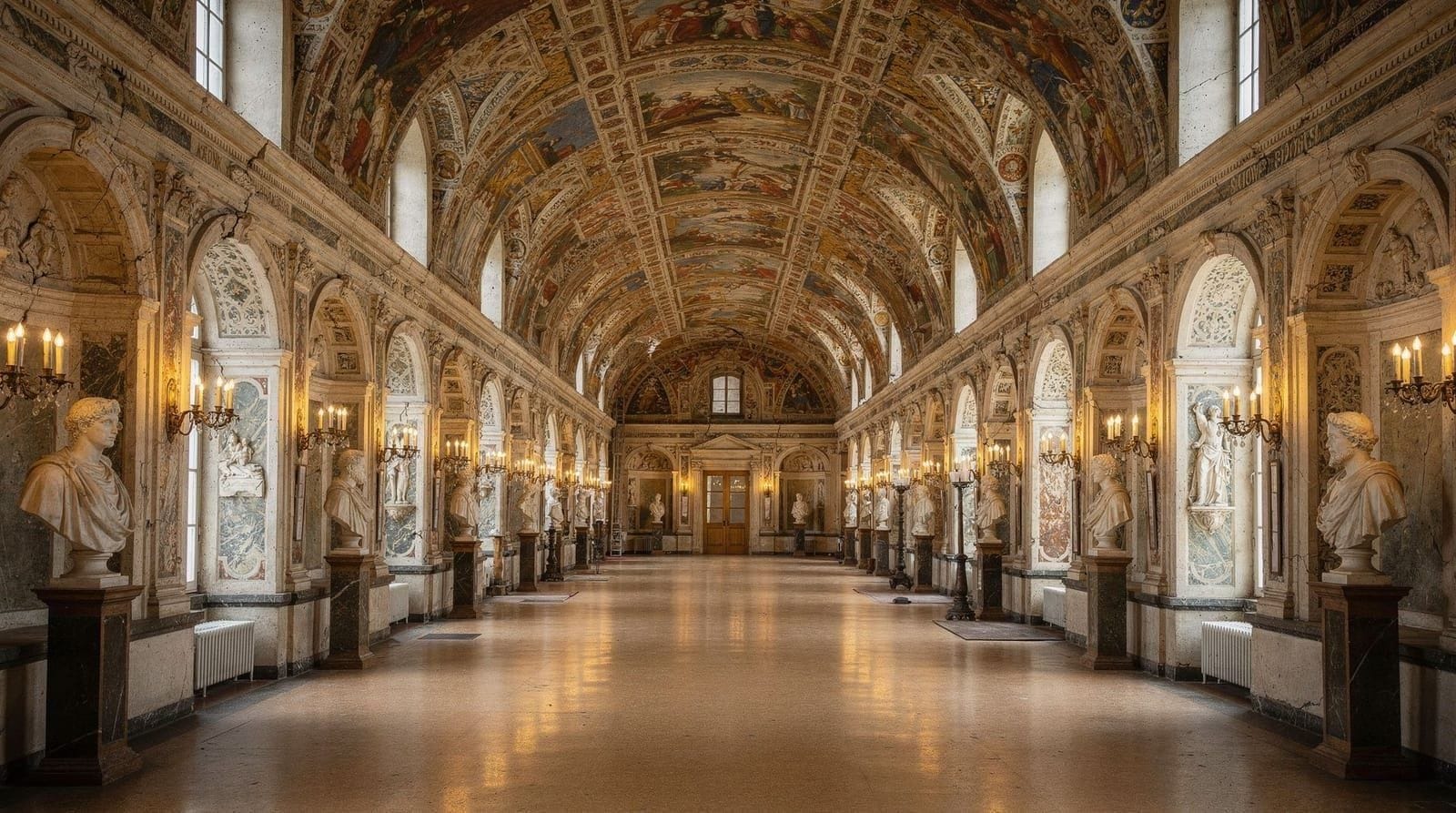
The Antiquarium — This is the first room that makes visitors stop and look up. Built between 1568 and 1571 for Duke Albrecht V to house his collection of ancient bronzes and busts, the hall runs 69 metres from end to end and is covered by a barrel vault painted between 1586 and 1600. The lunettes depict allegorical representations of Bavarian towns and markets; the walls are lined with 99 Roman portrait busts. It is the largest Renaissance hall north of the Alps, and standing at one end looking down the length of it is one of those museum moments that stays with you.
The Ancestral Gallery — A Baroque hall hung with 121 portraits of Wittelsbach rulers from the supposed founding of the dynasty to Elector Max Emanuel. It was used by the court for banquets and balls. The sheer density of imagery — floor to ceiling in heavy gilded frames — reads today as a deliberate argument for dynastic legitimacy.
The Rich Rooms (Reiche Zimmer) — Six interconnected rooms in the Rococo style, completed around 1730–37 under Elector Karl Albrecht to designs by François de Cuvilliés the Elder. These are among the finest Rococo interiors in Europe. The Green Gallery, in particular, features a ceiling painting by Johann Baptist Zimmermann and a suite of furniture and Chinese lacquer objects that gives a vivid sense of the Wittelsbach court’s taste for the exotic.
The Cuvilliés Theatre — Technically a separate venue but included in the Residenz complex, the Cuvilliés Theatre (also called the Altes Residenztheater) is the finest Rococo theatre in existence. The interior was saved during the war by being dismantled and stored in various locations across Bavaria; the building itself was destroyed and rebuilt. Today it still functions as a live performance venue. Check whether it is open during your visit — access is sometimes restricted when productions are staged. Concerts and opera performances here are an extraordinary experience if you can get tickets.
The Imperial Hall — A vast ceremonial hall on the upper floor, used for the most formal court occasions. The ceiling fresco, restored after war damage, depicts the glorification of Bavaria. Even post-restoration, the sheer scale is impressive.
The Chapel Rooms and Reliquary Gallery — Sometimes overlooked, the chapel wing contains a run of small rooms with relics, religious paintings and a private chapel. The Wittelsbach devotion to Catholicism runs through the entire palace, and this section gives context to their religious patronage.
The Treasury: 1,000 years of portable luxury
The Schatzkammer is housed in a separate wing accessed from the inner courtyard and requires either its own ticket or the combined pass. It is a world-class display by any measure — comparable to the Grünes Gewölbe in Dresden or the Imperial Treasury in Vienna.
The objects span roughly from the year 890 (a prayer book of Charles the Bald) to the early 20th century. Key highlights include:
- The Crown of an English Queen (c. 1370) — brought to Bavaria by Blanche of Lancaster, wife of Ludwig III; one of the oldest surviving crowns in the world
- The Bavarian Royal Insignia — the crown, orb and sceptre used at the coronation of Ludwig I in 1825
- The Statuette of St George — a 1597 enamelled gold and jewel-encrusted figure of extraordinary craftsmanship, attributed to the Munich court goldsmith Johann Vermeyen
- The Insignia of the Order of the Golden Fleece — the Wittelsbach held membership in this Habsburg-controlled chivalric order from 1546
The Treasury is dimly lit, and the objects are displayed in freestanding cases. Allow yourself time to stop: there is a tendency to pass through too quickly because each case looks like the last. The information panels are reasonably informative in English, but an audioguide adds significant context.
Which circuit should you actually walk
Because the museum is split into a morning and afternoon circuit that only partially overlap (some rooms rotate seasonally to protect fragile textiles and paintings from light exposure), first-time visitors often waste time backtracking. If you only have 90 minutes, prioritise the Antiquarium, the Ancestral Gallery and the Rich Rooms — these three alone cover the highlights most guidebooks reference and rarely close. The Nibelungen Hall and some smaller apartments are more likely to be closed for rotation in winter months; check the notice board at the entrance rather than assuming everything on the floor plan is open. Staff at the ticket desk will tell you plainly which rooms are closed that day if you ask.
The Residenz versus Munich’s other big museums
For visitors weighing up a limited number of museum slots, it helps to know how the Residenz compares. Unlike the Pinakothek museums, which are picture galleries best suited to art lovers willing to slow down in front of paintings, the Residenz is an immersive walk through furnished rooms and treasury cases — closer to a stately home than a gallery, and generally more accessible to visitors without an art history background. It also differs sharply from the Deutsches Museum, which is hands-on science and technology rather than decorative art. If you are choosing one indoor museum morning in Munich and history/opulence interests you more than science, the Residenz wins; if you are travelling with curious children, the Deutsches Museum usually wins instead.
The Hofgarten: free and often missed
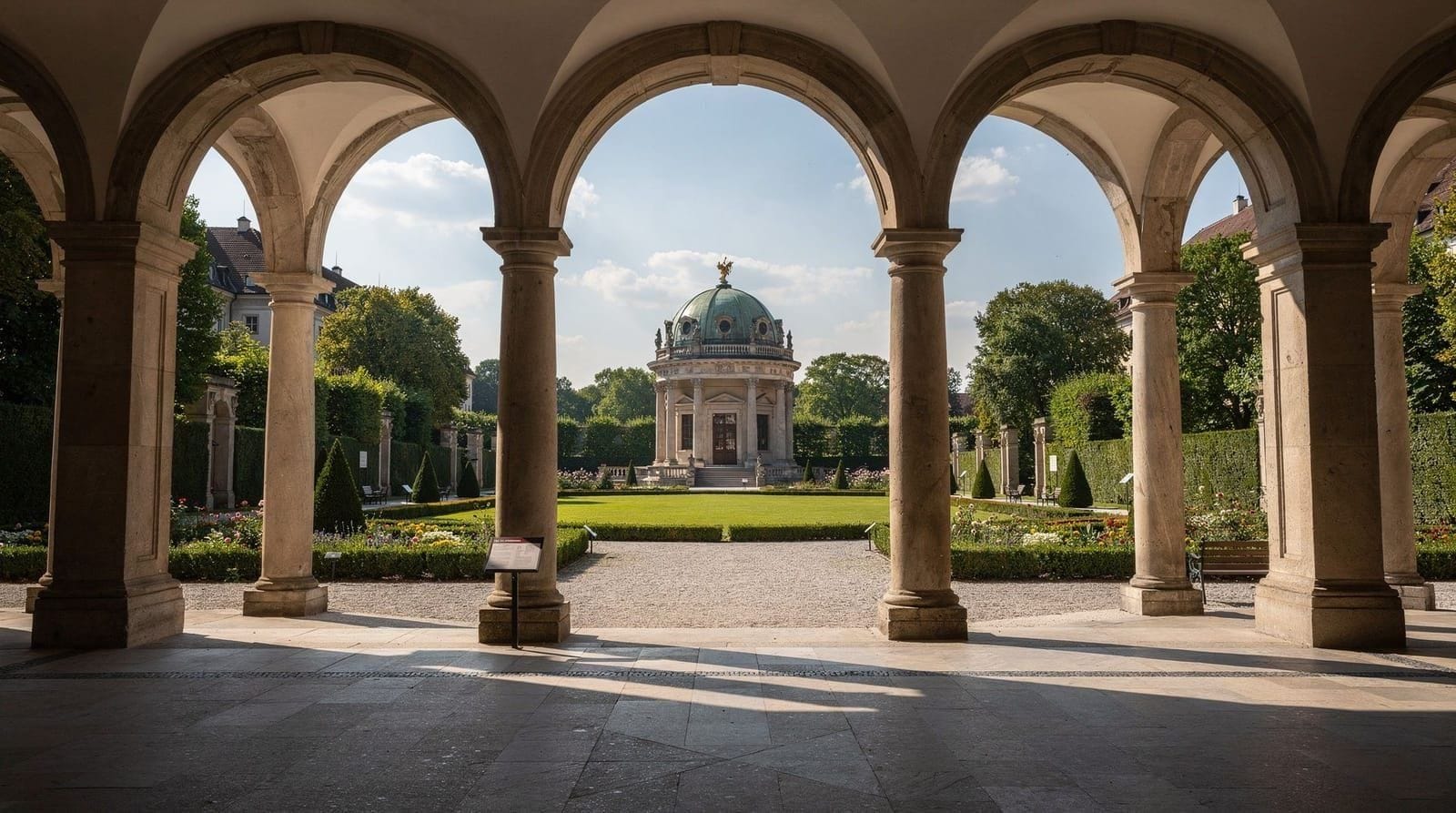
The Italian-style formal garden north of the Residenz (between the palace and the Bavarian State Chancellery) is free to enter and open year-round. It was laid out between 1613 and 1617 under Maximilian I, making it one of the earliest formal gardens in Munich. The central octagonal Dianatempel (Diana Temple, 1615) is used in summer for small concerts. On a warm afternoon, the Hofgarten is an excellent place to rest after the museum circuit — the gravelled paths, trimmed box hedges and avenue of plane trees feel authentically 17th century.
The Hofgarten is also a practical route between the Residenz and the Englischer Garten — the northern boundary opens directly onto Galeriestrasse, from which it is a 10-minute walk to the southern Eisbach surfer spot in the English Garden.
Comparing the Residenz to Nymphenburg
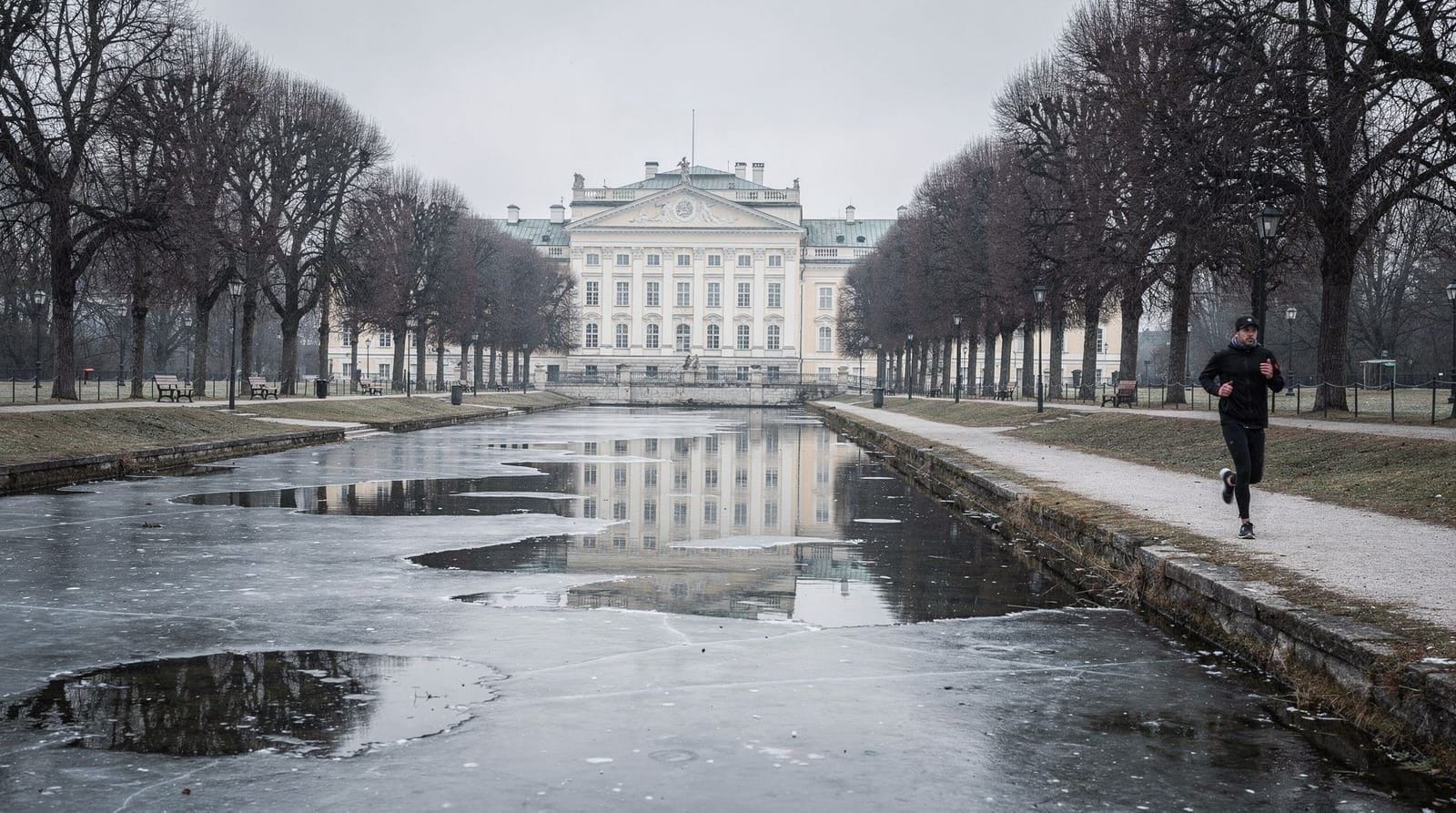
A common planning question: should you visit the Residenz or Nymphenburg Palace? The short answer is they are very different experiences and complement rather than duplicate each other. The Residenz is a dense urban palace — intimate in the sense that you move through rooms furnished with original or reconstructed objects, and you are close to the detail. Nymphenburg is a summer palace on the city’s western edge, much lighter in feeling, set in a formal park with canals, and best experienced when you can also walk the grounds. If you have two full days in Munich, do both. If you have one, and your interest is art and royal history rather than Baroque gardens, the Residenz is the priority. Private guided tour of the Munich Residenz, Museum and Treasury
Practical tips for visiting in 2026
Best time to arrive: Opening time (9am in summer) gives you the first hour before tour groups arrive. Between 11am and 2pm, the Antiquarium and Rich Rooms can get crowded. Late afternoon (after 4pm) is reliably quieter.
Wear comfortable shoes. The museum involves walking on period flooring — occasionally uneven — for 1.5–3 hours. Slipping on smooth parquet in the chapel wing is a real possibility if you wear leather soles.
Photography: Permitted throughout without flash. The Rich Rooms are challenging to photograph well (low light, reflective glass on some display cases), but the Antiquarium photographs beautifully in morning light.
Bag storage: Lockers are available at the entrance. Large bags and suitcases are not permitted in the gallery.
For families: Children under 18 enter free. The audioguide has a children’s version. The Residenz is not the most child-friendly museum in Munich — the Deutsches Museum is far better for kids — but interested teenagers and adults will find it compelling.
Combining visits: The Residenz is at one end of the Altstadt; Marienplatz is a 5-minute walk south. The Frauenkirche is another 5 minutes beyond that. A morning at the Residenz followed by an afternoon in the Altstadt is a natural pairing.
Where to eat nearby
The area around the Residenz is restaurant-heavy but tourist-dense. Spatenhaus an der Oper (Residenzstrasse 12) is an old-school Bavarian restaurant with table service, reasonable quality and fair prices for the location. Café Luitpold (Brienner Strasse 11), a 10-minute walk west, is a Munich institution for coffee and cake. For something quicker and less expensive, the Viktualienmarkt — 10 minutes south on Frauenstrasse — has excellent food stalls and the famous beer garden at its centre.
If you want a sit-down lunch without straying far, the streets between the Residenz and the Frauenkirche hold a mix of Bavarian taverns and quicker bakery counters, so you rarely need to walk more than five minutes from the palace exit to find something reasonable.
Accessibility and quiet hours
Most of the Residenz’s main circuit is wheelchair accessible via lifts, though a handful of smaller rooms in the older wings are reached by short flights of stairs — ask at the entrance for the accessible route map. If crowds or noise are a concern, the first hour after opening and the final ninety minutes before closing are consistently the quietest, since most tour groups arrive between late morning and early afternoon. The Treasury, being a separate ticketed section, tends to stay calmer throughout the day even when the main museum circuit is busy.
Day-trip and itinerary pairing
The Residenz pairs well with any Munich city tour as either a morning anchor or afternoon centrepiece. For a thematically connected full day, consider combining it with the Lenbachhaus (Blaue Reiter collection, 15 minutes west) or the Munich City Museum (10 minutes south, near Marienplatz).
For those with broader Wittelsbach interests, the Munich Residenz vs Nymphenburg comparison guide addresses which palace suits different visitor types. Munich City Pass — Residenz and 45+ attractions included
If you are making a longer Bavaria trip, the Wittelsbach story continues at Nymphenburg, Linderhof, Herrenchiemsee and of course Neuschwanstein — though that last is a creation of Ludwig II rather than the Munich court tradition.
Frequently asked questions about the Munich Residenz
How much does it cost to visit the Munich Residenz in 2026?
Adults pay €10 for the Residenz Museum, €10 for the Treasury, or €15 for the combined ticket. Under-18s enter free. There is no Sunday discount at the Residenz, unlike at the state-run art museums. Guided tours with included entry typically run €25–€45 through licensed providers.
Is the Munich Residenz the same as Nymphenburg Palace?
No — they are two separate palaces run by the Bavarian Palace Administration. The Residenz is in the city centre (near Odeonsplatz) and was the Wittelsbachs’ main city residence; Nymphenburg is on Munich’s western edge and served as their summer palace. Each requires a separate ticket and visit.
Can I visit only the Residenz Treasury without touring the palace?
Yes. The Treasury requires its own ticket (€10) and can be visited independently of the Residenz Museum. It has its own entrance within the complex. Allow 45–75 minutes for the Treasury alone.
What is there to see in the Hofgarten?
The Hofgarten is a free Baroque formal garden north of the Residenz. Its central point is the 1615 Dianatempel. The garden is used for outdoor concerts in summer and is a pleasant rest stop between the Residenz and the Englischer Garten. Access is unrestricted during daylight hours.
Are there guided tours of the Residenz in English?
Yes. Several licensed operators on platforms like GetYourGuide run English-language guided tours of the Residenz, including skip-the-line entry. The palace also provides an English audioguide. Official group tours in English are available at set times through the palace itself — check the Bayerische Schlösserverwaltung website for schedules.
What was bombed at the Munich Residenz in World War II?
Allied air raids in 1944–45 destroyed or severely damaged about 60% of the complex. The stone facades largely survived but roofs and interiors burned. The reconstruction, which took decades and was completed in the 1980s for some wings, is considered one of the most ambitious restoration projects in postwar Germany. Interpretive panels throughout acknowledge what is original and what is reconstructed.
What is the best room in the Munich Residenz?
This is subjective, but most visitors cite the Antiquarium as the single most spectacular room — the scale, the painted vault and the row of Roman busts create an overwhelming effect. The Green Gallery in the Rich Rooms is a close second for lovers of Rococo decoration.
Do I need to book Residenz tickets in advance?
Not usually. Box-office queues rarely exceed 15 minutes even in peak season, so walk-up tickets are fine for most visitors. Booking ahead mainly matters if your schedule is tight and you want a guaranteed entry slot, or if you prefer a guided tour with skip-the-line access and context you would otherwise miss on your own.
Top experiences
Bookable activities with verified prices and instant confirmation on GetYourGuide.