Asamkirche Munich: the Baroque chapel the Asam brothers built for themselves
Munich: old town walking tour
Is the Asamkirche worth visiting in Munich?
Yes, especially given it is free. The interior is one of the most concentrated examples of Baroque art in Germany — ceiling frescoes, gilded stucco, and trompe-l'oeil architecture packed into a space barely 8 metres wide. A visit takes 15–20 minutes and fits easily into a Sendlinger Strasse or Marienplatz walk.
| Where | Sendlinger Strasse 32, Altstadt |
| Cost | Free |
| Time needed | 15–20 minutes, up to 30 for a slow look |
| Getting there | 7–8 min walk from Marienplatz, or U-Bahn to Sendlinger Tor |
| Best time | Weekday mornings, outside the 13:00–14:00 lunch crowd |
A private chapel squeezed between two houses
At Sendlinger Strasse 32, between a shoe shop and a pharmacy, an ornate stone façade rises barely eight metres wide. There is no forecourt, no sweeping steps, no grand approach. The Asamkirche — formally the Klosterkirche St. Johann Nepomuk — simply appears on the pavement, its narrow rococo face carved with figures, pilasters, and a small pietà niche at street level.
This compression is not accidental. When Egid Quirin Asam purchased the plot in 1729, the city block was already tightly built. He bought the adjacent house for himself, built a small chapel attached to it, and created one of the most intensely decorated religious interiors in Germany in a space that holds fewer than 100 people. The Asamkirche was never meant for a congregation. It was a private act of devotion and artistic ambition.
Understanding that origin changes how you experience the building. This is not a municipal or episcopal commission designed to impress a public. It is the work of two brothers — one a painter, one a sculptor and architect — demonstrating what they could do without client interference. The result is more personal, more extreme, and in many ways more interesting than Munich’s larger and more famous churches.
The Asam brothers: who they were
Cosmas Damian Asam (1686–1739) and Egid Quirin Asam (1692–1750) were Bavarian artists trained partly in Rome, where both absorbed the full vocabulary of Italian Baroque and then pushed it further than most of their contemporaries.
Cosmas Damian was the painter. His specialty was illusionistic ceiling fresco — the technique of painting architectural elements and heavenly scenes onto a curved ceiling so convincingly that the viewer cannot immediately tell where the real architecture ends and the painted extension begins. You can find his work across southern Germany and Austria, in abbeys at Weingarten, Aldersbach, and Fürstenfeldbruck.
Egid Quirin was the sculptor and architectural designer. His stucco work — the gilded, layered, impossibly detailed surface decoration that covers nearly every surface of the Asamkirche — is among the finest of the Bavarian rococo. He was also responsible for the building’s structural design, including the manipulation of natural light through concealed windows that gives the interior its theatrical quality.
Together they worked as a unit on numerous commissions. The Asamkirche, built between 1733 and 1746, was their personal project — and also, incidentally, their greatest work in Munich. Egid Quirin died in 1750, just four years after its completion.
What you see before you enter: the façade
The façade of the Asamkirche is a compressed summary of the rococo vocabulary: pilasters, scrolls, statues in niches, a dramatic central arch, and a heavy cornice. At the very bottom, roughly at knee height, a small reclining figure represents a man being crushed under the weight of a rock — traditionally interpreted as the human condition under the weight of sin. Above the door, a figure of God the Father sits enthroned within a gilded frame. Between those two poles runs the entire theological programme of the exterior: humanity below, divinity above, the church as the passage between.
The façade is only about 9 metres high. Standing directly in front of it on the pavement, the proportions feel slightly compressed — everything has been packed in vertically. The effect is intentional; the Asam brothers wanted the façade to feel dense and concentrated, not spread wide.
Note also the house directly to the left (number 34): this was Egid Quirin Asam’s personal residence, connected internally to the church through a private balcony inside. He could attend services without leaving his home.
Entering the interior: preparation
The door is often already open during visiting hours. Step directly from the street into the church — there is no vestibule or decompression space. The transition from a busy pedestrian shopping street to the interior of the Asamkirche is almost disorienting in its abruptness.
The single nave is approximately 22 metres long, 8 metres wide, and around 14 metres to the top of the gallery, with the painted ceiling rising another 4 or 5 metres beyond that in the fresco. The space is tall relative to its width — deliberately so, as the proportions push the eye upward toward the ceiling frescoes before settling on anything else.
Give your eyes a moment to adjust. The light sources are indirect and controlled. Concealed windows behind the altar and in the upper walls provide illumination without visible openings, a technique Egid Quirin Asam used to create a sense of light arriving from no obvious source — appropriate for a space representing divine illumination.
The ceiling frescoes
The ceiling fresco by Cosmas Damian Asam is the first thing most visitors look up at, and it is worth spending serious time on it.
The fresco covers the entire barrel vault in a continuous composition depicting the life and martyrdom of St John Nepomuk. The technique is quadratura: the architectural elements painted at the edges of the fresco — cornices, pilasters, arches — are designed to read as continuations of the real architecture below. Standing in the nave and looking up, the transition from the actual stucco cornice to the painted cornice above it is nearly invisible.
Within this painted architecture, the heavenly scene opens upward: angels, clouds, light, and the culminating figure of St John Nepomuk ascending toward divine glory. Cosmas Damian painted this around 1735–1740, in the mid-point of his career, and the control of foreshortening — the bodies depicted as if seen from below — shows the full training he received in Rome.
The colours have faded somewhat from their original brilliance but remain warm: ochres, soft blues, rose pinks, and gold. Look for the diagonal quality of the composition; unlike many Baroque ceiling paintings, Cosmas Damian avoids pure symmetry, keeping the eye moving across and upward rather than settling at a single central point.
The stucco and gilding: Egid Quirin’s surfaces
If the ceiling is Cosmas Damian’s domain, the walls and gallery belong to Egid Quirin. The stucco work on every available surface — columns, gallery balustrades, window surrounds, cornices — is executed in the full rococo manner: asymmetrical cartouches, naturalistic foliage, cherub figures, drapery folds, and shell motifs, all rendered in white stucco and then selectively gilded.
The gilding is real gold leaf, applied over a red-brown bole (a clay preparation that gives the gold its warm undertone). The total surface area of gilded stucco in the Asamkirche is extraordinary given the size of the building — on a sunny afternoon, when the indirect light catches the surfaces from multiple angles, the interior appears to vibrate slightly.
The gallery level (not accessible to visitors) runs around three sides of the nave. From this upper level, Egid Quirin could observe the services in the private upper section of the church, distinct from the public nave below. The division between public and private access within the same space is a reminder of the building’s unusual status as a private chapel with compelled public opening.
The altar and the reliquary
The high altar, framed in a theatrical arch at the east end, is a coordinated work of architecture, painting, and sculpture. The altar painting depicts St John Nepomuk receiving the viaticum (last rites) before his execution — a narrative reference to his martyrdom. On either side, twisted columns (modelled on the Solomonic columns of the original St Peter’s Basilica in Rome, a deliberate reference) rise to support the entablature.
Beneath the altar, encased in a glass reliquary, is what the church describes as the skull relic of St John Nepomuk enclosed in a wax figure. Nepomuk was canonised in 1729 — the same year Egid Quirin Asam began planning the church — and the brothers dedicated their chapel to him partly as a celebration of that recent canonisation and partly because Nepomuk was deeply associated with Bavarian Catholic identity.
The theatrical framing of the altar — the concealed light source from above, the columns, the painted figures — is designed so that the eye moves directly from the reliquary below to the painted heaven in the ceiling fresco above. The architectural sequence has a clear vertical logic: relic, altar, painting, fresco, heaven.
Honest assessment: scale and expectations
The Asamkirche is sometimes described in guidebook superlatives that can lead to slight disappointment if you arrive expecting a vast cathedral. It is a small building. You can see the entire interior from the entrance door. The capacity of the public nave is perhaps 80–100 people, and it feels full at half that number.
What is genuinely remarkable is the density of high-quality work in a confined space. The ceiling fresco, the stucco, the altar architecture, and the reliquary are all at the level of quality you would expect in major pilgrimage churches ten times the size. The Asam brothers were not constrained by the small footprint; they used it. The compression makes the ornament feel almost overwhelming — exactly the Baroque intention, a designed environment intended to overwhelm the senses and direct them toward the spiritual.
A visit takes 15–20 minutes at a normal pace, or up to 30 minutes if you study the ceiling fresco in detail. There is no café, no shop, no visitor centre. You enter, you look, you leave. That directness is actually part of its appeal.
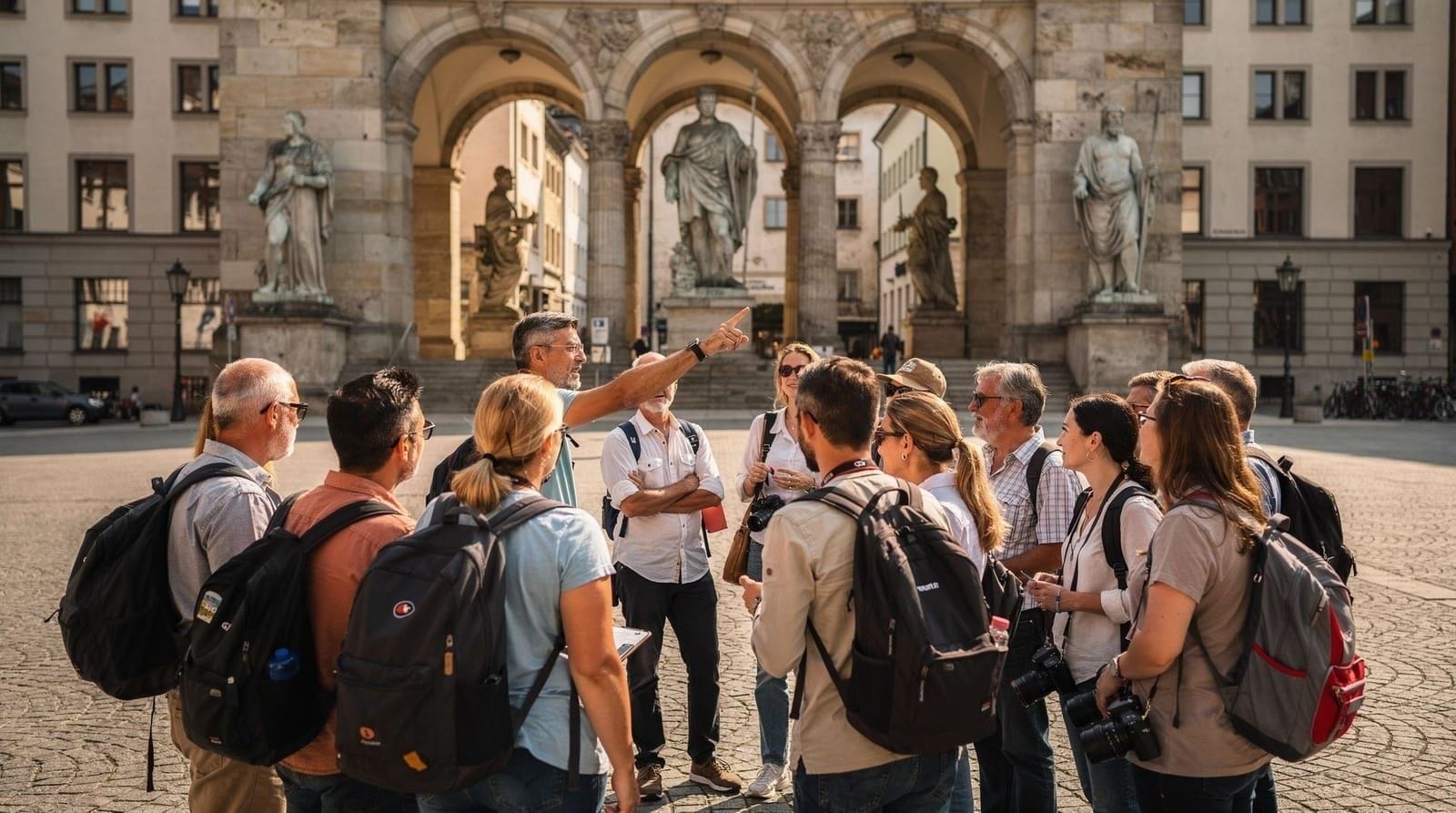
The Asamkirche is not consistently included in most city tours, which tend to focus on Marienplatz and the Frauenkirche. A guided Old Town walk that includes Sendlinger Strasse is the most reliable way to visit it with context. Munich Old Town walking tour including Sendlinger Strasse
Combining the Asamkirche with nearby sights
The Asamkirche sits on Sendlinger Strasse, one of Munich’s main pedestrian shopping streets running south from the Altstadt. The logical combination visits are straightforward.
Sendlinger Tor: The medieval gate at the south end of Sendlinger Strasse is a 5-minute walk from the church. Dating to 1318, it is one of three surviving gates of Munich’s medieval fortification ring. No entry fee; you walk through it. For context on the city’s medieval development, the Munich old town history guide covers the full sequence of the city’s walls and gates.
Viktualienmarkt: Munich’s daily outdoor food market is a 10-minute walk northeast of the Asamkirche, through the Blumenstrasse and into the market square. Open Monday to Saturday from early morning, it sells produce, cheese, meat, bread, and regional specialities. The central beer garden operates from spring through autumn. The Munich Altstadt guide covers the Viktualienmarkt and its position within the old city in more detail.
Marienplatz: The central square is about 7 minutes northeast of the church. If you are visiting on the hour between 11:00 and 17:00, you can time your walk to arrive for the Glockenspiel chime. The Marienplatz guide has the full schedule and a breakdown of the figures in the carillon.
Frauenkirche: Munich’s twin-towered cathedral is about 10 minutes northwest of the Asamkirche. The contrast between the two churches — one vast and brick Gothic, the other tiny and rococo — is instructive. The Frauenkirche guide covers tower access (when restoration permits) and the church’s history.
A tour that covers all of these in a single morning walk makes efficient use of the Altstadt’s compact layout. Munich Old Town and Viktualienmarkt walking tour
If you plan to visit multiple Munich museums and attractions in a single trip, the Munich City Pass may reduce entry costs for paid attractions, though the Asamkirche itself is always free. Munich City Pass covering 45 attractions
Getting to the Asamkirche
Address: Sendlinger Strasse 32, 80331 Munich.
On foot from Marienplatz: Walk south on Kaufingerstrasse/Neuhauserstrasse, turn left onto Rosenstrasse, then right onto Sendlinger Strasse. The church is on your right after about 250 metres. Total walk: 7–8 minutes.
U-Bahn: Sendlinger Tor (U1, U2, U3, U6) is a 3-minute walk south on Sendlinger Strasse, then back north to number 32. Marienplatz (U3, U6, S-Bahn all lines) is the slightly longer option at 8 minutes on foot.
There is no parking adjacent to the church. Sendlinger Strasse is a pedestrian zone. For public transport planning throughout Munich, the Munich public transport guide covers MVV tickets, zones, and routes.
The Asamkirche in context: Munich’s Baroque churches
The Asamkirche is the most concentrated example of the Asam brothers’ work in Munich, but it is not the only one. Their illusionistic frescoes appear at the Peterskirche (Alter Peter) on the south side of Marienplatz, and Egid Quirin worked on stucco decoration at several other Munich churches.
For a broader overview of Munich’s architectural development — from the Romanesque foundations through Gothic, Renaissance, and Baroque phases — the Munich architecture guide traces the city’s built environment chronologically. The Munich museum quarter history guide provides context on how the city expanded beyond the original Altstadt through the 19th century.
For visitors particularly interested in Catholic art and architecture, the Munich best attractions guide lists the Asamkirche alongside the Residenz, the Nymphenburg, and the Pinakotheken as one of the city’s most worthwhile free or low-cost sights. The Munich 1-day itinerary includes the church as part of a compact Altstadt route, and the Munich 2-day itinerary provides more time to explore the surrounding streets.
For context on the city’s history more broadly, the Munich City Museum — a 10-minute walk east toward St-Jakobs-Platz — has a permanent collection covering Munich’s development from the medieval period through the 20th century, including exhibits on the city’s role as a centre of Baroque and rococo patronage.
What to skip if you are short on time
If you only have a few minutes, prioritise the ceiling fresco and the altar sequence over the side stucco details — the vertical logic from reliquary to painted heaven is the building’s single most important idea, and it reads clearly even on a fast pass. Visitors trying to fit the Asamkirche into a packed 1-day Munich itinerary alongside Marienplatz, the Frauenkirche, and the Residenz often underestimate how much a 15-minute stop still requires walking time to and from Sendlinger Strasse — build in 25–30 minutes total including the detour from the main Altstadt loop.
For a calmer visit, avoid the late-morning window between 10:30 and 12:30, when tour groups doing the Sendlinger Strasse detour tend to cluster inside the small nave. Early morning right after opening or the hour before closing are both noticeably quieter, and the low, controlled light inside the church often reads better away from the midday crowd.
Photography and etiquette inside
Photography without flash is generally tolerated, though the Asamkirche remains a working place of worship and visitors should keep phones and cameras low-key rather than treating the small nave as a photo studio. Flash photography risks damaging the gilded surfaces over time and is discouraged for that reason as well as the disruption it causes in such a confined space. Speak quietly — sound carries unusually well in the tall, narrow nave, and a normal conversational volume can feel loud to other visitors standing a few metres away. If Mass is in progress or about to begin, visiting is not appropriate; return later in the day instead.
Frequently asked questions about the Asamkirche
Is the Asamkirche always open to visitors?
It is open during the posted hours (Mon–Sat 09:00–18:00, Sun 13:00–18:00) but closures for services and private events do happen without advance notice. If you arrive and find it closed, returning after 20–30 minutes usually resolves the issue. Sunday morning closures for Mass are predictable; other closures are not.
Is the Asamkirche the same as the Frauenkirche?
No. The Frauenkirche (Cathedral of Our Lady) is Munich’s main cathedral, a large Gothic brick church with two distinctive towers visible from much of the city, located near Neuhauserstrasse. The Asamkirche is a small private chapel on Sendlinger Strasse, several minutes’ walk away. They are completely different buildings in style, size, and function. The Frauenkirche guide covers the cathedral in detail.
Can you attend Mass at the Asamkirche?
The church remains active and Mass is held on Sunday mornings, which is why the building is closed to general visitors until 13:00 on Sundays. The Mass schedule is posted at the door and on the Archdiocese of Munich’s website. Visitors who wish to attend are welcome to do so.
Is the Asamkirche accessible to wheelchair users?
The entrance is at street level with no steps, but the interior is very small and has fixed pews with narrow aisles. Manoeuvring a wheelchair inside is possible in principle but practically difficult given the space constraints and the number of other visitors. There is no lift to the gallery level (which is not open to visitors in any case).
Why is the Asamkirche considered important despite being so small?
Its importance lies in three things: the quality of the art (the ceiling fresco and stucco are among the finest Bavarian rococo work in existence), the unusual history (a private commission by the artists themselves, not a client), and its perfect preservation. Unlike many Baroque churches that were damaged, altered, or lightened during 19th-century restorations, the Asamkirche survives largely as the Asam brothers left it. That completeness is rare.
How does the Asamkirche compare to other Munich churches as a visitor experience?
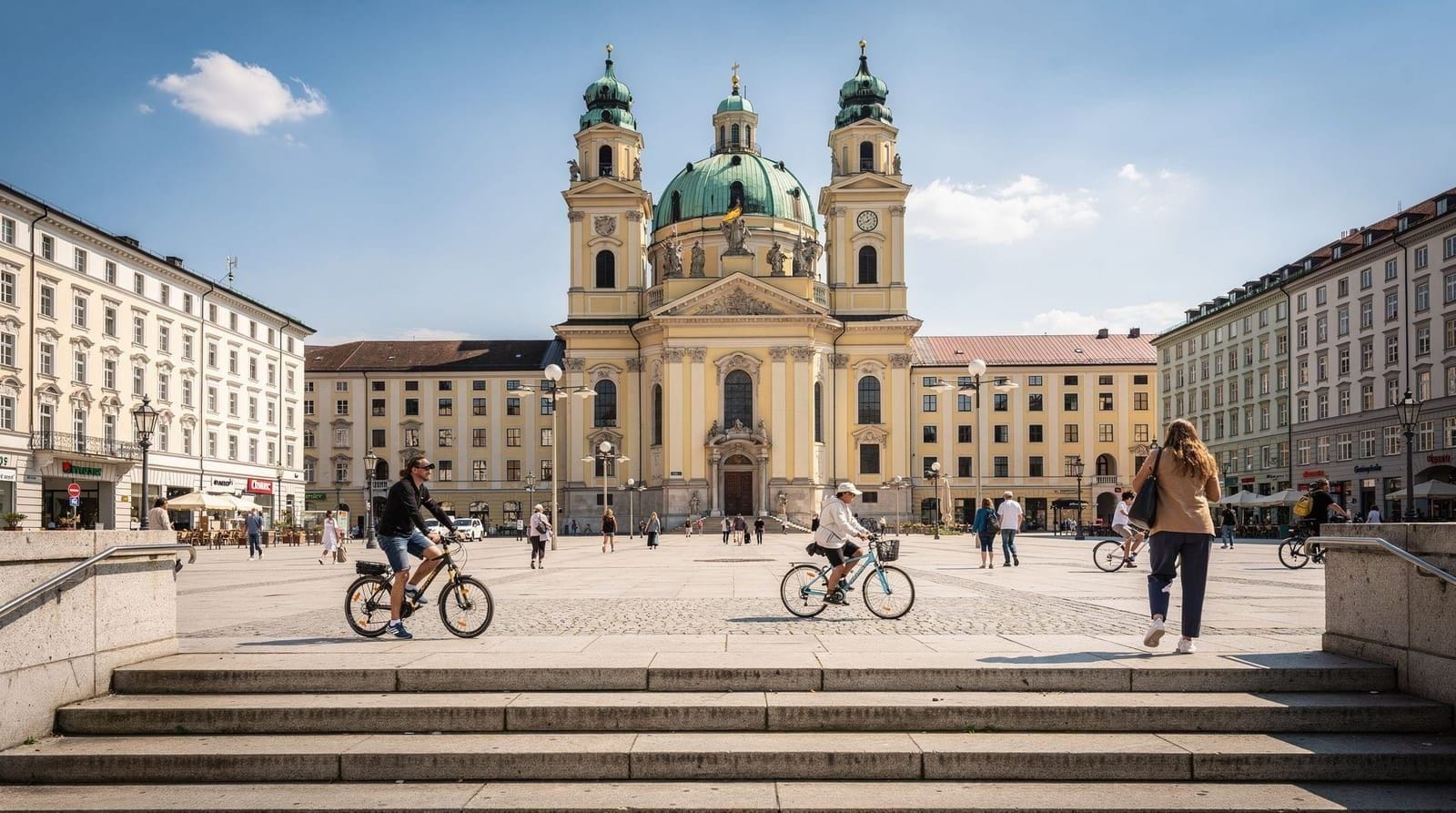
It is the most intense and concentrated. The Frauenkirche is grander and historically more significant to Munich’s identity but architecturally plainer inside. The Theatinerkirche on Odeonsplatz has a similarly lavish Baroque interior but in a much larger building. The Peterskirche has excellent views from its tower. The Asamkirche is the one that most rewards close looking in a short time.
Does the church appear on guided walking tours of Munich?
Some Old Town walking tours include a stop outside or inside the Asamkirche, particularly tours that cover Sendlinger Strasse as part of a wider Altstadt route. Not all tours do — those focused primarily on Marienplatz and the Viktualienmarkt may skip Sendlinger Strasse. When booking a tour, check the route description or ask the operator whether the Asamkirche is included. The Munich walking tours guide compares the main options currently available.
How does the Asamkirche fit into a self-guided walk?
Very easily — it sits directly on the pedestrianised Sendlinger Strasse, a short detour off the main route between Sendlinger Tor and Marienplatz. The Munich self-guided walk and the Munich old town walking route both pass close enough that adding the Asamkirche costs only a few extra minutes.
Is the Asamkirche a good stop for a first-time visitor with limited time in Munich?
Yes, precisely because it is so quick. For visitors following the Munich trip planning guide or wondering how many days in Munich they need, the Asamkirche is one of the best “high value, low time cost” stops in the entire Altstadt — free entry, no queue in most cases, and 15 minutes well spent.
Top experiences
Bookable activities with verified prices and instant confirmation on GetYourGuide.