Munich architecture guide: 900 years of building history
Munich: old town walking tour
What is Munich's most architecturally significant building?
Munich has exceptional buildings in several periods. The Frauenkirche (1488) defines the city skyline; Königsplatz is Europe's finest neoclassical urban ensemble outside Athens; the Asamkirche is one of the purest Rococo interiors in the world; and Frei Otto's Olympic stadium tent roof (1972) was a defining moment in 20th-century engineering. For a single building, the Glyptothek by Leo von Klenze (1830) most perfectly represents Munich's ambition as the 'Athens on the Isar'.
| Where | Old town core, Maxvorstadt (Königsplatz), Olympiapark |
| Time needed | A focused two-day tour covers the essentials |
| Cost | Mostly free to view; museum interiors around €7–12 |
| Getting there | U-Bahn to Marienplatz, Königsplatz or Olympiazentrum |
| Best time | Weekday mornings for the old town, any time for Olympiapark |
Reading Munich through its buildings
Munich is not a medieval city. Bombing destroyed roughly 70 percent of the city centre by 1945, and the postwar reconstruction prioritised a specific version of history — selectively rebuilding monuments while replacing the ordinary building fabric with functional modernism. What visitors see today is therefore a curated past: real historic buildings surrounded by confident postwar work, in a city that has been thoughtful enough about architecture in each era to produce outstanding examples at every scale.
This guide traces Munich’s architectural development chronologically, from the Romanesque foundations visible in the oldest churches to the engineering ambitions of the 1972 Olympics and the contemporary skyline. The story is also partly a political history: architecture in Munich has always been an expression of what the ruling class wanted the city to mean.
Romanesque origins: the Peterskirche and early foundations
The oldest church in Munich is the Peterskirche on Rindermarkt, near Marienplatz. A church has stood on this site since the late 12th century — the current building dates primarily from the 14th and 15th centuries, with a tower rebuilt in the 17th century after collapse. The interior is predominantly Baroque, but the site itself is Munich’s most ancient religious location.
The marienplatz-guide covers the Peterskirche in its spatial context, alongside the Altes Rathaus and the Neues Rathaus.
The Romanesque period in Munich has left fewer visible traces than in older German cities like Regensburg or Augsburg, partly because Munich developed later as a settlement and partly because the devastation of World War II was concentrated on exactly the area where early medieval fabric would have survived.
Gothic: the Frauenkirche and the definition of Munich
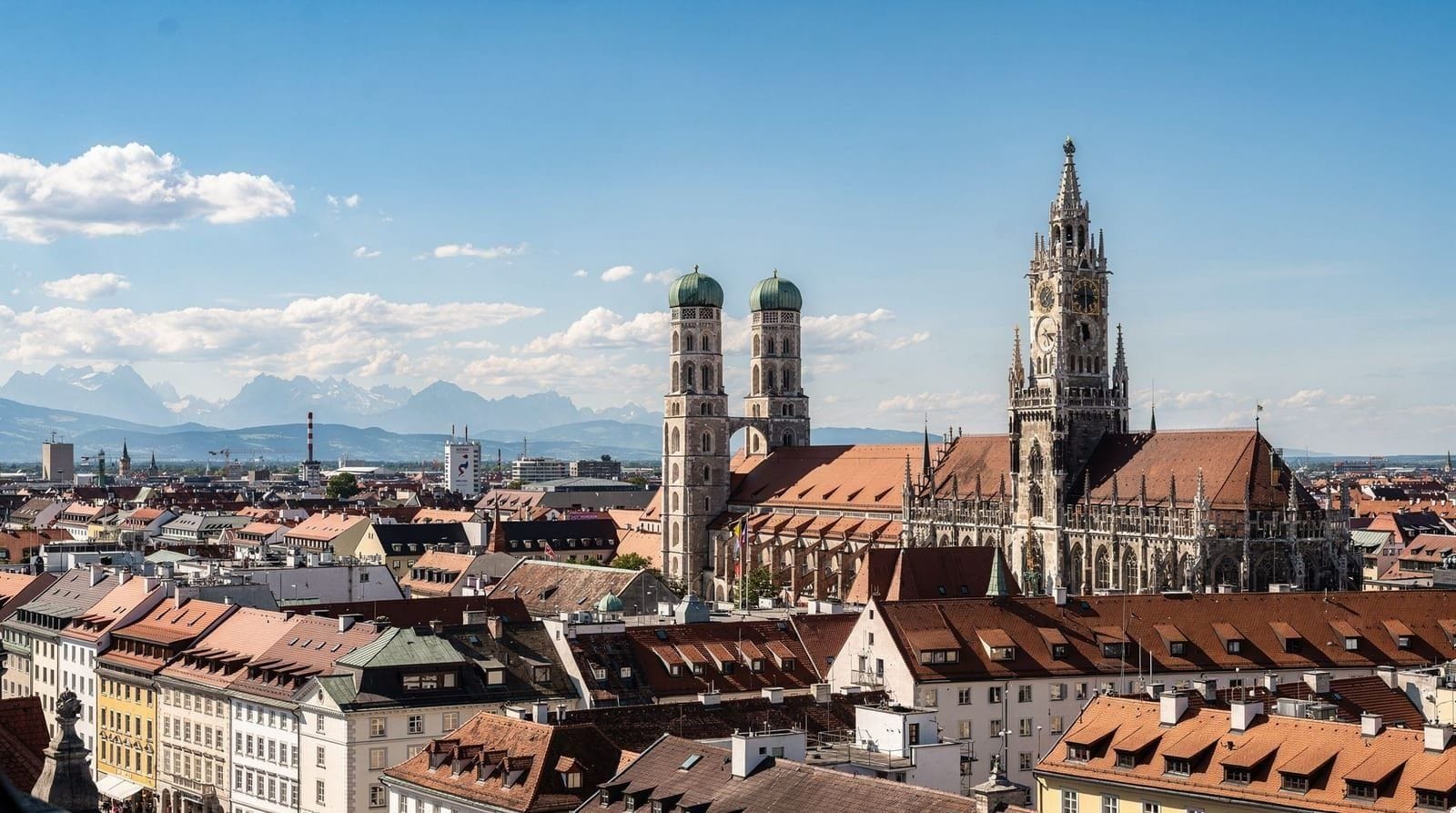
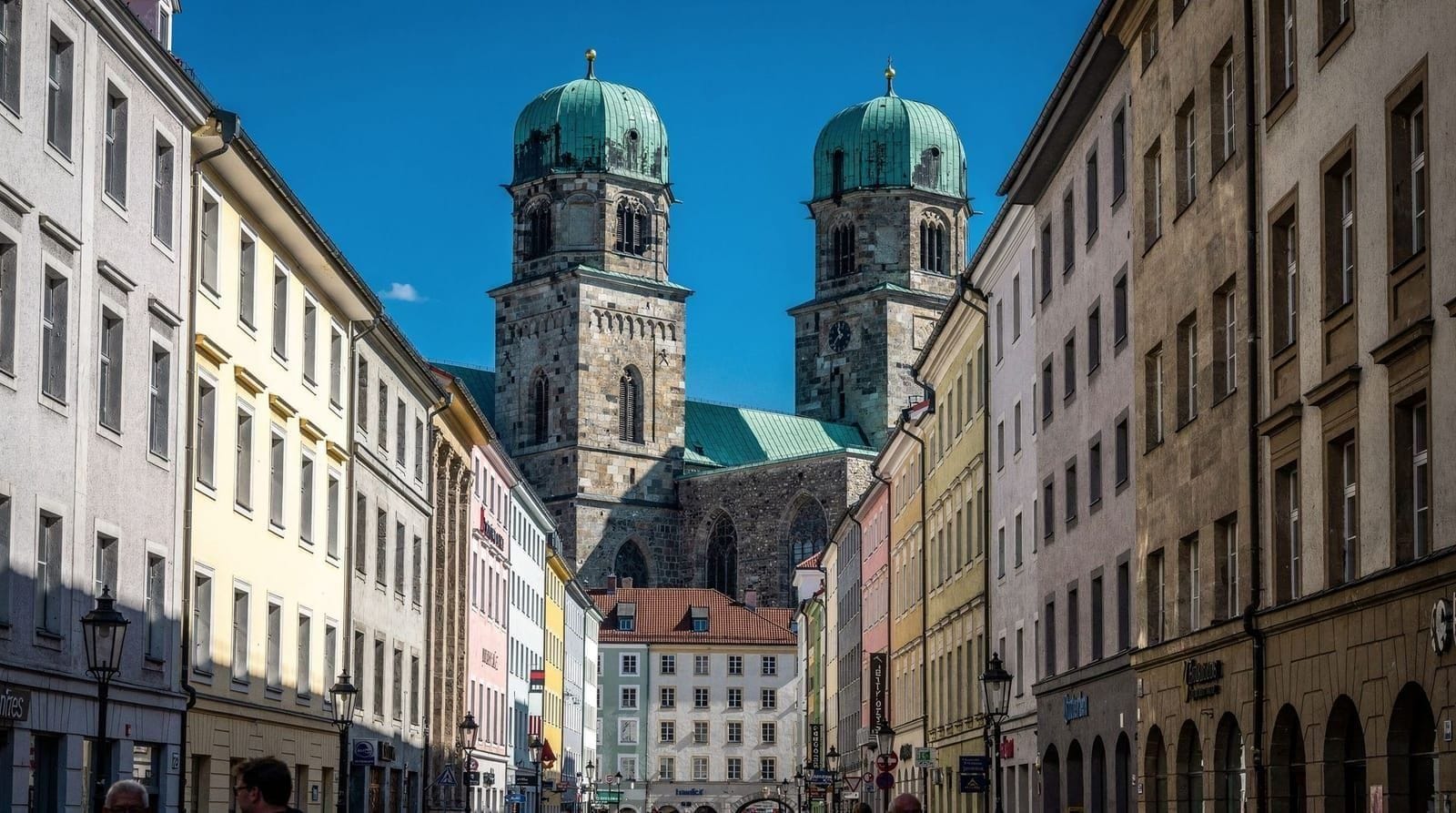
The Frauenkirche (Cathedral of Our Lady) is Munich’s defining architectural statement. Built between 1468 and 1488 under master builder Jörg von Halspach, it is a late Gothic brick hall church — a type characteristic of Bavaria, where stone was expensive and brick was the local building material. The twin towers rise to 99 metres and are capped with the rounded copper domes added in 1525.
Several things about the Frauenkirche are architecturally unusual:
The scale is remarkable for its date. The nave is 109 metres long and 40 metres wide — large enough to fit the twin towers lying on their sides inside the building. It was designed to be visible from the Alps, a point made frequently in historical accounts and still occasionally true on clear winter days from elevated viewpoints south of the city.
The building has very little carved stone decoration compared to French or English Gothic cathedrals of the same period. Bavarian Gothic is restrained and structural — the drama comes from height and light rather than ornament.
The interior contains the Devil’s Footprint (Teufelstritt) — a dark mark in the entrance floor from which the side windows are invisible, fuelling the legend that the devil was tricked into funding the building. This is, of course, a natural consequence of the hall’s geometry rather than supernatural intervention, but the legend is enjoyable.
The height restriction protecting the Frauenkirche’s dominance of the skyline has been periodically challenged by development interests and repeatedly upheld by public vote. Munich is one of very few major European cities that has deliberately maintained a low-rise city centre as a democratic decision rather than merely a historic accident. Munich old town walking tour — includes the Frauenkirche and Marienplatz
Renaissance: the Michaelskirche
The Jesuits arrived in Munich in 1559, and their church — the Michaelskirche on Neuhauser Strasse — is one of the most important Renaissance buildings north of the Alps. Built between 1583 and 1597, it introduced Italian Renaissance models into southern German architecture: a barrel-vaulted nave without columns, inspired by the Gesù in Rome, and a two-storey facade with giant orders.
The Michaelskirche became a direct model for dozens of subsequent Catholic churches across Germany and Austria. Its influence on the spread of Counter-Reformation architecture in German-speaking Europe was greater than almost any other single building. The vault, at 20 metres, was the widest in existence north of St Peter’s in Rome at the time of construction.
The crypt contains the tombs of 40 members of the Wittelsbach dynasty, including Ludwig II, and represents the only accessible royal burial site in Munich.
Baroque and Rococo: the Theatinerkirche and the Asamkirche
The Theatinerkirche on Odeonsplatz, built from 1663 to celebrate the birth of Crown Prince Max Emanuel, introduced full Italian High Baroque architecture to Munich. It was designed by Agostino Barelli and completed by Enrico Zuccalli, with the two-tower facade added by François de Cuvilliés the Elder in the 18th century. The yellow ochre exterior of the Theatinerkirche defines the visual character of Odeonsplatz as surely as the Feldherrnhalle opposite.
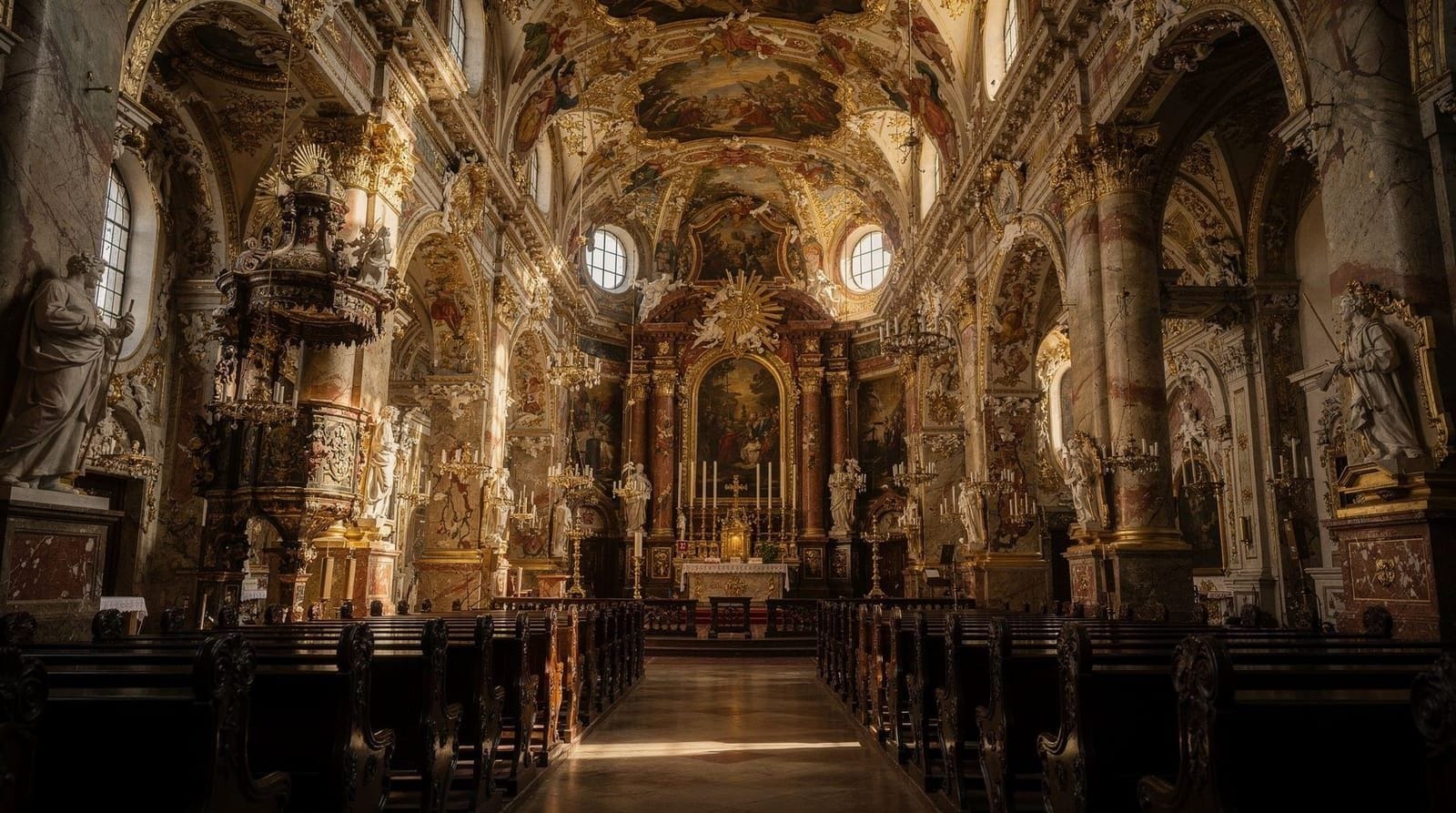
The Asamkirche (formally Klosterkirche St Johann Nepomuk) on Sendlinger Strasse is the most radical interior in Munich. Built between 1733 and 1746 by the brothers Cosmas Damian Asam (painter) and Egid Quirin Asam (sculptor and stucco worker), it was financed privately by the brothers as their personal chapel and attached to Egid Quirin’s house. The building is narrow — just 8.7 metres wide — but rises 28 metres to a ceiling fresco. Every surface is covered: stucco, gilding, painting, sculpture. There is no blank wall or undecorated space. The effect is deliberately overwhelming.
The Asamkirche Munich covers the Asamkirche in detail, including its iconographic programme and the brothers’ intentions.
Neoclassical: Königsplatz and the Athens on the Isar
Ludwig I and his court architect Leo von Klenze transformed Munich’s western edge — the Maxvorstadt district — between approximately 1815 and 1860 into what they explicitly called “the Athens on the Isar.” The ambition was to create a city that could claim cultural equivalence with classical antiquity.
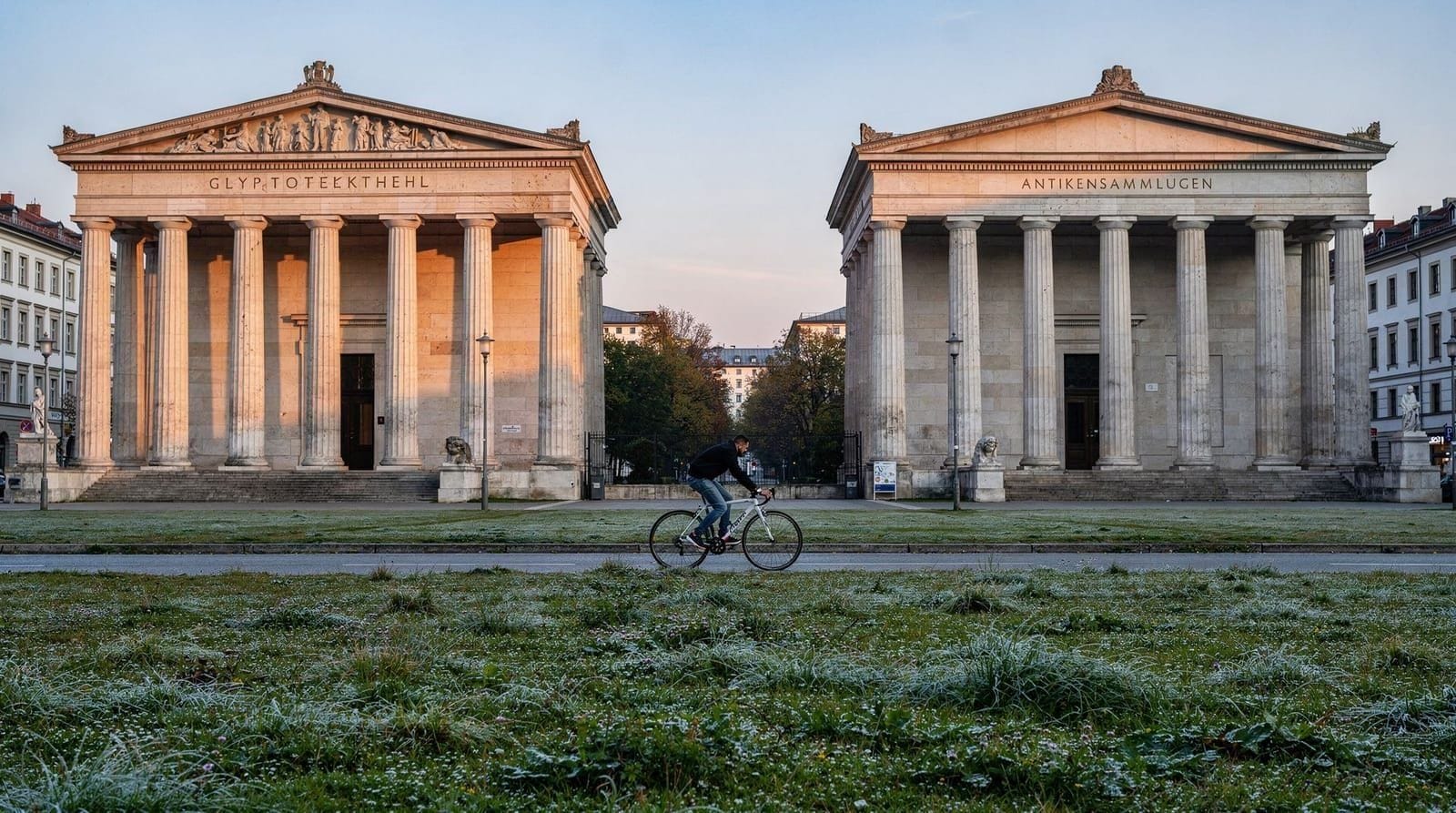
Königsplatz is the centrepiece. Three Greek revival buildings frame a square that is austere by comparison with most historic European plazas: no fountains, no market stalls, no retail frontage. The Glyptothek (1830), designed by Klenze to house Ludwig I’s ancient sculpture collection, occupies the north side with a Doric colonnade. The Staatliche Antikensammlungen (completed 1848) mirrors it on the south with an Ionic portico. The Propyläen gateway (completed 1862) closes the west end, designed to evoke the gateway of the Athenian Acropolis.
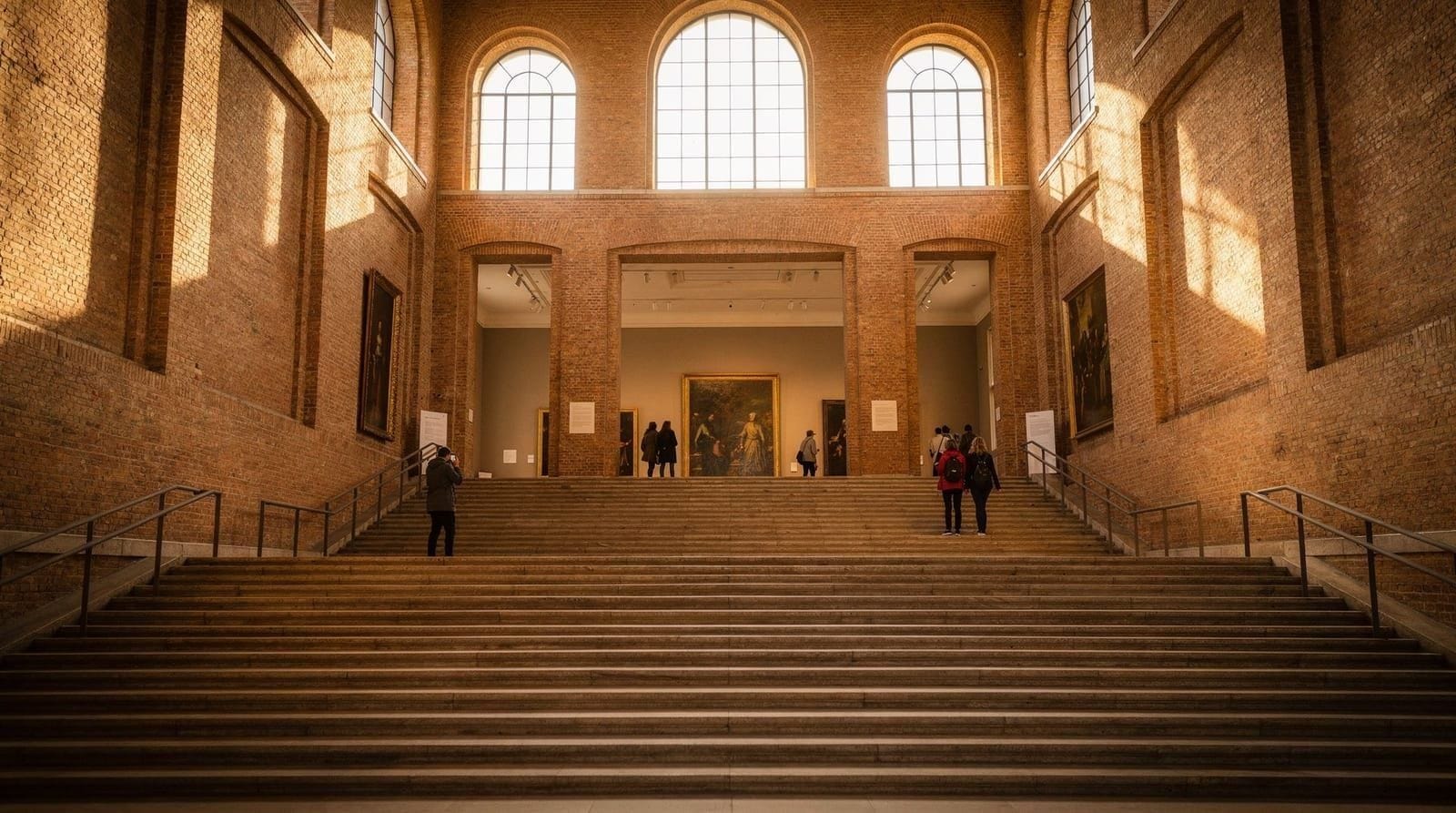
Klenze’s Alte Pinakothek (1836) on Barer Strasse introduced a new building type to museum architecture: the long gallery with lateral top-lighting. It became one of the defining models for 19th-century museum building internationally. The building was heavily damaged in the war and reconstructed in the 1950s with deliberate partial repair rather than full restoration — the exposed wartime brick on the building’s north facade is a visible record of the damage sustained.
Ludwigstrasse, running north from Odeonsplatz to the Siegestor, is the urban spine of Klenze and Gärtner’s neoclassical Munich. The consistent sandstone facades, the street’s axial precision and the Florentine Romanesque of Gärtner’s Ludwigskirche create an ensemble with no close parallel in Germany.
The Munich museum quarter guide covers the full Kunstareal context. Private walking tour: Alte Pinakothek and Munich old town
Historicist: the Neues Rathaus and Maximilianstrasse
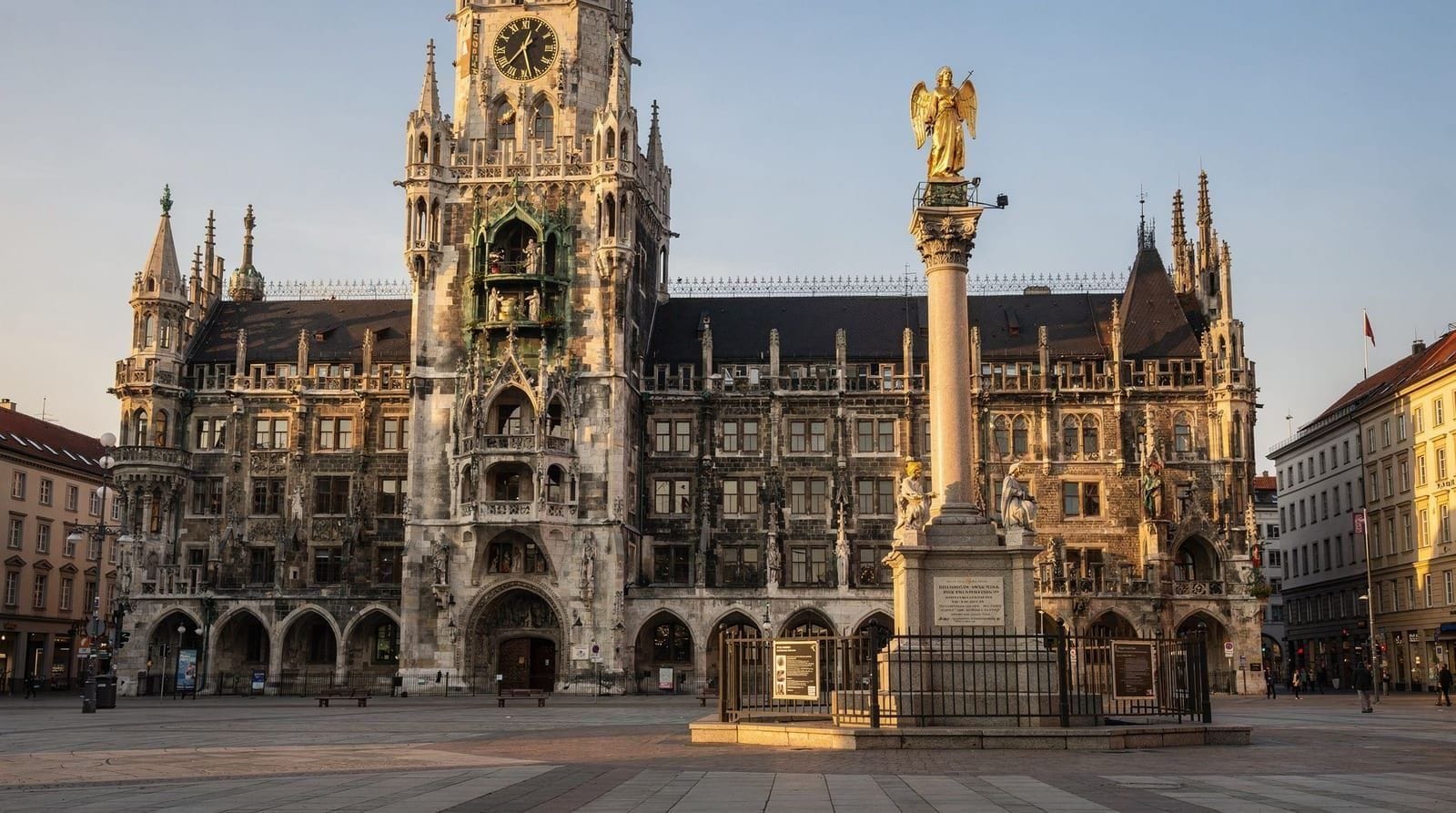
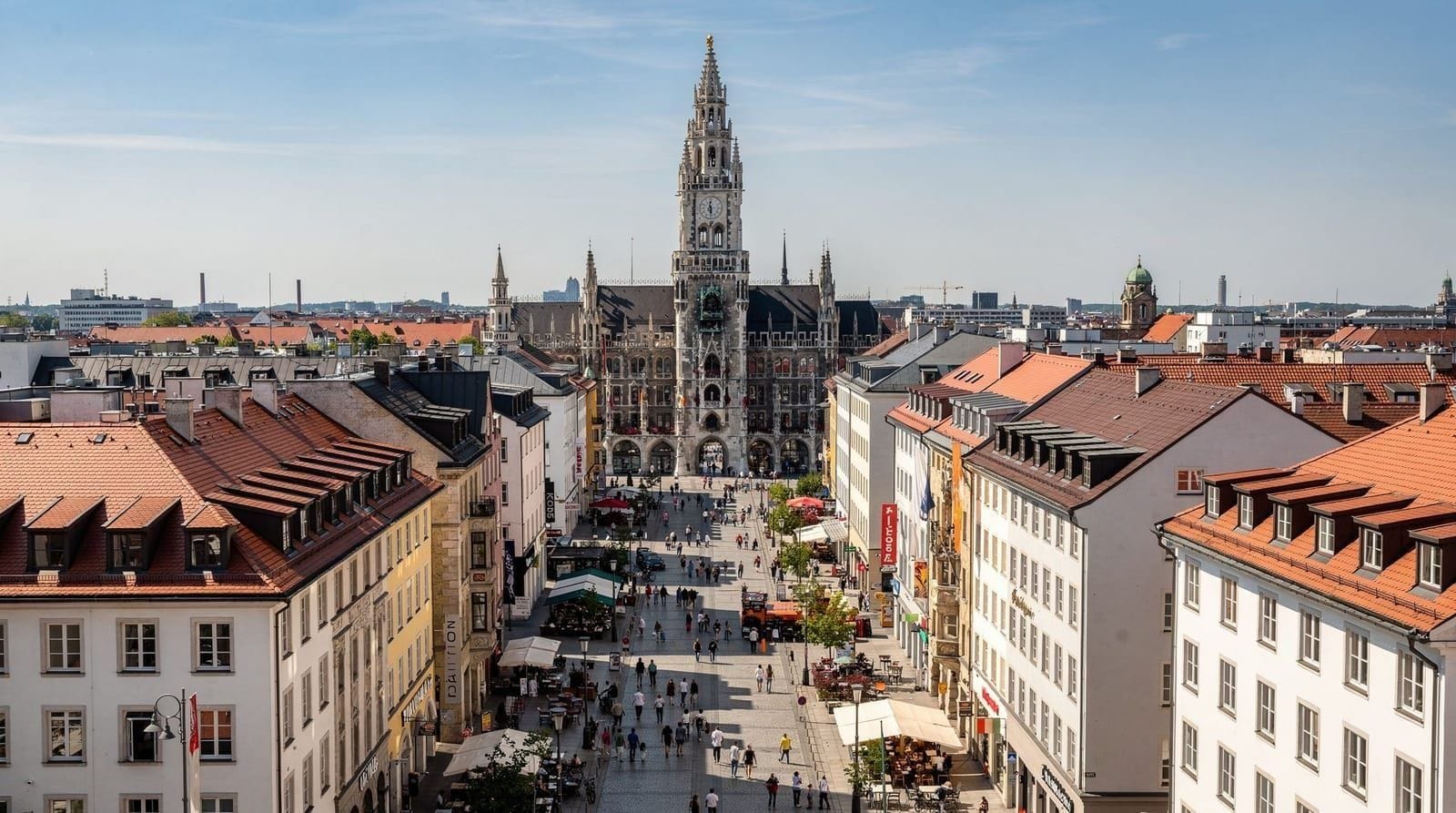
The Neues Rathaus (New Town Hall) on Marienplatz was built in phases between 1867 and 1909, designed by Georg von Hauberrisser in Neo-Gothic style. Its 85-metre tower houses the famous Glockenspiel — 43 bells and 32 life-size figures that perform at 11:00, 12:00 and 17:00. The Glockenspiel is Munich’s most-visited tourist attraction and probably its most gimmicky. The performance commemorates 16th-century jousting tournaments and the plague years, which is more interesting than the mechanical figures themselves suggest.
Maximilianstrasse, running east from Odeonsplatz past the Maximilianeum, was built under Maximilian II in a deliberately eclectic “Maximilianstil” — a 19th-century invention that drew on Gothic and Renaissance elements without committing to either. The street is now Munich’s luxury retail strip, but the architectural intention was originally a civic boulevard.
Post-WWII rebuilding: loss and selective memory
The postwar reconstruction of Munich’s historic centre involved a sequence of decisions that shaped the city’s current character. Some structures were reconstructed faithfully: the Nationaltheater (reopened 1963), the Cuvilliés Theatre (reconstructed 1958), the Frauenkirche (largely restored by the early 1950s), and the Theatinerkirche. The Residenz was partially reconstructed over decades.
But most of the ordinary urban fabric — residential blocks, commercial buildings, smaller churches — was replaced with functional modernist construction. The result is a city where historic set-pieces appear surrounded by 1950s and 1960s infill that nobody pretends is medieval. This honest duality is one of Munich’s more interesting architectural qualities.
The Munich royal history covers the Residenz reconstruction in more detail.
Modernist Munich: the 1972 Olympics and beyond
The Olympiapark complex (1968–1972), designed by Günter Behnisch and his team with landscape architect Günther Grzimek and structural engineer Frei Otto, is Munich’s most internationally significant 20th-century architectural achievement. The tent roof — a series of cable-supported acrylic panels covering the Olympiastadion, Olympiahalle and Schwimmhalle — appears light and organic from a distance, like a spider web or a sail. In reality, it is an engineering system of extraordinary complexity.
Frei Otto’s tent structures had been tested at smaller scales before 1972, but the Olympic complex was the largest and most visible application of his tensile roof principles. The engineering is based on masts, cables and membrane panels that distribute load through tension rather than compression — the opposite of conventional vaulted construction. The roof covers an area of roughly 74,800 square metres.
The decision to cover the main venues was not merely aesthetic. The brief from organiser Willi Daume was for “die heiteren Spiele” — the cheerful games — a conscious rejection of the military monumentalism of the 1936 Berlin Olympics. Light, transparent, organic: these were the design values. What happened on 5 September 1972 in the Olympic Village, covered in the Munich 1972 Olympics guide guide, tragically overshadowed the architectural vision.
The Olympiaturm (Olympic Tower, 1968) at 291 metres remains one of Munich’s tallest structures. It was built as a telecommunications tower and has a public viewing platform and rotating restaurant. The olympiapark-guide covers how to visit the complex today.
Contemporary architecture: BMW Welt and beyond
The BMW campus at the north end of the Olympiapark has accumulated three architecturally significant buildings:
The BMW Museum (Karl Schwanzer, 1972) is a three-storey inverted cylinder suspended from a central core — its circular form was meant to evoke a magnified piston, though the metaphor was not part of the original brief. The building predates BMW Welt but is architecturally more pure.
BMW Welt (Coop Himmelblau, 2007) is a double-cone roof structure in glass and steel — 16,000 square metres of roof held up by a central column of cables. It functions as a car delivery centre and brand showroom, which is perhaps the most honest brief architecture can receive: a building whose function is entirely commercial but whose execution is genuinely ambitious. It is free to enter.
BMW Group Plant Munich (the adjacent factory) has its own architectural heritage but is not publicly accessible without a specific factory tour.
In the city centre, the Pinakothek der Moderne (Stephan Braunfels, 2002) solved a difficult brief — connect three previously independent museum buildings — with a rotunda that mediates between them and a roof-lit central hall that is one of the most successful museum interior spaces in Germany. It anchors the western end of the Kunstareal, Munich’s museum district. Guided walking tour of Munich’s old town and architecture
The Munich skyline today
Munich’s low-rise character — enforced by the Frauenkirche height restriction — means the city’s skyline looks unlike any other German metropolis. Frankfurt has towers; Hamburg has the Elbphilharmonie; Munich has a flat horizon with the Frauenkirche’s copper domes and the Olympiaturm rising above it.
This has consequences for contemporary architecture. Major new buildings are pushed to the periphery — the airport, outlying business parks, the Riem exhibition centre (which includes a large park designed from the reclaimed airport site). In the city centre, significant contemporary architecture expresses itself through renovation and interiors: the Lenbachhaus was expanded underground and behind a new facade by Foster + Partners (2013); the Stadtmuseum was given a restrained contemporary wing.
For a city with Munich’s economic scale, its commitment to the height limit is unusual. Whether it reflects genuine conservatism, environmental sensitivity or simply civic attachment to the Frauenkirche’s symbolic role is a question that Munichers themselves debate actively.
Practical architectural touring
A focused architectural tour of Munich over two days might sequence as follows:
Day 1 — historic core: Start at Peterskirche (oldest site), walk to Marienplatz (Neues Rathaus, Altes Rathaus), Asamkirche on Sendlinger Strasse, Michaelskirche on Neuhauser Strasse, then east to Odeonsplatz and the Theatinerkirche. Afternoon: Residenz exterior and Cuvilliés Theatre (if timed access available).
Day 2 — Maxvorstadt and Olympic Park: Morning at Königsplatz (Glyptothek, Antikensammlungen, Propyläen), walk along Ludwigstrasse to the Siegestor, then the Alte Pinakothek and Pinakothek der Moderne. Afternoon: Olympiapark tent roof, Olympic Tower viewpoint, BMW Welt.
The Munich’s best attractions guide has broader context for prioritising between architectural and other sightseeing.
A quick timeline for reference
| Era | Approx. dates | Landmark |
|---|---|---|
| Romanesque | 12th–14th century | Peterskirche origins |
| Gothic | 1468–1488 | Frauenkirche |
| Renaissance | 1583–1597 | Michaelskirche |
| Baroque / Rococo | 1663–1746 | Theatinerkirche, Asamkirche |
| Neoclassical | 1815–1862 | Königsplatz, Alte Pinakothek |
| Historicist | 1867–1909 | Neues Rathaus |
| Modernist | 1968–1972 | Olympiapark, Olympiaturm |
| Contemporary | 2002–present | Pinakothek der Moderne, BMW Welt |
Seeing Munich’s architecture for free
Much of what makes Munich architecturally rewarding costs nothing to look at. The exteriors of the Frauenkirche, Theatinerkirche, Asamkirche and Michaelskirche are free, as is walking Königsplatz and Ludwigstrasse end to end. The Olympiapark’s tent roof can be viewed and walked beneath without a ticket — only the stadium tours and the Olympiaturm lift charge admission. For a self-paced route that strings the free highlights together without doubling back, the Munich self-guided walk is built around exactly this kind of architectural sightseeing, and the wider Munich walking tours guide compares free versus paid options if you would rather have a guide narrate the history as you go.
Newer additions worth knowing about
Beyond BMW Welt and the Pinakothek der Moderne, Munich’s more recent architectural investment has gone into renovation rather than new landmark towers, consistent with the city’s low-rise instinct. The Lenbachhaus extension (Foster + Partners, 2013) wrapped the original 19th-century villa in a gold-toned metal facade while preserving the historic rooms inside — the Lenbachhaus guide covers what the renovation changed and what it kept. The ongoing Hauptbahnhof rebuild is the largest current construction project touching the historic centre, and will be the most significant change to Munich’s station-area skyline in decades once complete. If a wider view over the mix of old and new interests you more than close-up detail, the Munich viewpoints guide ranks the best places to see the whole skyline at once, and on a clear day some of them stretch as far as the Alpine panorama south of the city.
Combining architecture with museum visits
Several of the buildings covered here are also working museums, so a Munich museums pass can make sense if you are visiting more than two or three — it typically pays for itself by the third stop and removes the friction of buying individual tickets at each door.
Frequently asked questions about Munich architecture
What is the oldest surviving building in Munich?
The Peterskirche site has the longest continuous sacred use, but the oldest surviving structure as a complete building is contested. Several towers and fragments of the medieval city wall remain in the Altstadt, including sections near the Sendlinger Tor. The Sendlinger Tor itself dates to the 14th century and is the best-preserved of Munich’s three surviving medieval gates.
Where can I see Munich’s medieval city walls?
Sections of the medieval city wall survive at several points: near Isartor on Zweibrückenstrasse, near Sendlinger Tor and in fragments elsewhere in the Altstadt. The old town originally had four gates: Isartor, Sendlinger Tor, Karlstor and Neuhauser Tor. Isartor and Sendlinger Tor are largely intact; Karlstor survives as a truncated tower; Neuhauser Tor was demolished.
Can you go up the Frauenkirche towers?
The south tower of the Frauenkirche has a lift and is open to visitors (admission approximately 7.50 euros for adults). The view from 99 metres is the best centrally located panorama in Munich. The lift is slow, the stairs are steep, and there is no outdoor viewing terrace — you look through windows. For a wider view including the Alps, the Olympiaturm is a better option.
Is the Asamkirche free to visit?
Yes, the Asamkirche on Sendlinger Strasse is a functioning parish church and entry is free, though donations are expected. It is open daily, typically 09:00–18:00, with closures during services. The interior is the most dramatic single room in Munich’s old town.
What happened to Munich’s original train stations?
Munich’s main station (Hauptbahnhof) was heavily bombed and rebuilt in a utilitarian modernist style in the 1950s. A major renovation and expansion project is currently under construction and is expected to produce a significantly improved station by the late 2020s. The original 19th-century glass-and-iron train shed is entirely gone.
Are there architecture walking tours in Munich?
Several specialist tour operators run architecture-focused walking tours, typically covering the Maxvorstadt museum quarter, the old town historic centre and occasionally the Olympiapark. The Architecture Museum at the Technische Universität München on Arcisstrasse also runs public events and has a library accessible to visitors.
Can I see Munich’s architecture without paying for any museums?
Yes — most of what defines Munich architecturally is exterior. The Frauenkirche, Theatinerkirche, Königsplatz ensemble, Ludwigstrasse and the Olympiapark tent roof are all free to view from outside. The only paid elements in the routes above are the Frauenkirche tower lift, the Olympiaturm and the museum interiors themselves.
Is one day enough to see Munich’s architectural highlights?
One long day covers the old town core reasonably well, but combining it with Königsplatz and Olympiapark in the same day means rushing at least one of the three. Two days, split as suggested in the touring plan above, gives each area enough time without feeling like a checklist exercise.
Top experiences
Bookable activities with verified prices and instant confirmation on GetYourGuide.