Olympiapark Munich: the complete visitor guide
Munich: BMW Welt, Allianz Arena, and Olympic Park tour
Is Olympiapark Munich worth visiting?
Yes — the park grounds are free to enter, the Olympic Tower (€9.50, 2026) gives one of Munich's best panoramas, and the tent-roof architecture remains striking. Allow 2–3 hours for the tower and a park walk; add half a day if visiting Sea Life or attending an event.
What to expect before you arrive
Olympiapark sits in the Milbertshofen district, about 4 km north of Marienplatz. It was built almost from scratch for the 1972 Summer Olympics — before the Games, the site was a post-WWII rubble dump and airfield. The transformation produced one of Europe’s most architecturally coherent sports complexes, and the park has remained functional and well-used ever since.
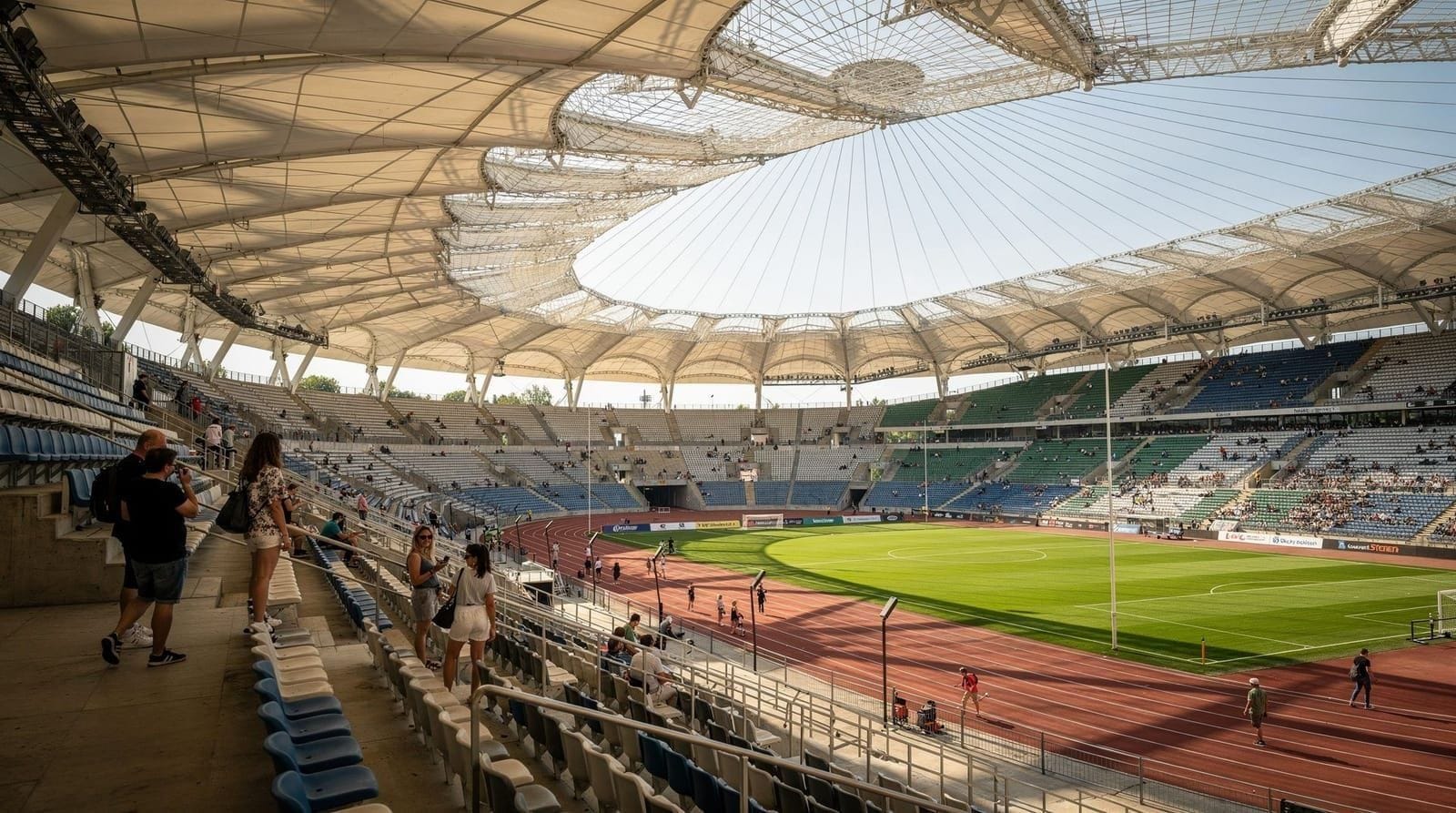
The defining visual element is the tent-roof structure: a sweeping canopy of acrylic glass panels suspended by steel cables, designed by Günter Behnisch and Frei Otto. In 1972 it was radical engineering; it still looks contemporary today. The roof covers the Olympic Stadium, Olympic Hall, and Olympic Swimming Hall — all of which remain in use, though for different purposes than the Games.
Two things set Olympiapark apart from comparable sites elsewhere in Europe: the grounds are genuinely free to enter, and the park is a working public space rather than a heritage museum. Locals jog, cycle, picnic, and swim in the Olympiasee lake. Events run year-round. The Olympic Tower is the main paid attraction; everything else is optional.
This guide focuses on practical 2026 information — what things cost, how long they take, and how to sequence a visit efficiently.
| Where | Milbertshofen, about 4 km north of Marienplatz |
| Cost | Park free; Olympic Tower around €9.50; Sea Life around €22–26 |
| Time needed | 2–3 hours for the tower and a walk; half a day with Sea Life or BMW Welt |
| Getting there | U3 to Olympiazentrum, around 10 minutes from Marienplatz |
| Best time | Weekday mornings (09:00–11:00) or after 20:00 for a quieter tower and evening light |
History in five minutes: from rubble field to Olympic icon
The ground Olympiapark now occupies has a stranger backstory than most visitors realise. Before it became a construction site for the 1972 Games, the area was Oberwiesenfeld — a former airfield that, after WWII, became one of Munich’s main dumping grounds for rubble cleared from bombed city blocks. Roughly 10 million cubic metres of debris were compacted and landscaped into the hills and lake basin that now define the park, including Olympiaberg. Planners deliberately avoided a monumental, closed-off “stadium district” in favour of an open landscape that ordinary Munich residents could use every day — which is precisely why it still functions as a park rather than a fenced heritage site more than 50 years later. Understanding this origin story makes the tent-roof architecture read differently: it was designed to look light, transparent, and unthreatening, a conscious contrast to the militarised staging of the 1936 Berlin Games. The Munich 1972 Olympics history guide covers the Games themselves, including the attack, in full.
Budget version: seeing Olympiapark for under €10
Not every visitor wants to pay tower and Sea Life prices, and Olympiapark genuinely works as a near-free half-day. Enter the park at no cost, climb Olympiaberg (free, about 15 minutes, and arguably the best value view in Munich), walk the full loop around the Olympiasee, and pass beneath the tent-roof canopy on the public paths. Add the Olympic Swimming Hall for around €5–7 if you want a proper local experience rather than a tourist stop — it is a genuine 1970s public pool, not a museum piece. Round it off with free browsing at BMW Welt next door. Total spend: €0–7, depending only on whether you swim. This budget route pairs well with the Munich on a budget guide for the rest of your trip.
Best photo spots in the park
The tent-roof canopy photographs best from two angles: looking up from directly beneath the steel cable anchors near the stadium, and looking down from the paths that climb alongside Olympiaberg, which give a rare top-down view of the geometry. The Olympiasee shoreline opposite the tower is the classic reflection shot, especially in the first hour after sunrise when the water is stillest. From the tower’s observation deck itself, the clearest Alps views (and therefore the best telephoto shots) come on cold, dry days after a front has passed — summer haze often flattens the mountain view even when the city itself is clear. For a different perspective on Munich’s skyline, the Munich viewpoints guide ranks the tower against the city’s other lookout points.
The Olympic Tower (Olympiaturm): what you get for €9.50
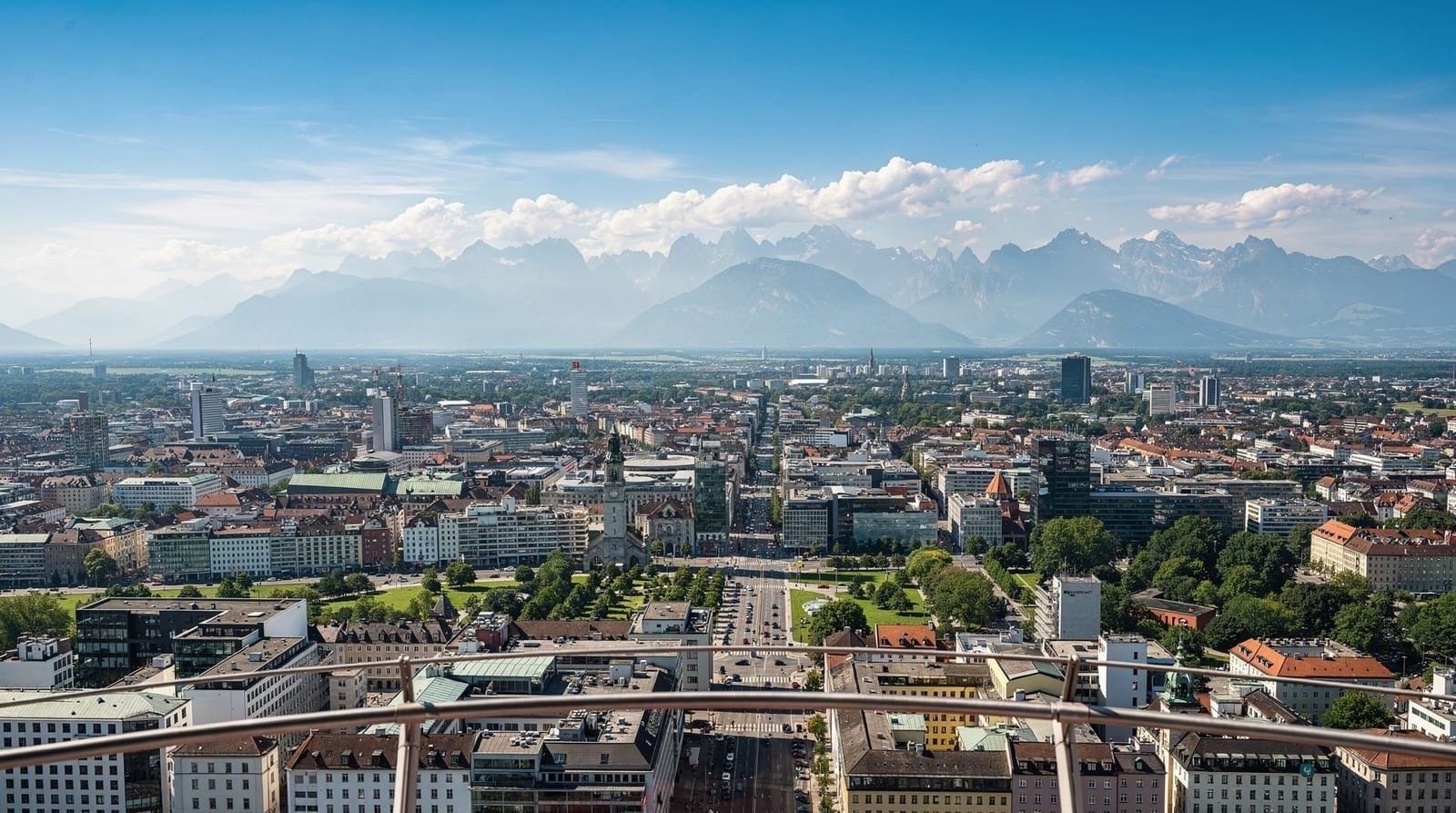
The Olympiaturm is a 291m telecommunications tower completed in 1968 — predating the Olympics themselves. The publicly accessible observation deck sits at 190m; the rotating restaurant is at 182m. At 190m you are above the roofline of almost everything in Munich, and the 360-degree view is genuinely expansive.
On a clear day, the Alps are visible to the south: the Zugspitze, Wendelstein, and the Bavarian Alps proper. Munich spreads north and east, flat and low-rise, punctuated by church towers. The BMW four-cylinder building is visible immediately to the east. The park’s tent-roof structure reads clearly from above, which is the best way to understand its geometry.
Practical details for 2026:
- Adults: €9.50
- Children (6–14): €4.00
- Children under 6: free
- Hours: daily 09:00–23:00, last entry 22:30
- The elevator to the observation deck takes around 30 seconds
The tower is never crowded in the way that, say, the Marienplatz viewpoint can get. The observation deck is enclosed and weatherproof. The floor has glass panels in places — not structural risk, but noticeable if you have vertigo.
The rotating restaurant at 182m completes one full rotation in approximately 53 minutes. Lunch and dinner service is available; expect mid-range to upper-mid-range prices (mains €18–32). Book ahead if you want to eat at the tower — it fills on weekends. A coffee stop at the restaurant without a full meal is possible if tables allow.
Night visits (after 21:00) are under-rated. Munich’s city lights spread in every direction and the park is illuminated during events. The queue for the tower is also shorter in the evening.
The park grounds: what is free
The park’s free attractions take at least 90 minutes to explore properly.
Olympiasee (Olympic Lake): The artificial lake at the centre of the park was created during construction. It is used for pedal boats in summer (€8–10/hour rental) and freezes partially in hard winters. The surrounding paths are flat and pleasant for walking or cycling. The open-air cinema, Kino am Olympiasee, sets up on the lake’s north bank each July and August — screenings typically start at dusk and cover current releases and classics.
Olympiaberg (Olympic Hill): The 56m hill to the south of the park is made of rubble — primarily WWII bomb debris and spoil from the U-Bahn tunnel excavations of the 1960s. The approach is a gentle spiral path or a steeper direct climb. The summit gives a free panoramic view that competes seriously with the tower for practical purposes if you are on a budget. The Alps are visible on clear days, and you get a top-down perspective on the tent-roof canopy.
The stadium and tent-roof area: You can walk directly up to and beneath the tent-roof structures at no charge. The views of the canopy from ground level and from the paths that run above it are among the more photogenic in the park. The Olympiastadion itself offers guided tours for around €5, taking you onto the pitch and into the historic stands. The stadium hosted the 1972 Olympics, the 1974 FIFA World Cup final, three European Cup finals, and decades of FC Bayern matches before the club moved to the Allianz Arena in 2005. It now hosts concerts and occasional events.
The memorial: A small, understated memorial to the 11 Israeli athletes and coaches killed in the 1972 hostage crisis stands in the park. The event — an attack by the Palestinian group Black September during the Games — had a lasting impact on global security protocols at international sporting events. The memorial is worth finding; it is not prominently signposted. The full historical context is covered in the Munich.
The swimming hall and sports facilities: The Olympic Swimming Hall still functions as a public swimming pool. Entry is around €5–7 for adults. It retains its original 1970s interior and is surprisingly uncrowded outside school holidays.
Sea Life Munich: honest assessment
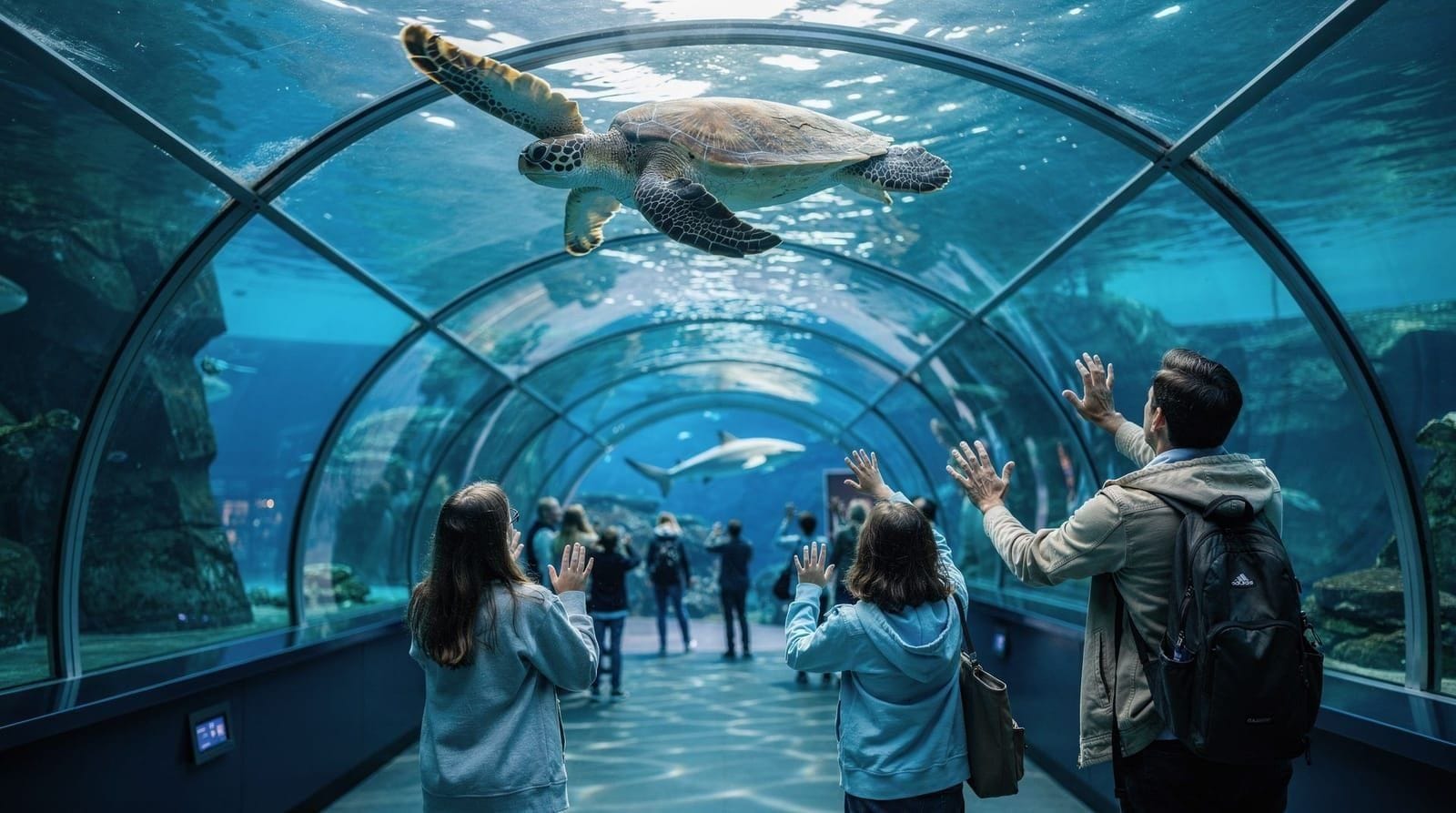
Sea Life Munich is positioned within the Olympiapark complex and is managed by the Merlin Entertainments group. It contains around 35 tanks and 5,000 sea creatures across freshwater and saltwater displays. The highlight is the 360-degree ocean tunnel walk near the end of the route.
Is it worth the price? At €22–26 per adult, Sea Life is the most expensive element of an Olympiapark visit. It is calibrated as a family attraction rather than a specialist marine biology experience. If you are traveling with children under 12, the tunnel walk and the touch pools (where permitted) make it worthwhile. Adults without children will likely find 90 minutes sufficient and the price borderline.
The combination logic: Combo tickets pairing Sea Life with the Olympic Tower, or Sea Life with the Munich City Pass, reduce the per-attraction cost. The Munich City Pass covers Sea Life among its 45+ inclusions — if you plan to use the pass for multiple attractions, the maths favor buying it rather than individual tickets.
Sea Life Munich day ticket — book online to save versus door pricing.
Queues at Sea Life can be significant during school holidays (Bavarian school holidays are staggered from other German states — check the calendar). Online booking with a timed entry slot avoids the worst of this.
BMW Welt and BMW Museum: the natural extension
The BMW campus is immediately east of Olympiapark, visible from the tower and reachable by a 5-minute walk from the U-Bahn exit. This combination — Olympiapark in the morning, BMW campus in the afternoon — makes for a coherent full day without covering excessive ground.
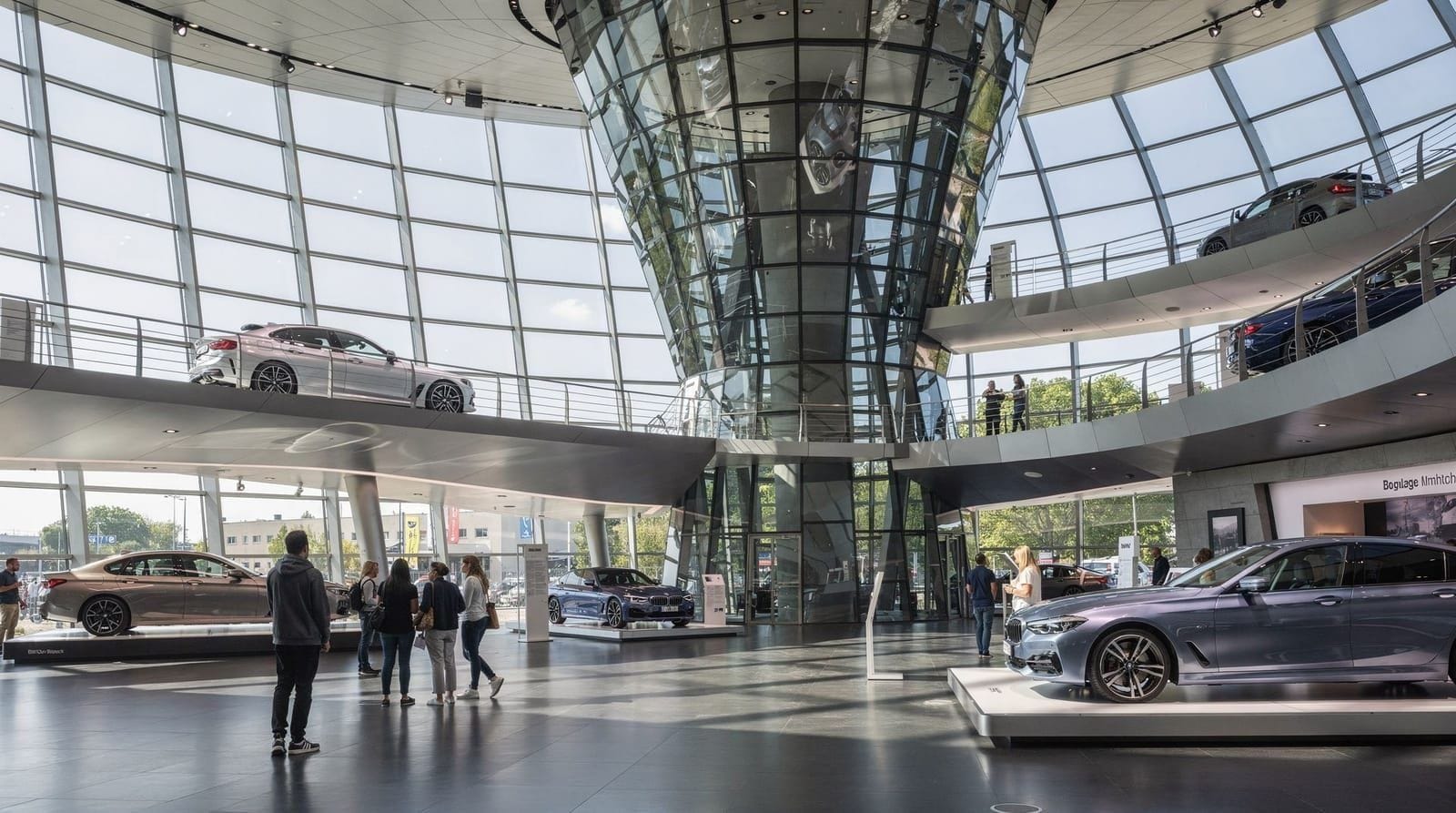
BMW Welt (BMW World) is the brand’s delivery and exhibition center. Entry is free. The interior is architecturally impressive — a double-cone atrium structure — and displays current BMW, Mini, and Rolls-Royce models. There is no hard-sell pressure; it functions partly as a showroom and partly as a visitor attraction. Allow 45–60 minutes.
BMW Museum (adjacent, connected by a pedestrian bridge) covers the company’s history from pre-war aircraft engines to current electric vehicles. Adult tickets cost €10 in 2026. It is one of the better corporate museums in Germany — the circular gallery structure works well spatially, and the historical content goes beyond marketing material. The BMW Welt and BMW Museum guide covers the museum in detail.
BMW Welt, Allianz Arena, and Olympiapark combined tour — a guided option that combines all three sites efficiently.
Seasonal events and what to plan for
Summer (June–August): Peak season in the park. Kino am Olympiasee runs from mid-July. The Olympic Stadium hosts concerts — past performers have included international acts requiring a large outdoor venue. Boat rentals on the Olympiasee are active. The park is busiest on weekend afternoons.
Autumn (September–October): Oktoberfest overlaps with early autumn. The park is quiet by comparison — a deliberate contrast if you find the Theresienwiese overwhelming. Temperature is usually pleasant for walking through October.
Winter (December–February): An ice rink opens in the park during winter, typically December through February. Cost is around €4–6 for entry plus skate rental. The park is quieter but still functional as a walking destination. The tower remains open year-round.
Spring (March–May): The park begins to wake up. Migratory birds use the Olympiasee. Fewer crowds than summer with mostly good walking weather.
| Season | Crowds | What’s on |
|---|---|---|
| Summer (Jun–Aug) | Busiest, especially weekend afternoons | Kino am Olympiasee, stadium concerts, boat rentals |
| Autumn (Sep–Oct) | Quiet, even during Oktoberfest | Mild walking weather, good tower visibility |
| Winter (Dec–Feb) | Quietest | Ice rink (~€4–6), tower open year-round |
| Spring (Mar–May) | Light-moderate | Migratory birds on the Olympiasee, fewer queues |
How to get there
U-Bahn: U3 direction Moosach or Olympia-Einkaufszentrum, get off at Olympiazentrum (the last stop). From Marienplatz: approximately 10 minutes, direct. From the U-Bahn exit, the tower is visible immediately — walk 3 minutes toward it.
Tram/bus: Trams 20 and 21 stop at Olympiapark. Bus 173 serves the area from the city center.
By bike: The route along the Nymphenburg Canal and then north via the English Garden extension is practical from the city center — about 25–30 minutes at a normal pace. Bike parking is abundant inside the park. The Munich covers route options.
Hop-on hop-off: The hop-on hop-off bus stops at Olympiapark. If you are using the bus as a city orientation tool, this makes it easy to combine with the city center route. See the Munich hop-on hop-off bus guide 2026.
No driving is recommended unless you are arriving outside peak hours — parking is limited and paid. On event days, the area becomes congested well in advance of the event start.
How to sequence a visit
The most efficient sequence depends on your interests and whether you have children:
Half-day (3–4 hours, adults, no events):
- Arrive at Olympiazentrum around 10:00
- Walk directly to the Olympic Tower — go up first while it is quietest (09:00–11:00 is reliably uncrowded)
- Walk around the Olympiasee and beneath the tent-roof structures
- Climb Olympiaberg (free, 15 minutes)
- Head east to BMW Welt for free browsing before lunch
Full day (with children): Add Sea Life Munich after the tower (allow 1.5–2 hours). The Sea Life exit leads back toward the U-Bahn, making it a natural final stop before heading into the city. Combine with the Munich for additional options nearby.
Evening visit: Tower visit after 20:00 for night views, then walk the lakeside for dusk light on the water. Some summer concerts in the stadium run from 19:00 — check the Olympiapark event calendar before planning.
Fitting Olympiapark into a Munich itinerary
Olympiapark occupies the northwestern edge of what a typical visitor covers in Munich. It sits beyond the English Garden and Schwabing, and is best treated as a half-day or full-day destination in its own right rather than a quick stop.
For a 2-day Munich itinerary, day 2 could start at Olympiapark in the morning and finish at the English Garden or Schwabing for the afternoon — the journey between them is 15 minutes by U-Bahn. The Munich neighborhoods overview places Olympiapark in geographic context relative to the districts you are likely to spend time in.
If you are planning a broader Munich visit, the Munich trip planning guide covers how to allocate days across the city’s major clusters. The Munich ranks Olympiapark relative to other major sites and is useful for deciding how to prioritize if your time is limited.
Munich City Pass covering 45+ attractions — includes Sea Life, the BMW Museum, and discounts on numerous other sites. Worth calculating against your planned itinerary.
Frequently asked questions about Olympiapark Munich
What are the opening hours of the Olympic Tower in 2026?
The Olympiaturm is open daily 09:00–23:00. Last entry to the observation deck is at 22:30. The tower operates on these hours year-round, including public holidays. The rotating restaurant has its own service hours — check the tower website for current lunch and dinner slots.
Can you swim in the Olympiasee lake?
No — the Olympiasee is not a designated swimming lake. It is used for boating and the surrounding paths for walking and running, but swimming is not permitted. The nearest official swimming option within the park complex is the Olympic Swimming Hall, which is a public pool open for lap swimming.
Is Olympiapark accessible for wheelchair users?
The main park paths and the area around the Olympiasee are flat and accessible. The Olympic Tower has a lift to the observation deck. The Olympiaberg hill involves a sloped path that is manageable for most wheelchairs but steep in sections. Sea Life Munich is fully accessible. Stadium tours may involve steps in older sections of the stands — confirm in advance with the Olympiastadion ticket office.
Is there food available in the park?
Yes. The park has several cafés and a restaurant in the tower complex. The Olympic Hall area has fast-food options on event days. Quality is adequate rather than notable — for a proper meal, Schwabing (10 minutes by U-Bahn at Münchner Freiheit) has a better range of cafés and restaurants.
Where exactly is the 1972 Olympics memorial?
The Gedenkstätte für die Opfer des Olympia-Attentats 1972 (memorial for the victims of the 1972 Olympics attack) is located in the park near the northern end, toward the Connollystraße area — the street where the Israeli team’s apartments were located. The park maps available at the U-Bahn exit mark its location. It is small and quiet; expect to spend 10–15 minutes there.
How does Olympiapark compare to the English Garden as a park visit?
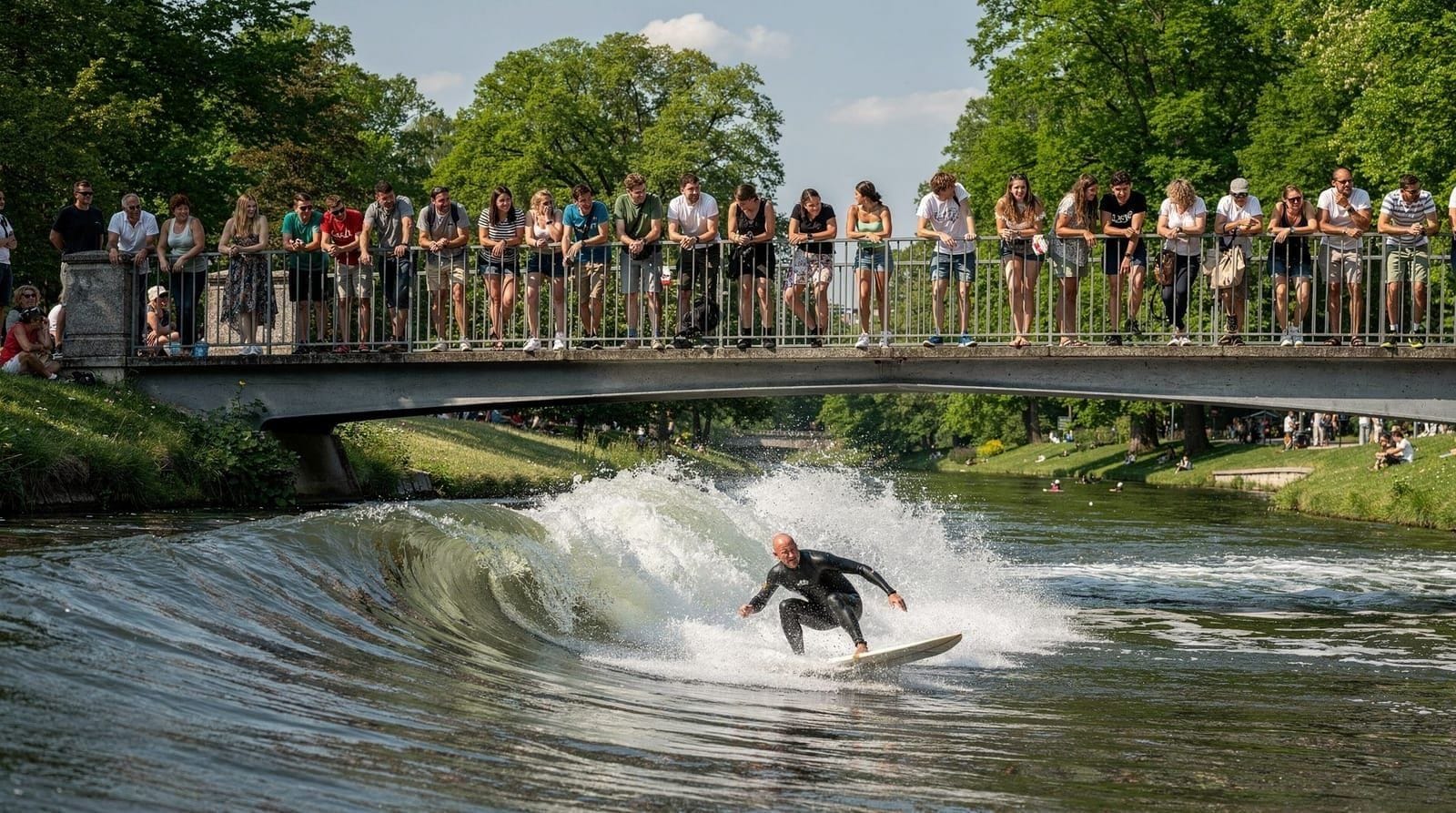
They serve different purposes. The English Garden is a natural landscape park — meadows, beer gardens, the Eisbach surfers, Chinese Tower. Olympiapark is an architectural and events space — the tent-roof structures, the tower, Sea Life, concerts. Both are free to enter and both are worth visiting on a multi-day Munich trip. See the English Garden Munich guide for the contrast.
Is there a guided tour of the Olympic Stadium?
Yes — the Olympiastadion offers guided tours that include the pitch, stands, and historical commentary on the 1972 Games and subsequent events. Tours run several times daily and cost approximately €5 per adult. Check the Olympiastadion website for current schedules, as tours do not run during events.
Can I visit Olympiapark for free?
Yes — the park grounds, Olympiaberg hill, the Olympiasee walking paths, and the areas beneath the tent-roof structures are all free to enter. The only paid elements are the Olympic Tower, Sea Life, the Olympic Swimming Hall, and stadium tours. A budget visitor can spend a full morning in the park without paying anything beyond transport.
How long should I spend at Olympiapark?
Budget 2–3 hours for the tower and a walk around the grounds. Add Sea Life Munich (1.5–2 hours) or BMW Welt and the BMW Museum (1–2 hours combined) to turn it into a half or full day. Families with young children often find a full day passes quickly once Sea Life and playground time are included.
Top experiences
Bookable activities with verified prices and instant confirmation on GetYourGuide.