Munich self-guided walk — the complete route planner for 2026
Munich: old town walking tour
Can you easily self-guide around Munich?
Yes. Munich is one of Germany's most walkable cities. The historic core fits into a 3 km radius, signage is excellent in English, and the U-Bahn fills any gaps. A solid self-guided day covers the Altstadt, Englischer Garten, and one or two museums without needing a guide at all.
Why Munich works well for independent walkers
Few German cities reward independent walking as consistently as Munich. The historic core is compact, signage in the U-Bahn and at street level is bilingual, and the mix of pedestrianised zones and wide pavements means you are rarely battling traffic. Unlike cities where the interesting architecture is scattered, Munich’s Altstadt concentrates its main sites within 1.5 km — and the districts immediately surrounding it each have their own distinct character.
This guide covers three self-guided walking formats: a focused Altstadt route (2–3 hours), a full-day walk combining the old town with Englischer Garten and a residential neighbourhood (5–7 hours), and a shorter option focused on the less-touristed west side of the city. Pick the format that matches your time and energy level.
| Where | Starts at Marienplatz or Hauptbahnhof |
| Cost | Free (aside from optional entries) |
| Time needed | 2–7 hours depending on route |
| Getting there | U-Bahn to Marienplatz or Hauptbahnhof |
| Best time | Before 9am for a quiet Altstadt |
At a glance, the three routes compare like this:
| Route | Duration | Distance | Best for |
|---|---|---|---|
| Route 1: Altstadt | 2–3 hours | 3.5 km | First-time visitors, half-day |
| Route 2: Altstadt + Englischer Garten + Schwabing | 5–7 hours | 12–14 km | Full-day, active walkers |
| Route 3: West side | 3 hours | 6 km | Second day, less-touristed |
Before you set out: orientation
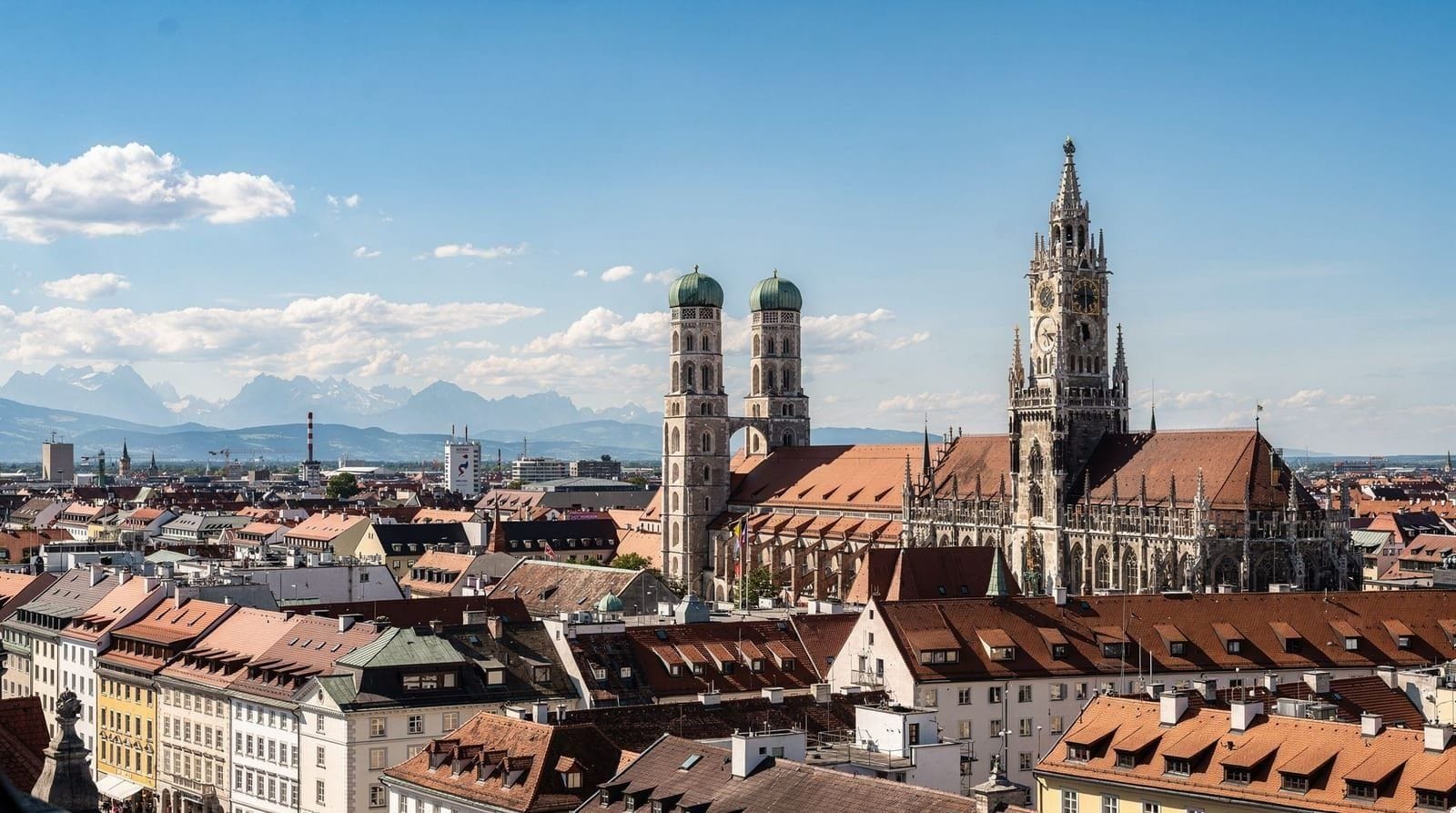
Munich is built on a flat plain with the Alps visible to the south on clear days. The River Isar runs north-south through the eastern part of the city, separating the Altstadt from the quieter Au-Haidhausen district. The Englischer Garten is the largest urban park in the city and provides a green corridor running from the city centre northward. The main train station (Hauptbahnhof) is about 1.2 km west of Marienplatz — a natural starting point if you arrive by rail.
Key orientation landmarks visible from many points in the Altstadt:
- Frauenkirche towers (north-west of Marienplatz) — 99 metres, always visible
- Peterskirche tower (“Old Peter”) — climbable; good for orientation at the start of your day
- Neues Rathaus — the large neo-Gothic building on the north side of Marienplatz
Route 1: Focused Altstadt walk (2–3 hours, 3.5 km)
This route is the foundation for any Munich self-guided visit. It covers the highest-density concentration of historic buildings in the city and requires no transport connections.
Start: Marienplatz U-Bahn station (U3/U6)
Step out of the U-Bahn and you are at the centre of the square. Spend 15 minutes here: read the Mariensaule column (erected 1638 after a plague), look at both the Neues Rathaus and the older Altes Rathaus (1470, now a toy museum), and orient yourself using the twin towers of Frauenkirche to your north-west.
Peterskirche (10 minutes walk, 20 minutes with tower climb)
Walk south from Marienplatz to Peterskirche, Munich’s oldest church. The interior is Baroque — white stucco and gold detail. If time and energy allow, the tower (306 steps, no lift) gives the best ground-level view of the Altstadt roofscape and is a genuine local favourite. Entry: €5 adults, €3 reduced.
Viktualienmarkt (10 minutes, allow 30 minutes)
Continue south to Viktualienmarkt, Munich’s daily open-air market. The market has been running continuously since 1807. Buy a pretzel (€1.50–2.50), look at the Bavarian cheese stalls, and note the beer garden at the centre — a good lunch stop if you are here late morning. The six maypole-style poles around the market bear symbols of traditional trades.
Sendlinger Strasse and Asam Church (15 minutes)
Walk west from Viktualienmarkt along Sendlinger Strasse. About halfway along, on the left, is the Asamkirche (Asam Church) — a tiny, extraordinarily lavish Baroque church built 1733–1746 by the Asam brothers for their own use. It is only 8 metres wide and 22 metres long, but the interior is one of the most densely ornamented spaces in Bavaria. Entry is free. Visiting takes 10–15 minutes; the Asam Church guide provides fuller context.
Frauenkirche (15 minutes walk north-west, allow 20 minutes)
Return east and then north-west to Frauenkirche (Cathedral of Our Lady). The building dates from 1468. Inside: look for the Devil’s footprint just inside the main door (see the Frauenkirche guide for the full legend), and note the calibrated austerity of the nave compared to the exuberance of Asamkirche you have just left. Entry is free; the south tower (when open) costs €5.
Marienplatz to Residenz (10 minutes)
Return to Marienplatz and walk north-east along Dienerstrasse or Residenzstrasse to Max-Joseph-Platz and the Residenz. The exterior of the Konigsbau (King’s Wing, 1826) faces the National Theatre. You can enter the main Residenz courtyard (Brunnenhof) for free through the archway. If you want to visit the museum, allow 2 additional hours — the Munich Residenz guide covers priorities.
Odeonsplatz and Feldherrnhalle (10 minutes)
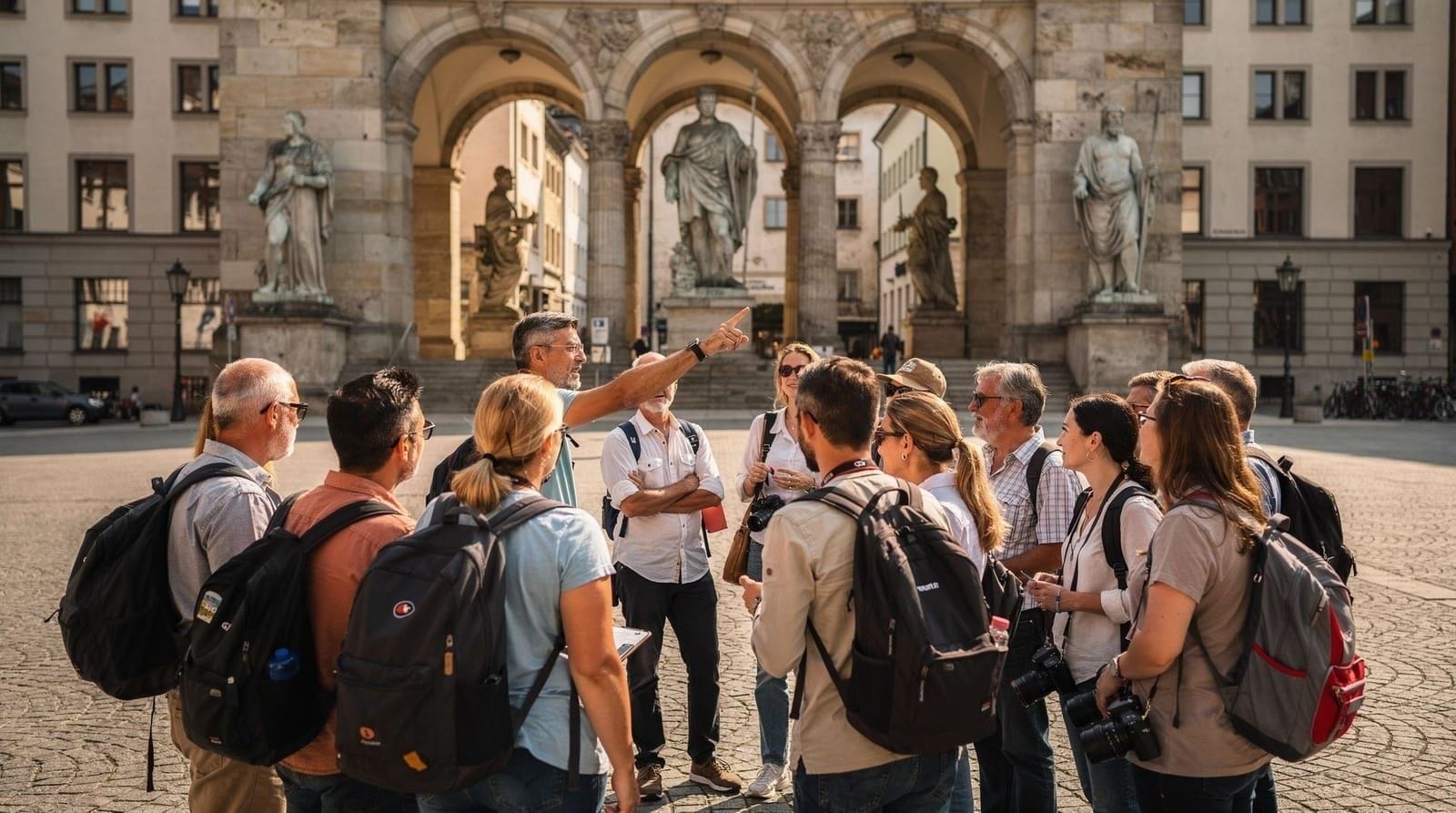
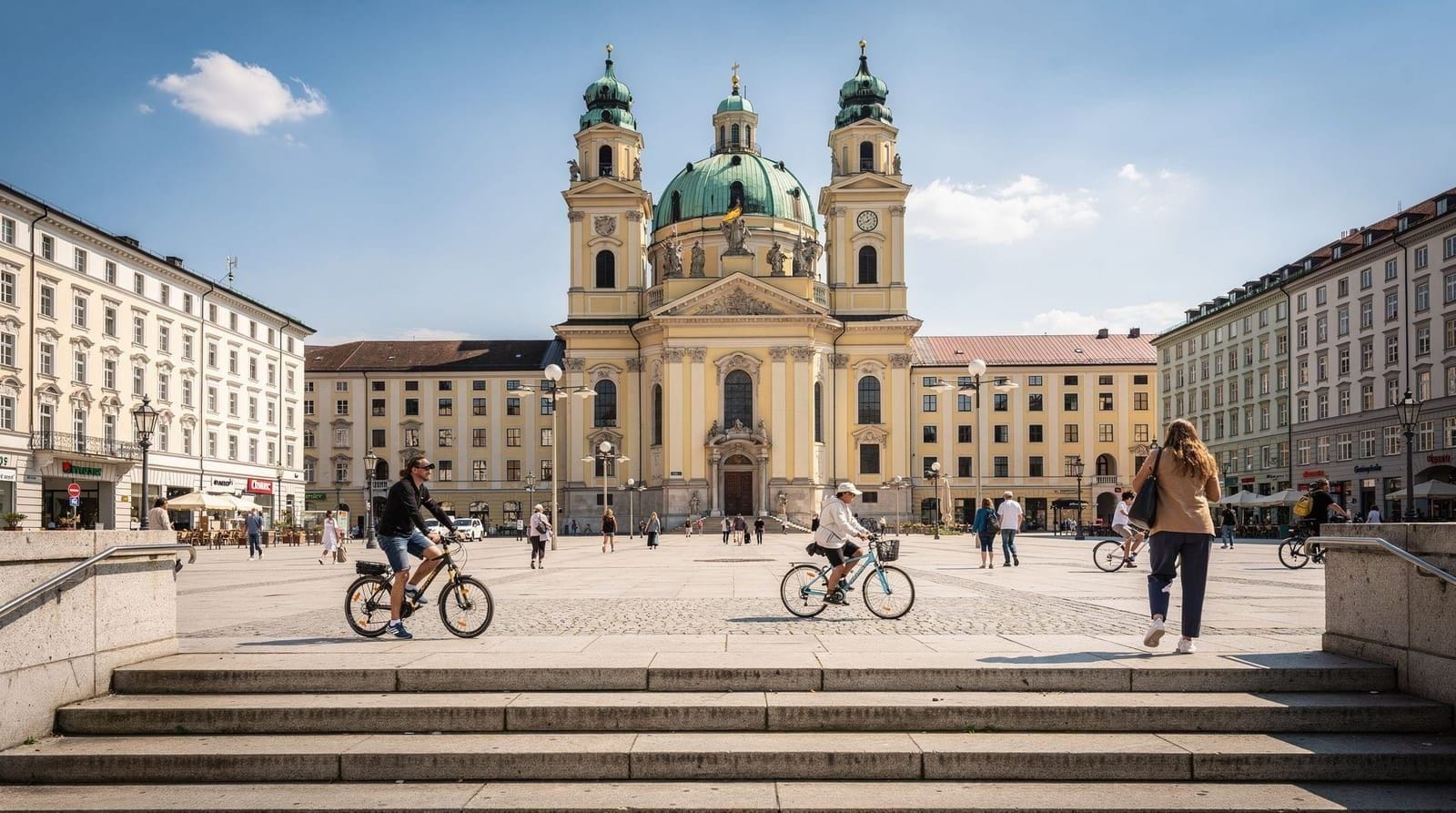
Continue north along Residenzstrasse to Odeonsplatz. The Feldherrnhalle (Field Marshal’s Hall) on the south side of the square was the site of the 1923 Beer Hall Putsch. The Theatinerkirche on the west side of the square is yellow Baroque and worth a brief interior visit. The side alley to the east of Feldherrnhalle — called Drückebergergasse (Dodgers’ Alley) — was used by Munich residents during the Nazi era to avoid passing the Putsch memorial without saluting. The detail is on a small plaque.
End of Route 1
You are at Odeonsplatz, served by U3, U4, U5, U6. The route has covered the core Altstadt. Total walking time approximately 2–3 hours at a relaxed pace.
Route 2: Full-day walk combining Altstadt, Englischer Garten, and Schwabing (5–7 hours, 12–14 km)
This route extends Route 1 northward into the Englischer Garten and the Schwabing neighbourhood, giving a complete picture of Munich’s variety.
Morning: Altstadt (Route 1 above)
Follow Route 1 ending at Odeonsplatz. Timing: approximately 10am finish if you start at 8am.
Hofgarten (15 minutes from Odeonsplatz)
Walk east from Odeonsplatz into the Hofgarten — a formal Italian-Renaissance garden laid out in 1613. The central Diana Temple hosts street musicians in warmer months. The northern arcade has 19th-century frescoes of Bavarian history. From the north end of Hofgarten, pass through the arcade gap into the Englischer Garten.
Englischer Garten: Eisbach and Chinese Tower (allow 1.5–2 hours)
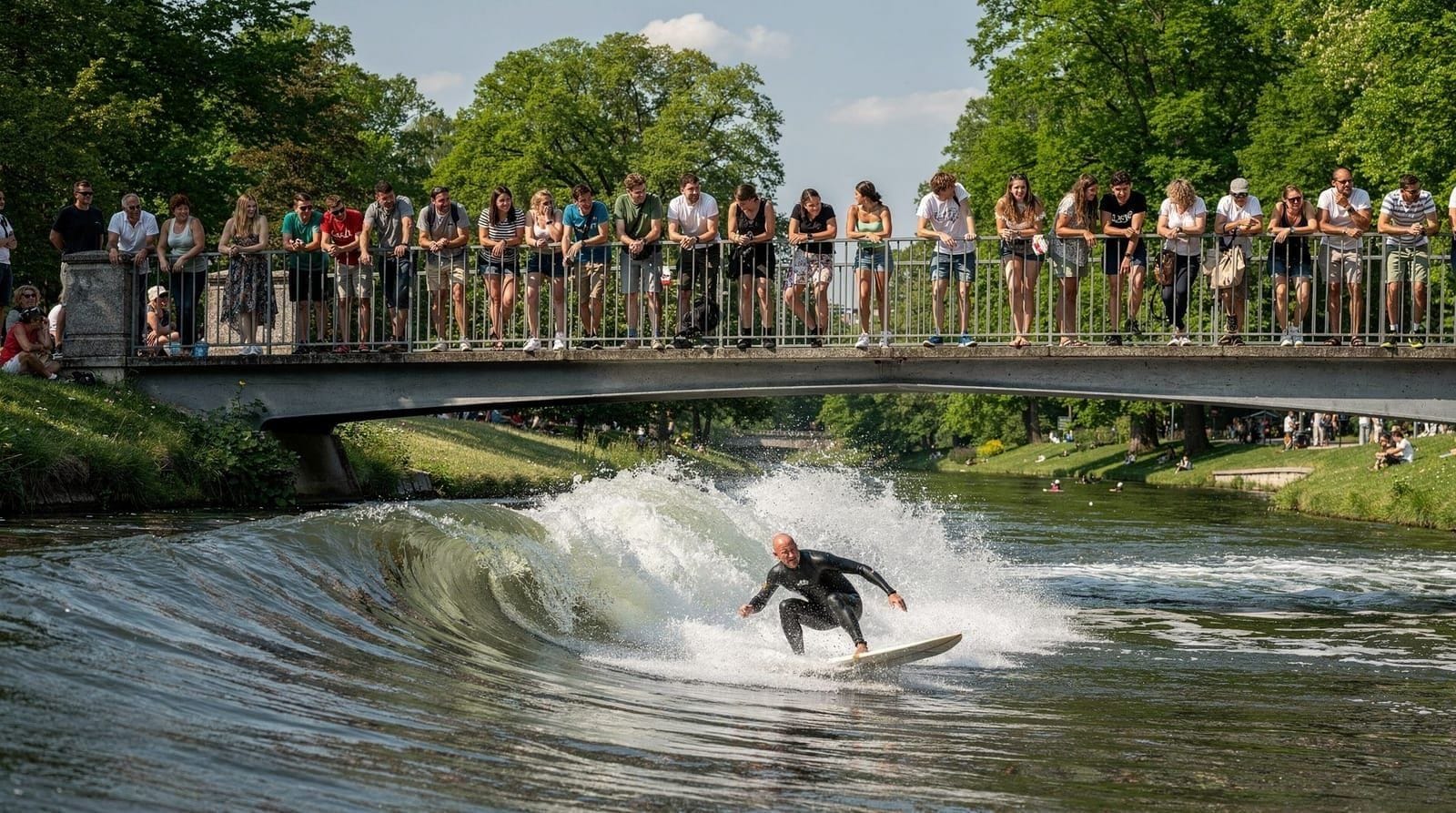
The Eisbach river channel runs along the park’s west edge. Just south of the Museum Lichtspiel bridge, a permanent standing wave attracts surfers year-round — this is a genuine Munich phenomenon worth 10 minutes. Walk north through the park (paths are well marked) for approximately 1.5 km to the Chinesischer Turm (Chinese Tower), a five-storey pagoda with one of Munich’s largest beer gardens. This is the logical lunch stop: a Mass (1 litre) costs €9–11, and food counters sell traditional Bavarian dishes at market prices. The English Garden guide covers the wider park.
Schwabing neighbourhood walk (2 km, allow 1 hour)
Exit the Englischer Garten on the west side near Universitat and walk south-west into Schwabing. Leopoldstrasse is the main boulevard — wide pavements, street cafes, bookshops. The Ludwig-Maximilians-Universitat campus (U-Bahn Universitat) is worth a walk-through; the main building and its square have direct connections to the White Rose resistance group. The Schwabing neighbourhood guide covers the cultural background.
Return to centre: U-Bahn from Muncher Freiheit or Giselastrasse
U-Bahn U3 or U6 from Muncher Freiheit returns to Marienplatz in 8 minutes.
Route 3: West side walk — Hauptbahnhof to Oktoberfest grounds and back (3 hours, 6 km)
This shorter route covers the less-visited western portion of the city, useful for a second day or a half-day.
Start: Hauptbahnhof
Walk south down Bayerstrasse. The Deutsches Jagd- und Fischereimuseum (German Hunting and Fishing Museum) on Neuhauser Strasse is housed in a former Augustinian church — an unusual combination worth noting even if you skip the museum itself.
Sendlinger Tor
Continue south to the Sendlinger Tor, one of Munich’s three surviving medieval city gates (1318). The gate and the short remaining section of city wall give an impression of the original Altstadt boundary.
Oktoberfest grounds (Theresienwiese)
Walk west along Sonnenstrasse and then south-west to Theresienwiese. For most of the year, the field is just a large open space. What is interesting is its scale — when Oktoberfest runs (late September to early October), this site hosts around six million visitors over two weeks in a tent city erected and dismantled annually. The Bavaria statue (18.5 metres, 1850) stands on a hill at the west end and is open for interior climbing. From the head of the statue, a narrow circular stair gives views across the city.
Return via Theresienwiese U-Bahn
U4/U5 from Theresienwiese returns to the city centre.
Adding a guided element
Self-guided walking works well for most Munich visitors, but a single guided tour early in your visit dramatically improves the quality of subsequent independent exploration. The context provided by a good guide — why the Residenz was built here, what happened at Odeonsplatz in 1923, why Schwabing became the bohemian centre it did — makes later self-guided walking richer. Munich: private tour with a local guide
A private guide allows you to ask specific questions and adapt the route to your interests. For budget-conscious visitors, a standard group walking tour of the Altstadt achieves the same orientation goal at a fraction of the cost. Munich old town guided walking tour
Practical self-guided walking kit for Munich
Navigation: Google Maps offline (download the Munich map before arrival). The city’s tourist office at Hauptbahnhof gives free printed maps.
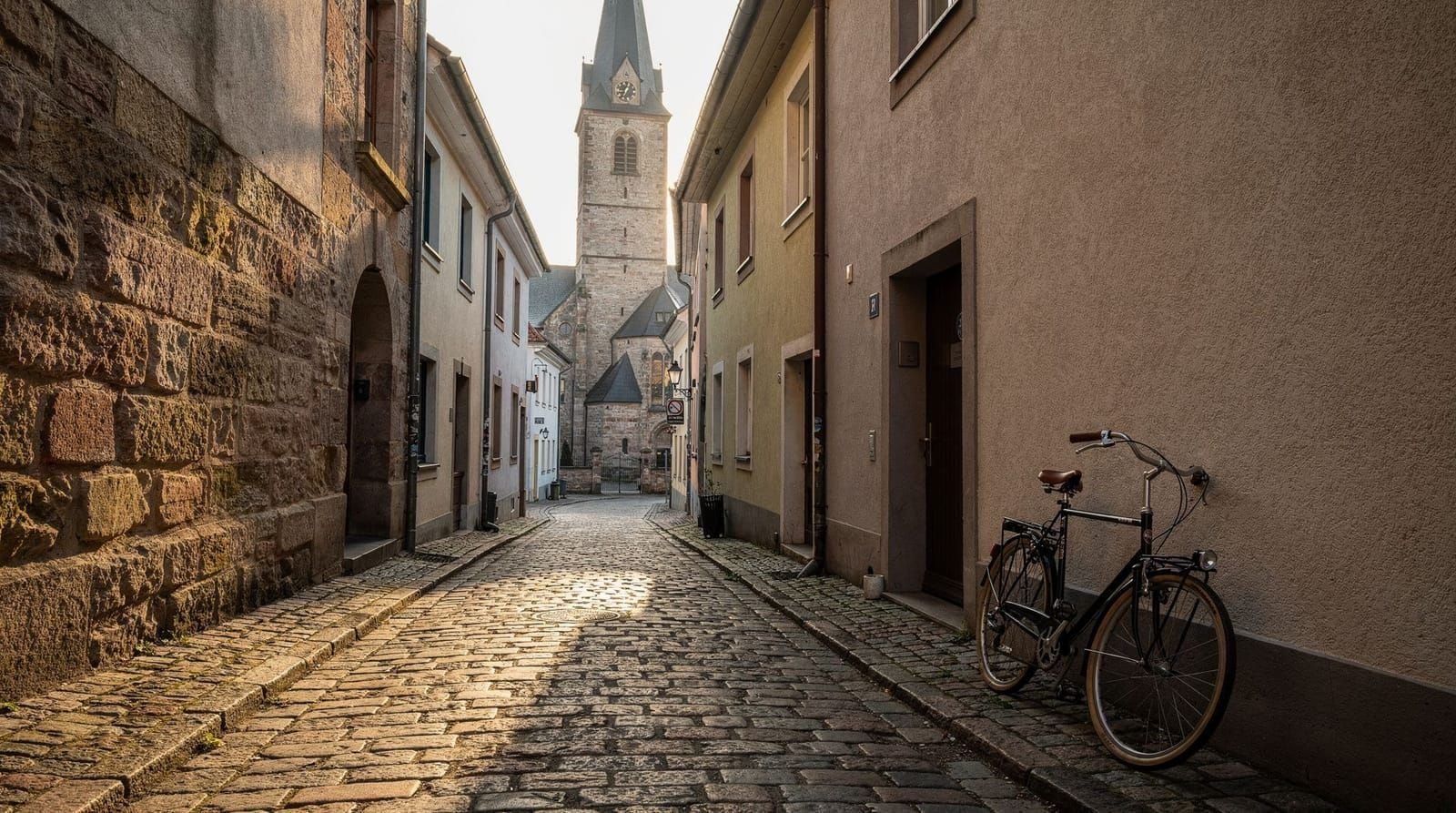
Shoes: Flat-soled comfortable walking shoes. The Altstadt has significant cobblestone coverage; uneven surfaces become slippery when wet.
Water: Tap water in Munich is excellent and drinkable. Bring a refillable bottle. Water fountains in the Englischer Garten are seasonal (May–October).
Transport backup: Load the MVG app for public transport top-ups. A day ticket costs €9.20 (inner ring zones). The Munich public transport guide covers all options in detail.
Cash: Some market stalls and small cafes in Munich remain cash-only. Carrying €20–30 in cash avoids inconvenience at Viktualienmarkt stalls.
Layers: Munich weather shifts quickly, especially in shoulder seasons. A light jacket that packs down small is more useful than a heavy coat you have to carry all day once the sun comes out.
Connecting with other Munich experiences
A self-guided walk works best combined with at least one structured tour experience. For first-time visitors deciding what to book, the guide to Munich tours for first-timers explains which formats work for which travel styles. For evening options after your walking day, the Munich night tours guide covers the post-dark version of the same streets.
Transport-wise, the getting around Munich guide explains how the U-Bahn, S-Bahn, and tram network interlock with walking routes, and where the boundaries of comfortable walking distance sit.
If you only have half a day
Route 1 alone is a genuinely complete Munich introduction — do not feel obliged to attempt Route 2’s full 12–14 km unless you have the time and stamina for it. A common mistake among first-time visitors on a tight schedule is trying to compress the full-day route into an afternoon, which usually means rushing through the Englischer Garten and arriving at Schwabing too tired to enjoy it. If your time is genuinely limited, Route 1 plus a relaxed hour in the Hofgarten and southern English Garden covers the essentials without the fatigue. For a longer stay, our Munich itinerary ideas guide shows how to spread these routes across multiple days alongside museums and day trips.
Frequently asked questions about Munich self-guided walks
How early should I start to avoid crowds in the Altstadt?
Before 9am, the Altstadt is genuinely quiet. Marienplatz at 7:30–8am, with bakeries just opening and pigeons on empty cobblestones, is the best version of the square. By 10am the tourist groups begin to fill it. If you want to photograph Marienplatz without crowds, early morning is the only reliable window.
Are there free audio guides for Munich?
Yes. Rick Steves Audio Europe (free app and website) includes a Munich self-guided audio tour covering Marienplatz, Frauenkirche, and the Residenz. It is slightly dated but factually solid. Spotify playlists and YouTube videos (search “Munich self-guided walking tour”) are alternative free options, though quality varies significantly.
Can I combine walking with the U-Bahn?
Absolutely, and this is often the smartest approach. Walk the Altstadt and Englischer Garten on foot; use the U-Bahn to bridge between the Altstadt and outer neighbourhoods like Schwabing (8 minutes from Marienplatz to Muncher Freiheit) or Nymphenburg Palace area (20 minutes from Marienplatz to Rotkreuzplatz, then 15-minute walk). The Munich U-Bahn and S-Bahn guide covers routes in detail.
What is the best single thing to see on a self-guided Munich walk?
Hard to single out, but Frauenkirche’s interior is consistently the most affecting. Marienplatz is expected; the Asamkirche is the surprise that most independent walkers mention most often after the fact. The beer garden at Viktualienmarkt at 11am on a sunny morning is a close contender for the most distinctly Munich experience.
How do I handle luggage on a Munich walking day?
If you are in transit and have bags, the Hauptbahnhof has staffed luggage storage (DB Reisegepack, around €5–8 per bag per day) and coin-operated lockers. The lockers near the north exit are most convenient for the Altstadt walk.
Is the Englischer Garten safe?
Yes. It is a large, well-used public park. As with any urban park, avoid isolated areas after dark. The main paths around Chinesischer Turm and Eisbach are busy until late evening in summer.
Which route should I do if it is raining?
Route 1 works reasonably well in light rain since much of it passes churches and covered arcades where you can shelter briefly, but a full downpour makes any outdoor walking route unpleasant. On a genuinely wet day, swap the walk for indoor options from our rainy day guide and save the walking routes for a drier day if your schedule allows it.
Do I need to book anything in advance for a self-guided walk?
No — the routes themselves require no booking. The only advance planning worth doing is for paid entries you might add along the way, such as Peterskirche tower or the Residenz museum, neither of which usually needs pre-booking but can have queues in peak season.
Top experiences
Bookable activities with verified prices and instant confirmation on GetYourGuide.