Munich U-Bahn and S-Bahn guide: lines, maps, and how to navigate
What is the difference between the U-Bahn and S-Bahn in Munich?
The U-Bahn is Munich's underground metro (8 lines, U1–U8), running on dedicated tracks fully within the MVV network. The S-Bahn is the suburban rail network (8 lines, S1–S8), run by Deutsche Bahn but covered by MVV tickets, which runs underground through the city centre and overground into the suburbs. Both use the same MVV tickets.
Munich’s U-Bahn and S-Bahn between them reach almost anywhere a visitor needs to go, and both run on the same MVV ticket, which removes most of the guesswork. The two systems look similar on a map but behave differently underground, and knowing the difference — plus a handful of key interchange stations — is enough to navigate the whole city confidently from day one.
| U-Bahn | 8 lines (U1–U8), fully underground, MVG-operated |
| S-Bahn | 8 lines (S1–S8), DB-operated, shares one central tunnel |
| Ticket system | Same MVV ticket works on both, plus trams and buses |
| Daytime frequency | Every 5–10 min (U-Bahn), ~2 min combined on Stammstrecke |
| Night service | All-night Fri/Sat; night buses (N-prefix) other nights after 1am |
Munich’s rail network: two systems, one ticket
Munich’s rail-based transit is split into two networks that look similar on a map but operate quite differently. Understanding the distinction helps you navigate faster and avoid wrong platforms.
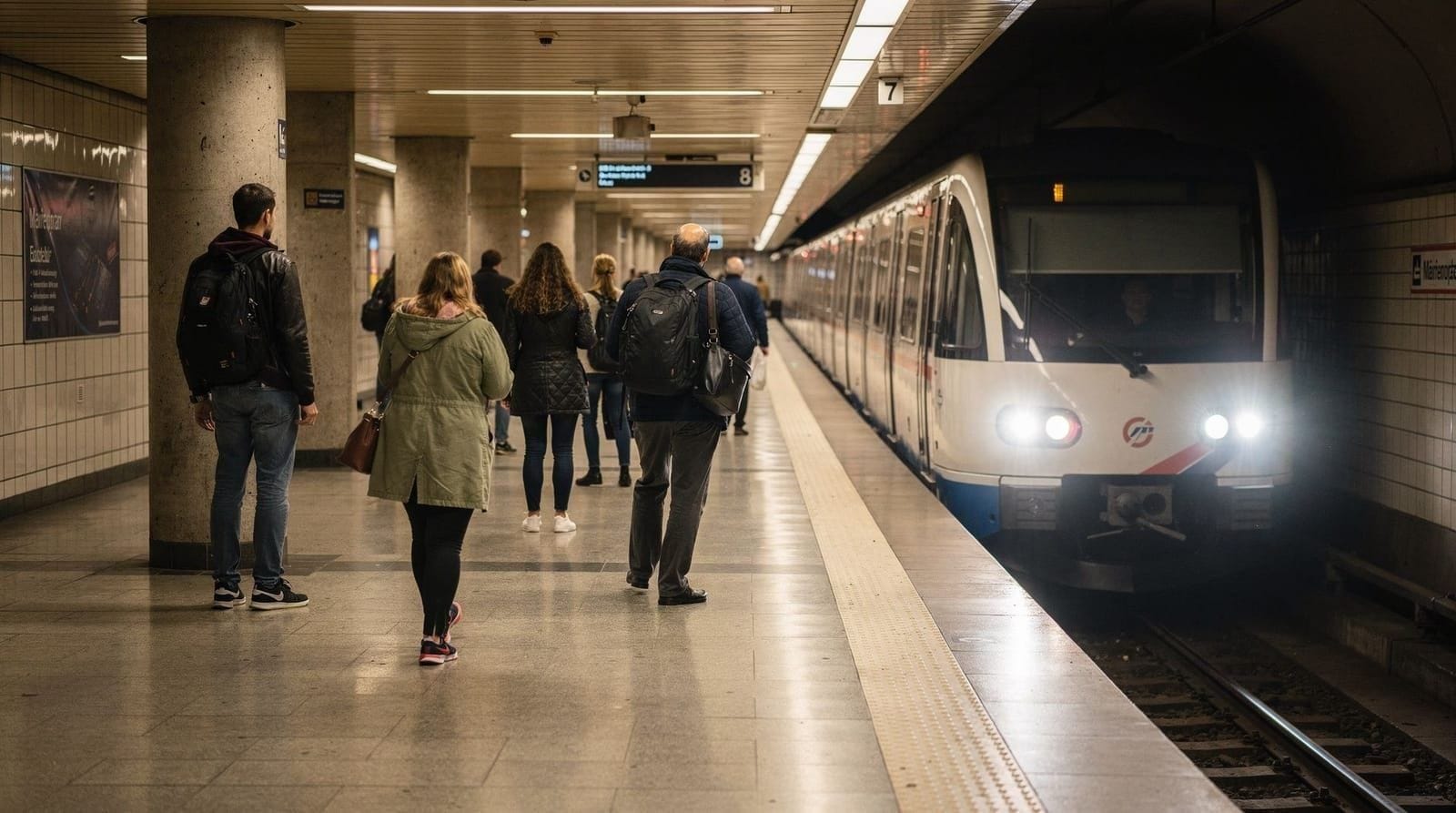
The U-Bahn (Untergrundbahn) is Munich’s dedicated underground metro, operated by MVG (part of the MVV). It has 8 lines, all underground within the city limits, running on tracks shared with no other traffic.
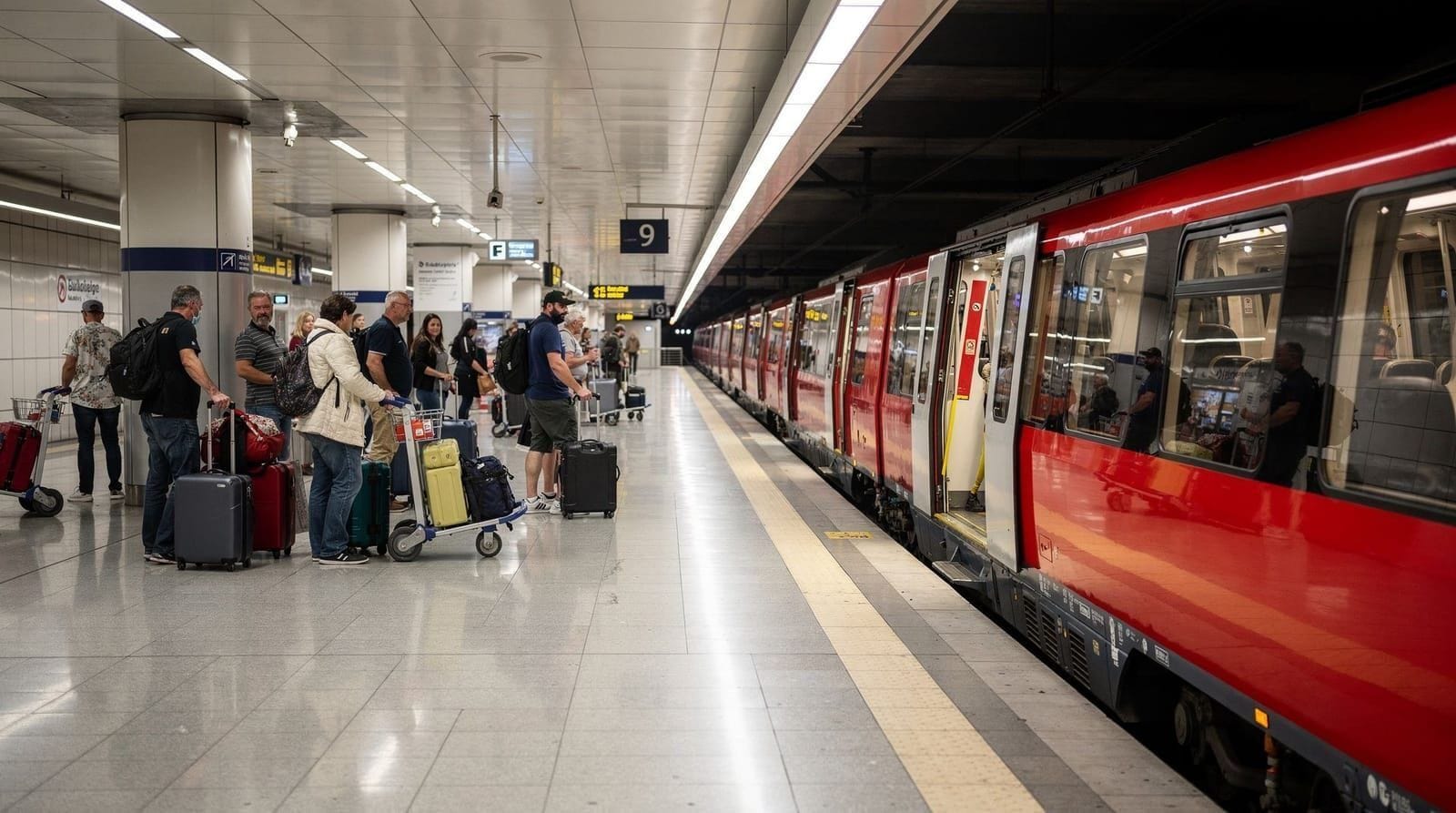
The S-Bahn (Stadtbahn) is the suburban rail network, operated by Deutsche Bahn but integrated into the MVV ticketing system. It runs underground through the city centre via the Stammstrecke (the east-west trunk tunnel) and then surfaces to serve outer suburbs and surrounding towns.
Both networks use the same MVV tickets. One validated ticket for the right zones works on both.
U-Bahn lines U1–U8
Munich’s U-Bahn network is relatively compact but covers the areas visitors need most. Here is a practical overview:
U1 — Olympia-Einkaufszentrum to Mangfallplatz
Runs northwest to southeast. Key stops for visitors include Hauptbahnhof, Sendlinger Tor, and Kolumbusplatz. The western end serves the OEZ shopping centre.
U2 — Feldmoching to Messestadt Ost
The long east-west line. Serves Hauptbahnhof, Sendlinger Tor, and continues east to the trade fair grounds (Messe München).
U3 — Moosach to Fürstenried West
Runs north-south through the western city. Key stops: Marienplatz (interchange with U6), Goetheplatz, Sendlinger Tor. Moosach in the northwest connects to S-Bahn at Moosach.
U4 — Arabellapark to Westendstrasse
A shorter east-west line through the northern and central city. Includes Odeonsplatz (close to the Residenz and Hofgarten), Hauptbahnhof, and Westendstrasse.
U5 — Laimer Platz to Neuperlach Süd
Another east-west line. Key stops include Hauptbahnhof and Ostbahnhof (important interchange with all S-Bahn lines). Serves the eastern residential suburbs.
U6 — Fröttmaning to Klinikum Großhadern
The long north-south spine of the network. Key stops: Marienplatz, Sendlinger Tor, Poccistrasse. The northern end serves Fröttmaning, which is where the Allianz Arena is located. The southern end serves the university hospital complex.
U7 — Westfriedhof to Neuperlach Süd
A partial line: technically U7 is U1+U2 combined at their southern ends, running as one service on certain parts of the track. Confusing on paper but in practice, platforms at the relevant stations make it clear.
U8 — Olympiazentrum to Neuperlach Süd
Another combined-routing line (U1+U2 variant). The result is that the segment between Sendlinger Tor and Ostfriedhof/Innsbrucker Ring sees a very high frequency of trains.
Frequency during daytime: every 5–10 minutes on most lines. Less frequent in early mornings and late evenings.
S-Bahn lines S1–S8
All S-Bahn lines converge on the central east-west Stammstrecke tunnel, making the city-centre segment extremely frequent (approximately every 2 minutes combined). Lines then diverge at Ostbahnhof to the east and Hauptbahnhof/Pasing to the west.
S1 — Flughafen München to Neufahrn/Freising
The airport line. Splits at Neufahrn into two branches: one terminates at Freising, the other at the airport. Runs underground through the city via the Stammstrecke to Pasing and beyond. Travel time airport to Hauptbahnhof: approximately 45 minutes.
S2 — Petershausen to Erding
Splits at Dachau to the northwest. Key stop for visitors: Dachau (for the memorial site). Also serves Erding in the southeast.
S3 — Mammendorf to Holzkirchen
Runs west to southeast. Serves Pasing and crosses the city via the Stammstrecke. Less significant for typical tourists but useful for reaching some southwest suburbs.
S4 — Geltendorf to Ebersberg
Runs west to northeast. Serves Pasing. Some S4 services terminate at Hauptbahnhof. This line connects to the BRB (Bayerische Regiobahn) at Geltendorf for onward travel toward Augsburg and Füssen direction.
S6 — Tutzing to Erding
Runs south through Starnberg and Tutzing. Key for day trips to Starnberger See — Starnberg station is the main access point for this lake district.
S7 — Wolfratshausen to Aying
Runs south through Deisenhofen. Serves Holzkirchen and Wolfratshausen (for access to Bad Tölz direction by connecting bus).
S8 — Flughafen München to Herrsching
The second airport line. Takes a slightly different route from the S1 through the city. Serves Ostbahnhof, Rosenheimer Platz, Marienplatz, Hauptbahnhof, and continues west to Herrsching (near Ammersee). Same travel time as S1 to/from the airport.
S-Bahn note on the Stammstrecke
Because all 8 lines share the central tunnel, delays on one line can cascade. If a signal problem or track issue occurs on the Stammstrecke, the entire network is affected. This is Munich’s known weak point. The second tunnel under construction (expected completion around 2028–2030) will provide redundancy.
Key interchange stations
Hauptbahnhof (Central Station)
Munich’s main railway hub. Served by all S-Bahn lines (S1–S8), U-Bahn lines U1, U2, U4, U5, U7, and U8 (depending on routing), regional trains (RE, RB, BRB), and intercity trains (ICE, IC, EC). If you get lost anywhere in Munich, come here and reorient.
Marienplatz
The heart of the old town. Served by S-Bahn (all lines via Stammstrecke) and U-Bahn U3/U6. The main interchange for tourists — from here you can reach most central attractions on foot or by transit.
Ostbahnhof
Served by all S-Bahn lines (S1–S8) and U5. Important for visitors in the east of the city (Au-Haidhausen neighbourhood, Rosenheimer Platz). Also handles some regional trains.
Sendlinger Tor
Key interchange for U1, U2, U6, and U8. Located south of the old town — useful for reaching the Isar riverbank, Glockenbachviertel, and southern neighbourhoods.
Odeonsplatz
Served by U3, U4, U5, U6. Located at the north edge of the old town, close to the Residenz, Hofgarten, and Theatinerkirche. The most pleasant way to enter the old town from the north.
The tram network
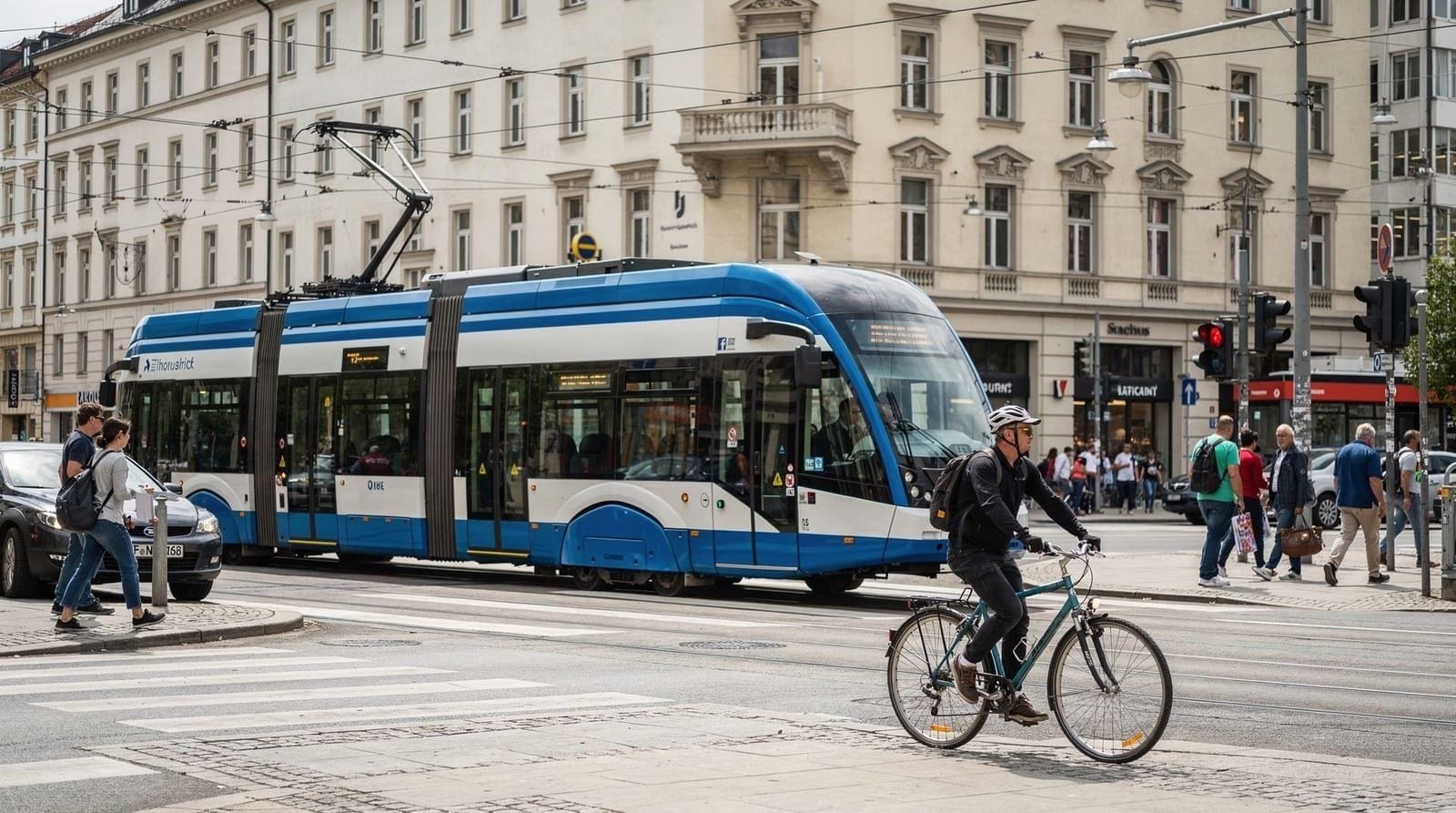
Munich has an extensive tram network covering areas not well served by U-Bahn, particularly in the northern and eastern city. The tram is slower than the U-Bahn but runs on the surface, giving you a view of the city.
Key tram lines for visitors:
- Tram 17: from Hauptbahnhof eastwards through the old town and into the east — useful for reaching some eastern neighbourhoods without going underground
- Tram 16: from Hauptbahnhof north through Schwabing — useful for the Englischer Garten northern entrance area
- Tram 19: along the northern edge of the old town, good for reaching Maxvorstadt and the Pinakothek museum quarter from the city centre
All trams use MVV tickets in the same zones. Validate at the machines inside the tram carriage.
Night services
Friday and Saturday nights (and nights before public holidays)
The U-Bahn runs all night at approximately 15–20 minute intervals. This is the best option for getting home after a late evening out. There is no extra charge.
Sunday to Thursday nights
Regular U-Bahn and S-Bahn service ends at approximately 1am. Night buses (Nachtlinien) cover all major routes after this, running every 30–40 minutes until around 5am when regular services resume. Night buses are marked with N before the line number (N17, N41, etc.) and use standard MVV tickets.
Planning night travel
If you are going out in the evening and need to be somewhere specific at a fixed time after 1am, plan around night buses rather than assuming you can use the U-Bahn. The MVV app shows night bus routes and times.
Reading the map
Munich’s transit map looks more complex than it is. A few pointers:
- U-Bahn lines are colour-coded: U1/U2 red, U3 orange, U4 teal, U5 light green, U6 dark blue, U7/U8 variants of U1/U2
- S-Bahn lines are all shown in green with numbers S1–S8
- The central segment of the map — from Ostbahnhof west through Marienplatz to Hauptbahnhof — is served by all S-Bahn lines running underground
- Pick up a physical map at any ticket machine or station information point — they are free and easier to read than a phone screen underground
Getting to key tourist sites by transit
| Destination | Best transit option | Nearest station |
|---|---|---|
| Marienplatz / Old Town | S-Bahn (any line) or U3/U6 | Marienplatz |
| Deutsches Museum | S-Bahn or tram | Rosenheimer Platz or tram 16/19 to Deutsches Museum stop |
| Nymphenburg Palace | U1 to Rotkreuzplatz + tram 12 | Schloss Nymphenburg (tram) |
| English Garden (Eisbach surfer) | U3/U6 to Giselastrasse | 10-min walk |
| Olympiapark | U3 | Olympiazentrum |
| Allianz Arena | U6 | Fröttmaning |
| BMW Welt | U3 | Olympiazentrum, 10-min walk |
| Munich Airport | S1 or S8 | Flughafen München |
| Dachau Memorial | S2 to Dachau + bus 726 | Dachau Bahnhof |
For more on reaching specific destinations, see the relevant guide — for example Dachau memorial guide or Olympiapark guide.
Reaching Munich’s neighbourhoods by transit
Most of Munich’s districts sit directly on a U-Bahn or S-Bahn line, which makes neighbourhood-hopping easy without a car.
Schwabing, north of the centre, is served by U3/U6 (Münchner Freiheit, Giselastrasse) — see the Schwabing neighbourhood guide for what to do once you arrive.
Maxvorstadt, home to the Pinakothek museum quarter, sits between U2 (Theresienstrasse, Königsplatz) and tram 27/28 — the Maxvorstadt guide covers the museum-hopping route.
Glockenbachviertel, south of the old town, is reached via U1/U2 to Fraunhoferstrasse or U3/U6 to Sendlinger Tor — full detail in the Glockenbachviertel guide.
Au-Haidhausen, east of the Isar, is served by tram 15/25 and S-Bahn to Rosenheimer Platz — the Au-Haidhausen guide has the walking route from the station.
The Munich Altstadt guide covers the old town itself, which is walkable end-to-end once you arrive at Marienplatz or Odeonsplatz.
Tickets, validation and accessibility
Buy tickets before boarding from the machines at any station entrance (English-language option available) or the MVGo app. There are no ticket barriers — the system runs on trust, backed by regular plain-clothes inspections. Validate paper tickets at the small blue or white stamping machines on platforms before your first journey; app tickets are validated automatically at purchase.
Most U-Bahn and S-Bahn stations have step-free access via lifts, and trains have a level or near-level boarding gap, though a handful of older S-Bahn stations still have platform gaps that need care with a wheelchair or a pram. The MVV website publishes a station-by-station accessibility list if step-free access is essential to your route.
The second tunnel: Zweite Stammstrecke
Construction of a second underground east-west rail tunnel (Zweite Stammstrecke) is underway and causes some disruption at stations in the city centre, particularly near Hauptbahnhof and Marienplatz. Hoardings and temporary platform changes are visible. The project is expected to be completed around 2028. When done, it will double the capacity of the central corridor and make the entire S-Bahn more resilient to delays.
Frequently asked questions about Munich’s U-Bahn and S-Bahn
Which line do I take to get from Hauptbahnhof to Marienplatz?
Any S-Bahn line (they all stop at both), or U3/U6. The U-Bahn is one stop; the S-Bahn is two minutes underground. Both are so close you will probably walk between the two stations faster than waiting for a train.
Is there a transit pass just for tourists?
Yes — the MVV Day Ticket (Tageskarte) is the standard tourist option. See the full Munich public transport guide for prices and options.
What are the blue seats on U-Bahn trains?
Priority seats, reserved for elderly passengers, pregnant women, people with disabilities, and those with small children. You are expected to give these up if someone who needs them gets on.
Can I use contactless payment to board the U-Bahn?
No. Munich’s transit system does not currently support open-loop contactless payment. You must buy a ticket in advance from a machine or the MVV app.
Why does the S-Bahn sometimes stop running and buses replace it?
The Stammstrecke is a single-track corridor used by all 8 S-Bahn lines. Any incident — track fault, medical emergency, signal failure — affects the whole network. Schienenersatzverkehr (rail replacement buses) are deployed when a section of track is closed. These are free with a valid transit ticket but significantly slower.
Is the U-Bahn or S-Bahn better for reaching Marienplatz from the airport?
Neither serves the airport directly except the S-Bahn — take S1 or S8 all the way to Marienplatz in about 40 minutes, no transfer needed. The U-Bahn does not reach Munich Airport at all, so this is really a non-choice: S-Bahn is the only rail option, and it is also the best-value one.
Do children travel free on the U-Bahn and S-Bahn?
Children up to 14 travel free with an accompanying adult on most MVV ticket types (day tickets, Streifenkarte), while under-6s travel free on all ticket types. Check the specific ticket conditions at the machine, as rules vary slightly by ticket category.