Munich Third Reich walking tour — sites, history and what to expect
Munich: Third Reich tour
What does a Munich Third Reich walking tour cover?
These tours visit key Nazi-era sites in the city centre — the former NSDAP headquarters on Brienner Strasse, the Feldherrnhalle where the 1923 Beer Hall Putsch ended, the NS-Dokumentationszentrum, and memorials to victims and resistance fighters. Most tours last 2.5 to 3 hours on foot.
Why Munich and the Third Reich are inseparable
No European city is more directly implicated in the rise of National Socialism than Munich. Between 1919 and 1933, Munich was the geographic and ideological birthplace of the Nazi movement — a fact the city confronted honestly only in recent decades. Understanding that history is not a grim footnote to a Munich trip; it is essential context for understanding how a cultured, prosperous city became the launching pad for catastrophe.
This guide covers the key sites in the city centre, what responsible guided tours include, how to plan a self-guided walk, and how to approach the material with the seriousness it deserves.
| Where | Odeonsplatz, Königsplatz, Brienner Strasse, central Maxvorstadt |
| Cost | Free outdoor sites; NS-Dokumentationszentrum around 7 EUR; guided tours vary |
| Time needed | 2.5–3 hours guided, up to 3 hours self-guided |
| Getting there | Walkable from Marienplatz; U3/U4/U5/U6 to Odeonsplatz |
| Best time | Weekday mornings — quieter at the memorials and inside the centre |
Munich as “Capital of the Movement”
The Nazis themselves branded Munich the “Hauptstadt der Bewegung” — Capital of the Movement. The title was not metaphorical. Hitler arrived in Munich in 1913 and never really left until the war years. The NSDAP was founded here in 1920, at the Hofbräuhaus. The failed Beer Hall Putsch of November 1923 was launched at the Bürgerbräukeller (long since demolished; a plaque marks Rosenheimer Platz) and ended in a volley of police fire at the Feldherrnhalle. After 1933, the party established its formal headquarters in the city’s Maxvorstadt district.
Walking through Munich today means walking through streets that the Nazi leadership considered their home ground. The sites are embedded in ordinary city fabric — next to the NS-Dokumentationszentrum on Brienner Strasse are apartment buildings, restaurants, the Egyptian Museum. That ordinariness is part of the historical lesson.
The core Third Reich sites in Munich
Feldherrnhalle, Odeonsplatz
The 1843 loggia at the southern end of Ludwigstrasse became the terminus of the failed putsch on 9 November 1923. After 1933, an SS guard of honour was posted here permanently, and Munich residents developed the “Türkengraben” — a detour through Viscardigasse alongside the Residenz — to avoid saluting the guards. A small brass plaque in Viscardigasse commemorates this quiet daily act of resistance. The square itself is worth pausing on: the Theatinerkirche behind you, the Residenz to your right, and below your feet, the memory of sixteen dead Nazi marchers whose cult of martyrdom the regime weaponised for years.
Königsplatz
A short walk west from Odeonsplatz, Königsplatz was designed in the early 19th century as a neoclassical forum. The Nazis paved over its lawns, demolished trees, and turned it into a parade ground. Two “temples of honour” flanking the square housed the sarcophagi of the putsch dead; both were demolished by American occupiers in 1945. The archaeological marks of the original paving stones are still visible if you know to look. Today the square has been restored with grass and houses the Glyptothek and the Antikensammlungen.
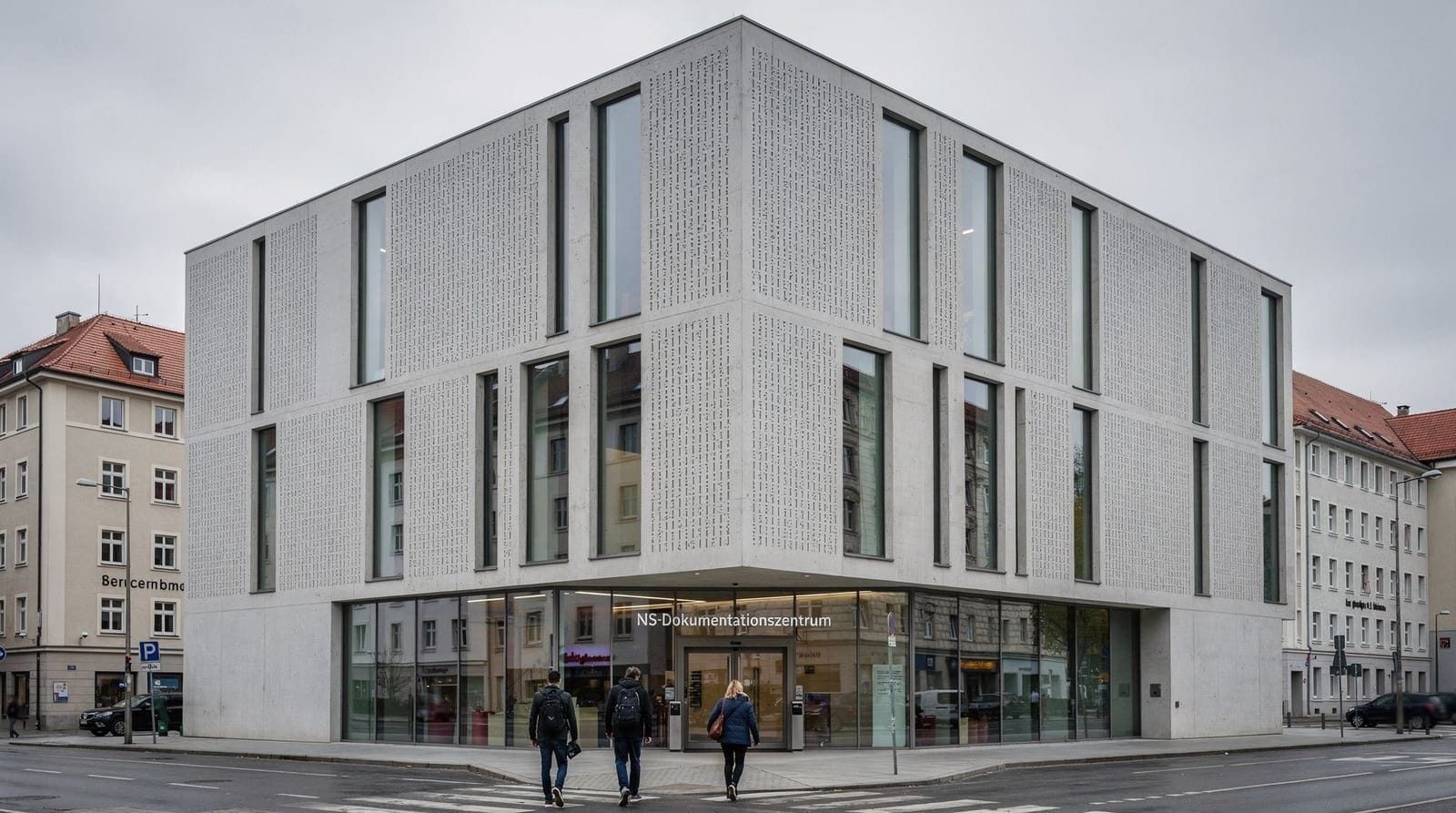
NS-Dokumentationszentrum, Brienner Strasse 34
Opened in 2015, the NS-Dokumentationszentrum occupies the site of the former “Braunes Haus” — the NSDAP’s national headquarters from 1930 to 1945. The building is a striking white cube, deliberately stark. Inside, four floors of permanent exhibition trace the rise of National Socialism, Munich’s specific role, and the consequences for Europe. The address — Brienner Strasse 34 — is deliberate: it is the same address as the Braunes Haus. A detailed guide to the NS-Dokumentationszentrum covers admission, exhibitions and how to plan your visit. Plan at least 90 minutes; two hours is more comfortable.
The former NSDAP administrative district
Between Brienner Strasse, Arcisstrasse, Meiserstrasse and Karolinenplatz lies what was the dense administrative core of the Third Reich’s Munich operations. The Führerbau (Hitler’s official Munich reception building) survives as the Hochschule für Musik und Theater at Arcisstrasse 12. The former Verwaltungsbau opposite is now the NS-Dokumentationszentrum site. Most guided tours walk this district slowly, explaining what stood where and what each building was used for.
Maxvorstadt as a whole
The district of Maxvorstadt — Munich’s university quarter, home to the Pinakotheken and the Lenbachhaus — was deliberately colonised by the Nazi party in the 1930s as both a power symbol and a counterweight to the cultural institutions already based there. Understanding Munich’s Maxvorstadt neighbourhood helps contextualise how the party inserted itself into the city’s existing cultural geography.
Guided tours: what options exist
 Third Reich and WWII walking tourCheck availability
Several professional operators offer Third Reich walking tours in Munich, with meaningful differences in quality and approach.
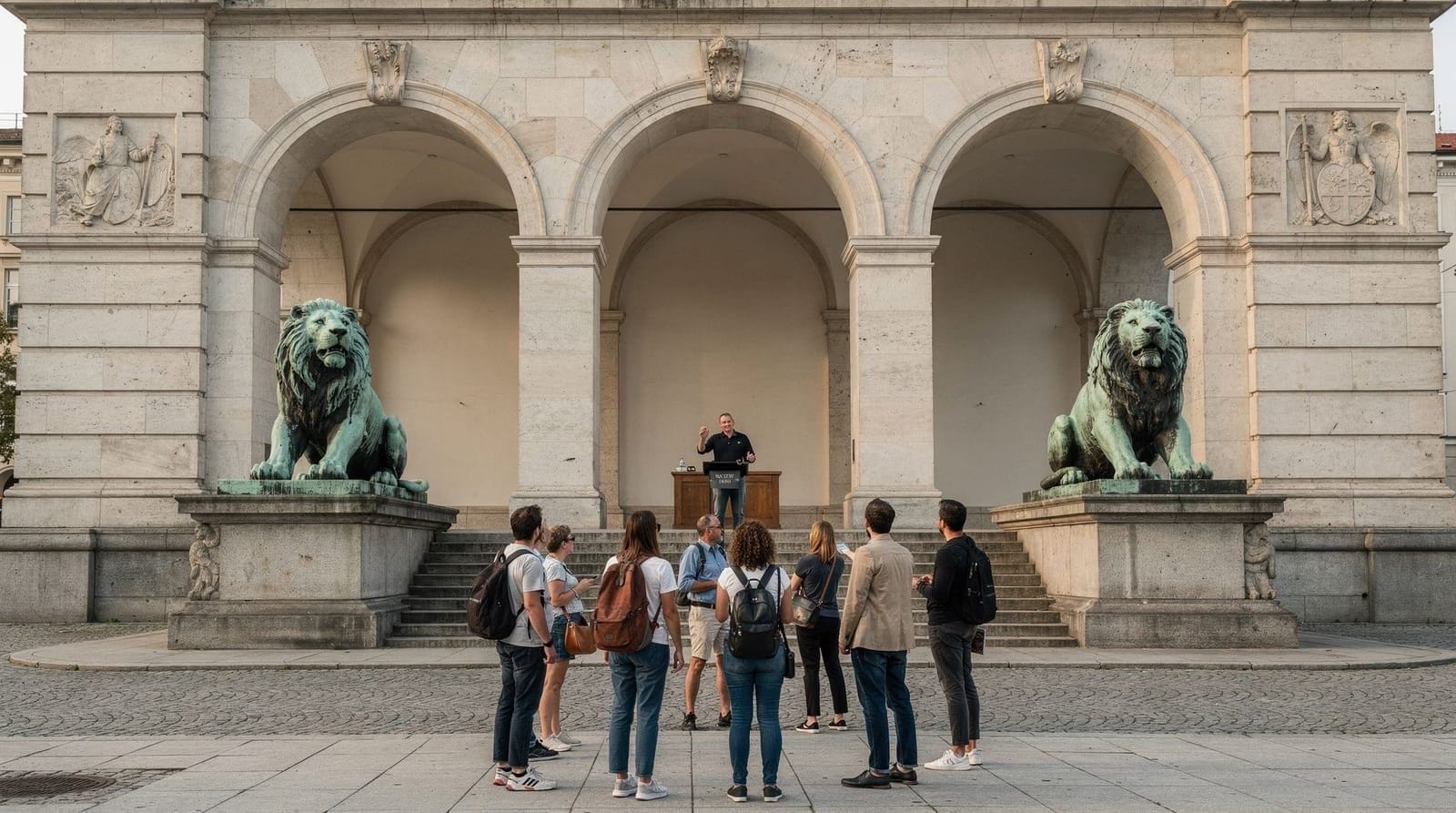
Standard group tours (typically 10 to 20 participants) cover the Feldherrnhalle, Viscardigasse, Königsplatz, and the NS-Dokumentationszentrum exterior in roughly 2.5 hours. Guides vary considerably in depth: the better ones are historians or trained guides who engage with the moral complexity of the material; others are more surface-level. English-language tours depart daily from central Munich. 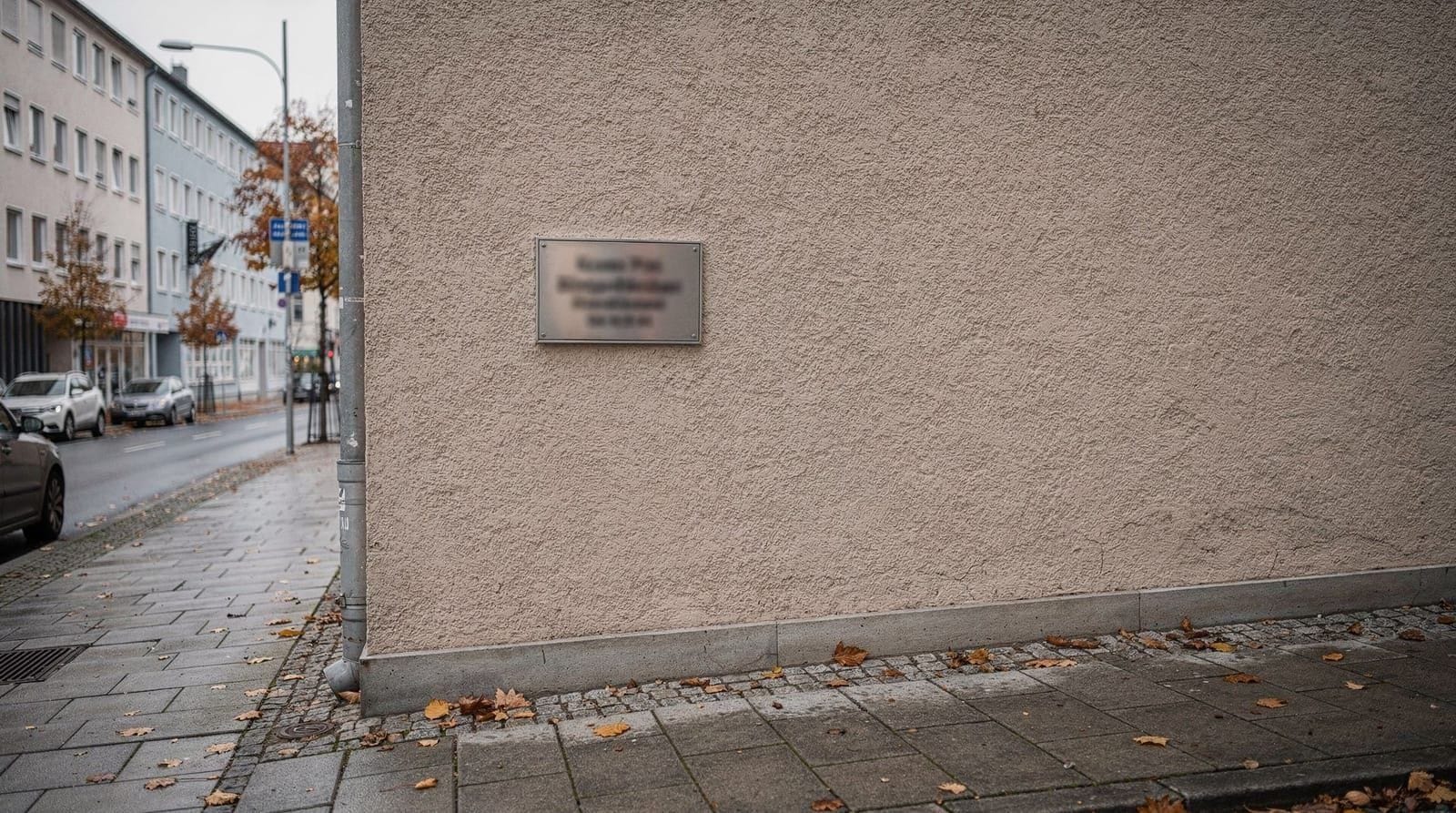 Third Reich and World War II private guided tourCheck availability
Private guided tours allow you to ask questions, spend more time at specific sites, and adapt the route. For visitors with a serious interest in the period, a private tour with a specialist guide is worth the premium. Several operators offer three to four hour private tours covering both the inner-city sites and the context of Munich’s broader role.
A segway-format tour exists for this route but should be considered carefully — the subject matter warrants a pace that allows reflection, and rolling through on a segway past memorials to genocide victims sits awkwardly with many visitors and local residents.
A self-guided walking route
For visitors who prefer to explore independently, the following route covers the main sites in roughly three hours at a reflective pace.
Start at Marienplatz — the historic heart of Munich’s old town. Walk north along Theatinerstrasse to Odeonsplatz and examine the Feldherrnhalle. Cut through Viscardigasse and look for the brass cobblestones commemorating the detour. Continue west along Galeriestrasse into Maximilianstrasse and then north to Brienner Strasse. Walk along Brienner Strasse past the Four Seasons Hotel (historically significant during the putsch era) to Brienner Strasse 34 and the NS-Dokumentationszentrum. Continue to Königsplatz and examine the square.
Allow time to enter the NS-Dokumentationszentrum if open (Tuesday to Sunday 10:00–19:00). Return via Arcisstrasse past the Führerbau/Hochschule für Musik und Theater. From there it is a short walk back east toward the Pinakotheken district.
Guided tour vs self-guided walk
Both approaches cover the core sites; the difference is depth, pacing and cost.
| Guided tour | Self-guided walk | |
|---|---|---|
| Cost | Paid, varies by group size | Free (plus NS-Dokumentationszentrum entry) |
| Time | Fixed 2.5–3 hours | As long as you want |
| Context | Historian-led narration, Q&A | Requires reading ahead or using the linked guides |
| Best for | First visit, limited time, want expert framing | Return visitors, those wanting to linger at specific sites |
| Flexibility | Fixed route and pace | Full control — skip, backtrack, sit and reflect |
If you only have one morning in Munich for this history, a guided walk is the more efficient choice — a trained guide connects the sites into a coherent narrative that is harder to assemble alone from plaques and signage. Birthplace of the Third Reich walking tour
Memorial etiquette and Stolpersteine
Munich has been slower than Berlin to adopt Stolpersteine — the small brass “stumbling stone” memorials set into pavements outside the former homes of Nazi victims — because the Munich city council long argued that stones underfoot risked being trodden on disrespectfully. Instead, the city favours plaques at eye level and dedicated memorial sites such as the NS-Dokumentationszentrum. A small number of privately funded Stolpersteine do exist around the city, mostly outside the historic centre. Wherever you encounter a memorial — a plaque, a stone, a name — pause rather than photograph and move on; treat it the way you would a gravestone.
Photography is generally permitted at outdoor sites and inside the NS-Dokumentationszentrum’s permanent exhibition, though flash and tripods are discouraged in the exhibition halls. Avoid posed or celebratory photos at any memorial — a quick respectful shot of a plaque or building facade is fine, but treat the Feldherrnhalle and Viscardigasse as you would a war grave, not a backdrop.
The Beer Hall Putsch in historical context
The putsch of 8 to 9 November 1923 is often described as a comic failure. It was not. Hitler and approximately 2,000 armed NSDAP members seized the Bürgerbräukeller on the evening of 8 November, held Bavarian state ministers at gunpoint, and attempted to declare a national revolution. The following morning’s march through Munich ended when Bavarian state police opened fire. Hitler fled, was arrested, and served nine months in Landsberg am Lech prison — during which he dictated “Mein Kampf.”
The putsch failed militarily but succeeded politically. It gave the NSDAP national media coverage, gave Hitler a propaganda trial platform, and generated sixteen martyrs whose cult the party weaponised for the following decade. The full history of the Beer Hall Putsch covers the events in detail.
The White Rose resistance
Any tour of Third Reich Munich should include the White Rose. Between 1942 and 1943, a small group of students at Ludwig Maximilian University — primarily Sophie Scholl, Hans Scholl and Christoph Probst — produced and distributed anti-Nazi leaflets calling for passive resistance. They were arrested at the university on 18 February 1943, tried before the People’s Court in Berlin, and guillotined four days later.
A memorial installation at Ludwig Maximilian University (Geschwister-Scholl-Platz 1) marks the spot where they were arrested. The DenkStätte Weiße Rose inside the main university building is free to enter. The White Rose resistance guide covers the history and the sites in detail.
Jewish Munich before 1933
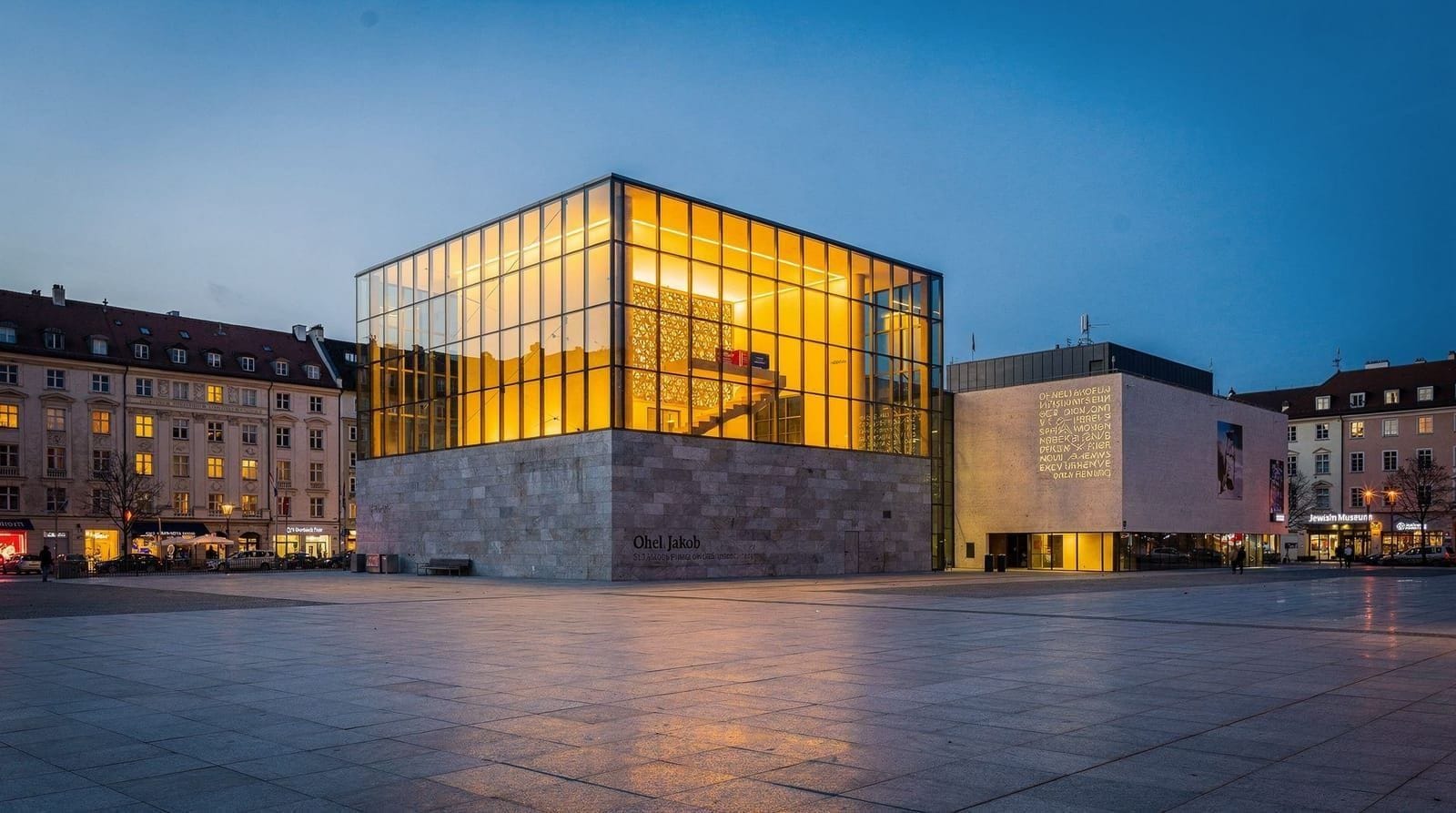
Munich had a significant Jewish community before the Nazi period — around 11,000 people by 1933. The Ohel Jakob synagogue on Sankt-Jakobs-Platz, reopened in 2006, stands on the site of the original synagogue burned during Kristallnacht on 9 November 1938. The Jewish Museum adjacent to it contextualises Munich’s Jewish history from the medieval period through the present. For a full account, see the Munich Jewish history guide.
Dachau: the concentration camp
Dachau, 30 minutes from central Munich by S2 train and bus, was the first Nazi concentration camp, opened in March 1933. The Dachau Concentration Camp Memorial Site is free to enter and receives over one million visitors annually. It operates as an educational and commemorative institution, not a tourist attraction. A complete guide to visiting the Dachau Memorial covers transport, what to expect and how to prepare.
If your interest in Third Reich history extends to Dachau, plan it as a separate half-day or full-day visit rather than tacking it onto a Munich walking tour.
What to do after the tour
Processing a morning spent with this material takes time. Many visitors find that the Englischer Garten or the banks of the Isar provide space for reflection. The English Garden is a ten-minute walk from Odeonsplatz and offers the kind of quiet green space that Munich does particularly well.
The NS-Dokumentationszentrum’s café on the ground floor is a calm, thoughtful space for coffee. Alternatively, the Café Luitpold on Brienner Strasse — a belle époque institution with a long and complicated history across the Nazi period — is worth knowing about.
Planning context
The Third Reich sites are all in walkable distance of central Munich. The NS-Dokumentationszentrum is closed Mondays. Most outdoor memorials are accessible at any time. The Munich public transport guide covers how to get around, and Munich’s Maxvorstadt guide helps orient you in the district where most of these sites sit.
If this is your first visit to Munich and you are trying to balance history with the city’s other attractions, how many days to spend in Munich offers honest advice on pacing.
Frequently asked questions about Munich Third Reich tours
Is it disrespectful to take a walking tour of Nazi-era sites?
No — professional tours of this kind are an important part of historical education and are welcomed by the city’s institutions. The NS-Dokumentationszentrum itself was built specifically to encourage engagement with this history. The distinction is between respectful, educational engagement and the kind of sensational “dark tourism” that treats suffering as spectacle. Quality guided tours fall clearly in the former category.
Can I visit the NS-Dokumentationszentrum on my own?
Yes. The centre is open Tuesday to Sunday, 10:00 to 19:00. Entry is 7 euros for adults, reduced rates for students and concessions. Audio guides are available in multiple languages. The permanent exhibition requires no advance booking, though temporary exhibitions may have limited capacity.
What happened to the Bürgerbräukeller where the putsch started?
The Bürgerbräukeller was demolished in 1979. The Gasteig cultural centre now occupies part of the site near Rosenheimer Platz. A small plaque marks the location. Georg Elser planted his time bomb here in November 1939 in a nearly successful assassination attempt on Hitler.
How does Munich compare with Berlin and Nuremberg for Third Reich history?
The three cities serve different historical functions. Munich is where the Nazi movement was born and headquartered. Berlin is where the regime ruled and planned the Holocaust. Nuremberg hosted the party rallies, the racial laws, and the post-war trials. A visitor seriously interested in this history should ideally visit all three; a day trip to Nuremberg from Munich is practical and the Nuremberg trials guide covers what to see there.
Are there any Third Reich sites in Munich that are not well-signed?
Yes. Several sites have minimal or no marking. The former Braunes Haus site now has the NS-Dokumentationszentrum. The former Führerbau has a small plaque but is primarily used as a music school. The Bürgerbräukeller site has only a small marker. Many tour guides flag this as an ongoing issue — the city has been historically slow to mark all sites, partly due to fears of creating pilgrimage points for right-wing groups.
What is the Georg Elser memorial?
Georg Elser was a Swabian carpenter who, acting entirely alone, planted a bomb in a column of the Bürgerbräukeller in November 1939 targeting Hitler. The bomb detonated on schedule but Hitler had left the hall early. Elser was arrested, held in Dachau and Sachsenhausen concentration camps as a “special prisoner,” and executed in Dachau on 9 April 1945, days before liberation. A small square near Odeonsplatz is named after him.
What is the best English-language book to read before visiting?
David Clay Large’s “Where Ghosts Walked: Munich’s Road to the Third Reich” (1997) is the most comprehensive single-volume account of Munich’s specific role. Richard Evans’s three-volume Third Reich trilogy provides the broader context. Ian Kershaw’s two-volume Hitler biography is essential for understanding the man at the centre.
Is photography allowed at the memorial sites?
Yes, generally. Outdoor plaques and squares can be photographed freely, and the NS-Dokumentationszentrum permits photography without flash in its permanent exhibition, though tripods and professional setups are discouraged. The etiquette that matters more than the rule: keep photos respectful and factual rather than posed, and avoid using memorial sites as a backdrop for unrelated content.
Are there Stolpersteine (“stumbling stones”) in Munich?
A small number exist, mostly funded privately outside the historic centre, but Munich’s city council has historically preferred plaques and dedicated memorial sites over pavement stones, unlike Berlin where Stolpersteine are widespread. The NS-Dokumentationszentrum remains the city’s primary and most comprehensive commemorative institution.
Top experiences
Bookable activities with verified prices and instant confirmation on GetYourGuide.