Munich Jewish history — from medieval origins to the new synagogue
Munich: birthplace of the Third Reich guided walking tour
What is the history of Munich's Jewish community?
Munich has had a Jewish community since the 12th century, with periods of expulsion, re-admission and growth. By 1933 approximately 11,000 Jews lived in Munich. The Nazi period brought persecution, Kristallnacht (1938), deportations from 1941, and near-total destruction of the community. A renewed community has grown since 1945; the Ohel Jakob synagogue on Sankt-Jakobs-Platz opened in 2006.
A community shaped by centuries of inclusion and exclusion
Munich’s Jewish history spans nearly nine centuries, marked by cycles of welcome and expulsion that characterised Jewish life across medieval and early modern Europe — and then by the unique catastrophe of the Nazi period, which systematically destroyed a community that had become an integral part of Munich’s cultural, academic and commercial life.
To visit Munich’s Jewish sites today is to encounter both that loss and a remarkable post-war renewal: a Jewish community that has grown from a handful of survivors to approximately 9,000 members, served by a major new synagogue, a Jewish museum and a range of cultural institutions on the rebuilt Sankt-Jakobs-Platz.
| Key site | Sankt-Jakobs-Platz (synagogue, museum, community centre) |
| Jewish Museum entry | Around €6 adults, €3 reduced |
| Getting there | U3/U6 Sendlinger Tor, 5 min walk |
| Deportation memorial | Gleis 11, Munich Hauptbahnhof, free |
| Time needed | 2–3 hours for museum + Stolpersteine walk |
Medieval and early modern Jewish Munich
The earliest documented evidence of a Jewish community in Munich dates to the 12th century. Like Jewish communities across the Holy Roman Empire, Munich’s Jews were subject to a legal framework that defined them as imperial property — taxed, occasionally protected, frequently accused and periodically expelled.
The worst medieval episode was the Munich Massacre of 1285, when the Jewish community was falsely accused of ritual murder following the disappearance of a Christian child. The community was attacked; according to contemporary accounts, Jews took refuge in their synagogue, which was burned. The exact number of victims is unknown. A plaque in the area around the Jakobskirche marks the approximate location of the medieval synagogue.
Jews were expelled from Munich in 1442, allowed to return intermittently, and remained subject to restrictions — on residence, professions and movement — that were not lifted until the gradual emancipation of the 18th and 19th centuries. Bavarian Jews were granted full legal equality only with German unification in 1871.
The 19th-century community: growth and civic integration
The emancipation of the 19th century transformed Munich’s Jewish community. From a small, legally restricted population, it grew into a significant presence in Munich’s commercial, academic, artistic and legal life. By 1910, approximately 11,000 Jews lived in Munich — around 3.5 percent of the city’s population.
This community was overwhelmingly middle-class, German-speaking and highly integrated into Munich’s civic life. Jewish Munichoises included prominent lawyers, doctors, academics, artists, newspaper editors and business figures. The community’s institutional life was centred on the Ohel Jakob synagogue, dedicated in 1887 on Herzog-Max-Strasse. The building — an ornate structure in Moorish-Renaissance style — reflected the community’s confidence and its expectation of permanence.
The writer Lion Feuchtwanger, the poet Rainer Maria Rilke (who associated with Munich’s Jewish intellectual circles), the conductor Bruno Walter and the cabaret artist Karl Valentin all had significant connections to Munich’s Jewish cultural life in this period. The city’s art scene in Schwabing in the early 20th century was notably mixed, with Jewish artists, patrons and collectors central to the circles that included Wassily Kandinsky and Franz Marc.
1933 to 1938: persecution and flight
The National Socialist seizure of power in January 1933 began a process of exclusion and persecution that unfolded in stages. Munich, as the NSDAP’s home city, was in some respects an early laboratory for anti-Jewish measures.
April 1933 brought the organised boycott of Jewish businesses across Germany. Jewish civil servants, including university professors and judges, were removed from their positions under the Law for the Restoration of the Professional Civil Service. The Nuremberg Laws of September 1935 stripped Jews of German citizenship and prohibited marriages and sexual relations between Jews and non-Jews.
In Munich, the pressures were acute. Jewish-owned businesses faced systematic campaigns of intimidation. The Jüdisches Gemeindeblatt — the community’s newspaper — reported a steady stream of exclusions, attacks and humiliations. Jewish families who could, emigrated: to the United States, to Britain, to Palestine, to South America. Those who had the means and connections found exit; those who lacked resources or believed the situation would stabilise often could not.
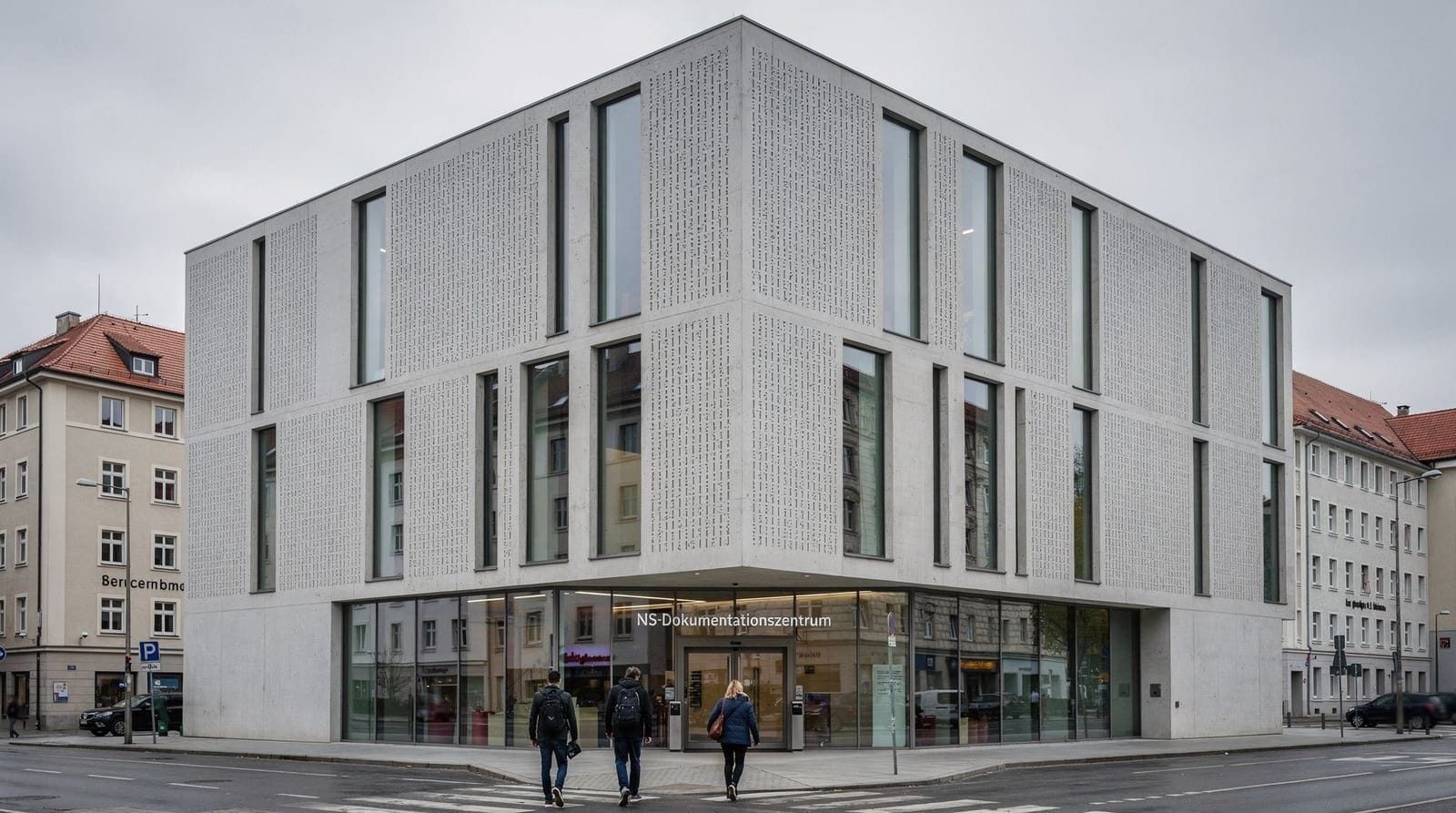
The NS-Dokumentationszentrum guide covers the general history of this period; the NS-Dokumentationszentrum itself documents Munich’s specific cases.
Kristallnacht, 9 November 1938
The pogrom of 9 to 10 November 1938 — known as Kristallnacht (Night of Broken Glass) — was a nationally coordinated attack on Jewish property, synagogues and individuals, organised by the SS and SA under the pretext of avenging the assassination of a German diplomat in Paris.
In Munich, the Ohel Jakob synagogue on Herzog-Max-Strasse was set on fire. The building burned while Munich firefighters stood by to protect adjacent non-Jewish property. Jewish-owned shops throughout the city centre were looted and their windows smashed. Jewish men were arrested and taken to Dachau concentration camp. Several Munich Jews were beaten; some killed.
The ruins of the Ohel Jakob synagogue were subsequently demolished. The site is today occupied by a hotel. No memorial marks it prominently, though a small plaque exists on the pavement.
Kristallnacht was the turning point at which the character of Nazi anti-Jewish policy shifted from legal exclusion to physical violence. For many German Jews who had until then remained, it became clear that emigration was no longer an option but an urgent necessity. Those who could still leave did so in the months that followed. But international immigration restrictions were tightening, and the window for exit was narrowing.
1941 to 1945: deportations and the Holocaust
The first deportation transport of Munich Jews left from Munich Hauptbahnhof on Platform 11 on 20 November 1941, carrying approximately 1,000 people to the Kaunas ghetto in Lithuania. Most were killed within days of arrival. Further transports followed: to Piaski, to Theresienstadt (the “model camp” used as a transit ghetto), to Auschwitz-Birkenau, to Riga and to other extermination sites.
Of the approximately 11,000 Jews living in Munich in 1933, the majority had emigrated by the time deportations began. Of those who remained, approximately 4,000 to 5,000 were deported. The survival rate for deported Munich Jews was extremely low.
The Gleis 11 memorial at Munich Hauptbahnhof marks Platform 11, the departure point for the deportations. The memorial — a series of information panels and a modest sculpture — is accessible as part of Hauptbahnhof’s public space. It is easy to miss in the bustle of a major train station; finding it requires looking for the Gleis 11 signs in the eastern section of the station.
The Stolpersteine network
Distributed across Munich’s pavements are thousands of Stolpersteine — small brass plaques, 10 by 10 cm, embedded in the pavement outside buildings where Holocaust victims lived or worked. The project was created by the artist Gunter Demnig in 1992 and has since become the largest decentralised memorial in the world, with over 100,000 Stolpersteine in more than 1,200 cities.
A Stolperstein reads, typically: “HERE LIVED / [Name] / BORN [year] / DEPORTED [date and destination] / MURDERED [date and place].” The deliberate use of the past tense “lived” — and the instruction to “stumble” over the stone, bowing your head to read it — personalises the abstract scale of the Holocaust. Each Stolperstein is a specific individual, not a statistic.
Stolpersteine are particularly dense in Munich’s Maxvorstadt, Schwabing and Altstadt districts, where much of the Jewish community was concentrated. Walking slowly through these areas and reading the plaques is one of the most affecting ways of engaging with what happened.
Sankt-Jakobs-Platz: the new Jewish quarter
The centre of Munich’s renewed Jewish communal life is Sankt-Jakobs-Platz, a square in the Altstadt south of Sendlinger Strasse. The square previously housed the Jakobskirche and was an unremarkable part of the city centre. It was chosen in 2003 as the location for a new synagogue, Jewish museum and community centre — a visible, central expression of Jewish life in Munich.
Ohel Jakob synagogue
The new Ohel Jakob synagogue opened on 9 November 2006 — the 68th anniversary of Kristallnacht. The date was chosen deliberately. The building, designed by architects Wandel Hoefer Lorch, is a stone cube on a travertine plinth, clad in panels of Hebrew text from the psalms. The interior combines traditional elements (the ark, the bimah) with a modern aesthetic. The synagogue serves the Israelitische Kultusgemeinde München und Oberbayern, which in 2026 has approximately 9,000 members — a community that has grown substantially through immigration from the former Soviet Union since the 1990s.
The synagogue is not a tourist site but an active house of worship. External viewing is unrestricted. Guided visits can sometimes be arranged through the community administration; security arrangements for entry are in place, reflecting the sadly continuing need for protection.
Jewish Museum Munich
The Jüdisches Museum München opened in 2007 in an adjacent building on Sankt-Jakobs-Platz 16. Its permanent exhibition — “Migration und Heimat” (Migration and Home) — takes a thematic rather than purely chronological approach to Munich Jewish history, organised around questions of displacement, belonging and identity.
The museum is an important complement to the NS-Dokumentationszentrum’s coverage of the Nazi period. Where the Dokumentationszentrum focuses on how National Socialism emerged and was enabled, the Jewish Museum tells the story of the community it targeted and destroyed — and the community that has rebuilt since.
Practical information:
- Address: Sankt-Jakobs-Platz 16, 80331 Munich
- Opening hours: Tuesday to Sunday, 10:00 to 18:00. Closed Mondays.
- Admission: 6 euros adults, 3 euros reduced (2026 prices).
- Getting there: U3/U6 to Sendlinger Tor, 5 minutes walk north.
The community centre
Between the synagogue and the museum, a large community centre (Gemeindezentrum) houses the community’s social, educational and cultural functions — a kosher restaurant (Schmock, a popular secular restaurant is adjacent on Augustenstrasse), library, youth groups and administrative offices. The complex together represents the largest and most visible investment in Jewish communal life in Germany outside Berlin.
A self-guided route through Jewish Munich
For visitors who prefer to walk the sites at their own pace rather than join a group tour, the following route covers the essential locations in roughly half a day.
- Start at Sankt-Jakobs-Platz — view the Ohel Jakob synagogue exterior and visit the Jewish Museum (allow 90 minutes for the permanent exhibition).
- Walk north through Maxvorstadt — Stolpersteine are densely distributed here; a slow 30–40 minute walk reading the pavement plaques is one of the most affecting parts of the route.
- NS-Dokumentationszentrum on Brienner Strasse — covers the broader mechanics of how National Socialism took hold in Munich; complements the Jewish Museum’s focus on the community itself. See the NS-Dokumentationszentrum guide.
- Finish at Munich Hauptbahnhof, Gleis 11 — the deportation memorial, a quiet and easy-to-miss conclusion to the route. Look for the signage in the eastern section of the station.
The full route covers roughly 3–4 km and is entirely on foot or a short U-Bahn ride between the first and second stops. Most visitors find a mid-route break useful — the Jewish Museum’s café is a reasonable stop before the walking portion.
Engaging with Jewish Munich today
 birthplace of the Third Reich guided walking tourCheck availability
The most thoughtful engagement with Munich’s Jewish history combines several elements: the Jewish Museum on Sankt-Jakobs-Platz, the NS-Dokumentationszentrum on Brienner Strasse, the Stolpersteine walks through Maxvorstadt and Schwabing, and the Gleis 11 memorial at Hauptbahnhof. None of these institutions and sites is primarily oriented toward tourists; all are oriented toward education and memory.
The Munich Third Reich walking tour guide includes the NS-Dokumentationszentrum and the broader party-era sites. For visitors who want to combine the Jewish history with broader WWII context, the Munich WWII history guide provides the chronological framework.
The Munich to Dachau day trip guide covers how to combine a visit to Sankt-Jakobs-Platz and central Munich with the Dachau Memorial in a single day — though the emotional weight of both on the same day is significant and should be planned for.
Jewish contributions to Munich’s cultural and intellectual life
Beyond the institutions and memorials, Munich’s Jewish history is woven into the city’s broader cultural fabric in ways worth noting for visitors interested in Munich’s architecture and civic history. Jewish patrons, collectors and architects contributed significantly to Munich’s built environment and museum collections through the 19th and early 20th centuries — several buildings around Maxvorstadt and the old town have Jewish commercial or philanthropic origins that predate their current uses, though this history is often unmarked and requires specific research or a specialist guide to surface.
The Lenbachhaus, one of Munich’s major art museums, holds significant works connected to the Schwabing-based Blue Rider group, whose circle included Jewish patrons and dealers central to early 20th-century German modernism. Understanding this cultural context adds depth to a Munich museum visit beyond the standard art-historical framing.
The Munich Jewish community today
Munich’s Jewish community of approximately 9,000 members in 2026 is the third largest in Germany, after Berlin and Frankfurt. It is notable for its proportion of post-Soviet immigrants: from the early 1990s, Germany opened its doors to Jewish immigrants from the former Soviet Union, and a substantial portion of the current Munich community has roots in Russia, Ukraine and other former Soviet states.
This demographic shift has changed the character of the community — linguistically, culturally and religiously. It is a community navigating questions of integration and identity that are not unlike those faced by the pre-war community in earlier eras. The Jewish Museum’s “Migration and Home” theme reflects this directly.
Frequently asked questions about Munich’s Jewish history
When was the first Jewish community in Munich established?
The earliest documented evidence of a Jewish presence in Munich dates to the 12th century, shortly after the town’s founding in 1158. The community grew over subsequent centuries but faced periodic persecution and expulsion — most notably the 1285 massacre and expulsion, and subsequent expulsions in the 15th and 16th centuries.
Is the Ohel Jakob synagogue open to non-Jewish visitors?
The Ohel Jakob synagogue is an active place of worship, not a tourist attraction. External viewing of the building is unrestricted. Interior visits for non-community members are generally only possible through arranged guided tours, which can sometimes be organised through the Israelitische Kultusgemeinde München. Security screening is in place for all visitors.
Where is the memorial to the deportations at Munich Hauptbahnhof?
The Gleis 11 memorial is located on Platform 11 in the eastern section of Munich Hauptbahnhof. Look for the commemorative panels on the platform. The memorial is accessible as part of the station’s public space without any ticket or admission charge.
What is the Jüdisches Gemeindeblatt?
The Jüdisches Gemeindeblatt was the newspaper of Munich’s Jewish community, published from 1908 to 1938. Issues are archived and provide a detailed record of community life, the growing pressures of the Nazi period, emigration decisions and the documentation of persecution. The Jewish Museum holds archival material from this publication.
Are there any Jewish restaurants or cultural venues in Munich?
Yes. The Schmock restaurant on Augustenstrasse, adjacent to Sankt-Jakobs-Platz, is a popular Jewish-style restaurant open to all and not specifically a community institution. Several bakeries and food businesses with Jewish connections operate in Munich. The Jewish Museum’s café is accessible to all during museum opening hours.
How many Munich Jews survived the Holocaust?
Precise figures are difficult to establish. Of the approximately 11,000 Jews in Munich in 1933, the majority emigrated before deportations began in 1941. Of those deported — estimated between 4,000 and 5,000 people — survival rates were very low. The postwar Jewish community in Munich initially numbered only a few hundred survivors and displaced persons; its growth to the current 9,000 members reflects both natural growth and immigration over eight decades.
How long should I allow to visit Jewish Munich’s sites properly?
A minimum of 2–3 hours for the Jewish Museum and a walk through the nearby Stolpersteine. A fuller half-day (4–5 hours) allows time to also visit the NS-Dokumentationszentrum and the Gleis 11 memorial at Hauptbahnhof, giving a more complete picture across both the community’s history and the mechanics of its persecution.
Is there a guided tour that focuses specifically on Jewish Munich?
Specialist guided tours focused specifically on Jewish history are less common than general Third Reich history tours, but several Munich-licensed guides offer them on request, often combining the Jewish Museum, Stolpersteine and Gleis 11 into a structured 2–3 hour walk. Contacting the Munich tourist office or a specialist history tour operator directly, rather than searching for a fixed daily departure, is usually the most reliable way to arrange one.
Top experiences
Bookable activities with verified prices and instant confirmation on GetYourGuide.