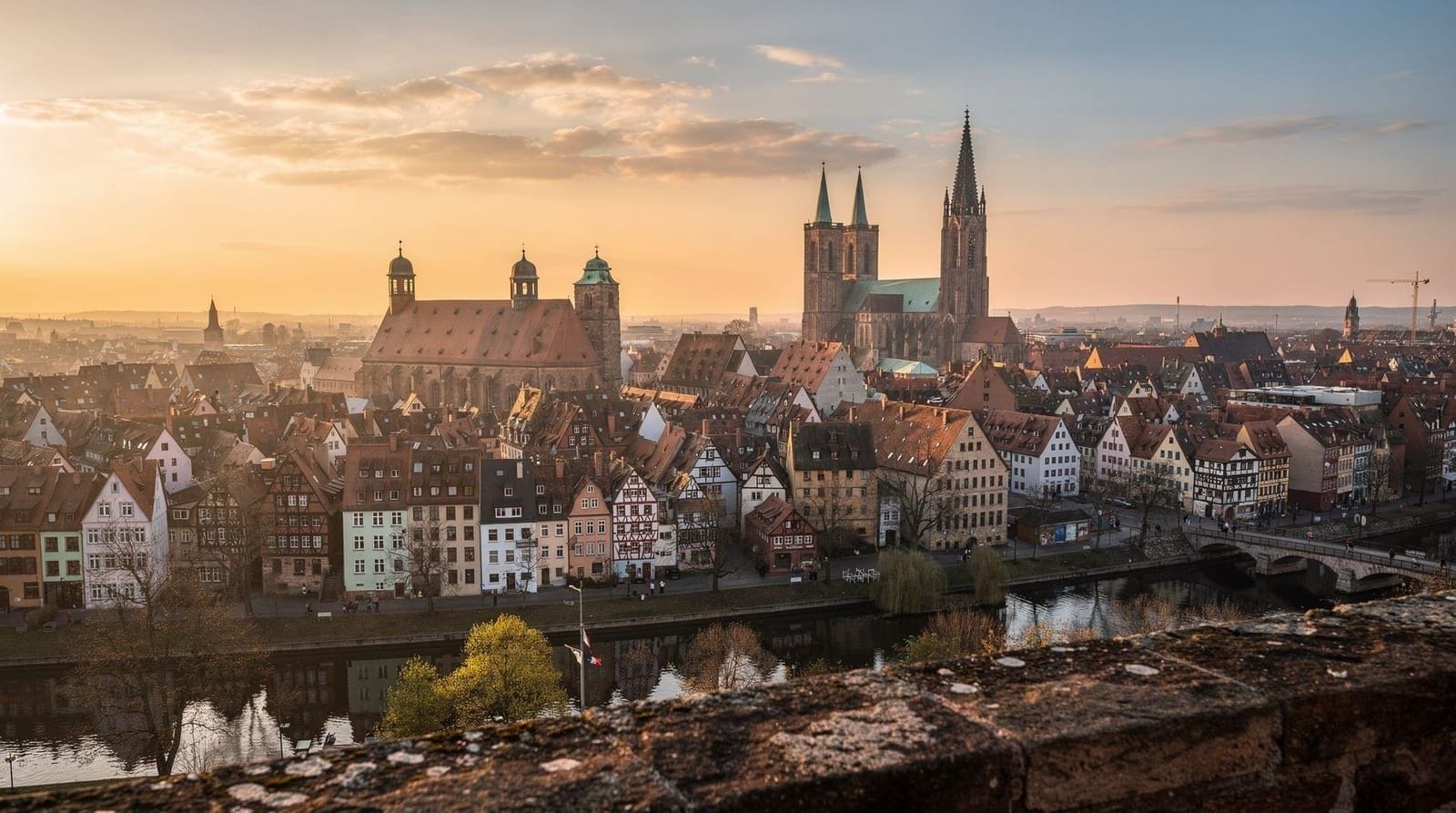
Nuremberg trials guide — Memorium Nürnberger Prozesse and what to see
From Munich: Nuremberg day tour
Where did the Nuremberg trials take place and can I visit?
The Nuremberg trials took place in the Nuremberg Palace of Justice (Justizgebäude Nuremberg) at Bärenschanzstrasse 72. Courtroom 600, where the main IMT trial was held from November 1945 to October 1946, is still used as an active court but opens to visitors when not in session. The Memorium Nürnberger Prozesse — the adjacent museum — is open daily except Tuesdays.
| Where | Bärenschanzstrasse 72, Nuremberg (1hr by ICE from Munich) |
| Cost | around €7.50 adult for the Memorium; ICE train around €30+ return |
| Time needed | half a day for the Memorium plus Courtroom 600 |
| Getting there | ICE/IC from Munich Hauptbahnhof, then tram 9 or bus 36 |
| Best time | any weekday; closed Tuesdays |
The Nuremberg trials in their historical context
Between 20 November 1945 and 1 October 1946, the four Allied powers — the United States, the United Kingdom, France and the Soviet Union — tried 24 surviving senior Nazi leaders before an International Military Tribunal (IMT) in Nuremberg. The trial, conducted in Courtroom 600 of the Palace of Justice, prosecuted defendants on four counts: crimes against peace, war crimes, crimes against humanity, and conspiracy to commit these crimes.
The Nuremberg trials were unprecedented. For the first time in history, political and military leaders of a defeated state were held individually accountable for the decisions they made in office. The principle — that following orders does not excuse criminal conduct, and that crimes against humanity transcend national sovereignty — transformed international law and laid the foundations for the subsequent United Nations Charter and the Universal Declaration of Human Rights.
Understanding the Nuremberg trials matters not just as history but as a living legal and moral framework. The Memorium Nürnberger Prozesse, the memorial museum adjacent to Courtroom 600, makes this argument directly and effectively.
Why Nuremberg?
Nuremberg was not an obvious choice for the tribunals. It was heavily bombed — roughly 90 percent of the medieval old town was destroyed — and the Palace of Justice itself was damaged. But the Allies chose it for reasons that went beyond logistics.
Nuremberg had been the spiritual capital of the Nazi movement since 1927, when the first major NSDAP party rally was held there. The Reichsparteitagsgelände — the massive rally grounds designed by Albert Speer — was where the annual choreographed spectacles of the Nazi regime were staged, including the 1935 rally at which the Nuremberg Laws were announced, stripping Jews of German citizenship. Putting the trial in Nuremberg was a deliberate inversion: the city that had hosted Nazi triumphalism would now host accountability.
Pragmatically, the Palace of Justice on Bärenschanzstrasse had a large, intact courtroom (Courtroom 600, capacity around 200 people for the trial’s needs) and an adjacent prison complex in the same building. Defendants could be held, tried and sentenced in one location.
The defendants and the verdicts
The main IMT trial in Courtroom 600 brought 24 defendants to trial, though one (Robert Ley) committed suicide before proceedings began, and one (Gustav Krupp) was declared medically unfit. The 22 defendants who stood trial included:
Hermann Göring — Reichsmarschall, head of the Luftwaffe and the Gestapo’s original architect. Convicted on all four counts, sentenced to death. Committed suicide by cyanide capsule hours before his scheduled execution.
Rudolf Hess — Hitler’s deputy, who had flown to Scotland in 1941 in a bizarre solo peace mission and was imprisoned in Britain for the rest of the war. Convicted on counts one and two, sentenced to life imprisonment. He died in Spandau Prison, Berlin, in 1987 at the age of 93 — the last prisoner held there.
Joachim von Ribbentrop — Foreign Minister who negotiated the Molotov-Ribbentrop Pact. Convicted on all four counts, hanged on 16 October 1946.
Wilhelm Keitel — Chief of the Wehrmacht High Command. Convicted on all four counts, hanged.
Albert Speer — Hitler’s architect and later Armaments Minister, who claimed ignorance of the Holocaust. Convicted on counts three and four, sentenced to 20 years imprisonment. His performance in court — expressing remorse, distancing himself from Himmler — became controversial; historians debate the sincerity of his claims.
Karl Dönitz — Navy Commander, briefly Hitler’s successor. Convicted on counts two and three, sentenced to 10 years imprisonment.
Hans Frank — Governor-General of occupied Poland. Convicted and hanged.
Of the 22 defendants who stood trial: 12 received death sentences, 3 received life imprisonment, 4 received prison sentences of 10 to 20 years, and 3 were acquitted. Ten defendants were hanged on 16 October 1946 in the prison gymnasium (Göring had already died the night before). Hermann Göring’s death by suicide on the eve of his execution was a significant embarrassment for the Allies.
The subsequent Nuremberg trials (1946 to 1949)
The main IMT trial was followed by twelve subsequent trials before American military tribunals, conducted in the same Courtroom 600 between 1946 and 1949. These trials prosecuted specific groups of perpetrators:
- Doctors who conducted medical experiments on concentration camp prisoners (Doctors’ Trial)
- Nazi judges who administered the regime’s legal terror (Judges’ Trial)
- SS-Einsatzgruppen commanders who carried out mass shootings of Jews on the Eastern Front
- Senior Krupp and I.G. Farben executives who used slave labour
- Military commanders (the OKW Trial)
- SS and concentration camp officials (the Pohl Case)
The subsequent trials extended the legal principles of the IMT and further developed the concept of crimes against humanity in international law. The Memorium’s exhibition covers them in detail.
The Memorium Nürnberger Prozesse
The Memorium Nürnberger Prozesse is the memorial museum adjacent to Courtroom 600, opened in 2010. It occupies part of the Palace of Justice building and documents the trials, their legal significance and their historical context.
The exhibition
The Memorium’s permanent exhibition is organised in four sections:
Background — Nazi Germany’s crimes, the Allied decision to prosecute, and the legal framework developed for the trials.
Course of the trials — a detailed chronological account of the main IMT trial, the defendants, the evidence presented and the verdicts.
Legal legacy — how the Nuremberg principles influenced subsequent international law: the UN Charter, the Genocide Convention, the Universal Declaration of Human Rights, the International Criminal Court.
Memory — how the trials have been remembered, debated and re-evaluated since 1946.
The exhibition uses extensive archival film footage — the Nuremberg trials were the first major international trial to be photographed and filmed in their entirety, including the executions. Some of this footage is used in the exhibition.
Courtroom 600
Courtroom 600 is the most significant single space in the building. The room has been largely preserved in its 1945 configuration — the raised bench for the judges, the dock where defendants sat with their guards, the translators’ booth (the trials used the first major simultaneous interpretation system, with defendants and counsel wearing headphones). Walking into the room is a direct encounter with a decisive moment in legal history.
The courtroom is still used for actual trials in the German court system and is only accessible to visitors when the court is not sitting. The Memorium provides information on when access is possible; it is worthwhile checking before your visit.
Practical information:
- Address: Bärenschanzstrasse 72, 90429 Nuremberg
- Opening hours: Wednesday to Monday 10:00 to 18:00. Closed Tuesdays.
- Admission: 7.50 euros adults, 1.50 euros reduced (2026 prices).
- Getting there from Nuremberg Hauptbahnhof: Tram 9 to Sielstrasse or Bus 36 to Justizgebäude. Journey approximately 20 minutes. A taxi from the Hauptbahnhof takes about 15 minutes.
Planning your visit: Allow around 90 minutes to two hours for the Memorium exhibition alone if you’re reading the panels in detail, longer if a Courtroom 600 viewing is possible on the day. Audio guides are available in German and English and are worth the small extra cost given the density of legal and historical detail. Because Courtroom 600 remains an active court, it’s worth checking the Memorium’s website the morning of your visit rather than assuming access — court sittings can bump visitor access with little notice. The museum shop stocks English-language books on the trials if you want to go deeper than the exhibition allows.
The Nazi party rally grounds (Dokumentationszentrum Reichsparteitagsgelände)
Visiting the Memorium alone misses one of the most extraordinary surviving physical relics of the Nazi period. The Nazi party rally grounds — Zeppelinfeld, Zeppelinhauptribüne, and the incomplete Congress Hall — are located at the southern end of Nuremberg, about 4 km from the city centre.
The Dokumentationszentrum Reichsparteitagsgelände, housed within the unfinished Congress Hall, contains a permanent exhibition on the history and purpose of the rallies, the propaganda films (especially Leni Riefenstahl’s “Triumph of the Will”), and the architecture of power. The Zeppelinhauptribüne — the grandstand from which Hitler addressed hundreds of thousands of followers — still stands on the Zeppelinfeld, though it is in poor condition and accessible only with guided tours due to structural concerns. American troops held a race meeting on the field in 1945 and demolished the central swastika with explosives.
Opening hours: Wednesday to Monday 09:00 to 18:00 (to 20:00 on Thursdays). Admission 6 euros. Nearest tram stop: Doku-Zentrum.
Combining the Memorium with the rest of Nuremberg in one day
A single day trip from Munich can realistically cover both WWII sites and a taste of the old town, if you plan the sequence deliberately. Take an early ICE train (the first departures run before 7am), arrive at the Memorium for opening at 10am, allow two hours there, then take the tram to the Dokumentationszentrum Reichsparteitagsgelände for the early afternoon. That leaves the late afternoon for the reconstructed old town — the Kaiserburg (Imperial Castle), the Hauptmarkt, and the Nuremberg Chronicle-era streets — before the return train. It’s a full day, not a relaxed one; if you’d rather split the WWII sites and the old town across two visits, that’s a reasonable adjustment rather than a compromise, especially given how dense the Memorium’s content is on its own.
Getting from Munich to Nuremberg
The most practical route is the ICE or IC train from Munich Hauptbahnhof to Nuremberg Hauptbahnhof, which runs multiple times per hour and takes approximately one hour. Advance tickets from Deutsche Bahn start around 30 euros for a day return.
The Bayern-Ticket (regional day pass, see the Bayern-Ticket guide) does not cover ICE services. If cost is a priority, regional RE trains on the same route take approximately 1 hour 45 minutes but accept the Bayern-Ticket. Up to five people can travel together on one Bayern-Ticket, making it economical for groups. The day trip from Munich to Nuremberg guide covers the timing options and what to combine.
If you’d rather not manage the train connections and site logistics yourself, a guided day trip from Munich covering Nuremberg’s historic sites is a straightforward alternative. Guided day trip from Munich to Nuremberg
The historical relationship between Munich and Nuremberg
The two cities together tell the full story of the Nazi movement’s rise and fall. Munich is where the party was founded, headquartered and achieved its first mass support. Nuremberg is where the party staged its most spectacular self-presentations — and where the surviving leadership was ultimately held to account.
The Munich Third Reich walking tour guide covers Munich’s city-centre sites. The NS-Dokumentationszentrum guide covers Munich’s dedicated documentation centre. The Munich WWII history guide provides the full chronological context.  Third Reich and WWII walking tourCheck availability
A combined visit to Munich’s Third Reich sites and a day trip to Nuremberg provides the most complete understanding of the movement’s history and ultimate reckoning. The legal principles established in Courtroom 600 between 1945 and 1949 remain the foundation of international humanitarian law and the International Criminal Court — they are not purely historical but live on in ongoing prosecutions of war criminals in The Hague.
Frequently asked questions about the Nuremberg trials
Were the Nuremberg trials fair?
This question has been debated by legal scholars since 1945. Critics have raised the issue of victors’ justice — the Allies were themselves party to acts that might have qualified as war crimes (Dresden bombing, the Soviet Katyn massacre). The tribunal had no neutral judges. However, defendants had legal counsel, were able to mount defences, and several were acquitted. Most legal historians conclude that despite legitimate procedural criticisms, the substantive justice of the main verdicts is not seriously in doubt.
What happened to the defendants who were acquitted?
Three defendants were acquitted: Hjalmar Schacht (former Reichsbank President), Franz von Papen (former Vice-Chancellor) and Hans Fritzsche (radio propagandist). Their acquittals were controversial — the Soviet judge dissented. Schacht and von Papen were subsequently tried by German denazification courts and convicted; Schacht was eventually acquitted on appeal.
What is the connection between Nuremberg and the International Criminal Court?
The Nuremberg principles — that individual leaders are criminally accountable for war crimes and crimes against humanity, and that following orders is not a defence — were codified by the United Nations in 1950 and formed the foundation for the Rome Statute of 1998 establishing the International Criminal Court. The ICC, based in The Hague, has jurisdiction over genocide, crimes against humanity and war crimes and has prosecuted cases from Sudan, the Democratic Republic of Congo, Kenya and other situations.
What was the Nuremberg Laws’ connection to the city?
The Nuremberg Laws — two pieces of legislation formally announced at the 1935 NSDAP party rally in Nuremberg — stripped Jews of German citizenship and prohibited marriages and sexual relations between Jews and non-Jews. They were named for the city where they were announced, not where they were drafted (which was primarily Berlin). The Documentation Centre at the rally grounds covers the laws and their consequences.
Can I visit the prison where the defendants were held?
The prison in the Palace of Justice complex where the Nuremberg defendants were held is no longer accessible to visitors — it remains part of an operational judicial facility. The Memorium’s exhibition includes documentation of the prison conditions. Some of the original cells are documented in archival photographs.
Are there other sites in Nuremberg related to WWII?
Beyond the Memorium and the Documentation Centre, Nuremberg has extensive wartime history. The medieval old town was 90 percent destroyed in bombing and comprehensively reconstructed after the war. The Nuremberg Chronicle, one of the earliest printed books with illustrations, was produced in Nuremberg in 1493 — the city has a long history as a centre of printing, crafts and commerce that predates and outlasts the Nazi period. The Nuremberg destination page covers the city’s full visitor profile.
Is the Nuremberg trials guide suitable as a day trip with children?
It’s best suited to teenagers and adults with a genuine interest in history — the subject matter is heavy, including archival footage of the trials and, in places, the executions. Younger children are unlikely to engage with the dense legal and historical content. If travelling with a mixed-age family, consider splitting time between the Memorium and lighter Nuremberg attractions in the old town, described on the Nuremberg destination page.
Top experiences
Bookable activities with verified prices and instant confirmation on GetYourGuide.