Beer Hall Putsch guide: Munich's 1923 Nazi coup attempt
Munich: Third Reich and WWII walking tour
What was the Beer Hall Putsch and where did it happen?
The Beer Hall Putsch was a failed coup attempt by Hitler and the NSDAP on 8–9 November 1923 in Munich, beginning at the Bürgerbräukeller beer hall in the Haidhausen district. On the evening of 8 November, Hitler interrupted a political meeting, fired a pistol at the ceiling and declared a national revolution. The following day, a march of approximately 2,000 armed supporters toward the city centre was halted at the Feldherrnhalle on Odeonsplatz, where a police confrontation left 16 putschists and 4 police officers dead.
| Where | Feldherrnhalle, Odeonsplatz; NS-Dokumentationszentrum, Brienner Strasse |
| Cost | Feldherrnhalle free; NS-Dokumentationszentrum around €9 |
| Time needed | 10 minutes at Feldherrnhalle; 2–3 hours at the documentation centre |
| Getting there | U3/U6 to Odeonsplatz; U2 to Königsplatz |
| Best time | Weekday mornings at the documentation centre; closed Mondays |
The night Munich was nearly overthrown
At 8:30 on the evening of 8 November 1923, a man wearing a black frock coat pushed through the crowded main hall of the Bürgerbräukeller beer hall in Munich’s Haidhausen district. He climbed onto a chair, fired a pistol at the ceiling, and shouted: “The national revolution has broken out! The hall is surrounded by 600 heavily armed men. Nobody is allowed to leave.”
The speaker was Adolf Hitler. The man at the podium he had interrupted — Gustav Ritter von Kahr, the Bavarian State Commissioner — was mid-speech to an audience of about 3,000 Munich businessmen, politicians and officials. The evening was about to change the trajectory of German history, though not in the direction Hitler intended.
The Beer Hall Putsch of 8–9 November 1923 was a failed coup attempt that left 20 people dead on the streets of central Munich and landed Hitler in prison. It was also the event that transformed him from a regional agitator into a national figure, and that forced him to develop the electoral strategy that would eventually put him in power a decade later.
Munich was the only place this could have happened. The city was simultaneously the political base of the nascent NSDAP, the capital of a Bavarian state government that was itself in open tension with the national government in Berlin, and a city still traumatised by the violence of the post-WWI revolutionary period.
Context: Weimar hyperinflation and Bavarian separatism
Understanding why the putsch happened requires understanding the crisis of 1923. The Weimar Republic was facing simultaneous hyperinflation, French-Belgian occupation of the Ruhr industrial region, and a political system that its opponents on both left and right regarded as illegitimate.
By November 1923, a loaf of bread in Germany cost several billion marks. Savings accumulated over lifetimes had been wiped out. The middle classes — professionals, small businessmen, civil servants — were devastated in a way that the working class, which had little savings to lose, was not. This group formed the core of the NSDAP’s early support.
Bavaria had its own complications. The Bavarian state government under Kahr was effectively running an independent conservative-nationalist administration with limited deference to Berlin. A faction within this government was sympathetic to nationalist revolution, but Kahr’s version of revolution was Bavarian-led and monarchist in character, not Hitlerian. This distinction mattered enormously to the putsch’s outcome.
The NSDAP in 1923 had approximately 55,000 members, centred on Munich. Hitler was 34 years old. His political model was the March on Rome of October 1922, in which Mussolini had marched on the Italian capital and forced his appointment as prime minister. Hitler believed something similar could work in Germany — beginning in Munich, then expanding to Berlin.
The Bürgerbräukeller: 8 November 1923
The Bürgerbräukeller at Rosenheimer Strasse 5 was a large Munich beer hall with a capacity of several thousand people. On 8 November, Kahr had arranged a public address to speak about the political crisis. The audience included the leading figures of Munich’s conservative establishment.
Hitler’s forces had been planning for weeks. SA units surrounded the building before Kahr began speaking. Storm troopers wheeled in a machine gun positioned to cover the crowd. At 8:30, Hitler fired his pistol at the ceiling — the bullet hole was reportedly preserved and shown to visitors for years afterward — and demanded the floor.
He forced Kahr, Lossow and Seisser into a side room at gunpoint. Erich Ludendorff, the WWI general and nationalist figurehead whom Hitler had recruited as a prestigious ally, arrived later and added authority to the proceedings. After negotiation that ranged from threats to patriotic appeals, all three officials verbally agreed to support the putsch. They were then released to “carry out their duties” — a catastrophic miscalculation by Hitler.
The moment they were out of the building, Kahr and Lossow began making arrangements to suppress the putsch. Kahr withdrew to a government building and issued a statement annulling his coerced commitments. Lossow contacted the Reichswehr. By the early hours of 9 November, state forces were moving to reinforce police positions throughout Munich. Walking tour: Third Reich and WWII Munich — includes Feldherrnhalle
9 November 1923: the march and the Feldherrnhalle
On the morning of 9 November, Hitler and his allies faced a choice: abandon the putsch or press forward. Ludendorff, whose military prestige was central to the plan, refused to back down. The decision was made to march.
At approximately 12:00 noon, a column of roughly 2,000 armed SA men and supporters assembled outside the Bürgerbräukeller and marched through the streets of Munich toward the centre. Hitler was near the front, as was Ludendorff, Hermann Göring and other NSDAP leadership figures. They carried swastika flags and weapons.
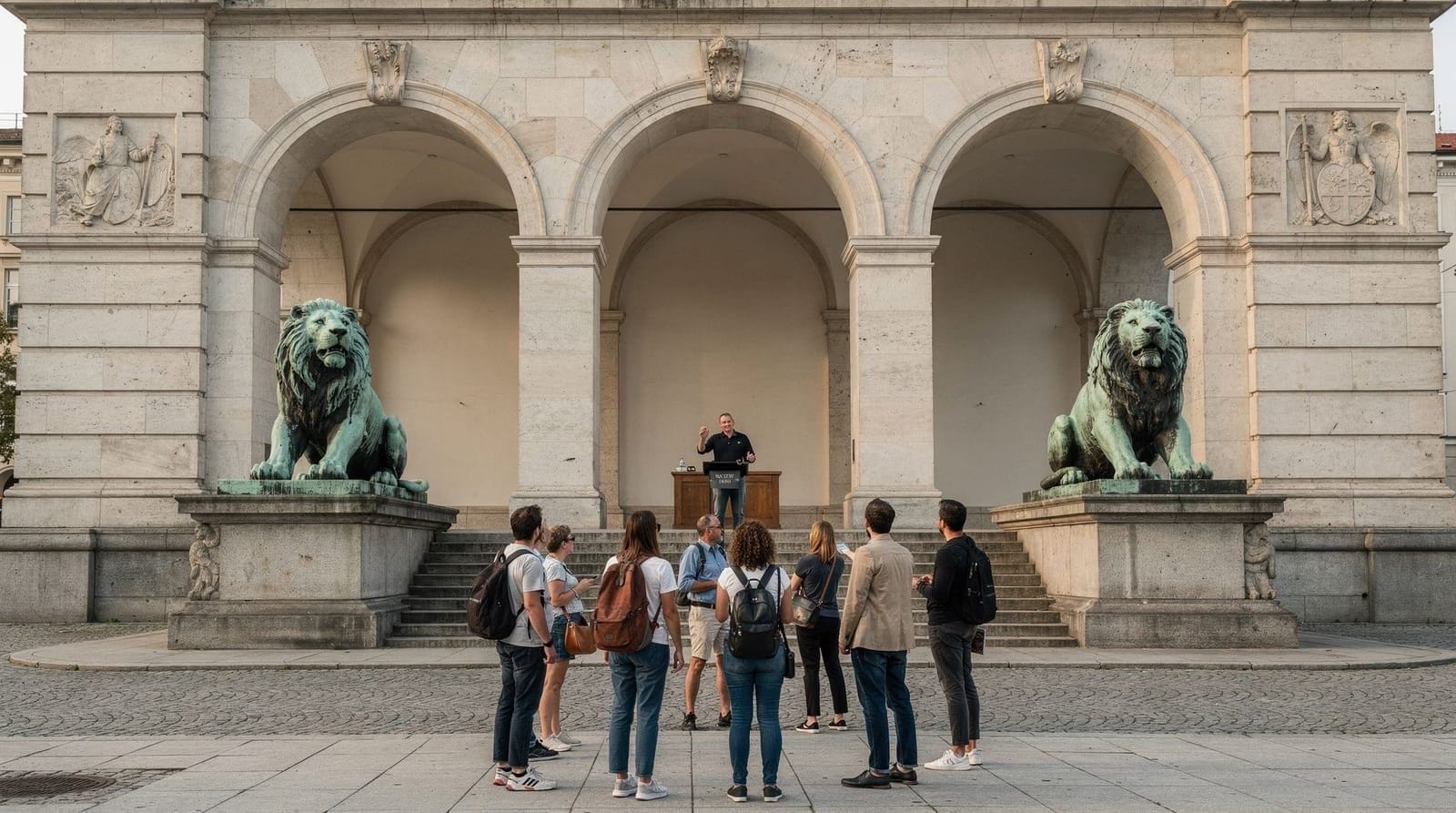
The route took them across the Ludwigsbrücke, through the Isartor and up the Tal toward Marienplatz, where they turned north along Weinstrasse. At Odeonsplatz, the column was blocked at the narrow passage beside the Feldherrnhalle — a neoclassical loggia commemorating Bavarian military heroes, completed in 1844 on the model of the Loggia dei Lanzi in Florence.
The Landespolizei (state police) had deployed across the passage with rifles. The exact sequence of who fired first has never been definitively established. The exchange of fire lasted approximately 30 to 60 seconds. When it ended, 16 NSDAP members and 4 police officers lay dead or dying in the street. Hitler, next to a man who was shot and killed, dislocated his shoulder as he was pulled to the ground. He was subsequently helped away from the scene in a waiting car.
Ludendorff, displaying either extraordinary courage or extraordinary indifference, walked through the police line and was arrested on the other side.
Hitler’s arrest and the Landsberg trial
Hitler fled Munich and was sheltered for two days at the villa of his American supporter Ernst Hanfstaengl in Uffing am Staffelsee, south of Munich on the Staffelsee lake. He was arrested there on 11 November, in what he later described as a moment of complete despair in which he considered suicide.
The trial for high treason ran in Munich from 26 February to 1 April 1924. The proceedings were extraordinary. The presiding judge, Georg Neithardt, was sympathetic to the nationalist cause and allowed Hitler far more latitude than standard court procedure permitted. Hitler used the trial as a platform for nationalist speeches that were reported extensively in the German and international press. Rather than defending himself against the charge of treason, he embraced it: he had attempted to commit treason against the “November criminals” of 1918.
The verdict was five years in Landsberg Prison with the possibility of parole after six months, the minimum sentence under the law. Several of the other defendants received lighter sentences or were acquitted. Ludendorff was acquitted entirely, a verdict that the prosecution regarded as a national embarrassment.
Hitler served approximately eight months at Landsberg am Lech, a fortress prison about 65 kilometres west of Munich. His conditions were comfortable: he had a private room, received extensive visitors and was treated more as a political prisoner than a common criminal. Rudolf Hess, who had voluntarily surrendered and joined him in prison, took dictation for what would become Mein Kampf. Hitler was released on 20 December 1924. Guided tour: birthplace of the Third Reich, Munich
The Feldherrnhalle: a Nazi pilgrimage site and anti-pilgrimage site
After the Nazis came to power in 1933, the Feldherrnhalle became a sacred site in Nazi ideology. The dead of the putsch were declared martyrs of the movement, and the spot where they fell was marked with a memorial tablet installed in 1933. SS guards were posted, and anyone passing the memorial was required to give the Nazi salute.
A significant number of Munichers began making detours through a parallel alley — the Viscardigasse, now popularly called “Shirkers’ Alley” (Drückebergergasse) — to avoid both the memorial and the compulsory salute. This modest act of everyday non-compliance is one of the small historical details that Munich guides with better-than-average historical knowledge tend to mention.
After 1945, the memorial was removed. The Feldherrnhalle today is exactly what it was built to be in 1844: a neoclassical architectural element at the north end of Residenzstrasse, flanked by two sculptures of lions. It is now used primarily as a backdrop for outdoor concerts, political rallies of various kinds and tourist photographs.
The marienplatz-guide covers the surrounding area in more detail, including the approach from Marienplatz through Theatinerstrasse.
The NS-Dokumentationszentrum
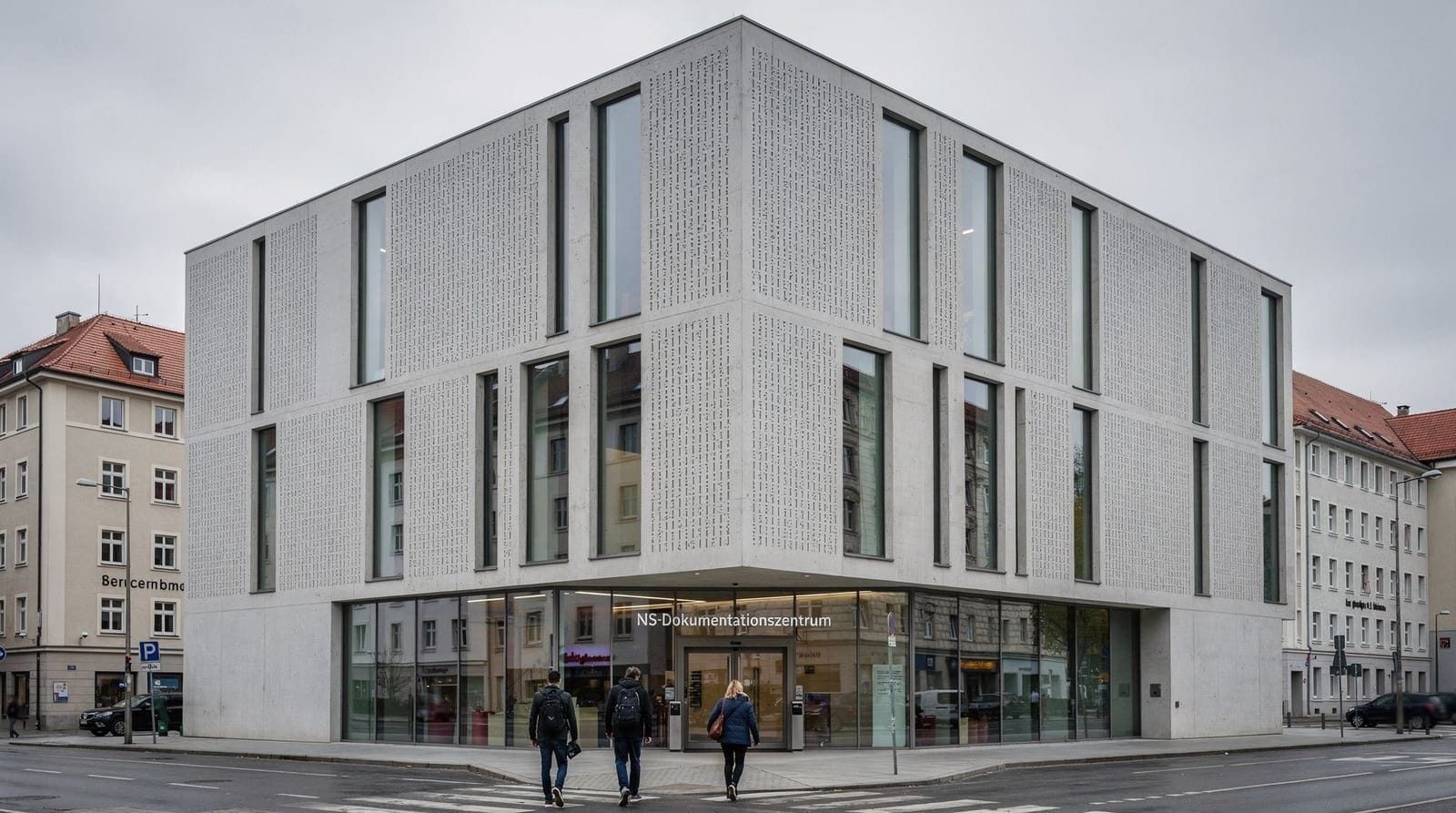
The Dokumentationszentrum für die Geschichte des Nationalsozialismus (NS-Dokumentationszentrum) opened on Brienner Strasse in Maxvorstadt on 1 May 2015 — exactly 70 years after Germany’s surrender. It occupies the site of the NSDAP’s former headquarters, the Braunes Haus (Brown House), which was demolished after the war.
The permanent exhibition “Munich and National Socialism” traces the city’s role across four floors, from the NSDAP’s founding years through the war, the Holocaust and the postwar period. The building’s design by Berlin architects Brückner and Brückner uses a cube of white concrete with full-height interior atrium, lit from above. The exhibition is scholarly in tone and relies on original documents, photographs and contemporary testimony rather than dramatic reconstruction.
Practical information:
- Address: Brienner Strasse 34, 80333 Munich (U2 Königsplatz station)
- Opening hours: Tuesday–Sunday 10:00–19:00, closed Mondays
- Admission: 9 euros adults, free for under-18s
- Allow 2–3 hours for the permanent exhibition
- English-language audio guide available
The NS-Dokumentationszentrum Munich has fuller practical information on visiting.
The Bürgerbräukeller site today
The original Bürgerbräukeller was demolished in 1979. The site on Rosenheimer Strasse in Haidhausen was subsequently developed with the Hilton München City Hotel and a concert/events hall. A small commemorative installation — the Erinnerungsort Bürgerhaus Bürgerbräu — documents the site’s significance.
One additional historical note: on 8 November 1939 — exactly 16 years after the putsch — a bomb hidden in a column of the Bürgerbräukeller (which by then had been extensively renovated and was still in use as an event venue) exploded 13 minutes after Hitler left the building. The bomb was constructed by Georg Elser, a Swabian cabinet-maker acting entirely alone. Eight people were killed; 63 were injured. Hitler survived. Elser was captured, imprisoned in Dachau and executed in April 1945, shortly before the end of the war. Private or small-group Third Reich and WWII walking tour
Visiting the Beer Hall Putsch sites: practical information
The main commemorative and educational sites associated with the putsch are:
Feldherrnhalle on Odeonsplatz: free, always accessible. Take U3/U6 to Odeonsplatz. The original passage where the confrontation occurred is the narrow gap between the Feldherrnhalle and the Theatinerkirche.
NS-Dokumentationszentrum on Brienner Strasse: the most thorough institutional treatment of the period, 9 euros adults, closed Mondays. Take U2 to Königsplatz.
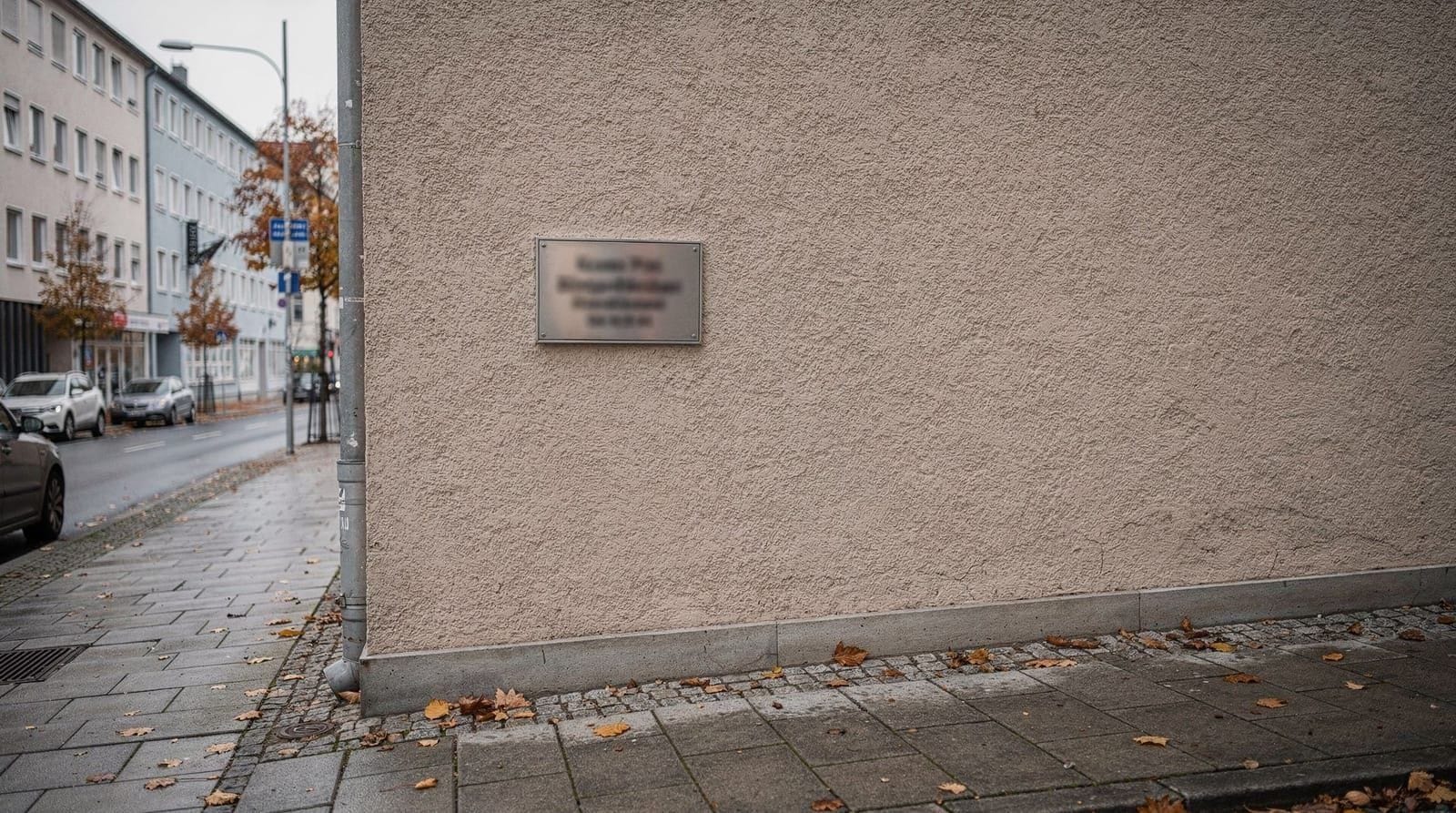
Bürgerbräukeller site on Rosenheimer Strasse: no formal exhibition, but the address (now the Hilton hotel) is historically documented and a plaque marks the significance. Take S-Bahn to Rosenheimerplatz.
Landsberg am Lech (where Hitler was imprisoned): about 65 km west of Munich, reachable by train (approximately 1 hour on the BOB line toward Kaufbeuren, change at Kaufering). The former prison is still in use as a correctional facility and is not publicly accessible, but the town of Landsberg itself has a municipal museum with documentation of the period.
Most organised Third Reich walking tours in Munich include the Feldherrnhalle as a stop and explain the putsch in context. The Munich Third Reich walking tour guide covers these tours in more detail.
For visitors combining this with broader history of the period, the White Rose resistance guide covers the student resistance movement at LMU Munich, and the Dachau Concentration Camp Memorial Site covers the concentration camp memorial site. Private Third Reich and WWII guided tour
The putsch in retrospect: Munich’s uncomfortable centrality
Munich’s role as the birthplace of National Socialism is a fact the city has processed with varying degrees of directness at different periods. In the immediate postwar years, many Munichers preferred to emphasise their victimhood under the regime — the destruction of the city, the forced conscription, the civilian suffering. The role of Munich as an enthusiastic early base for the NSDAP was underemphasised.
The opening of the NS-Dokumentationszentrum in 2015 marked a turning point in official acknowledgement. The exhibition does not soften Munich’s involvement. It documents the city’s enthusiastic early adoption of Nazi ideology, the role of Munich’s business and professional elites in enabling the movement, and the local bureaucratic apparatus that implemented persecution.
This honesty is both educationally valuable and commercially complicated — Munich is now simultaneously one of Germany’s top tourist destinations and the city where the most destructive political movement of the 20th century was born, funded and organised. The city handles this by providing serious educational infrastructure (the NS-Dokumentationszentrum, the DenkStätte Weiße Rose, the Dachau memorial site) while not allowing the Nazi period to dominate its tourist identity.
Visitors who want to understand Munich’s character fully need both: the Residenz and the Nymphenburg, but also the Feldherrnhalle and the NS-Dokumentationszentrum.
How the putsch fits into a broader Munich history day
The putsch sites work well as one thread within a longer Third Reich history day rather than a standalone visit. A logical sequence: start at the NS-Dokumentationszentrum in the morning for the full historical context, walk to the Feldherrnhalle and Viscardigasse (a route also covered in the Munich old town history guide), then continue to sites connected to the White Rose resistance at LMU Munich in the afternoon — a deliberate counterpoint, since the White Rose story is about resistance to the regime the putsch helped bring to power. Visitors with a full day can extend this into the Dachau memorial guide as a separate half-day trip, though that deserves its own dedicated visit rather than being rushed onto the same day.
For context on how this period sits within Munich’s longer royal and civic history, the Munich royal history and Wittelsbach guide explains the Bavarian state structures — including Kahr’s separatist-leaning government — that the putsch tried to co-opt. The Munich WWII history guide picks up the story from 1933 onward for visitors who want the fuller arc from putsch to war.
Frequently asked questions about the Beer Hall Putsch
Why did Hitler choose a beer hall for the putsch?
The Bürgerbräukeller was not chosen at random. It was one of the largest public assembly spaces in Munich, capable of holding several thousand people, and it was the venue for a pre-announced speech by Gustav von Kahr that guaranteed the presence of the city’s political establishment. Seizing the audience as effectively captured political hostages was central to the plan.
What were the long-term consequences of the putsch trial?
The trial gave Hitler a national public platform that vastly exceeded what the NSDAP could have achieved through normal political organizing. Foreign correspondents covered the proceedings. The relatively lenient sentence signalled that sympathetic judges could be found within the German judicial system. The prison period gave Hitler uninterrupted time to write Mein Kampf and plan his post-prison political strategy.
Is there a museum specifically about the Beer Hall Putsch?
There is no museum exclusively dedicated to the putsch, but the NS-Dokumentationszentrum on Brienner Strasse gives it significant coverage within its broader exhibition on Munich and National Socialism. Some specialist guided tours focus specifically on the 1923 events and visit the Bürgerbräukeller site, the Feldherrnhalle and the NSDAP’s former political geography.
How did Mussolini’s March on Rome influence Hitler’s planning?
Hitler openly modelled the putsch on Mussolini’s successful seizure of power in October 1922. He believed the same dynamic — a paramilitary march on the capital combined with intimidation of the ruling establishment — could be replicated in Germany, beginning in Munich and moving north to Berlin. The crucial difference was that Mussolini had the acquiescence of the Italian king and military; Hitler could not secure comparable support from Kahr and Lossow once they were no longer under direct duress.
What happened to the NSDAP while Hitler was in prison?
The NSDAP was officially banned after the putsch. Leadership split between various factions while Hitler was at Landsberg. When he was released in December 1924, he set about rebuilding the party from scratch, this time with explicit commitment to pursuing power through elections rather than armed uprising. The electoral results in the late 1920s were initially poor — the NSDAP got around 3 percent in 1928 — but the Depression of 1929 changed the political landscape dramatically.
Where can I see photographs of the Bürgerbräukeller?
The NS-Dokumentationszentrum has archival photographs of the Bürgerbräukeller interior and the putsch events. The Stadtarchiv München (Munich City Archive) holds extensive photographic documentation of the period and is accessible to researchers.
How much time should I budget for the putsch sites specifically?
The Feldherrnhalle itself takes about 10 minutes to see properly, including the Viscardigasse detour. Combined with the NS-Dokumentationszentrum (2–3 hours) and the walk between them, budget half a day if you want serious context rather than a quick photo stop. See the Munich trip planning guide for how to fit a history-focused half-day into a broader itinerary.
Are the putsch sites appropriate for children or teenagers?
The Feldherrnhalle and Odeonsplatz are simply public squares and fine for any age. The NS-Dokumentationszentrum is a serious, text-heavy museum better suited to teenagers and adults than young children; its treatment of the material is scholarly rather than sensationalised, which most families find handles a difficult topic responsibly. The Munich WWII history guide has more on age-appropriate framing for this period.
Top experiences
Bookable activities with verified prices and instant confirmation on GetYourGuide.