White Rose resistance guide: Munich's student heroes
Munich: Third Reich and WWII walking tour
What was the White Rose resistance movement in Munich?
The White Rose was a non-violent student resistance group based at Ludwig Maximilian University Munich. Between June 1942 and February 1943, core members Sophie Scholl, Hans Scholl, Alexander Schmorell, Christoph Probst, Willi Graf and philosophy professor Kurt Huber produced and distributed six anti-Nazi leaflets. Sophie and Hans Scholl were arrested on 18 February 1943 after being seen scattering leaflets in LMU's atrium. All core members were executed by guillotine, most on 22 February 1943.
A university atrium that changed history
At 11:00 on the morning of 18 February 1943, a university custodian named Jakob Schmid grabbed a young man by the collar on the second floor of Ludwig Maximilian University Munich. Hans Scholl had just shoved several hundred copies of the sixth White Rose leaflet off a balcony into the atrium below. His sister Sophie, standing nearby, had kicked the remaining pile over the edge almost as an afterthought. Schmid held both siblings until the Gestapo arrived. Four days later, they were dead.
This event — so ordinary in its setting, so catastrophic in its consequence — happened in one of Germany’s most prestigious universities. The White Rose was not a partisan cell or a military network. It was a handful of medical students and one professor who believed that words printed on paper could erode the foundations of a totalitarian state. Whether they were right is almost beside the point. What they did required a quality of courage that most people never have to summon.
Understanding Munich’s role in the Nazi period is impossible without the White Rose. The city where Hitler staged his first coup attempt in 1923 — covered in the Beer Hall Putsch guide guide — was also the city where a group of students openly called for resistance while the regime was still at the height of its power. That contradiction is part of what makes Munich’s history so charged.
| Where | Geschwister-Scholl-Platz 1, Maxvorstadt (LMU main building) |
| Cost | Free (DenkStätte museum) |
| Time needed | 45–60 min for the DenkStätte; half a day combined with NS-Dokumentationszentrum |
| Getting there | U3/U6 to Odeonsplatz, then 5 min on foot |
| Best time | Weekday mornings; closed weekends |
The founding members and their backgrounds
The White Rose is most closely associated with six names, but the network was wider. The core members who produced the leaflets were:
Hans Scholl was born in 1918 in Ingersheim. Like many German teenagers in the 1930s, he initially joined the Hitler Youth with some enthusiasm, before becoming disillusioned with the organisation’s ideology and conformity. He enrolled in medicine at LMU Munich in 1939.
Sophie Scholl was Hans’s younger sister, born in 1921. She studied biology and philosophy at LMU. Contemporary accounts describe her as practically-minded and less given to philosophical discussion than her brother, which is perhaps why she was the one who made the decision to push the last pile of leaflets over the balcony.
Alexander Schmorell was born in Orenburg, Russia, to a German father and a Russian mother who died when he was young. He grew up in Munich, spoke Russian fluently, and maintained a deep connection to Russian Orthodox Christianity. His experience on the Eastern Front as a military medical auxiliary profoundly radicalised him against the war. He was canonised by the Russian Orthodox Church in 2012 as Holy Martyr Alexander of Munich.
Christoph Probst was the only member of the group with children — three of them, the youngest an infant at the time of his arrest. He was 23 when he was executed. The Gestapo found a handwritten draft of a seventh leaflet in his pocket when he was caught.
Willi Graf was a devout Catholic from Saarbrücken who had resisted the Hitler Youth and joined instead a Catholic youth organisation that was subsequently banned. He was part of the group that returned from service on the Eastern Front in late 1942 and contributed to the later leaflets.
Kurt Huber was not a student but a professor — a musicologist and philosopher at LMU who had quietly opposed the regime for years. He wrote the sixth leaflet almost entirely himself. He was tried separately and executed on 13 July 1943.
The six leaflets: what they said and how they were distributed
Between June and July 1942, the group produced four leaflets in Hans Scholl’s apartment at Schwabing’s Franz-Josef-Strasse. They were typed on a typewriter, duplicated on a hand-operated copying machine and posted in envelopes to addresses chosen largely at random from the Munich telephone directory — doctors, teachers, pub landlords. The group specifically targeted people they considered likely sympathisers.
The first leaflet opened by quoting Schiller and appealing to readers’ moral sense: “Since the conquest of Poland, 300,000 Jews have been murdered in this country in the most bestial manner. Here we see the most terrible crime ever committed against the dignity of man.” This was 1942. The Holocaust was a known fact to those in Munich with access to letters and reports from the East, but articulating it openly in print required extraordinary nerve.
The fifth and sixth leaflets appeared after the group’s return from their Eastern Front deployment in late 1942 and early 1943. By this time, the Battle of Stalingrad had turned the war’s tide. The sixth leaflet, written largely by Kurt Huber, called for active resistance and the removal of the National Socialist government. Copies were mailed to addresses in Munich, Stuttgart, Frankfurt, Vienna and Salzburg. The last distribution — the one that led to the arrests — was carried out on 18 February 1943 inside LMU itself.
If you are visiting Munich and want to understand this period in context, the Munich Third Reich walking tour and Munich in World War II provide broader framing.
Arrest, trial and execution
Jakob Schmid, the LMU custodian who detained the Scholls, was later awarded a cash prize of 3,000 Reichsmarks for his actions. He was one of several ordinary citizens whose cooperation maintained the regime’s surveillance apparatus.
The Scholls were handed to the Gestapo immediately. Interrogations began that afternoon. Christoph Probst was identified from his handwriting on the draft seventh leaflet found in Hans’s coat pocket, and was arrested the same day.
Roland Freisler, the president of the People’s Court, conducted the trial on 22 February 1943 — just four days after the arrests. Freisler was known for screaming at defendants, interrupting their statements, and staging proceedings as ideological theatre rather than legal proceedings. The outcome was never in doubt. All three defendants were sentenced to death and executed by guillotine at Stadelheim Prison later the same afternoon.
Hans Scholl is reported to have shouted “Es lebe die Freiheit!” — Long live freedom — before his execution. He was 24. Sophie was 21. Christoph Probst was 23.
Alexander Schmorell and Willi Graf were executed on 13 July 1943, the same day as Kurt Huber. The regime attempted to frame the executions as routine justice rather than political suppression, but copies of the sixth leaflet were already circulating in exile and eventually reached Allied intelligence. The Royal Air Force printed millions of copies and dropped them over Germany under the title “A German pamphlet.” Walking tour: Third Reich and WWII Munich
Geschwister-Scholl-Platz: visiting the site today
The square directly in front of Ludwig Maximilian University was renamed Geschwister-Scholl-Platz (Scholl Siblings Square) in 1946. The name is both a memorial and a statement — it occupies the heart of the university district and cannot be ignored.
The university itself at Geschwister-Scholl-Platz 1 is an active campus. The atrium where the leaflets were thrown from the balcony is open to visitors during university hours. The second-floor walkway from which Hans Scholl pushed the stack of leaflets looks exactly as it did in 1943 — the building survived the war largely intact.
The square also contains a pavement installation: replicas of White Rose leaflets embedded in the cobblestones, created by sculptor Hubert Distler in 1997. It is easy to miss if you do not know to look for it. Approach from Ludwigstrasse and look at the ground near the main entrance.
Two fountains flank the square, and student life continues around them exactly as it did in 1943 — cyclists, café tables, the general bustle of a functioning university district. This ordinariness is deliberate as a form of remembrance: rather than sealing the site off as a monument, Munich chose to let the university keep using it, so visitors encounter the history inside an unbroken continuity of daily life rather than a museum diorama.
The DenkStätte Weiße Rose museum
Inside LMU’s main building, on the ground floor near the entrance, is the DenkStätte Weiße Rose (Memorial Site White Rose). The permanent exhibition opened in 1997 and was significantly expanded in 2012 to coincide with the 70th anniversary of the movement’s founding.
The exhibition uses original documents, photographs, facsimiles of the leaflets and testimonies from surviving witnesses. It covers not just the core group but the wider network of contacts in Hamburg and other cities who distributed the leaflets.
Practical details:
- Address: Geschwister-Scholl-Platz 1, 80539 Munich
- Opening hours: Monday–Friday 10:00–16:00, Thursday 10:00–18:00
- Admission: free
- Getting there: U3/U6 to Odeonsplatz, then 5 minutes on foot north along Ludwigstrasse
The DenkStätte does not have an audio guide, but all panel texts are available in English. The space is small — budget 45 to 60 minutes.
The wider Maxvorstadt context
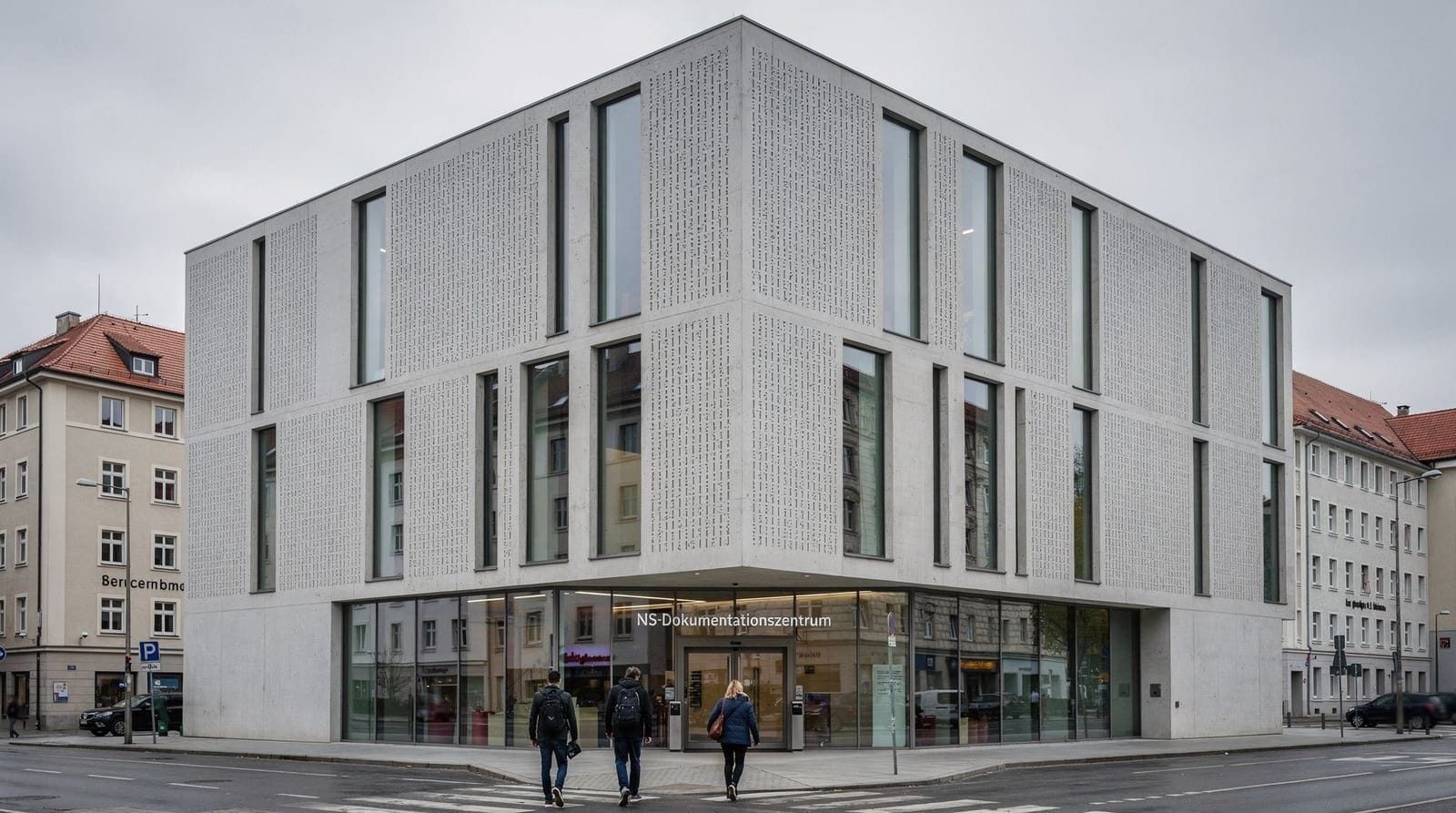
The White Rose operated in the Maxvorstadt district, Munich’s university and museum quarter. This is also the neighbourhood of the NS-Dokumentationszentrum, Munich’s permanent documentation centre on National Socialism, which opened in 2015. If you are spending time at the DenkStätte, it is worth combining the visit with the NS-Dokumentationszentrum, about 10 minutes on foot west on Brienner Strasse.
The Munich museum quarter guide guide covers the broader Kunstareal (museum district), which includes the Pinakotheken, the Lenbachhaus and the NS-Dokumentationszentrum within a walkable cluster.
The NS-Dokumentationszentrum Munich guide goes deeper into what the NS-Dokumentationszentrum covers and how to plan your visit there.
For historical context going back further, the Munich royal history guide explains the period immediately preceding the Nazi rise to power, including the 1918 revolution that ended the Wittelsbach monarchy.
Remembrance beyond Munich
The White Rose’s legacy extends well beyond the university district. In Germany, thousands of schools bear the names of White Rose members. Sophie Scholl appears on commemorative stamps and has been the subject of multiple biographical films, including Marc Rothemund’s 2005 “Sophie Scholl — die letzten Tage” (Sophie Scholl: the final days), which reconstructed her interrogation from Gestapo records discovered in East German archives after reunification.
Alexander Schmorell’s Orthodox canonisation in 2012 made international news, particularly in Russia, where his story connects themes of Russo-German cultural identity. He is buried in the Eastern Orthodox cemetery in Munich’s Au-Haidhausen district, which is open to visitors.
Kurt Huber’s case is sometimes treated separately from the student members because of his age — he was 50 at the time of his execution — and his professional standing as a tenured professor. His rehabilitation within German academic circles took longer than that of the students. Guided tour: birthplace of the Third Reich, Munich
How the White Rose fits into Munich’s wider WWII history
Munich carries an unusually heavy dual identity in the Nazi period: it was both the “Hauptstadt der Bewegung” (capital of the movement), where the party was founded and Hitler staged the 1923 Beer Hall Putsch, and the city that produced the most visible student resistance to the regime. Visiting both sides of that history in the same trip gives a fuller picture than either alone. The beer hall putsch guide covers the 1923 coup attempt and the sites connected to it, many within walking distance of the Feldherrnhalle.
For the Jewish community’s experience under the same regime, the Munich Jewish history guide covers the synagogue, the former Jewish quarter and the deportation memorials scattered through the city centre — a history that intersects with the White Rose’s own moral argument, since the first leaflet explicitly named the murder of Jews in Poland as its starting point. For the older layers of the same streets, the Munich old town history guide provides context on how the Altstadt looked and functioned before 1933.
Comparing the sites is also useful for planning. The DenkStätte is a 45–60 minute stop; the NS-Dokumentationszentrum is a two-to-three-hour deep dive; Dachau is a half-day excursion outside the city. None of them are interchangeable — each covers a different part of the story — but together they form a coherent picture of how Munich moved from a democratic university city to the movement’s headquarters and back.
Planning your visit
A focused White Rose visit requires about half a day if you combine the DenkStätte, the atrium and a walk to the NS-Dokumentationszentrum. A full-day itinerary that also takes in the Feldherrnhalle, the former site of the Bürgerbräukeller and Marienplatz can be done on foot — Munich’s old town is compact.
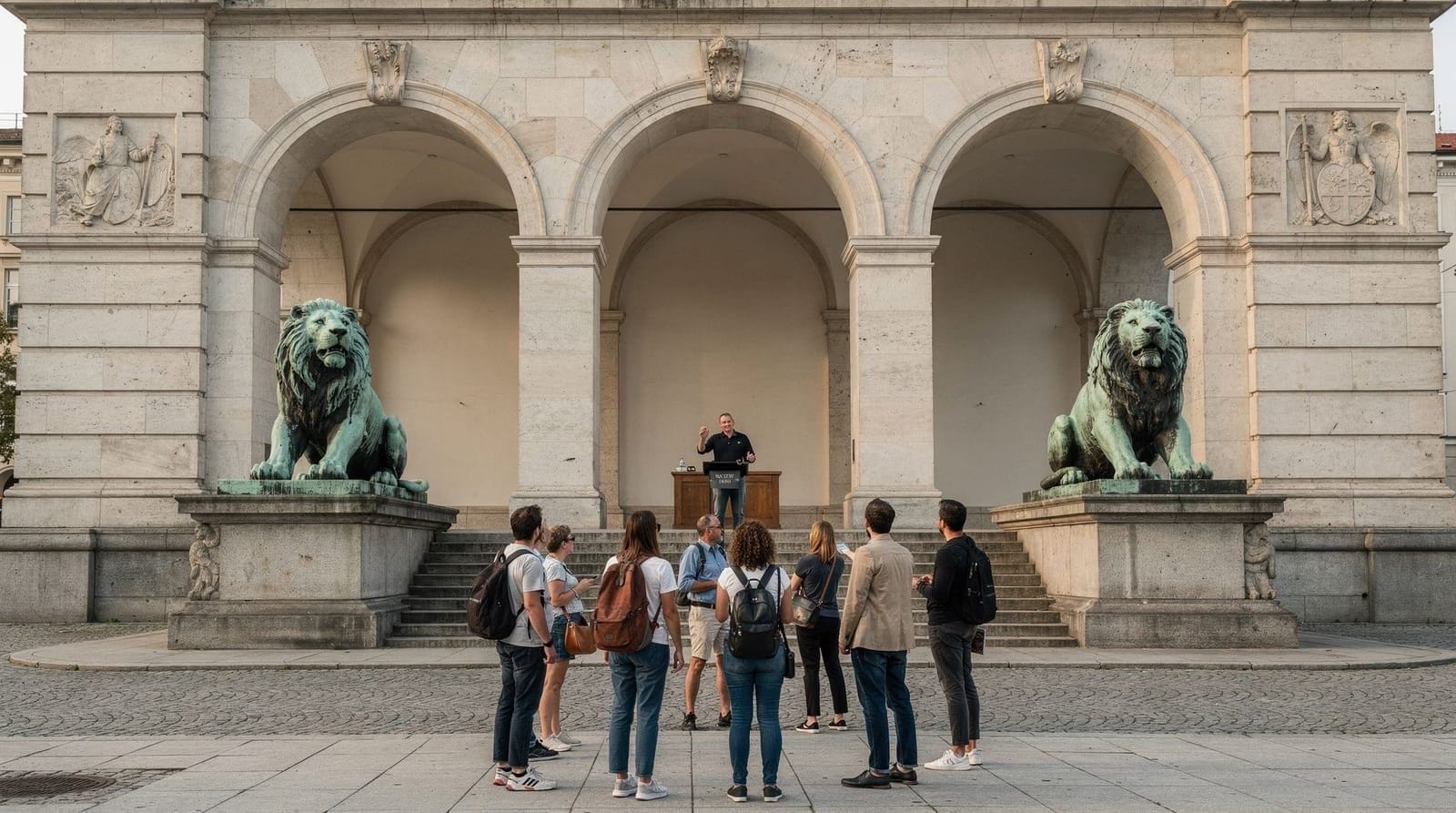
Most organised Third Reich walking tours in Munich include a stop at Geschwister-Scholl-Platz and explain the White Rose story in context. For those who prefer self-guided exploration, the NS-Dokumentationszentrum sells a walking map that connects 22 Third Reich–related sites across the city centre.
If you are visiting in February, the anniversary of the arrests (18 February) and executions (22 February) is marked each year at the university with commemorative events, usually organised by LMU’s student government.
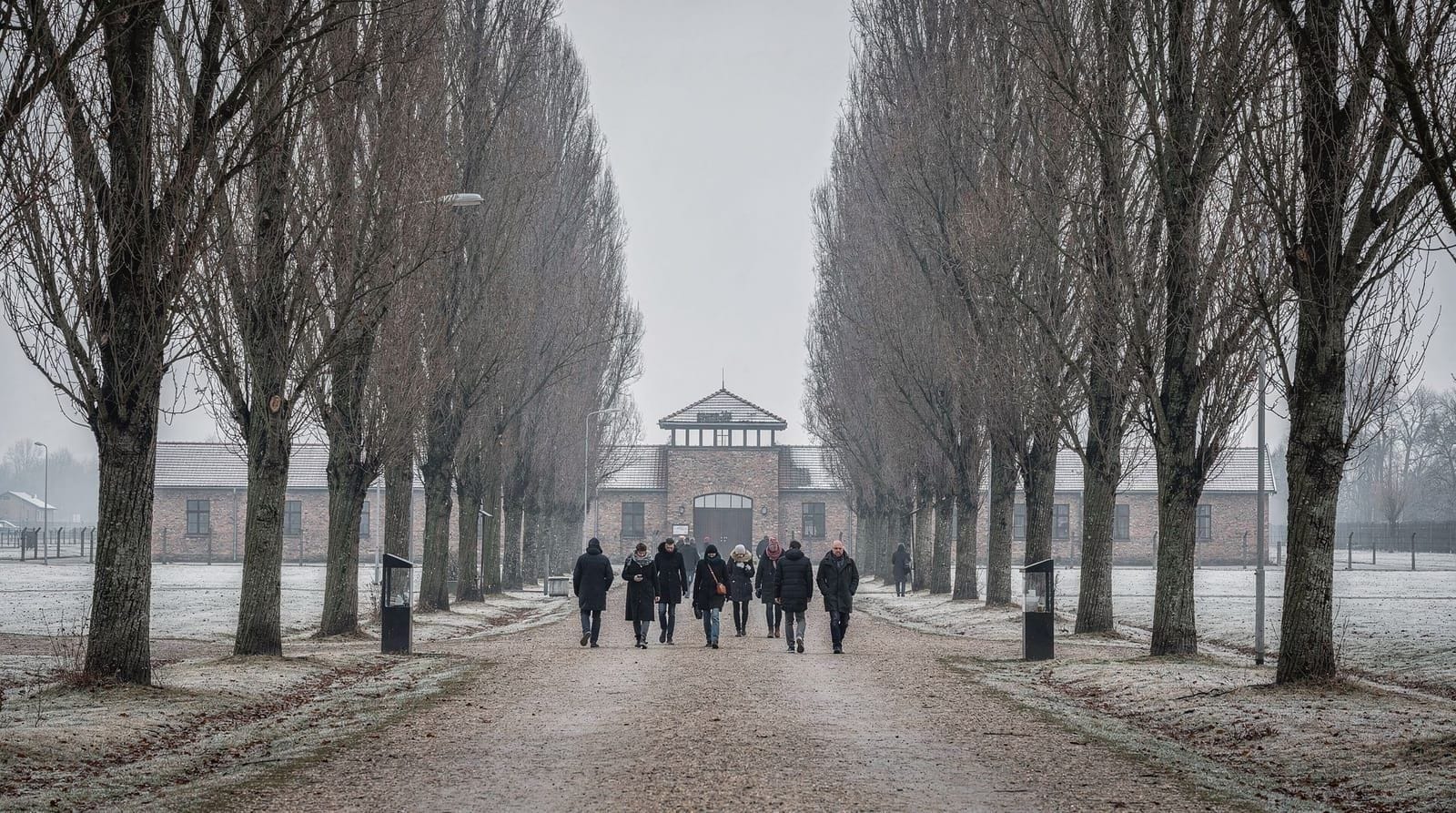
The Dachau Concentration Camp Memorial Site covers the Dachau concentration camp memorial site, 17 kilometres northwest of Munich, which provides the most direct encounter with the regime’s system of terror that the White Rose members were protesting.
For visitors combining history with neighbourhood exploration, the maxvorstadt-guide covers the area’s cafes, bookshops and institutions around the university. Private or small-group Third Reich walking tour
Honest assessment: what to expect and what to skip
The DenkStätte is excellent but small. Do not expect a full museum experience — it is more a focused memorial exhibition. The Weiße Rose Stiftung (White Rose Foundation), based in Munich, maintains the historical record and organises travelling exhibitions that sometimes have more material than the permanent DenkStätte display.
The university atrium is evocative precisely because it is still in daily use. Students eat lunch in the space and walk the same balconies. There is no dramatic installation or reconstruction. You are simply standing in the place where something happened.
Guided tours vary significantly in quality. The best ones are led by historians or educators with genuine expertise in the period, not generalist city guides who cover the topic in five minutes. Reading reviews before booking is worth the effort.
The NS-Dokumentationszentrum is the most thorough treatment of National Socialism in Munich — four floors covering the city’s role as the movement’s birthplace and capital. Budget two to three hours and note it is closed on Mondays. Private Third Reich and WWII guided tour
Frequently asked questions about the White Rose resistance movement
Where can I find the White Rose memorial inside LMU Munich?
The DenkStätte Weiße Rose is on the ground floor of LMU’s main building at Geschwister-Scholl-Platz 1. Enter through the main entrance facing the street, and the exhibition is signposted immediately inside. It is free and open Monday to Friday, 10:00 to 16:00 (Thursday until 18:00). The cobblestone leaflet installation is in the pavement outside the main entrance.
How far is the White Rose site from Marienplatz?
Geschwister-Scholl-Platz is approximately 1.2 kilometres north of Marienplatz — about 15 minutes on foot via Theatinerstrasse and Ludwigstrasse. The U3/U6 line connects Marienplatz to Odeonsplatz (one stop), from which LMU is a 5-minute walk.
Did anyone help the White Rose members escape or warn them before the arrest?
Several people who received the leaflets kept quiet rather than reporting them — a form of passive resistance. There is no evidence that anyone attempted to warn the Scholls before 18 February 1943. The speed of the arrest and trial — from 18 February to execution on 22 February — was deliberate: the regime wanted to prevent any possibility of the case becoming a cause célèbre.
Are there other White Rose memorials in Germany outside Munich?
Yes. The Weiße Rose Stiftung maintains ties with memorials at the sites where members grew up, including Ulm (where the Scholl family lived before Munich) and Saarbrücken (Willi Graf’s home city). The Hamburg node of the White Rose network — led by Helmut Hübener — has its own commemorative sites. In Munich, beyond the DenkStätte, the Luitpoldblock in Schwabing near the former Gestapo headquarters also carries commemorative markers.
What happened to Jakob Schmid, the custodian who arrested the Scholls?
Jakob Schmid received his 3,000 Reichsmark reward and continued working at LMU for a time. After the war, he faced denazification proceedings. He died in 1964. His role is neither glorified nor entirely hidden in the historical record — he appears as an example of the ordinary bureaucratic and social compliance that enabled the regime.
Is there a film or book I should read before visiting?
Marc Rothemund’s 2005 film “Sophie Scholl — die letzten Tage” is the most detailed dramatic reconstruction of the final days, based directly on Gestapo interrogation transcripts found in East German archives. For written accounts, Annette Dumbach and Jud Newborn’s “Sophie Scholl and the White Rose” (updated 2006) is the standard English-language history. Inge Scholl, the surviving sister, wrote “Die Weiße Rose” in 1952, which provides a family perspective.
Can I visit the site where the White Rose members were executed?
Stadelheim Prison, where the executions took place, is still an active prison in Munich’s Obergiesing district and is not open to the public. The execution chamber no longer exists in its original form. The site is documented in written records and addressed in specialist guided tours that cover the full arc of the regime’s judicial terror in Munich.
Do I need a guide to understand the White Rose site, or can I visit on my own?
You can visit independently — the DenkStätte’s panels are in both German and English, and the exhibition is compact enough to follow without a guide. A guide adds value mainly through context: how the White Rose connects to the Beer Hall Putsch sites, the NS-Dokumentationszentrum and the wider Third Reich history across Munich. If you only have 45–60 minutes, self-guided is perfectly sufficient.
How does the White Rose site compare to visiting Dachau?
They are different in scale and tone. The White Rose site is small, free and focused on a specific act of resistance; a visit takes under an hour. Dachau is a half-day excursion 17 kilometres outside Munich, covering the regime’s system of concentration camps directly. Many visitors combine a morning at the White Rose site and NS-Dokumentationszentrum with an afternoon or separate day at Dachau, since the two experiences are complementary rather than overlapping.
Top experiences
Bookable activities with verified prices and instant confirmation on GetYourGuide.