NS-Dokumentationszentrum Munich — exhibition guide and visitor information
Munich: birthplace of the Third Reich guided walking tour
What is the NS-Dokumentationszentrum in Munich?
The NS-Dokumentationszentrum (National Socialism Documentation Centre) is Munich's main institution for research and public education about the history of National Socialism. Located at Brienner Strasse 34 — the former site of the Nazi party's national headquarters — it opened in May 2015 and contains four floors of permanent exhibition. Admission is 7 euros; it is open Tuesday to Sunday.
The building and its location
The NS-Dokumentationszentrum stands at Brienner Strasse 34, Maxvorstadt — a white cube of a building, deliberately severe, on the site of the former NSDAP national party headquarters. The address is the same as the “Braunes Haus,” the Nazi party’s brown-painted palazzo that stood here from 1930, purchased by the party from a private owner with funds partially raised by selling membership documents. The Braunes Haus was damaged in Allied bombing raids and demolished after the war, leaving an empty lot that remained undeveloped for decades while Munich debated what to do with the site.
| Address | Brienner Strasse 34, Maxvorstadt |
| Cost | EUR 7 adult, EUR 3.50 reduced, under 18 free |
| Time needed | 90 minutes minimum, 2–3 hours for the full exhibition |
| Getting there | U2 to Königsplatz, 3-minute walk |
| Hours | Tuesday–Sunday, 10:00–19:00; closed Mondays |
The choice to build a documentation and education centre rather than a commercial building or a park was the result of decades of civic discussion. The NS-Dokumentationszentrum opened in May 2015 — 70 years after the end of the war — designed by the Berlin architectural firm Georg Scheel Wetzel. The building’s stark white exterior contrasts deliberately with the ornate 19th-century buildings on Brienner Strasse. The decision not to attempt historical reconstruction or camouflage the newness of the building was intentional.
The historical context: Brienner Strasse and the “party mile”
To understand the NS-Dokumentationszentrum, it helps to understand the district around it. In the 1930s, the Nazis turned the area between Brienner Strasse, Arcisstrasse, Meiserstrasse and Karolinenplatz into a compact administrative hub for the party.
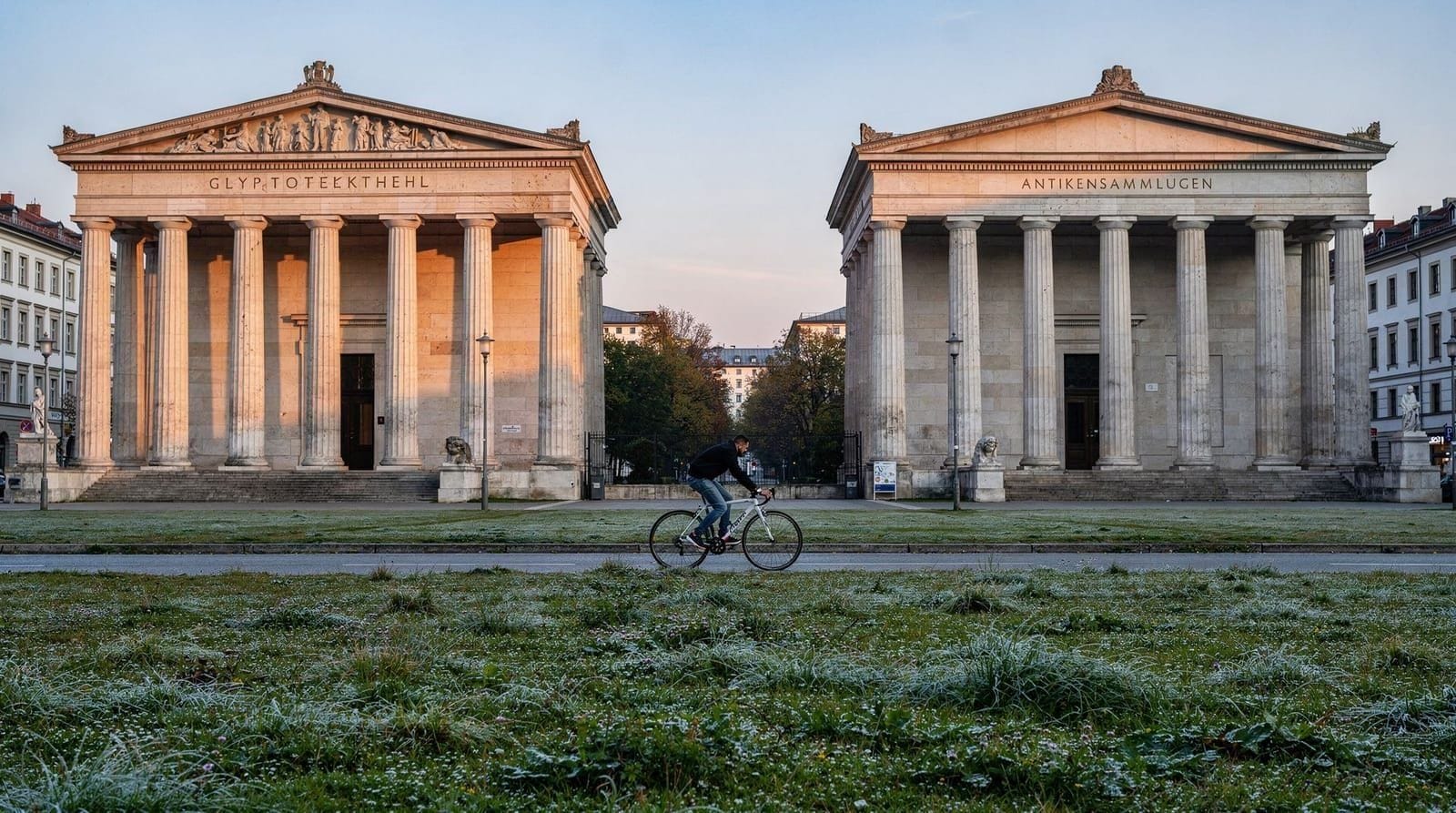
At Brienner Strasse 34, the Braunes Haus. At Arcisstrasse 12, the Führerbau — Hitler’s official Munich reception building and conference centre where the 1938 Munich Agreement was signed. Opposite the Führerbau, the Verwaltungsbau, an administrative building housing party offices. The ensemble formed what was called the “Ehrentempel” zone — a self-conscious attempt to create an architectural expression of party power in what was already Munich’s most prestigious residential and cultural street.
The Führerbau at Arcisstrasse 12 survives today as the Hochschule für Musik und Theater. The former Verwaltungsbau is now the administrative building of the Staatsliche Sammlung für Ägyptische Kunst (Egyptian Art collection). The original Nazi street layout — including the paved Forum between the two buildings where the Munich Agreement was signed — is still visible.
Most guided Munich Third Reich walking tours cover this district in detail. Walking it before entering the NS-Dokumentationszentrum provides useful physical orientation.
The permanent exhibition: structure and content
The permanent exhibition — “München und der Nationalsozialismus” (Munich and National Socialism) — occupies four above-ground floors of the building. The exhibition is chronological in overall structure but thematic within each floor.
Ground floor: context
The ground floor establishes Munich’s political and social landscape before 1933: the First World War’s impact, the November Revolution of 1918, the short-lived Munich Soviet Republic of 1919, and the conditions of hyperinflation and political instability in which the NSDAP found fertile ground. The exhibition contextualises why Munich — an arts-oriented, cosmopolitan, Catholic city — became the seedbed for a movement of radical right-wing nationalism.
First floor: rise and consolidation
The first floor covers the NSDAP’s growth, the Beer Hall Putsch of 1923, Hitler’s trial and imprisonment, and the party’s legal path to power from 1930 to 1933. It specifically documents Munich’s role: the role of Munich newspapers, business donors, aristocratic supporters and popular movements in enabling the NSDAP’s success. The Beer Hall Putsch history guide provides deeper coverage of this period.
The exhibition does not present the Nazi rise as inevitable or as the product of one man’s will. It emphasises choices made by real people — financiers, politicians, journalists, voters — and is particularly attentive to the specific ways Munich’s social networks enabled the movement.
Second floor: persecution and war
The second floor documents the systematic persecution of Jews, political opponents, the disabled, Roma and Sinti, and others under Nazi rule, from the early boycotts of 1933 through deportations and the Holocaust. Munich’s specific role is documented — the Ohel Jakob synagogue’s destruction on Kristallnacht, the deportation of Munich’s Jewish population from 1941, the Dachau concentration camp’s relationship to Munich’s administrative apparatus.
This floor contains the exhibition’s most disturbing archival photographs and documents. The exhibition does not linger on atrocity for its own sake but does not minimise it.
The Dachau Memorial guide provides information on visiting the concentration camp, which operated under direct administrative supervision from Munich.
Third floor: occupation, resistance and liberation
The third floor covers the wartime period — Munich’s experience of Allied bombing (74 raids from 1940 to 1945, approximately 6,000 civilian deaths), acts of resistance including the White Rose group at Ludwig Maximilian University, and the liberation of Munich by American forces on 30 April 1945.
The White Rose section is particularly thorough, documenting the leaflets, the arrest of Sophie and Hans Scholl and other members, their trial before the People’s Court in Berlin, and their execution on 22 February 1943. The White Rose resistance guide covers the sites associated with this history in Munich today.
Top floor: aftermath and memory
The fourth floor addresses questions that are in some ways the most uncomfortable: post-war Munich’s relationship to its Nazi past, the slow process of denazification, the legal proceedings against perpetrators, and the decades-long delay before Munich established this institution. The exhibition asks — without false modesty — why it took Munich until 2015 to open a dedicated documentation centre, when Berlin had its Topography of Terror in 2010 and Nuremberg its Documentation Centre in 2001.
Visiting in practice
Practical information
- Address: Brienner Strasse 34, 80333 Munich
- Opening hours: Tuesday to Sunday, 10:00 to 19:00. Closed Mondays and on certain public holidays.
- Admission: Adults 7 euros. Reduced (students, seniors, Munich Card holders) 3.50 euros. Under 18: free.
- Getting there: U2 to Königsplatz (3 minutes walk). Alternatively U1/U2 to Odeonsplatz and walk west along Brienner Strasse (10 minutes).
- Audio guide: Available at the information desk. Multiple languages. Recommended for independent visitors without a guide.
- Bookshop: Well-stocked with academic and popular histories in German and English. The centre’s own catalogue of the permanent exhibition is a worthwhile purchase.
- Café: A ground-floor café is open during exhibition hours. Coffee and light meals available.
- Accessibility: The building has full lift access. All floors are wheelchair accessible. Toilet facilities are accessible.
How to combine the NS-Dokumentationszentrum with other sites
The centre works best when combined with a walk through the surrounding district. Before entering, walk from Odeonsplatz along Brienner Strasse (15 minutes), noting the Feldherrnhalle, the Theatinerkirche, the former Four Seasons Hotel (historically significant in the putsch era), and the surviving Nazi-era administrative buildings around Königsplatz. After visiting the centre, examine the Führerbau exterior at Arcisstrasse 12 and the forum space between it and the former Verwaltungsbau.  birthplace of the Third Reich guided walking tourCheck availability
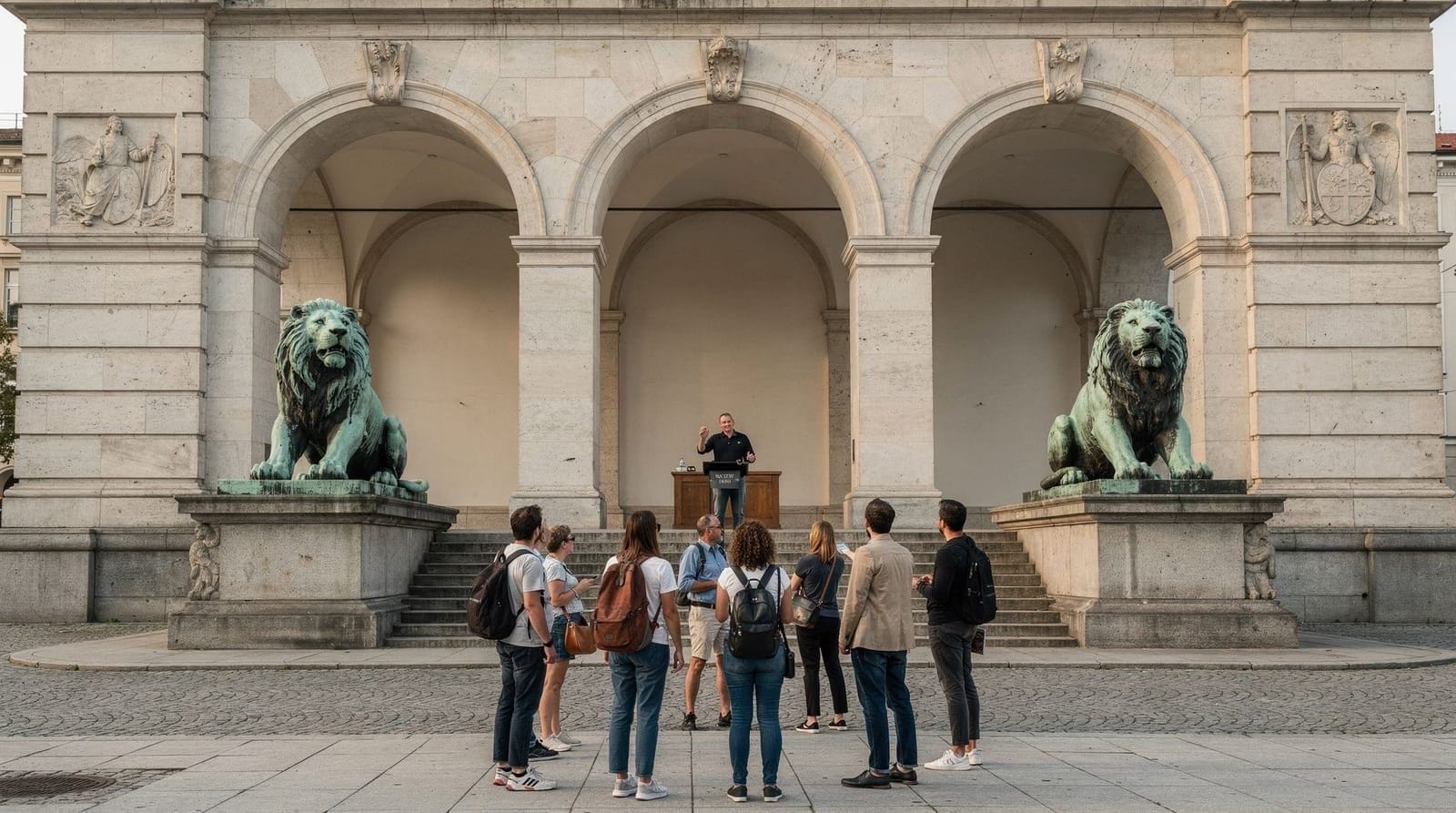
A guided walking tour of the district provides historical narration for the outdoor sites that the NS-Dokumentationszentrum does not cover. Most quality walking tours start or end near the centre and can be combined with an independent visit to the exhibition.
For visitors with limited time: if you can only do one indoor institution covering Munich’s Nazi-era history, the NS-Dokumentationszentrum is the right choice. It is more contextual and less overwhelming than Dachau for an introductory visit, while being genuinely substantive.
For visitors who want full coverage: plan the NS-Dokumentationszentrum for a morning or afternoon and Dachau as a separate half-day, ideally not on consecutive days. The emotional weight of both sites in one day is significant.
What to expect emotionally and how to pace your visit
The exhibition is dense — text-heavy, archival, and deliberately unsensational, which means it rewards a slower pace than a typical museum visit. Most visitors find the second floor (persecution and the Holocaust) the most emotionally demanding section; it is worth allowing extra time there rather than rushing to keep to a fixed schedule. Benches are placed throughout the exhibition for visitors who want to pause. There is no single “correct” pace: some visitors move through all four floors in 90 minutes with the audio guide’s shorter route, while others spend a full afternoon reading every panel.
If you are visiting alone, the exhibition works well as a solitary, reflective experience. If visiting as a group or family, agree beforehand on a rough time budget so that faster and slower readers are not left waiting on each other awkwardly between floors — the layout makes it easy to regroup at the ground-floor café or in the entrance hall.
Language and accessibility of the exhibition
All permanent exhibition text is presented in both German and English throughout, so an audio guide is a convenience rather than a necessity for English-speaking visitors — unlike some Munich museums where English coverage is partial. The audio guide adds context, personal testimonies and additional detail beyond the wall text, and is worth the modest cost if you have the extra time. Large-print materials and additional accessibility resources are available on request at the information desk for visitors who need them.
The Munich Agreement of 1938 — the Führerbau connection
Because the NS-Dokumentationszentrum stands adjacent to the Führerbau, visitors often ask about the Munich Agreement. On 30 September 1938, British Prime Minister Neville Chamberlain, French Premier Édouard Daladier, Italian Prime Minister Mussolini and Adolf Hitler met at the Führerbau on Arcisstrasse 12 and signed an agreement transferring the Czechoslovak Sudetenland to Germany. Chamberlain returned to London and declared “peace for our time.”
Less than six months later, Hitler occupied the rest of Czechoslovakia in violation of the agreement. Eleven months after Munich, he invaded Poland. “Munich” became a word for the failure of appeasement — a lesson in what happens when democratic governments make territorial concessions to authoritarian states in hopes of avoiding conflict.
The Führerbau still has the original room where the agreement was signed, though the building is used as a music school and is not generally accessible to the public. The NS-Dokumentationszentrum’s exhibition covers the agreement and its context.
The institution in context
The NS-Dokumentationszentrum is not a Holocaust memorial in the mode of Berlin’s Memorial to the Murdered Jews of Europe, nor a concentration camp site in the mode of Dachau. It is a history and education institution focused specifically on Munich’s relationship to National Socialism — how the movement developed here, how the city’s political and cultural landscape enabled it, and what happened to Munich and its residents under Nazi rule.
This focus on Munich’s specific agency and complicity — rather than a general account of the Third Reich — is the centre’s most distinctive contribution. It does not allow Munich to see itself purely as a victim of national forces, but insists on examining local choices and local responsibility. For visitors from outside Germany who may know the broad outlines of Nazi history but less about Munich’s specific role, this is genuinely valuable framing.
The Munich WWII history guide provides a broader chronological framework for the period covered in the exhibition.
Frequently asked questions about the NS-Dokumentationszentrum
Is there a connection between the NS-Dokumentationszentrum and Dachau?
The two institutions are independent. The NS-Dokumentationszentrum is a city-funded historical education centre focused on Munich’s relationship to National Socialism. The Dachau Concentration Camp Memorial Site is a memorial and documentation centre at the former camp. They complement each other: the NS-Dokumentationszentrum provides political and social context; Dachau provides visceral contact with what resulted from that political movement.
Can I use a Munich City Museum ticket at the NS-Dokumentationszentrum?
The two institutions are separate. However, there is a combined “3 Munich Museums” ticket covering the NS-Dokumentationszentrum, the Lenbachhaus and the Munich City Museum — check current availability at any of the three venues.
Are there temporary exhibitions at the NS-Dokumentationszentrum?
Yes. The centre regularly hosts temporary exhibitions on related themes — resistance movements, specific victim groups, post-war justice, contemporary issues of historical memory. Check the centre’s website for current programming before your visit.
Is the NS-Dokumentationszentrum appropriate to combine with a beer garden or Oktoberfest visit on the same day?
Visitor experience varies. Some people find that the afternoon following a morning visit to the NS-Dokumentationszentrum is best spent in quiet reflection. Others find the contrast of Munich’s civic normalcy — the Englischer Garten, a beer garden, a walk along the Isar — a meaningful antidote to the weight of the exhibition. There is no single “correct” way to manage the emotional register of the day.
Why did it take Munich until 2015 to open this centre?
The centre’s own top-floor exhibition addresses this question directly. The short answer involves post-war political priorities, the psychological difficulty of confronting local complicity (as opposed to distant regime crime), the specific political atmosphere of Munich as a CSU stronghold, and ongoing debates about whether commemoration would create pilgrimage sites for right-wing groups. The decision to proceed in 2005 and open in 2015 reflected both generational change and the influence of similar institutions in other German cities.
How long should I really plan for a visit?
Ninety minutes is the practical minimum to get real value from the exhibition without rushing. Two to three hours allows a thorough read of all four floors including the audio guide’s additional testimonies. Visitors combining it with the surrounding district walk (Königsplatz, Führerbau, Feldherrnhalle) should budget a half-day in total.
Is the exhibition suitable for teenagers?
Yes, generally from around age 14, though the second floor’s material on persecution and the Holocaust is difficult and includes disturbing archival photographs. Teenagers with some prior context on WWII history tend to get the most out of the visit; younger children are usually better served by the outdoor sites with a guide who can adjust the content on the spot.
Top experiences
Bookable activities with verified prices and instant confirmation on GetYourGuide.