Munich cafes guide — best coffee houses and neighbourhood cafes
Munich: old town food tour with 10+ tastings, beer and pretzel
Does Munich have a good cafe culture?
Munich has a strong cafe culture with two distinct traditions — the grand Kaffeehäuser (coffee houses) in the Austrian-influenced style, and a newer specialty coffee scene concentrated in Schwabing, Maxvorstadt, and the Glockenbach. The grand Café Luitpold and Café Frischhut represent the traditional end; roasters like Man Versus Machine represent the specialty end.
Two coffee traditions in one city
Munich’s café culture operates on two distinct tracks that rarely intersect: the grand Kaffeehaus tradition inherited from Vienna and the Austrian Empire, and the specialty coffee movement that emerged in the city’s creative neighbourhoods over the past 15 years.
The first is formal, marble-tabled, and built around lingering — you sit, you read, you order a second coffee an hour later, nobody rushes you. The second is precise, technically focused, and concerned with origin, roast profile, and extraction method. Both are genuinely good. Understanding which type you’re walking into — and what to order at each — makes coffee in Munich considerably better.
| Grand Kaffeehaus | Café Luitpold, Maxvorstadt — table service, cake, unhurried |
| Specialty coffee | Man Versus Machine, Glockenbach/Maxvorstadt — precise, laptop-tolerant |
| Unique item | Schmalznudeln at Café Frischhut, mornings only until sold out |
| Typical spend | €4–12 for coffee + cake or Bavarian breakfast |
| Best neighbourhood for cafes | Glockenbach for contemporary, Schwabing for local, Altstadt for grand |
| Sunday opening | Grand Kaffeehäuser generally open; specialty cafes vary |
The grand Kaffeehäuser
Café Luitpold
Address: Brienner Straße 11, 80333 Munich (Maxvorstadt, near Odeonsplatz) Hours: Monday-Saturday 8am-8pm, Sunday 9am-7pm
Café Luitpold opened in 1888 and occupied a prominent corner of Maxvorstadt until bombing in 1944 left little standing. The rebuilt version restored the essential character — high ceilings, chandelier, marble surfaces, a glass-roofed inner courtyard — while adapting to a modern service model. The result is the closest Munich has to a genuine grand Viennese Kaffeehaus: proper table service, a substantial cake display, and an unhurried atmosphere.
The coffee is well-prepared (the Großer Brauner is the house recommendation — a double espresso with a small amount of cold milk served separately), and the pastry selection is genuinely impressive. The Apfelstrudel, the Donauwelle (cherry and chocolate layer cake), and the seasonal tortes rotate with quality. A Verlängerter and a slice of Donauwelle costs around €10-12 — not cheap, but the setting earns the price.
Luitpold occupies a position directly between Odeonsplatz (where the Munich Residenz is located) and the Pinakothek museum quarter, making it a natural stop on a morning museum run.
Café Rischart
Multiple locations: Marienplatz (Rindermarkt 2), Hauptbahnhof, and several branches across the city. Hours: Vary by location; Marienplatz branch open 7am-8pm daily.
The Rischart chain is Munich’s most established bakery and café operation — family-owned since 1912 and one of the few companies that produces genuinely good product at scale. The Marienplatz branch is the most prominent location, and the bread and pastry quality is consistently above the average bakery-café. The Laugengebäck (lye-baked rolls and sticks) here is among the better versions in the centre.
Rischart is more café-bakery than pure Kaffeehaus — the pace is faster, particularly at the Marienplatz branch — but the coffee is properly prepared and the cake quality is high. The Streuselkuchen (crumble cake) and the seasonal Pflaumentarte (plum tart in autumn) are particularly good.
Café Frischhut — the Schmalznudeln institution
Address: Prälat-Zistl-Straße 8, 80331 Munich (city centre, near Viktualienmarkt) Hours: Monday-Saturday, 9am-approximately 2pm (closes when dough runs out)
Café Frischhut is not a grand Kaffeehaus. It is a small, slightly scruffy room with plastic tables, basic coffee, and one thing that nobody else in Munich makes: Schmalznudeln. These are flat, coin-shaped fried dough discs, pressed slightly in the centre, dusted with icing sugar, and eaten warm. The texture is crispy at the edges, soft in the middle, and completely unlike any other Munich pastry.
The café opens at 9am and closes when the day’s batch of Schmalznudeln runs out — sometimes by noon on busy days, sometimes by 1pm on quiet weekdays. Arriving before 11am is safe. The menu is almost entirely Schmalznudeln and coffee, and that simplicity is the point. Price: around €3-4 for two pieces.
This is listed in every serious Munich food guide and recommended by locals who have been eating here for decades. Go.
Specialty coffee in Munich
Munich’s specialty coffee scene developed significantly from 2010 onward and has matured into a small but consistent group of serious operators. The concentration is in Maxvorstadt, Schwabing, and the Glockenbach — the city’s most internationally minded residential areas.
Man Versus Machine
Locations: Müllerstraße 23 (Glockenbach) and Schellingstraße 9 (Maxvorstadt) Hours: Monday-Friday 8am-6pm, Saturday 9am-6pm, Sunday 10am-5pm
Man Versus Machine is Munich’s most technically rigorous coffee operator and has been since its founding in 2010 — one of the early specialty coffee shops in Germany. The roastery (based in Maxvorstadt) sources single-origin beans from direct relationships with producers in Ethiopia, Colombia, Guatemala, and elsewhere, and roasts to a lighter profile than traditional German café coffee, emphasising origin character over roast character.
The Schellingstraße location in Maxvorstadt is the roastery café — the primary venue, with the most extensive filter menu and the highest rotation of different single-origin offerings. The Müllerstraße location in Glockenbach is slightly smaller and more neighbourhood-café in character.
Both serve espresso, flat whites, filter (V60 and batch brew), and seasonal cold brew. The flat white here is genuinely one of the best in Munich — balanced, precise, properly extracted. Cost: espresso €3-3.50, flat white €4.50, filter €4-5.
Vits Coffee
Address: Lindwurmstraße 68, 80337 Munich (Glockenbach) Hours: Monday-Saturday 8am-6pm, Sunday 9am-5pm
Vits Coffee is a roaster-café with a more Mediterranean influence in its café character — the setting is warmer and more relaxed than Man Versus Machine, and the food offering is more developed (good pastries from local suppliers, occasional lunch specials). The coffee is consistently well-prepared, with a wider range of milk-based options than some specialty cafes.
The Glockenbach location places it in the neighbourhood guide context: the area is covered in the Glockenbachviertel guide and is walkable from the old town via the Isarvorstadt.
Kaffeerösterei Münchner Freiheit
Address: Münchner-Freiheit-Platz 10, 80804 Munich (Schwabing) Hours: Monday-Saturday 8am-7pm, Sunday 9am-7pm
Located directly at the Münchner Freiheit U-Bahn square in Schwabing, this roastery café is the best option in the northern part of the city — useful after visiting the English Garden or if you’re staying in the Schwabing area. The coffee is roasted on-site and the beans are sourced from Central and South American producers primarily. The setting is relaxed, with outdoor seating on the pedestrianised Münchner-Freiheit-Platz in good weather.
The Schwabing neighbourhood guide covers the area more broadly, including restaurant and shopping options alongside the cafes.
Ordering coffee like a local
A few small conventions make a real difference to how a Munich café visit goes. At table-service Kaffeehäuser, wait to be seated rather than choosing your own table — this is standard practice and staff will show you to a free spot. Ordering is done at the table, not the counter, and the bill is paid at the table when you are ready to leave, not on collection of your order.
At counter-service specialty cafes, the reverse applies: order and pay at the counter, and your drink is either brought to your table or you collect it from the bar depending on the venue. Watch what regulars do on your first visit if it is unclear.
Menu terms worth knowing: a “Verlängerter” is an espresso lengthened with hot water, roughly equivalent to an Americano. A “Melange” (more common in the Austrian-influenced Kaffeehäuser) is closer to a cappuccino, with steamed milk and foam. “Milchkaffee” is a large milky coffee, typically served in a bowl-shaped cup rather than a standard mug — common at breakfast.
Munich café culture by neighbourhood
Different parts of Munich have distinct café characters:
Altstadt and Innenstadt (city centre): The grand Kaffeehäuser and established bakery-cafés. Best for traditional atmosphere and ease of access. Café Luitpold, Rischart, and Frischhut are the standouts.
Maxvorstadt (museum quarter): Specialty coffee around Schellingstraße and Türkenstraße, alongside the café culture that serves the Ludwig Maximilian University campus. Cheap lunch options, laptop-friendly cafes, and a young, international crowd. Man Versus Machine’s roastery cafe is here.
Schwabing: Neighbourhood cafes serving the residential streets north of the English Garden. More relaxed pace, more local character. The Münchner Freiheit area has the best concentration.
Glockenbach and Isarvorstadt: The most contemporary café scene in Munich. Independent coffee shops, natural wine bars that open mid-morning, and a concentration of cafes with strong brunch and lunch offerings. Vits Coffee, several smaller espresso bars, and some of Munich’s better modern European café-restaurants are here.
Haidhausen (Au-Haidhausen): The eastern district across the Isar has a growing café scene alongside its established Wirtshaus culture. More casual, very local, useful if you’re visiting the Au-Haidhausen area.
What to eat with coffee in Munich
Bavarian café food follows a distinct logic that differs from French café culture or Italian espresso bar culture:
Frühstück (breakfast) at a café: Many Munich neighbourhood cafes serve a substantial breakfast — bread basket with Brezn, butter, honey, various cheeses, cold cuts, and a soft-boiled egg, for €9-14. This “Bavarian breakfast” at a café is a tradition that extends well into late morning (some cafes serve it until noon or even 1pm).
Kuchen (cake): The German cake tradition is important in Munich cafes. Streuselkuchen (buttery crumble cake), Käsekuchen (cheesecake, baked rather than chilled), Blechkuchen (sheet cake in various seasonal flavours), and the classic Torte varieties (Schwarzwälder Kirschtorte, Donauwelle) are the common forms. Quality varies significantly — the best café pastry in Munich is at Luitpold and at the best independent bakeries.
Apfelstrudel: The Austrian apple strudel — thinly rolled dough wrapped around spiced apple filling, baked until the exterior is flaky and golden — is properly embedded in Bavarian café culture given the Austrian cultural influence on Munich. A good version with vanilla sauce costs €5-7. The worst tourist-café version is a pre-frozen roll with no flavour.
Schmalznudeln: As described above — the unique Frischhut speciality. Not available elsewhere in the city.
Guided food and coffee experiences
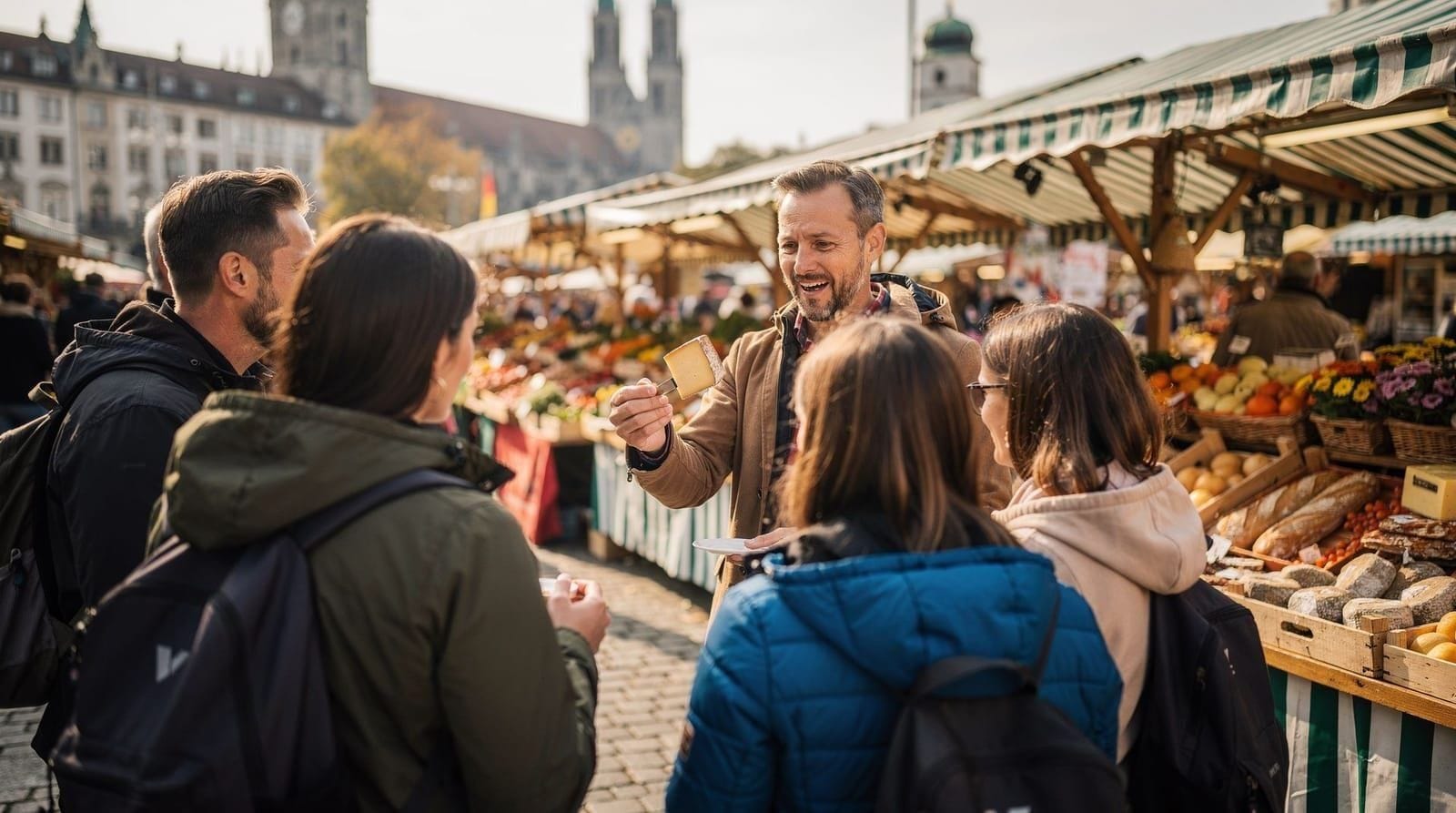
For visitors who want to understand Munich’s café culture in the context of its broader food scene, the old town food tour with 10 tastings includes a café stop alongside the sausage and market elements of a classic Munich food exploration.
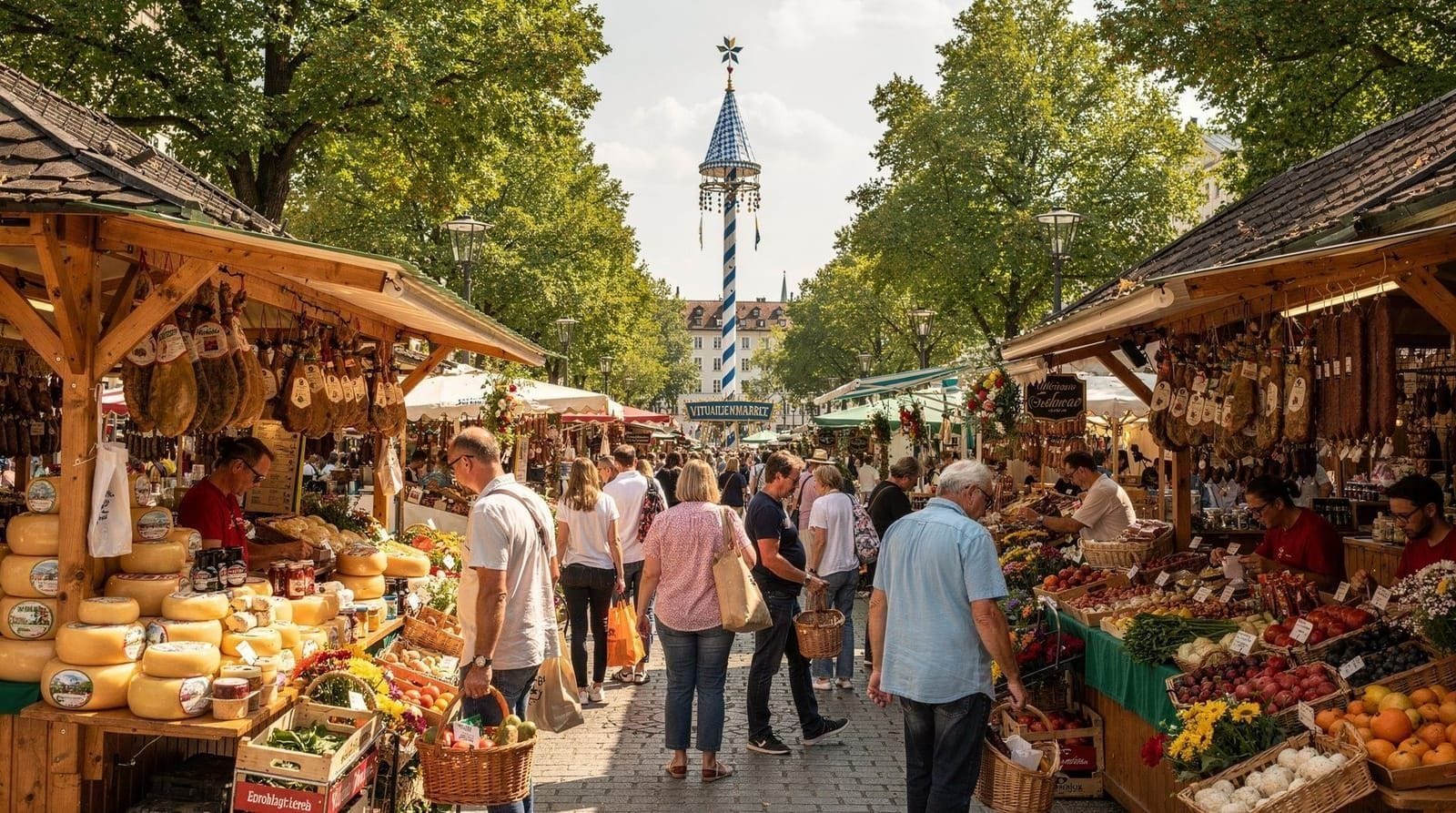
The Viktualienmarkt gourmet food tour concentrates on the market area adjacent to where several traditional cafes operate — useful for combining a market visit with a café stop in the historic centre.
Munich’s cake and pastry tradition
The Bavarian pastry tradition is underappreciated relative to the sausage and beer culture, but it is genuinely distinctive and worth understanding for any café visit:
Brezn: The foundational item. A proper Munich Brezn has a thick, dark-brown lye-baked exterior with a glossy surface, a dense and chewy crust, and a soft interior that tears along the characteristic three-strand form. The coarse salt crystals (Grobes Salz) on the top are structural, not decorative — they draw moisture and create a textural contrast. Poor Brezn (pale, soft throughout, thin crust) are common at chain bakeries; good Brezn are available at Rischart, Hofpfisterei, and small independent bakers throughout the residential neighbourhoods.
Streuselkuchen: Sheet cake with a crumble topping — a dense, buttery, vanilla-scented base layer topped with Streusel (a rough crumble of flour, butter, and sugar) that bakes to a slightly sandy, crisp texture. The quality version at a good Munich café is much better than the name suggests. Available at most Kaffeehäuser.
Donauwelle: A layered cake — chocolate and vanilla sponge interleaved with sour cherries, covered with chocolate ganache and a thin white layer. The name means “Danube wave,” referring to the visual pattern of the layers when cut. At its best it is one of Bavaria’s more sophisticated cake forms — tart cherry, rich chocolate, and a contrast between the dense sponge and the crisp ganache shell. Café Luitpold does a particularly good version.
Apfelstrudel: Thinly rolled strudel dough (stretched until translucent — a skilled technique) wrapped around a filling of spiced apple, raisins, and breadcrumbs, baked until the exterior is flaky and golden. Served warm with vanilla sauce. The quality of the dough is the differentiator — cheap versions use puff pastry or a pre-made shortcrust, which are completely different. Café Luitpold and the better Wirtshaus restaurants serve a properly made strudel.
Schmalznudeln at Café Frischhut: The unique Munich item described above — fried dough discs available only at one location, until they run out. Worth making a specific trip for.
Lebkuchen: Not exclusively a Christmas product, though that is when they are most associated. Bavarian Lebkuchen (gingerbread) range from the commercial round variety to hand-decorated artisan pieces. The spice blend — a combination of anise, cinnamon, cloves, cardamom, and sometimes black pepper — is distinctly Bavarian rather than Northern German. Specialty bakeries and Christmas market vendors are the best sources.
Coffee shop working culture in Munich
Munich has developed a secondary café culture around remote working that is distinct from the traditional Kaffeehaus model. The relevant distinctions for visitors who want to work:
Laptop-friendly specialty cafes: Man Versus Machine (both locations), Vits, and most independent specialty coffee shops in Maxvorstadt and Glockenbach are laptop-tolerant. The expectation is that you buy coffee every 1-2 hours if you stay for several hours — this is the unwritten but real convention. WiFi is typically reliable and the atmosphere is quiet enough for focused work.
Traditional Kaffeehäuser: Café Luitpold has a more formal atmosphere that is less suited to laptop work — the marble tables are not ergonomic and the background noise level is higher at busy periods. It is comfortable for reading or conversation but not for a working session. The side café area is quieter than the main dining room.
Neighbourhood Stehcafé (standing cafés): Small counter cafes where coffee is consumed standing or in a single chair and the entire transaction takes 5 minutes. Common around S-Bahn and U-Bahn stations and in residential streets. Not for working, but the fastest way to get a good coffee when in transit.
Munich café culture after dark
Munich’s café scene largely closes by 7-8pm — this is not a city with a late-night café culture in the Mediterranean sense. After the cafes close, the culture shifts to bars, Wirtshäuser, and the beer halls. However, some café spaces transform:
The Glockenbach neighbourhood has a few café-bar crossover spaces that stay open into the evening, serving wine and cocktails from 6pm onward in spaces that function as cafes during the day. These occupy the gap between café and bar that is more developed in Berlin or Vienna.
For the broader Munich nightlife and late-night eating options, the Munich nightlife guide covers the shift from daytime café culture to the evening restaurant and bar scene.
Munich café pricing in 2026
A realistic breakdown:
- Espresso at a traditional café: €2.50-3.50
- Cappuccino or flat white at a specialty café: €4-5.50
- Slice of cake: €4-7 depending on the cake and the venue
- Full Bavarian breakfast at a café: €9-14
- Schmalznudeln at Frischhut: €3-4 for a pair
- Apfelstrudel with vanilla sauce: €5-7
The Munich budget guide puts café costs in context alongside restaurant and beer garden spending for a full trip budget estimate.
Grand Kaffeehaus vs specialty coffee: which to choose
Visitors with limited time often ask which tradition to prioritise. The honest answer depends on what you want from the stop.
| Grand Kaffeehaus | Specialty coffee | |
|---|---|---|
| Best for | Reading, conversation, a proper cake stop | Quality espresso/filter, working on a laptop |
| Atmosphere | Formal, marble tables, unhurried | Precise, casual, quieter background noise |
| Typical stay | 45–90 minutes | 30–60 minutes, longer if working |
| Standout order | Großer Brauner + Donauwelle at Luitpold | Flat white or V60 at Man Versus Machine |
| Where | Altstadt, Maxvorstadt | Glockenbach, Maxvorstadt, Schwabing |
Most first-time visitors do well combining both in a single day — a grand Kaffeehaus in the morning for orientation and cake, a specialty stop in the afternoon if you need to work or want technically better coffee.
Café stops that pair well with a day of sightseeing
Munich’s cafes are positioned conveniently around the main sightseeing routes, which makes it easy to build them into an itinerary rather than treating them as a separate outing.
Starting a museum morning at Café Luitpold before the Pinakothek quarter, breaking for Schmalznudeln at Frischhut near the Viktualienmarkt around mid-morning, or finishing an English Garden walk at the Kaffeerösterei Münchner Freiheit in Schwabing are all natural combinations that avoid backtracking across the city. If you are staying in Glockenbachviertel, Vits Coffee makes a reliable breakfast stop before heading into the Altstadt.
Frequently asked questions about Munich cafes
Are Munich cafes generally open on Sundays?
The grand Kaffeehäuser (Luitpold, Rischart branches) open on Sundays, typically slightly later than weekday hours (9-10am rather than 7-8am). Specialty coffee shops vary — many close or run shorter hours on Sundays. Café Frischhut is closed Sundays. Bakery-attached cafes often open Sunday mornings. Check specific opening hours before planning a Sunday café visit.
Is tipping expected at Munich cafes?
Yes, tipping is standard but not as formalised as in the US. The norm at a table-service café is to round up the bill or add 5-10%. At a counter-service café or specialty coffee bar, tipping is optional and at the customer’s discretion — a tip jar is typically present but leaving nothing is perfectly accepted.
Do Munich cafes have outdoor seating?
Most Munich cafes with any exterior access run outdoor seating from April through October, weather permitting. Pavement cafes (Schanigarten in Austrian-influenced usage) are particularly pleasant in the pedestrian zones around Maxvorstadt and in the Glockenbach’s side streets. The Café Luitpold terrace is one of the more pleasant outdoor café spots in the city centre.
Are there quiet cafes in Munich for reading or working?
Yes. Café Luitpold’s side café area is generally quiet outside lunch hours. Neighbourhood cafes in Maxvorstadt along Schellingstraße and Türkenstraße have a student-library character — quiet, laptop-tolerant, and tolerant of long stays. Avoid the Marienplatz cafes if you want quiet — the tourist throughput makes sustained concentration difficult.
What is the difference between a Café and a Kaffeehaus in Munich?
In practice, these terms are used interchangeably in Munich. Technically, a Kaffeehaus implies the Austrian tradition — marble tables, table service, newspapers available, unhurried atmosphere, a focus on coffee preparations and cake. A Café is a looser term covering everything from a bakery with seating to a modern espresso bar. Most Munich establishments just call themselves Café regardless of style.
Where can I find the best breakfast cafe in Munich?
For traditional Bavarian breakfast: Café Luitpold or any established Wirtshaus serving the Weißwurst Frühstück. For specialty coffee with good food: Vits in the Glockenbach or Man Versus Machine in Maxvorstadt. For the most distinctive single item: Café Frischhut for Schmalznudeln before 11am.
Which Munich cafe is best for a first-time visitor with limited time?
Café Luitpold, for the combination of setting, cake, and central location between Odeonsplatz and the Pinakothek quarter — it gives a genuine sense of the grand Kaffeehaus tradition without requiring a detour. If you can only add one more stop, make it Café Frischhut for the Schmalznudeln, since it is unlike anything else in the city and closes once the day’s batch runs out.
Do Munich cafes serve alcohol?
Many do, particularly in the evening. Grand Kaffeehäuser like Café Luitpold serve wine and some spirits alongside coffee, and the café-bar crossover spaces in Glockenbach shift to wine and cocktails from around 6pm. Specialty coffee shops focused purely on coffee typically do not serve alcohol at all — check individual venues if this matters for your visit.
Top experiences
Bookable activities with verified prices and instant confirmation on GetYourGuide.