Allianz Arena and FC Bayern Museum: the honest guide
Munich: FC Bayern Museum and Arena view
Is the Allianz Arena tour worth doing without a match ticket?
Yes — the FC Bayern Museum alone is worth the €12 entry, and the combined museum and arena guided tour (€21) gives meaningful access to the pitch, press room, and dressing rooms. Allow 2–3 hours for both. Guided tours run weekdays only and are suspended on match days.
The Allianz Arena sits well outside Munich’s historic centre, so it rewards a bit of planning: decide upfront whether you’re doing the museum only, the combined tour, or building a whole afternoon around football and BMW. The essentials below get you oriented before the fuller detail underneath.
| Where | Fröttmaning, northern Munich (U6 from the centre) |
| Cost | Museum around €12; combined museum + tour around €21 |
| Time needed | 60–90 min museum only; 2–3hrs for museum + guided tour |
| Getting there | U6 to Fröttmaning, then a 15-minute signposted walk |
| Best time | Weekday mornings; tours pause on match days |
Before you go: what the Allianz Arena actually is
The Allianz Arena opened in May 2005 on the northern edge of Munich, in the Fröttmaning district. It replaced the Olympiastadion — FC Bayern’s home from 1972 to 2005 — and was designed by the Swiss architectural firm Herzog and de Meuron, the same practice behind the Beijing National Stadium (Bird’s Nest). The building cost approximately €340 million and took roughly three years to construct.
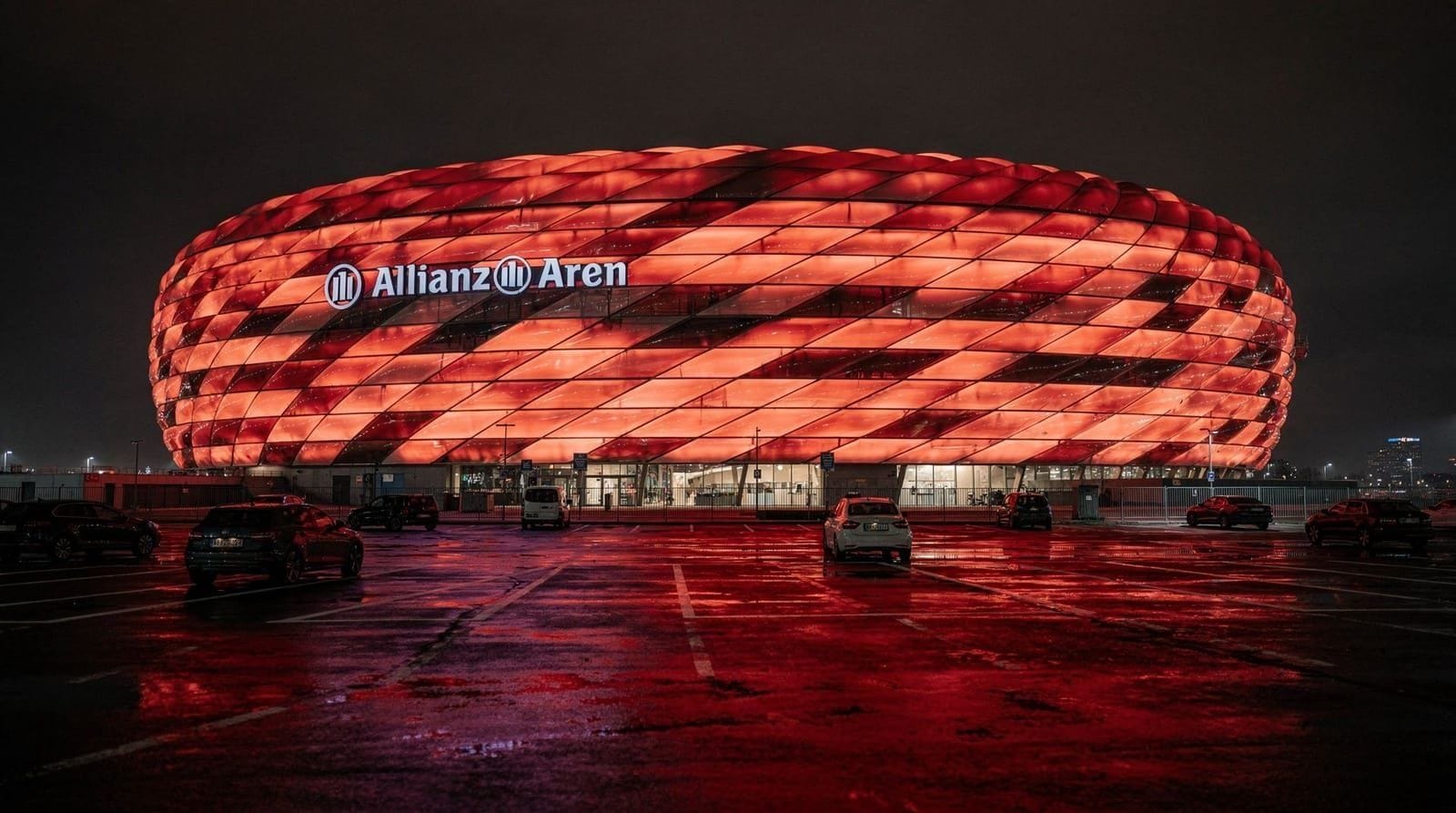
The arena’s exterior cladding — 2,874 ETFE (ethylene tetrafluoroethylene) plastic air panels — is what makes it immediately distinctive. The panels can be illuminated in white (neutral), red (FC Bayern match), or blue (which was used when TSV 1860 Munich still played here). Since 1860 departed in 2017, the blue illumination is rarely used. The red illumination on match nights is visible from miles away and has become a Munich landmark in its own right.
Capacity is 75,024 for domestic matches, reduced to approximately 66,000 for UEFA competitions (UEFA requires more press and safety space). This makes it the largest stadium in Germany and one of the ten largest in Europe.
Two features make a visit worthwhile even without a match ticket: the FC Bayern Museum and the guided arena tour. This guide covers both, plus the practical logistics of visiting and attending a real match.
The FC Bayern Museum: what is inside
The FC Bayern Museum is located within the Allianz Arena complex, accessible from the stadium’s concourse level. It opened in 2012 and has been updated in subsequent years. The museum focuses exclusively on FC Bayern Munich — the club’s history, trophies, and identity — rather than the arena itself.
The trophy room: The centrepiece is the trophy display: multiple Bundesliga championship trophies, DFB-Pokal cups, and the Champions League / European Cup trophies (the club has won the competition six times as of 2026). The presentation is effective — good lighting, clear labelling, and audiovisual context for non-German visitors who may not recognise each season.
The jersey archive: One of the museum’s most interesting sections is the chronological display of FC Bayern kits from the club’s 1900 founding to the present. The evolution of kit design over 120 years is more visually engaging than it sounds, particularly the contrast between post-war homemade-looking strips and the heavily branded modern versions.
Interactive displays: Several rooms use touchscreens and video walls to let visitors explore player statistics, memorable matches, and historical seasons. The quality is reasonable — better than average for a club museum, though it obviously presents the club in a wholly positive light.
The Legends section: Displays dedicated to key figures in the club’s history — Franz Beckenbauer, Gerd Müller, Karl-Heinz Rummenigge, Oliver Kahn, and more recently Arjen Robben, Franck Ribéry, and Robert Lewandowski. The Robben and Ribéry display acknowledges their Champions League final contribution in 2013 with reasonable enthusiasm.
What the museum does not cover: There is minimal critical perspective. The 1999 Champions League final loss is not given significant space. The museum is a celebration, not a balanced historical account — that is consistent with every club museum in world football.
Adult ticket: €12. Allow 60–90 minutes to see everything properly.
FC Bayern Museum entry ticket — book ahead for guaranteed entry, particularly during school holidays.
The guided arena tour: what you see
The guided arena tour runs approximately 70 minutes and is conducted in German and English (check availability when booking). It takes you into parts of the stadium that are otherwise inaccessible.
The players’ tunnel: The approach to the pitch from the dressing rooms. At 75,000 capacity, the acoustic effect when two sets of fans are in full voice — which you get a small simulation of via the tour’s sound system — gives some sense of the matchday atmosphere.
The dressing rooms: Both home and away dressing rooms are included. The FC Bayern home dressing room is well-equipped; the away dressing room is functional but deliberately less comfortable — this is a common tactic at major clubs. The attention to detail (sponsor branding, individual lockers, the massage tables) makes this one of the tour’s more interesting stops.
Pitch level: You access the pitch perimeter and can look across the playing surface from field level. The scale is different from what you see from the stands — the pitch appears considerably larger from ground level. The turf is maintained to a standard that becomes obvious up close.
The press conference room: The formal post-match press conference room, with the sponsor-branded backdrop familiar from broadcast footage. Good for a photo if you follow the club’s media coverage.
VIP and business areas: The tour passes through hospitality areas and the business seating sections. The view from the business seats is, objectively, excellent — these are expensive for a reason.
The media gantry: Some tours include access to the elevated media positions. Views from here — looking down on the full pitch with the stands rising on all sides — give the clearest sense of the arena’s scale and design.
The combined museum and arena tour costs approximately €21.
FC Bayern Museum and arena tour combined — the most efficient option for a non-match visit.
Attending a real match: practical reality
If you want to attend a Bundesliga match, the process requires more planning than for most tourist activities.
Ticket availability: FC Bayern Munich has one of the highest season-ticket saturation rates in German football. The proportion of seats available to non-season-ticket holders is limited. For high-profile matches — derby matches (though the traditional Munich derby against 1860 is in a lower division as of 2026), Champions League games, matches against Borussia Dortmund or Bayer Leverkusen — available tickets disappear within hours of going on general sale. Matches against lower-table Bundesliga sides have somewhat better availability.
Where to buy: The official source is fcbayern.com. Third-party platforms resell tickets at a premium; be cautious about authenticity. GetYourGuide and similar platforms offer legitimate ticket + transfer packages for certain matches.
Prices: Standing tickets in the Südkurve (south curve — the active supporter section) start around €30 for Bundesliga matches. Central seated areas cost €60–100+. Business and premium hospitality packages run €150–300+ per person. Champions League matches at all tiers cost significantly more.
Arriving early: For popular matches, arrive at least 90 minutes before kickoff. The U6 Fröttmaning exit can have 20,000+ people walking the same route simultaneously. Food and drink inside the stadium is standard — Bratwurst, pretzels, Augustiner beer. Eating and drinking before you arrive is more comfortable and cheaper.
Bag policy: The Allianz Arena enforces a bag size restriction: bags must be no larger than 40×30×20cm. Clear bags are preferred. Large backpacks, suitcases, and holdalls are not permitted. Check the current match-day regulations on the official FC Bayern website — policies have tightened in recent years.
No match available? The museum and arena tour combination is a genuinely good substitute. It provides historical depth that a single match cannot offer, and you see areas of the building that are closed on match days.
The 1860 Munich chapter: brief context
TSV 1860 München — Munich’s second major football club, founded 1860 — co-funded and initially co-occupied the Allianz Arena when it opened in 2005. The two clubs shared the stadium for over a decade, though FC Bayern were always the primary tenant.
1860’s financial difficulties worsened in the mid-2010s. The club was relegated to the third division (3. Liga) in 2017 and their investor withdrew, making it impossible to continue at the Allianz Arena. They relocated to the Grünwalder Stadion in Giesing — a 15,000-capacity ground with a strong traditional supporter culture. As of 2026, 1860 remain in the 3. Liga.
The history matters for understanding Munich’s football geography: the city has two clubs with distinct identities, but only one that occupies the Allianz Arena. If you want to watch 1860 Munich at the Grünwalder Stadion — a very different matchday experience, cheaper tickets, strong local atmosphere — that is covered in the Munich.
Euro 2024 and the arena’s international role
The Allianz Arena was one of the ten venues for UEFA Euro 2024, hosted in Germany. Munich staged five group stage matches plus a round of 16 game during the tournament. The arena’s infrastructure — transport links, capacity, and experience — was considered among the best of the tournament venues.
The Euro 2024 legacy has been an increase in international visitor interest in the arena. If you are visiting in 2026, the tour staff are well-practised at explaining the venue to visitors who know it primarily from international rather than domestic football.
Getting there in detail
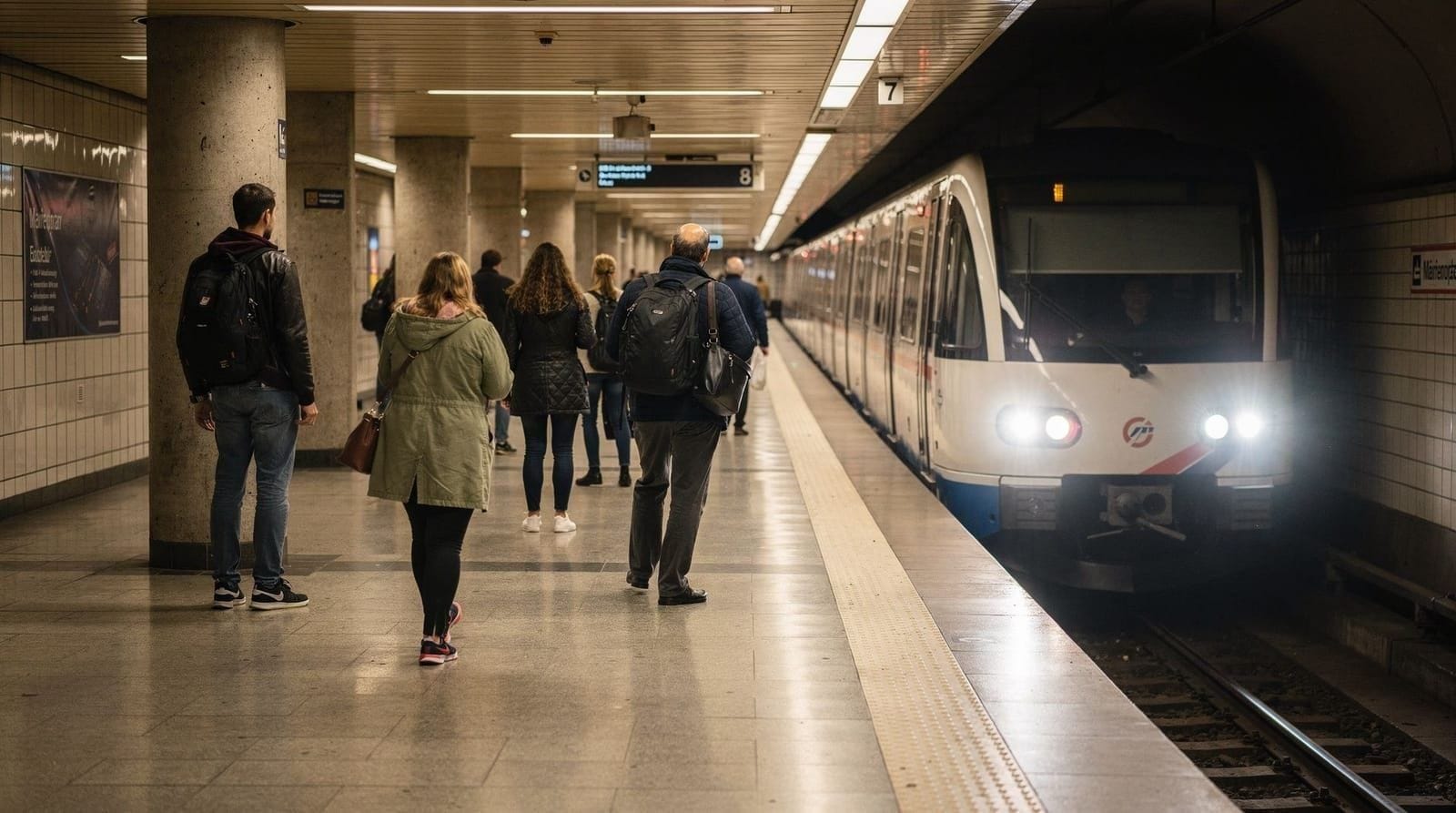
By U-Bahn (recommended): U6 direction Garching-Forschungszentrum, exit at Fröttmaning (the last stop before the turnaround). Journey time from Marienplatz: approximately 20–25 minutes. From Fröttmaning station, follow the signs for Allianz Arena — a 15-minute walk across a flat path beside the motorway flyover. On match days, this walk is crowded but well-managed. On non-match days, the path is straightforward but slightly industrial in character.
On match days: The U6 runs additional trains at high frequency before and after matches. Expect full carriages for the 45 minutes before kickoff. The journey from the city center is fast; the bottleneck is the station exit and the path to the stadium. Return journeys after the match can take 30–45 minutes longer than normal due to the volume of passengers.
By bus: The city bus route 292 serves Fröttmaning from the Scheidplatz interchange. Useful if you are coming from the northwest rather than the city center.
Cycling: The route from central Munich is around 12–15 km and largely follows cycle paths through Schwabing and Freimann. Not practical on match days. On non-match days, bicycle parking is available outside the arena.
By car: Avoid on match days. Parking is limited, traffic management is complex, and journey times are unpredictable. The Munich public transport guide covers the full network context.
Combining the arena with nearby attractions
The Allianz Arena sits in an area of Munich that has little else to recommend it to tourists — the Fröttmaning district is largely industrial. The combination logic therefore points back toward the city center or the BMW complex.
BMW Welt and BMW Museum are in Olympiazentrum, about 7 km southwest — approximately 20 minutes on the U6 via Münchner Freiheit. A visit to the arena in the morning followed by BMW Welt in the afternoon is a coherent full-day structure for visitors interested in both. The BMW Welt and BMW Museum guide covers the BMW campus.
Olympiapark is adjacent to the BMW complex and can be combined with BMW Welt for a full day in the north of the city. See the olympiapark-guide for what is included. Guided tour combining BMW Welt, Allianz Arena, and Olympiapark covers all three in a single structured day.
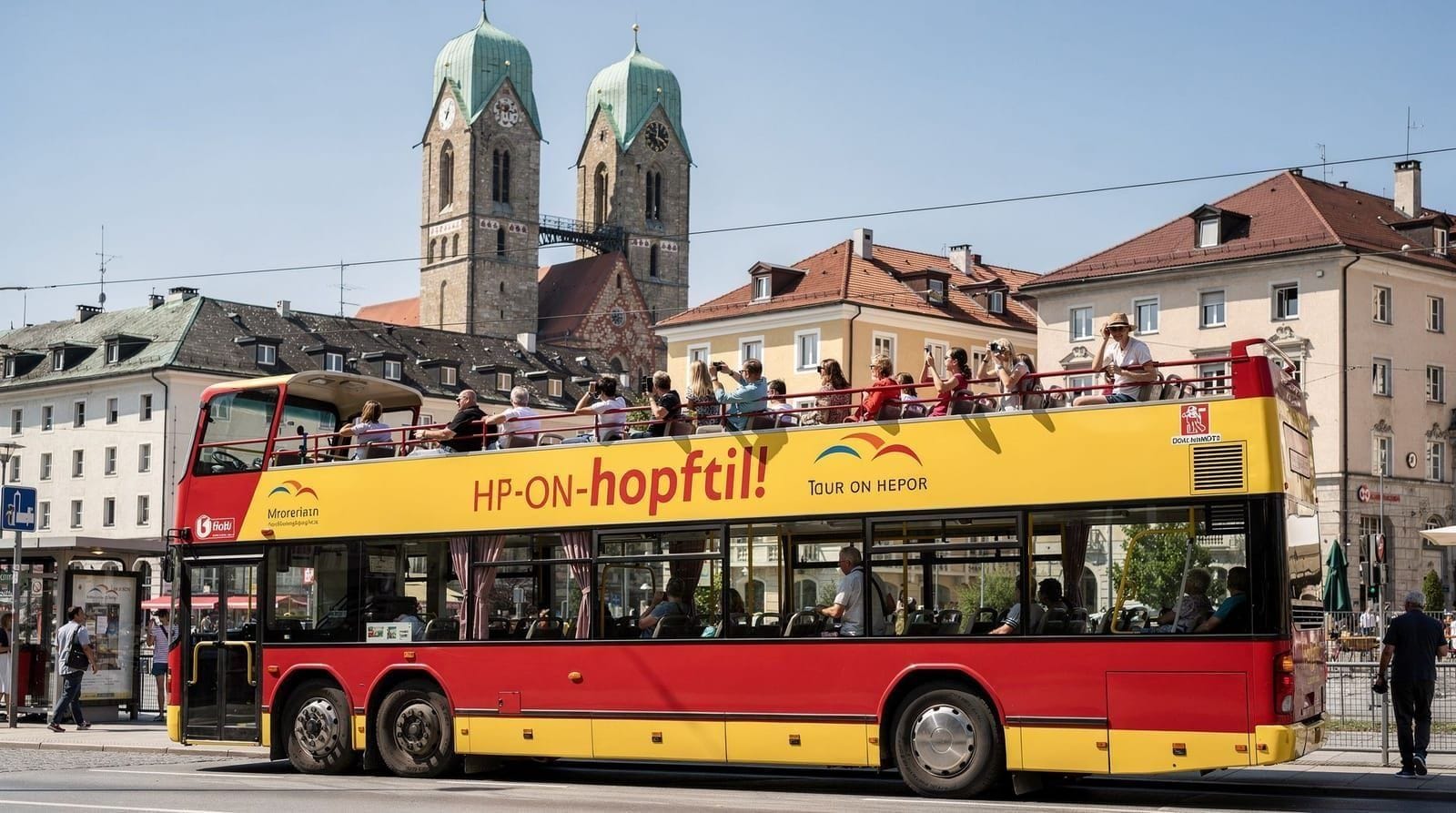
City bus tour: A city sightseeing bus route stops at the Allianz Arena and connects to the city center. Useful if you want to approach the arena as part of a broader orientation tour rather than a standalone trip. See the Munich hop-on hop-off bus guide 2026 for how the route is structured.
City bus tour including Allianz Arena — connects the arena to the city center in a single ticket.
How the arena fits into a Munich itinerary
The Allianz Arena is not in walking distance of central Munich attractions. Treat it as a dedicated half-day destination rather than a stop on a walking route.
For a 3-day Munich itinerary, the most practical slot is afternoon of day 1 or morning of day 2, paired with the return journey via Schwabing or Maxvorstadt for evening eating. The Schwabing neighborhood guide and maxvorstadt-guide cover the areas you pass through on the U6.
For families, the museum is suitable for football-interested children from around age 8 upward. The Munich covers age-appropriate Munich activities more broadly, including options near the arena.
On a budget, the museum-only ticket at €12 represents good value compared to many Munich museum prices. The Munich budget guide 2026 places it in context alongside free and paid city attractions.
Where to stay for an Allianz Arena visit
The arena itself is not a place to base yourself — Fröttmaning is a transport hub and stadium precinct, not a neighbourhood with hotels or restaurants. Stay in central Munich instead and treat the arena as a half-day trip out and back on the U6. Schwabing is the most convenient base for arena visitors, since the U6 runs straight through it on the way to Fröttmaning, putting the stadium 15–20 minutes from your hotel door. The Munich where-to-stay guide breaks down the other central options if Schwabing does not suit your itinerary, and the getting around Munich guide explains how the U-Bahn network connects the main tourist areas to Fröttmaning without needing to change lines more than once.
If you are combining the arena with an early or late kickoff, factor in that the U6 runs less frequently very late at night — check the last train time back to your area before committing to a full matchday out.
Munich football culture beyond FC Bayern
FC Bayern dominates Munich’s football identity, but the city’s football story has more depth than the museum alone conveys. TSV 1860’s exile to the Grünwalder Stadion (discussed above) is one thread; another is how football fits into Munich’s broader civic self-image, alongside beer culture and the 1972 Olympics. If the Olympic connection interests you, the U6 line that carries you to Fröttmaning also serves Olympiazentrum for the Olympiapark guide and the adjacent BMW campus — both discussed above as same-day pairings. For visitors who want the football theme without the Allianz Arena’s out-of-centre location, the FC Bayern club shop in the city centre near Marienplatz stocks similar merchandise to the museum shop, useful if you are short on time.
Planning an Allianz Arena day around your itinerary
Because the arena sits apart from everything else worth seeing in Munich, it earns its place on longer stays more easily than very short ones. On a 2-day Munich itinerary, the arena competes directly with the Altstadt and Nymphenburg for your limited time and often loses unless football is a priority. On a 4-day itinerary or longer, it slots naturally into a half-day without displacing the core sights. Families building a trip around the Munich with kids guide tend to pair the arena with a relaxed, low-walking afternoon, since the museum’s flooring and ramps are stroller-manageable even if the surrounding area is not scenic.
Frequently asked questions about Allianz Arena and the FC Bayern Museum
Is the FC Bayern Museum open on Sundays?
Yes — the museum is typically open on Sundays and public holidays, usually 10:00–18:00. Hours can vary around Bundesliga match days (the stadium complex is partly operational for match preparation). Check the official FC Bayern website for the current week’s opening hours before visiting.
Can children visit the arena tour?
Yes — there is no age restriction on the guided tour, and children’s ticket prices are available (typically €8–10 for concessions). The tour involves walking on varied surfaces including stadium ramps and pitchside areas, all manageable. The guided commentary assumes basic football knowledge, which may mean some sections are less engaging for very young children.
What food options are available at the Allianz Arena on non-match days?
The arena’s catering facilities are largely closed on non-match days. There is typically a café or snack outlet open near the museum entrance. For a proper meal, return to central Munich or Schwabing — the Fröttmaning district has few dining options.
Is the Allianz Arena tour available in English?
Yes — guided tours are conducted in German and English. English-language tours are typically offered at specific scheduled times rather than on demand. Confirm the English-language tour schedule when booking. The FC Bayern Museum uses multilingual signage and audio guide options in English.
How far in advance should I book FC Bayern match tickets?
For fixtures against top Bundesliga clubs or Champions League knockout matches, book as soon as tickets go on sale — sometimes 3–4 months in advance. For standard Bundesliga fixtures against mid-table or lower-table sides, a few weeks’ notice may be sufficient. Monitor the official FC Bayern ticketing calendar from the start of the season.
What happened to 1860 Munich at the Allianz Arena?
TSV 1860 München co-occupied the Allianz Arena from 2005 until 2017, when financial collapse forced them out. They now play at the Grünwalder Stadion in Giesing (capacity approximately 15,000). The history of Munich’s two football clubs and their relationship with the city is an interesting sub-topic — the Munich touches on the Giesing district where 1860’s ground is located.
Is ticket touting a problem at the Allianz Arena?
On match days for high-demand fixtures, ticket touting occurs outside the stadium. Risks include counterfeit tickets and prices 3–5x face value. The official FC Bayern website and authorized resellers are the only safe sources. If you encounter someone selling outside the ground, assume the ticket may be invalid. Use the Munich for broader advice on common visitor scams in Munich.
Can I visit the Allianz Arena as a half-day trip from central Munich?
Yes, comfortably. Budget around 20–25 minutes each way on the U6 plus the 15-minute walk from Fröttmaning station, and 1–3 hours on-site depending on whether you do the museum only or the combined tour. A morning slot works well, leaving the afternoon free for Schwabing or a return to the Altstadt.
Is the Allianz Arena worth it if I am only in Munich for one day?
Probably not, unless football is your main reason for visiting. A single day in Munich is better spent on the compact Altstadt sights, which are walkable and dense with things to see; the Allianz Arena’s round-trip transport time eats a disproportionate share of a one-day Munich itinerary. Save it for a second or third day if you have one.
Top experiences
Bookable activities with verified prices and instant confirmation on GetYourGuide.