English Garden nature guide: Eisbach surfers, Kleinhesseloher See and the full park
From Munich: Zugspitze mountain van tour with Garmisch town
What is the English Garden in Munich and what can you do there?
The Englischer Garten is Munich's main urban park — at 3.7 square kilometres, larger than Central Park in New York. It is free, open 24 hours, and contains the Eisbach river surfing wave (year-round, city centre), Kleinhesseloher See lake with rowboats, the Chinesischer Turm beer garden (7,000 seats), the Monopteros Greek temple, and the Japanisches Teehaus. It is one of the largest urban parks in the world.
Munich’s green lung: the park as a natural environment
The Englischer Garten is frequently cited in terms of its size comparison to Central Park — 3.7 square kilometres versus 3.4 — but that comparison understates what makes it distinctive. The English Garden is not a manicured civic park with landscaped flowerbeds and fountains. It is a landscape park in the 18th-century English tradition: designed to look natural, with winding paths, naturalistic plantings, artificial hills, and a network of water channels drawn from the Isar river system.
This means that large sections of the park feel genuinely unstructured — open meadows, woodland paths, river channels with no adjacent development, areas where you can walk for 20 minutes without seeing a building. For a park entirely within a major European city, that feeling of open space is unusual and valuable.
The natural core of the English Garden is the Isar river system. The Eisbach and Auer Mühlbach are artificial channels drawn from the Isar that run through the park, powering the Eisbach wave at the south entrance and the waterfeatures in the central section. The Kleinhesseloher See in the north is an artificial lake created when the park was originally constructed in the late 18th century. The park’s green character comes from these water features and from the old chestnut and oak woodland that has developed over two centuries.
From a nature perspective, the park functions as a wildlife corridor through the city. The tree population includes old-growth specimens, and the water channels support fish (including trout in the cleaner sections), waterfowl, and — in the meadow areas — a surprising diversity of wildflowers in spring.
| Where | 3.7km² park, south entrance at Prinzregentenstrasse |
| Cost | Free; rowboats around €10/30min, tea ceremony €8–10 |
| Time needed | 1 hour for the Eisbach and Monopteros, half-day for the full length |
| Getting there | U4/U5 to Lehel (south), U3/U6 to Münchner Freiheit (central) |
| Best time | Early morning for wildlife and quiet, spring for wildflowers |
The Eisbach wave: urban river surfing
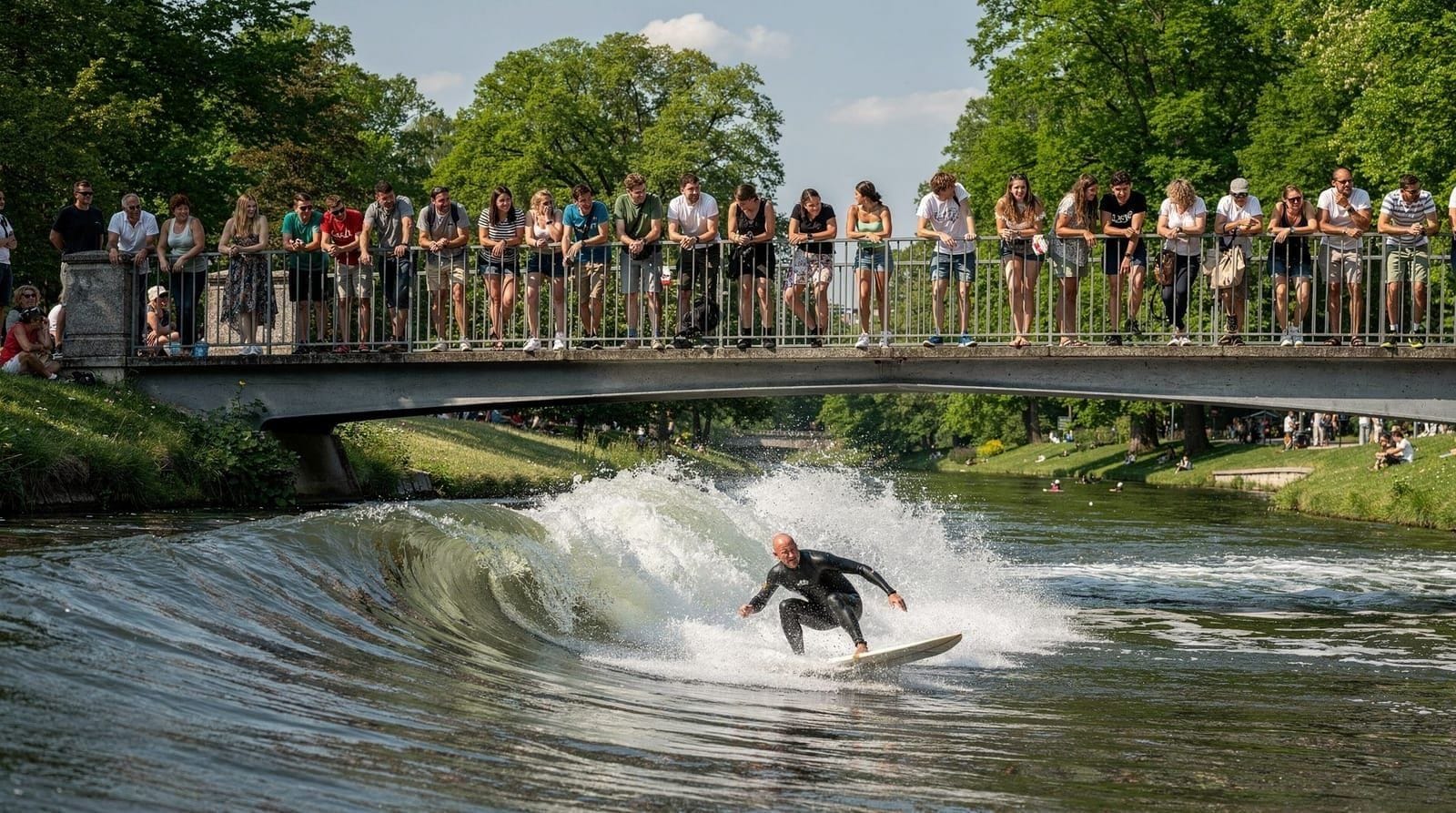
The Eisbach wave is the single most unusual thing in the English Garden, and possibly the most unusual thing in Munich. At the southern entrance to the park, where the Eisbach channel passes under the Prinzregentenstrasse bridge, a concrete sluice gate creates a standing wave approximately 1 metre high. Munich surfers discovered this in the 1970s. They have been riding it every day since — year-round, in all weather including snow.
What you see: A single surfer at a time rides the wave in place — the wave is stationary and the surfer moves on it as if on an ocean wave. The channel is about 4-5 metres wide. A queue of surfers waits on the bank. A crowd watches from the bridge above and from the channel walkway. The session is informal — there is no official surf club or ticketing. Surfers take turns based on unspoken queue etiquette.
The surfers: The Eisbach community includes both dedicated regular surfers (Munich has a genuine surf culture despite being 700 kilometres from the nearest ocean) and visiting surfers who come specifically to ride the wave. The skill level is generally high — the current is extremely strong (estimated at 30 km/h), the space is limited, and the wave requires quick adaptation. Wipeouts are common and the river is forceful. Swimming capability and surf experience are genuinely necessary.
Watching: Free, always. The bridge above the channel gives the best elevated view. The walkway directly beside the channel puts you at water level, closest to the action. On summer weekends, 30-40 spectators may be watching at any moment. On a cold January morning, you might find 5 people watching and a surfer in a full winter wetsuit.
The second wave: Further north in the park, on the Auer Mühlbach channel, a smaller wave (Auer-Mühlbach-Welle) has developed. It attracts a local crowd and is less visited by tourists. The quality of the wave is considered slightly lower than the Eisbach by most surfers, but it offers more practice time due to shorter queues.
Kleinhesseloher See: the lake and the Seehaus
The Kleinhesseloher See is an artificial lake in the northern section of the English Garden, created when the park was designed in the 1790s. It is roughly oval, about 500 metres across, and surrounded by trees on the western and northern shores with an open meadow area to the east.
Rowboats: Pedal boats and traditional rowboats are available for hire on the west bank near the Seehaus beer garden. In 2026, rental is approximately €10 per 30 minutes. The boats are available from roughly April through October, weather permitting. The lake is calm and the rowing is easy — this is a traditional leisure activity rather than a sporting pursuit. On warm Sunday afternoons in summer, the lake fills with boats.
The Seehaus beer garden: On the north bank of the lake, the Seehaus beer garden has approximately 2,500 seats. It draws a more local crowd than the Chinesischer Turm — being further from the tourist core of the park, it sees more Munich residents from the Schwabing and Maxvorstadt neighbourhoods. The beer selection and food quality are consistent with standard Munich beer garden fare. The lakeside setting makes it one of the more pleasant beer gardens in the city for a warm afternoon. See the best beer gardens in Munich guide for comparisons.
The lake environment: The Kleinhesseloher See supports a population of ducks, geese, and coots that have become entirely comfortable with human presence. Feeding bread is discouraged (it causes nutritional problems for waterfowl) but watching the bird activity is pleasant. In unusually cold winters, the lake partially freezes and is used for informal ice skating.
Chinesischer Turm: the beer garden and the pagoda
The Chinesischer Turm (Chinese Tower) is the most famous structure in the English Garden and serves as the navigational centre-point of the park. The five-storey wooden pagoda — built in 1789 in a style inspired by the English fashion for Chinese garden ornaments — was rebuilt after World War II damage; the current structure dates from 1952 but replicates the original.
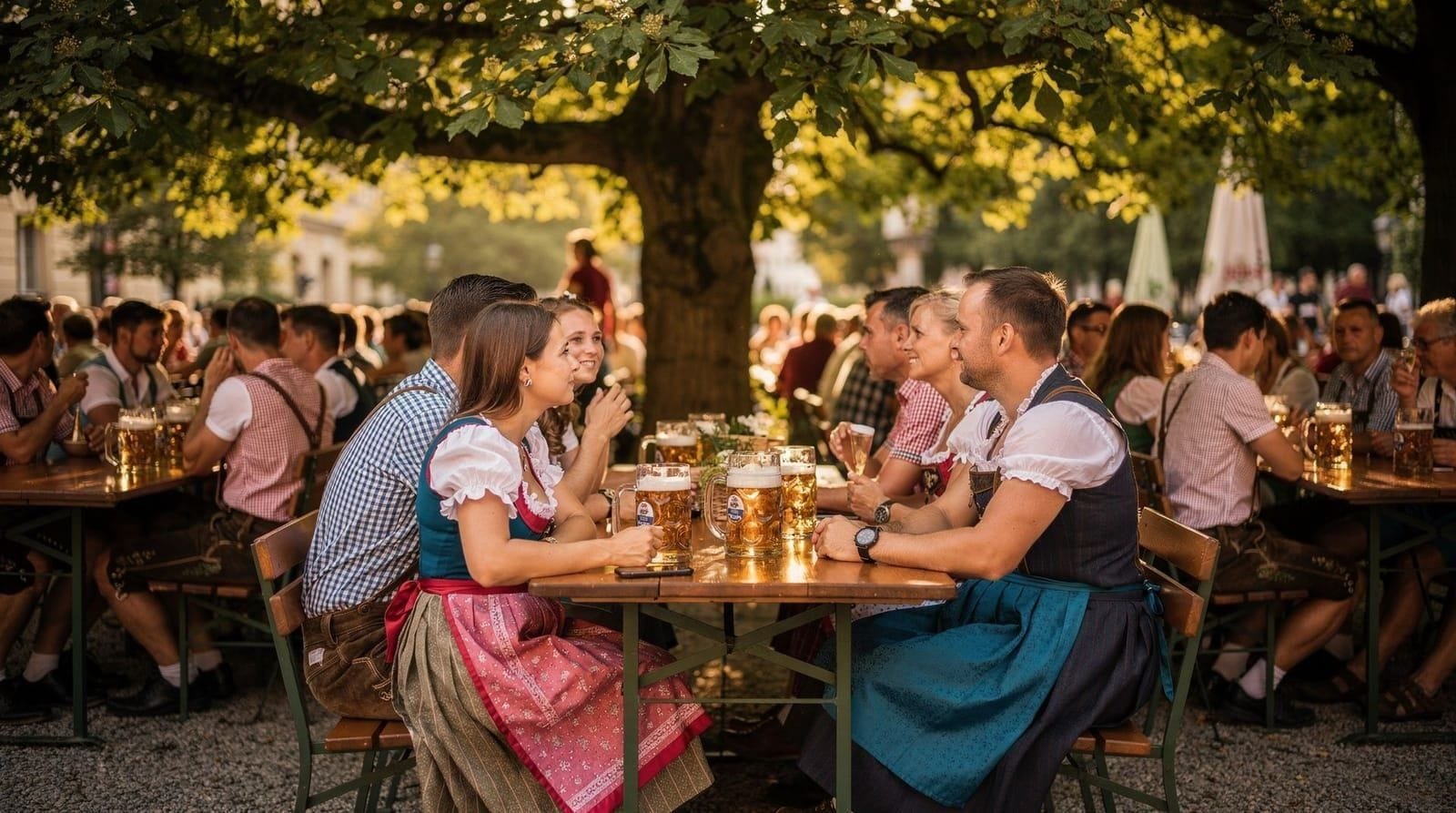
The beer garden: Surrounding the tower, the beer garden has approximately 7,000 seats making it the second-largest in Munich after the Hirschgarten. A brass band plays from the tower’s first-floor platform on weekends (typically Saturdays and Sundays in summer). Food stalls serve classic Bavarian beer garden fare: roast chicken (Hendl), Steckerlfisch (grilled fish on a stick), pretzels, Obatzda (a Camembert-based cheese spread), radishes.
Honest assessment: This is a genuine Munich institution, not a tourist trap in the pejorative sense. The beer is authentic Munich draught, the format is historically rooted in Munich beer garden culture, and the setting is pleasant. However, in peak summer, the crowd skews heavily international. If finding local Müncheners is important to you, the Seehaus (north section) or Augustinerkeller (west of the city centre) draws a more mixed local crowd.
Navigation from the south entrance: Walk straight north from the Eisbach along the main park path — approximately 1.7 kilometres, 25-minute walk. Bus 154 from Münchner Freiheit U-Bahn station stops near the Chinese Tower as an alternative. Day trip to Zugspitze and Eibsee — compare the alpine lake experiences with Munich’s city park
Monopteros: the temple view
The Monopteros is a 10-column Ionic rotunda on an artificial hill in the southern section of the park, about 5 minutes north of the Eisbach. Designed by Leo von Klenze and completed in 1838, it was built as a garden folly — a decorative architectural structure intended for its visual effect rather than functional use.
The structure itself is not a building you enter but a circular colonnade open to the air. The view from the hill it sits on is what matters: south across the park’s meadows and into the Altstadt, with the twin towers of the Frauenkirche visible above the treeline. On clear days, the Alps are visible to the south beyond the city.
The meadow on the southern slope of the Monopteros hill is one of Munich’s most democratic sunbathing spots — in warm weather, hundreds of people sit on the grass. The FKK (naturist) tradition is strongest here and on the meadows nearby; topless and nude sunbathing is practised openly and is accepted as part of the local social norm. Visitors who prefer not to encounter this should simply walk north.
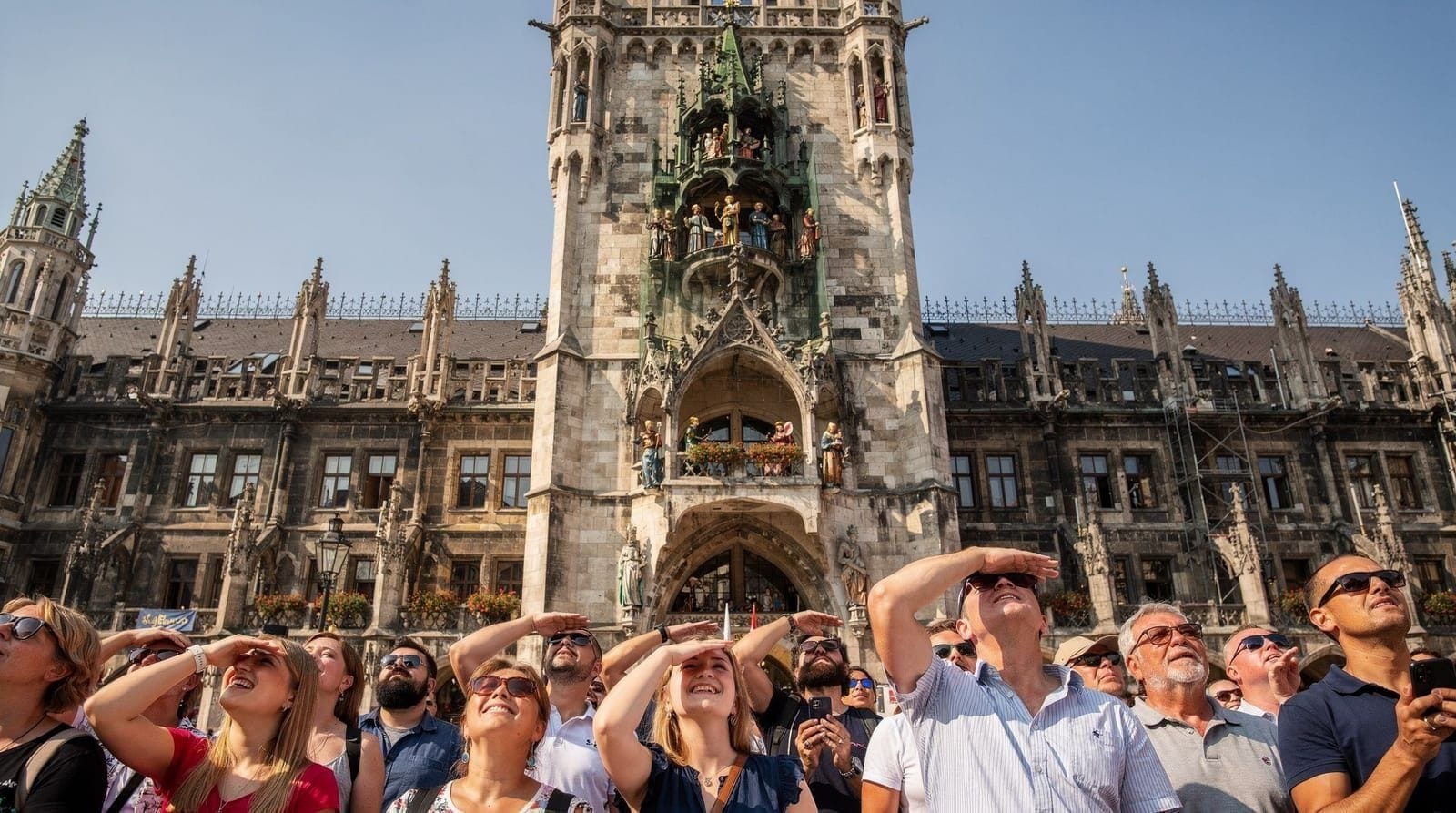
For an elevated view of Munich from slightly higher, see the Munich viewpoints guide for alternatives including the Olympiaturm and the Neues Rathaus tower.
Japanisches Teehaus: the tea ceremony island
The Japanisches Teehaus (Japanese Tea House) sits on the Auer Mühlbach island, a small island reached by a footbridge south of the Kleinhesseloher See. It was donated to Munich by the Japanese government for the 1972 Olympic Games and was constructed using traditional Japanese materials and techniques. The surrounding garden includes stone lanterns, a small pond, and plantings arranged in Japanese garden style.
Tea ceremony events: On certain Sundays — typically the last Sunday of the month from April through October — the teahouse is open to the public for authentic tea ceremony demonstrations. Admission is approximately €8-10 and includes the ceremony itself, conducted by practitioners trained in traditional Japanese tea culture. Seats are limited; booking in advance is recommended (check the Japanisches Teehaus München website for current schedule).
Outside ceremony days: The surrounding garden and the exterior of the teahouse are freely visible from the path. This is one of the calmer, quieter spots in the park — the island setting and Japanese planting give it a different atmosphere from the rest of the English Garden.
The park in all four seasons
Spring (March to May): Beer gardens reopen from late March when temperatures allow. Wildflowers appear in the meadows in April and May. The Kleinhesseloher See boat hire resumes. This is the season when Munich returns to the park after winter — a noticeable social event in the city.
Summer (June to August): Maximum activity. Eisbach surfers daily. All beer gardens and the boat hire at full operation. Crowded meadows, particularly near the south entrance and Chinesischer Turm. The park is at its most social — also at its most crowded. Arrive before 11am to the southern section if you want space on the meadows. Munich’s Isar river beaches attract some of the sunbathing crowd away from the park in the hottest weeks.
Autumn (September to October): The chestnut trees around the Chinesischer Turm turn colour in September — one of the best autumn tree spectacles in Munich. Beer gardens close from mid-October. Crowds thin. The park becomes more local and less tourist-oriented. For the relationship between the park season and Oktoberfest timing, see the Munich autumn guide.
Winter (November to February): Eisbach surfers continue year-round. Beer gardens are closed. The park is still open and used — dog walkers, joggers, and local residents make regular use of it. In cold winters, the Kleinhesseloher See may partially freeze. The bare chestnut trees expose views through the park that are invisible in summer. Frost on the meadows in early morning is particularly atmospheric.
| Season | Wildlife highlight | Crowds |
|---|---|---|
| Spring (Mar–May) | Wildflowers, waterfowl nesting | Moderate, growing |
| Summer (Jun–Aug) | Full activity, birdlife on the lake | High, especially weekends |
| Autumn (Sep–Oct) | Chestnut colour change | Moderate, thinning |
| Winter (Nov–Feb) | Surfers in wetsuits, frost mornings | Low |
Spotting wildlife in the park
Early morning (before 8am) is consistently the best window for wildlife: the meadows near the Kleinhesseloher See attract herons and occasional kingfishers along the quieter channels, and the woodland sections in the park’s north hold squirrels and a healthy songbird population largely undisturbed by the daytime crowds. The Isar tributaries running through the park support a trout population in the cleaner upper stretches near the Eisbach, visible from the bridges if the water is clear. This is also the best time to see the park’s chestnut and oak canopy without the meadows already full of picnickers.
Practical navigation
Distance estimates within the park:
- Eisbach (south entrance) to Monopteros: 5 minutes on foot
- Eisbach to Chinesischer Turm: 25 minutes on foot
- Chinesischer Turm to Kleinhesseloher See (Seehaus): 15 minutes on foot
- Full park length south to north: approximately 70 minutes at a leisurely pace
U-Bahn access:
- South entrance (Eisbach): U4/U5 to Lehel, then 5-minute walk east
- Central section (Chinesischer Turm): U3/U6 to Münchner Freiheit, then 15-20 minute walk south, or bus 54/154
- North end: limited public transport; most visitors do not reach the far north
Cycling: Cycling is permitted on designated paths in the park. The main north-south path accommodates cyclists. Avoid cycling on pedestrian-only paths and meadows. For a guided cycling experience through the park and Munich, the Munich bike tours guide covers options.
Food and drink: Beyond the beer gardens, no restaurant or café is present in the park. The beer gardens operate food stalls but the selection is limited to Bavarian pub fare. Bring a picnic if you want flexibility — the beer gardens traditionally allow you to bring your own food and only require you to purchase drinks.
Toilets and facilities: Public toilets are located near the Chinesischer Turm and the Seehaus; there is nothing at the far south or far north extremes of the park, so plan around the central section if you need facilities on a long walk.
Running and jogging: The park is one of Munich’s most popular running routes, with well-maintained gravel paths and a reasonably flat profile throughout. Early morning and early evening are the busiest times for local runners, particularly along the main north-south axis.
Connecting the English Garden to wider Munich
Hofgarten and Residenz: A 15-minute walk southwest from the Eisbach brings you to the Hofgarten — the formal Baroque garden adjacent to the Munich Residenz. The contrast between the formal Hofgarten and the naturalistic English Garden is instructive.
Schwabing and Maxvorstadt: The west and northwest edges of the English Garden border these Munich neighbourhoods. The Schwabing neighbourhood guide covers the cafes, bars, and residential character of this area.
Day trips from the park: The English Garden is a natural starting point for exploring further afield. The Munich lakes guide covers Starnberger See, Tegernsee, Ammersee, and Chiemsee — all accessible by train for a half-day lake excursion.
Beyond the park to the Alps: If the English Garden’s tame nature leaves you wanting real mountain scenery, Munich’s proximity to the Alps makes a day trip straightforward. Zugspitze and Garmisch day tour from Munich reaches Germany’s highest peak in about 90 minutes from the city.
Frequently asked questions about the English Garden nature
Where are the Eisbach surfers in Munich?
The Eisbach surf wave is at the southern entrance to the English Garden, where the Eisbach channel passes under the Prinzregentenstrasse bridge. From Marienplatz, it is about 20 minutes on foot. By U-Bahn, take U4 or U5 to Lehel and walk 5 minutes east.
Can you rent rowboats on the lake in the English Garden?
Yes. Rowboats and pedal boats are available on the Kleinhesseloher See. Rental costs approximately €10 per 30 minutes. The hire point is on the west bank near the Seehaus beer garden, typically April through October.
Is the Chinesischer Turm beer garden open in winter?
No. It is seasonal, opening late March or April and closing in October. The park itself is open year-round.
What is the Monopteros in the English Garden?
A Greek-style circular temple on an artificial hill, built in 1838. Positioned for its view over the park and the Altstadt; the Frauenkirche towers are visible to the south. Popular sunbathing spot.
How do I get to the English Garden from central Munich?
The south entrance (Eisbach) is 20 minutes on foot from Marienplatz, or U4/U5 to Lehel. For the Chinesischer Turm, bus 54/154 or U3/U6 to Münchner Freiheit then 20 minutes south.
Is there nudity in the English Garden?
Yes, in certain meadow areas near the Monopteros. FKK (naturist) sunbathing is a longstanding Munich tradition and is legal in these areas. Walk north toward the Chinese Tower to avoid it.
What is the Japanese Tea House in the English Garden?
A genuine traditional Japanese teahouse donated for the 1972 Olympics, on the Auer Mühlbach island. Tea ceremony events on certain Sundays (approximately €8-10). The surrounding garden is freely viewable outside ceremony days.
What’s the best time of day to see wildlife in the park?
Early morning, ideally before 8am, when the meadows and lake are quiet and herons, waterfowl and songbirds are most active. By mid-morning the crowds along the main paths have pushed most visible wildlife back into the quieter northern woodland.
Is the English Garden a good alternative to visiting the Alps?
Not really as a substitute, but it’s a good complement — the park gives you genuine green space and river wildlife within the city, while the Alps deliver a completely different scale of nature. Most visitors do both: the park on a low-key day, and a dedicated day trip to Zugspitze or the Munich lakes for real mountain and lake scenery.
Top experiences
Bookable activities with verified prices and instant confirmation on GetYourGuide.