Munich e-scooter guide — rules, operators and fines for 2026
Munich: old town walking tour
Can I ride an e-scooter in Munich as a tourist?
Yes. Tier, Lime, and Bolt all operate e-scooter fleets in Munich. Download the operator's app, verify your driving licence or ID, and you can rent one within minutes. Rides cost €0.20–0.25 per minute plus an unlock fee of €1.00. You must ride on bike lanes or roads, not on pavements. Riding in the main pedestrian zone around Marienplatz is prohibited.
E-scooters in Munich: the honest picture
E-scooters arrived in Munich in 2019, generated the usual cycle of enthusiasm and pedestrian irritation, and have since settled into a regulated coexistence with the city’s cycling and walking culture. As of 2026, three operators maintain active fleets, the regulatory framework is well-established, and a combination of fines and geofencing has pushed most scooters onto appropriate infrastructure.
For visitors, the scooter is most useful for specific scenarios: bridging between U-Bahn stops or across distances that are slightly too far to walk comfortably (1.5–3 km), or for light exploration in residential districts where bike lanes run parallel to quiet streets. It is not a substitute for Munich’s excellent public transport, and it is genuinely not the right tool for navigating the Altstadt. On cobblestones, scooters are unstable and prohibited zones are frequent.
This guide covers the three operators, current pricing, the legal framework, where you can and cannot ride, and what fines look like in practice.
| Where | Bike lanes and Tempo-30 streets; banned in the Altstadt pedestrian zone |
| Cost | ~€1.00 unlock + €0.18–0.25/min, or ~€15 day pass |
| Best use | 1.5–3km “last kilometre” gaps, not Altstadt sightseeing |
| Licence | Category AM or higher, or moped certificate |
| Minimum age | 14, with M1 licence needed under 18 |
| Alcohol limit | 0.5 promille, same as car drivers |
The three operators: Tier, Lime, and Bolt
Tier Mobility
Tier is the largest e-scooter operator in Munich by fleet size. Their scooters are identifiable by a predominantly dark grey and green livery. Tier is headquartered in Berlin and is the dominant operator in most German cities.
Fleet quality: Tier’s current Munich fleet (predominantly the Tier 3 and Tier 4 models) is larger and more stable-feeling than earlier scooter generations. Maximum speed is limited to 20 km/h (German legal maximum for e-scooters on public roads). Battery indicators are visible before unlocking.
Pricing (2026):
- Unlock fee: €1.00
- Per minute: €0.22
- Day pass: €14.99 (unlimited rides up to 30 minutes each; extensions at reduced rate)
App: Available on iOS and Android. Requires driving licence upload for activation (accepted from EU and most international licences). Tier also integrates into Google Maps’ multimodal route planning in Munich.
Lime
Lime operates the second-largest fleet in Munich, identifiable by green and white livery. The Lime Gen4 scooter is one of the most stable consumer e-scooters available and handles Munich’s surface variety better than older models.
Pricing (2026):
- Unlock fee: €1.00
- Per minute: €0.23 (standard), up to €0.25 during peak demand
- Lime Pass: €14.99 for 60 minutes of unlock credits per day (rolls over partially)
App: iOS and Android. Lime was one of the first operators to introduce automatic slow-down zones (geofenced areas where the scooter reduces to 6 km/h regardless of throttle — these include areas immediately adjacent to Marienplatz and the pedestrian zone).
Bolt
Bolt has a smaller fleet in Munich but consistent coverage in the inner ring. Known for slightly lower per-minute pricing.
Pricing (2026):
- Unlock fee: €1.00
- Per minute: €0.18–0.20
- Day pass: available seasonally (check the app for current offers)
App: iOS and Android. Bolt requires a phone number verification and driving licence confirmation.
Which operator to use?
For most visitors, Tier is the default choice — widest coverage, reliable app, and the day pass is good value for anyone planning more than 70 minutes of riding. Check all three apps simultaneously for bike availability at your starting location; stock at any given point can vary significantly by time of day. Multiple apps are free to download and maintain.
Pricing comparison at a glance (2026)
| Operator | Unlock | Per minute | Day pass |
|---|---|---|---|
| Tier | €1.00 | €0.22 | €14.99 |
| Lime | €1.00 | €0.23–0.25 | €14.99 |
| Bolt | €1.00 | €0.18–0.20 | Seasonal |
A 20-minute ride costs approximately €5.40 with Tier, €5.60 with Lime, and €4.60 with Bolt. At these prices, e-scooters are cost-comparable to a single MVV public transport journey for medium distances, though they do not carry any additional passengers.
German e-scooter law: what applies in Munich
Germany’s Elektrokleinstfahrzeuge-Verordnung (eKFV) governs e-scooters across the country. Munich enforces it actively. Key rules for visitors:
Licence requirement: A valid driving licence (category AM or higher) or a moped certificate is legally required. Tier and Lime enforce this via in-app verification. Enforcement at street level varies — spot checks exist but are less systematic than in some other German cities.
Helmet: Not legally required for adults. The law recommends helmets but does not mandate them. Lime offers helmet rentals at select stations. Given Munich’s cobblestoned side streets and mix of traffic, a helmet is a sensible precaution for longer rides.
Maximum speed: 20 km/h on roads and bike lanes. In designated slow zones (typically around pedestrian-heavy areas), geofencing reduces speed to 6 km/h automatically. You cannot override the governor.
Alcohol: The drink-scooter limit is 0.5 promille — the same as for car drivers. Above 1.6 promille, a fine of €1,500 plus licence implications applies. Following Oktoberfest-related incidents in 2022 and 2023, Munich police increased enforcement around festival grounds specifically.
Age minimum: 14 years old. Under 18 requires an M1 (moped) licence or equivalent. App age verification is in place.
Where you can ride in Munich
Good for e-scooters
Bike lanes (Radwege and Radfahrstreifen): Dedicated cycle paths and cycle lanes painted on roads are the primary legitimate space for e-scooters. Munich has approximately 1,200 km of marked bike infrastructure, so most inner-city journeys can be completed on designated lanes.
Quiet residential streets: Streets marked as Tempo-30 zones (30 km/h speed limit, identifiable by yellow roundel signs) are comfortable for e-scooter use. Most of Schwabing, Maxvorstadt, Glockenbachviertel, and Haidhausen fall into this category.
Schwabing: The streets north of Universitat and Muncher Freiheit are well-equipped with bike lanes and low traffic. Riding from Odeonsplatz to Schwabing’s cafe district (Leopoldstrasse) takes about 10 minutes by scooter.
Outer districts: Nymphenburg Palace area, the residential streets around Sendling, and the Haidhausen district across the Isar all have adequate bike lane coverage for scooter use.
Where e-scooters are banned or restricted
Pedestrian zones (Fussgangerzonen): The main pedestrian spine of Munich — Kaufingerstrasse from Hauptbahnhof east to Marienplatz, continuing as Neuhauser Strasse — is completely off-limits. Same for Viktualienmarkt and the immediate Marienplatz area. Tier and Lime use geofencing to make scooters unrideable in these zones; Bolt relies more on enforcement and parking zone restrictions.
Pavements: Riding on any pavement (Burgersteig) where no shared-use symbol is posted is illegal. This is the single most commonly enforced rule in Munich. Fines range from €55 for basic pavement riding to €100 if a pedestrian is endangered.
Parks (partially restricted): The Englischer Garten has designated bike lanes on which scooters are permitted. Riding on the grass paths or off-lane within the park is not permitted and carries fines.
Isar riverbanks near the city centre: The paths between Deutsches Museum and Maximiliansbrucke are popular but have mixed legal status for scooters depending on the specific path section. Watch for signage; when in doubt, walk.
Parking rules and fines
E-scooters must be parked:
- On the carriageway edge (not blocking the pavement)
- In designated e-scooter or bike parking areas
- Upright and not blocking any access points
Prohibited parking spots that carry fines:
- Pedestrian crossings or tactile paving strips (guide strips for visually impaired users)
- Shop entrances and building doorways
- Disabled parking bays
- Bus and tram stops (within the marked zone)
- Pavements where the remaining walkway would be less than 1.5 metres
Fine levels (2026):
| Offence | Fine |
|---|---|
| Riding on pavement | €55–100 |
| Blocking pedestrian access when parking | €15–55 |
| Riding without a valid licence | €300+ |
| Riding under alcohol influence (above 0.5 promille) | €500–1,500 |
| Riding in pedestrian zone | €25–100 |
Munich police issue on-the-spot fines, and scooter riders are a visible enforcement target in the Altstadt area during summer.
E-scooters vs bikes vs public transport: which to use when
| Scenario | Best option |
|---|---|
| Altstadt sightseeing | Walking |
| Marienplatz to Englischer Garten | E-scooter or bike |
| Hauptbahnhof to Schwabing | U-Bahn (6 minutes, €3.20) |
| Altstadt to Nymphenburg Palace | Bike or tram |
| Multi-stop day across the city | Day U-Bahn/S-Bahn ticket |
| 1–2 km gap not covered by U-Bahn | E-scooter |
E-scooters fill a specific gap rather than replacing other transport. For the Altstadt and museum-heavy days, walking and the U-Bahn cover everything efficiently. For the “last kilometre” or for connecting between cycling-friendly districts, a scooter makes sense.
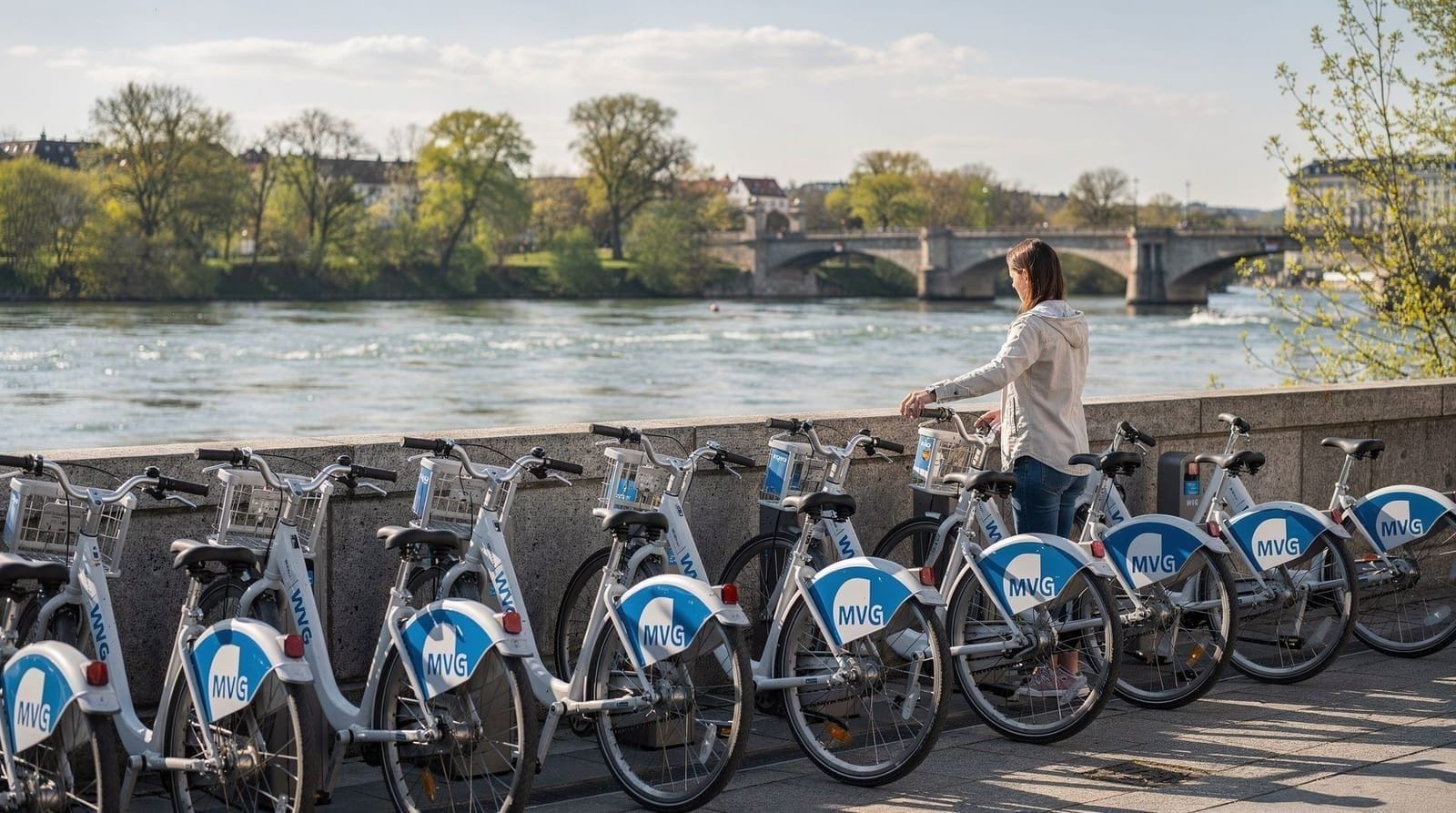
The getting around Munich guide compares all modes across a full range of itinerary scenarios. For bike rental as an alternative to scooters, the Munich bike rental guide covers MVG Rad and independent shops.
Practical tips for using e-scooters in Munich
Check the battery before unlocking. All apps show battery percentage before you start. A scooter with below 25% may cut out before you reach your destination; select one with 60%+.
Avoid cobblestones. Munich’s Altstadt has extensive cobblestone coverage. E-scooters are stable on smooth tarmac but uncomfortable and harder to control on uneven cobbles. Stay on marked bike lanes where available and dismount for cobblestone stretches if the lane ends.
Lock via app, not physically. Ending a ride requires locking through the app. Physical locks are not user-operated. If the app fails to connect, try restarting it before calling support.
Screenshots of the parking photo. All three operators require a photo of the parked scooter taken through the app to end the ride. Take this seriously — if the scooter is parked in a restricted zone, you will be unable to end the ride and will continue to accrue charges until you move it to a valid location.
Oktoberfest period: During Oktoberfest (late September–early October), Theresienwiese and surrounding streets have additional no-ride and no-park zones. Fleet availability near the festival grounds is also reduced. The Oktoberfest guide covers practical transport notes for the festival period.
Why an e-scooter is the wrong tool for the Altstadt
It is worth being direct about this, since it is the single most common mistake visitors make with Munich’s e-scooters. The Altstadt’s extensive cobblestone surfaces make scooters genuinely uncomfortable and less stable than on tarmac, the main pedestrian spine (Kaufingerstrasse to Marienplatz) is geofenced against riding at all, and the distances between major Altstadt sights — Marienplatz, Frauenkirche, Viktualienmarkt, the Residenz — are all well under a 10-minute walk from each other. A scooter adds cost and inconvenience here with no real time saving. For a properly guided introduction to the Altstadt that covers the history a scooter ride skips entirely, a walking tour is the better investment of time. Munich Old Town walking tour
Scooter versus bike for longer exploration
For trips longer than about 3km, or for a genuinely enjoyable way to see the English Garden and its beer gardens, a rented bike is usually the better choice over an e-scooter — bikes handle Munich’s mixed surfaces better, allow you to carry a small bag more comfortably, and a guided bike tour adds context a solo scooter ride cannot. Munich bike tour with beer garden stop covers exactly this kind of longer, more relaxed exploration, and the Munich bike rental guide covers independent bike rental if you’d rather go at your own pace.
Frequently asked questions about Munich e-scooters
Do I need to return an e-scooter to a specific location?
No. All three operators use a dockless model — you can end a ride at any valid parking location, not just where you picked up the scooter. The app shows valid ending zones; if your location is flagged as invalid, you will need to move a short distance.
Can I ride an e-scooter with a passenger?
No. German law and all operator terms explicitly prohibit carrying passengers on e-scooters. The maximum is one rider.
What happens if a scooter breaks down while I’m riding?
Stop safely and end the ride via the app (mark the scooter as broken in the fault-reporting section). You will not be charged for the time the scooter was not functioning if you report immediately. Customer support for all three operators is available via in-app chat.
Are there age restrictions beyond the 14-year minimum?
No upper age restriction exists, but operators can refuse access based on licence status. Children aged 12–13 cannot legally ride e-scooters anywhere in Germany regardless of supervision.
Is it worth getting the day pass on Tier or Lime?
If you plan more than 70 minutes of riding across the day (including unlock fees), yes. The day pass at €14.99 saves money compared to per-minute billing for active use. For a single trip of 20–30 minutes, pay-as-you-go is cheaper.
Can I use an e-scooter to reach the Deutsches Museum or Olympiapark?
The Deutsches Museum is on an island in the Isar — riding across the Ludwigsbrucke bridge to reach it is straightforward; the bridge has a bike lane. Olympiapark is in the north of the city (Olympiazentrum U-Bahn stop) — at 5 km from Marienplatz, it is possible by scooter via bike lanes but takes 20–25 minutes. For Olympiapark, the U3 is faster (10 minutes).
Is it worth renting an e-scooter to see the Altstadt?
No. The Altstadt’s main pedestrian zone is geofenced against riding entirely, the cobblestones make scooters unstable where riding is allowed, and the major sights are within easy walking distance of each other. Walking, or a guided walking tour for context, is the better choice for this specific part of the city.
Should I rent an e-scooter or a bike for a day exploring the English Garden?
A bike, in most cases. The English Garden’s paths are long and varied enough that a bike is more comfortable over a full visit, and a guided bike tour adds historical and cultural context. Reserve the e-scooter for shorter, point-to-point trips rather than an extended exploration.
Top experiences
Bookable activities with verified prices and instant confirmation on GetYourGuide.