Munich to Regensburg day trip: Bavaria's most underrated medieval city
Munich: one perfect day in Regensburg day tour
How long is the train from Munich to Regensburg and what does it cost?
The direct regional train from Munich Hauptbahnhof to Regensburg Hauptbahnhof takes approximately 1 hour 25 minutes. The Bayern-Ticket covers this journey. Trains run roughly every 30-60 minutes. A full day in Regensburg requires 6-8 hours and covers the medieval old town, the stone bridge, the Cathedral, and a boat trip on the Danube.
The underrated gem of Bavarian day trips
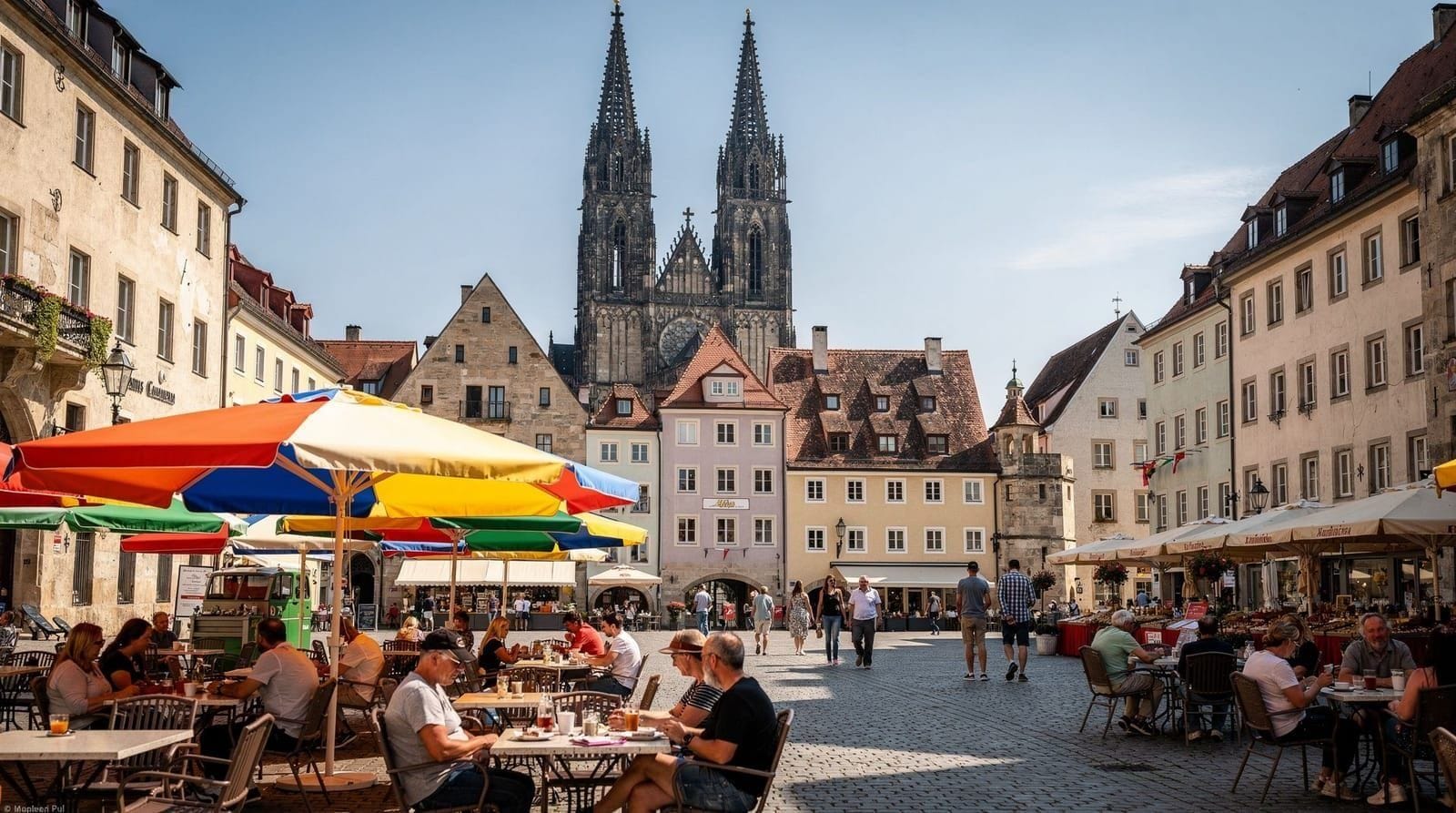
Regensburg is the answer to a question many Munich visitors ask: is there somewhere like Rothenburg — a genuine medieval city — but without the overwhelming tourist infrastructure? Regensburg is exactly that.
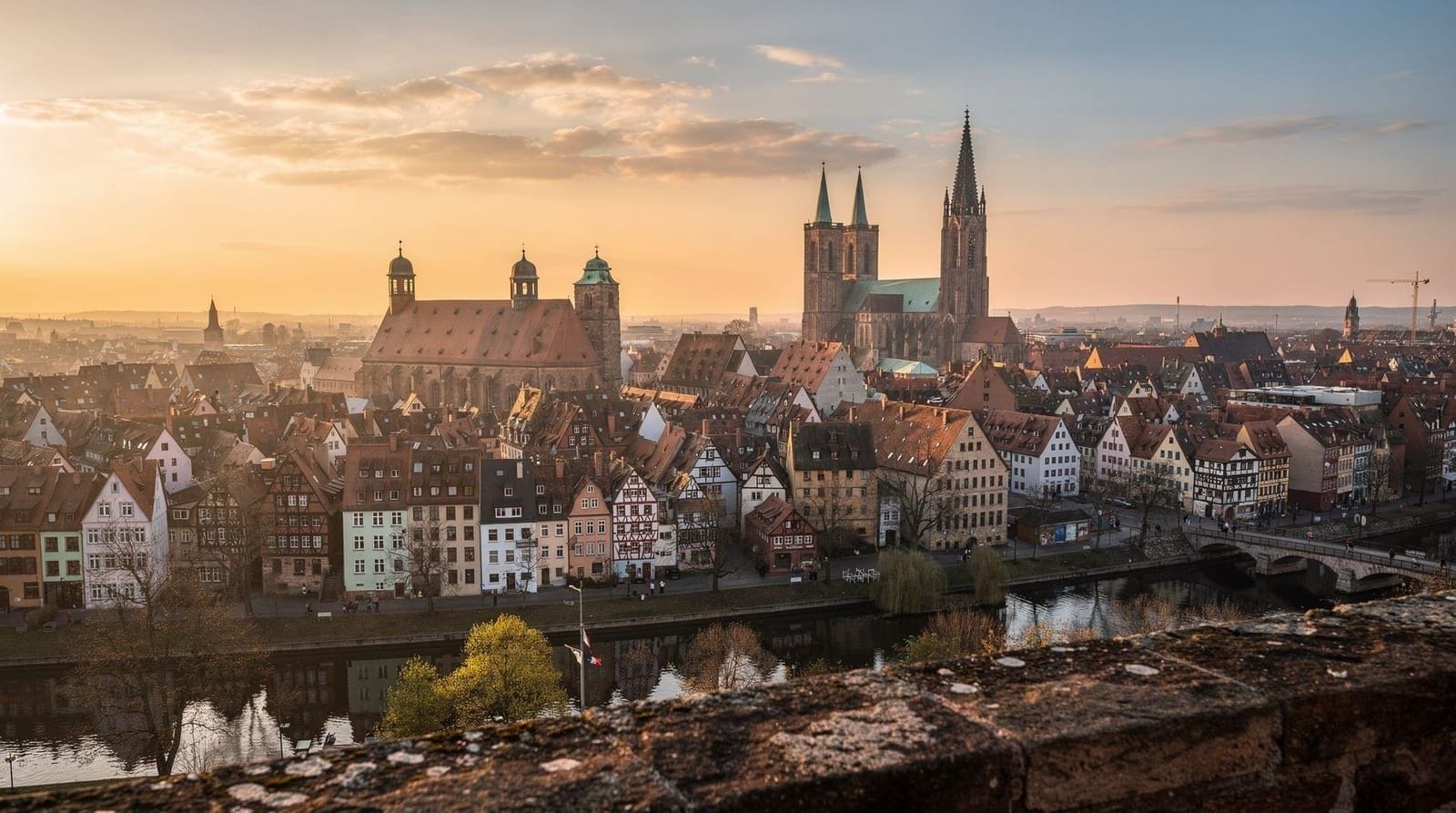
The UNESCO-listed old town (Altstadt) is one of the largest intact medieval city centres in Germany, with over 1,000 Romanesque and Gothic buildings surviving. The Cathedral (Dom St. Peter) is one of the finest Gothic works in Bavaria. The stone bridge (Steinerne Brücke, built 1135-1146) is still in daily use as a pedestrian crossing. The Roman gate (Porta Praetoria, circa 179 AD) stands in a side street in near-complete condition.
And unlike Nuremberg, Rothenburg, or Salzburg, Regensburg has not been overwhelmed by tourist infrastructure. It has a population of 160,000 and an active university (Universität Regensburg, one of Bavaria’s major institutions), which means the old town has real bakeries, bookshops, and bars alongside the heritage sites. This is a city that is lived in, not just preserved for display.
The train from Munich takes 1h 25min on a direct service. The Bayern-Ticket covers it. This is the most overlooked day trip in Bavaria.
| Where | Regensburg, on the Danube, ~120km north of Munich |
| Cost | Bayern-Ticket ~€29 covers the train; budget €50–60/person total |
| Time needed | 6–8 hours for a full day |
| Getting there | Direct regional train, ~1h25, no change needed |
| Best time | Arrive before 10am on a weekday for the quietest old town |
Getting from Munich to Regensburg
Trains: Direct regional trains run from Munich Hauptbahnhof to Regensburg Hauptbahnhof approximately every 30-60 minutes. The journey takes 1h 25min. No change required. The Bayern-Ticket covers this journey in full.
Key departure times from Munich Hbf (2026 timetable):
- 7:25 → arrives Regensburg approximately 8:50
- 8:25 → arrives Regensburg approximately 9:50
- 9:25 → arrives Regensburg approximately 10:50
For a full day, the 7:25 or 8:25 departure gives the best allocation of time. The old town is manageable on foot and the Cathedral opens early, so arriving before 10am lets you explore the quieter morning hours before day-tripper groups arrive (mostly from Nuremberg and Munich, and in smaller numbers than at more famous destinations).
From Regensburg station to the old town: The Hauptbahnhof is a 10-minute walk from the old town centre. Walk north on Maximiliansstrasse — the Cathedral towers are visible ahead and orient you clearly. Alternatively, Bus 5, 6, or 11 connects the station to the Rathausplatz in about 5 minutes.
Left luggage: Station lockers at Regensburg Hauptbahnhof, approximately €3-4. Guided day trip to Regensburg from Munich — UNESCO old town tour
The old town: what to see and in what order
Regensburg’s old town is compact enough to walk across in 15 minutes, but detailed enough to absorb a full day. The following circuit covers the main sites in a logical walking order.
Dom St. Peter (Regensburg Cathedral)
The Cathedral is the centrepiece of the Altstadt and visible from most of the old town. Construction began in the 13th century and continued — as was common for major Gothic churches — for several centuries, with the twin towers completed only in the 19th century. The interior is striking: the nave is tall, narrow, and well-lit by large Gothic windows, several of which contain original medieval stained glass (13th-14th century) — some of the best-preserved in Germany.
Admission: Free. Hours: Typically 6:30am-6pm (check for variations during services).
The Cathedral Treasury (Domschatz, accessed separately, entry approximately €3) contains medieval goldsmith work and vestments. Worth 30 minutes if Gothic decorative arts interest you.
The Cathedral Sparrows (Spatzen): The Regensburger Domspatzen is one of Germany’s oldest boys’ choirs, founded in 975 AD. If your visit coincides with a Sunday High Mass (10am), the choir is worth hearing — the acoustic quality of the Cathedral nave enhances it considerably.
Porta Praetoria: the Roman gate
Walk to Unter den Schwibbogen, immediately north of the Cathedral, to find the Porta Praetoria — the north gate of the Roman fortress Castra Regina, built around 179 AD. The structure is remarkable: a significant portion of the original Roman stonework survives, and the characteristic Roman voussoir arch is clearly visible. The gate has been incorporated into later medieval buildings on either side, which is why it survived.
A small window in the adjacent building (now a restaurant) gives a view down to the original Roman street level — the pavement is over two metres below the current ground surface. Free to view.
Steinerne Brücke (Stone Bridge)
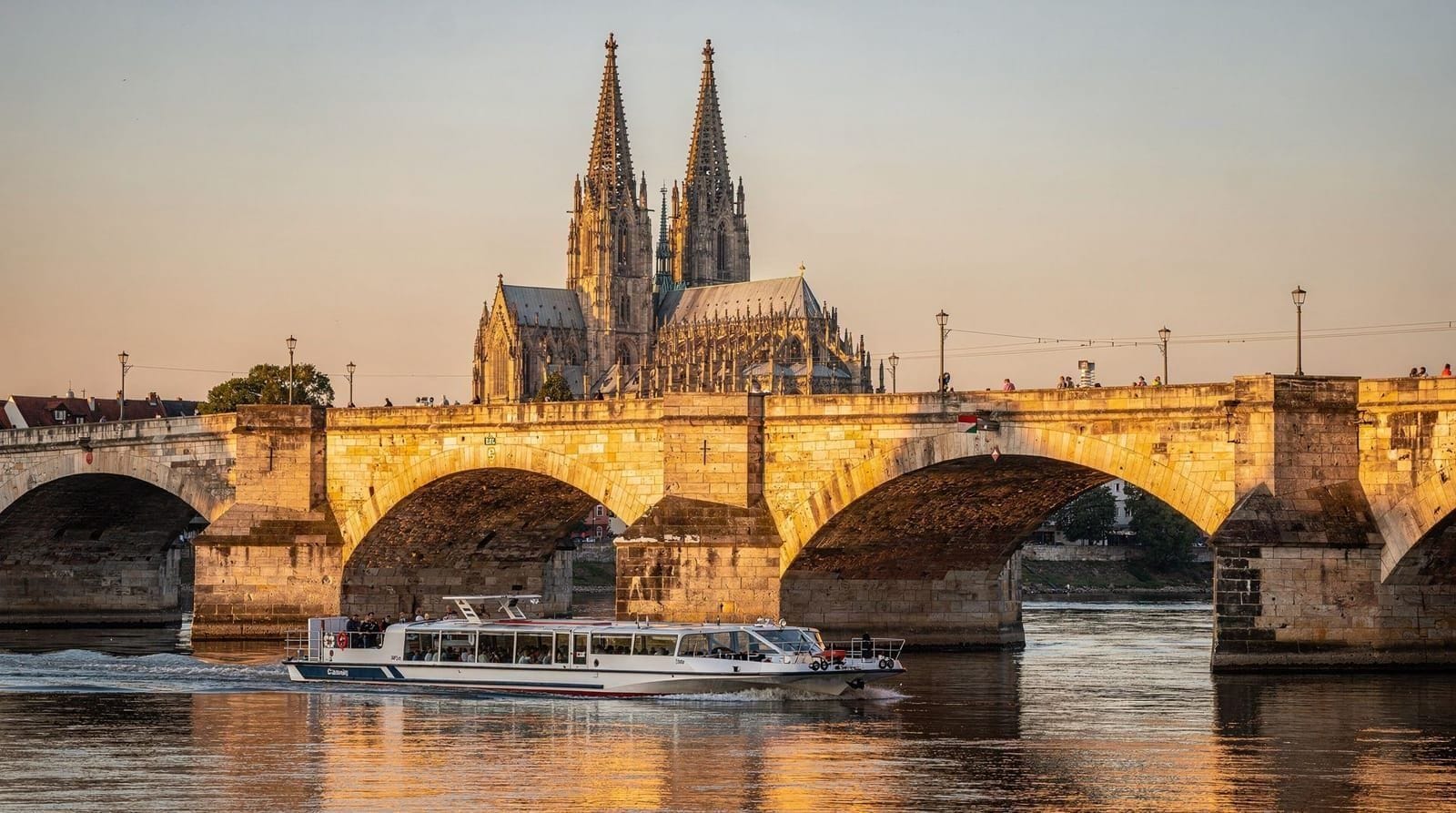
The Steinerne Brücke was built 1135-1146 under Bishop Otto I to replace a series of temporary wooden crossings. For over 800 years it was the only permanent bridge in the upper Danube, making Regensburg the dominant crossing point for trade and military movement in Bavaria.
The bridge is 336 metres long with 16 surviving arches (three were removed in the 19th century to improve water flow). Walking across it takes about 5 minutes. The view from the centre — Cathedral towers to the south, river islands to the north — is the signature image of Regensburg and completely unmediated by commerce or ticketing. Free to walk.
The salt warehouse (Historische Wurstküche) sits at the southern end of the bridge. The Wurstkuchl restaurant (Thundorfer Strasse 3) immediately below it is the oldest continuously-operating restaurant in the world at its current location — sausages have been sold here since the 12th century, feeding bridge workers and later river traders. Current format: outdoor grills, counter service, benches facing the river. Sausages approximately €10 for six with sauerkraut. Touristy but worth it for the location and the sausages.
The old town towers and merchants’ houses
Medieval Regensburg was a wealthy trading city, and wealthy merchants built towers on their houses — a sign of status analogous to modern penthouse apartments. Over 20 of these towers survive, giving parts of the old town an unusual vertical profile for a northern European city. The Baumburger Turm (Wahlenstrasse) is the most accessible, and the Römerturm cluster near the Porta Praetoria gives a sense of how the streetscape would have looked.
The Goliathhaus (Goliath House, Watmarkt 6) has a remarkable exterior mural of Goliath from 1573 — a secular painting of David and Goliath on a merchant’s house, advertising the building’s name. It is easy to miss; look up.
Altes Rathaus and the Imperial Diet
The Altes Rathaus (Old Town Hall) on Rathausplatz was the meeting place of the Immerwährender Reichstag — the Perpetual Diet of the Holy Roman Empire, which sat in Regensburg continuously from 1663 to 1806. During this period, Regensburg was effectively the parliamentary capital of the Empire. Tours of the Reichssaal (Imperial Hall) run daily in German (English available at certain times); entry approximately €9. Private full-day Regensburg tour from Munich by car
The Danube: boat trips and the riverside
A 75-minute boat trip on the Danube from the Steinerne Brücke landing provides a different perspective on the city — the riverbank, the Cathedral, and the medieval towers are seen from the water. Schiffahrt Klinger operates regular departures in season (April-October) from approximately €12-15 for adults. Not a must-do, but a pleasant addition if you have the time and the weather is good.
The Danube riverside path heading east from the bridge (towards the suburb of Stadtamhof, on the island between two Danube channels) is a good 20-minute walk for its own sake — cafes, local residents, and river views without tourist infrastructure.
Kepler Memorial Museum: the astronomer who died here
Johannes Kepler, who established the laws of planetary motion, lived in Regensburg from 1628 and died here in 1630. The Kepler-Gedachtnishaus (Keplerstrasse 5) is a small museum in the house where he died, with exhibits on his astronomical work and his time in Regensburg. Entry approximately €5.
This is a specialist interest rather than a mainstream sight, but worth noting for visitors interested in the history of science. Kepler’s grave is in the Protestant cemetery in the suburb of Stadtamhof — it was destroyed during the Thirty Years’ War but a reconstruction stands at the site.
Where to eat and drink in Regensburg
Wurstkuchl (Thundorfer Strasse 3): Already mentioned — the historic sausage restaurant at the base of the stone bridge. Essential for the location. Queue likely from noon. Open from approximately 8am.
Cafe Felix (Fischmarkt 5): Good coffee and breakfast options in the old town, without tourist pricing. Used by local university students as well as visitors.
Brauhaus am Schloss (Unter den Schwibbogen 8): Bavarian beer hall immediately below the Porta Praetoria. Solid food, local beer, outdoor seating. More relaxed than the Wurstkuchl for a full sit-down meal.
Leerer Beutel (Bertoldstrasse 9): Cultural centre with a good restaurant and wine bar, popular with the local arts crowd. More interesting than the typical tourist restaurant. Open from noon.
Tourist-trap alert: Restaurants on the main Rathausplatz and immediately facing the stone bridge charge a premium for location. The Wurstkuchl is worth the tourist pricing given its historical significance; other waterfront restaurants on the main tourist circuit are not.
What to skip or reconsider
Walhalla: The Walhalla is a Greek Revival temple built by King Ludwig I on a hill above the Danube, 12km east of Regensburg (accessible by boat from the Steinerne Brücke landing or by bus). It is a hall of fame for Germanic figures, modelled on the Parthenon. It is visually dramatic but requires 30-40 minutes transit each way, is busy in peak season, and the boat service connection is infrequent. Unless you specifically want to visit it, Walhalla is better as a standalone half-day trip rather than an addition to an already full Regensburg day.
Schloss Thurn und Taxis: The princely palace of the Thurn und Taxis family (who ran the early European postal system) is adjacent to the old town and open for tours. The palace is large and the tours are detailed. It is genuinely interesting for architectural history but is a secondary priority — fit it in only if you have run out of old-town material, which is unlikely.
Comparing Regensburg to other day trips from Munich
Regensburg occupies a specific niche: it is the choice for travellers who want a genuine medieval city without crowds, with real Roman history, and a slower pace than the tourist mainstream. It is not as visually theatrical as Neuschwanstein, not as historically heavyweight as Nuremberg, but it is more authentic and more comfortable than either. Many visitors who go to Nuremberg first and then Regensburg prefer Regensburg for the experience of actually spending time in the city. For a full comparison, see Best day trips from Munich.
The day trips by train from Munich guide covers practical Bavaria-wide rail logistics including Bavaria-Ticket variations and cross-border options.
Regensburg vs Nuremberg vs Rothenburg, at a glance:
| Regensburg | Nuremberg | Rothenburg | |
|---|---|---|---|
| Character | Lived-in medieval city, Roman remains, Danube | Medieval old town + WWII history | Fairy-tale medieval, very touristed |
| Crowds | Low to moderate | Moderate | High, especially midday |
| Journey time | ~1h25, no change | ~1h10–1h50 | ~2h30–3h, multiple changes |
| Best for | Authentic pace, food, Roman history | History depth, range of eras | Classic postcard Bavaria |
A suggested one-day itinerary
Morning (8:50–12:00): Arrive on the 7:25 train, walk to the old town, start at the Cathedral before the day-tripper groups arrive, then the Porta Praetoria and the old town towers.
Midday (12:00–13:30): Cross the Steinerne Brücke and eat at the Wurstkuchl, or avoid the queue with a sit-down lunch at Brauhaus am Schloss.
Afternoon (13:30–16:30): Altes Rathaus tour, a wander through Stadtamhof across the river, and optionally the Danube boat trip if the weather is good.
Early evening (16:30–18:00): Coffee or a final walk before catching a return train — services run regularly into the evening.
This pace leaves room to skip the boat trip or the Altes Rathaus tour if you prefer to simply wander, which is a legitimate way to spend a Regensburg day given how walkable and low-stress the old town is.
Frequently asked questions about Regensburg from Munich
Is Regensburg worth a day trip from Munich?
Yes. Regensburg has one of the largest intact medieval old towns in Germany, more authentic than Rothenburg and less crowded than Nuremberg. The stone bridge, the Cathedral, the Roman gate, and the Danube location make it a rich destination. It is also an underrated food city.
What is the Steinerne Brücke in Regensburg?
The Steinerne Brücke (Stone Bridge) was built 1135-1146 and spans the Danube with 16 arches over 336 metres. It was the only fixed crossing of the upper Danube for centuries. Still in daily pedestrian use. The view from the bridge is one of the classic images of Bavaria.
What is the Wurstkuchl?
The Wurstkuchl (Thundorfer Strasse 3) is one of the oldest continuously operating restaurants in the world, with records of sausage-selling at this location dating to the 12th century. Grilled pork sausages with sauerkraut, outdoor seating by the Danube, approximately €10 for six sausages.
How much does a day trip to Regensburg cost?
With a Bayern-Ticket (€29 single, €38 for two), the train is covered. Cathedral entry is free. Altes Rathaus tour approximately €9. Danube boat trip approximately €12. Wurstkuchl lunch approximately €10-12. Budget €50-60 per person for a full day.
What is the Roman history in Regensburg?
Regensburg was the Roman military camp of Castra Regina, established around 179 AD. The Porta Praetoria (north gate) survives intact in the old town — one of the oldest Roman structures in Germany. The Danube was the Roman Empire’s northern frontier.
Is Regensburg better than Nuremberg for a day trip?
They serve different purposes. Nuremberg is better for WWII history and a larger city atmosphere. Regensburg is better for authentic medieval immersion, Roman history, a relaxed local pace, and the Danube setting. If you have already visited Nuremberg, Regensburg is the clear next choice.
Is Walhalla worth adding to a Regensburg day trip?
Generally no, unless you have a light itinerary otherwise. It requires 30-40 minutes of transit each way with infrequent boat connections, and adding it on top of a full Regensburg old-town day risks rushing both. Treat it as a separate half-day trip if it genuinely interests you.
Is Regensburg suitable for a rainy day?
Yes, reasonably well. The Cathedral, the Altes Rathaus tour, the Kepler Museum, and several cafes and restaurants provide indoor options, and the old town’s narrow streets offer some shelter between showers. It is less weather-dependent than a trip built around the Danube boat or Walhalla.
Top experiences
Bookable activities with verified prices and instant confirmation on GetYourGuide.