Deutsches Museum with kids — the honest family guide for 2026
Munich: Deutsches Museum guided tour with entry ticket
Is the Deutsches Museum worth visiting with kids?
Yes, but selectively. The Kids' Kingdom (Kinderreich) is purpose-built for ages 3–8 and genuinely outstanding. Older children (8–14) tend to love the mining tunnel and the ships section. Plan 3–4 hours and resist the urge to cover the whole museum — it has over 80,000 exhibits across 6 floors and 73,000 m² of space.
Why the Deutsches Museum is different from other science museums
Most children’s science museums are purpose-built entertainment centres. The Deutsches Museum is something else: a genuine research collection covering the history and present of science and technology, with over 80,000 objects, that has spent decades adding hands-on elements for younger visitors. The result is uneven — some sections are thrilling, others are dense text panels aimed at adults — but the peaks are very high.
Founded in 1903 and housed on a Isar river island since 1925, the museum occupies a building so large that it takes a serious effort to plan a coherent visit rather than drifting through corridors and missing the best parts. This guide identifies what actually works with children.
| Where | Museumsinsel, on the Isar, 15 min walk from Marienplatz |
| Cost | Around €36 for 2 adults + 1 child (6–17) |
| Time needed | 3–4 hours for a focused family visit |
| Getting there | Tram 16 from Sendlinger Tor, 2 stops |
| Best time | Weekday mornings; book the Kinderreich slot on arrival |
Kids’ Kingdom (Kinderreich) — the essential first stop
The Kinderreich occupies a substantial dedicated section of the first floor and is the museum’s most deliberate investment in family visitors. It is designed for ages 3–8, though children up to 10 often linger.
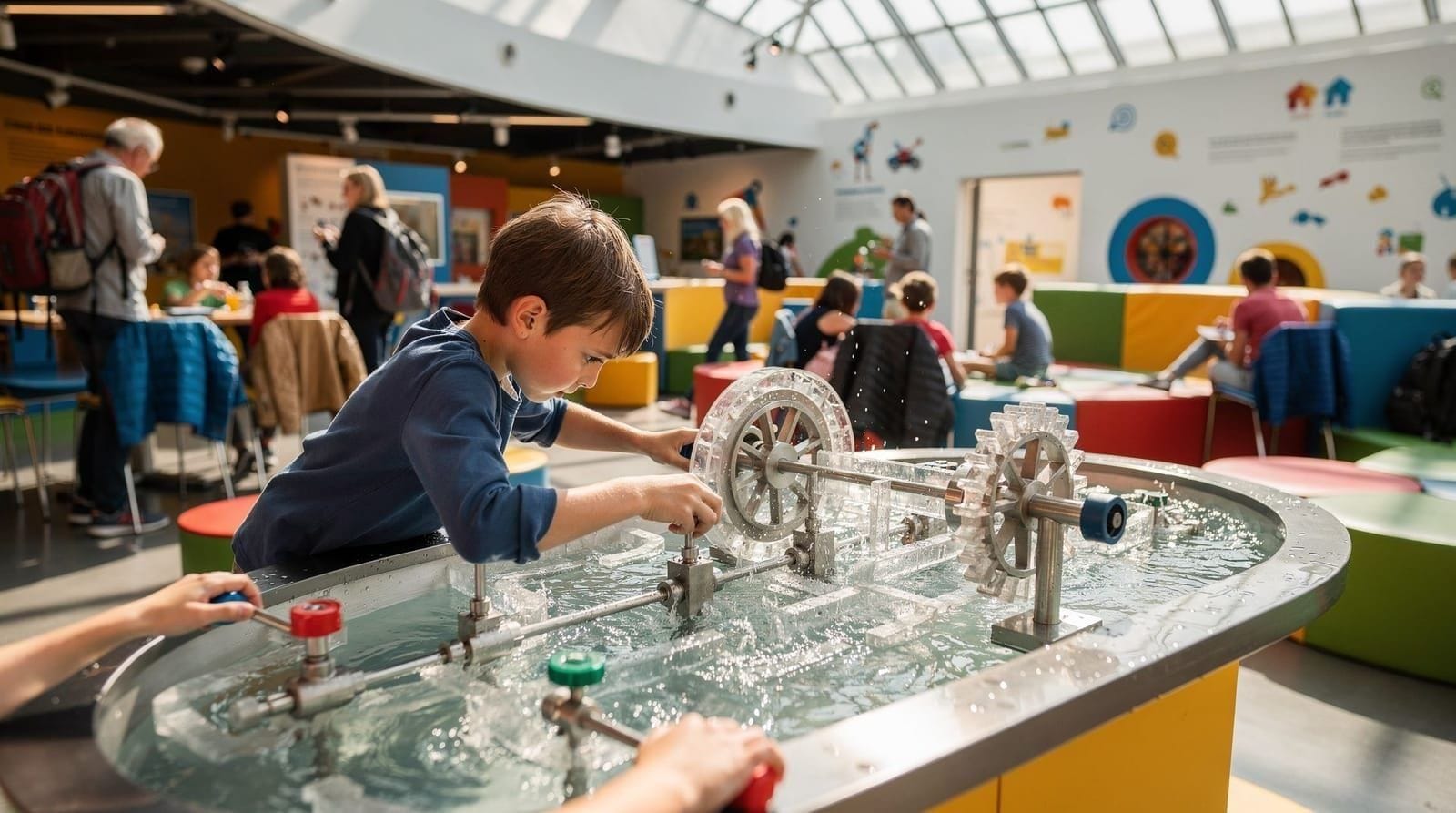
What is inside. The space is divided into themed areas where children interact with scaled-up scientific principles. There is a giant climbing structure that illustrates concepts of energy and momentum; a water experiment area with canals, locks and water wheels where children change into waterproof aprons; a light and shadow room with large mirrors and projectors; a musical instrument gallery where children play; and a building and construction zone with foam blocks at toddler and child scale.
Every exhibit requires physical engagement — there are no screens or passive displays in the Kids’ Kingdom. This makes it genuinely absorbing for the age group it targets.
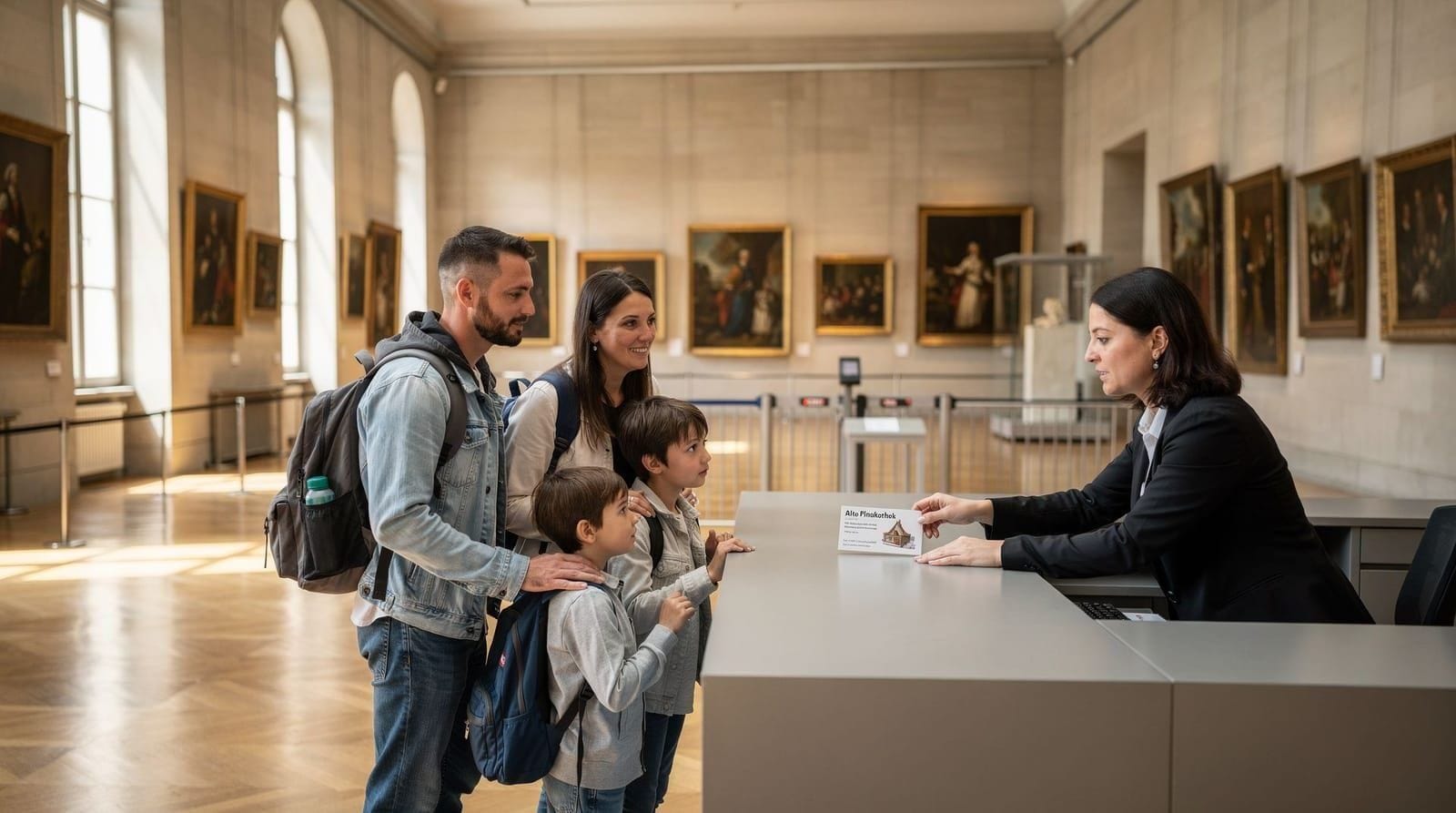
Practical notes. Entry to the Kinderreich is timed: adults without children are not admitted (this is strictly enforced). During school holidays and weekend mornings, there can be queues of 30–45 minutes. Ask at the information desk on arrival for a timed-entry ticket. The space accommodates strollers — there is a dedicated parking area at the entrance. Maximum visit time is 90 minutes per group during busy periods.
What parents should know. It is loud, active and requires adult supervision of all children — you cannot stand back and watch passively. Multiple children split up easily in the larger play zones. Agree on a meeting point when you enter.
Mining exhibit — best for ages 8 and up
The Bergwerk (mining section) is one of the most consistently impressive exhibits in the museum regardless of age. A reconstructed mine shaft descends through different geological eras, with full-scale mining machinery, rock formations, tunnels and sound effects. Children walk through the tunnels as if underground.
The exhibit covers salt, coal, iron ore and other mineral extraction across history, and the transition from hand tools to industrial equipment is viscerally clear. It is also one of the few sections where the physical environment — narrow tunnels, dim lighting, equipment at full scale — creates genuine atmosphere.
Age note. Young children (under 7) may find the tunnel sections slightly claustrophobic or dark. Most children 8 and up are enthusiastic. Allow 60–90 minutes.
Ships, submarines and aircraft
Three sections consistently engage children who have an interest in machines:
Ships (Schifffahrt). Full-scale vessel cross-sections and historical boats. The centrepiece is a 1930s cargo vessel with an accessible interior. Allow 30–45 minutes.
Submarines (U-Boot Wilhelm Bauer). The museum has a decommissioned WWII-era submarine on site (currently under renovation as of 2026 — check the museum website before planning around this specifically). When open, it is a highlight for children 8 and up.
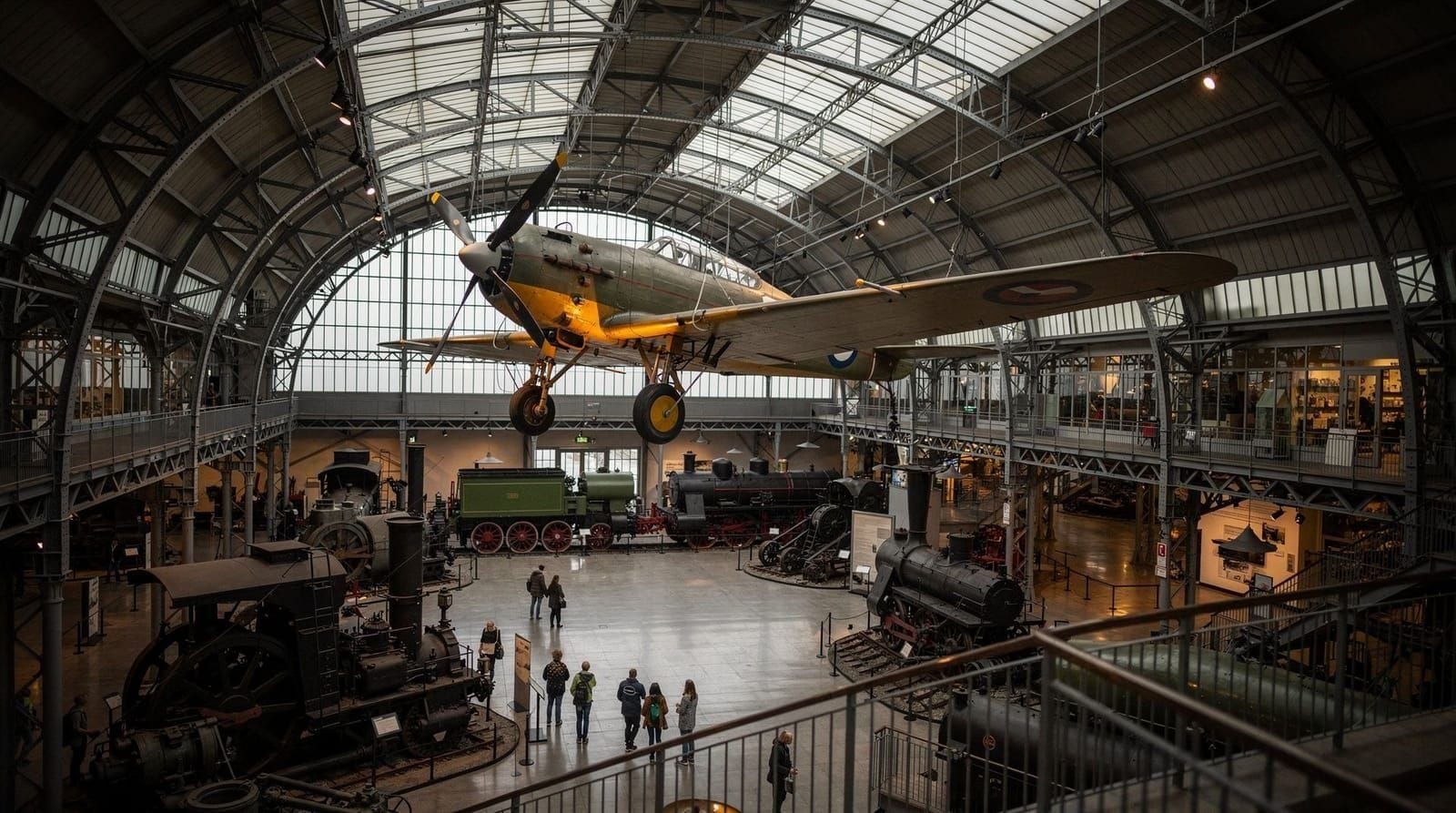
Aircraft and space flight (Luft- und Raumfahrt). The aircraft hall has full-scale planes suspended from the ceiling and walk-through cockpit simulators. The space section includes rocket engines and a replica of the European Spacelab. Best for children 9 and up.
Age-by-age guide
Ages 2–4. Stick to the Kids’ Kingdom. The museum’s scale and complexity is overwhelming for toddlers outside the designated space. Plan 1.5–2 hours maximum and leave before lunch queues form.
Ages 5–7. Kids’ Kingdom plus the ships section and aircraft hall. These combine hands-on elements with visually dramatic objects. Avoid the densely text-heavy physics and chemistry areas.
Ages 8–11. Mining exhibit, ships, aircraft, and possibly the energy section (Energie) which has working models of turbines, generators and solar panels. Children who enjoy the school curriculum connection to physics will find the energy section rewarding. Allow 4 hours.
Ages 12–15. The chemistry laboratory reconstructions, the pharmaceutical section and the computer history section (Informatik) are worth adding. Teenagers with engineering interests should see the Brücken (bridges) section, which uses physical models to explain load distribution. Allow 4–5 hours if interests are broad.
Tickets and getting there
Tickets 2026. Adults €15, youth 6–17 €6, under 6 free. No family ticket currently. The Munich Museums Pass (around €45 per adult for three consecutive days) covers admission and suits families doing multiple museums.
A guided entry ticket for the Deutsches Museum can include a guided introduction, which is useful if you want context without navigating independently.
Getting there. Tram 16 from Sendlinger Tor to Deutsches Museum (2 stops, 5 minutes). From Marienplatz: tram 16 or walk along the Isar — about 15 minutes. By S-Bahn: S1–S8 to Isartor, then 8-minute walk over the Corneliusbrücke. There is no parking attached to the museum; the surrounding streets are limited-time zones.
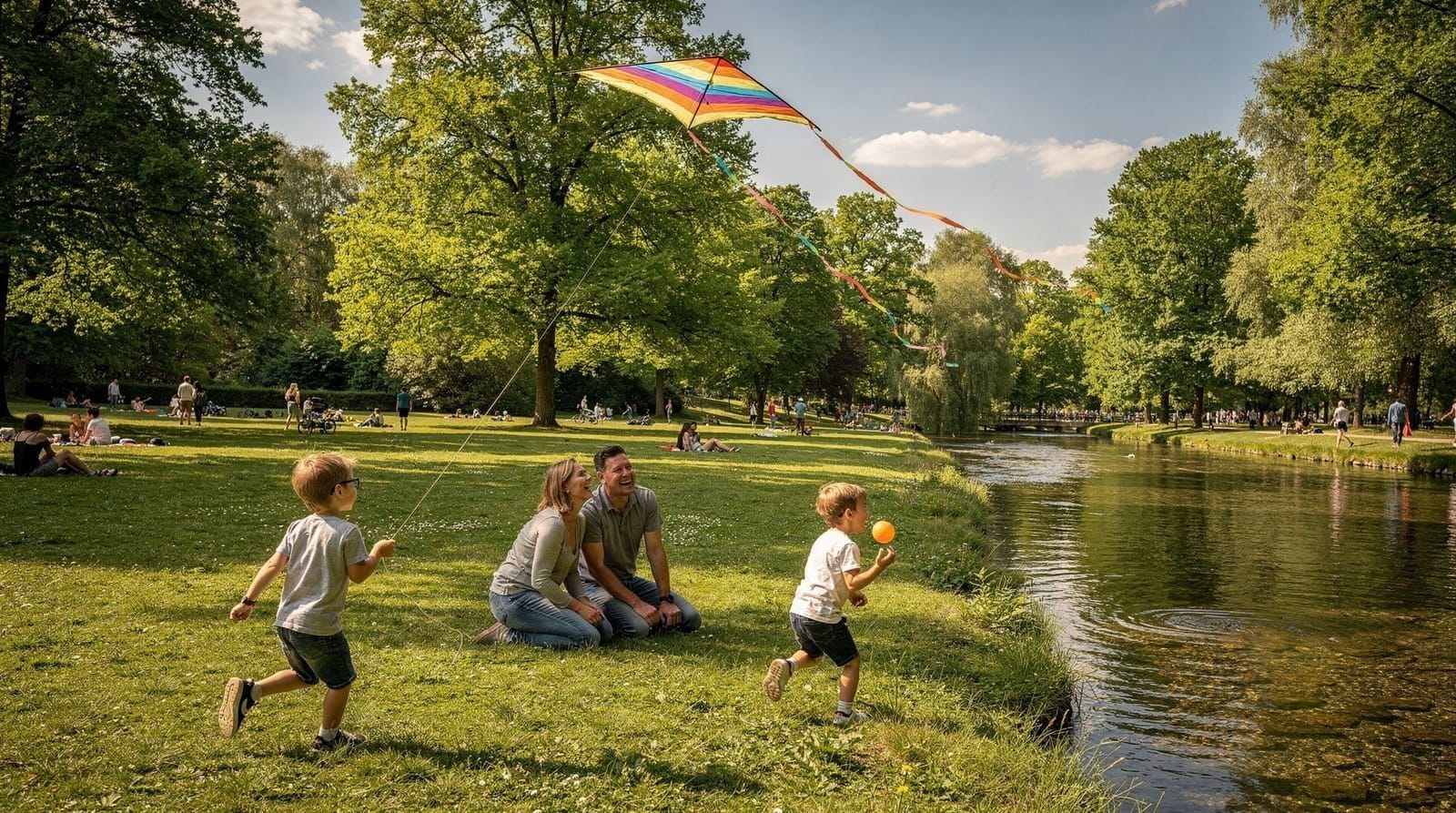
Museum island. The main building is on the Museumsinsel — the flat island in the Isar. The grounds have Isar river views and green areas suitable for a picnic lunch; the grassy riverbank adjacent to the museum is popular with families on warm days.
What to skip on a family visit
The Deutsches Museum is honest about the fact that covering everything is impossible. For family visits, skip:
- The musical instruments hall (Musikinstrumente) — beautiful but passive and text-heavy for children under 12.
- The pharmaceutical section — fascinating for adults, but not child-engaging.
- The heavy industry hall — impressive machines but context requires adult-level reading.
- The ceramics and glass sections — specialist interest, not child-friendly.
Spending 3–4 hours on the sections above instead produces a much better experience than exhausting yourselves across six floors.
Combining with other attractions nearby
The Deutsches Museum pairs well with:
- Olympiapark (20 min by S-Bahn) — the Olympiaturm observation tower and the Sea Life Munich aquarium are both nearby. See our Olympiapark guide.
- English Garden — 20 minutes’ walk north from the museum along the Isar. The beer garden at the Chinese Tower has a children’s carousel and space for children to run freely. Read the English Garden guide.
- Lunch at Viktualienmarkt — 15 minutes’ walk west into the Altstadt. The market has food stalls covering many cuisines and is easier for families than restaurant dining with young children. See our Viktualienmarkt food guide.
For a full day plan including the museum, see the Munich with kids guide.
Guided visit or independent?
The museum is navigable without a guide, but families often find a guided introduction valuable. A 90-minute family-oriented guided tour hits the Kids’ Kingdom, mining section and aircraft in a curated loop and helps you find the sections that are best for your children’s ages. Ask at the information desk about German- and English-language family tours; English-language family tours run on selected dates in school holidays.
For a private tour that covers the museum alongside Munich’s old town highlights, a private family tour of Munich’s old town can be arranged with a licensed guide who tailors the route to children’s interests.
Key exhibits to check before your visit
The Deutsches Museum is undergoing a rolling renovation programme that has been running since 2019 and will continue through the late 2020s. Several major halls close and reopen on a rotating schedule. Before visiting, check the official museum website for current closure notices — the submarine and parts of the aeronautics hall have been inaccessible at various points, and the renovation timeline shifts regularly.
Currently confirmed open (as of 2026):
- Kinderreich (Kids’ Kingdom)
- Mining exhibit (Bergwerk)
- Ships and navigation
- Energy
- New technologies wing (partially)
- Aircraft hall
- Chemistry and physics demonstrations
Check before planning around:
- Submarines — confirm open status before making this a centrepiece
- Heavy industries section — partially under renovation
- Musical instruments — verify if this aligns with your children’s interests
The museum website maintains a live closure map. Taking two minutes to review it before buying tickets avoids disappointment.
Budget planning for a museum day
For a family of two adults and two children (one over 6), total admission runs €36 (€15 + €15 + €6). Add an IMAX film at €24 (€15 adult + €10 child) if you want the cinematic experience. Audio guides cost approximately €5 per device (adults only; no children’s version in English).
Lunch at the museum restaurant: budget €12–14 per adult main, €7–9 children’s portion. For a family of four, on-site lunch costs €45–55. Bringing sandwiches from the bakeries around Isartor (5 minutes’ walk from the museum) cuts this to near zero — the riverside picnic areas outside the museum entrance are pleasant in good weather.
Transport: from the centre, a 2-hour tram or U-Bahn ticket covers the journey (€3.90 per adult; children under 6 travel free, children 6–14 with a group ticket travel free with an adult Bayern-Ticket). A day pass (Tageskarte, €9.80 per adult) covers the full day if you are combining the museum with other locations.
Total realistic day budget for a family of 4 (two adults, two children aged 4 and 8): admission €36, IMAX €24, picnic lunch €12, transport day pass €20 = approximately €92, significantly less than equivalent theme park days.
The Deutsches Museum in rain and heat
The museum is fully air-conditioned in summer (a genuine relief during Munich’s July heat waves when temperatures regularly exceed 32°C). On rainy days it becomes a popular refuge — expect higher visitor volumes and longer Kids’ Kingdom wait times. On sunny summer days, visitor numbers are actually lower in the morning as families head to the lakes and outdoor attractions first.
If Munich is experiencing a heat wave, the Deutsches Museum is one of the most reliably cool large indoor spaces in the city. For more indoor options, see our Munich rainy day kids guide.
Where it fits alongside other family attractions
Families spending several days in Munich rarely have room for every child-friendly sight, so it helps to see how the Deutsches Museum stacks up. It beats Sea Life Munich and most playgrounds for sheer depth of engagement, but it demands more stamina from young children than a park visit. If you’re weighing options for a full itinerary, the Munich family day trips guide and munich playgrounds and parks cover lower-energy alternatives for the days in between.
Quick reference: what to prioritise by age
| Age group | Prioritise | Skip |
|---|---|---|
| 2–4 | Kids’ Kingdom only | Everything else |
| 5–7 | Kids’ Kingdom, ships, aircraft | Physics, chemistry text panels |
| 8–11 | Mining, ships, aircraft, energy | Musical instruments |
| 12–15 | Chemistry, computing, bridges | Kids’ Kingdom (too young) |
This mirrors the age-by-age breakdown above but is a fast reference for splitting a group with a wide age range — send older children ahead to the mining exhibit while younger ones finish in the Kinderreich.
Stroller and accessibility notes
The museum is largely stroller-friendly, with lifts connecting all floors, though the Bergwerk’s tunnel sections are narrow and not practical with a pushchair — leave it at the dedicated parking area near the entrance and carry younger children through. Accessible routing avoiding stairs is available; ask at the information desk for the current map, since renovation work occasionally shifts step-free routes.
Frequently asked questions about the Deutsches Museum with kids
Do we need to book tickets in advance for the Deutsches Museum?
Online pre-booking is available and avoids the ticket queue at busy periods. The museum rarely sells out entirely, but morning queues on Saturdays and school holiday weekdays can run 20–30 minutes. The Kids’ Kingdom timed entry is managed internally — you cannot pre-book a Kids’ Kingdom slot online.
Is there a coat check or bag storage?
Yes. Lockers are available on the ground floor (€2 coin-operated, refundable). Large pushchairs and buggies can be left at the supervised stroller park near the Kids’ Kingdom entrance.
Can we split the museum visit over two days?
Yes — the ticket is valid for one day, but the Munich Museums Pass covers 3 consecutive days across multiple venues. For families, two shorter 3-hour visits on consecutive days often works better than one exhausting full day.
What languages are exhibits available in?
Exhibit labels are primarily in German, with English translations available on most major exhibits. An English audio guide is available for adults. The family audio guide is currently available in German only.
Is there a quiet space for feeding babies or nursing?
A family room with a nursing chair and baby-changing table is located on the ground floor. The museum café has high chairs. The outdoor riverside area can also serve as a quieter break space on warm days.
How does the Deutsches Museum compare to the BMW Welt for families?
BMW Welt is free, visually spectacular and suits car-enthusiast children and teenagers. It has fewer hands-on elements than the Deutsches Museum but works well for an afternoon. The two are 8 km apart; the BMW Welt Museum guide covers logistics.
Is the museum suitable for children with sensory sensitivities?
Parts of the Kinderreich are loud, particularly the musical instruments and water zones. The mining exhibit includes sudden sound effects. If your child is sensitive to noise, come on a weekday morning when the museum is quieter, and preview the Kids’ Kingdom by arriving at opening time. Request a museum map at the entrance to identify quieter routes.
Can we combine the Deutsches Museum with a rainy-day itinerary elsewhere in Munich?
Yes. If the whole day is wet, pair a morning at the Deutsches Museum with an afternoon at the Pinakothek der Moderne (also indoors) or a covered stretch of the Viktualienmarkt for lunch. See the Munich rainy day kids guide for a fuller wet-weather plan that avoids backtracking across the city.
Do we need a full day, or is a half-day visit enough with young children?
A half-day (3–4 hours) is enough for most families with children under 10, and is actually preferable — young children tire before the museum’s full scale can be appreciated anyway. Save the remaining half-day for something lower-energy nearby, like the riverside green space outside the museum or the English Garden.
Top experiences
Bookable activities with verified prices and instant confirmation on GetYourGuide.