Zugspitze — Germany's highest peak guide
Complete guide to visiting the Zugspitze: cog railway vs cable car, Eibsee, summit experience, tickets, best time to go, and day trip logistics from
From Munich: tour of Germany's highest peak Zugspitze
Quick facts
- Elevation
- 2,962 m (Germany's highest peak)
- Access from Garmisch
- Cog railway (75 min) or cable car from Eibsee (10 min)
- Adult round-trip ticket (2026)
- EUR 69
- Distance from Munich
- 100 km (1h 20 min train to Garmisch + ascent time)
- Open
- Year-round (weather-dependent closures possible)
Standing on Germany’s roof
At 2,962 metres, the Zugspitze is Germany’s highest mountain and the centrepiece of the Wetterstein massif on the German-Austrian border. On a clear day, the summit platform offers views across Bavaria and the Allgäu to the north, the Austrian and Tyrolean Alps to the south, the Dolomites to the southeast, and the Swiss Alps on the western horizon — four countries visible from a single vantage point.
Unlike many iconic Alpine summits, the Zugspitze requires no mountaineering skill or specialist equipment. Two mechanised ascent options — a historic cog railway and a modern gondola — make the summit accessible to anyone fit enough for a staircase. The result is a genuine high-altitude experience without the commitment of a technical climb, which makes it both enormously popular and entirely worth the visit.
The Zugspitze sits directly above Garmisch-Partenkirchen, the alpine resort town that serves as the main gateway. From Munich, expect a total journey of around 2.5–3 hours door-to-summit.
| Where | Wetterstein massif, German-Austrian border, above Garmisch-Partenkirchen |
| Cost | Around EUR 69 adult round-trip ticket (2026) |
| Time needed | Half day (ascent + summit) or full day including Eibsee |
| Getting there | BRB train from Munich Hbf to Garmisch, about 1h20, then cog railway or cable car |
| Best time | Late June–September for visibility; December–April for glacier skiing |
Getting from Munich to the Zugspitze
The standard route from Munich by public transport:
- Take the BRB train from Munich Hauptbahnhof to Garmisch-Partenkirchen (hourly, 1 hour 20 minutes, Bayern-Ticket valid).
- At Garmisch, transfer to the Zugspitzbahn (cog railway) from a dedicated platform directly at the station, or take the RVO Bus 9606 to the Eibsee for the cable car ascent.
Total journey time Munich to summit: approximately 3 hours by rail + cog railway, or 2.5 hours by rail + bus + cable car.
A guided day trip that handles logistics is the most efficient option for many visitors: a full-day Zugspitze tour from Munich includes return transport and summit ticket, leaving from the city centre. For a private option with more flexibility, a private Zugspitze and Eibsee tour from Garmisch covers both the summit and the lake.
By car from Munich, take the A95 to Garmisch-Partenkirchen (about 1 hour). From there, drive to the Eibsee car park (10 km south on the B23) for the cable car, or park near the Zugspitzbahnhof in Garmisch for the cog railway. Car park fees at Eibsee are EUR 5–8 per day.
See the Zugspitze day trip guide for more routing details, and the Bavarian Alps cable cars guide for context on the mountain transport network.
The two ascent options
Zugspitzbahn — the cog railway
The Zugspitzbahn is a narrow-gauge cog railway (Zahnradbahn) that has operated since 1930. It departs from the Zugspitzbahnhof in Garmisch-Partenkirchen, initially running through a tunnel for most of the lower section, before emerging above the Eibsee and climbing steeply through the Zugspitzplatt glacier plateau to the summit station at 2,588 m (Zugspitzplatt). From there, a cable car carries you the final section to the summit at 2,962 m.
Journey time: approximately 75 minutes from Garmisch to the glacier plateau, plus a few minutes on the final cable car. The railway runs every 30 minutes during peak periods, less frequently in winter outside ski season hours. The experience is scenic and historically interesting — the tunnel section through the mountain’s interior is notable, and the emergence onto the glacier above Eibsee is dramatic.
Key consideration: The cog railway is the more atmospheric option but also the slowest. On busy summer days, trains fill quickly in the morning from Garmisch. Go early (first departure around 07:00) to avoid queues at the ticket windows and crowding on the train.
Eibsee cable car
The Eibsee Seilbahn is a modern gondola that ascends from the Eibsee (at 1,000 m) directly to the summit station at 2,962 m in approximately 10 minutes. It holds 100 passengers per cabin and offers sweeping views over the Eibsee itself and the surrounding mountains during ascent.
The cable car is the faster, more dramatic-feeling option and is recommended if you want to combine the visit with time at the Eibsee lake. The Eibsee is a short walk from the cable car base station and is worth 1–2 hours on its own.
Key consideration: In summer, queues for the Eibsee gondola can be long (60–90 minutes) unless you pre-book a timed slot online. Booking in advance is strongly recommended between June and September.
Using both
The standard round-trip ticket (EUR 69 adults in 2026) allows you to ascend one way and descend the other — a common strategy is to take the cog railway up (for the experience) and descend by cable car to Eibsee (for the lake and lake-level perspective). Check the timetable when purchasing, as the last departures from the summit are around 17:00 in summer.
At the summit
The summit area spans both the German and Austrian sides of the border. The German infrastructure (Bayerische Zugspitzbahn Bergbahn) is on the north/east side; the Austrian Zugspitze Arena (Tiroler Zugspitzbahn) operates on the south side.
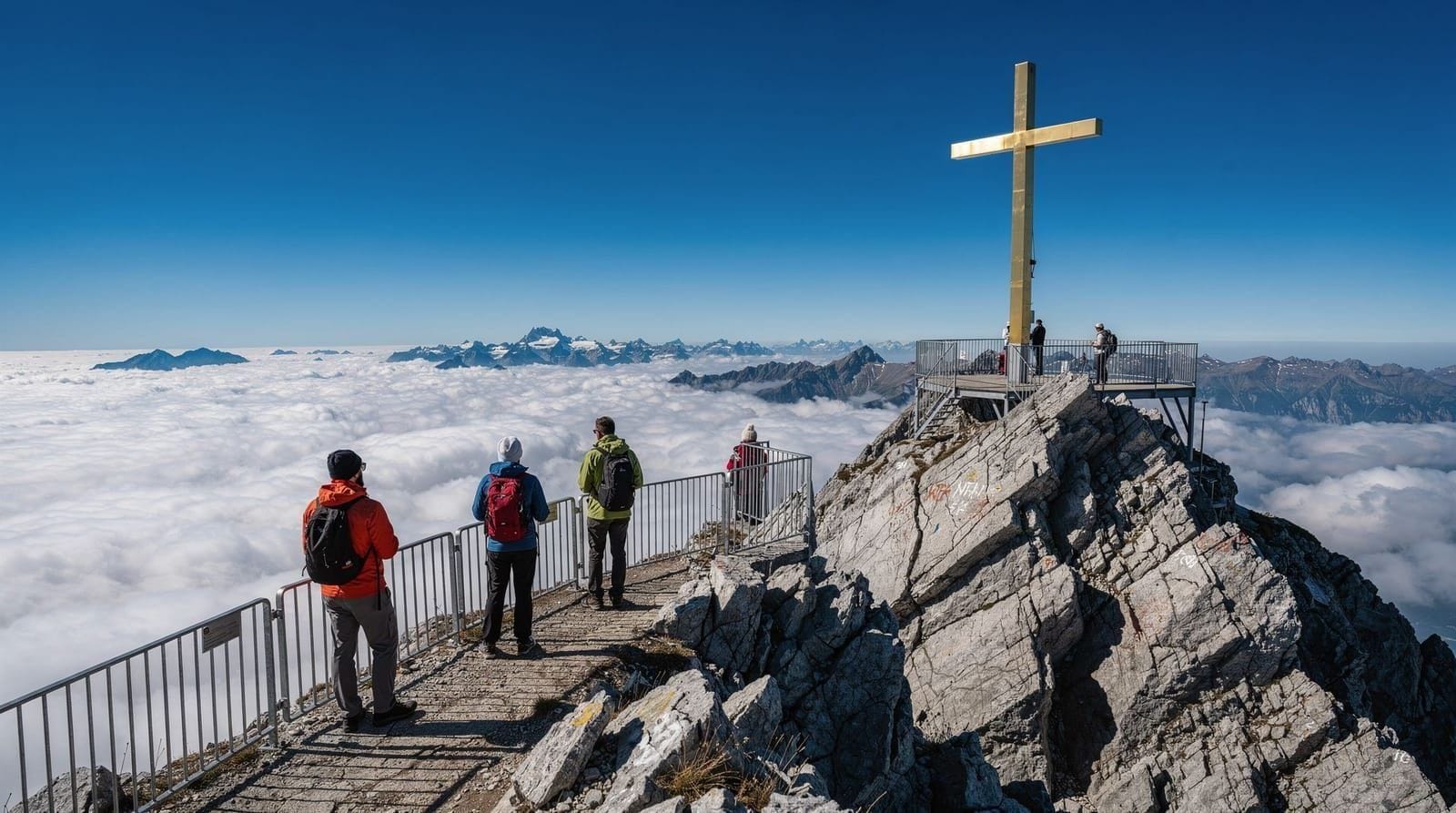
Summit platform: The main viewing terrace is at the very top of the peak, accessible via stairs and a short outdoor path from the terminal. There is a golden cross (Gipfelkreuz) erected in 1851 that serves as the photo focal point; expect queues to photograph next to it in summer. The 360-degree panorama is the genuine reward — on a clear day, the view extends 250+ km.
What to bring: Even in summer, summit temperatures are typically 10–15°C cooler than in Garmisch (often 5–10°C at the top when it is 20°C below). Wind chill makes it feel colder. Bring a warm layer, sunscreen (UV radiation at altitude is significant), and sunglasses.
Summit restaurants: The Zugspitz restaurant on the German side serves Bavarian food and drinks at summit prices — a Weissbier costs EUR 6–7, a main course EUR 18–24. The quality is adequate and the experience is part of the visit, but calibrate expectations accordingly. A snack and hot drink is more practical than a full meal.
Glacier skiing: The Zugspitzplatt glacier at around 2,600 m is Germany’s only remaining glacial ski area and operates year-round snow permitting (though coverage has been diminishing in recent years due to climate change). Day passes for the glacier area are included in the standard Zugspitze ticket for winter visitors.
The Eibsee
The Eibsee (lit. “yew tree lake”) sits at 1,000 metres elevation, 10 kilometres south of Garmisch-Partenkirchen. It is one of the most visually striking lakes in Germany: the water is extraordinarily clear (visibility to 7–8 metres) and ranges from deep teal in the centre to turquoise-green in the shallows, with the Zugspitze massif rising directly behind.
A 7.3-kilometre footpath (Eibseeufer-Weg) circumnavigates the lake; the full circuit takes about 1.5–2 hours and is suitable for all fitness levels. Several small beaches allow swimming in summer — water temperature peaks around 18°C in August.
The Eibsee Hotel (a 4-star establishment directly on the lake shore) has a lakeside restaurant open to non-guests; lunch here (EUR 20–30 per head) is one of the more pleasurable ways to spend time after a summit visit.
For context on the broader alpine lake landscape around Munich, see our Munich lakes guide.
Tickets and planning
Prices in 2026:
- Adult round-trip (cog railway + cable car, or cable car both ways): EUR 69
- Children 6–15: EUR 44.50
- Children under 6: free
- Family ticket (2 adults + 2 children): EUR 168
Tickets can be purchased at the Zugspitzbahnhof in Garmisch, at the Eibsee cable car base, or online at zugspitze.de. Online booking allows timed-entry selection for the Eibsee cable car, which is strongly recommended in summer to avoid queues.
When to arrive: For the clearest views, aim to be at the summit before 11:00, when afternoon cloud build-up typically begins in summer. First trains from Garmisch depart around 07:00; the first Eibsee cable car runs around 08:00.
Weather: The Zugspitze webcam (zugspitze.de) shows live summit conditions. Cloud cover is common; the mountain is clear more often in the morning than the afternoon. Don’t plan around a single day — if you have flexibility, check the forecast and go on the clearest day.
Winter visits: The summit and glacier area operate throughout winter. Snow cover is virtually guaranteed between November and April. Summit access is possible year-round (barring severe weather closures), but call ahead or check the website during storm periods.
Hiking options around the Zugspitze
Not everyone wants to reach the summit by cable car alone. For hikers with proper mountaineering experience, the classic route to the top on foot is the Reintal approach — a genuinely serious two-day route (typically overnighting at a mountain hut such as the Knorrhütte) involving significant elevation gain, exposed sections, and via ferrata-style fixed sections near the top; it is not a casual day hike and should not be attempted without appropriate gear, fitness and, ideally, a guide. A far gentler option is walking part of the Eibsee circuit and then riding the cable car up rather than down, which gives a genuine sense of the mountain’s scale without any technical difficulty. The 2-day guided hike to the Zugspitze summit is the practical way to attempt the on-foot route without route-finding or logistics risk. For most visitors, though, the mechanised ascent remains the sensible choice — the Zugspitze’s terrain above the treeline is genuinely alpine and not forgiving of underestimation.
Glacier and winter sports context
The Zugspitzplatt glacier is Germany’s only remaining glacial ski area and has been in continuous use since 1928. The glacier sits between 2,600 and 2,950 metres; the main ski runs descend about 350 vertical metres through the plateau before the cog railway carries skiers back to the summit. Total pisted area is modest — around 20 km — but the snow quality and altitude guarantee good conditions from November into May in most years.
What the glacier ski area lacks in size it compensates for in spectacle and altitude. The panoramic views while skiing are exceptional, and the experience of skiing on Germany’s only glacier has a novelty that draws visitors from across the country. However, the climate data tells a more sobering story: the Zugspitz glacier has lost approximately 40% of its area since 1900, and the lower sections no longer hold snow reliably in warmer winters. The ski area operates with snowmaking at lower elevations.
For skiers based in Munich, the Zugspitze is most commonly combined with a stay in Garmisch-Partenkirchen, which has its own separate valley ski area (the Garmisch Classic) and direct train access from Munich. The Munich skiing day trips guide compares the Zugspitze glacier with other accessible Alpine resorts.
The Zugspitze as a border landmark
The Zugspitze summit sits on the Germany-Austria border; the Austrian side is operated by the Tiroler Zugspitzbahn, which runs a separate cable car from the Zugspitz Arena ski resort in Austria’s Tyrol region. Visitors can cross from the German summit to the Austrian side on foot within the summit building, though Austrian lift tickets are separate from German tickets. The Austrian descent leads to Ehrwald in the Tyrolean valley, an option for organised groups or those with vehicles waiting on both sides.
This dual-nation character means the summit has two restaurants, two lift operators, and signage in three languages (German, Austrian German, and English). The German side has the golden summit cross and the larger observation deck; the Austrian side has somewhat better mountain views to the south.
Honest assessment
The Zugspitze is genuinely impressive — the summit views on a clear day rank among the best in Germany — but a few caveats:
The commercial infrastructure at the top is functional rather than atmospheric. The summit building is a 1980s construction with cafeteria aesthetics; if you are comparing to the summit experience on the Schilthorn or Jungfraujoch in Switzerland, expect a more modest presentation. What you get is the raw reality of standing on Germany’s highest point, not a themed experience.
In peak summer (mid-July to late August), crowds at the summit can be substantial, especially between 10:00 and 14:00 when the majority of guided tours arrive. Early starts and late arrivals (last gondola back is around 17:00) offer a noticeably quieter experience.
The cost (EUR 69 per adult) is not cheap for what amounts to a gondola ride. If budget is tight, the Alpspitze cable car offers excellent views from a lower peak at roughly half the price.
Zugspitze by season
| Period | Conditions | Notes |
|---|---|---|
| Late June–August | Warmest, most crowded | Best visibility odds but longest queues 10:00–14:00; book Eibsee slots ahead |
| September | Clear, cooling | Often the best visibility-to-crowd ratio of the year |
| October–November | Cooling fast, early snow possible | Shoulder season; check webcam closely before travelling |
| December–April | Winter/ski season | Glacier skiing operating; snow at valley level too, dress accordingly |
| May–early June | Transitional | Some snow lingering at summit; check trail and lift status before a hiking-focused visit |
Frequently asked questions about the Zugspitze
How long does a Zugspitze day trip from Munich take?
Allow a full day: roughly 1.5 hours travel each way to/from Garmisch, 1.5 hours for the cog railway ascent, 2–3 hours at the summit, and time at the Eibsee if you descend that way. Departing Munich by 07:30 gets you to the summit by 10:30 and allows a relaxed day before the last trains back.
Do I need to book Zugspitze tickets in advance?
In summer (June–September) and during ski holidays, yes — particularly for the Eibsee cable car, which sells out timed entry slots. Book online at zugspitze.de. The cog railway at Garmisch has fewer immediate sell-out issues but can have long queues at the ticket window without a pre-purchased ticket.
What is the difference between the Zugspitze and the Alpspitze?
The Zugspitze (2,962 m) is Germany’s highest peak, accessed by cog railway or gondola. The Alpspitze (2,628 m) is a neighbouring peak accessed by the Alpspitzbahn gondola (EUR 38 adults return, 2026) and has excellent views including the Alpspix cantilevered walkway. The Alpspitze is less crowded and less expensive. Many visitors who have already done the Zugspitze on a previous trip prefer the Alpspitze on return visits.
Can children visit the Zugspitze?
Yes. There are no age restrictions and the summit is fully accessible via the cable cars and lifts within the summit building. Children aged 6–15 pay EUR 44.50; under-6 is free. The main consideration is warmth — bring adequate layers for children, as summit temperatures are significantly colder than at valley level.
Is the Zugspitze worth visiting in winter?
Yes, particularly for skiers. The glacier ski area is the only one in Germany and offers reliable snow. Non-skiers can visit the summit in winter and the views of the snow-covered Alps are exceptional. Note that cable car capacity is shared with ski equipment in winter, so queue planning is still relevant.
What should I wear to visit the Zugspitze in summer?
At the summit, expect temperatures of 5–12°C in summer even when Garmisch is 20°C+. A mid-layer (fleece or light down jacket), windproof outer layer, and sun protection (sunscreen and sunglasses) are essential. Closed shoes are preferable to sandals — the summit walkways can be icy in early season.
Are there other mountains near Garmisch worth visiting?
The Bavarian Alps cable cars guide compares all the accessible peaks: the Alpspitze, the Wank (1,780 m, good family option), the Kramerspitz (an unfacilitated hiking summit above Garmisch), and the Karwendel range accessible from Mittenwald. The Zugspitze vs Nebelhorn comparison helps if you’re weighing options.
How do I check if the Zugspitze summit will be clear before I go?
Check the live webcam and forecast at zugspitze.de the evening before and again the morning of your visit. The mountain is clear more often in the morning than the afternoon, when cloud tends to build up, so an early start improves your odds even on a marginal-forecast day. If you have flexible dates, shifting a day based on the forecast is worth more than any other single decision you can make for this trip.
Should I take the cog railway or the cable car if I only have time for one way up and down?
If time is limited, the Eibsee cable car is faster in both directions (about 10 minutes each way) and lets you combine the summit with time at the lake. If the journey itself is part of the appeal, the cog railway’s 75-minute ascent through the tunnel and across the glacier plateau is the more atmospheric choice, but it eats into your summit time. Most visitors with a full day do one way each, as described above.
Top experiences
Bookable activities with verified prices and instant confirmation on GetYourGuide.