Königssee — emerald lake, electric boats, and St. Bartholomä
Complete guide to Königssee lake: electric boat tours, St. Bartholomä chapel, Obersee hike, Jenner gondola, and how to get there from Munich or
Schönau: Königssee and Lake Obersee day trip with boat ride
Quick facts
- Location
- Schönau am Königssee, 5 km from Berchtesgaden
- Length
- 7.7 km; up to 192 m deep
- Boat to St. Bartholomä
- EUR 21 adults return (2026)
- From Munich by train
- ~2 h 45 min (train to Berchtesgaden + local bus)
- National park
- Berchtesgaden National Park — no private motorboats
The lake that allows no engines
The Königssee is one of the purest lakes in Germany, and its water quality is maintained by a rule that has been in effect since 1909: only the official electric boats (and two rowboats) are permitted on the water. No private motorboats, no jet skis, no speedboats. This restriction — unusual in a country where regulations tend to be pragmatic rather than idealistic — has preserved the lake’s extraordinary clarity (visibility down to 8 metres) and its surrounding Berchtesgaden National Park in a state that feels genuinely wild rather than managed.
The lake sits in a steep-sided fjord carved by glaciers, surrounded by rock walls that rise 1,500–2,000 metres on three sides. The Watzmann’s east face dominates the west shore. The lake is 7.7 km long and up to 192 metres deep — making it one of Germany’s deepest. At 603 metres elevation, it stays cold year-round; water temperature peaks around 18–20°C in August in the shallower northern section near the landing stage.
For most visitors, the Königssee is experienced as part of a Berchtesgaden day trip. It can also be reached independently from Munich. Either way, the combination of the boat ride, the St. Bartholomä chapel, and the optional Obersee hike makes it one of the most satisfying half-day or full-day excursions in the Bavarian Alps.
| Where | Schönau am Königssee, 5 km south of Berchtesgaden |
| Cost | Around EUR 21 boat return (St. Bartholomä) |
| Time needed | Half day (St. Bartholomä) to full day (Obersee) |
| Getting there | Train to Berchtesgaden (~2h30) + local bus |
| Best time | May–Oct for full boat service |
Getting to Königssee
By public transport from Munich: Take the train to Berchtesgaden (approximately 2 hours 30 minutes, change at Freilassing or Salzburg), then take RVO Bus 841 or 843 from Berchtesgaden town centre to Schönau am Königssee (10–15 minutes, running approximately every 20–30 minutes). The Bayern-Ticket covers regional trains but not ICE connections; check the DB Navigator app for the current fastest route.
By car from Munich: The A8 toward Salzburg, then the B20/B305 south toward Berchtesgaden. Journey time approximately 2 hours. Parking at Schönau am Königssee is available in several large car parks (EUR 6–8 per day); the main Parkplatz am Königssee is a 5-minute walk from the landing stages.
Guided tours from Munich: a full-day Königssee van tour from Munich covers transport and includes time for the boat trip. For a combined Königssee and salt mine visit: the Königssee boat ride and Berchtesgaden salt mine tour manages both in one day.
The walk from Schönau am Königssee village to the boat landing is about 800 metres along a paved pedestrian path (no vehicles on this final section).
The electric boat tour
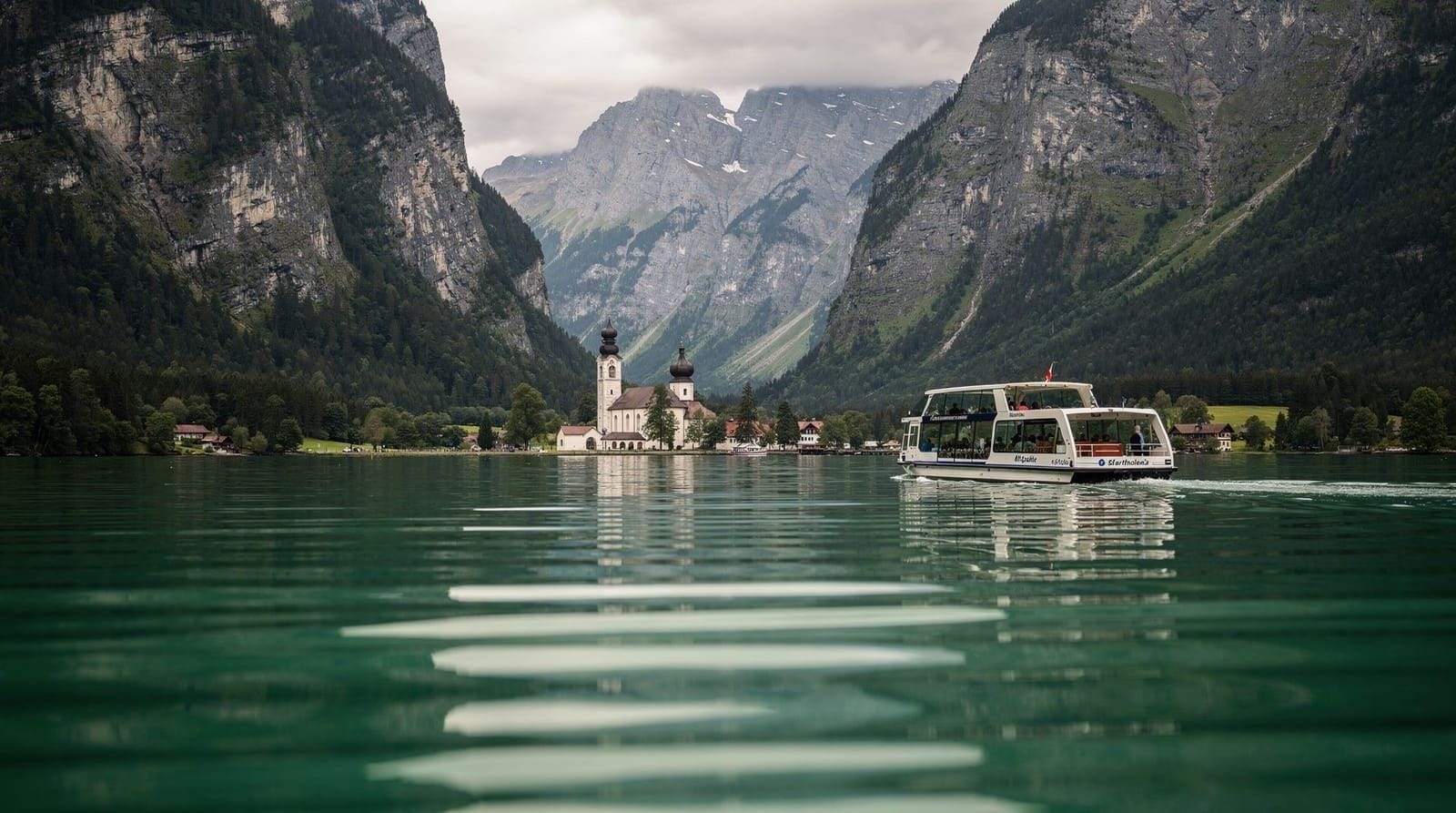
The Königssee boat service (Bayerische Seen-Schifffahrt) has operated electric boats since 1909, and the current fleet of white wooden boats is pleasantly low-key compared to the tourism machinery at other major Alpine lakes. Boats run from the Schönau landing stage south toward St. Bartholomä (4.5 km, approximately 25 minutes each way) and — in summer — continue to the Salet landing stage at the southern end of the navigable lake (another 15 minutes).
Tickets (2026):
- Schönau → St. Bartholomä → Schönau: EUR 21 adults, EUR 10.50 children 6–14
- Schönau → Salet → Schönau: EUR 27 adults, EUR 13.50 children 6–14
- Schönau → St. Bartholomä → Salet → Schönau: EUR 27 adults (same price)
Tickets are purchased at the landing stage; there is no online pre-booking for the boats. In summer (July–August), queue times of 30–60 minutes before departure are common at peak hours (09:00–13:00). Arriving before 09:00 or after 14:00 significantly reduces waiting time.
The echo demonstration (Echoschall) is a tradition: boat captains play a short melody on a trumpet or flugelhorn at a specific point on the lake where the rock wall creates a recognisable echo. Every captain does this; it is brief and pleasant without being overhyped.
For an exclusive experience, a private boat charter on the Königssee and Obersee covers both lakes at your own pace with a dedicated boat.
St. Bartholomä
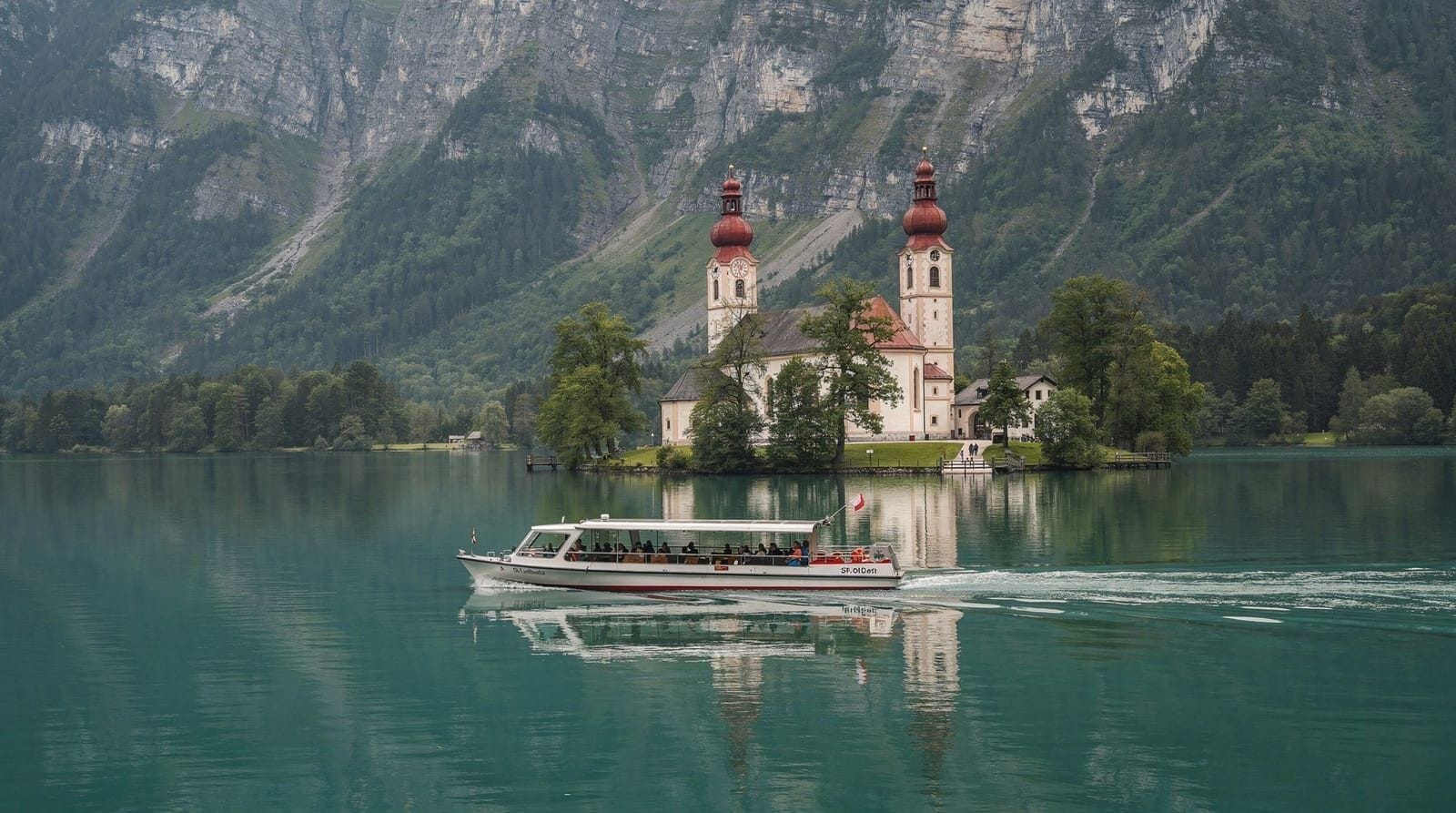
The St. Bartholomä landing stage (accessible only by boat or on foot via a multi-hour trail) is the halfway point on the main boat route. The focal point is the Wallfahrtskirche St. Bartholomä, a small pilgrimage church with distinctive onion domes in red and green that appears in virtually every photograph of the Königssee. The church dates to around 1134, with its current Baroque form from 1697. It functions as an active pilgrimage site and is open to visitors; a short visit inside takes 5–10 minutes.
The landing area has a small restaurant (Gaststätte St. Bartholomä) that serves grilled fish — primarily Saibling (Arctic char) — from the Königssee. The fish is caught in the lake and is genuinely good; a grilled char costs EUR 18–24. This is probably the most legitimate “local speciality” in the area, and the short stop at St. Bartholomä for lunch before boarding the return boat is recommended over eating at the busier main landing stage.
Boat turnaround time at St. Bartholomä is typically 60 minutes, which is enough for the church, a short walk along the lakeshore, and a quick lunch. If you want to hike to the Obersee (see below), you continue from St. Bartholomä to the Salet landing rather than returning here.
Walking trails from St. Bartholomä lead north along the lake shore toward the Eiskapelle (a permanent snow arch from avalanche debris, visible from late spring), a 1.5-hour walk each way from the landing.
The Obersee hike
The Obersee is a smaller lake beyond the Salet landing stage (the southernmost boat stop), separated from the Königssee by a 200-metre gravel bar. To visit it, take the boat to Salet (the last stop, EUR 27 round trip from Schönau) and walk 20 minutes across the flat gravel bar to the Obersee.
The Obersee is considerably quieter than the Königssee — fewer day-trippers make it this far — and many visitors find it more beautiful: the water is a darker, more intense green, the surrounding peaks feel closer, and the Röthbach waterfall (Germany’s highest free-falling waterfall at 470 metres) drops dramatically into the lake at its southern end. Standing at the Obersee with the Röthbach in the background is one of the most compositionally striking alpine views in Bavaria.
Allow 2–3 hours at the Salet end if you want to walk to the Obersee and back at a relaxed pace, with time to sit by the water. The path from Salet to the Obersee shore is easy (flat, well-maintained gravel path). There is a small hut at the Obersee (Fischunkelalm) that serves drinks but not full meals.
The full boat journey Schönau → St. Bartholomä → Salet → walk Obersee → return is a satisfying full day: allow 5–6 hours at the lake.
The Jenner gondola
The Jennerbahn gondola ascends from just outside Schönau am Königssee to the Jenner summit at 1,874 metres. From the top, the views looking down over the Königssee — its full length visible from above, framed by the Watzmann to the west and the Austrian peaks to the south — are among the most dramatic in the Berchtesgadener Land.
In summer, the gondola operates as a hiking starting point and scenic viewpoint. Round-trip ticket costs EUR 34 for adults (EUR 20 for children 6–15) in 2026. Hiking from the Jenner summit follows marked trails across the high ridge; the path to the Jenner Alm (an alpine hut at 1,650 m) is straightforward and takes about 45 minutes from the top station.
In winter, the Jenner serves as a ski area with 18 km of pistes, predominantly blue (easy) and red (intermediate) routes, with snow reliability generally good from December to March. Day ski passes cost EUR 42–48 for adults.
Around the landing area
The area immediately around the Schönau landing stage is the most commercial part of the Königssee experience. There are souvenir shops, food stalls, and a car-free promenade between the car parks and the lake. The quality of food on this strip is mediocre and prices reflect the captive audience; if you are eating at the lake, save the meal for St. Bartholomä (char) or bring your own food (there are picnic benches along the lakeshore south of the main landing).
The town of Schönau am Königssee itself (slightly north of the landing area) has a weekly farmers’ market (Thursday mornings in summer) and a quieter atmosphere. For accommodation near the lake, the Hotel Schiffmeister (directly on the lakefront) and several Pensionen in Schönau are good options at EUR 80–130 per night.
The national park context
The Königssee sits entirely within the Berchtesgaden National Park, Germany’s only Alpine national park. This designation has specific implications for visitors: no private motorboats (hence the electric-only rule), no wild camping, no picking flowers or collecting rocks, and no dogs off the leash. The restrictions are enforced, and for good reason — the result is a lake ecosystem that is genuinely pristine by European standards.
The water quality is tested regularly by the Bavarian Environment Agency and consistently meets EU drinking water standards at the main bathing points. This is remarkable for a lake that receives around 1.5 million visitors per year. The electric boat company does major maintenance on the hull and engines during the winter closure (boats return to operation in mid-December for the year-round service, with reduced timetables in winter).
The national park does not have a visitor centre at the Königssee landing stage itself; the main Nationalpark-Haus is in Berchtesgaden town (about 5 km north, on Dr.-Imhof-Straße). It has a free exhibition on the park’s geology, wildlife, and history and is worth 45 minutes if you have a second day in the area.
Wildlife in the national park includes alpine ibex (reintroduced in the 1960s, now numbering around 250), chamois, golden eagles, and a recovering population of brown bears near the Austrian border. Ibex are most easily spotted on the rocky cliffs above the Königssee’s western shore, visible from the boat.
Winter at the Königssee
Outside the main season, the Königssee has a different but genuine appeal. The boat service continues year-round on a reduced timetable (typically Schönau to St. Bartholomä only, with fewer daily departures), and in a hard winter the shallow northern section of the lake can partially freeze, creating striking ice formations along the shore. The surrounding peaks carry snow well into May, and the near-total absence of summer crowds makes for a quieter, more contemplative visit. The Jenner switches over to its winter ski operation (18 km of pistes, day passes EUR 42–48), so the gondola still runs, just for a different purpose. Layered clothing and proper footwear matter more than in summer — the lakeside promenade can be icy, and boat crossings are noticeably colder on the water than on shore.
Day-trip combinations
The Königssee is most naturally combined with Berchtesgaden town and/or the Eagle’s Nest. Several effective combinations:
Königssee only (half day): Take the first boat at 08:00, sail to St. Bartholomä, walk along the shore, have lunch at the Gaststätte St. Bartholomä, return by 13:00. Add the Jenner gondola in the afternoon (EUR 34 return, 45 minutes each way plus ridge time) to see the lake from above. Complete by 17:00 for the train back to Munich.
Königssee + Obersee (full day): First boat to Salet (EUR 27), 20-minute walk to Obersee, 2 hours at the lake, return by 15:00. This is the recommended full-day version and the one that most rewards those willing to go past the main tourist stopping point.
Königssee + Berchtesgaden salt mine (full day): Morning at the lake, afternoon in the salt mine (book timed slot in advance). This avoids the Eagle’s Nest (closed November–May) and works year-round.
The Munich to Berchtesgaden day trip guide covers which combination works best depending on your arrival time and transport.
Practical advice
Crowds: The Königssee is at its busiest between mid-July and late August, particularly on weekends. Arriving early (the boat service typically begins at 08:00) is the most effective way to avoid the main queue surge. Weekday visits in June and September are significantly quieter.
What to bring: The lake environment is cool and often breezy on the water even in summer. A light jacket is useful on the boat. If walking to the Obersee, wear shoes suitable for gravel paths. The sun reflects strongly off the water — sunscreen and sunglasses are practical.
Photography: The most photographed view of the Königssee is from the boat approaching St. Bartholomä from the north, with the church in front and the rock walls behind. This works best with morning light (east-facing). The view from the Jenner gondola looking south is better for afternoon light. The Obersee with the Röthbach waterfall works at any time but is more dramatic when the waterfall flow is high (June–July, snowmelt peak).
Accessibility: The main boat landing at Schönau and the boats themselves are wheelchair accessible. The path to St. Bartholomä from the landing is flat. The Obersee walk from Salet is on a compacted gravel path — accessible for most but may be challenging in wet conditions.
Frequently asked questions about Königssee
How long does the Königssee boat trip take?
A return trip from Schönau to St. Bartholomä takes about 50 minutes of sailing time (25 minutes each way) plus your time ashore. If the boat waits 60 minutes at St. Bartholomä, the total time is about 2 hours. Adding Salet for the Obersee walk extends the day to 4–6 hours depending on pace.
Do I need to book the boat in advance?
No advance booking is available or necessary — tickets are purchased on the day at the landing stage. In peak summer, you may queue 30–60 minutes for the next available boat. The queue moves reasonably quickly as boats depart every 15–30 minutes depending on demand.
Can I swim in the Königssee?
Swimming is permitted but the water stays cold year-round (18–20°C maximum in August, often 14–16°C in June). The shallow northern section near the main landing has the warmest water. There are no organised swimming areas with lifeguards; swim at your own discretion. The Obersee is slightly warmer than the Königssee in summer.
Is the Königssee suitable for a visit with young children?
Yes. The boat trip is child-friendly and the flat path at St. Bartholomä is manageable for strollers and young walkers. The main challenge for families with young children is the queue time in peak summer. Arriving early (first boat departure around 08:00) is especially worthwhile with children who may tire of waiting.
How do I combine Königssee with the Eagle’s Nest in one day?
Arrive at Schönau by 09:00, take the first available boat to St. Bartholomä (return by 12:30), then travel to the Obersalzberg by bus for the Eagle’s Nest bus (last full ascent typically 15:30). This is achievable but does not leave time for relaxed meals or the Obersee walk. A two-day stay in Berchtesgaden is a much better option. The Berchtesgaden destination page covers planning both in detail, and the Munich to Berchtesgaden day trip guide sets out realistic timings for a single long day versus an overnight stay.
What is the difference between the Königssee and the Obersee?
The Königssee is the main lake with the boat service and St. Bartholomä chapel. The Obersee is a smaller, quieter lake accessible via a 20-minute walk from the Salet boat landing at the southern end of the Königssee. The Obersee is generally less crowded and has the Röthbach waterfall (Germany’s highest free-fall) dropping into it. Most visitors see only the Königssee; the Obersee rewards those willing to continue.
Is the Jenner gondola or the boat trip better for photography?
They serve different purposes. The boat trip gives close-up, water-level views — the church at St. Bartholomä framed by rock walls — while the Jenner gondola gives the wide aerial view showing the lake’s full 7.7 km length and its fjord-like shape. Serious photographers do both if time allows: the boat trip in the morning for soft east-facing light, the Jenner in the afternoon when the sun has moved around to illuminate the lake from above.
What other activities are available near the lake?
The Jenner ski area and gondola viewpoint are directly adjacent to the lake’s northern shore. Berchtesgaden town (salt mine, Obersalzberg documentation centre, Eagle’s Nest) is 5 km north. Salzburg is 25 km northwest — accessible as a half-day extension if you have your own transport. The best day trips from Munich ranked guide places Königssee in context relative to other options.
Königssee vs the Obersee vs the Jenner viewpoint
Visitors with a single half-day sometimes struggle to prioritise between the three main experiences at the lake. Here’s how they compare:
| Option | Time needed | Crowds | Best for |
|---|---|---|---|
| St. Bartholomä boat trip | 2 hours | Moderate–high | The classic Königssee photo, church, char lunch |
| Obersee hike (via Salet) | 4–6 hours | Low | Quiet water, Röthbach waterfall, fewer people |
| Jenner gondola | 2–3 hours | Low–moderate | Aerial view of the whole lake, easy ridge walk |
If you only have half a day, the St. Bartholomä boat trip is the essential one — it’s the classic image most people come for. With a full day, add the Obersee for genuine quiet, or the Jenner for the view that no boat trip gives you: the lake’s full length from above.
Families and accessibility
The boats, the Schönau landing stage, and the path to St. Bartholomä are all stroller- and wheelchair-friendly, making Königssee one of the more accessible Alpine lake destinations. The Obersee walk from Salet is compacted gravel and manageable for most, though it can be muddy after rain. The Jenner gondola is straightforward for all ages, but the ridge trails beyond the top station involve genuine alpine terrain and are better suited to children old enough to hike confidently. Life jackets are provided on the boats for children on request. The echo demonstration and the char lunch at St. Bartholomä tend to be trip highlights for younger visitors.
Top experiences
Bookable activities with verified prices and instant confirmation on GetYourGuide.